Eurotunnel PLC

UK travellers warned of EU border deadline for rules enforced today

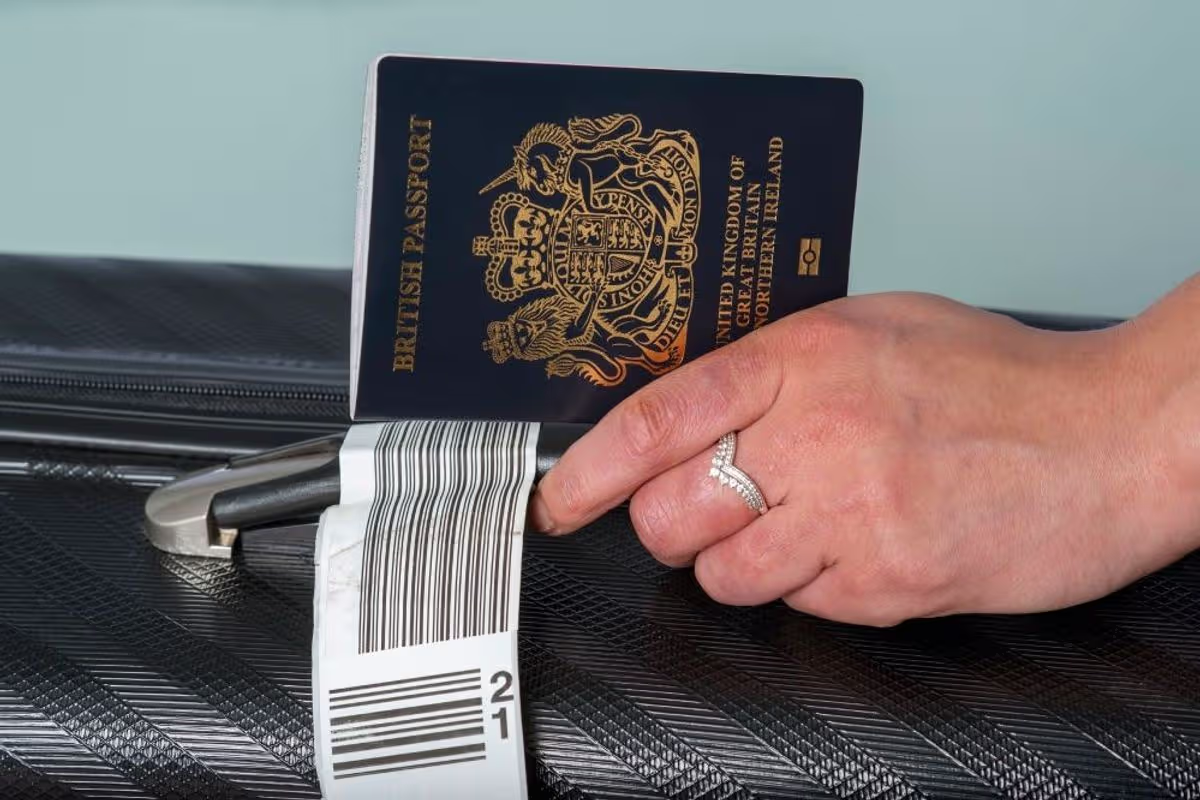
Under the change Britons will provide four fingerprints and a facial biometric scan to a machine during their first arrival

British travellers visiting Europe are being warned to prepare for the possibility of even longer queues from today. The rollout of the EU’s new border check tech aims to eventually speed up entry, but its expansion this month presents a risk of greater delays, according to travel association ABTA.

Under the automated Entry/Exit System (EES), Britons will provide four fingerprints and a facial biometric scan to a machine during their first arrival, followed by one scan on each subsequent arrival and departure. “As more places introduce the system, and more passengers are processed through it, there is a greater risk that people will face queues and delays,” ABTA warns.

“It’s important travellers are prepared for this as they prepare to go through passport control.” The EU set a January 10 deadline for its member states to roll out the EES at half of their border crossings.

Manual passport stamping will continue until 9 April, meaning double red tape. “We are also urging border authorities to do all they can to minimise delays. They have contingency measures at their disposal – such as standing down the system or limiting checks – and we want them to be utilised to help manage the flow of people,” ABTA says.

The Entry Exit System (EES) requires non-EU citizens to register at the EU border by scanning their passport and having their fingerprints and photograph taken. The rollout began last October and mean British passport-holders need to register on their first visit to a country where EES checks are operating. Registration is valid for a rolling three-year period or until the passport expires.

The new system will be phased in over six months, meaning different ports may have varying requirements until April 2026. By January 10 half of all checkpoints should be in operation.

On exit, and for subsequent visits to a participating country, travellers will only need to scan their passport and provide either fingerprints or a photograph at the border.

EES will be a requirement when entering Schengen area countries including Iceland, Liechtenstein, Norway and Switzerland. EES will not be required when travelling to Ireland and Cyprus.

For travellers using the Port of Dover, Eurotunnel at Folkestone or Eurostar at St Pancras International, the process will take place at the border before they leave the UK.

The government has supported these juxtaposed ports (Eurostar, St Pancras; Eurotunnel, Folkestone; and the Port of Dover) with £10.5m of funding for border infrastructure to make the change as smooth as possible for travellers. While EES is an EU system, the government has been working closely with the travel industry, ports and transport operators to help raise public awareness and understanding of the border changes.

Minister for Border Security and Asylum, Alex Norris, said: “We recognise that EES checks will be a significant change for British travellers, which is why we have worked closely with our European partners to ensure the rollout goes as smoothly as possible.

“The UK and EU have a shared objective of securing our borders and these modernisation measures will help us protect our citizens and prevent illegal migration.”

Minister for Aviation, Maritime and Decarbonisation, Keir Mather, said: “We’ve backed our ports and operators with £10.5 million to help them get ready for the EU’s new Entry/Exit System, ensuring they have the infrastructure and systems in place to manage the changes.

“Our priority is to minimise disruption for travellers and hauliers, particularly at our busiest border crossings. We’ll continue working closely with European partners and local resilience forums to keep traffic flowing and journeys smooth.”

Travellers do not need to take any action before travelling and the process is free. Registration will take place upon arrival at the EU border and may take slightly longer than previous border checks.

Whilst the checks should only take 1-2 minutes for each person, they may lead to longer wait times at border control upon arrival in the Schengen area. At the juxtaposed ports, where registration will be completed in the UK prior to departure, there may be longer waits at busy times. Eurotunnel, Eurostar and the Port of Dover have plans in place to minimise disruption as much as possible.

Children under 12 will not be fingerprinted but under the new EU rules, all travellers, including babies, will be photographed and have digital records created.

The UK Government has rolled out its own Electronic Travel Authorisation (ETA) scheme, which is a digital permission to travel for visitors who do not need a visa for short stays, or do not have another valid UK immigration status prior to travelling to the UK.

Source link

Eurostar warns of ‘further issues’ as passengers still face delays after travel chaos

Eurostar services resumed after a power outage in the Channel Tunnel caused all trains heading to mainland Europe to be cancelled

Eurostar travellers have been cautioned that disruption may continue, despite services restarting following a power failure in the Channel Tunnel. Thousands of passengers endured lengthy delays after the rail operator scrapped all London to Europe journeys on Tuesday when an overhead power supply fault and a broken-down LeShuttle train blocked all routes.

Limited services recommenced on the single operational line on Tuesday evening, with Eurostar reporting “further issues with rail infrastructure overnight”. A statement on the Eurostar website read: “We plan to run all of our services today, however due to knock-on impacts there may still be some delays and possible last-minute cancellations.”

The first Wednesday departure from St Pancras to Paris’ Gare du Nord station, timetabled for 6.01am, was axed, though all remaining services appeared as scheduled on the firm’s website. A statement released by Eurostar on Tuesday evening, encouraging passengers to rebook for a different day where possible, read: “Although outside of our control, we apologise for the disruption today and will continue to keep customers updated with the latest information and support them with rescheduling their bookings.”

LeShuttle services were similarly disrupted by the electrical fault. Having warned of six-hour holdups at the Folkestone terminal on Tuesday, the company reported these had reduced to just 30 minutes by Wednesday morning. However, six-hour queues persisted in Calais, with passengers urged to check in at their scheduled times.

The Channel Tunnel carries both Eurostar services and LeShuttle vehicle-carrying trains linking Britain and France. Getlink, which runs the Channel Tunnel, confirmed that “an incident related to the power supply to trains occurred last night in part of the Channel Tunnel, affecting train and shuttle traffic”.

On Tuesday, Eurostar personnel at St Pancras station in central London were spotted distributing water bottles to those waiting behind cordons who were caught up in the disruption. Vehicles attempting to cross the Eurotunnel created tailbacks on routes approaching the Folkestone terminal.

READ MORE: ITV’s Dr Amir Khan inundated with support after woman saved in restaurantREAD MORE: Single parking space in swanky London neighbourhood could be yours…for almost £300,000

LeShuttle traveller Tim Brown revealed he had been stranded in his vehicle on the train at the Calais terminal for over three hours with “no access to food or water”.

Mr Brown, who was attempting to return to Britain after celebrating Christmas in Germany, was journeying with his dogs Rilo and Vinnie who he said are “hating life” trapped on the train.

“The fact that nobody has come around offering everybody a bottle of water is what has shocked me the most,” he said. “I know things happen, but surely that would be an easy way to help.”

Source link

Foreign Office issues travel warning to Brits heading to France

People are being warned to expect disruption

British travellers heading to France have been handed an urgent alert following major disruption. The warning comes after Eurostar axed all its London-to-Europe departures for the day due to a power cut that forced the Channel Tunnel to shut down.

A broken-down LeShuttle train has now been removed from the Channel Tunnel. The firm confirmed that no passengers were left stranded inside following the power outage that led to the closure.

All Eurostar services from London to the continent were scrapped for the day. LeShuttle journeys through the Channel Tunnel are “expected to resume gradually” following the earlier electrical supply problem, according to the tunnel’s operator.

The Foreign Office has now updated its guidance in response to the disruption.

READ MORE: Single parking space in swanky London neighbourhood could be yours…for almost £300,000READ MORE: ‘I used ChatGPT to fight parking ticket – company ended up paying me £462’

Its Foreign Travel Advice states: “Eurostar services to and from Belgium, France and the Netherlands are experiencing severe delays and last-minute cancellations. Eurotunnel LeShuttle services between UK and France are also disrupted. Travellers should expect disruption and check the latest service updates with operators.”

Getlink, the company responsible for managing and running the tunnel, released a statement saying: “An incident related to the power supply to trains occurred last night in part of the Channel Tunnel, affecting train and shuttle traffic. A technical intervention is required, which is currently underway.

“The service is temporarily suspended in both directions. Traffic is expected to resume gradually around 1500 CET for LeShuttle customers.

“Our teams are working to restore the situation as quickly as possible. Waiting times will be adjusted throughout the day.

“Eurotunnel apologises for the inconvenience and thanks its customers for their patience and understanding.”

Source link

Major boost for incredible £7.4bn tunnel that will connect Europe and Africa

A feasibility study has concluded that a railway tunnel beneath the Strait of Gibraltar is technically viable, with Spain now commissioning blueprints for the ambitious project

A colossal underwater tunnel linking Europe and Africa could finally be on the cards after the project received a major boost.

The ambitious project, which would see the tunnel burrow beneath the Strait of Gibraltar, has been reignited by Spain after being mooted by various governments for decades. Now scientists have declared that such an engineering feat is possible.

In October, a study commissioned by the Spanish Government and carried out by German tunnel experts Herrenknecht concluded that drilling a railway tunnel below the Strait would be technically achievable with current technology. Since then, Spanish consultancy firm Ineco has been tasked with drawing up a blueprint for the project by the end of next year, with hopes that Government approval could be granted as early as 2027.

The concept of creating a man-made link between Europe and Africa first surfaced in the 1970s, popping up intermittently in election campaigns and Government agendas since then, but no tangible steps have been taken until now. Previous proposals included the establishment of a joint Spain-Morocco committee in 1979 to assess the feasibility of the plan.

READ MORE: I stayed at UK’s worst hotel and used UV light in my windowless room – I wasn’t preparedREAD MORE: Wizz Air’s new £40 route to sun-drenched city that is ‘world’s best place to live’

The proposed tunnel, to be drilled beneath the nine-mile stretch of water separating southern Spain from Morocco, would take inspiration from the Eurotunnel, which opened in 1994 and links Britain to northern France under the English Channel.

The Herrenknecht report, formally commissioned by the Spanish Society for Studies on Fixed Communication across the Strait of Gibraltar (Secegsa), under the Ministry of Transport, has assessed the feasibility of constructing the railway tunnel in its most complex sections, especially under the Camarinal Threshold – an area with extremely difficult geological conditions.

The most recent cost estimate for the project is €8.5 billion (£7.4 billion), according to Voz Populi.

The project, featuring two separate railway tunnels each carrying trains in one direction, is set to connect Punta Paloma in Cadiz with Morocco’s Cape Malabata, near Tangier. The tunnel would span roughly 26 miles, with nearly 17 miles of the route submerged underwater, reports the Express.

It’s also projected to reach a depth of 1,540 feet – significantly deeper than the Channel Tunnel, which only dips to 246 feet below sea level. Upon completion, the journey is estimated to take about 30 minutes by train, with the capacity to carry both passengers on high-speed AVE trains and freight.

The project faces significant technical challenges, particularly due to its location at the boundary between the Eurasian and African tectonic plates along the Azores-Gibraltar fault line, Morocco World News reports.

If given the green light, fieldwork is anticipated to commence in 2030, with the main construction phase scheduled for between 2035 and 2040. However, these dates could be subject to change.

While initial plans aimed to complete the tunnel by 2030, coinciding with the FIFA World Cup co-hosted by Spain, Portugal, and Morocco, experts have since stated that this timeline is unrealistic, given the project’s complexity and its current preliminary stage of studies.

The current proposed route, from Punta Paloma to Cape Malabata, comes after decades of discarded proposals, including an early concept for a suspension bridge. This type of connection was eventually ruled out due to the Strait’s depth, seismic activity and extreme wind conditions.

The project is being jointly managed by SECEGSA and its Moroccan counterpart, SNED (National Society for Strait Studies). Both organizations are working to establish a reliable rail connection for passengers and freight between Europe and North Africa.

Source link