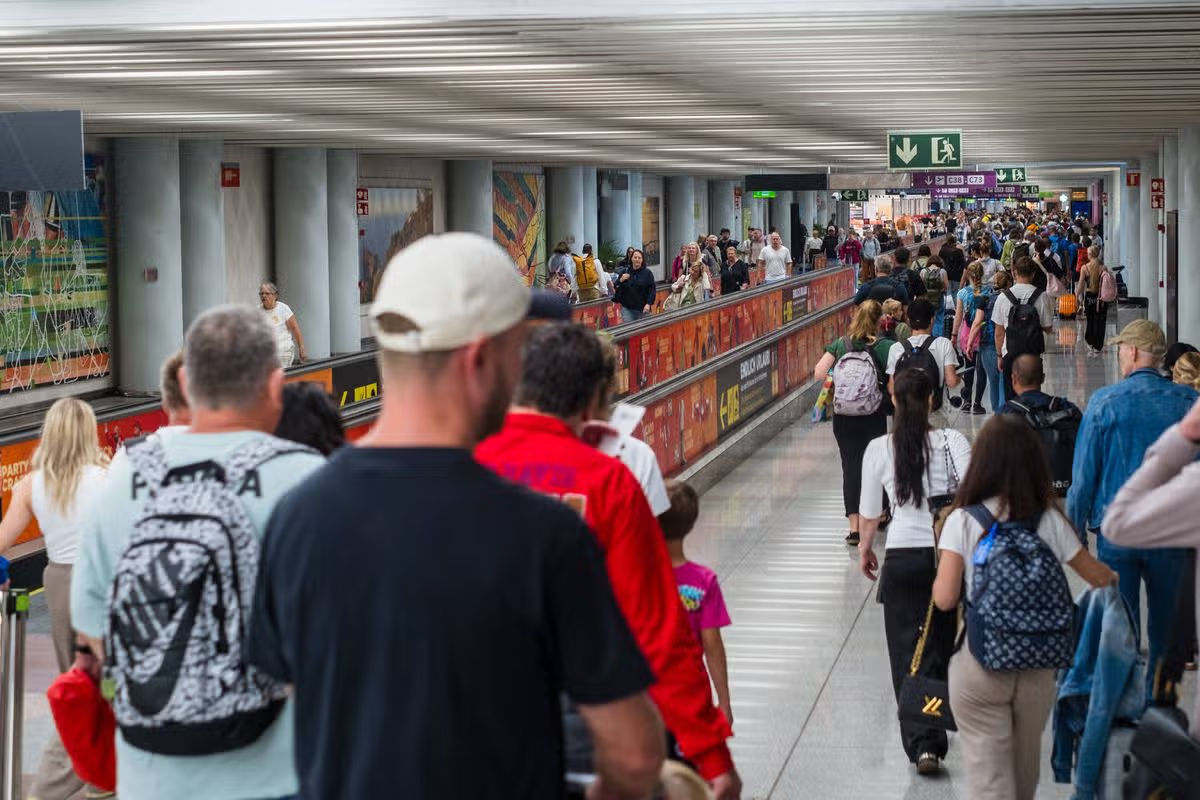
It is the only Spanish airport on the official new list – issues could regularly last for two hours or more

Palma de Mallorca Airport in 2025(Image: jaanalisette via Getty Images)
Brits jetting off to a Spanish holiday hotspot in August should pay attention to a new official airport update. Spanish media reports say that Palma Airport will be operating beyond its capacity for 18 days throughout August, according to an official analysis – for more than two hours on 10 occasions.
It has been reported that the airport in Mallorca is the only Spanish airport featured on a list of airports where Eurocontrol – the central organisation for coordination and planning of air traffic control for all of Europe – has identified mismatches between predicted demand and available capacity during August and September.
The list also features several Greek airports – Athens, Corfu, Heraklion, Kos, and Chania – alongside Istanbul’s Sabiha Gökçen and London’s Gatwick. As a result, Palma Airport faces an extremely busy August, Spanish media reports claim. According to Eurocontrol forecasts, it will surpass its operational capacity on 18 days, more than half the month.
On 10 of those occasions, the excess demand will stretch beyond two consecutive hours, while on the remaining eight, it will be concentrated within two-hour windows, Eurocontrol says. The capacity for Palma is set to stand at roughly 74 movements per hour, comprising approximately 33 arrivals and 40 departures, the agency says. During particular time slots, the anticipated flight demand will outstrip the number of operations the system can accommodate, says Eurocontrol.
Eurocontrol says the forecasts do not mean airports will be overwhelmed. Yet they say their analysis aims to identify periods when high concentration of flights may require measures to regulate traffic flow.
El Diario reports that the European agency projects that demand will also surpass the airport’s capacity at least eight times between September 1 and 27, with three instances stretching beyond two consecutive hours and five lasting two hours. Yet airport operator Aena has told media in the country that under no circumstances has Palma Airport been operated “beyond its declared capacity”. They say that if demand ever exceeds the established airspace capacity due to an unforeseen event, such as storms or regulatory measures, not all operations are permitted to take place simultaneously.
In such cases, they say air traffic control regulates the flow of flights through various traffic management and sequencing measures. Sources at the airport have also told Spanish media that a major overhaul there has resulted in a larger security checkpoint featuring hand luggage screening machines that do away with the need to remove liquids and electronic devices, as well as “more efficient routes throughout all areas, including the one dedicated to inter-island passengers”.
Eurocontrol said in its assessment of Europe-wide air traffic: “July 2026 set new records for air traffic. The EUROCONTROL area recorded its highest ever monthly traffic, with over 1.13 million flights and a peak of 37,659 flights on Friday 24 July. Worldwide, commercial aviation also reached an all-time high of 153,359 flights on 23 July.
“On average, capacity among the busiest 10 carriers remained stable compared to the previous week.” The update comes as tourists heading to Spain and other EU nations face the prospect of lengthy queues this summer at airports. The EU rolled out its Entry/Exit System (EES) in April, which requires passengers from the UK and other non-EU countries to register their fingerprints, photograph and personal details upon their first arrival. This has resulted in lengthy hold-ups for countless passengers.
EES delays lead to big increase in waiting times at EU airports
The Financial Times reported this month that peak waiting times at two major European airports – Munich and Frankfurt – have doubled this summer compared with the same period last year, following the EU’s chaotic rollout of its new electronic border system. Mallorca is amongst the many airports where significant delays have been reported on multiple occasions throughout the year..
Ryanair chief executive Michael O’Leary said the system should be moved online. “Only the Europeans would invent s*** like this,” he told investors last month, adding that the airline had witnessed substantial queues at around 15 airports.
The scorching temperatures are also heaping further pressure on the airport, according to the Majorca Daily Bulletin. The publication reported that Palma Airport workers are once again demanding the immediate reopening of the airport canteen.
Staff say the facility is essential as somewhere they can eat and take refuge from the sweltering summer heat. The Balearic Government has urged airport operator Aena to reopen the venue as swiftly as possible.
Reports suggest that officials believe Aena is currently working to adapt the premises with the aim of getting the canteen back up and running in the near future.