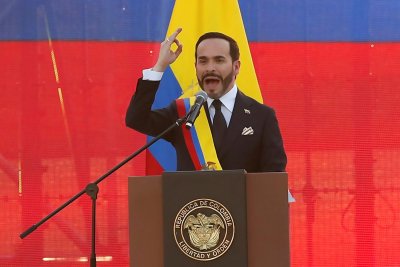
Abelardo de la Espriella, the winner of Colombia’s June 21 presidential runoff election, delivers a speech in Cali, Colombia, on Friday during his swearing-in ceremony. Photo by Ernesto Guzman Jr./EPA
Aug. 7 (UPI) — The far-right lawyer Abelardo de la Espriella was sworn in as president of Colombia Friday amid tight security at a ceremony held in the auditorium of a private university in Cali, the South American nation’s third-largest city.
De la Espriella took an oath to “faithfully uphold the Constitution and laws of Colombia” as he received the presidential sash from Sen. Honorio Henríquez, president of Colombian congress and a member of the far-right Democratic Center party.
Once installed, the new leader then swore in his vice president, José Manuel Restrepo, while his guest of honor, 74-year-old farmer Luis Felipe Yagüé, looked on as a symbol of De la Espriella’s support for small business owners and entrepreneurs, the Spanish news agency EFE reported.
The event triggered tight security measures, with 11,000 members of the security forces mobilized to ensure safety in Cali and the surrounding areas, local media reported. The strict measures included a ban on alcohol sales, transportation restrictions and reinforcements of the National Police.
No incidents of violence or narcoterrorism were reported in Cali on Friday, officials said.
Former Colombian presidents such as César Gaviria, Álvaro Uribe and Iván Duque were in attendance for the ceremony, but 2016 Nobel Peace Prize winner Juan Manuel Santos, president from 2010 to 2018, was not invited, EFE reported.
Also in attendance at Santiago de Cali University were King Felipe VI of Spain, Argentine president Javier Milei and FIFA president Gianni Infantino, as well as host of other Latin American leaders.
Meanwhile, members of outgoing Colombian President Gustavo Petro’s leftist Historical Pact party, boycotted De la Espriella’s swearing in ceremony. Many of them claim the ally of U.S. President Donald Trump won through fraud in the June 21 runoff election and that his victory was illegitimate.
Petro last month barred De la Espriella from holding his inauguration at a military base, triggering an unprecedented institutional dispute highlighting the country’s deepening political polarization.
The then-president repeated his claim that the incoming government “was not elected by a majority of the people.”
During the ceremony, De la Espriella reiterated his “tough-on-crime” credentials by announcing he will publish a list of local narco-terrorist organizations and instruct police to battle them more forcefully in a further repudiation of Petro’s “Total Peace” strategy of negotiating with armed groups.
“The option of dialogue is completely exhausted,” he asserted, according to CNN.
New president, who replaces leftist Gustavo Petro, continues rightward political shift in Latin America.
Published On 8 Aug 20268 Aug 2026
Right-wing lawyer Abelardo de la Espriella has been sworn in as Colombia‘s president after winning a run-off election on promises to crack down on the armed groups, cut government spending by as much as 40 percent, and revive the South American country’s oil and gas industry.
De la Espriella, 48, took the oath of office on Friday, breaking with tradition by holding the ceremony not in the capital, Bogota, but in Cali, a city in Colombia’s volatile southwest that has long borne the brunt of the government’s conflict with armed groups.
Recommended Stories
list of 3 itemsend of list
The choice signaled a decisive break from the strategy of negotiated peace with those groups pursued by outgoing leftist leader Gustavo Petro, whom de la Espriella defeated in June’s runoff. De La Espriella has dismissed Petro’s policy as a failure.
“There will be no room for maneuvers that undermine the stability of the nation,” de la Espriella said on Friday, as he pledged to “relentlessly defeat narco-terrorism”.
He added that “the option of dialogue is completely exhausted”.
A political newcomer known to supporters as “El Tigre”, The Tiger, de la Espriella built his fortune and public profile as a lawyer and businessman rather than through elected office, largely self-financing his campaign as an outsider candidate.
His arrival in power marks a sharp ideological reversal for a country that, for the past four years, was led by a former rebel fighter who was frequently critical of the drug and immigration policies of United States President Donald Trump.
De la Espriella has, in contrast, hewed closed to Trump and his militaristic approach to drug crime in Latin America.
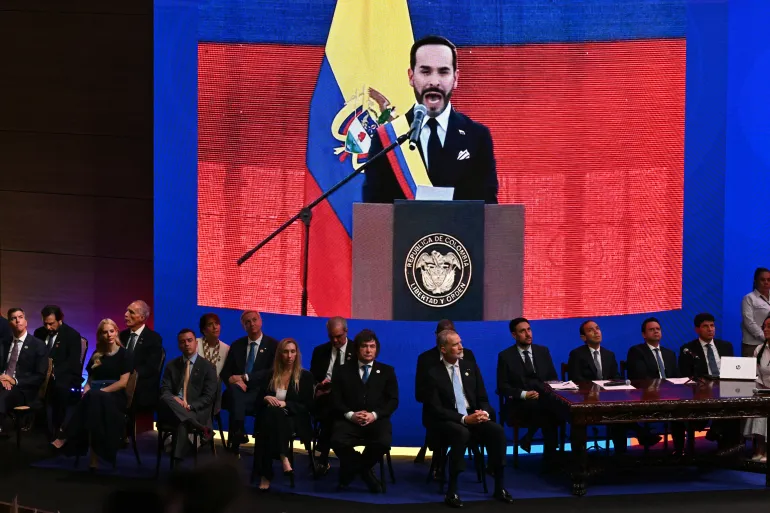
Security dominated Friday’s ceremony, which was held at a university auditorium before Congress. Soldiers and armoured vehicles lined roads near the venue, and police manned checkpoints screening vehicles for explosives in the preceding days.
Guests at Universidad Santiago de Cali watch Colombia’s new President Abelardo de la Espriella deliver a speech from the Pichincha Battalion on a giant screen during his inauguration ceremony in Cali. [AFP/Luis Acosta]
After the ceremony, de la Espriella travelled to a nearby military battalion to address troops directly, framing the visit as both a morale boost for the armed forces and a signal to the country’s armed groups of the approach he plans to take.
Colombia’s southwest remains contested territory for dissident factions of the demobilised FARC rebel movement who rejected the peace deal signed a decade ago. The Clan del Golfo drug cartel, and the National Liberation Army, or ELN guerrilla group are also active in the area.
The new president has also pledged to join the so-called “Shield of the Americas”, a US-backed regional coalition against drug trafficking that grew out of a summit hosted by the Trump administration in March. He has vowed to restored diplomatic relations with Israel and sever ties with Cuba and Nicaragua, branding them “tyrannies”.
Petro had initially refused to accept the election result, alleging that vote tallies had been manipulated. The claim was dismissed by international observers and Colombia’s own electoral authorities. Petro ultimately conceded he would respect the outcome.
Still protests broke out in Cali, Bogota and Barranquilla on inauguration day.
In Cali’s Puerto Resistencia neighbourhood, once the epicentre of mass anti-government demonstrations in 2021, 25-year-old protester Sebastian Ocampo said residents were “defending dignity” against a president he said had not won their support.
De la Espriella’s win extends a run of electoral victories by conservatives across Latin America, with seven elected since Trump returned to the White House in January 2025. That includes Peru’s Keiko Fujimori, Jose Antonio Kast in Chile, and Argentina’s Javier Milei.
Trump personally endorsed de la Espriella’s campaign.
Leaders in attendance at Friday’s event included Spain’s King Felipe VI, acting US Attorney General Todd Blanche, FIFA president Gianni Infantino, and several of Latin America’s other conservative leaders, including Milei and Kast.
Footage shows Colombian outsider Abelardo de la Espriella in an armoured vehicle next to his vice-presidential candidate, Jose Manuel Restrepo, celebrating a narrow lead in the preliminary election results.
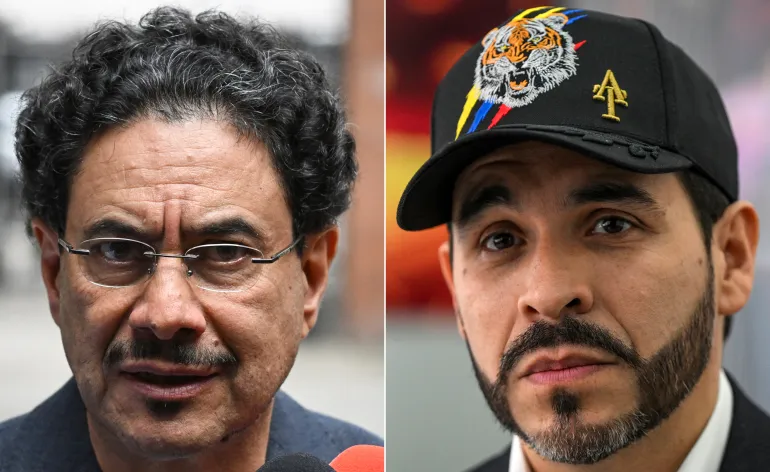
Far-right outsider Abelardo de la Espriella will face left-wing Senator Ivan Cepeda in the run-off for Colombia’s presidential election next month.
After polls closed on Sunday, the two candidates quickly surged ahead in the vote tally, extinguishing the hopes of right-wing Senator Paloma Valencia, a former frontrunner.
Recommended Stories
list of 3 itemsend of list
As of Sunday afternoon, with 99 percent of the votes tallied, de la Espriella took the lead, with 43 percent of the ballots cast in his favour.
Cepeda trailed him by more than 600,000 votes, earning 40 percent support.
Neither candidate breached the 50-percent threshold needed to avoid a head-to-head match-up on June 21. But the results are likely to buoy de la Espriella’s campaign going into the final round.
Cepeda had consistently topped public opinion polls in the final weeks before the vote. A May 24 poll from the National Consulting Centre (CNC) showed him with more than 33 percent support, ahead of de la Espriella’s 30.9 percent.
Ivan Cepeda, left, will face Abelardo de la Espriella in the June 21 run-off election [AFP]
De la Espriella’s ‘outsider’ campaign
Questions about security were at the forefront of voters’ concerns going into Sunday’s election.
De la Espriella, a businessman and lawyer who has never held elected office, leaned heavily into fears of crime as he launched an outsider campaign, similar to the dark-horse bid of Argentinian President Javier Milei.
By contrast, Cepeda is a well-known quantity in Colombian politics. His father was a senator, too, before he was assassinated in 1994, in what was widely considered to be an act of political violence.
Cepeda himself has served as a senator since 2014. Before that, he served in the Chamber of Deputies, representing the capital, Bogota.
During his political career, he became embroiled in a long-running legal dispute with former right-wing President Alvaro Uribe, whom he accused of complicity with right-wing paramilitaries.
Uribe initially sued Cepeda for defamation, but in a dramatic twist, Colombia’s Supreme Court dismissed the charge and instead investigated Uribe for witness tampering.
While Uribe was initially found guilty and sentenced to 12 years of house arrest, an appeals court ultimately struck down the verdict, citing procedural errors, including insufficient evidence.
Electoral workers greet voters at a polling station in Bogota, Colombia, on May 31 [Mauricio Duenas Castaneda/EPA]
Security a top concern
Central to the rift in Colombia’s politics is the country’s six-decade-long internal conflict.
Since 1964, criminal networks, government forces, left-wing rebels and right-wing paramilitaries have all jockeyed against one another for power and territory.
Cepeda has been critical of right-wing efforts to solve the conflict through military might alone.
Instead, he has allied himself with Colombia’s outgoing president, Gustavo Petro, the first left-wing figure ever elected to the country’s highest office.
A former rebel fighter, Petro has championed a policy he calls “Total Peace”, which actively seeks negotiated solutions to the fighting.
While critics have questioned the efficacy of “Total Peace”, pointing to a recent uptick in violence, Cepeda has nevertheless pledged to carry it forward. He represents Petro’s left-wing Historic Pact party in this year’s election.
In an interview this month with CNN, Cepeda acknowledged the policy’s “immense challenges”, saying: “We cannot continue to develop conversations that do not yield clear results.”
But he rejected overly militaristic solutions, as well as the prospect of intervention by the United States. The US-led “war on drugs”, Cepeda said, has “failed spectacularly”.
De la Espriella, meanwhile, has embraced the kind of hardline security platform commonly associated with El Salvador’s leader, Nayib Bukele.
His platform includes a pledge to crack down on crime and build 10 megaprisons in Colombia.
Nicknamed “The Tiger”, he founded the Defenders of the Homeland political party and is known to rally with the slogan, “Stand firm for the nation”.
“The only peace process I believe in is one imposed by the force of arms and the laws of the republic,” de la Espriella told The Associated Press news agency this month.
Like US President Donald Trump, de la Espriella has also threatened to launch a bombing campaign to disrupt drug-trafficking, killing suspects by downing planes and shooting boats.
But such campaigns have been widely denounced as a form of extrajudicial killing, effectively denying suspects the chance of defending themselves in a court of law.
Supporters of presidential candidate Ivan Cepeda watch the election results arrive in Bogota, Colombia, on May 31 [Matias Delacroix/AP Photo]
Narrowing odds for Colombia’s left
More than 23.6 million Colombians voted in Sunday’s election, though there was a high number of blank or nullified ballots.
Early estimates, with 99 percent of ballots tallied, indicate that 245,342 voting sheets were null, and another 406,830 were left blank.
The second round is likely to be an uphill battle for Cepeda. Colombia’s right-wing is expected to consolidate behind de la Espriella in the second round.
In Sunday’s vote count, more than 10.3 million ballots were cast for de la Espriella, compared with roughly 9.7 million for Cepeda.
A victory for the right would continue a regional trend in Latin America. Last year alone, left-wing governments in Chile, Honduras and Bolivia were all replaced by right-wing presidential contenders.
De la Espriella signalled his optimism about the second round in a social media post as the results rolled in.
“We are going to defeat tyranny and absolutism,” de la Espriella wrote. “We have advanced to the run-off thanks to the more than 10 million Colombians who answered the roar. In 21 days, we will make history!”