eric

What Eric Lauer is working on to turn things around with the Dodgers

Left-hander Eric Lauer strode up the bullpen mound at Petco Park as the Dodgers-Padres series finale Wednesday transitioned into the late innings.

He had been available to provide length as a reliever, but the plan had been for him to throw either way, he said.

The Dodgers didn’t end up needing him to cover innings, so he tossed a side session. And now Lauer has the weekend to address the mechanical issues that plagued his bumpy first six weeks of the season with the Toronto Blue Jays before making his Dodgers debut Tuesday as a starter against the Rockies at Dodger Stadium.

“It’s nice having a little change of scenery, because it gives me a nice full-blown reset,” Lauer said. “I can get my feet back under me, I can get out of my head a little bit more, understand what makes me good and what’s got me to this point, and run with that.”

Lauer, who landed on waivers at a convenient time for the Dodgers, is their immediate answer to a sudden rotation depth problem.

They don’t expect him to save the day in the absence of Blake Snell (elbow surgery to remove loose bodies) and Tyler Glasnow (back spasms). But the Dodgers saw an opportunity to fill a hole in their roster and ideally help him reverse his early-season regression.

“We’ve had our guys take a look and we’ll sit down and talk through some stuff, see how much we can do on the fly, how much of it is not just subconscious,” general manager Brandon Gomes said. “But we know the makeup is really good, and we’re looking forward to getting our hands on him and helping him be as successful as he’s been in the past.”

As long as Lauer gradually improves, his presence allows the Dodgers to keep their starters on a six- to seven-day rotation, without taxing their relievers with regular bullpen days, at least while they wait for other pitchers to return to health and/or build up their workloads.

Lauer’s only months removed from success. He owned a career-best 3.18 ERA last season and was even better in the postseason, authoring 5 ⅔ scoreless innings against the Dodgers in the World Series.

Dodgers reliever Will Klein, who threw opposite Lauer in the 18-inning Game 3 of the World Series, was one of the first people he met when he joined the team in San Diego.

“He introduced himself, and I was like, ‘All right, I know you, I remember you,’” Lauer said.

Coming off of winning the pennant, Lauer’s ERA ballooned this year to 6.96 ERA. In mid-April, the Blue Jays tried using an opener in front of Lauer when he faced the Diamondbacks. And his reaction made headlines.

“To be real blunt, I hate it,” he told reporters then. “I can’t stand it. But you work with what you got.”

This week, surrounded by different set of reporters in the visitors dugout at Petco Park earlier this week after joining the Dodgers, Lauer gave a knowing smile when the topic of usage with Toronto came up.

“There was no ill will there, there was no hurt feelings,” he said of his comments on openers. “It was a very simple question, I thought, how do you feel about an opener? I think if you ask most starters in the league, they would probably have the same response, that they don’t like it. But it doesn’t mean that I’m not willing to do it. It doesn’t mean that I’m not a team player.”

He said he cleared it up with Blue Jays pitching coach Pete Walker and manager John Schneider right away.

“I’m not going to have a problem if there is somebody in front of me,” he said. “It’s part of the game, it’s become part of the game. And we’re all here to win ballgames. It’s not about any individual player. So that was a lot more than I expected that to turn into.”

So far, Lauer has praised the Dodgers’ communication. And he’s been reunited with pitching coach Mark Prior, who was the Padres’ minor-league pitching coordinator when Lauer began his professional career in San Diego’s system.

When Lauer diagnoses his season, he sees two sets of issues working in concert.

“A couple things had compounded for me, and it was just kind of eating at me a little bit too much,” Lauer told The Times. “And I work with a mental skills coach and stuff, to where that shouldn’t happen. But I wasn’t mentally my best, which was making me not my best physically, which made me start to want to tinker.”

Lauer feels like he has a hold on the mental side. Now it’s working from the ground up to get his delivery back in sync. The goal, as Lauer explains it, is to find positions that create tension in his delivery, and pattern them until they feel like second nature.

Making mechanical adjustments during the season, however, tends to be two steps forward, one step back.

Lauer isn’t expected to have it all figured out for his start Tuesday. The Dodgers just want to see him compete with whatever he has that day.

“We compete, and then we go back to the process,” Lauer said. “…Then hopefully the process over time becomes more patterned, more grooved. And then it becomes less process, more just fine-tuning to compete.”

Source link

Dodgers acquire Eric Lauer from Blue Jays, adjust pitching roster

As the Dodgers navigate the ripple effects of a series of recent pitching injuries, they added bullpen depth on Sunday by acquiring left-hander Eric Lauer from the Blue Jays for cash considerations.

The Blue Jays designated Lauer for assignment last week, after a bumpy start to the season. Lauer had yielded a league-leading 11 home runs in eight appearances.

It was a contrast to the far steadier presence he’d provided on the mound last year en route to an American League pennant, when he posted a 3.18 ERA in the regular season and 3.12 in the postseason. Lauer didn’t give up a run against the Dodgers in two World Series appearances, including 4 2/3 innings in Game 3.

To make room on the 40-man roster, the Dodgers transferred right-hander Brusdar Graterol (right shoulder surgery recovery) to the 60-day injured list.

The Dodgers, who had to pivot to a bullpen game Friday when southpaw Blake Snell (left elbow surgery to remove loose bodies) landed on the IL, made a series of bullpen-related roster moves Sunday morning.

They put left-hander Jack Dreyer on the 15-day IL with left shoulder discomfort. Imaging showed “nothing relevant,” other than inflammation, manager Dave Roberts said. The Dodgers hope he’ll be ready to be reinstated after a minimum stint.

“He was warming up yesterday and then felt something in his shoulder, some soreness,” Roberts said. “We just wanted to be proactive.

The team also optioned left-hander Charlie Barnes to triple-A Oklahoma City. And they recalled two fresh relievers, right-handers Paul Gervase and Chayce McDermott.

Source link

Contributor: ‘Trump 2028’ could be a vote for Ivanka, Eric or Don Jr.

With President Trump continuing to tank in the polls, the parlor game we know as “2028 Republican primary speculation” is back in full swing among the chattering classes.

Vice President JD Vance — who would normally be considered the heir apparent, and who just happened to make a campaign stop in Iowa recently — now finds his “America First” brand positioning complicated by Trump’s Iran misadventure. So much for an easy glide path to the nomination.

Secretary of State Marco Rubio would seem to benefit from Vance’s stumbles, but in a political moment that fetishizes “authenticity,” Rubio risks coming across like a man who irons his blue jeans. Add to that his reputation as a foreign policy hawk in a party that increasingly wants out of “forever wars,” and he’d be the ideal presidential candidate for … 2004.

All of which has opened the door to more imaginative speculation. “If Pat Buchanan and Roger Ailes had a baby,” former “Meet The Press” host Chuck Todd recently quipped, “it would be Tucker Carlson.”

Ailes, of course, was the media-savvy evil genius who took Fox News to No. 1. And while “Pitchfork Pat’s” populist presidential campaigns weren’t ultimately victorious, he is credited with paving the way for Trump’s eventual 2016 victory.

As this comparison suggests, Carlson could make a formidable Republican presidential candidate. The hitch? Carlson and Trump have recently been trading blows, which is not where any potential Republican candidate wants to be.

For all of his polling woes, Trump still enjoys an 85% approval rating among Republicans, according to the recent Washington Post-ABC News-Ipsos poll. And his recent defeat of Indiana Republican legislators who dared defy him over gerrymandering only underscores the point: Trump’s grip on the Republican Party remains firm.

Even if you dismiss talk of a third Trump term as overwrought constitutional fan fiction, it’s hard to imagine a Republican nominee emerging without Trump’s blessing — let alone in defiance of it.

Which brings us to the latest theory making the rounds: Trump isn’t going to pass this torch to anyone lacking the proper surname.

In this telling, Vance is the loyal, if naive, assistant manager waiting for the boss to retire and hand him the keys to the office — only to discover it’s a family business and the ne’er-do-well son has just pulled into the parking lot in a Ferrari.

Enter Donald Trump Jr., whose chief qualification is name recognition so strong it could probably win a Republican primary on its own.

Add to that daddy’s endorsement, and as the Bulwark’s Jonathan V. Last has noted about Vance and Rubio, “Challenging Don Jr. would turn them into enemies of the people.”

But that doesn’t mean this is a slam dunk for Junior.

As British-American journalist Sarah Baxter recently wrote, “like Logan Roy, the patriarch in the television drama Succession, Trump loves playing his children off against each other. He thinks it instills a healthy killer instinct in his privileged offspring.”

This is to say that Junior isn’t the only potential heir lurking in the wings.

Last year, for example, Eric Trump told a journalist: “I think I could do it. And by the way, I think other members of our family could do it too.”

Which brings us to the wildest speculation of all: Ivanka Trump.

Now, to be sure, Ivanka has kept a polite distance from politics (and her father) in recent years, and she doesn’t exactly electrify the MAGA faithful. But she was always her father’s favorite, and her aforementioned liabilities could be overcome with a sufficiently enthusiastic paternal endorsement.

And once she became the standard bearer, Ivanka could market herself as both continuity and “change” — a neat trick, if she can pull it off.

In that sense Republicans could keep the Trump brand while offering a kinder, gentler, fresher face — all while making GOP history with a female presidential nominee.

This, of course, raises the question: Why would Ivanka — or any of the Trumps — want to be part of a political dynasty?

Among the many reasons, the Trump family is raking in cash. Lots of it. And as long as the next president could conceivably be a family member — a possibility that remains operable even if a Trump family member were to lose the general election in 2028 — the spigot will remain on.

That’s one of the reasons that, although Vance would normally be Trump’s obvious successor, the smart money might actually be to bet on someone with the last name “Trump.”

Now, if this dynastic denouement sounds far-fetched, of course it is. But so was electing a thrice-married casino magnate to the presidency in 2016. And so reelecting him in 2024.

We’re living in an era when the seemingly improbable isn’t just possible — it might even be likely.

Matt K. Lewis is the author of “Filthy Rich Politicians” and “Too Dumb to Fail.”

Source link

We won’t let Eric have a smartphone to protect him from social media… we must keep up pressure on government to do more

TV star Simon Cowell’s fiancée Lauren strongly believes social media MUST be made safe for our children. 

The US socialite, 48, is a determined campaigner for tougher curbs.  

Simon and Lauren have agreed not to let son Eric access social media Credit: Getty
Tragic Jools Sweeney, with mum Ellen Roome Credit: PA

Her passion for change is driven by her sons – Adam, 20, from a previous relationship and 12-year-old Eric with music mogul Simon – plus the anguish of parents who blame online content for their child’s death.  

This week, the Government finally agreed to bring in stronger, age-based restrictions for under-16s following pressure from grieving mums and dads. 

Here, Lauren – who does not allow Eric to use social media – explains why more needs to be done . . .  

WHEN I heard what had happened to 14-year-old Jools Sweeney, it broke my heart. 

SICKO SNARED

Moment smirking ex-Spandau Ballet singer arrested for raping & abusing 6 women


home truths

Katie Price says she’s never had one-night stand but sister calls her a ‘liar’

Lauren and Simon have given him a basic ‘brick phone’ so he can text and use WhatsApp while staying off smartphones Credit: Getty
Simon and Lauren won’t allow Eric to access social media Credit: Getty

After he had been playing ­happily with his friends one afternoon, his mother Ellen Roome came home to find his lifeless body in his bedroom

Jools was one of several British children who died in 2022 having seemingly copied a deadly challenge shown on TikTok

I thought, “God forbid, this could have been my child”. 

My youngest son Eric, 12, isn’t much younger than Jools was, and my eldest Adam, 20, is close to the age Jools would be now. 

Jools Sweeney’s mum Ellen is one of the parents behind a campaign called Raise The Age, which wants the restriction on access to social media to be raised from 13 to 16
Education Secretary Bridget Phillipson has been forced to commit to implementing social media restrictions for under-16s Credit: AP

Since then, myself and Simon have met Ellen, who is a remarkable woman taking on the big tech giants. 

Ellen is one of the parents behind a campaign called Raise The Age, which wants the restriction on access to social media to be raised from 13 to 16. 

The policy was opposed by the UK Government, but they finally saw sense this week and agreed to introduce stronger controls on what young people can and cannot do online.  

There is no issue more important to parents right now. It’s what everyone cares about.

Making social media safe is the topic that dominates all my parent group chats.  

In our family we have already made up our minds. 

Me and Simon won’t allow our son Eric to access social media. 

We recently gave him a brick phone so he can communicate with his friends by text and WhatsApp

A lot of his friends use Snapchat, but I said no to that platform because I believe it is one of the least safe products. 

Eric is fine with that decision because we have had so many ­discussions about the dangers. 

But a lot of parents are not aware of the risks, particularly on seemingly innocuous sites such as Discord, Pinterest and CapCut. 

It is unreasonable to expect ­parents to monitor everything their children do online. 

Instead, it should be the government which keeps them safe. 

The evidence we hear is sick.

The tech companies knew their ­platforms were addictive and yet they kept going, inventing new ways to keep our children hooked.  

Some told our politicians that their products were safe, even though their own internal research showed they did not believe it.  

In my opinion, these firms put profits ahead of children’s safety, and that is absolutely unacceptable.  

We have seen groundbreaking court cases in the US which ruled that these platforms were intentionally designed to be addictive and were endangering children.  

Our children could not wait any longer because they were dying as a result of what they saw and experienced online. 

This movement isn’t about a total ban on the internet.

It is about a restriction on unsafe and harmful social media.  

We want an end to infinite scrolling where children are sent ­material they did not ask for, and an end to strangers being able to message them.  

Those firms that make their products safe will be available — those that don’t must restrict access by law or face massive fines. 

I met with Lord Nash, who has been calling in the House of Lords for tougher controls on social media. 

It was his pressure which forced the Education Secretary Bridget Phillipson to commit to implementing social media restrictions for under-16s. I hear people saying that restrictions won’t work because children will find workarounds.  

However, we haven’t given up on age restrictions for alcohol just because some children still get their hands on booze.  

When seatbelt laws were first passed, many people ignored them. 

But eventually, the message got through that they save lives.

Now, it is natural to strap in safely. 

The Government U-turn doesn’t mean the fight is over.  

Far from it. 

We need to keep the pressure on them to act quickly. 

Our children cannot wait years, because they are dying every month as a result of what they see online. 

I made a vow to Ellen, who I consider to be a close friend, to not give up until social media is safe for our children. 

I have huge respect for the families that are campaigning for this change.

They know it won’t bring their children back. 

But they want to do everything in their power to stop anyone else experiencing these horrors. 

Source link

Here’s why Eric Swalwell escaped accountability for so long

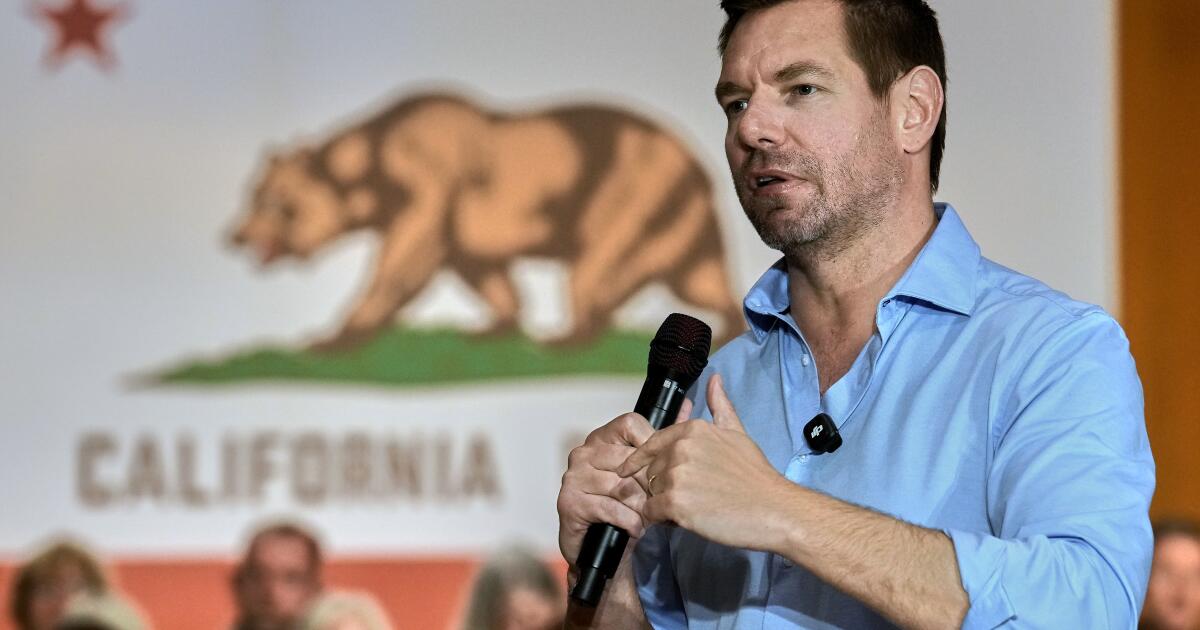
The implosion of Eric Swalwell’s gubernatorial campaign and his once-promising political career has left a great many questions rising from the smoldering wreckage.

Questions about his character, judgment and staggering recklessness.

The question — as misguided as it is inevitable — of why his accusers hadn’t come forward sooner. (My columnizing colleague, Anita Chabria, incisively addressed that one, discussing the nature of suppressed trauma and the believability hurdle that many victims of sexual assault unduly face.)

Then there’s the question of how and why Swalwell’s creepy and allegedly criminal behavior stayed hidden from public view for so long — especially when the impossible-to-miss fixture of cable TV embarked on a high-profile campaign to lead the nation’s most-populous state.

Swalwell, 45 and married, had a widely whispered about reputation for showering inappropriate and unwelcome attention on younger women. Rumors — vague, unsubstantiated — were a source of incessant dirt-dishing among political insiders and also circulated extensively online. (Not, however, the more serious allegations of sexual assault.)

The veil was finally pierced last week when the San Francisco Chronicle published a graphic account of a woman alleging sexual encounters with Swalwell while the Democratic lawmaker was her boss. She said he sexually assaulted her twice when she was too intoxicated to consent.

A few hours later, CNN followed up with a report that three other women had recounted various kinds of sexual misconduct. On Tuesday, yet another alleged victim came forth, saying she was drugged and raped by Swalwell in 2018.

The former congressman has flatly and vigorously denied criminal wrongdoing while acknowledging and apologizing for unspecific “mistakes.”

Those vociferous, flat-out denials had been enough to sway the politicians and union leaders who endorsed Swalwell’s gubernatorial bid, until the weight of evidence made Swalwell’s assertions untenable.

If the allegations are true and Swalwell is, in fact, a liar, lecher and sexual assailant, why wasn’t that widely reported up until now? Was it negligence, or gullibility on the part of the political press corps? The short answer is that a wide gulf exists between rumor and fact and Swalwell lurked in that gray space, living and thriving in the shadows between provability and denial.

It’s not unusual for rumors about financial, sexual or other peccadilloes to attend a campaign. They’re often trafficked by political rivals, which automatically raises suspicion and invites particular skepticism.

Much of the chatter never moves past a relatively small, dishy circle of political gossips because the supposed misdeeds, while titillating, can’t stand up to rigorous scrutiny. Or a legal challenge. That’s the baseline for many news outlets to broadcast or publish a story. Call them what you will — legacy, corporate, mainstream, lamestream — many of the largest, most influential sources of news and information won’t pass along allegations they can’t independently verify and, if necessary, defend in court.

The challenge is verifying all that loose talk.

Politicians don’t wear body cams, or broadcast their lives 24/7. (OK, Beto O’Rourke did livestream from a Texas laundromat during his 2018 Senate bid, holding up a soggy pair of underwear when he addressed the “boxers or briefs” question. But he’s an exception.)

Journalists don’t have subpoena power and can’t force people to tell them what they know. A reporter is only as good as his or her sources, their knowledge, truthfulness and credibility.

Reporting on misdeeds of an intimate nature can be especially difficult and complex. There’s rarely black-and-white documentation, such as a money trail leading to a hotel bedroom. It’s hard to find an eyewitness or reliable third party who can vouch for what took place between people behind closed doors. It takes time and trust to develop sources who can substantiate incidents of sexual misconduct, assault or abuse.

Swalwell apparently did an excellent job deceiving those around him, including some congressional and campaign staffers who’d known him for years and worked closely with the seven-term lawmaker, day in, day out. They were shocked by the statements of his alleged victims; the words “double life” have come up many times.

If Swalwell managed to hoodwink those closest to him, it’s easy to see why journalists had a hard time wrangling the firsthand accounts and other facts they needed to make their findings public.

When it comes to reporting on scandal, there is often the question of timing.

In 2003, The Times was widely criticized for publishing an account of Arnold Schwarzenegger’s misconduct — touching women in a sexual manner without their consent — just days before California’s gubernatorial recall election. Despite the report, which Schwarzenegger did not contest, voters kicked Gray Davis out and replaced him with the Hollywood super-duper star.

In 1992, the Washington Post and Portland Oregonian were widely criticized for their failure to publish accounts of Sen. Bob Packwood’s misconduct — unwanted sexual advances and touching women without their consent — until weeks after he was elected to his fifth term. Packwood resigned in 1995 after the Senate Ethics Commission voted unanimously to expel him.

The allegations against Swalwell were revealed well before the June 2 primary. Not soon enough for those asking how he managed to get away for so long with his predatory behavior. But plenty of time to inform California voters before they weighed in on his candidacy.

Public attention will soon shift. But for Swalwell, the legal and other ramifications are just beginning.

Source link