equality

Women’s Day in South Africa turns 70 with equality still out of reach | Women’s Rights

One of my favourite protest songs rings out every year on August 9, which is Women’s Day in South Africa. The song works as a call and response: one set of voices cries out, “You have struck a woman,” while another set responds, “so, you have struck a rock!”

The chant dates back to the historic protest that gave South Africa’s Women’s Day its date and meaning. In 1956, 20,000 women marched on the Union Buildings in Pretoria in opposition to “pass laws” that the apartheid regime was seeking to extend to African women. African men were already subject to the indignity of carrying passes, and with this latest move, thousands of domestic workers across the country immediately understood that they too would be subjected to random stops and searches by police. What little freedom of mobility they enjoyed would be snatched away.

Led by the multiracial Federation of South African Women (FEDSAW) and the Women’s League of the African National Congress (ANC), a group of politically engaged women organised a petition and a march to oppose the incoming laws.

After months of hard work, thousands of women, most of them Black, woke up at the crack of dawn and began to make their way to the Union Buildings, the seat of power of the Afrikaner government. By nine that morning, they had gathered in front of the office of the Minister for Native Affairs.

It was no accident that the rally took place on a Thursday, which was also known as “Sheila’s Day.” In the 1950s and 1960s, Sheila was a generic name used to describe Black women who were domestic workers; a casual way for white women employers to refer to the African women who worked in their homes without having to remember their actual individual names. Most madams gave their staff Thursdays off and so it came to be known as Sheila’s Day.

As a delegation handed over a petition, the women broke out in song, pointedly addressing then Prime Minister JG Strijdom and insisting, “Strijdom, you have struck the women, so you have struck a rock!”

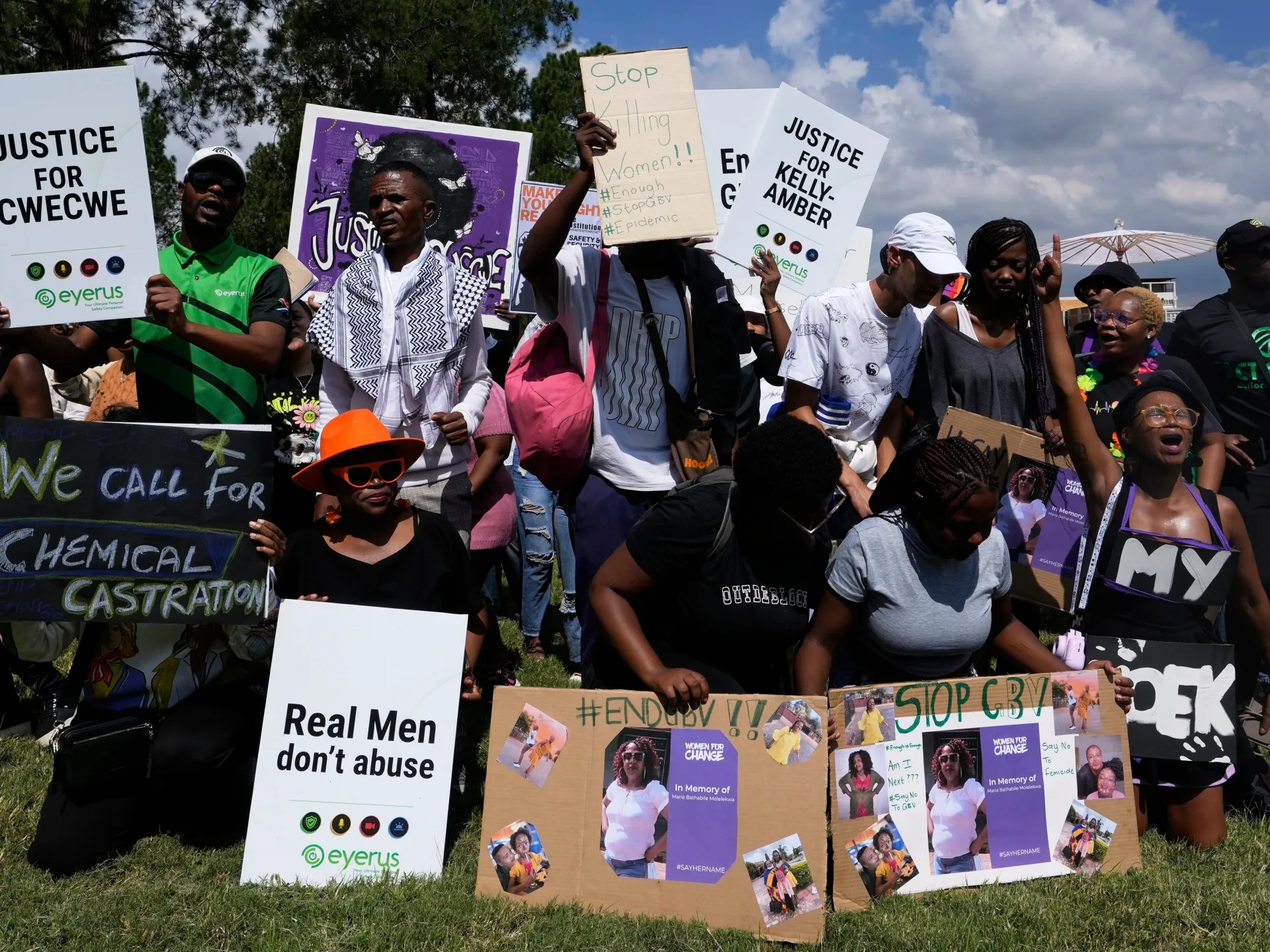
I was a young feminist in the 1990s and I remember singing that song countless times at rallies, protesting gender-based violence and calling for treatment for pregnant women living with HIV and AIDS. I remember, too, the stories of older women who marched on August 9, who reminded younger activists that many of them had taken to the streets over the objections of their husbands and fellow male comrades. They explained that at the time they did not have the language to explain how race, class and gender intersected; they just knew how sexism felt in their bodies.

By the time we were marching for a new set of rights, they had gifted us the language and analysis to describe how race, class and gender shaped women’s experiences. Their stories also showed us that sexism did not sit neatly outside the struggle against apartheid: women could stand alongside men in a liberation movement while still having to fight for equality with those same men. This was one of the most important legacies of the women’s march in 1956.

The rally that day failed to stop the pass laws, but it had a far more significant impact on the South African political landscape, effectively launching the South African women’s movement. The momentum and defiance of that day gave women in subsequent generations a blueprint for activism and analysis.

When apartheid ended in 1994, many of the women who had been at the forefront of the march in 1956 were still active in politics. The movement they had helped build was such a powerful force in the transition to democracy that almost a third of the incoming parliament comprised women, making South Africa one of only a handful of countries with such strong women’s representation in politics.

Once they were in power, the daughters of 1956 pushed through numerous legal and policy changes on reproductive rights, customary law and marriage – and the rights of domestic workers.

As a result of their efforts, South Africa has some of the most progressive laws and policies promoting gender equity and equality in the world. More than 30 years after the end of apartheid, women still constitute about 45 percent of parliamentarians and 44 percent of ministers.

Yet these gains have not translated into safety. South Africa’s first national gender-based violence study found that 33.1 percent of women aged 18 and older had experienced physical violence in their lifetime, while one in five men surveyed admitted to perpetrating physical or sexual intimate partner violence. The persistence of such violence exposes the limits of formal equality: laws can change faster than the attitudes, relationships and behaviours that shape women’s lives.

The same gap between formal rights and lived reality is evident in economic life. The disconnect between the rights enjoyed by women in positions of power who have helped shape South Africa’s laws and the lives of women in the poor communities to which they are accountable is stark.

South African women living in poverty are besieged by high levels of unemployment, gender-based violence and poor access to health and education services, while middle-class women enjoy many of the privileges once reserved for whites only. This is because in the last 30 years the ANC-led government has done little to dismantle the underlying economic structures that upheld apartheid. Formal equality has not translated into material equality for millions of women.

It is hard to find hope for women in South Africa’s statistics. Indeed, many women I know don’t celebrate Women’s Day – they are weary. Yet the women’s movement that the march helped galvanise 70 years ago still has much to teach us.

The lesson we learn from the vibrant movement that was created that day is that gender equality cannot be driven by women’s demands alone. Real progress requires call and response. Women have been making the call for generations. It is time for men to respond.

The views expressed in this article are the author’s own and do not necessarily reflect Al Jazeera’s editorial stance.
Source link

Justice Kennedy reflects on his time deciding the Constitution’s promise of liberty and equality

Justice Anthony M. Kennedy, the Supreme Court’s most influential member prior to his retirement, has watched quietly for eight years as a new conservative majority took charge.

He was troubled by partisan gerrymandering, but a year after he stepped down, a 5-4 ruling closed the federal courts to challenges to state voting maps that allow one party to rig the elections in its favor.

Though he believed abortion was a moral wrong, he cast the crucial vote in 1992 to uphold Roe vs. Wade and the principle that a woman, not the government, had the right to decide on ending an early pregnancy.

Four years ago, that decision was overturned on a 5-4 vote.

While Kennedy has refrained from commenting on the current court or President Trump, he has written a memoir that tells his life story and explains the reasoning behind the major decisions of his era.

It has become common for the justices to write books, but they steer clear of writing about the work of the court. Kennedy’s book, “Life, Law & Liberty,” is, like the justice, the exception to that rule.

An Irish Catholic from Sacramento and a Reagan Republican, Kennedy had a generally conservative voting record over 30 years on the high court. But he had a distinct view of liberty and justice.

“The nature of injustice is that we may not always see it in our own times,” he wrote in 2015.

Kennedy rejected the “rigid” view that the Constitution’s promises of liberty and equal protection of the law, as well as the protection against cruel and unusual punishment, were limited to their “original” meaning in the Bill of Rights of 1791 or the 14th Amendment of 1868.

After all, slavery and segregation were legal for much of American history, and women were not protected from discrimination by the promise of “equal protection” in the 14th Amendment.

Kennedy remained open to new rights and liberties. The goal, he wrote, was “a decent society in which the Constitution and the rule of law treat all with dignity and equality.”

He was the justice who made the difference in several areas of law, none more significant than in LGBTQ+ rights.

He wrote the court’s four major rulings rejecting discrimination based on sexual orientation. In 2015, he spoke for the 5-4 majority to uphold same-sex marriages nationwide.

“No union is more profound than marriage, for it embodies the highest ideals of love, fidelity, devotion, sacrifice, and family,” he wrote. “Many same-sex couples provide loving and nurturing homes to their children, whether biological or adopted. And hundreds of thousands of children are presently being raised by such couples.”

They “ask for equal dignity in the eyes of the law. The Constitution grants them that right,” he concluded in Obergefell vs. Hodges.

He also believed that teenagers who commit crimes are not as culpable as adults. He wrote a court opinion in 2005 ending executions for murderers who were under age 18 at the time of their crime.

Five years later, he wrote the court’s opinion holding it was cruel and unusual punishment for judges to impose a sentence of life in prison with no chance for parole for a teenager’s crime that did not involve homicide. In the case before the court, a Florida teen was given a life term for committing an armed robbery and a home burglary prior to his 18th birthday.

Kennedy marked his 90th birthday on Thursday and says his favorite topic of conversation is not the nine justices but his nine grandchildren. He still goes to the court some days and says he is worried by the tone in Washington and around the country.

“It is too partisan and confrontational,” he said in a recent interview with The Times. “I’m concerned that the divisiveness may be reflected at the court.”

Democracy requires “reasoned and respectful debate,” he said, not personal attacks and name calling.

Kennedy may be the last justice of his kind, said Washington University law professor Daniel Epps, a former Kennedy clerk.

“I don’t think we’ll see another justice who is so ideologically unpredictable and who votes against his party of appointment in some of the hugest cases in our lifetimes,” he said. Kennedy emerged from “an appointments process that was less polarized, where there were conservative Democrats and liberal Republicans and a Senate filibuster, which all made it possible for moderates to be appointed.”

While Kennedy describes himself at times as a small-town lawyer from Sacramento, he knew the two California governors, both Republicans, who reshaped the Supreme Court.

Kennedy’s father was a friend of Gov. Earl Warren, and young Tony played with Warren’s children. He also worked as a young page in the state Capitol when Warren was governor.

He was a high school senior in 1954 when Warren, the new chief justice, spoke for a unanimous court to strike down racial segregation in the case of Brown vs. Board of Education.

He and his father agreed the ruling was long overdue. It also provided an early lesson in how justices can uphold the fundamental principles of the Constitution despite intense opposition in much of the nation.

He said he later learned a second lesson. The Brown decision was “a historic step forward” but it “just a beginning” in the fight against entrenched racial injustice.

In writing the same-sex marriage case, Kennedy cited Warren’s opinion in the 1967 case of Loving vs. Virginia which struck down the bans on interracial marriages in 16 states.

As as young lawyer, Kennedy worked on special projects for Gov. Ronald Reagan and admired him greatly. He was just 38 years old when, at Reagan’s behest, he was appointed to the U.S. 9th Circuit Court of Appeals.

As president a decade later, Reagan had appointed Justices Sandra Day O’Connor and Antonin Scalia to the Supreme Court and elevated William Rehnquist to be the chief justice. But his third nominee — Judge Robert Bork — was voted down as too conservative by the Senate.

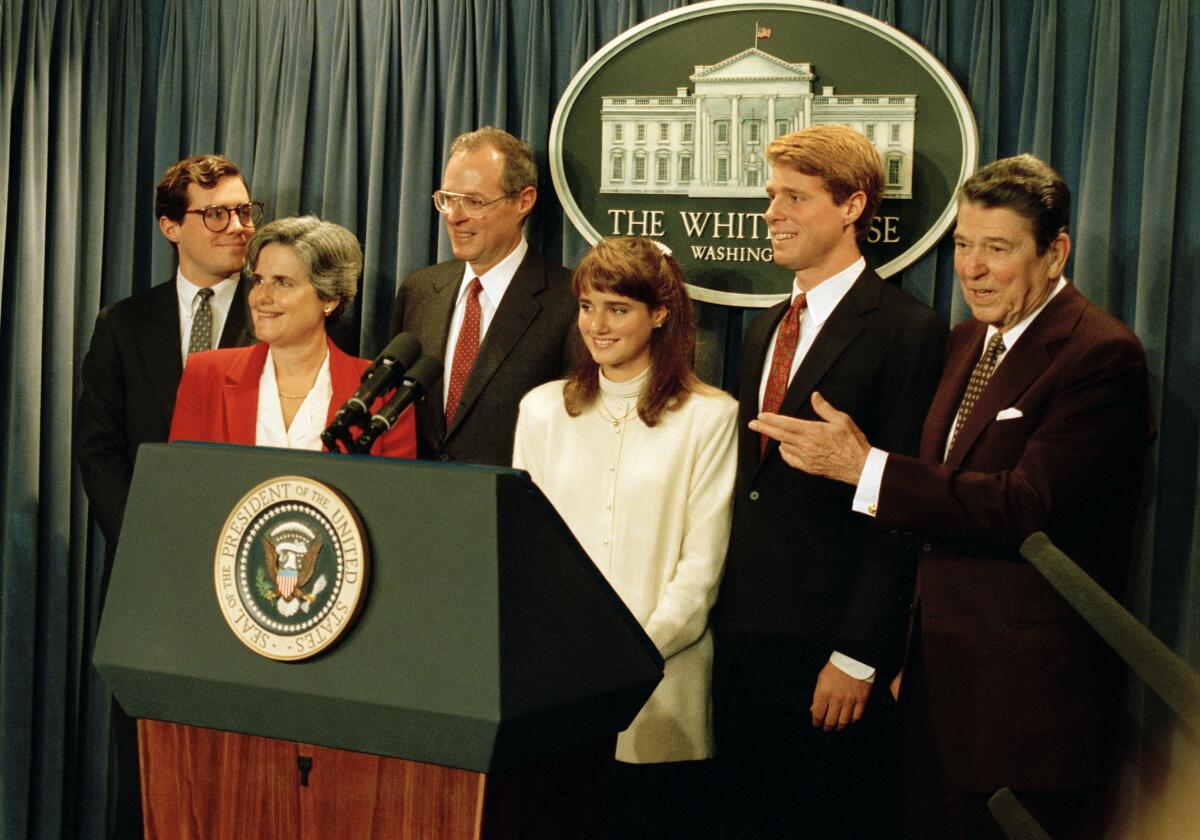
Reagan invited Kennedy to the White House and offered him the nomination. Kennedy recalled telling Reagan that he and his wife Mary were happy in Sacramento where all their friends and family lived. We don’t know anyone in Washington, he said.

President Reagan gestures toward Judge Anthony M. Kennedy's family after nominating Kennedy to the Supreme Court in 1987.

President Reagan gestures toward Judge Anthony M. Kennedy’s family after nominating Kennedy to the Supreme Court in 1987.

(Dennis Cook / Associated Press)

In his best imitation of Reagan’s voice, he recounted the president’s response: “You know me. And you know Nancy.”

Kennedy accepted the nomination and was confirmed in February 1988 by a 97-0 vote, the last justice to win unanimous approval from the Senate.

His three decades on the court were shaped in part by his relationship with Scalia.

Kennedy and his wife bought a house in the same northern Virginia neighborhood where Scalia lived. In their early years on the court, they appeared to be friends and allies.

They broadly supported freedom of speech. To the surprise of many, they cast the deciding votes in 1989 to rule that the 1st Amendment protects the right to burn an American flag in protest.

A year later, Kennedy and Scalia dissented vehemently when the court ruled the Michigan Chamber of Commerce and its corporate supporters could be barred from advertising their support for state candidates.

The decision triggered a decades-long dispute that ended with the Citizens United ruling in 2010. Kennedy spoke for a 5-4 conservative majority to rule that corporations, unions and other groups were free to spend money independently to oppose or support candidates.

But when the court was closely split in major cases, Kennedy was likely to be in majority while Scalia wrote scathing and increasingly personal dissents.

“I would hide my head in a bag,” Scalia wrote in dissent in the same-sex marriage case, rather than join an opinion “couched in a style that is as pretentious as its content is egotistic.”

Kennedy was put off by a different jab. Scalia said the justices do not represent the full country. For example, the court lacks a “genuine Westerner (California does not count),” he wrote.

Since Scalia’s death, his influence has grown especially with the younger generation of conservatives.

Two of Trump’s appointees — Justices Neil M. Gorsuch and Brett M. Kavanaugh — were clerks for Kennedy in 1993, but they are far more likely to cite Scalia and his views on interpreting laws or the Constitution. Justice Amy Coney Barrett, Trump’s third appointee, was a clerk for Scalia.

While Kennedy did not respond to Scalia’s harsh dissents, they hung over their last year together on the court.

One day in early February of 2016, Scalia stopped by Kennedy’s office to talk.

“Nino said he had come to regret deeply the tone of his Obergefell dissent and its personal references. He apologized for being intemperate,” Kennedy wrote. “Neither of us is big on hugging, but we hugged, both of us smiling.”

They agreed to get together for dinner with their wives when he returned from a hunting trip to Texas.

A week later, Scalia’s wife Maureen called to tell them of his death.

“Nino and I spent 28 years on the court together,” Kennedy wrote. “We sometimes agreed and sometimes disagreed, but I respected him and miss him very much.”

Source link

Kathy Hilton out as WeHo Pride grand marshal after backlash

Kathy Hilton will no longer be the grand marshal of West Hollywood’s pride parade.

The city and WeHo Pride on Wednesday released a joint statement, announcing that “The Real Housewives of Beverly Hills” star would no longer serve as the Grand Marshal Icon for the 2026 WeHo Pride Parade. The event is scheduled for Sunday.

“After thoughtful discussions, the City of West Hollywood, the WeHo Pride production team, and Kathy Hilton have determined that the 2026 WeHo Pride Parade will not designate a Grand Marshal Icon honoree,” read the statement.

The decision comes less than a week after Hilton was announced. That May 28 announcement was met with swift backlash from the LGBTQ+ community and allies, who called out Hilton’s ties to President Trump and alleged MAGA-leaning politics. Critics also cited accusations that the socialite had used a homophobic slur while on a trip with other cast members of “The Real Housewives of Beverly Hills,” an action she has previously denied.

In their joint statement, West Hollywood and the WeHo Pride team expressed their appreciation for “the respectful and sincere dialogue” around both the event and the “role and significance” of Pride honorees.

“The City of West Hollywood has always believed that Pride belongs to the community,” the joint statement said. “Since its earliest days, Pride has served as both a celebration and a platform for activism, visibility, resilience, and the ongoing pursuit of equality, dignity, and justice for LGBTQ+ people. … These conversations reflect the passion people have for WeHo Pride and underscore the importance of ensuring that WeHo Pride continues to honor the history, values, and diverse voices of the LGBTQ+ community.”

In a statement, Hilton expressed gratitude for being considered for grand marshal and reaffirmed her commitment to the LGBTQ+ community and causes.

“My reason for wanting to be involved in this year’s WeHo Pride weekend was simple: to celebrate, support, and share in the joy of a community that means a great deal to so many people,” Hilton said. “Pride is, and always will be, about celebrating and uplifting LGBTQ+ voices, experiences, and achievements. … My support for the community and WeHo Pride is unwavering.”

She also mentioned several queer advocacy organizations and events she has supported over the years, including GLAAD, the Elton John AIDS Foundation, the Elizabeth Taylor AIDS Foundation, Dr. Mathilde Krim, God’s Love We Deliver and Project Angel Food.

The latest Pride-related dust-up follows the abrupt cancellation of the Long Beach Pride Festival in May. The city’s Pride Parade took place as planned.

Both snafus have occurred as conservative politicians and advocates continue to attack LGBTQ+ rights and visibility nationwide. Some Republican governors have even pushed for conservative alternatives to Pride month festivities. A recent Gallup poll has found that after years of steady gains, support for marriage equality and same-sex relationships has slipped, particularly among Republicans.


Source link

Billie Jean King graduates from college 65 years after enrolling

Long before Billie Jean King won dozens of Grand Slam tennis titles, founded the Women’s Tennis Assn., became part owner of the Dodgers and was awarded the Presidential Medal of Freedom, she enrolled in what was then called Los Angeles State College.

Three years later in 1964, King left without a degree to devote full attention to her burgeoning tennis career.

Failing to earn the degree bothered her, and King would correct anyone who said she had graduated.

“I said, ‘Don’t ever say ‘graduated.’ I haven’t earned it — yet,’” she said.

“Yet” became a reality Monday when King, 82, received her bachelor’s degree in history from the same school she attended more than 60 years ago — now called Cal State Los Angeles — walking across the Shrine Auditorium stage with the rest of the Class of 2026.

King also served as a commencement speaker, telling the roughly 6,000 fellow graduates, “It is a privilege for me to be here.

“Yeah, baby, only 61 years!”

King mentioned that “like many of you,” no one in her immediate family had graduated from college.

She noted that her lifelong fight against discrimination began when she realized at age 12 that nearly everyone at tennis clubs was white.

“I asked myself, ‘Where is everybody else?’” King said. “From that day forward, I committed my life to equality and inclusion for all. Tennis is a global sport and it became my platform, but equality was my dream — to make the world a better place.”

“We can never understand inclusion unless we’ve been excluded.”

Known then as Billie Jean Moffitt, she chose Los Angeles State because tennis coach Scotty Deeds trained men and women together. She soon became an international star, winning a Wimbledon doubles championship at 18 with Karen Hantze, who was only 17.

She married her college sweetheart Larry King in 1965 and they divorced in 1987. Afterward, King and Ilana Kloss, an accomplished tennis player in her own right, were a couple for decades before marrying in 2018 in a secret ceremony in the apartment of former New York City Mayor David Dinkins.

“You’re finding your truth, and it doesn’t have to stay the same,” King told People magazine at the time. “I only liked guys when I was young. I didn’t think about girls. And then all of a sudden I’m like, ‘Oh my God, what’s happening?’ My truth was changing over time. It took me forever.”

King became a trailblazer for LGBTQ+ and women’s civil rights and was awarded the Presidential Medal of Freedom in 2009 in part for her advocacy for equality. King and Kloss co-founded the Billie Jean King Leadership Initiative to promote inclusive workplaces and gender equality.

Shortly after they married, King and Kloss became part owners of the Dodgers and the Sparks, acquiring undisclosed minority stakes in the franchises through an invitation from controlling owner Mark Walter.

“We believe all professions, and professional sports, need to be more inclusive and equitable,’’ Walter said at the time. “It’s going to be wonderful to have a role model like her in both clubhouses from time to time.’’

King returned to Cal State L.A. in the 2025 spring semester. She also earned course credit for her interaction with fellow students enrolled through the university’s Prison Graduation Initiative.

“They have made a commitment to improving their lives through education,” she said, and “getting their degree will be life-changing for them.”

King now knows the feeling firsthand. At the graduation ceremony on Monday, she wore a gold stole embroidered with a multicolored tennis racket and the letters G.O.A.T — greatest of all time.

“It means a lot more to me than I thought,” she told reporters. “I am so glad I did it. My hope is that one other person will go back to school.

“It’s never too late, whatever age you are, whatever your abilities are, go for it if you want it.”

The Associated Press contributed to this report.

Source link