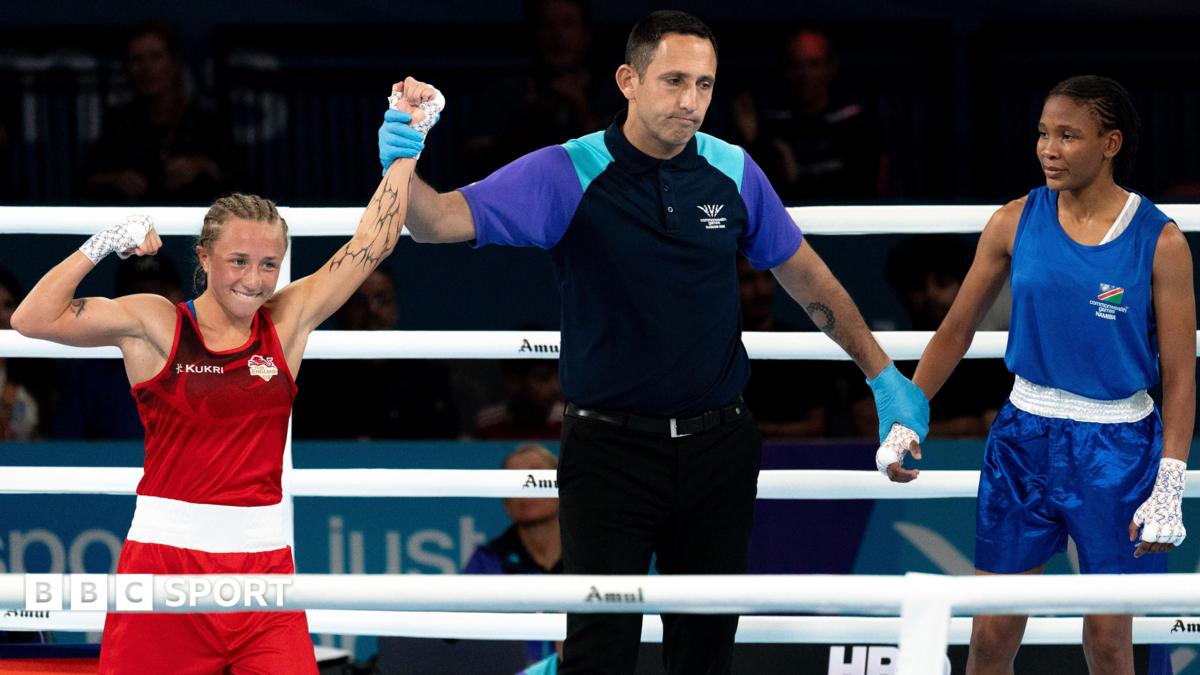
Meanwhile, a boxer from Tuvalu claimed her country’s first ever Commonwealth Games medal without winning a fight.
Because there were only five entrants, Tarona Taafaki received a bye to the last four, meaning she was automatically guaranteed at least a bronze medal.
The 20-year-old lost her first and only fight in the women’s 75kg division – which was a semi-final – to India’s Lovlina Borgohain on Friday, losing every round on all three of the judges’ cards.
Taafaki’s coach and father, Badi Taafaki, says the population of the tiny Pacific island nation – at 10 square miles the fourth smallest in the world – will celebrate the medal and use it to highlight a climate change emergency.
“For the people of Tuvalu, this medal means everything,” he said. “We’re one of the smallest nations in the world, so a medal like this is hugely significant.
“If we can win medals, more people around the world will recognise Tuvalu and begin to understand the challenges we face because of climate change.
“It is very real for us. The coastal erosion is unbelievable, and the countdown is now measured in years, not decades.”
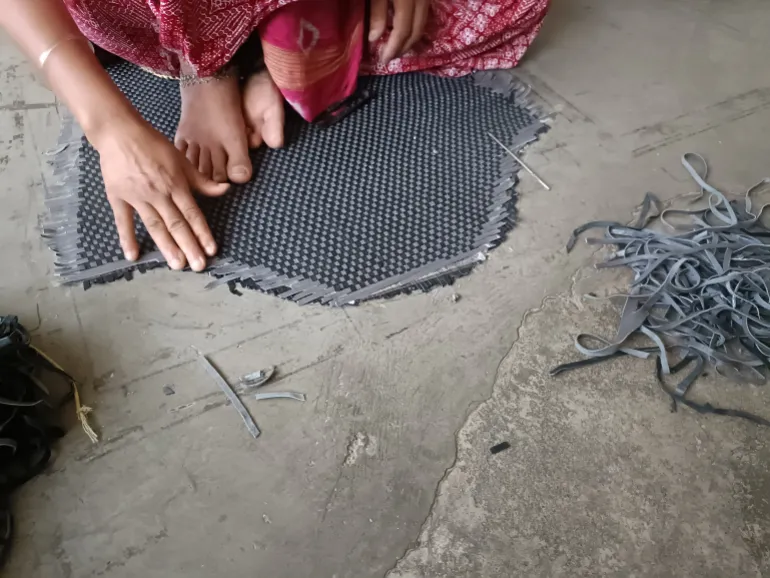
New Delhi, India – On a searing hot afternoon in a dense working class neighbourhood of the Indian capital, Shehnaz Bano sits on the dilapidated floor of her one-room home, deftly stitching pieces for a new leather jacket.
To make each piece – a sleeve, a front or back panel or a shoulder yoke – the 38-year-old mother of two teenage sons spends hours, but is paid a mere 100 rupees (about $1) for each piece.
Recommended Stories
list of 4 itemsend of list
“Imagine if I was a regular employee and I did the same work for the same hours, but on a factory floor. I would have been paid more, right?” Bano asked.
“Just because I work from home, I don’t get equal pay or rights.”
That is because Bano, like nearly 260 million others across the world, is a home-based worker (HBW) – people employed to produce goods or services in or near their homes. The HBWs are part of what is referred to as the global informal economy. Such a form of employment is characterised by low wages, denial of workers’ rights, lack of social security or established hours of work, or paid leave.
The HBWs are also a highly-feminised workforce, with nearly 57 percent being women, according to a 2024 estimate by Women in Informal Employment: Globalising and Organising (WIEGO), a United Kingdom-based global research organisation focused on improving conditions for the working poor, especially women, in the informal economy.
On this day 30 years ago, however, an effort was made to change the condition of the HBWs – with little success so far.
The International Labour Organisation (ILO), a United Nations’ body, during a conference at its headquarters in Geneva, Switzerland, adopted the landmark “Convention 177”, or the Home Work Convention on June 20, 1996, recognising HBWs at the same level as traditional wage earners.
It was the first comprehensive call to set an international standard for the HBWs. The convention called upon ILO members to adopt and implement policies that promote equality of treatment between HBWs and other wage earners.
Convention 177 officially came into force on April 22, 2000.
However, only 13 countries have ratified it so far and none from South Asia. That is despite Asia and the Asia-Pacific regions accounting for the largest concentration of HBWs, as well as being the hub of global fashion and manufacturing supply chains.
Renana Jhabvala was in the room in Geneva – along with hundreds of government and non-government delegates – when the home-based worker Convention was adopted.
As a member of the Self Employed Women’s Association (SEWA), a prominent Indian trade union of women workers, the 73-year-old activist was at the ILO’s International Labour Conference (ILC), and still remembers the exhilaration and optimism in the room.
“Discussions had gone on for nearly 21 days, but none of us knew whether the Convention would get adopted or not. We were all in a really big hall at the ILC… There was a majority in the final vote and the Convention got passed,” she told Al Jazeera.
But labour rights activists, experts and labour economists say a lack of recognition of the HBWs despite three decades of adopting the ILO convention has deepened structural inequalities among the workers, especially in a developing country like India.
According to them, the HBWs, especially women, remain largely “invisible” to the policymakers, while they are forced to work for inadequate wages under unsafe and exploitative working conditions.
“Convention 177 has been instrumental in recognising home work as ‘real work’ and home workers as workers entitled to labour rights,” Deepa Bharathi, a senior specialist of gender and non-discrimination at ILO’s Bangkok-based Decent Work Team, emailed Al Jazeera.
“In South Asia, home-based work is often embedded in complex subcontracting arrangements, making employment relationships difficult to identify and regulate. Challenges in labour inspection, gaps in data and the invisibility of home workers in policy frameworks have also slowed progress,” Bharathi said in response to a question on the low ratification of the Convention, particularly in South Asia.
With most home-based workers in the region being women, their work is often seen as an extension of household responsibility, Bharathi said. “This undervaluation, combined with broader gender inequalities, has been a significant barrier to ratification and implementation,” she added.
When asked about the ILO’s priorities for strengthening the Convention’s implementation, Bharathi said: “For women home-based workers in particular, the focus must remain on visibility, fair pay, social protection, safe working conditions, access to training and childcare and a stronger collective voice.”
‘I cannot go out and work’
Bano lives in New Delhi’s Kapashera area, a settlement of mainly migrant workers on the city’s southwestern edge whose name literally translates to a “cotton settlement” in English. The area is known for its cotton and leather garment manufacturing units.
In its congested alleys lie buildings that rent out single room units to informal worker families. In one such room lives Bano with her sons and her husband who works as a lift operator in an upscale mall in Gurugram, a business district housing several Fortune 500 companies on the outskirts of New Delhi.
The leather panel of a jacket that Bano is working on in New Delhi, India [Anuja/Al Jazeera]
Bano epitomises the arc of a typical HBW in India. She began working as a beedi (a tiny, hand-rolled cigarette) roller in her village in neighbouring Uttar Pradesh state’s Azamgarh district. After marriage, she joined her husband in New Delhi and took to stitching leather jacket pieces from home.
The move from her rural employment as a beedi roller to a piece-rate worker in the city did not change her continuing precarious situation: long hours, irregular work, low wages and work that leaves her eyes strained and fingers aching.
She is paid barely one dollar for her work on each piece of a leather jacket that is sold in a foreign market for $200 or more – more than double Bano’s average monthly income. Moreover, to cut costs and maximise profit, the contractors often split such work among several workers.
“Only those who are in distress do this kind of work. We have rent, bills, grocery and school fees to pay. How much will my husband do alone?” Bano told Al Jazeera.
The HBWs fall into two categories: own account workers with direct access to markets and piece rate workers who are usually employed through intermediaries. Bano belongs to the latter, which is considered more vulnerable due to low and arbitrary piece rate payments.
In another corner of Kapashera, Sangeeta Devi, 30, puts the final touches – buttoning, repairing, finishing – before the garments she makes return to the factories.
She is doing all this inside an 8×8 foot (2.4m) room, where her family of six, including four schoolchildren sleep, eat, work and study. She cooks, cleans and even bathes in the same room.
“I cannot go out and work because then who will take care of my children?”
“On any given day, there are 100 pieces of clothing in this tiny room. Each time, I have to keep them aside while doing household chores,” the migrant worker from Bihar, one of India’s poorest states, told Al Jazeera.
Sangeeta Devi gets a dollar for every 100 garment pieces she completes.
“I really want to do a job where I can work easily from home, take care of my children and get paid well. I don’t know if that’s even possible,” she told Al Jazeera.
Her neighbour, Putul Devi, does similar work and earns about $20 a month.
“I have been cooking on firewood because of high fuel costs. And when it rains, I don’t know what to save from spoiling – the firewood or the cloth pieces that I bring home,” she told Al Jazeera.
Putul Devi at her home in New Delhi, India [Anuja/Al Jazeera]
Shalini Sinha, home-based work sector specialist at WIEGO, said female HBWs in India face “continued invisibility” even after three decades of recognition of their work.
“Home continues to be seen as a place of habitat and not as a place of work,” Sinha told Al Jazeera.
“There is also the broader issue of women’s economic work not being adequately recognised in labour discourse when it is done from home. It is often seen as an extension of her care work,” she added.
From an Indian perspective, said Sinha, there is an “urgent need for better statistics and a dedicated policy or law for home-based workers, which still does not exist”.
Elizabeth Khumallambam, who works for Community for Social Change and Development (CSCD), an NGO that works with women HBWs in Kapashera, said a social security code introduced in India in 2020 mentions HBWs, but “no one knows” how it will be implemented on the ground.
Introduced as part of India’s labour reform laws, the code consolidated nine social security-related laws into a single framework to ensure social security protection for all workers, including those in the unorganised sector.
“Frankly, for us the challenge begins at making workers understand the value of their own work. Many don’t consider this as work and so they do not think it needs due rights and protection,” Khumallambam told Al Jazeera.
Alakh N Sharma, a labour economist and director at New Delhi-based non-profit, the Institute for Human Development, said there is a “bias in the system”, due to which women’s work is being left behind in statistics and official counting.
According to him, technology-aided counting, probing questions and sensitivity among investigators, could help in addressing the statistical blind spot.
“Safety concerns, mobility constraints and social norms – all these factors stop women from joining formal workplace-based employment. But the single biggest reason is often care work responsibility, particularly childcare,” Sharma told Al Jazeera.
In 2022, Sandosh Kumar P, a Communist Party of India (CPI) parliamentarian moved a legislation aimed at the welfare of the BHWs, but the parliament did not take it up for discussion.
In December 2024, India’s ministry of labour and employment was again asked in parliament whether it has an official assessment of the HBWs, and if it was proposing to enact a law on them. It replied that the Code on Social Security 2020 provides social security to the unorganised workers, including the HBWs. It also said the government has created a national database of such workers.
Looking back at the 30 years since the historic recognition of HBWs, Jhabvala said she did not view such Conventions or laws from the lens of success or failure.
“It is like a weapon, a tool of change. If we want to fight, this option is available,” she said.
Rawalpindi, Pakistan – On a cold January morning, Anum Shakoor gallops across a field, wrapped in a black shawl that billows behind her as she charges forward, a 1.8-metre (6ft) lance gripped tightly in her hand.
The 30-year-old has already claimed her first peg. The second lies close ahead.
Recommended Stories
list of 4 itemsend of list
Her horse tears across the dry earth, kicking up a cloud of dust that hangs in the air as she charges forward. A few metres out, Shakoor lowers the lance, steadying her aim and bracing for impact.
She misses by 2.5cm (1 inch).
A collective gasp ripples through the crowded bleachers. Many onlookers shake their heads. Some look away.
Shakoor exhales and slows her horse to a walk. Around her are the desolate, windswept fields on the outskirts of Rawalpindi in northern Punjab province.
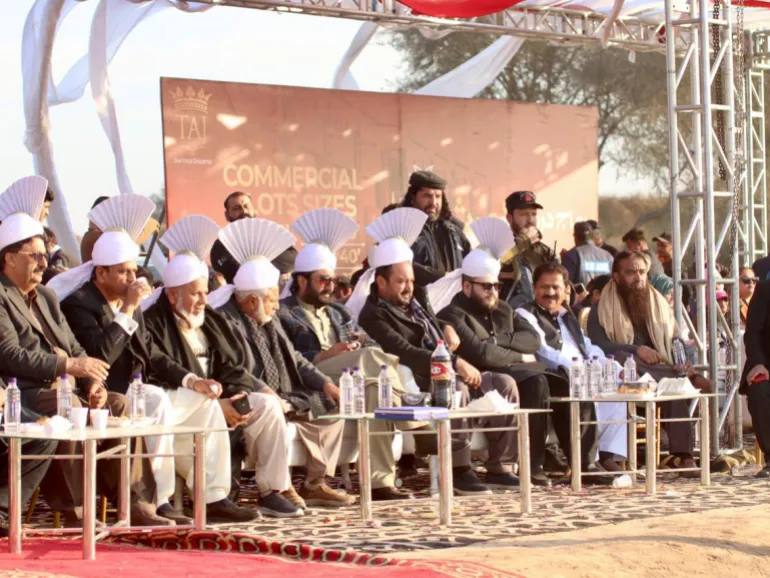
And there are men, most of them wearing turbans. Men with “dhol” (drums) hanging from their necks. And men whose fathers had ridden before them and their fathers before their fathers. The men who take pride in the ancient sport, some of whom perhaps are not ready to accept that women are now participating in an overwhelmingly male “neza baazi”, or tent pegging, a high-stakes sport in which horse riders gallop across a field to pierce a buried wooden target.
Local political and feudal elites seen wearing traditional turbans at a tent pegging event near Rawalpindi [Mutee Ur Rehman/Al Jazeera]
The field is lined with thousands of male spectators, gathered to watch the teams of riders charging one after the other at a small wooden peg buried in the ground, trying to pierce it cleanly and carry it forward on their lance.
The event is known as a “mela” in Punjabi, a carnival-like competition typically held on the outskirts of the garrison city.
The beat of drums intertwined with the sharp bursts of the shehnai (oboe), traditionally played in weddings, pierces the cold winter air. Salespeople call out to the crowds from bustling stalls selling cardamom tea and varieties of fried fritters.
Before the competition starts, riders mount their adorned horses, some of which are dressed in embroidered velvet gowns. Others have braided manes or brass bells ringing softly at their necks.
One of the 74 teams competing in this year’s mela is Shakoor’s Bint-e-Zahra Club, Pakistan’s first female-only tent-pegging club. It has three other riders: Eshal Ibrahim and Noor un Nisa Malik, both 16, and Sehrish Awan, a 32-year-old mother of two competing for the first time in a mela.
Shakoor says the club was formed in 2025 after she reached a “frustrating realisation” that female riders practised and played only in mixed clubs. “We wanted to give women riders a stage for training so they can form a community,” she says.
The women are an unusual sight at a competition that has almost entirely male riding teams, mainly male fans and even male musicians.
So when Bint-e-Zahra’s members prepare to make their run, the audience is in for a rare sight. Photographers, vloggers and locals rush to film them, surrounding them from all sides.
Sehrish Awan straightens her lance at a competition organised by a US-based riding club [Mutee Ur Rehman/Al Jazeera]
Ibrahim is accompanied by her mother, who trails closely behind her, keeping a careful eye on her teenage daughter.
“I cannot even take pictures of her in the crowd,” says Fatima Adeel, who accompanies Ibrahim to every mela. “I am in charge of her. I cannot leave a teenage girl alone in a sea of men.”
Shakoor agrees.
“Any woman who wants to come in this sport should be encouraged so she can gain the respect she deserves in the sport,” she says. “Our society cannot bear a woman’s lead in any field.”
‘No concept of a player’
Several kilometres away, Ayesha Khan, 22, gallops on Sawa, the horse she has ridden since she was eight, for a practice run with her club.
She was 17 when her father encouraged her to try out for the women’s national team. A year later, she was the only woman selected for Pakistan’s under-21 mixed gender team and was sent to South Africa for a tournament to compete against a team that had four girls and one boy.
“I was hit with the realisation of how tent pegging is conditioned to appear masculine in Pakistan. But my father and brothers taught me riding when I was five. I used to be the only child riding a horse between adults,” Khan says, describing herself as “addicted” to riding.
Ayesha Khan picks up the first peg at the 2022 Grand Prix Tent Pegging Championship in Jordan [File: Courtesy of Ayesha Khan]
Khan joined the women’s team in 2022 and quickly worked her way up to becoming its captain. That same year, she took the women’s team to Jordan, where it competed against 13 countries.
“We came third,” Khan recalls proudly. “Yet that was the only trip that the Pakistani women’s team competed in internationally. Before that trip, never. After that, never again.”
In 2024, the International Tent Pegging Federation organised an open international competition in Jordan. Pakistan sent a men-only team although the event was open to women. It was simply assumed that only men would want to go.
“In Pakistan, we don’t have the concept of a player,” Khan tells Al Jazeera. “We have the concept of male and female. Unless there is a women-only event, our federation exclusively sends male teams.”
But Khan persisted. At 20, she became the first Pakistani woman to compete against and beat 70 male riders at a mela. Today, she captains Pakistan’s only all-women tent pegging team.
How women entered the sport
The event near Rawalpindi that Shakoor attended was organised by Samiullah Barsa, a 27-year-old United States national of Pakistani origin, as part of his wedding celebrations.
“No wedding is complete without neza baazi,” says Barsa, who is dressed in a blazing red waistcoat and cowboy boots.
His family emigrated in the 1980s from the Punjab city of Gujrat to the US state of Ohio, where they own a stable and host annual melas. Last year, their mela drew more than 2,000 visitors, Barsa says.
Barsa recalls the first time he saw women compete in tent pegging. In 2015, he attended a mela at Kot Fateh Khan in Attock district, an hour from the capital, Islamabad, and the hometown of Malik Ata, fondly remembered as “Baba-e neza baazi” (the father of tent pegging).
Ata was a politician who came from an influential feudal family in Kot Fateh Khan. He was also a legendary equestrian who organised grand melas and invited hundreds of teams from across Pakistan to compete in various equestrian sports, including neza baazi.
At the first such grand mela, Ata invited the Australian women’s tent-pegging team, setting the stage for Pakistani women to embrace the sport.
In 2021, the Equestrian Federation of Pakistan, established by Ata, sponsored six girls to train under a South African coach. Khan was among those who made the journey to South Africa. She credits Ata for laying the roots of female participation in Pakistani tent pegging.
A team of women at a practice session in Rawalpindi, Pakistan [Mutee Ur Rehman/Al Jazeera]
Barsa says Ata’s contribution to the sport cannot be denied and it was time for women to have their own teams.
“Everywhere along the world, women and men have separate competition. For instance, in football or in cricket, have you ever seen women competing against men?” he asks. “When female teams lose against male teams, they lose hope and don’t come forward.”
But has it been easy for women to pursue the sport?
Not really, both Khan and Shakoor say.
‘I never gave up’
Shakoor says there is tremendous social pressure on girls and women to conform to roles defined by the patriarchy.
“My mother has told me multiple times that I have to get married. But since I am part of such a manly sport, she worries how will I get good proposals. My sister did so too, but I never gave up,” she says.
“My brother stood up for me and told my mother that I am excelling in my passion. He asked her to let me live my life.”
Khan is relatively young, so marriage is not a concern for now. But she has heard relatives whisper to her mother: “It is probably just a phase. She should focus on her studies.”
A vendor serves tea and savoury food at a mela near Rawalpindi [Mutee Ur Rehman/Al Jazeera]
Before going to a mela, Khan tries to find out details about the organisers. With the events often spanning two or three days, she also asks whether there are separate enclosures for women. Most riding fields have none or few restrooms or spaces for prayers for women.
In Pakistan, tent pegging is mainly played in northern Punjab, where villages and spacious fields stretch along the Ravi River, allowing the horses to freely run.
Khan says many girls have reached out to her wanting to pursue tent pegging. But most of them don’t have family support. And then there are financial and structural obstacles, which compound women’s lack of access to the sport.
“Not everyone has the privilege of owning a horse, especially women, who are already restricted by society,” Ibrahim says.
Even if you are able to own one, there is a significant cost attached to their upkeep. A horse’s monthly feed averages 30,000 to 35,000 Pakistani rupees ($107 to $125), which is nearly the monthly minimum wage in Punjab. Caretaker fees and rental charges more than double that amount.
“It’s a class thing. Everything related to horses is,” Khan says. A sporting horse costs about $1,500 in Pakistan.
Ayesha Khan holding Pakistan’s flag at the Under-21 World Tent Pegging Championship 2023 held in South Africa. She was the only girl in a team of four boys [Courtesy of Ayesha Khan]
Shakoor agrees. She says she was able to buy a horse after saving from her monthly salary as a manager for a global microfinance network. “You can’t put a price on passion,” she says, using a Punjabi saying.
She says she puts her horse before everything, even her own meals or health. “If I am sick, I do not care about my medicine,” she says. “But I lose sleep if my horse is sick.”
But the high cost of the sport also means many opportunities are lost. Shakoor says she has missed several tent-pegging events because she could not afford to haul her horse across cities for multiple days of competitions.
“Had I had any financial support through sponsorship, I would not have missed those events,” she says.
For Barsa’s event alone, Shakoor’s team spent more than 100,000 rupees ($358), which included the cost of transporting five horses, their feed and lodging.
Similarly, at the national tent pegging trials, every rider must bring their own horse, a rule that shuts out anyone who cannot afford transport, let alone own a horse.
Awan, the 32-year-old mother of two children, used to ride horses as a hobby and began visiting melas to observe how tent pegging was played. Intrigued by the sport, she reached out to Shakoor on Instagram, asking to become a member of Bint-e-Zahra.
In recent years, videos featuring female riders have gained millions of views on Instagram and TikTok, sometimes surpassing their male counterparts. Khan and Zoya Mir, the vice captain of the national tent pegging team, run joint TikTok and Instagram accounts, Equestrians In Green, where they post about their sporting victories.
Some videos show the women playing neza baazi in slow motion, picking up a peg mid-gallop or emerging from clouds of dust dressed in their club’s gear, often set to trendy music and paired with captions that challenge the stereotypical association of horse riding with men. Some of these videos have millions of views.
But the social media visibility also comes at a cost.
Khan recalls a viral video of women riders wearing turbans at a mela, causing a backlash from veteran male riders who claimed “women were polluting the sport.”
The turban, traditionally worn by men as a mark of their social position as well as a defining part of a horse rider’s identity, takes on an added significance in neza baazi. For some, women wearing it is seen as a challenge to a space long associated with male authority.
But the riders at the Rawalpindi mela push ahead despite the vitriol. They wear their turbans with pride – Awan tying hers over a red niqab that covers half of her face while Shakoor has hers pulled low, the way her mentor taught her.
Shakoor pulls up a photo from her Instagram account, which has more than 8,000 followers. Two riders wearing turbans pluck a peg side by side. The dip of their lances, the slight sway of their bodies, the moment of lift are all nearly identical.
“This is a picture of me with my mentor Chaudry Nazakat Hussain, my true inspiration,” she says. “He encouraged me to create Bint-e-Zahra.”
Last year, a mela held in Jathli in Rawalpindi’s Tehsil Gujjar Khan had 50 participating teams with nearly 200 riders – all male except Shakoor, Ibrahim and Malik. Representing the Bint-e-Zahra Club, Shakoor fought her way into the last seven in the team captains’ round, which is a recent addition in melas in which the captain of each club runs for a position.
Shakoor, the only woman among the final seven qualifying riders, did not secure a position but considers being included a feat nonetheless. “In the captains’ round, horses are assigned to riders randomly. This minimises odds of performing better. A sportsman is known for their skill, not their horse,” she says.
Of all the lessons the sport has taught her, Shakoor says the most valuable has been courage.
“This is a sport of the brave. If you don’t have the heart for it, it’s not for you,” she says. “Passion and dedication have no gender. … We don’t want to prove we are better than men. We only want equal respect.”
May 22 (UPI) — The Federal Communications Commission on Friday opened public comment on a petition from the Disney-owned network ABC to declare its show The View as a “bona fide news interview program.”
Disney submitted the petition in early May on behalf of its television station KTRK-TV in Houston and its parent company ABC for the declaration in order to receive an exemption from laws requiring that non-news programming include equal time for representation of political candidates for office.
The equal time rule is part of the Communications Act of 1934, which created the FCC and regulations for the use of wire and radio, and later television, communications.
The rule is meant to ensure equal access to broadcast station facilities for all candidates for office — essentially, the same amount of air time — to prevent broadcasters from using the public airwaves to push one political candidate or party over another.
Disney and ABC’s request for an exemption to the rule, which are generally granted for news broadcasts, stems from years-long squabbling between President Donald Trump and various people who have hosted The View, which is a news and pop culture analysis program hosted by a panel of women.
“Is The View a ‘bona fide news interview program?” FCC Chairman Brendan Carr said in a post on X announcing the public comment period.
“Under FCC case law, tv shows do not qualify as ‘bona fide news’ if their decisions are based on partisan purposes, such as an intention to advance or harm an individual’s candidacy,” Carr said.
Disney compared the show to NBC’s Meet The Press and CBS’ Face The Nation, which feature interviews and roundtable analysis of political and news topics.
Carr, however, contends that The View does not meet the criteria of those shows as news programs, and so should be required to offer time to multiple candidates in a political race if they feature one of them.
In its May 7 petition to the FCC, Disney and ABC noted that the FCC’s actions could upend “settled law and practice,” as well as “chill critical protected speech both with respect to ‘The View’ and more broadly.”
The filing also notes that the show has “been broadcasting under a bona fide news exemption granted to it more than 20 years ago,” and that the exemption “remains valid.”
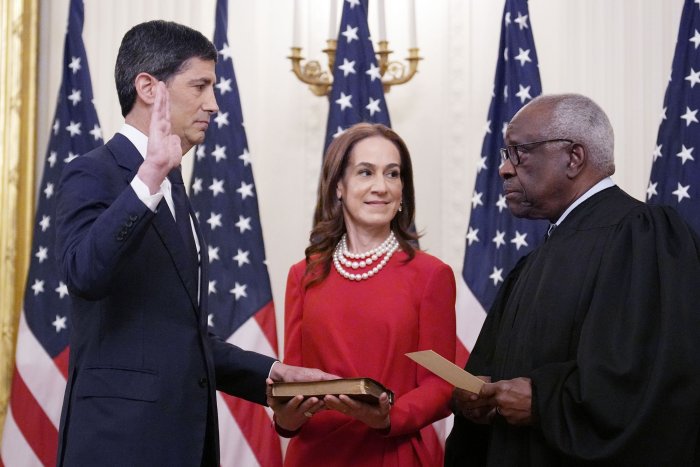
Kevin Warsh takes the oath of office as he is sworn-in as the new chairman of the Federal Reserve by Supreme Court Associate Justice Clarence Thomas in the East Room of the White House on Friday. Photo by Yuri Gripas/UPI | License Photo

![India home-based workers [Anuja/Al Jazeera]](https://i0.wp.com/occasionaldigest.com/wp-content/uploads/2026/06/HBW-Putul-Devi-at-her-one-room-home-in-New-Delhi-1781976215.jpg?w=640&ssl=1)
![Local political and feudal elites wearing honorary turbans look on as a tent pegging event kicks off [Mutee Ur Rehman/Al Jazeera]](https://i0.wp.com/occasionaldigest.com/wp-content/uploads/2026/05/IMG_3-1-1779082712.jpg?w=640&ssl=1)
![A female rider, Sehrish Awan, straightens her lance as she gears up for competition in a mela organised by a USA-based riding club [Mutee Ur Rehman/ Al Jazeera]](https://i0.wp.com/occasionaldigest.com/wp-content/uploads/2026/05/IMG_5-1-1779082721.jpg?w=640&ssl=1)

![A team of young women riders warm up for a practice session in Rawalpindi, Pakistan [Mutee Ur Rehman/Al Jazeera]](https://i0.wp.com/occasionaldigest.com/wp-content/uploads/2026/05/IMG_2-1-1779082705.jpg?w=640&ssl=1)
![A local vendor serves tea and savoury food items at in a mela [Mutee Ur Rehman/Al Jazeera]](https://i0.wp.com/occasionaldigest.com/wp-content/uploads/2026/05/IMG_4-1-1779082716.jpg?w=640&ssl=1)