Chuck Norris, a former martial arts champion and 1980s action-film hero, has died at the age of 86, according to his family.
In a statement posted to Instagram on Friday, his family described Norris’s death as sudden.
Recommended Stories
list of 3 itemsend of list
“It is with heavy hearts that our family shares the sudden passing of our beloved Chuck Norris yesterday morning,” the Norris family wrote.
“While we would like to keep the circumstances private, please know that he was surrounded by his family and was at peace.”
According to the publication Variety, Norris had been hospitalised in Hawaii since Thursday, though details were not disclosed.
Norris was the six-time undefeated World Professional Middleweight Karate Champion from 1968 to 1974. But he rose to wider fame in a series of action films, including 1985’s Code of Silence, 1984’s Missing in Action and 1986’s The Delta Force.
He further cemented his status as a household name when he starred from 1993 to 2001 in the popular TV series Walker, Texas Ranger, playing a principled lawman.
Norris’s tough-guy image made him an internet meme in his later years, though he received pushback for his far-right political views and embrace of conspiracy theories.
His family expressed gratitude to fans for their prayers during his hospitalisation.
“He lived his life with faith, purpose, and an unwavering commitment to the people he loved,” the post read. “Through his work, discipline, and kindness, he inspired millions around the world and left a lasting impact on so many lives.”
‘The ultimate tough guy’
Norris starred in more than two dozen films, often portraying stoic loners, soldiers, lawmen and all-American heroes who captured criminals and rescued hostages.
He made his film debut in 1973’s The Way of the Dragon, where he famously faced martial arts icon Bruce Lee in Rome’s Colosseum.
In 1985, Time magazine dubbed him “the ultimate tough guy” and “the undisputed superstar” of the B-movie action genre.
On screen, Norris was known for his signature roundhouse kicks, shrugging off gunfire and dispatching opponents with ease. His tough-guy persona made him a box-office draw and a television staple.
Decades later, he joined fellow action stars Sylvester Stallone, Arnold Schwarzenegger and Bruce Willis in 2012’s The Expendables 2, helping defeat a villain played by Belgian fighter Jean-Claude Van Damme.
He also became an unlikely internet phenomenon. In 2005, “Chuck Norris Facts”, a series of satirical jokes about his strength and masculinity, went viral and inspired several books.
The “Facts” included jokes like “Chuck Norris has a mug of nails instead of coffee in the morning” and “Chuck Norris doesn’t do push-ups; he pushes the Earth down.”
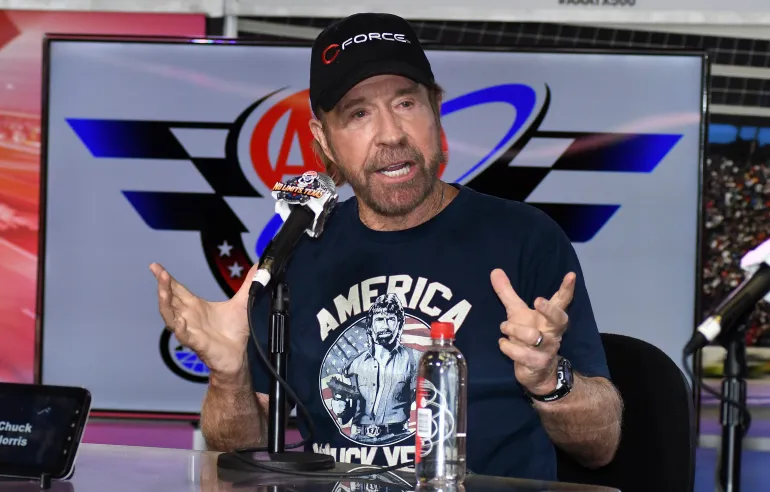
Chuck Norris speaks to reporters before the NASCAR Sprint Cup Series auto race at Texas Motor Speedway in Fort Worth, Texas, on November 6, 2026 [File: Larry Papke/AP Photo]
‘Texas has lost a legend’
Carlos Ray Norris was born on March 10, 1940, in Ryan, Oklahoma, the oldest of three brothers. The family moved to California after his parents divorced.
He described himself as extremely quiet and introverted as a young man, which he attributed to his father’s alcoholism and the family’s poverty.
“In school I was shy and inhibited,” Norris wrote in his 2004 memoir, Against All Odds: My Story. “If the teacher asked me to recite something aloud in front of the class, I would just shake my head no.”
According to Norris, he was also not a natural athlete growing up, and he credited his martial arts career to intense training.
After graduating from school, he enlisted in the US Air Force in 1958. While stationed in South Korea, he learned Tang Soo Do, a form of karate, and other martial arts.
The future film star started teaching martial arts in California after his discharge. Actor Steve McQueen, who was one of Norris’s students, eventually encouraged him to try acting.
Tributes poured in following news of his death, including from political figures who shared Norris’s far-right leanings.
“Texas has lost a legend,” Texas Governor Greg Abbott wrote on X, referencing Norris’s work on Walker, Texas Ranger.
“He electrified generations of conservatives. Giving them a passion and voice to fight for the principles that make America the greatest nation on earth.”
Israel’s Prime Minister Benjamin Netanyahu also paid tribute, calling Norris “a great friend of Israel and a close personal friend”.
High-profile stars and artists also mourned Norris’s passing, including several of Norris’s colleagues.
Stallone, for instance, wrote in a statement, “I had a great time working with Chuck. He was All American in every way. Great man and my condolences to his wonderful family.”
Author Stephen King, meanwhile, shared a memory of being thrilled — and scared — by Norris’s performance in the action-horror film Silent Rage.
Walt Disney Co.’s incoming president and chief creative officer, Dana Walden, has unveiled her leadership team, which includes several familiar faces from the company’s film, television and marketing units.
Walden will become Disney’s first woman president on Wednesday. She will report to Josh D’Amaro,who will succeed Bob Iger as Disney’s chief executive, following the company’s annual meeting with shareholders and its high-profile leadership handoff.
Walden’s senior team includes her longtime creative partner, Alan Bergman. As chairman of Disney Entertainment and Studios, Bergman will continue to oversee Disney’s film studios, including production, marketing and distribution.
Bergman also will retain oversight of Disney’s streaming programming in concert with Walden.
Disney executives Joe Earley and Adam Smith were named co-presidents of Disney’s entertainment direct to consumer offerings — Disney+ and Hulu. Both executives will be responsible for strategy and financial performance and report to Walden and Bergman.
Earley and Walden worked together when they were Fox executives; Earley will also serve as head of content strategy.
Smith continues in his role as Disney Entertainment chief product and technology officer. He also will continue to collaborate with ESPN Chairman Jimmy Pitaro on matters related to ESPN and ESPN+.
Debra OConnell will step into a newly-formed role as chairman of Disney Entertainment Television.
She will have a broad TV portfolio that includes ABC Entertainment, Disney-branded cable channels, Hulu Originals as well as programming from National Geographic, 20th Television and 20th Television Animation.
OConnell will continue to oversee ABC News and the ABC-owned television stations, including KABC-TV Channel 7 in Los Angeles.
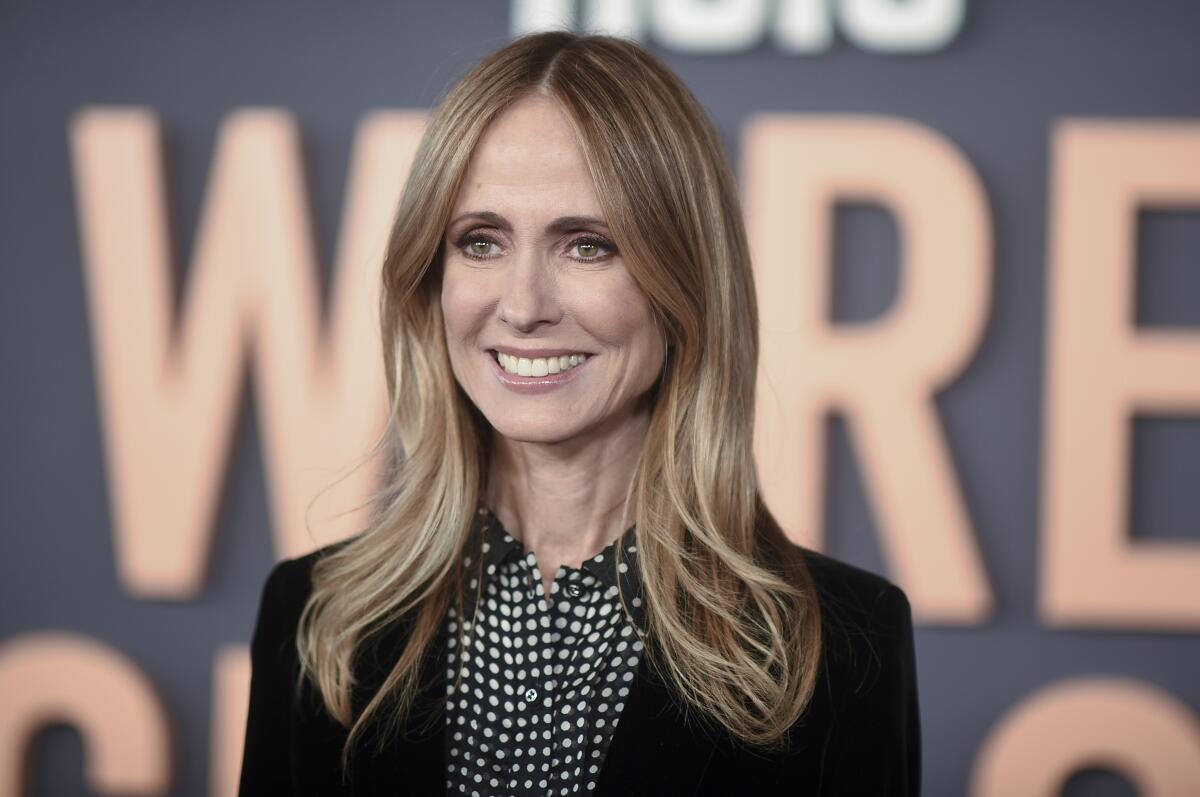
Disney’s incoming president Dana Walden has established her senior leadership team.
(Richard Shotwell/Richard Shotwell/Invision/AP)
Sean Shoptaw, who serves as executive vice president for games and digital entertainment, and his organization, will shift from Disney Experiences and into Walden’s division.
Shoptaw oversees Disney’s games business and its collaboration with Epic Games to develop a Disney universe connected to Fortnite.
John Landgraf remains chairman of FX and will continue to report directly to Walden.
Asad Ayaz, who is chief marketing and brand officer, has an influential remit across Disney’s various business segments. He will report to D’Amaro and Walden.
“The strength of Disney has always been the emotional connection between our stories and the people who love them,” Walden said in a statement. “As fans engage with Disney across more formats and platforms than ever before, we are bringing together the full power of our creative businesses to build an even more connected experience for audiences.”
One Battle After Another was the big winner of the 98th Academy Awards, taking home six Oscars.
Paul Thomas Anderson’s black comedy about a has-been revolutionary won Best Picture, Best Director, Best Adapted Screenplay, Best Supporting Actor, Best Film Editing, and Best Casting.
Recommended Stories
list of 1 itemend of list
Sinners, which entered the ceremony with a record 16 nominations, was the second-biggest winner of the night, with four awards.
Michael B Jordan earned Best Actor for his leading role, while director Ryan Coogler picked up his first Oscar for Original Screenplay.
In the acting categories, Jessie Buckley won Best Actress for Hamnet, marking her first Academy Award, while Amy Madigan was recognised as Best Supporting Actress for Weapons.
Elsewhere, the South Korean musical fantasy KPop Demon Hunters won two Oscars, while Frankenstein also secured two awards.
Here is the full list of winners:
Best Picture One Battle After Another
Best Actress Jessie Buckley, Hamnet
Best Actor Michael B Jordan, Sinners
Best Supporting Actress Amy Madigan, Weapons
Best Supporting Actor Sean Penn, One Battle After Another
Best director Paul Thomas Anderson, One Battle After Another
Best Original Score Ludwig Göransson, Sinners
Best Animated Film KPop Demon Hunters
Best International Feature Sentimental Value
Best Documentary Feature Mr Nobody Against Putin
Best Casting Cassandra Kulukundis, One Battle After Another
Best Sound Gareth John, Al Nelson, Gwendolyn Yates Whittle, Gary A Rizzo and Juan Peralta, F1
Best Original Screenplay Ryan Coogler, Sinners
Best Adapted Screenplay Paul Thomas Anderson, One Battle After Another
Best Documentary Short All the Empty Rooms
Best Live Action Short Film The Singers and Two People Exchanging Saliva (tie)
Best animated short film The Girl Who Cried Pearls
Best Music (Original Song): EJAE, Mark Sonnenblick, Joong Gyu Kwak, Yu Han Lee, Hee Dong Nam, Jeong Hoon Seo and Teddy Park for Golden, KPop Demon Hunters
Best Film Editing: Andy Jurgensen, One Battle After Another
Best Cinematography: Autumn Durald Arkapaw, Sinners
Best Production Design: Tamara Deverell and Shane Vieau, Frankenstein
Best Costume Design Kate Hawley, Frankenstein
Best Makeup and Hairstyling Mike Hill, Jordan Samuel and Cliona Furey, Frankenstein
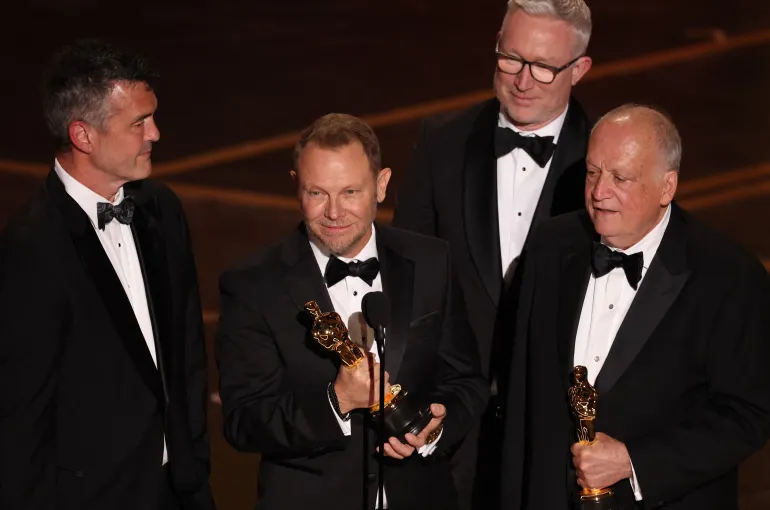
Best Visual Effects Joe Letteri, Richard Baneham, Eric Saindon and Daniel Barrett, Avatar: Fire and Ash
Visual effects supervisor Eric Saindon, visual effects artist Richard Baneham, Daniel Barrett and visual effects supervisor Joe Letteri accept the award for Best Visual Effects for Avatar: Fire and Ash [Patrick T. Fallon/AFP]
As anticipated, it ended up being One Battle After Another’s night at the 98th annual Academy Awards, with the political thriller carting away six Oscars out of a total of 13 nominations.
But while Paul Thomas Anderson’s magnum opus continued its march towards award-season domination, there were moments of genuine surprise and subversion in Sunday’s ceremony.
Recommended Stories
list of 3 itemsend of list
Some of those moments had to do with the current political climate in the United States.
Host Conan O’Brien and his fellow presenters deftly avoided mentioning President Donald Trump by name, but their barbs took direct aim at his policies since returning to office.
Other surprises came from within the filmmaking community itself. For only the seventh time in Oscar history, a tie was announced: Two films had gotten an equal number of votes for Best Live Action Short.
As a result, both the surrealist thriller Two People Exchanging Saliva and the moody bar-room drama The Singers shared the Academy Award.
Here are six key takeaways from the night.
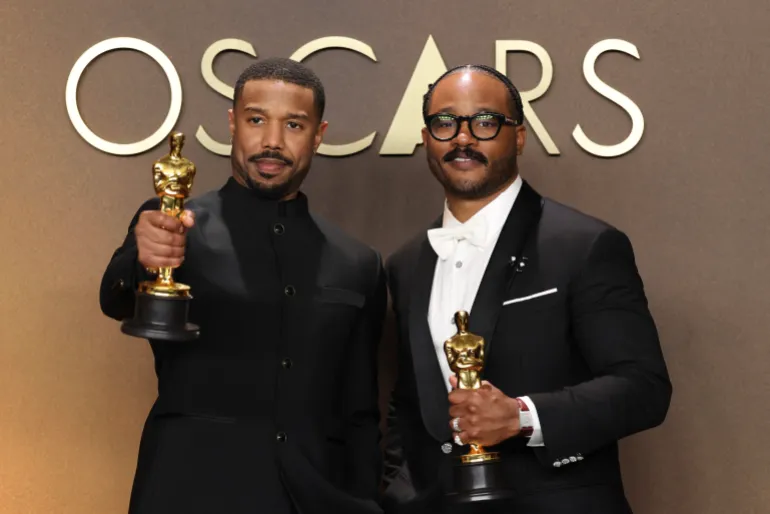
Actor Michael B Jordan holds the Oscar for Best Actor next to director Ryan Coogler, who earned an Oscar for Best Original Screenplay [Valerie Macon/AFP]
A two-horse race between Sinners and One Battle
The vampire film Sinners came into Sunday night’s ceremony with a record 16 Oscar nominations. But the big question of the night was: How many nods could it actually convert into wins?
Its biggest competition was, of course, Anderson’s One Battle After Another, which had the second highest tally of nominations.
Sinners director Ryan Coogler and Anderson were in direct competition in several top categories, including Best Picture and Best Director.
In both cases, Anderson came out ahead, though he acknowledged how fickle such awards can be.
“ I just want to say that, in 1975, the Oscar nominees for Best Picture were Dog Day Afternoon, One Flew Over the Cuckoo’s Nest, Jaws, Nashville and Barry Lyndon,” the four-time Best Director nominee said, listing films now considered to be Hollywood classics.
“There is no best among them. There is just what the mood might be that day.”
In the categories for Best Supporting Actor and Best Film Editing, One Battle After Another also triumphed, as well as for the inaugural award for Best Casting.
But in a sign of how well matched their two films were, both Coogler and Anderson emerged from the night with writing Oscars.
Anderson picked up Best Adapted Screenplay award for his use of the Thomas Pynchon novel Vineland, while Coogler made off with the Best Original Screenplay Oscar for Sinners, a work inspired by his uncle’s love of the blues.
US cinematographer Autumn Durald Arkapaw poses in the press room with her Oscar for Best Cinematography [Valerie Macon/AFP]
Jordan dunks on Chalamet in Best Actor race
Sinners, which won four Academy Awards overall, earned some of the most emotional, nail-biting victories of the night.
In the Best Cinematography category, for instance, Autumn Durald Arkapaw became the first woman to top the field.
It was her first nomination and first win, with Arkapaw besting veteran cinematographers like Marty Supreme’s Darius Khondji and Frankenstein’s Dan Laustsen, both multiple nominees.
Another big win for Sinners came in the form of Michael B Jordan, the actor whom Coogler has cast in every film since his directorial breakout in 2013’s Fruitvale Station.
Jordan, 39, was in a tight race for Best Actor with another young performer, 30-year-old Timothee Chalamet of the 1950s ping-pong drama Marty Supreme.
But Chalamet’s aggressive campaigning may have ultimately sabotaged his prospects. Multiple cracks were taken throughout the night at Chalamet’s recent comments disparaging opera and ballet.
“Nobody cares anymore” about either art form, Chalamet said in an interview last month.
“We can change society through art, through creativity, through theatre and ballet and also cinema,” director Alexandre Singh said pointedly during his acceptance speech for Best Live Action Short.
O’Brien, meanwhile, acknowledged the backlash with a joke about heightened security at the night’s Oscar ceremony.
“I’m told there are concerns about attacks from both the opera and ballet communities,” O’Brien said, before turning to Chalamet. “They’re just mad you left out jazz.”
Irish actress Jessie Buckley celebrates her win during the 98th Annual Academy Awards [AFP]
A conga line of snubs
Given the dominant performances from Sinners and One Battle After Another, plenty of critically acclaimed films left empty-handed, or nearly so.
Guillermo del Toro’s Frankenstein, as expected, earned three wins in technical categories, including Best Production Design, Best Costumes and Best Hairstyling and Makeup.
Netflix’s smash hit KPop Demon Hunters, meanwhile, also fulfilled expectations that it would dominate in its categories, Best Animated Feature and Best Original Song.
But then there were former frontrunners like Hamnet that failed to generate much traction, including for director Chloe Zhao, a past Oscar winner. Out of eight nominations total, it only came away with one win: a Best Actress trophy for Irish performer Jessie Buckley.
Marty Supreme and the Brazilian film The Secret Agent fared worse, however. Despite having nine nominations and being considered an early shoo-in for Best Actor, Marty Supreme scored no wins.
The Secret Agent, which swept the Best Actor and Best Director categories at the 2025 Cannes Film Festival, also earned nothing at this year’s Oscars.
Same was true for the quirky kidnapping drama Bugonia, from Oscar darling Yorgos Lanthimos.
South Korean-US singer Ejae poses with the Oscar for Best Original Song for the film KPop Demon Hunters[Angela Weiss/AFP]
Fears about artificial intelligence
The ceremony, however, did occasionally veer away from the competition between the films to discuss issues facing the film industry and the country as a whole.
Among those was the creeping growth of artificial intelligence (AI) in the creative sector.
In the weeks leading up to the 98th Oscars, an AI-generated video clip had gone viral, appearing to show Hollywood icons Brad Pitt and Tom Cruise in a rooftop brawl worthy of a James Bond movie.
The clip had been generated through AI software developed by the Chinese firm ByteDance, and Hollywood leaders quickly denounced it as a threat to their livelihood, not to mention a copyright infringement.
Those concerns reverberated on the Oscar stage on Sunday, with O’Brien and others addressing the growing use of AI.
“Tonight we are celebrating people, not AI, because animation – it’s more than a prompt,” actor Will Arnett said emphatically as he introduced the animation awards.
O’Brien, meanwhile, joked that, by next year, his hosting gig would be taken by “a Waymo in a tux”.
Host Conan O’Brien performs onstage during the 98th Annual Academy Awards [Patrick T Fallon/AFP]
Trump skewered for threatening free speech
Another concern looming over the night’s Oscar ceremony came in the form of President Donald Trump, who has courted controversy by launching deadly military attacks in Venezuela and Iran, as well as leading a violent immigration crackdown in the US.
At no point was Trump mentioned by name. But his leadership was alluded to throughout the night.
O’Brien, the host, set the tone early on with his oblique jabs at the Republican president in his opening monologue.
“When I hosted last year, Los Angeles was on fire,” the two-time Oscar emcee said in remarks dripping with sarcasm. “But this year, everything’s going great.”
Fellow comedian Jimmy Kimmel was even more direct. Last September, his show was briefly suspended after Trump criticised the comedian.
The head of the Federal Communications Commission, a Trump appointee, subsequently threatened the broadcasting license of the TV channel Kimmel performs on.
“There are some countries whose leaders don’t support free speech. I’m not at liberty to say which. Let’s just leave it at North Korea and CBS,” Kimmel quipped, referring to another channel that cancelled a fellow late-night comedy show.
Several filmmakers honoured at the Oscars likewise waded into the controversies surrounding Trump.
Best Documentary Feature winner David Borenstein, for instance, implied a parallel between his film — an exploration of authoritarianism in Russia — and what is currently happening in the US.
“Mr Nobody against Putin is about how you lose your country,” Borenstein explained.
“What we saw when working with this footage is that you lose it through countless small little acts of complicity: when we act complicit, when a government murders people on the streets of our major cities, when we don’t say anything, when oligarchs take over the media.”
Indian actress Priyanka Chopra and Spanish actor Javier Bardem present the award for Best International Feature Film [Patrick T Fallon/AFP]
Political speeches avoid mention of Iran war
The Oscars come roughly seven months ahead of the pivotal midterm elections in the US, which could see Trump’s Republican Party lose its majorities in Congress.
But while several filmmakers did hint at their anti-Trump stances, few explicitly denounced his policies.
For example, Norway’s Joaquim Trier, the winner of the Best International Feature category, veiled his criticism in a James Baldwin quote about the duty to protect children.
“Let’s not vote for politicians who don’t take this seriously into account,” Trier said.
No artist during the night referenced the US and Israeli war against Iran either, though its effects were felt among the participants of this year’s Oscar crop.
Writer-director Jafar Panahi, whose work was up for two Oscars on Sunday, has already said he plans to return to his native Iran after the awards season concludes.
Meanwhile, Iranian politician Sara Shahverdi — the subject of a nominee in the Best Documentary Short category — was prevented from attending the Oscars at all due to Trump’s ban on visas for 39 countries.
Palestinian actor Motaz Malhees, star of the Oscar nominee The Voice of Hind Rajab, likewise told media outlets he could not be present at the ceremony due to the travel ban.
The most pointed acknowledgements of the US-led and US-backed conflicts in the world were brief. When Spanish actor Javier Barden took the Oscar stage to present an award, he offered up six words, “No to war, and free Palestine!”
Russian filmmaker Pavel Talankin, meanwhile, made a similar appeal to the audience. “In the name of our future, in the name of all of our children, stop all of these wars now,” he said.
But by and large, the Oscar winners and presenters kept their remarks vague, emphasising global unity over political criticism.
“If I can be serious for just a moment, everyone watching right now around the world is all too aware that these are very chaotic, frightening times,” O’Brien told the audience at the outset of the night.
“It is at moments like these that I believe that the Oscars are particularly resonant. Check it out. Thirty-one countries across six continents are represented this evening, and every film we salute is the product of thousands of people speaking different languages.”
Cinema, he and others argued, transcended borders. The talent on stage was not the US’s alone.
The 98th Academy Awards, known as the Oscars, will celebrate some of the top films released in 2025 on Sunday.
The ceremony will take place in Los Angeles with actors, directors and filmmakers from around the world competing for Hollywood’s most prestigious prizes.
Recommended Stories
list of 3 itemsend of list
But this year’s ceremony comes at a time of global tension, with the ongoing war in Iran serving as a sombre backdrop to Hollywood’s annual celebration.
“My job is always to try to walk a very thin line between entertaining people and also acknowledging some of the realities,” host Conan O’Brien said during a Wednesday news conference with the Oscars creative team.
Here is what we know about the upcoming ceremony:
Where will the Oscars be held?
The 98th Academy Awards will take place at the Dolby Theatre at Ovation Hollywood in Los Angeles on March 15.
The ceremony will start at 4pm West Coast time in the United States (23:00 GMT), with official red carpet coverage beginning at 3:30pm (22:30 GMT).
Where can I watch the ceremony?
The 2026 Oscars will be broadcast in the US on the TV channel ABC. Viewers with a cable subscription can also watch online by signing in through the ABC app or ABC.com.
The ceremony will also be streamed live on the video platform Hulu.
Those without traditional cable can access the broadcast through live TV streaming services that carry ABC, including Hulu + Live TV, YouTube TV, AT&T TV and FuboTV.
But the Oscars’ ties with ABC may soon be at an end. Last year, the Academy announced that, beginning in 2029, the Oscars will sever its decades-long relationship with ABC and stream exclusively on YouTube.
The shift to an online-only platform is a big shake-up for the Academy Awards, ending a tradition more than half a century old.
ABC began broadcasting the Oscars in 1976, and before that, it aired on a rival channel, NBC, starting in 1953.
Who is hosting the Academy Awards?
O’Brien is hosting the 98th Academy Awards, marking his second consecutive year emceeing the ceremony.
“This year, I know where the doughnuts are. I know my way around a little bit, and so, I think that’s going to be fun,” Conan said.
In remarks this week, the comedian explained he believes the key to success on the Oscar stage is having a good time and staying in the moment.
He added that he and his writing team are still refining the material ahead of the show, to keep it as current as possible.
“What’s happening in the world will be reflected in the show,” he said.
How can I watch the red carpet?
The Oscars red carpet is broadcast several hours before the ceremony, as filmmakers and other celebrities arrive for the ceremony.
The red carpet has long served as a stage for Hollywood’s best fashions, and actors often pause for interviews with social media and television hosts to discuss the awards and what they’re wearing.
Several shows will broadcast from the red carpet:
The official Oscars red carpet (“On the Red Carpet at the Oscars”): 20:30 GMT, hosted by Tamron Hall and Jesse Palmer
Streaming services: Viewers without cable can watch through platforms that carry ABC, including Hulu + Live TV, YouTube TV, fuboTV and Sling TV.
E! Live from the Red Carpet: 21:00 GMT
Streaming services: The E! network will carry the live coverage, as will the streaming platform Peacock and live TV service providers like Roku, Hulu + Live TV, YouTube TV and more.
British comedian Amelia Dimoldenberg also returns for the third year as the official Oscars social media correspondent.
Who is presenting?
As is tradition, last year’s acting winners will return to present awards at the ceremony. They include Adrien Brody (The Brutalist), Kieran Culkin (A Real Pain), Mikey Madison (Anora) and Zoe Saldana (Emilia Perez).
They will be joined by a wide range of actors and filmmakers presenting throughout the night, including Javier Bardem, Chris Evans, Chase Infiniti, Demi Moore, Kumail Nanjiani, Maya Rudolph, Will Arnett, Priyanka Chopra Jonas, Robert Downey Jr, Anne Hathaway, Paul Mescal, Gwyneth Paltrow, Rose Byrne, Nicole Kidman, Jimmy Kimmel, Delroy Lindo, Ewan McGregor, Wagner Moura, Pedro Pascal, Bill Pullman, Lewis Pullman, Channing Tatum and Sigourney Weaver.
Top row from left: Rose Byrne, Nicole Kidman, Delroy Lindo, Ewan McGregor and Wagner Moura. Bottom row from left: Pedro Pascal, Bill Pullman, Lewis Pullman, Channing Tatum and Sigourney Weaver [AP]
Who is performing at the Oscars?
This year’s show will feature two musical performances tied to the Best Original Song nominees.
Rei Ami, EJAE and Audrey Nuna are set to perform the hit single Golden from the animated film KPop Demon Hunters, and actor Miles Caton will reprise the song he sang in the movie Sinners, called I Lied to You, alongside songwriter Raphael Saadiq.
Like the film itself, the Sinners musical performance at the Oscars will serve as a tribute to Black artistry across generations and genres.
As such, it will include an array of artists, from ballerina Misty Copeland to rocker Brittany Howard to blues and jazz musicians like Eric Gales, Bobby Rush and Alice Smith, among others.
What movies have the most nominations?
Sinners is the most-nominated film in Academy Award history with 16 nominations.
That tally broke the previous record of 14 nominations, which was held by three films: All About Eve (1950), Titanic (1997) and La La Land (2016).
Ryan Coogler’s feature mixes supernatural horror, romance and blues culture. Set in 1932 Clarksdale, Mississippi, the story centres on a community opening a juke joint that soon finds itself under siege by vampires.
“I wrote this script for my uncle who passed away 11 years ago,” Ryan Coogler said in an interview with The Associated Press. “I got to imagine that he’s listening to some blues music right now to celebrate.”
One Battle After Another follows with 13 nods at this year’s Oscars, while Frankenstein, Marty Supreme and Sentimental Value each secured nine nominations.
The Academy also continued its tilt towards international films with this year’s lineup of nominees. Every major acting category, for instance, included at least one international nominee.
Is there any Arab representation at this year’s Oscars?
Arab cinema had a strong presence during the awards season. Several films from the region were shortlisted for Best International Feature Film, including:
The Voice of Hind Rajab (Tunisia)
Palestine 36 (Palestine)
All That’s Left of You (Jordan)
The President’s Cake (Iraq)
One of them, The Voice of Hind Rajab, ultimately secured an Oscar nomination, marking a significant moment for Arab cinema.
Actors Nesbat Serhan, Motaz Malhees, Saja Kilani and Clara Khoury play first responders from the film The Voice of Hind Rajab [CineCanibal/AP]
What is the Voice of Hind Rajab?
The Voice of Hind Rajab is a 2025 docudrama directed by Kaouther Ben Hania.
It dramatises the final hours in the life of five-year-old Palestinian girl Hind Rajab, who was killed by Israeli forces in Gaza in 2024. But the film weaves in real-life recordings of Rajab’s desperate phone calls to emergency personnel from the Red Crescent group.
“The arrival of Hind Rajab’s voice to these platforms — and its ability to break through the indifference that exists there — is in itself something extremely valuable,” Gaza-based filmmaker Mohammed al-Sawwaf told Al Jazeera’s journalist Maram Humaid.
To al-Sawwaf, the film’s Oscar nomination means that Rajab’s death is no longer a passing news item or a single tally in a growing death toll. It is a cultural event, a memorial that forces viewers to confront the horrors facing Gaza’s young children.
“A story of a human being from Gaza has been presented as the story of a person with a life and meaning, rather than the image of a Palestinian appearing as a number on news screens,” he said.
“Palestinians have tried for many years to tell their stories and to be visible, but they were often met with rejection, doubt, or barriers placed in front of them.”
Al-Sawwaf believes Hind Rajab’s story can help illuminate the humanitarian crisis facing thousands of other Palestinians suffering in Gaza.
“A story like Hind Rajab’s represents a symbol of thousands of other stories,” he said. “There are thousands of women and men who had full lives, details, and dreams that are no less human than hers.”
Why was an Iranian film submitted by France?
It Was Just an Accident, directed by Iranian filmmaker Jafar Panahi, is also among the nominees on Sunday night, competing in two categories: Best International Film and Best Original Screenplay.
Though It Was Just an Accident was a co-production from several countries, France ultimately submitted the film as its entry in the Best International Feature competition.
Panahi’s work is often critical of the Iranian government, and in the past, he faced prison time and a ban on his filmmaking as a result. It was not considered as Iran’s entry.
France instead has championed the film as evidence that the country is a safe haven for “singular and courageous cinema”.
But Panahi said his thoughts remain focused on those back home in Iran.
“I am constantly thinking about them,” he told Bloomberg from New York, four days after the US and Israel launched their offensive against Iran.
Panahi shot the film clandestinely in Iran without government approval.
What are the best picture nominees?
Ten films are in competition in the Best Picture category:
Bugonia: A science-fiction story about two men who kidnap a powerful executive, believing she is an alien threatening Earth.
F1: A sports drama starring Brad Pitt as a veteran Formula One driver who returns to racing to mentor a promising young teammate.
Frankenstein: Guillermo del Toro’s adaptation of Mary Shelley’s novel, following scientist Victor Frankenstein and the tragic creature he brings to life.
Hamnet: A historical drama focusing on the grief of Agnes and William Shakespeare following the death of their 11-year-old son, Hamnet.
Marty Supreme: A sports drama starring Timothee Chalamet as an ambitious table tennis player determined to prove he is the greatest at his sport.
One Battle After Another: A dark action-comedy directed by Paul Thomas Anderson, following a father and daughter on the run from a racist military leader intent on tracking them down.
The Secret Agent: A political thriller about a widowed college professor on the run from a vengeful government minister during Brazil’s dictatorship in the 1970s.
Sentimental Value: A drama exploring grief, memory and complicated relationships in a family of artists in modern-day Oslo.
Sinners: A supernatural thriller about twin brothers who return to their hometown to found a juke joint, only to be confronted by past relationships, racism and a gang of vampires.
Train Dreams: A portrait of a railroad worker on the Idaho frontier at the start of the 20th century, questioning whether his past decisions may have doomed him to a life of heartbreak.
Who are the nominees for the Best Director category?
Chloe Zhao for Hamnet
Josh Safdie for Marty Supreme
Paul Thomas Anderson for One Battle After Another
Joachim Trier for Sentimental Value
Ryan Coogler for Sinners
Joachim Trier, Josh Safdie, Chloe Zhao, Ryan Coogler and Paul Thomas Anderson are in competition in the Best Director category [Mike Blake, Benoit Tessier, Mario Anzuoni, Mario Anzuoni and Mario Anzuoni/Reuters]
Who are the nominees for best actor?
Timothee Chalamet for Marty Supreme
Leonardo DiCaprio for One Battle After Another
Ethan Hawke for Blue Moon
Michael B Jordan for Sinners
Wagner Moura for The Secret Agent
Ethan Hawke, Leonardo DiCaprio, Michael B Jordan, Wagner Moura and Timothee Chalamet face off in the Best Actor category [Mario Anzuoni, Daniel Cole, Mario Anzuoni, Mike Blake and Daniel Cole/Reuters]
Who are the nominees for Best Actress?
Jessie Buckley for Hamnet
Rose Byrne for If I Had Legs I’d Kick You
Kate Hudson for Song Sung Blue
Renate Reinsve for Sentimental Value
Emma Stone for Bugonia
Rose Byrne, Emma Stone, Jessie Buckley, Renate Reinsve and Kate Hudson have been honoured as Best Actress nominees [Daniel Cole, Mario Anzuoni, Daniel Cole, Mike Blake and Daniel Cole/Reuters]
What are the biggest surprises and snubs?
This year’s nominations included several unexpected picks and notable omissions.
Among the biggest surprises was Delroy Lindo’s first-ever Oscar nomination for his supporting role in Sinners, a recognition many felt was long overdue.
“The best part of this process has been that people are so genuinely happy for me,” Lindo, 73, told The New York Times.
“It’s not an ego thing. It’s nothing to do with that. It has everything to do with affirmation.”
Another unexpected nod came in the Best Picture category for the racing drama F1, an action-packed summer blockbuster.
In an interview with the racing tournament Formula 1, director Joseph Kosinski explained that the team created an entirely new filming system to capture the kind of visuals he had imagined.
“We had to develop a new camera system, taking everything we learned on Top Gun: Maverick and pushing it much further,” Kosinski said.
Actress Kate Hudson was also a surprise in the highly competitive Best Actress category, earning her first Oscar nod in 25 years for the musical drama Song Sung Blue.
She said the film offered a rare opportunity to portray a mature female character with depth and ambition. Her role is based on the real-life story of Claire Sardina, who performed as part of a Neil Diamond cover band.
“I got to play the comedy, some sense of humour. I got to play the love story, the desire. I got to play being a mother, and then I got to go into a place of where my life force is taken out of me,” Hudson said in an interview with NPR’s Fresh Air with Terry Gross.
Among the most notable snubs was the sequel Wicked: For Good, which received no nominations amid mixed reviews. The first Wicked film earned a whopping 10 nominations last year, winning two Oscars, for Best Costumes and Best Production Design.
Actor Paul Mescal also missed out on a nomination for his performance as William Shakespeare in Hamnet, while director Guillermo del Toro was overlooked in the Best Director category for Frankenstein.
Other notable omissions included Chase Infiniti (One Battle After Another) and Jesse Plemons (Bugonia).
What are the predictions for the winners?
For months, One Battle After Another was considered the clear favourite for Best Picture and Best Director. But in the final stretch of the awards season, the competition has tightened, with Sinners gaining momentum.
Jessie Buckley is widely expected to win Best Actress for Hamnet. Michael B Jordan, meanwhile, is predicted to win Best Actor for Sinners, overtaking stiff competition from Timothee Chalamet, star of the film Marty Supreme.
In the supporting actor categories, Teyana Taylor (One Battle After Another) is considered a strong contender for Best Supporting Actress, and Sean Penn (One Battle After Another) is favoured for Best Supporting Actor.
Irish rapper Liam O’Hanna welcomes ruling in case he says was ‘never about any threat to the public, never about terrorism’.
Published On 11 Mar 202611 Mar 2026
Share
British prosecutors have lost an appeal seeking to reinstate a “terrorism” charge against a member of Irish rap group Kneecap accused of waving a Hezbollah flag during a gig in London.
London’s High Court on Wednesday rejected prosecutors’ attempts to challenge a lower court’s decision to throw out the case against Liam O’Hanna in September due to a technical error.
Recommended Stories
list of 3 itemsend of list
The decision means the case will not proceed. In a statement, the Crown Prosecution Service said the High Court had “clarified how the law applies” to such cases and that it accepted “the judgement and will update our processes accordingly”.
O’Hanna – also known as Liam Og O hAnnaid (his name in Gaeilge, the Irish language) and by the stage name Mo Chara (“My Friend”) – was charged in May of last year with displaying a Hezbollah flag during a November 2024 concert in London, in violation of the United Kingdom’s 2000 Terrorism Act.
Kneecap’s members – who rap in Gaeilge and English and have been outspoken in their condemnation of Israel’s genocide against Palestinians in the Gaza Strip – have called the attempted prosecution a “British state witch-hunt”.
Liam O’Hanna (Liam Og O hAnnaid) welcomed the ruling during a news conference in Belfast, Northern Ireland [Charles McQuillan/Getty Images]
O’Hanna welcomed the ruling on Wednesday, saying during a news conference in Belfast that the case was “never about me, never about any threat to the public and never about terrorism”.
“It was always about Palestine, about what happens if you dare to speak up, about what happens if you can reach large groups of people and expose their hypocrisy, about the lengths Britain will go to cover up Israeli and US war crimes,” he said.
Cheered by supporters at the event, O’Hanna was joined by Kneecap bandmates JJ O Dochartaigh and Naoise O Caireallain – better known by their respective stage names, DJ Provai and Moglai Bap.
“Your own High Court ruled against you,” O’Hanna added, addressing the UK government.
“The pathetic thing about this whole process is that you falsely tried to label me a terrorist when it is the British government ministers that are arming and assisting a genocide in Gaza, the destruction of Lebanon, and the senseless slaughter of schoolkids in Iran.”
PLANS have been revealed to turn an abandoned attraction into a new leisure spot in a popular seaside town.
The Kursaal in Southend-on-Sea has stood empty for six years and during that time has fallen into disrepair.
Sign up for the Travel newsletter
Thank you!
The Kursaal – a historic entertainment venue in Southend-on-Sea will get a new lease of lifeCredit: AlamyStar Amusements, which owns an arcades venue near the pier, will take over the buildingCredit: Alamy
But now, the once thriving attraction that had a circus, arcades, a ballroom, a dining hall and even a zoo, will be transformed into a new leisure destination.
Though the details of what the attraction will be have not been announced yet, Daniel Cowan, Council leader at Southend-on-Sea City Council, said: “The Kursaal is woven into the story of Southend and for too long the Kursaal’s future has been uncertain.
“Today we can say it has a credible local operator, a leisure vision for the building and a clear path to reopening,” reports the BBC.
The Kursaal – which translates to ‘cure hall’ and usually refers to the main hall of a spa town – opened back in 1901 and hosted famous musicians such as Queen, Black Sabbath, Rod Stewart and AC/DC.
Former attractions included bumper cars, a ski jump, a ghost train and a figure-of-eight rollercoaster.
Under the plans to reopen the historic venue that currently sits on the list of neglected sites, essential repairs will be carried out first.
Currently managed by the property group AEW, the Grade-II listed venue’s lease will be handed over to Star Amusements by the end of this summer.
Star Amusements already runs a number of attractions along the seafront, including an arcades venue close to Southend Pier.
Bayo Alaba, the Labour MP for Southend East and Rochford, said that the Kursaal is “a building of historical significance and architecture“.
He added: “Great-grandparents met in the ballroom, children have grown up laughing in its arcades and bowling alleys, and countless memories made here connect generations across our city.”
Nick Singer, the operations director at Star Amusements also shared that the new attraction would be “high quality” and that whilst there is a lot of work to do, they are “ready to move forward”.
When the venue opened over 100 years ago, it was one of the world’s first purpose-built amusement parks.
And to date, several distinctive features remain such as a dome which was even featured on a Royal Mail stamp in 2011.
Between 1919 and 1934, the Kursaal was also home to Southend United F.C.
It is unclear what the building will reopen as but previously the Kursaal had arcades, a bowling alley and a ballroomCredit: AlamyThe Kursaal is about a two-minute walk from Southend-on-Sea’s Golden Mile beachCredit: Alamy
Most of the building was then closed down in 1973, before it fully closed in 1986.
It reopened in 1998 but closed again in 2020, with just a small Tesco Express remaining open on the ground floor.
The Kursaal is about a two-minute walk from Southend-on-Sea’s Golden Mile beach and promenade, where you will find amusement arcades, cafes, and entertainment venues.
Taking to social media, many people have expressed their excitement about the news with one person commenting: “Please have ballroom facilities there to host dance competitions!”
The BBC war drama depicts a fictional nuclear attack on Britain by Russia and its devastating aftermath – and was so disturbing it was banned from broadcast for two decades
The nuclear war drama was deemed ‘too horrifying’ for British viewers(Image: Anadolu, Anadolu via Getty Images)
In the face of escalating conflicts worldwide – from the intensifying US-Israel joint operation against Iran in the Middle East, Israel’s ongoing war on Gaza following Hamas’ October 2023 attack, to the four-year-long Russia-Ukraine war still in progress – it’s no exaggeration to say we’re witnessing a catastrophic level of global unrest.
Amidst this turmoil, the looming threat of nuclear warfare is ever-present. The aftermath of such a conflict would bring about unimaginable destruction and devastation – the fallout is too horrific to contemplate.
This chilling scenario was portrayed in a BBC documentary from 1965, a film so disturbing it was banned from television broadcast for two decades by the British Broadcasting Corporation itself.
At the time, the corporation justified its decision to prohibit the documentary, stating: “The effect of the film has been judged by the BBC to be too horrifying for the medium of broadcasting. It will, however, be shown to invited audiences..”
The controversial pseudo-documentary finally aired in Great Britain on 31 July 1985, twenty years after its initial scheduled screening date of 6 October 1965. This broadcast coincided with the week leading up to the 40th anniversary of the Hiroshima bombing, reports the Express.
The War Game is currently available for free streaming on BBC iPlayer or can be bought for £5.99 on Amazon Prime Video.
Written, directed and produced by Peter Watkins for the BBC, The War Game depicted a fictional nuclear strike on Britain by the Soviets and its devastating consequences.
The docu-film’s official synopsis states: “In this British documentary, a hypothetical Chinese invasion of South Vietnam triggers a new world war between East and West. In the town of Rochester, Kent, the anticipation of a nuclear attack leads to mass evacuations.
When a stray missile actually explodes, the ensuing firestorm blinds all those who see it. It’s not long before the fabric of society is ripped apart owing to radiation poisoning, a lack of infrastructure and rioting for food and other necessities.”
On 13 April 1966, The War Game had its premiere at the National Film Theatre in London, where it screened until 3 May. Barred from broadcast, the 47-minute docu-drama subsequently appeared at numerous international film festivals, including Venice, where it secured the Special Prize.
The recognition continued – the prohibited BBC production went on to claim the Academy Award for Best Documentary Feature in 1967, alongside two BAFTAs for Best Short Film and the UN Award.
Boasting a near-flawless 93% approval rating on review aggregator site Rotten Tomatoes, The War Game has earned widespread acclaim from critics and viewers.
One reviewer commented on the docu-drama: “Nothing that you have heard or read can fully prepare you for Peter Watkins’ 1965 faux documentary on the aftermath of a nuclear attack on Great Britain.”
Another reviewer added: “One of the most disturbing, overwhelming, and downright important films ever produced.”
A third critic described it as essential viewing, noting: “It was produced by the British Broadcasting Corp. but never televised because it was felt its showing would be both horrifying and depressing. It is. It also is realistic, informative and shattering. It is a movie that everyone should see.”
Whilst one critic said: “Still packs a whallop. Will stick with you for life. Don’t say I didn’t warn you,” another commented on the nuclear war drama, “One of the most skillful documentary films ever made.”
Viewer reactions mirror this sentiment, with one audience member writing in an extensive review: “The War Game, although created as a TV movie for the BBC for the 20th anniversary of the bombing of Hiroshima and Nagasaki, is easily the one of the most disturbing movies I have ever seen, on par only with Gus van Sant’s “Elephant. ” It accurately portrays the effects and aftermath of a nuclear attack and uses a handheld documentary style that makes everything chillingly real.
“There were several times during the film when I had to remind myself that Britain had never suffered a nuclear attack and the footage I was looking at was not real. There are very few films that have left me in the state that this one did when it was over. Much like “Schindler’s List” or “American History X,” this is the kind of movie I think everyone should watch because it is so incredibly informative and brings the viewer so much closer to understanding the pain and monstrosity of a nuclear attack.”
Another viewer described it as: “A harrowing punch in the gut that nothing prepared me for. Unforgettable.”
Meanwhile, one audience member remarked about Watkins’ drama: “Really shook me up and left me reeling for a while after seeing it. Peter Watkins ruined my 3 day weekend with this masterfully done piece of film. Needs to be required viewing for every being capable of understanding images and sound.”
The War Game can be streamed free of charge on BBC iPlayer until July 2026, or purchased for £5.99 through Amazon Prime Video.
The critically acclaimed war drama is currently streaming on Amazon Prime and stars an Oscar-winning Hollywood A-lister in a completely unrecognisable avatar.
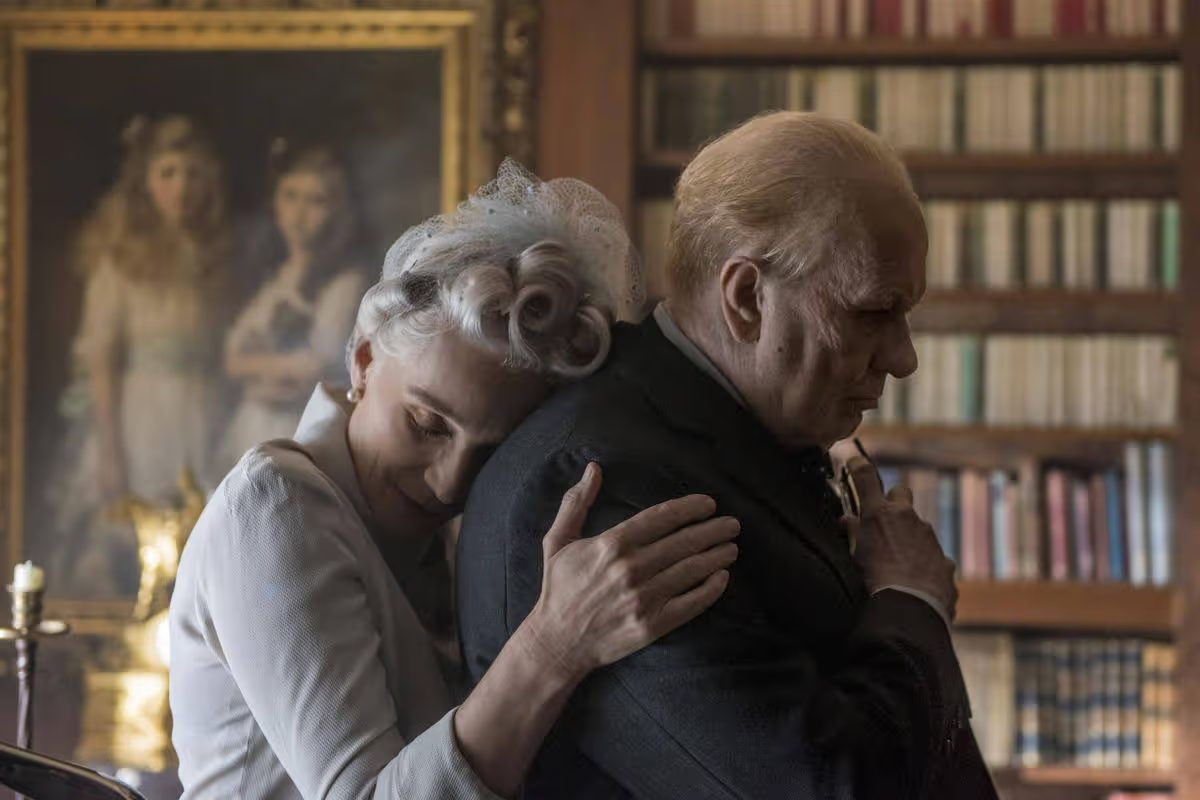
The lead actor has been hailed for their outstanding performance in the film (Image: Focus Features/Dumfries And Galloway Standard)
A compelling wartime period drama has been branded essential viewing by audiences and critics, featuring an exceptionally gifted actor whose portrayal earned him an Academy Award.
Helmed by Joe Wright from a script by Anthony McCarten, this 2017 historical drama chronicles Winston Churchill’s tenure as Prime Minister during the Second World War, specifically focusing on the critical May 1940 war cabinet crisis.
The film takes its name, Darkest Hour, from the phrase used to describe those perilous early war days, when British forces were stranded at Dunkirk, France teetered on the brink of collapse, and impossible odds faced Britain and the Allied Forces. Churchill himself had used the term ‘Darkest Hour’ in his public addresses during that period.
The official synopsis reads: “The fate of Western Europe hangs on Winston Churchill in the early days of World War II. The newly appointed British prime minister must decide whether to negotiate with Hitler or fight on against incredible odds. During the next four weeks in 1940, Churchill cements his legacy as his courageous decisions and leadership help change the course of world history.”
Get Amazon’s Prime Video free for a month
This article contains affiliate links, we will receive a commission on any sales we generate from it. Learn more
TV lovers can get 30 days’ free access to tantalising TV like The Boys, Reacher and Clarkson’s Farm by signing up to Amazon Prime. Just remember to cancel at the end and you won’t be charged.
Gary Oldman takes on the leading role of Winston Churchill, becoming utterly unrecognisable as the British PM through a transformation requiring over three hours daily to achieve, using intricate makeup and delicate prosthetics.
Speaking to ABC News, Oldman revealed of his dramatically transformed look in the film: “It took three hours, 15 minutes and then getting into the costume and everything, it was just under four hours, 48 days consecutively.”
He added: “And then I would be dressed as Winston by the time the director arrived and the other actors for rehearsal. So it was very odd. They did not see me as Gary for three months for the entire shooting because I was always in my makeup.”
Shedding the character at the end of each gruelling day proved equally challenging. The acclaimed actor explained to the publication it was a “very slow process” whereby a special solution was required to dissolve his appearance, resulting in approximately 18-hour working days.
Oldman confessed he genuinely feared he “would not have the stamina” to endure the entire shoot, yet somehow pushed through and “loved every minute of it”.
Raking in $150 million at the global box office against a production budget of $30 million, Darkest Hour proved an undeniable commercial triumph, reports the Express.
Beyond its box office success, Darkest Hour earned widespread critical acclaim, securing six Academy Award nominations including Best Picture, Best Cinematography, Best Makeup and Hairstyling, and Best Actor – the latter of which Oldman triumphantly claimed, along with the Oscar for makeup and hairstyling.
Boasting an impressive 84% critics’ approval rating on Rotten Tomatoes, Darkest Hour received widespread acclaim from reviewers, with one writing: “As a portrait of leadership at its most brilliant, thoughtful and morally courageous, “Darkest Hour” is the movie we need right now.”
Unsurprisingly, Oldman’s portrayal garnered particular praise, with one critic saying: “Oldman brings a wicked wit and compassionate heart to the role, one for which he seems almost superhumanly suited for – and that’s really saying something, consider how many great actors have played Churchill.”
Another impressed reviewer wrote: “It’s an amazing performance: the only star turn I’ve seen in which a famous actor visible in nearly every scene would be unrecognisable if we didn’t know his name already.”
Whilst a fourth critic succinctly said: “Darkest Hour is a one man show for Oldman. And what a show it is.”
Audience responses echoed similar sentiments, with one admirer writing: “A deeply gripping and entertaining vignette of leadership from one of history’s greatest. Superbly well cast and designed. I wasn’t expecting to enjoy it as much as I did. Highly recommended.”
Another viewer said about the film: “One of those films that gives you goosebumps as Churchill bumbles his way into history (again). Oldman is superb as Churchill and the filing is so atmospheric you almost feel as if you’re in the House of Commons or his house with him. Kirsten Scott-Thomas and Lily James along with Ronald Pickup are perfect in their roles. If you’ve ever been in the War Rooms in London you can sense the claustrophobic hive of activity that unbelievably held the British war effort together. A film that I could watch more than once.”
A third admirer added: “Gary Oldman was indeed phenomenal on this one. And even without Gary’s performance, this would still be a worthy watch.”
Darkest Hour is currently available to stream on Amazon Prime Video.
Ensure our latest headlines always appear at the top of your Google Search by making us a Preferred Source. Click here to activate or add us as your Preferred Source in your Google search settings.