LAPD scrambles to find enough officers to police the Olympics
A request from Los Angeles police officials to boost staffing and purchase new vehicles in time for the 2028 Olympic and Paralympic Games has been met with deep skepticism by City Council members who worry about committing funding amid uncertainty around the plan to secure the venues.
During an hours-long budget hearing Tuesday, LAPD Chief Jim McDonnell repeated a warning he has issued in recent months, suggesting that public safety will suffer if the city doesn’t hire more officers to replace the hundreds expected to leave the department in the next two years.
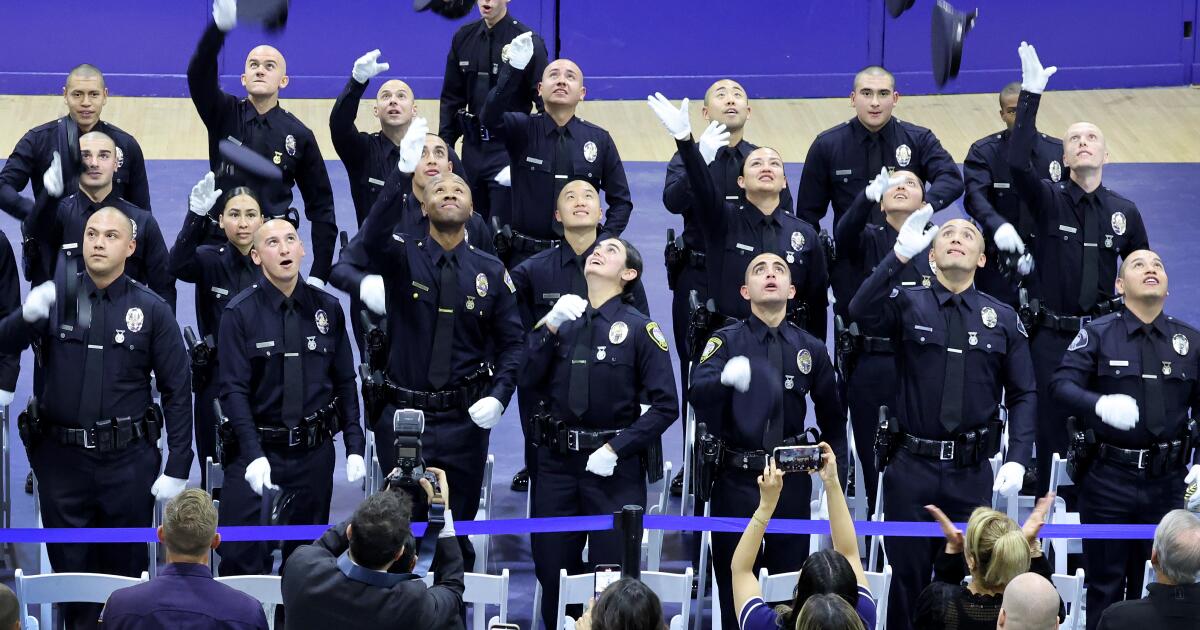
Despite recent recruitment gains, McDonnell said the council needs to fund the new hires now, so the department can staff up in time for the Olympics. Under the current security plan, the LAPD would supply about 2,400 officers, or just under a third of the total officers needed to police the Games.
The LAPD is requesting 520 new police recruits for the next fiscal year, which would grow the 8,600-member department by about 10 officers, with projected attrition at 510 officers.
The department is also requesting nearly $100 million from the city to purchase more than 500 new vehicles, as well as equipment such as an upgraded radio network, new computers and more than 1,600 body cameras, for the Games. LAPD officials said that after the Games, the vehicles would be used to upgrade the department’s aging fleet.
LAPD Cmdr. Mario Mota told council members at the Tuesday hearing that hundreds of the new vehicles would police the eight Olympic venues within city boundaries. The additional patrol cars and other specialized vehicles would also allow police to continue normal operations elsewhere over the 66 days between the July 14 start of the Olympic Games and the end of the Paralympic Games, he said.
LAPD officials said there was a misconception that federal authorities will take the lead on all security operations at Olympic venues. In fact, the federal priority will be safeguarding international delegations and protecting high-security areas, while the LAPD and other state and local agencies will be responsible for securing areas where most Olympic-related events are being held. The LAPD will still respond to 911 calls within city limits.
The U.S. Secret Service has not yet released details on how many federal agents will flood secure zones around venues, which include Los Angeles Memorial Coliseum, Exposition Park and Crypto.com Arena.
Some L.A. officials have expressed growing fears that taxpayers and the city treasury could be hit with a round of crippling costs if the city doesn’t ink a rigorous deal with LA28, the nonprofit that is organizing the Games, to ensure a “zero-cost” event.
The federal government has set aside $1 billion for Olympics security spending, including for local and state law enforcement, but has given few details about when and how it will distribute those funds, amid concerns that President Trump and a Republican-controlled Congress might not follow through with its funding pledge. The exact costs to L.A. and other local governments remain unknown, as officials wait to hear from federal security agencies about what services will be needed.
Police officials previously told the department’s civilian watchdog that the city has to allocate the money to the LAPD before the federal government can say how much it will reimburse.
That uncertainty didn’t sit well with some council members.
“What is LAPD’s role inside the perimeters of the venues?” Councilmember Katy Yaroslavsky, who heads the budget committee, asked at one point during the meeting. “The fact we haven’t nailed this down and it feels like we’re having two conversations — it’s confusing and frustrating.”
Some council members questioned whether the new vehicles in the budget proposal were necessary — and fiscally responsible.
When asked why the department can’t lease squad cars or repurpose existing vehicles, an LAPD official admitted that those options hadn’t been explored — which drew an exasperated response from Councilmember Tim McOsker.
Some of the concerns raised by the City Council echoed activists and other observers, who point to the LAPD’s increased militarization after the 1984 Summer Olympics — when it acquired new equipment that some say was disproportionately used against communities of color in the years that followed.
Security preparations for the Olympics have been ongoing for years. The LAPD has sent delegations to Italy and France to observe security measures in those host nations. But in other ways, progress has been slow. Several months ago, McDonnell quietly replaced the department’s Olympics czar, Cmdr. Hamed Mohammadi, with Deputy Chief Billy Brockway.
“We’re going in the wrong direction as far as personnel,” McDonnell said. In all, police officials estimated that 30,000 law enforcement employees from various state and local agencies will be involved in the security operations.
Mayor Karen Bass, who is running for reelection, once hoped to bring the LAPD back to 9,500 officers — its size when she took office. But amid a continuing budget crunch, she recently said she is more focused on keeping the department from getting smaller.
Overtime for Los Angeles police officers, and any other major expenses, would be acutely felt by a city government that recently closed a nearly $1-billion budget deficit, in part by slowing police hiring. The police union may try to negotiate for bonus, hazard and standby pay for officers who work the Games when their contract expires next June.
The last U.S. host city, Salt Lake City, had a much smaller police department but benefited from an infusion of federal funding and mutual aid agreements with neighboring agencies. Under California law, LAPD officials said, law enforcement agencies can enter mutual aid agreements only after a state of emergency has been declared, such as after a natural disaster.
Several council members asked whether the department has considered lobbying for changing the state law; LAPD officials admitted that they haven’t.
Some on the council also questioned whether the department should be doing more to reassign sworn officers working administrative jobs that could be handled by civilian employees.
Times staff writer James Rainey contributed to this report.