England

Children to be banned from using phones in schools in England by law

The British government said Monday that it will pass legislation to bar smartphones from schools in England amid broader political and societal debate over whether to ban social media for children younger than 16. File photo by Sascha Steinbach/EPA

April 21 (UPI) — The British government announced it will pass legislation to ban children from using smartphones in schools in England.

The plans unveiled Monday in the House of Lords by Baroness Jacqui Smith, the education minister, formalize what is already policy in many schools but introduces a “clear legal requirement” that would empower them to enforce it — including removing phones from children before class.

The proposed amendment to the Labour administration’s Children’s Wellbeing and Schools Bill came after repeated efforts by members of the upper chamber over the past few months to tack on a social media ban for children younger than 16.

Further “ping pong” opposition and blocking, with the Lords repeatedly refusing to pass the legislation and sending it back to the House of Commons, could risk the flagship bill running out of time to become law in the current session of parliament, which is due to end within weeks.

“We recognize the strength of feeling on this issue, both in this House and beyond,” said Baroness Smith.

“Notwithstanding the fact that we think the guidance already in place provides head teachers and schools with a range of approaches to be able to deliver the objective that we all share, we are committing to tabling an amendment in lieu, which will place the existing guidance on a statutory footing in the Bill, creating a clear legal requirement for schools.

“We’ve listened to concerns about how we support headteachers in delivering on this policy and we have listened to parliament,” added Baroness Smith.

The law will only apply to schools in England because education is an area where power is devolved to the parliaments and assemblies of the other countries of the United Kingdom — Scotland, Wales and Northern Ireland.

The move came two months after the Department for Education issued new guidance to schools that they should be phone-free environments, including during lessons, between lessons, breaktimes and at lunch, but stops short of an outright ban, stating only that phones must be off and in a bag or jacket.

Baroness Smith rejected criticism from some Lords that while the government’s proposal removes the “not seen, not heard” policy from guidance to schools — because phones remain a distraction even when off and out of sight — there was confusion with schools assuming the existing policy remains unchanged and “will continue to be the norm in schools.”

“We have now taken that out of the guidance, and we would be willing to consider whether we should be stronger on that. It is a complex area where different schools and different head teachers might have different ways of achieving the outcome, but it is not possible for me to say that it would be impossible [for children to still use their phones],” said Baroness Smith.

Kemi Badenoch, the leader of the opposition Conservative Party opposition, said Tuesday that her party had been battling Prime Minister Keir Starmer for a ban for over a year and that it had only been realized due to the efforts of her education secretary, Laura Trott.

“In March last year, I asked Starmer to ban phones in schools. He dismissed it as ‘completely unnecessary.’ Now it’s the latest Government U-turn. This is a testament to the relentless work of Laura Trott and our shadow cabinet,” Badenoch wrote on X.

“Now, let’s get under-16s off social media,” she added.

In a post online, Laura Trott, credited the efforts of teachers, parents and health professionals for what she said was “the right step for improving behaviour and raising attainment in our classrooms,” but vowed to hold the government to its word on making sure phones were actually banned.

“We’ll push the government to make clear that ‘not seen & not heard’ policies aren’t allowed,” wrote Trott.

Children race to push colored eggs across the grass during the annual Easter Egg Roll event on the South Lawn of the White House in Washington on April 21, 2025. Easter this year takes place on April 5. Photo by Samuel Corum/UPI | License Photo

Source link

I quit England to raise family in Ireland but miss three things about the UK

After eight years of living in London, I made the move back to Ireland shortly after turning 30 when I had to weigh up where was better to raise a family, and below is a glimpse into my experience

The year was 2017, my college (universiaty) exams in Dublin were complete and I had two ambitions — move to London and put my degree to some use by making a living as a journalist.

Part one was straightforward, given my girlfriend had already made the plunge a few months before, and the second part was achieved after I got a job at a local newspaper not too long after touching down in Gatwick.

As for why living in London was so high on my to-do list, I had been going on trips across the Irish Sea since I was a kid, predominantly to watch my childhood heroes like Robbie Keane score at the old White Hart Lane before rushing back to catch a flight to Dublin Airport hours after the final whistle.

So, the dream had been fulfilled and over the years I got a season ticket which took me to Wembley and the plush new Tottenham Hotspur Stadium. When I wasn’t watching Mauricio Pochettino’s men take us agonisingly close to glory, I had become a national reporter.

However, fast forward to 2023, and suddenly the dream wasn’t what it once was.

My partner and I had had our first child — and we were living in a tiny one-bedroom flat in Greenwich, south-east London.

We loved the apartment, it was small, but we had been there for a few years. However, add a baby girl into the mix, and things were suddenly much more challenging.

Our families were both based in Ireland, so we had to make a choice — either pay more to rent somewhere bigger, while also forking out fortunes for childcare in London, or move back to Ireland.

After a memorable few years in London, where we hold so many great memories including one year of raising our daughter there, we had to move home, as so many Irish eventually do after exploring different countries in their youth.

We have now been back for a couple of years, and below are three things that I miss about the UK.

1) Public Transport

My parents live in County Meath and my partner’s parents live in County Cavan — and we now live between both of our childhood homes.

Although having free childcare on hand is a game changer (we have since had kid number two), the main thing we miss about London is the public transport.

Whatever I was doing in London, there were numerous ways I could get home again, be it the underground, the DLR, the bus, the trains or simply walking.

In Ireland, particularly if you are not living in Dublin, driving is essential.

There is no train station near me, and if I didn’t want to get stuck in traffic driving into Dublin City Centre, I would have to rely on Bus Eireann.

I have used the service three times since I’ve been back, on each occasion the bus was over 30 minutes late, and twice there was overcrowding, with some passengers being forced to stand, which was far from safe or comfortable.

Even once you get to Dublin, the public transport is incomparable to London. Frankly, any Londoners who find themselves overly complaining about things like delays or strikes, you have no idea how good you have it.

2) Sporting Events

Another miss is going to sporting events, and I now have to settle with watching Spurs on the TV, although given we now struggle to draw matches let alone win, perhaps that’s not a bad thing.

But it wasn’t just the football, it was the old pubs on Tottenham High Road, and meeting up with pals before and after the games.

Football aside, there was also Wimbledon, where you could just go and enjoy the sunshine and tennis on Henman Hill.

Another big one was martial arts. I remember seeing George Groves in Wembley Arena and also UFC London events at The O2 which was within walking distance of my flat. For years, professional boxing bouts in Ireland didn’t happen, and you may want to read about my experience at the Regency Hotel shooting to understand why.

There is plenty of sport to enjoy in Ireland, and although I’m a casual GAA and rugby fan, there’s still nothing like having Premier League action at your doorstep, and some of my favourite adventures were the away days, be it Arsenal, Fulham or Manchester United.

3) Weather

This isn’t something that can be helped, so there is little point moaning about it for long, but the weather in London compared to home is much different.

London was generally warmer and it rained less, and any rare bit of sun we get in Ireland, you will hear people firing up their lawn mowers, because everyone knows the opportunity to cut the grass is limited.

No regrets

Having said all that, you may be thinking that I regret moving back home, and still pine for my old life in London.

However, this isn’t the case, and the switch has given my family a better quality of life.

My daughter turns three next month and she is thriving — and is close to all of her grandparents who get to see her and her baby brother often. This also gives us a chance to get a break, something that wasn’t possible without family support in London.

We’ve also managed to buy our first home, something that would have been impossible for us in the English capital, where getting on the property ladder wasn’t even worth dreaming about. Having said that, there is also a huge housing crisis in Ireland, and we were one of the lucky ones.

And although I don’t have White Hart Lane on my doorstep, raising a family in Ireland is hard to beat for several reasons which I can get into another day. If we had stayed, we wouldn’t have been able to welcome a second child, who is already being brainwashed into supporting a certain London club like his sister.

Despite my concerns about the public transport and the live sport, life is now calmer. I now do Brazilian Jiu-Jitsu classes three times a week, which has been far better for my mental and physical health than watching the club I love which is destined for the Championship.

And one thing England will never beat Ireland on is a pint of Guinness down the local.

So having said all that — Sláinte!

Source link

Iceland 0-1 England: How Hannah Hampton’s heroics bailed out Lionesses

Hampton’s performance was not a clean one as she fumbled several crosses and was not convincing on set-pieces.

She almost dropped the ball into the path of Sveindis Jonsdottir late on too, but rescued it just in time to spare her blushes.

Hampton’s has been patchy of late for Chelsea, but like all world-class players she delivers when it really matters.

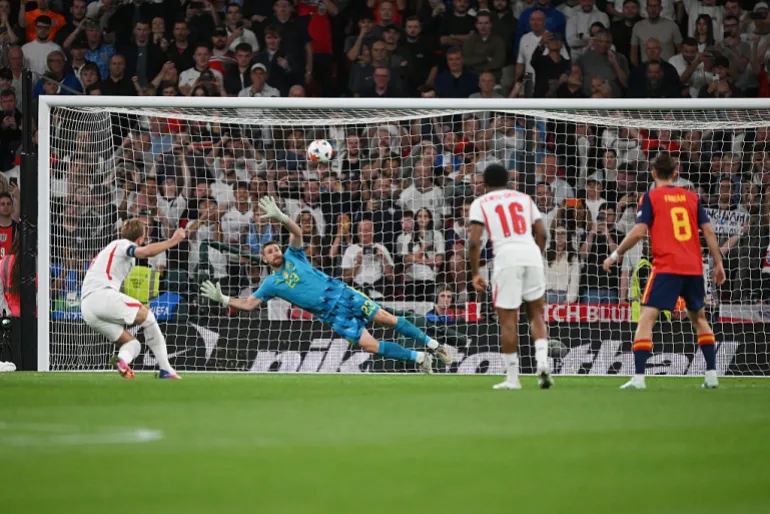
She did it against Spain on Tuesday, as England held on to a significant 1-0 win in part thanks to her acrobatic save, denying Edna Imade late on.

At Wembley, her predecessor Mary Earps was being celebrated for her Lionesses career before kick-off, but Hampton has taken her gloves seamlessly, shining at Euro 2025 and now impressing as England look to seal their spot in next year’s World Cup.

Despite the spotlight, Hampton was humble at full-time in Iceland, joking about the simplicity of the game and her role within it.

“Alessia [Russo] puts the ball in one end and I stop it going in at the other. It’s a simple game when you break it down,” she told BBC Radio 5 Live.

“I am just glad I get to be involved. It means I don’t freeze to death! I’m always willing to put my body on the line.”

But there was no downplaying by England manager Sarina Wiegman, who said Hampton’s saves against Iceland were “crucial” to securing the victory.

“It is always a team effort and a team performance but it’s really nice to have a goalkeeper that stops the ball going in – especially when it’s really hard for the team and they are struggling,” added Wiegman.

“That’s called teamwork. She showed again that she is a world-class goalkeeper.”

Arsenal striker Russo added: “She was amazing. Big moments kept us in it and she showed up three or four times to get us the three points.

“Sometimes you need someone to step up like that.”

Source link

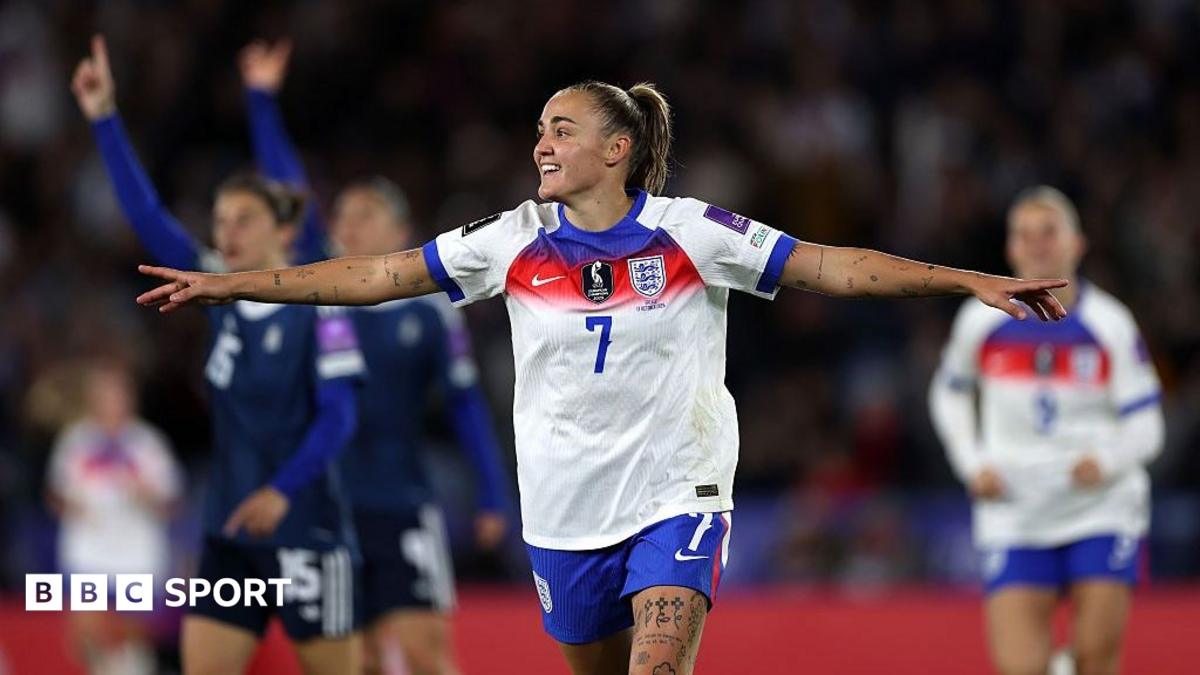
England women play 500th game: Landmark Lionesses moments

England’s Lionesses are no strangers to making history.

The past decade has been rich in landmark moments; a first tournament medal, a first major trophy, and a first title defence – on foreign soil to boot.

When Sarina Wiegman’s side play Iceland in Reykjavik on Saturday (17:30 BST) they will reach another milestone – the 500th fixture for England’s senior women’s team.

The game is important for securing qualification for next year’s World Cup in Brazil, with England keen to win more silverware in the famous white shirt.

But regardless of the result, the match will be etched in history as a reminder of how far the English women’s game has come.

In 1921, the Football Association (FA) banned women’s football, considering the game “most unsuitable for females”, external.

The decision consigned women’s football to park pitches and small venues for half a century before the decision was overturned in 1971.

To mark 500 not out, BBC Sport takes a look at 11 defining moments in the history of England’s women.

Source link

Ashley Cole: ‘Italy made me a manager when England discouraged me’

Arriving at his training session, Cole was all business, talking mostly in English while throwing in Italian phrases.

One local staff member was impressed by his willingness to tidy up the equipment, which he said was uncommon for a player who had enjoyed such a successful playing career.

To Cole, a former schoolboy from east London, that behaviour is normal. Even his new title – ‘Mister’, bestowed on all managers in Italy – is something he is still getting used to.

“I don’t see myself above anyone at this club,” he said. “Of course I have to be the leader of the group, but I’ll pick up a cone.”

Cole had some awareness of what he was arriving into in Emilia‑Romagna – nicknamed Italy’s ‘food valley’ and famous for parmigiano reggiano, balsamic vinegar from Modena and prosciutto di parma – with his wife Sharon Canu an important sounding board.

“I certainly didn’t go looking for an Italian wife [when he joined Roma in 2014], but I came back with one,” he joked.

“Sharon has been great for me. She’s from Rome, but she understands that people in smaller cities really love the club where they live. I have to embrace that.”

One example is Cole’s routine of buying a five euro ‘piadina’ – an Italian flatbread sandwich – from a stall outside Cesena’s stadium before his media conferences. The food stand also regularly feeds the squad after home matches.

In this working‑class town of fewer than 100,000 people, Cole’s side are underdogs in Serie B – something he identifies with.

“I liked that the owners have a similar background to me – hard work, graft, underdogs nobody believed in – but they created a really successful business,” he said.

“They also wanted someone to believe in them and give them a chance.”

Cesena, like most Italian clubs, rent their stadium and training facilities from the local authority, but Cole has innovated where he can.

He created a video analysis room and uses a high-angle tactical camera to film his sessions, which he watches back in full every day.

“I came here thinking something had to change,” Cole said. “We hadn’t won away from home for a long time, so that had to change – it wasn’t working.

“We’d gone a number of games without a win, so that had to change too. We needed higher intensity in training and matches. The style of football had to change.

“We had to be more adaptable to the different styles we come up against, and we needed more control in games through possession.”

In his first media conference, Cole also called out Italy’s failure to qualify for three consecutive World Cups as a sign they needed to be open to new styles of football, which he is implementing before a trip to face Palermo on Saturday.

Source link

England cricket captain Stokes ‘lucky’ to be alive after facial injury | Cricket News

England captain Ben Stokes was struck on the face by a cricket ball, which required surgery for a broken cheekbone.

England Test captain Ben Stokes has said he feels “quite lucky” to be alive as he recovers from surgery after being hit in the face by a cricket ball.

All-rounder Stokes required the procedure after suffering a broken cheekbone sustained by being hit by the ball during a net session while he was coaching academy players at his domestic county side Durham in February.

Recommended Stories

list of 4 itemsend of list

Stokes is set to play in two first-class County Championship games next month, but he revealed the incident could have been so much worse.

“I copped one straight in the face,” the 34-year-old told the England and Wales Cricket Board.

“Pretty nasty but, funnily, probably the best result of a bad situation, to be honest. Just a couple of inches one way or the other, I might not be here doing this interview, if I didn’t turn my head round.

“All things considered, although I had pretty major facial surgery to sort it out – it was a bit of a mess under here (cheekbone), I’ve got out quite lucky. So pretty thankful for that.”

He added: “Obviously it set everything back about a month, five weeks, with getting back to where I wanted to be to play at the start of the season for Durham, but just had to sort of quickly go back to the drawing board and put a plan together to get me ready to play a couple of games for Durham before the Test summer starts.

“At the back end of all that now, but it was a pretty scary situation. Thankfully still here and everything’s all right.”

Stokes is expected to be fit to lead England in the first Test of their home season against New Zealand at Lord’s starting on June 4, as they look to recover from their woeful 4-1 Ashes humiliation in Australia.

Stokes downplays rift with England coach McCullum

Stokes, meanwhile, has played down reports of disagreements with head ⁠coach Brendon McCullum but added that they do have different viewpoints at times.

British media reported that former New Zealand captain McCullum’s relationship with Test ⁠captain Stokes frayed during the Ashes series defeat in Australia, though the duo have publicly backed each other.

“I am very confident in mine and Brendon’s ability to be able to work together, because we’ve done it for ‌such a long period of time now,” Stokes said in an interview with the England and Wales Cricket Board (ECB).

“But we work together in a slightly different way. The main point of me and Brendon is our alignment towards winning things and making this team as good as they can be.”

Since taking charge in 2022, McCullum and Stokes implemented ⁠an ultra-aggressive style of play known as “Bazball”, which has ⁠come under much scrutiny since England’s Ashes defeat, prompting the ECB to launch a thorough review into the team’s preparations.

McCullum was retained as coach.

“Agreeing on every single thing, that’s ⁠just impossible,” Stokes said.

“We agree 95% of the time on things, but those 5% things that we might ⁠have different views on, we talk about it ⁠between each other and then we end up getting to the place where we want to get to.

“We put a lot of our heart and soul into this job. Brendon certainly ‌has for the four years he’s done it so far, and hopefully we’ll still be together at the end of 2027, winning what we want ‌to ‌win.”

England host New Zealand for a three-Test series in June before eight limited-overs matches at home to India.

Source link