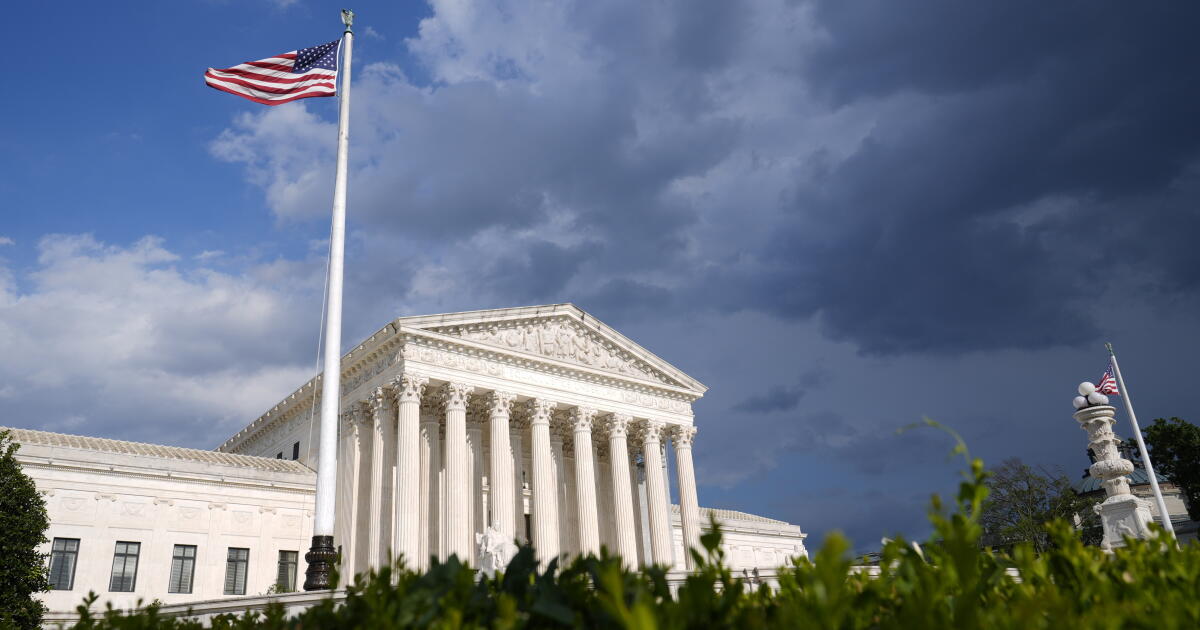
Supreme Court considers whether to bar victims from suing federal agents
WASHINGTON — The Constitution protects the rights of Americans but normally does not allow them to sue federal agents for violating those rights.
This rights vs. remedies dispute has divided the Supreme Court for nearly 50 years.
It did so again Monday when the justices heard arguments on whether to throw out a lawsuit brought by a federal prison inmate in Hawaii who suffered a broken tailbone in a gang fight.
Kekai Watanabe said he told prison nurse Francis Nielsen he was in intense pain. He was given only an over-the-counter pain medication. Seven months later, an X-ray finally revealed the damage from the fracture and the source of his continuing agony.
Acting on his own, Watanabe sued Nielsen for cruel and unusual punishment in violation of the 8th Amendment.
A federal judge dismissed his suit, citing the Supreme Court’s decades of skepticism over such lawsuits. However, the 9th Circuit Court of Appeals revived his claim and pointed to a 1980 ruling that allowed a similar suit brought by a mother whose son died of an asthma attack in a federal prison.
It was the last time the high court had upheld a lawsuit for money damages against a federal agent for violating a constitutional right.
But the Supreme Court agreed to hear an appeal in Nielsen vs. Watanabe. And during Monday’s arguments, the justices debated whether to further narrow such lawsuits or to reject them entirely.
The court’s conservatives say only Congress can authorize lawsuits for money damages against federal agents and employees. And they noted that in the Federal Tort Claims Act, Congress authorized damage suits against the United States for such claims.
“The power to create damages remedies belongs to Congress, not federal courts,” said Lucas Walker, an attorney for the prison nurse. “It’s time to end the Bivens experiment.”
He was referring to a 1971 decision in which the Supreme Court for the first time authorized such a constitutional claim for money damages against federal agent. In that case, known as Bivens, the suit was against several FBI agents for an unreasonable search during a drug raid in violation of the 4th Amendment.
Walker argued the court should overturn the Bivens case as well as the later ruling allowing a suit involving gross medical negligence.
But Joshua Wesneski, an attorney for Watanabe, said the prospect of being sued for wrongdoing “has a powerful deterrent effect.”
This issue has taken on new significance because of the aggressive and sometimes violent actions of federal immigration agents. They may be charged with a crime but they are not subject to being sued for damages by victims or their families.
After the Civil War, Congress passed an enforcement law that authorized suits against state and local officials acting under color of law who violated constitutional rights. But there is no comparably broad law for federal officers and agents.
That’s why a Los Angeles police officer who uses excessive force can be sued in a federal court, but the same is not true of a federal immigration agent.
Democrats in the Senate may try to change that in the year ahead.
Sens. Alex Padilla (D-Calif.) and Richard Blumenthal (D-Conn.) have proposed an “Accountability for Federal Law Enforcement Act” to allow victims to sue for “damages for constitutional and civil rights violations committed by federal law enforcement agents.”
They said Congress needs to extend the same legal accountability to federal agents that has long applied to police and other state and local officials.
“Recent incidents — from violent ICE and CBP raids to abuses by federal task forces — have underscored this gap in accountability,” Padilla said. “These events have eroded public trust and shown how federal officers can act with impunity even when their conduct clearly violates constitutional protections.”