Trump’s plan for rising energy costs: Pump oil, make data centers pay
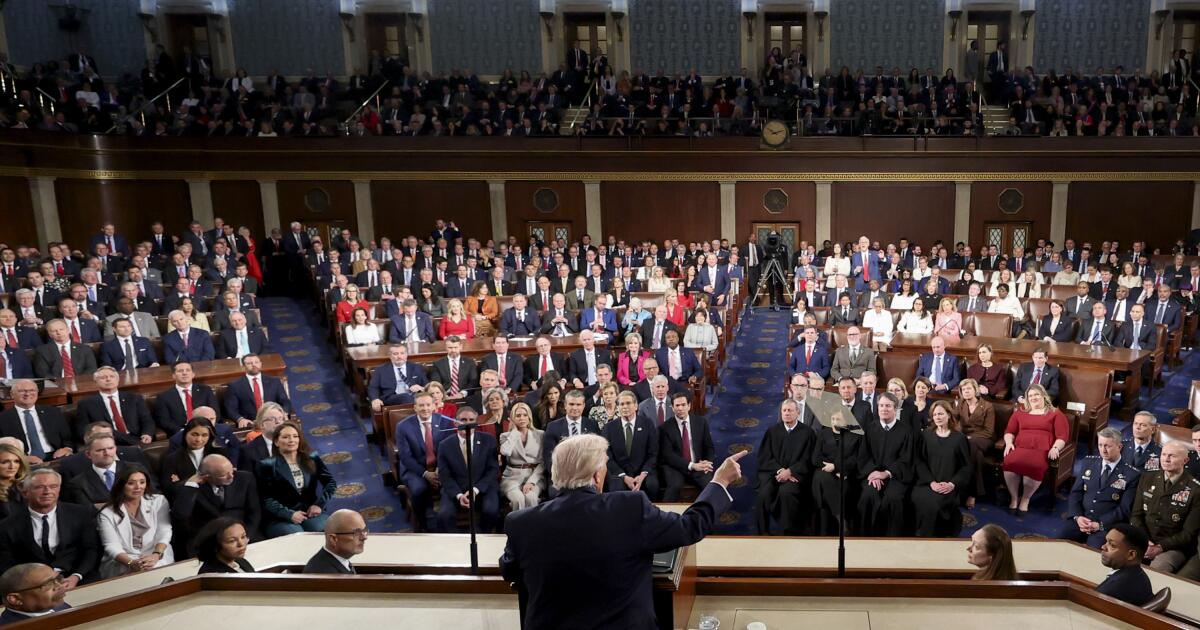
Energy affordability was in the spotlight during President Trump’s lengthy and at times rambling State of the Union address Tuesday evening as the president promised to bring down electricity prices in an effort to assuage voter concerns about rising costs.
The president announced a new “ratepayer protection pledge” to shield residents from higher electricity costs in areas where energy-thirsty artificial intelligence data centers are being built. Trump said major tech companies will “have the obligation to provide for their own power needs” under the plan, though the details of what the pledge actually entails remain vague.
“We have an old grid — it could never handle the kind of numbers, the amount of electricity that’s needed, so I am telling them they can build their own plant,” the president said. “They’re going to produce their own electricity … while at the same time, lowering prices of electricity for you.”
The announcement comes as polling shows Americans are dissatisfied with the economy and concerned about the cost of living. Experts on both sides of the political spectrum have said the energy affordability issue could translate to poor outcomes for Republicans in the midterm elections this November, as it did in a few key races in New Jersey, Virginia and Georgia last year.
While Trump has focused on ramping up domestic production of oil, gas and coal, residential electric bills have been soaring — jumping from 15.9 cents per kilowatt-hour in January 2025 on average to 17.2 cents at the end of December, according to the U.S. Energy Information Administration.
Through one year into his second term as president, Trump has vastly changed the federal landscape when it comes to energy and the environment, reversing many of the efforts made by the Biden administration to prioritize electrification initiatives and investments in renewable energy via the Inflation Reduction Act and Bipartisan Infrastructure Law.
Among several changes, Trump’s administration has slashed funding for solar programs, ended federal tax credits for electric vehicles and canceled grants for offshore wind power — even going so far as to try to halt some such projects that were nearing completion along the East Coast.
Trump has also championed fossil fuel production and on Tuesday doubled down on his “drill baby drill” agenda, touting lower gasoline prices, increased production of American oil and new imports of oil from Venezuela.
Many of the president’s efforts are designed to loosen Biden-era regulations that he has said were burdensome, ideologically motivated and expensive for taxpayers.
Trump has taken direct aim at California, which has long been a leader on the environment. Last year, the president moved to block California’s long-held authority to set stricter tailpipe emission standards than the federal government — an ability that helped the state address historical air quality issues and also underpinned its ambitious ban on the sale of new gas-powered cars in 2035.
Trump also slashed $1.2 billion in federal funding for California’s effort to develop clean hydrogen energy while leaving intact funding for similar projects in states that voted for him. In November, his administration announced that it will open the Pacific Coast to oil drilling for the first time in nearly four decades, a move the state vowed to fight.
But perhaps no issue has come across voters’ kitchen tables more than energy affordability.
So far this term, Trump has canceled or delayed enough projects to power more than 14 million homes, according to a tracker from the nonprofit Climate Power. The group’s senior advisor, Jesse Lee, described the president’s data center announcement as a “toothless, empty promise based on backroom deals with his own billionaire donors.”
“Making it worse, Trump is continuing to block clean-energy production across the board — the only sources that can keep up with demand, ensure utility bills don’t keep skyrocketing, and prevent massive new amounts of pollution,” Lee said in a statement.
Earlier this month, Trump’s Environmental Protection Agency repealed the endangerment finding, the U.S. government’s 2009 affirmation that greenhouse gases are harmful to human health and the environment, in what officials described as the single largest act of deregulation in U.S. history. The finding formed the foundation for much of U.S. climate policy. The EPA also loosened guidelines around emissions from coal power plants, including mercury and other dangerous pollutants.
The president’s environmental record so far is “written in rollbacks that put the interests of some corporate polluters above the health of everyday Americans,” read a statement from Marc Boom, senior director of the Environmental Protection Network, a group composed of more than 750 former EPA staff members and appointees.
Further, Trump has worked to undermine climate science in general, often describing global warming as a “hoax” or a “scam.” During his first year in office, he fired hundreds of scientists working to prepare the National Climate Assessment, laid off staffers at the National Oceanic and Atmospheric Administration and dismantled the National Center for Atmospheric Research, one of the world’s leading climate and weather research institutions, among many other efforts.
In all, the administration has taken or proposed more than 430 actions that threaten the environment, public health and the ability to confront climate change, according to a tracker from the nonprofit Natural Resources Defense Council.
The opposition’s choice for a rebuttal speaker is indicative of how seriously it is taking the issue of energy affordability: Virginia Gov. Abigail Spanberger focused heavily on energy affordability during her campaign against Republican Lt. Gov. Winsome Earle-Sears last year, including vows to expand solar energy projects and technologies such as fusion, geothermal and hydrogen. Virginia is home to more than a third of all data centers worldwide.