Emerges

F/A-XX Next Gen Naval Fighter Concept Video Emerges From Northrop Grumman

On the same day that the Chief of Naval Operations answered our question about the future of the F/A-XX sixth-generation naval fighter program, stating a final selection between the offerings from Boeing and Northrop Grumman will be coming in August, the latter of the two firms has released a new teaser video. Previously, we only had one rendering of Northrop’s notional F/A-XX concept. Now we have a more detailed panning video and a new head-on perspective view.

The video clip, posted on Northrop Grumman’s X account this evening, as seen below, states: “We’re bringing tomorrow’s horizon into focus, faster, stronger, and ready when the warfighter needs it.”

What we see in the clip is the same general design we saw in the still image earlier, but much more of it. This includes a head-on shot, showing the aircraft’s stealthy and efficient tailless design and rear-set dorsal inlets, as well as its very broad nose and canopy.

Northrop Grumman capture

The aircraft in the new stylized video clip has some interesting proportions. The size of the landing gear and especially the canopy give it something of a smaller overall appearance than what one would expect from a heavy sixth-generation naval fighter that will be stuffed with fuel and weapons. Of course, this could be due to the somewhat ‘cartoonish’ nature of this new glitzy clip, and how accurate this rendering is to the actual Northrop Grumman F/A-XX is still unknown. At the very least, some of the aircraft’s features (such as its inlets) will have been significantly changed for security issues pertaining to its sensitive design elements.

We also see the wings, which look like they have a bit of camber on the outer sections and possibly a bit of ‘crank’ too. We also see the wings folded in the first part of the clip.

Screenshot

What could be a weapons bay with its doors open is also visible in some of the angles seen in the clip. At first glance, this appeared to be for the jet’s very stout-looking landing gear, but they are curved inward. There are additional doors on the centerline, as well, pointing to two separate bays.

Overall, because of the size of the canopy, it is hard to tell if this is a single-seat or a two-crew aircraft. The canopy is so large in these renders that a side-by-side crew arrangement may even be possible, although that seems unlikely.

Once again, we don’t know how close this computer-generated model is to the real thing, but considering this aircraft will have to carry a sizable weapons load and have something approaching a combat radius of 1,000-miles, while still fitting well within the confines of a supercarrier, it should be firmly in the heavy fighter class.

Maybe Northrop Grumman will share more on its F/A-XX at the annual Sea-Air-Space convention in Washington this week, and we will be ready to report it from the scene if they do.

We have reached out to Northrop Grumman with questions, and we will update this post if we hear back.

Contact the author: Tyler@twz.com

Tyler’s passion is the study of military technology, strategy, and foreign policy and he has fostered a dominant voice on those topics in the defense media space. He was the creator of the hugely popular defense site Foxtrot Alpha before developing The War Zone.


Source link

Evidence Of Ukraine Using AIM-120C-8 Missiles Emerges

Recently uncovered wreckage of an Advanced Medium-Range Air-to-Air Missile (AMRAAM) reveals that Ukraine is employing the AIM-120C-8 version, a weapon that is close to the ‘top of the line’ for these missiles. Ukraine can employ AMRAAMs of all types from its F-16 fighters, as well as from the ground-based National Advanced Surface-to-Air Missile System (NASAMS) air defense system.

The wreckage of an AIM-120C-8 missile, apparently found in the aftermath of a Russian air attack on Dnipro. via Dnipro Main News/Telegram

A photo showing part of an AMRAAM missile body clearly marked with the AIM-120C-8 designation began to circulate online recently. According to available accounts, the wreckage was found in the aftermath of a Russian air attack on Dnipro in central Ukraine, during which the Ukrainian Armed Forces were active in defense of the city.

Previous imagery of Ukrainian F-16s had confirmed they were using some version of the AIM-120C, which can be identified on account of its cropped fins for internal carriage in the F-22 and F-35. This appears to be the first confirmation that the AIM-120C-8, specifically, has been supplied to Kyiv, in addition to earlier AIM-120A/B versions.

As we’ve discussed in the past, the AIM-120C offers some significant advantages over the earlier AIM-120A/B models.

In general, the ‘Charlie’ version offers a range of advanced capabilities that reflect the continuous development of both this specific sub-variant and the AIM-120 series overall. Even in its earliest sub-generation versions, the C-model features notable upgrades in terms of range, guidance, resistance to countermeasures, and other key areas.

An F-35C launches an AIM-120C AMRAAM from its internal weapons bay over a controlled sea test range in the Pacific Ocean. U.S. Air Force/ Christopher Okula

Successive improvements reportedly introduced on the AIM-120C family include a new WDU-41/B warhead (AIM-120C-4), a new WPU-16/B propulsion section with a larger motor and electronic counter-countermeasures (ECCM) upgrades (AIM-120C-5), and an updated proximity fuze (AIM-120C-6). Meanwhile, the AIM-120C-7 features further improved ECCM, an upgraded seeker, and a longer range.

The exact differences between the AIM-120C-8 and the AIM-120D are somewhat unclear, although the D-model, at least, is understood to feature two-way datalink with third-party targeting capabilities. The AIM-120D may also feature an active electronically scanned array (AESA) seeker, while the C-8 remains a mechanically scanned antenna. There have been previous suggestions that the AIM-120D is reserved for the U.S. military and its closest allies, while other international customers receive the AIM-120C-8.

Maintainers prepare AIM-120D AMRAAMs for carriage by F-15s during an exercise at Kadena Air Base, Japan. U.S. Air Force/Senior Airman Peter Reft

It was an AIM-120D that was used for what the U.S. Air Force described as the “longest known” air-to-air missile shot, during a series of tests in airspace near Eglin Air Force Base, Florida, in the fall of 2024. The launch platform on that occasion was an F-22. This would fit with reports that the D-model features significantly greater range than earlier versions, although, once again, the precise differences between AIM-120C-8 and AIM-120D are unclear.

Both the AIM-120C-8 and the AIM-120D have also been further enhanced under the F3R program, developed for the U.S. Air Force. F3R stands for form, fit, function refresh, and is primarily intended to eke out more performance from the missile, as you can read more about here. It’s not clear if Ukraine’s AIM-120C-8s also benefit from the F3R improvements.

A recent promotional video from Raytheon includes footage of a separation launch of the latest-generation AMRAAM F3R from a U.S. Navy F/A-18F Super Hornet:

Air Dominance With a Digital Edge thumbnail

Air Dominance With a Digital Edge


The plan was for the U.S. Air Force to begin to receive AMRAAMs incorporating F3R starting early 2023, as part of the Lot 33 production run. The U.S. AMRAAM program of record is expected to continue into around 2027 or 2028. As for the AIM-120C-8, these missiles are expected to remain in production for international partners long beyond 2030.

Regardless, the AIM-120C-8 offers Ukraine a notably long-range weapon.

While official performance figures are classified, it is generally assumed to be able to hit targets at a distance of between 75 and 100 miles. Of course, in practical applications, a whole range of factors impact a missile’s reach, above all, the energy and altitude state of the launching aircraft and the target.

In an air-to-air context, the weapon goes some way toward closing the gap with Russia’s R-37M missile, known to NATO as the AA-13 Axehead. According to the manufacturer, at least in its export form, the R-37M can defeat “some types” of aerial targets at a range of up to 124 miles. This likely refers to only larger, less agile, aircraft targets and is very much a “sales brochure figure,” with all the caveats that entails.

A Russian Aerospace Forces Su-35S fires an R-37M missile during a weapons test. Russian Ministry of Defense screencap

At this stage, we don’t know for sure whether the wreckage in Dnipro came from an air-launched AMRAAM, i.e., fired by an F-16, or if it was an effector from a ground-based NASAMS.

In the case of the F-16, the importance of the AMRAAM cannot be overstated. This was the first active-radar-guided air-to-air missile to be fielded by Ukraine. This is a class of weapons that the Ukrainian Air Force long campaigned for. One of its fighter pilots, the late Andrii Pilshchykov, better known by his callsign “Juice,” told TWZ back in 2022: “The lack of fire and forget missiles is the greatest problem for us.”

More recently, Ukrainian F-16s have had to rely more heavily on AMRAAMs. Earlier this year, reports emerged indicating that Ukraine had been left late last year with only “a handful” of U.S.-made AIM-9 Sidewinder air-to-air missiles for its F-16s, after the supply of these short-range weapons dried up.

A U.S. Air Force F-16C armed with AIM-120C AMRAAM, AIM-9L/M Sidewinder, and AGM-88 HARM missiles. U.S. Air Force

This left the F-16 pilots with AMRAAMs plus the jet’s internal 20mm M61 Vulcan cannon.

As we have discussed many times before, taking out slow-moving drones via another fixed-wing aircraft with guns can be very challenging and downright dangerous, especially for fast jets. AMRAAMs can be employed against drones and cruise missiles, too, but are more expensive weapons than the Sidewinders. Each AMRAAM costs around one million dollars.

An earlier view of a Ukrainian F-16 carrying AIM-120 AMRAAM and AIM-9L/M missiles, underwing fuel tanks, plus the Terma pylons with integrated self-defense systems. The AMRAAMs have uncropped fins, so they are AIM-120A/B versions. Ukrainian Air Force

To help plug the gap, Ukrainian F-16s have begun using laser-guided 70mm Advanced Precision Kill Weapon System II (APKWS II) rockets. These rockets provide an extremely valuable, lower-cost option for engaging long-range kamikaze drones and subsonic cruise missiles. U.S. Air Force F-16s began using them in combat last year, as we were first to report.

A photo showing one of Ukraine’s F-16s apparently carrying a pair of LAU-131/A seven-shot 70mm rocket pods loaded with APKWS II rockets. via Avia OFN/Telegram

While somewhat less likely, there’s also a possibility that the Dnipro wreckage came from an AIM-120C-8 fired by a NASAMS.

Deliveries of the first two Ukrainian NASAMS batteries were expedited after Russia’s large-scale missile and drone assault on major population centers in Ukraine in late 2022.

A video showing the Ukrainian NASAMS in action:

Привітання до Дня Повітряних Сил ЗС України 2023 thumbnail

Привітання до Дня Повітряних Сил ЗС України 2023


As we explored at the time, a critical advantage of NASAMS is the fact that it fires the exact same missiles used in air-to-air applications. It does not require a special AMRAAM variant or major modifications to existing missiles. In addition, it can fire other types of effectors, including the AMRAAM-ER, which is a hybrid of the AIM-120 and the RIM-162 Evolved Sea Sparrow Missile (ESSM), and the infrared-homing AIM-9X Sidewinder and IRIS-T missiles

It might be expected that Ukrainian NASAMS is being fed with older AIM-120A/Bs, which, in the ground-launched application, are capable of engaging targets from relatively close ranges to up to roughly 20 miles away and from around 1,000 feet to 50,000 feet. These targets include everything from cruise missiles — which it is very good at engaging — to crewed aircraft and drones.

Soldiers load AIM-120s training rounds into a NASAMS launcher. Public Domain

Another major factor behind the appearance of the AIM-120C-8 wreckage could be the indication that stocks of older (AIM-120A/B and earlier C-version) missiles have been depleted, leading to the inclusion of higher-end C variants. If so, this would increase the pressure on at least some of the foreign partners who are supporting Ukraine with weapons, particularly given the global imbalance between the supply and demand for munitions. The conflict in Iran is likely to intensify this strain, as the United States is reportedly delaying deliveries to customers to prioritize replenishing its own inventories.

As it stands, we now have confirmation that Ukraine is using what is almost certainly the most advanced and capable version of the AMRAAM that is available to all but the very closest U.S. military allies. As such, it should provide Ukraine with a particularly powerful tool in its ongoing battle against Russian air attacks.

Contact the author: thomas@thewarzone.com

Thomas is a defense writer and editor with over 20 years of experience covering military aerospace topics and conflicts. He’s written a number of books, edited many more, and has contributed to many of the world’s leading aviation publications. Before joining The War Zone in 2020, he was the editor of AirForces Monthly.


Source link

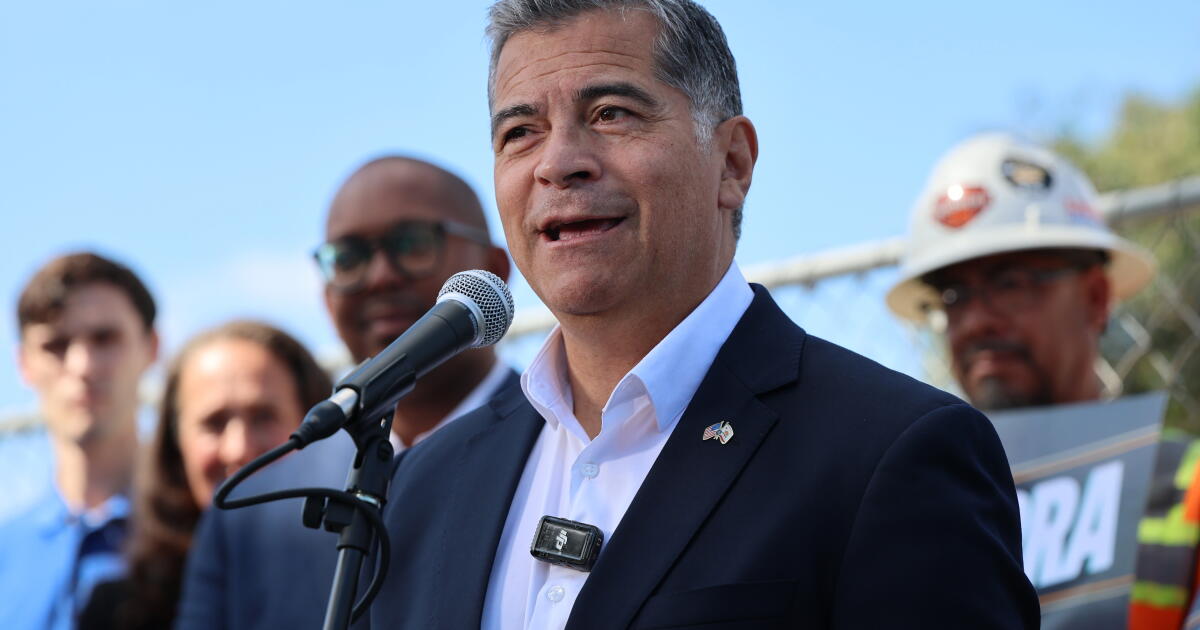
Column: After Swalwell scandal, a ‘safe choice’ for Democrats emerges

Xavier Becerra seems like the type of steady, trustworthy fellow you’d like your daughter to marry. But she’s attracted to a charming party animal.

Then the flashy dude does something really stupid and repulsive. Daughter is jarred into her senses and decides to size up the unexciting but reliable guy.

That’s how I’m seeing the suddenly captivating contest to succeed termed-out Gov. Gavin Newsom.

OK, it’s not a perfect analogy. Becerra is 68, been happily married for 37 years and the couple have three grown children. But the principle’s the same: He’s the safe choice. The hot other character merely fooled lots of people for a while.

You’re reading the L.A. Times Politics newsletter

George Skelton and Michael Wilner cover the insights, legislation, players and politics you need to know. In your inbox Monday and Thursday mornings.

Becerra is suddenly getting a hard look because the fast-stepping, front-running Democrat Eric Swalwell revealed himself to be totally unworthy of public office.

Five women accused the married Bay Area congressman of sexual misconduct, including rape. He denied the allegations but apologized to his wife for past “mistakes in judgment.” Donors, endorsers, staffers and voters immediately fled his campaign. And he quickly slunk away.

And Becerra surged.

Why?

“People are looking for something stable,” Becerra answered when I asked. “Everybody likes pizzazz and glitter. Then all of a sudden their hero falls from grace. And they look for who they can trust.”

Dan Schnur, who teaches political communications at USC, UC Berkeley and Pepperdine, says: “Democrats had a near-death experience with Swalwell. They don’t seem to be in the mood to take more risks.”

Schnur calls Becerra “this year’s version of Joe Biden’s 2020 campaign.” He’s the safe choice. “Sometimes being ‘none of the above’ is good enough.”

Since Swalwell’s collapse, the once-floundering Becerra has had a meteoric rise in the polls.

A survey conducted for the state Democratic Party showed Becerra rising by 10 points from single digits to tying Tom Steyer, a billionaire hedge fund founder turned climate warrior. Close behind was former Orange County Rep. Katie Porter.

Those three are now the leading Democratic competitors for a slot on the November ballot. The top two vote-getters in the June 2 primary, regardless of party, will advance to the general election.

Republican former Fox News host Steve Hilton was leading the entire field in the poll, followed closely by Riverside County Sheriff Chad Bianco.

Steyer and Porter are both liberals in their ideology and personalities. Neither are flamethrowers, but they‘re fiery. In contrast, Becerra also is an ideological liberal, but with a low-key demeanor that might cause one to mistake him for a political moderate.

San José Mayor Matt Mahan is clearly a Democratic centrist. But in this era of intense polarization, moderation may be a hard sale. At least, it has been so far for Mahan.

Among those six Democratic and Republican candidates, Becerra boasts by far the most outstanding political resume.

He was U.S. secretary of Health and Human Services under President Biden. Before that as state attorney general, California’s mild-mannered “top cop” showed his aggressiveness by suing the first Trump administration 123 times and winning the vast majority of cases. He also served 12 terms in Congress from Los Angeles and became part of the Democratic leadership. And he served one term in the state Assembly.

That’s an impressive list. But Schnur says Becerra was “the least impressive” candidate in a 90-minute televised debate last week.

“He talked in very vague generalities,” the former political operative says, but adds: “In the middle of the other candidates’ drama and emotional outbursts, he seemed very calm and safe.”

Some pundits and pols have been calling on Becerra to show more fire. But that’s not him. He’s guarded and understated. It’s how he’s wired. If he attempted a personality change, it probably wouldn’t work. There’s a risk of it seeming contrived and phony.

But Becerra should be more specific on issues. Exactly how would he make life better for Californians?

His basic answer when asked how he’d solve a given problem pestering California is essentially: Trust me. I’ll meet with all sides and figure it out.

That’s not just a cop-out. It’s his pragmatic modus operandi.

That reserved style prompted this shot during the debate from Porter, who tends toward specificity:

“Mr. Becerra, you have all these lovely plans. But there are never any numbers, any revenue plan, any details. … The how, the why and how much, it’s all missing.”

Becerra responded with some rare emotion: “That’s very rich to hear from someone who’s never had to actually run a government.” The former Cabinet secretary said he’d balanced four federal HHS budgets that were larger than the California state budget.

I asked Becerra about some issues last week. Here’s partly what he said:

Housing costs: Expedite building by streamlining more regulations. “We’ll continue to have rules, but let’s make them smart rules.”

Gas prices: Keep more refineries from closing. “Let them know they can operate and produce and not lose money. That’s an easy one.”

High-speed rail: ”We’re going to build the bullet train, but not this bullet train. It’s too expensive. Sit everybody down and come out with a position.”

Banning new gas cars by 2035: Is Newsom’s goal realistic? “Seeing what I see, no. We can’t make it by ‘35, but we can make it.”

But let’s be honest. Elections usually turn more on likability than policy positions.

“Decency may be a quality that goes a long way” in the governor’s race, says longtime Democratic strategist Darry Sragow. “In part that’s because of the Swalwell revelations and also because of Trump, who’s not decent. Decency may be what people are looking for.”

But Democrats are riled up by Trump and they’re also demanding backbone and fight.

Many are eyeing Becerra as someone perhaps worth partnering up with. A bit more passion from him could help sustain their interest.

What else you should be reading

The must-read: The congressional landmine stirring fears about the midterm election — and a Trump power grab
Brace yourself: Voter ID controversy headed for California with initiative on November ballot
The L.A. Times Special: How a Trump-endorsed Republican could become California’s next governor

Until next week,
George Skelton


Was this newsletter forwarded to you? Sign up here to get it in your inbox.

Source link

As oil prices plunge below $91 after weeks, a new Hormuz crisis emerges | Oil and Gas News

Brent crude falls more than 9 percent after Iran said it will reopen the strategic waterway, only to shut it down again over US blockade of its ports.

Oil prices have plummeted to their lowest point in weeks after Iran said the Strait of Hormuz was open for passage during a ceasefire in Lebanon, and United States President Donald Trump said he expected to ⁠reach a deal to end the war soon.

Brent crude, the international benchmark, fell more than 9 percent to $90.38 a barrel on Friday, taking it below $91 for the first time since March 10.

Recommended Stories

list of 4 itemsend of list

The plunge came after Iranian Foreign Minister Abbas Araghchi said the strait was “completely open” and would remain so for the duration of the 10-day ceasefire between Israel and Lebanon, which took effect on Friday.

Hailing Tehran’s announcement, Trump declared the waterway “ready for business and full passage,” but said the US Navy’s blockade of Iranian ports would remain in “full force” until the sides reached a peace deal.

On Saturday, however, Iran rowed back on its decision to reopen the Strait of Hormuz, warning that it would continue to block transit through the key waterway as long as the US blockade of Iranian ports remained in effect.

The announcement came after Trump said the blockade “will remain in full force” until Tehran reaches a deal with the US, including on its nuclear programme.

Roughly one-fifth of the world’s oil passes through Hormuz and further limits would squeeze already constrained supply, driving prices higher once again.

Amid the escalation, Pakistani officials say they are trying for more talks between the US and Iran ahead of the April 22 ceasefire deadline.

Meanwhile, ship tracking data displayed by MarineTraffic earlier on Saturday showed a significant uptick in vessels crossing the strait, which is located between Iran, the United Arab Emirates and Oman.

“It’s busy out there, the busiest I’ve seen it since the Strait of Hormuz was effectively closed at the beginning of the war,” Michelle Wiese Bockmann, an analyst at maritime intelligence firm Windward, said in a post on X.

“Last night there were few ships taking the risk but overnight there seems to have been a change.”

While Iran allowed a limited number of vetted ships to transit the waterway since the start of the war, traffic has remained at a trickle compared with pre-conflict levels.

The near-total closure of the strait has triggered one of the worst energy shocks in history, driving up fuel prices and prompting governments to roll out emergency measures.

Oil prices have swung wildly since the US and Israel launched strikes on Iran on February 28, hitting a post-conflict peak of $119 a barrel on March 19.

Source link

Pope Leo Emerges as a Forceful Global Voice, Clashing with Trump

Pope Leo XIV has stepped into a more assertive global role, adopting a sharper and more direct tone on international issues during his recent Africa tour. After maintaining a relatively cautious profile in the early months of his papacy, Leo has begun openly criticising war, inequality, and global power imbalances. His remarks have drawn repeated criticism from Donald Trump, particularly over his condemnation of the U.S.-Israeli war involving Iran.

Shift in Tone and Leadership Style:
Leo’s recent speeches mark a clear departure from traditional Vatican restraint. Speaking in African देशों such as Cameroon and Algeria, he has issued strong warnings about global injustice, accusing powerful actors of undermining peace and violating international norms. This more confrontational approach reflects a deliberate effort to position the papacy as an active moral voice in global affairs.

Clash with Political Power:
The pope’s remarks have brought him into direct conflict with Trump, who has publicly criticised Leo’s views on foreign policy. This exchange underscores a broader tension between moral authority and political leadership, particularly as the pope challenges the conduct of powerful nations in ongoing conflicts.

Moral Authority on the Global Stage:
Observers suggest Leo is consciously embracing a more visible and influential role, using his platform to highlight the human cost of war and inequality. His decision to deliver strong messages while visiting regions affected by poverty and conflict adds weight and immediacy to his statements, reinforcing his image as a global moral leader.

Breaking with Vatican Convention:
Traditionally, the Vatican has balanced moral advocacy with diplomatic neutrality to preserve its role as a mediator. Leo’s more direct criticism signals a shift in that balance, prioritising clarity and urgency over cautious diplomacy. This approach echoes, but may exceed, the tone of predecessors such as Pope Francis, who also spoke out on global injustices but often with more measured language.

Personal Experience and Perspective:
Before becoming pope, Leo formerly Robert Prevost spent decades in Peru, where he witnessed conflict, poverty, and political instability firsthand. These experiences appear to inform his willingness to speak bluntly about violence, corruption, and the failures of global leadership.

Analysis:
Pope Leo’s emergence as a more forceful voice reflects a strategic and moral recalibration of the papacy’s role in global politics. By speaking more directly, he aims to assert the Church’s relevance in an increasingly volatile world, particularly at a time when traditional diplomatic mechanisms appear strained.

However, this approach carries risks. Greater outspokenness may enhance moral clarity but could also limit the Vatican’s ability to act as a neutral mediator in conflicts. The public clash with Trump highlights how easily moral interventions can become entangled in political disputes.

Ultimately, Leo’s leadership signals a shift toward a more activist papacy, one that prioritises direct engagement with global crises over cautious neutrality. Whether this strengthens the Church’s influence or complicates its diplomatic role will depend on how effectively he balances moral authority with geopolitical realities.

With information from Reuters.

Source link