LOS ANGELES — U.S. immigration officials worked with Iran to deport Iranians in 2025, newly released emails show, revealing a working relationship between the U.S. and Iranian governments despite tensions mounting between the countries.
Hundreds of emails exchanged between U.S. immigration officials, which were obtained by the National Iranian American Council and made public Tuesday, offer the most transparent play by play yet of how the two countries worked together to arrange for more than 100 Iranians to be flown back to Iran on three separate immigration flights in September and December 2025 and January 2026.
The emails show that Iranian officials had some influence over which Iranian immigrants in the U.S. were sent back to their home country, and U.S. Immigration and Customs Enforcement officials apparently heeded some last-minute changes to deportation lists at the request of Iran.
“Per request from the Iran Embassy I added a few cases,” one unnamed ICE official wrote in late August, a month before the first deportation flight in September. Just over a week later, someone with the same job title moved to make another, unspecified change to the deportation list after they said they met with the “Director at the Iranian Embassy.”
“Iran has requested that I amend the previous manifest and expedite the removal process,” the official wrote.
In a Sept. 26 email, just three days before the deportation flight left U.S. soil, an ICE official said in an email that the Iranian Embassy was still making requests for three additional Iranians on the flight. It’s not clear who ended up on the flight, which ended up being much smaller than initially planned. Iranian officials were still making requests the day the flight departed, although one official wrote that those requests were denied.
Coordination of the flights remained a high priority even as ICE officials acknowledged internally that Iranians were fleeing Iran amid the deadly 12-day war with the U.S. and Israel in June 2025, emails show. The flights departed just months after the U.S. and Israel agreed to a ceasefire with Iran.
The new emails highlight a clear departure from a decades-long practice by the U.S. of welcoming Iranian dissidents, exiles and others since the 1979 Islamic Revolution forced a large number of Iranians to flee.
The deportation of Iranians to a country whose government has a pattern of violent persecution against women, religious minorities and political dissidents has drawn significant criticism from human rights activists.
The Department of Homeland Security did not offer comment in response to an emailed request sent Tuesday afternoon.
Some deportees were handpicked by Iranian officials, emails show
Iranian officials acknowledged in September 2025 that as many as 400 Iranians could be returned under an agreement with the Trump administration. They said most of the Iranians had crossed into the U.S. from Mexico illegally, while some faced other immigration issues.
It is not clear from the emails how frequently U.S. immigration officials had direct contact with the Iranian government. Sometimes messages were conveyed through Qatari officials, who helped charter the deportation flights through Doha, but other times officials reference regular meetings with the “Iranian delegation,” the “Director at the Iranian Embassy” and other unnamed Iranian officials.
It is not clear whether the people Iran put on the list had volunteered to repatriate or if they were forced. Previous reporting from The New York Times revealed that asylum-seekers were among those deported to Iran, while others said they were deported against their will.
At least one person was deported who wasn’t supposed to be, emails showed.
“An Iranian not included on the final manifest we sent to the Qatari MOI was boarded on the flight,” an unnamed U.S. official wrote.
In response, another unnamed U.S. official wrote, “I have no idea how the case/person got through on the plane.”
U.S. prioritized deportation efforts during war
Emails suggest that pressure to carry out the Iranian deportations came from the highest levels of the Trump administration, even when U.S. and Israel were exchanging strikes with Iran in a 12-day conflict between June 13 and June 24, 2025.
Just days after Trump’s June 16 warning on social media that “Everyone should immediately evacuate Tehran!” the former acting director of ICE, Todd Lyons, called the repatriation of Iranian immigrants a “priority” in an email sent to the agency’s head of removal operations Marcos Charles and a number of unnamed staff.
Shortly after Lyon’s email, Charles forwarded the message to a group of officials whose names are redacted. An unnamed ICE official responded, warning that “removal will prove difficult” amid the ongoing conflict because Iran wasn’t issuing the travel documents for Iranians eligible for deportation. On top of that, the Iranian airspace was closed to all flights during the bombings and Iranians were fleeing the country.
Charles was unfazed, telling staff in a subsequent email to make a plan to deport 58 Iranians with final removal orders in ICE custody at the time.
“We need a plan forward ASAP,” Charles wrote. Another official, who name was redacted, urged colleagues to “identify a solution for this White House priority.”
Jamal Abdi, the president of the National Iranian American Council, said the emails undermine Trump’s assertions that the U.S. is at war with Iran to save ordinary Iranians from a repressive regime.
“It demonstrates that the top priority here was to kick out as many people as possible by whatever means necessary,” Abdi said.
Iranian officials had access to immigration detainees
On several occasions, the emails show ICE officials arranging for Iranian officials to meet for unspecified reasons with people detained in the U.S., echoing testimony from Iranian asylum-seekers in an unrelated lawsuit filed by an unaffiliated Iranian interest group in July.
Eleven Iranians in immigration detention said they were forced to meet with Iranian government officials while in ICE detention. Those Iranian authorities knew intimate details about their asylum claims, according to the sworn declarations filed in a Washington, D.C., court in July.
The lawsuit alleges that U.S. immigration agencies have been illegally sharing confidential information about Iranian asylum-seekers with the Iranian government.
The U.S. government is allowed to work with government officials of foreign countries to coordinate deportation logistics. However, federal regulations passed in the late 1990s prohibit the government from sharing information that could reveal that the person getting deported applied for asylum.
DHS vehemently disputed the lawsuit’s allegations.
“These allegations that ICE shared asylum application records with the Iranian government are FALSE,” DHS said in a statement in July.
Customers are being sent emails that explain everything they need to be aware of
Keep your Sky account safe from scammers (stock image)(Image: Getty)
Sky is sending emails out to customers with a message about ‘security’. In the UK, Sky serves more than 25 million people, about 36% of all households. Sky Broadband boasts nearly 5.8 million active users and employs around 20,000 people across the UK.
In a new email delivered to its customers, the connectivity company reminded people about the importance of watching out for scammers. It said: “At Sky, we’re committed to helping you keep your account secure. So, we wanted to give you some tips on how to stay vigilant.”
Urging customers to stay safe and explaining what steps to take, Sky added: “Sometimes, scammers pretend to be trusted brands so that they can try to trick you into sharing your personal information or even placing an order they may ask you to send on to them when it arrives.
“If you’re unsure about a call, text or any other message, end the conversation. Head to the My Sky app or sky.com to see if anything looks wrong — be sure to check your account details and your recent orders.”
For customers who receive calls, texts and WhatsApp messages, Sky advises “stay vigilant”. It says: “Fraudsters can sound convincing, especially if they rush you, pressure you, or offer a deal that seems too good to be true.”
Remembering the following information “will help you stay in control”
Sky will never ask for the password you use to sign into the My Sky app or sky.com
Ask you to place an order on our website while on the phone with you.
Tell you to share your screen on any device.
Ask you to read out your full payment card details (unless you contacted us first).
Pressure you into making decisions.
Sky says it always sends texts “from Sky”, adding: “Be cautious of other senders claiming to be us.” The company also says it will always give you the option to hang up and contact the customer service team if you’re unsure.
It added: “Use our verified Sky UK WhatsApp Business account — look for the blue tick. Remember, if anyone contacts you unexpectedly, sounds urgent, or asks for details, stop and take a moment.”
In terms of deliveries, Sky urges customers to be aware that if someone asks to return items they weren’t expecting to receive, or pressures them to return something using a QR code or courier. It says: “If you ever need to return Sky equipment, always use Sky’s official returns process.”
If you believe you’ve fallen victim to a scam, reach out to your bank right away if you shared any money or personal information. After that, make sure to report the incident to Action Fraud, the UK’s national reporting centre. You can do this by calling 0300 123 2040 or by visiting the Action Fraud website. It’s important to act quickly to protect yourself.
Travellers have reacted with anger after the change was made to services on flights
09:38, 09 Jul 2026Updated 10:40, 09 Jul 2026
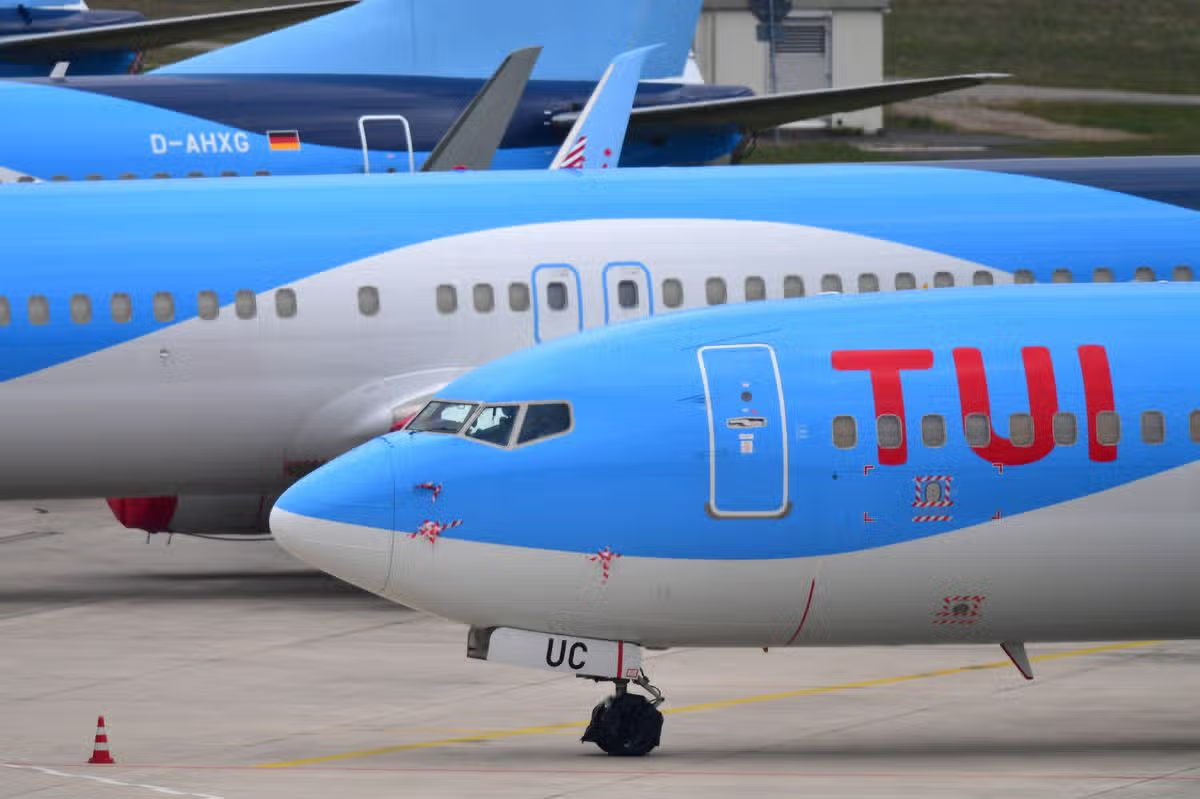
TUI passengers have been told their bookings have changed – and offered a small refund(Image: Getty)
TUI has emailed passengers telling them of an ‘important change’ to holidays already booked. Travellers have reacted with anger after the change was made to services on the flight – with alcoholic drinks off the menu.
In messages posted on Facebook pages from holiday travel companies, it emerged TUI is making the change from November 1. Anyone travelling long-haul with the company has been told that complimentary drinks will no longer be service in economy class.
Instead travellers will receive one complimentary beer or wine with the main meal. All other drinks will now have to be paid for – however, passengers travelling in Premium will continue to receive complimentary alcoholic drinks as part of their experience.
Anyone already booked is being offered a small amount of money back: “If you’ve already booked and paid for a long-haul holiday departing after 1st November, TUI has announced a £12.50 per person, each-way goodwill refund for affected customers.” Many have been sent an email with the subject in caps saying ‘IMPORTANT NEWS REGARDING A CHANGE TO YOUR HOLIDAY’.
The travel operator said: “Everyone will have their own opinion, but for some travellers this could take away a little of that ‘holiday starts on the plane’ feeling.”
Jamie thought it was a good thing: “Probably a good thing with the number of alcohol related incidents onboard these long-haul holiday flights. “ However, Nigel was taking his trade elsewhere: “Plenty saying book with another airline, good luck with that, particularly if you do not have easy access to London airports.” One user said: “That is a tiny amount of refund.”
Some have not had nice experiences. Charlotte said: “Last time we did long haul paid premium it wasn’t loads of drinks it was moderated and disappointing for the amount of money we spent and rudeness of staff.” A user added: “It would make me consider another airline first. But I’ve had issues with TUI when we were supposed to go to Jamaica last year so already not in my good books. If the £12.50 was ongoing, that’s actually reasonable, but to have to pay for drinks moving forward sucks a bit.”
Graeme added: “This is a total joke.” Olive said: ”TUI can ram that nonsense. The whole idea of long haul is getting smashed.”
June added: “The drinks were never ‘free’…they were complimentary. There’s a difference. The complimentary drinks were meant to be limited, but people just take the proverbial’ **** Not surprised it’s been pulled.”
TUI responded to one user: “Thank you for your comment. We’re sorry to hear of your disappointment with the changes to our long-haul service. This change helps us focus on the things that matter most, like keeping fares competitive, maintaining great value overall, and giving customers more flexibility in how they spend onboard.
“Soft drinks will remain free, customers will still get a complimentary beer or wine with their main meal, and there’ll be a wider range of alcoholic drinks available to buy, so people can choose exactly what they want during their flight. Thanks!”
Last month, it emerged that TUI Airways was ranked among the worst airlines for UK flight punctuality, with one route having an average delay of more than three-quarters of an hour.
The leisure carrier’s departures from UK airports were an average of 20 minutes and 24 seconds behind schedule in 2025, according to analysis of Civil Aviation Authority (CAA) data.
The least punctual of its routes with at least 100 flights was from Birmingham to the Greek island of Zante, which had an average delay of 46 minutes.
Rory Boland, editor of consumer magazine Which? Travel, said it was “unacceptable” that airline passengers “continue to face unreliable service” amid fare rises. He went on: “Airlines must do more to support travellers during delays, including clearly communicating their rights and eligibility for compensation.
“It’s worth putting in a claim with your airline if you think it’s responsible – and escalating the complaint if it refuses to pay.” TUI Airways is owned by TUI Group, which also operates the UK’s second-largest package holiday company.
Many of its holiday customers use the airline, which serves more than 20 UK airports.
The punctuality analysis took into account all scheduled and chartered departures from UK airports by the 34 airlines which operated more than 2,500 of these flights last year. Cancelled flights were not included.
Aage Dunhaupt, TUI Group’s director of communications, said: “We fully understand that for holidaymakers, every minute counts. Minimising delays remains a top priority, and our teams work continuously to improve operational performance across our network.”
Mr Dunhaupt said the airline makes “a conscious choice” to operate flights “wherever possible, even if they are delayed, rather than cancelling them”, as this ensures passengers reach their destination “rather than facing the risk of extended disruption”.
He added: “If we were to follow broader industry practices of cancelling flights more readily, our punctuality ranking would improve significantly.
“However, this would come at the expense of our customers.”
Officials at the Korea Internet & Security Agency (KISA) check Internet systems at the KISA situation room in Seoul, South Korea. Photo by YONHAP / EPA
June 26 (Asia Today) — More than 4 in 10 South Korean employees who participated in a government cybersecurity exercise opened simulated phishing emails, but companies that had conducted repeated training recorded significantly better results, officials said Friday.
The Ministry of Science and ICT and the Korea Internet & Security Agency announced the findings at a review meeting at the Post Tower in central Seoul.
A total of 630 companies and 255,460 employees participated in the government’s cybersecurity crisis response exercise for the first half of 2026.
The government conducts the exercise twice a year to improve security awareness and strengthen companies’ ability to respond to cyberattacks.
The latest exercise was held from May 11 through May 22 and covered four areas: phishing emails, distributed denial-of-service attacks, penetration testing and vulnerability detection and response.
The phishing exercise targeted employees at 569 companies.
Participants received simulated malicious emails designed to resemble messages from familiar institutions or routine workplace correspondence.
The government monitored whether participants opened the emails and clicked attached files that would have triggered malware infections in a real attack.
The results showed that 41.6% of participants opened the simulated phishing emails. About 12.7% clicked an attachment and reached the simulated malware infection stage.
Large companies, which had the highest rate of conducting their own cybersecurity exercises, recorded the lowest figures.
Employees at large companies had an email open rate of 35.4% and a simulated infection rate of 9.8%, highlighting the value of repeated training, officials said.
The distributed denial-of-service exercise tested web servers and development servers at 147 companies by sending simulated attack traffic.
Officials measured how quickly each company detected and responded to the traffic.
Companies that had previously participated in the exercise took an average of 20 minutes to detect and respond to the attack.
First-time participants took an average of 64 minutes, more than three times as long.
The vulnerability assessment covered 241 companies.
Investigators found 28 types of security vulnerabilities at 32 companies. Twelve of those companies had six types of vulnerabilities that required immediate corrective action.
The ministry and the agency provided the affected companies with their assessment results and instructions for addressing the weaknesses.
Lim Jeong-gyu, director general for information security network policy at the ministry, said the emergence of advanced artificial intelligence was making cyber threats facing companies increasingly serious.
“Building technical defense systems is important, but having all employees directly experience and respond to a simulated crisis can prove invaluable at a critical moment,” Lim said.
He encouraged companies to participate regularly in cybersecurity exercises rather than treating them as one-time events.
Since its creation more than a century ago, the Los Angeles Bureau of Street Lighting has been in the lamppost business and little else.
But in recent months, the little-known city agency has found itself pulled into a fierce debate over L.A.’s relationship with Flock Safety, a surveillance technology company that has been criticized for supplying data used to enable the Trump administration’s immigration crackdown.
In L.A., Flock operates dozens of automated license plate readers, which allow authorities to scan for vehicles that have been reported stolen or are registered to known fugitives, tracking their movements throughout the city.
The devices are often mounted on municipal light poles, which makes the Bureau of Street Lighting responsible for their installation.
Reports that Flock has shared license plate data with federal authorities, including U.S. Immigration and Customs Enforcement, have prompted dozens of mostly smaller cities across the country to end their relationship with the company. But in L.A. it still has found willing customers, including the LAPD.
Hundreds of emails obtained by The Times through public records requests reveal how LAPD boosters, homeowner associations and elected officials have engaged in a months-long campaign to pressure the Bureau of Street Lighting to speed up installations of the plate readers.
Flock, headquartered in Atlanta, said that it contracts with roughly 5,000 U.S. law enforcement agencies nationwide, and that its technology complies with a California law that limits what information can be shared with federal authorities. A company spokesperson said that Flock’s technology is “built around transparency, accountability, and local control.”
“Our customers own and control their data, which is deleted after 30 days by default,” the spokesperson, MoMo Zhou, said in a statement to The Times. “Our platform includes safeguards like audit trails to help ensure accountability at every step. Every day, Flock supports communities across the country in addressing crime and locating missing people.”
The Bureau of Street Lighting, with 177 employees and a relatively modest budget of $49.4 million, would seem an unlikely player in the broader debate over police surveillance. It is primarily tasked with repairing and fortifying the city’s more than 210,000 streetlamps — a frequent target of copper wire thieves — and maintaining its network of electrical vehicle charging stations.
The push to put up more plate readers has come amid calls for greater transparency around the Los Angeles Police Department’s dealings with Flock. In March, the Police Commission asked the department to report back on what information the company’s scanners collect and share. In recent months, the commission declined to approve donations of Flock cameras.
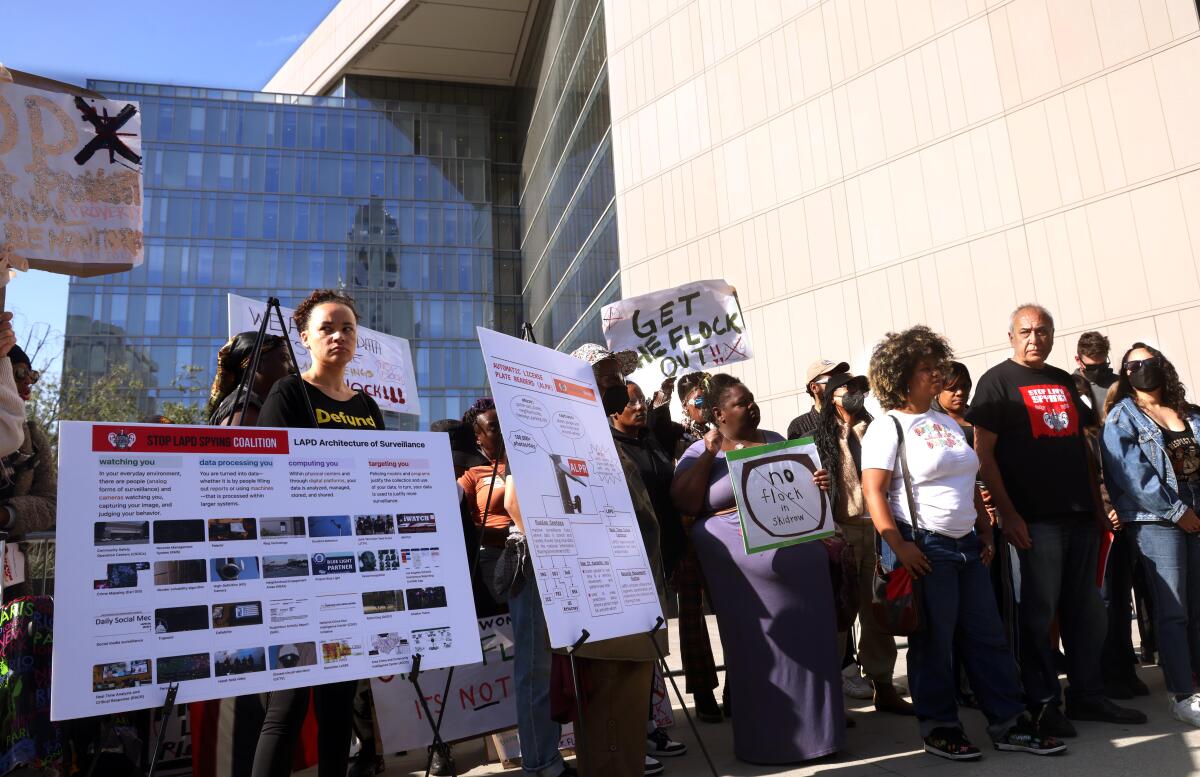
Members of the Stop LAPD Spying Coalition held a news conference to express opposition to Flock Safety, a license plate reader, ahead of a Los Angeles Board of Police Commissioners meeting on March 3, 2026.
(Genaro Molina / Los Angeles Times)
The commission ordered its inspector general to conduct an audit of the LAPD’s use of license plate reader technology, with the findings expected to be released in the summer.
Recently, Councilmember Ysabel Jurado introduced a motion urging the commission to “refrain from entering into any new Memoranda of Understanding, Contracts, or other Agreements, or implement any pilot programs with Flock Safety or its affiliates.” LAPD officials said last month that the city attorney’s office has been working on drawing up a formal contract with Flock.
Behind the scenes, though, the pressure to work with Flock has been ratcheting up from other council offices and community groups.
When a representative from Councilmember Katy Yaroslavsky’s office emailed the streetlighting bureau urging speed, she received a response that said the installation process shouldn’t be rushed because some city light poles can’t support the weight of a Flock reader, which is normally powered by a solar panel.
“The last thing we need is to have a pole fall onto someone or something if there are high winds,” the bureau’s Clinton Tsurui wrote in the June 4, 2025, email.
In another exchange, Tsurui expressed frustration with a colleague who had offered what he thought was an overly optimistic timetable for installing new plate readers.
He wrote: “smh, promising things we can’t do is going to catch up with us one day.”
The Los Angeles Police Foundation, a nonprofit group that has long bankrolled equipment for the LAPD and offered other support, has criticized delays in installing the Flock devices. Last year, the foundation facilitated the donation of dozens of Flock cameras, most of which ended up in affluent neighborhoods on the city’s Westside and in the San Fernando Valley.
Records show that in May 2025, Dana Katz, the foundation’s executive director, reached out to the mayor’s office with a request to waive permit and rental fees associated with installing the new readers. Katz wrote in an email that the extra expense of around $2,000 per device were “cost prohibitive and detrimental to public safety.”
Katz also pointed out that in some places, there are no city-owned poles on which to mount the devices — but offered a possible solution.
“Flock has its own pole that has been accepted by the County of Los Angeles for these situations, and we would like the City to accept the use of them, too,” she wrote to Robert Clark, the city’s then-deputy mayor of public safety.
A few of L.A.’s historic streetlights stand outside the Bureau of Street Lighting’s office near Virgil Avenue and Santa Monica Boulevard.
(Jason Armond / Los Angeles Times)
Katz wrote Clark again on Aug. 6 to ask why officials were estimating a six-to-12-month wait for approval of new Flock readers on public property in the neighborhoods of Cheviot Hills and Brentwood Park, where there were no existing city poles to mount them. She noted that the county’s engineering department had already approved the company’s poles, and asked Clark whether there was a way for the city to “piggyback on these other entities’ approvals in order to speed this up so that these neighborhoods don’t have to wait so long for help in preventing these home invasions?”
In the following weeks, Katz’s emails took on an increasingly urgent tone. In one of her last messages, email records show, she told an aide she expected more help than the mayor’s office was offering.
“With all due respect, the answers you have provided are completely generic and do not provide any guidance and direction as to how we can expedite this process,” she wrote.
She added: “I’ve said it before, and I will say it again — these delays are harmful to public safety.”
A spokesperson for the mayor’s office told The Times that ultimately neither Clark nor the aide intervened on the Los Angeles Police Foundation’s behalf.
Email records show Flock’s courtship of the bureau dates at least to spring 2024, when the company agreed to donate two of its plate readers to help combat copper thefts.
Tsurui emailed LAPD Capt. Celina Robles to say that the company’s executives had requested an in-person meeting with the bureau and the LAPD “to discuss the benefits of this product and how it can benefit the city moving forward.”
On June 24, 2024, a lobbyist from the D.C. firm Modern Fortis emailed Bureau of Street Lighting Executive Director Miguel Sangalang seeking to “explore a public-private partnership” between Flock and the city. Sangalang took another meeting to discuss Flock a few months later with former City Councilmember Joe Buscaino, who after leaving City Hall had gone to work for Ballard Partners, a powerful Florida-based lobbying firm.
In January 2025, after wildfires devastated Pacific Palisades, Altadena and other areas, Flock stepped in again. The company agreed to donate more than 50 plate readers, free of charge for six months, to the wealthy Palisades area, where residents and law enforcement officials were on high alert about potential theft.
A Flock Safety automated license plate reader in Costa Mesa.
(Courtesy of the city of Costa Mesa)
In the days and weeks that followed, city and police officials continued to pepper the bureau about speeding up the approval process.
On Jan. 21, 2025, records show, Cmdr. Randall “Randy” Goddard of the LAPD’s Information Technology Bureau wrote streetlighting officials to say that the Palisades community “could use a big favor from your department.”
LAPD Chief Jim McDonnell “fully supports this and has been working with the City Attorney’s office to finalize the terms,” Goddard wrote.