Venezuela Expresses ‘Concern’ Over Colombia Violence, Petro Claims Agreement Behind Bombing
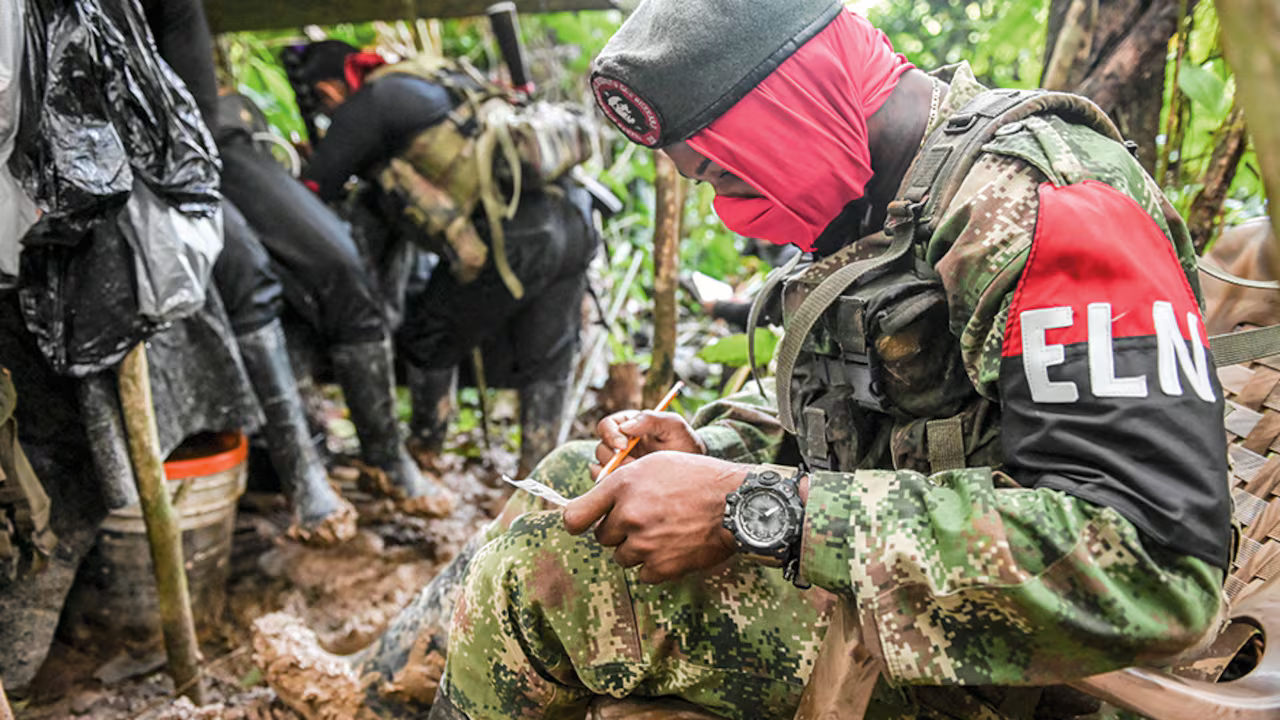
Armed groups operate along the extensive Venezuela-Colombia border. (AFP)
Caracas, May 15, 2026 (venezuelanalysis.com) – The Venezuelan government expressed “deep concern” on Wednesday over the “escalation of violence” in Colombia’s border region of Catatumbo.
Caracas’ reaction came one day after the Colombian Armed Forces announced the killing of seven combatants from the National Liberation Army (ELN) during a bombing operation that Colombian President Gustavo Petro said was carried out “within the framework of agreements” with Venezuela.
“Venezuela has been taken by surprise by these events and rejects any armed action that jeopardizes peace, stability, and the security of border communities,” Venezuelan Foreign Minister Yván Gil stated in an official communiqué. The statement added that Venezuelan authorities are concerned with “how this new escalation once again impacts the lives of people on both sides of the border,” causing “serious consequences” for local populations.
However, just 24 hours earlier, Petro had stated on social media that the Colombian army and air force carried out the attack against the ELN “within the framework of agreements with Bolivarian Government of Venezuela” led by acting President Delcy Rodríguez.
At the same time, Petro clarified that there is currently no peace process with the ELN, rejecting claims that the guerrilla organization resumed armed operations because of state noncompliance.
“Organizations that continue to seek total or partial control over illicit economies and reject agreements aimed at dismantling those structures are not part of any peace process,” he wrote.
Petro and Rodríguez met in Caracas on April 24, where they pledged to “combat organized crime” along the more than 2,200-kilometer shared border between the two countries. The meeting also resulted in plans for joint military coordination, intelligence-sharing mechanisms, and expanded security cooperation.
Details of the Operation
According to Colombian Armed Forces commander General Hugo López, the operation dealt a “major blow” to a unit of the Luis Enrique León Guerra Front, commanded by the guerrilla leader known as “Sucre,” which was reportedly responsible for providing security to the ELN’s Central Command and National Directorate.
The military stated that seven guerrillas were killed during the bombing operation. Nevertheless, insurgents reportedly abandoned the camps and removed the bodies of those killed, according to local outlet Blu Radio.
Colombian forces also reported discovering fortified camps, explosives, drone-launching devices, and materials used in the fabrication of anti-personnel mines.
The ELN, however, denied suffering casualties. In a video posted on Facebook, the guerrilla organization claimed that the attack “fell flat.”
“They attempted to surprise ELN guerrilla units fighting the 33rd Front, but this time they failed (…) We suffered no casualties as a result of this bombing,” the group stated. “Our forces remained active in responding to enemy aggression and continue to hold territory.”
The 33rd Front is a dissident faction of the former Revolutionary Armed Forces of Colombia (FARC). The group joined peace talks with the Colombian government and currently maintains a ceasefire while Temporary Location Zones are established for regrouping under Resolution 161 of May 2026. Nevertheless, it is now facing an escalating conflict with the ELN in border.
The latest attack was the third bombing operation carried out in Colombia in 2026 and the twentieth such military strike under Petro’s administration. Of those, three targeted the ELN, five targeted the Clan del Golfo, and twelve were directed against FARC dissident groups.
Colombia’s armed conflict, which has persisted for more than six decades, has intensified again in 2026 amid growing fragmentation among armed groups competing for territorial control. Despite the 2016 peace agreement between the Colombian government and the FARC, as well as Petro’s ongoing “total peace” initiative, forced displacement and violence against civilians have reached record levels in regions such as Catatumbo and Colombia’s Pacific coast.
The porous and extensive border has also led armed groups such as the ELN to establish a significant presence inside Venezuelan territory, controlling territories and with documented involvement in drug trafficking and mining activities.
Venezuela on different occasions attempted to facilitate peace negotiations in the Colombian conflict. Caracas hosted dialogue rounds between the Petro government and the ELN before talks broke down.
Edited by Ricardo Vaz in Caracas.