Did Elizabeth Holmes and Billy Evans get paid for their documentary?
Elizabeth Holmes was once celebrated as the world’s youngest self-made female billionaire, with an estimated fortune of $4.5 billion. Today, the disgraced Theranos founder is serving a federal prison sentence for defrauding investors and owes hundreds of millions of dollars in restitution.
Suffice it to say, she has a complicated relationship with money.
That tension runs through “You Can See Everything,” Nathan Fielder and Lance Oppenheim’s hit documentary about Holmes and her longtime partner, Billy Evans, an heir to a wealthy San Diego hotel family.
In the nearly three-hour, wildly unpredictable film, a reenactment staged by Fielder depicts Evans pushing for a share of the documentary’s profits, sparking a dispute with the filmmakers over whether paying their subjects would compromise the project’s integrity. Holmes, meanwhile, maintains that money has never been her primary motivation. As Fielder probes the couple’s finances, he struggles to determine how much Holmes knows about Evans’ dealings — and where their financial interests begin and end.
Here’s what “You Can See Everything” reveals about Holmes and Evans’ finances, and what it leaves unanswered. Warning: Major spoilers ahead.
Did Holmes and Evans get paid to participate in the documentary?
No. But for a time, compensation was on the table.
The film was financed by A24, which gave Fielder and Oppenheim unusual freedom to pursue the project without any deadline or obligation to turn what they captured into a finished film. As Fielder recalled during a Q&A following the film’s secret premiere at the Telluride Film Festival in September, the studio told them that if nothing came of it, “you can just throw everything away.”
In one of the film’s pivotal sequences, Fielder stages a reenactment, based on his recollections, of a meeting with Evans, Holmes, Oppenheim and two A24 executives. Amanda Seyfried, who won an Emmy for portraying Holmes in Hulu’s “The Dropout,” plays her again, while Christopher Abbott takes on the role of Evans. After Holmes leaves to check on the couple’s children, Evans raises the question of compensation.
“I do know that there is potential for this movie to also make a lot of money,” Evans says. “And I feel strongly that if this movie were to make money, that we should be entitled to some of it.”
Fielder objects, arguing that payment could cast doubt on the couple’s motives and suggest they had influence over the finished film. Evans insists that compensation is nonnegotiable.
According to Fielder, A24 ultimately agreed to a profit-sharing arrangement, though the documentary doesn’t disclose its terms.

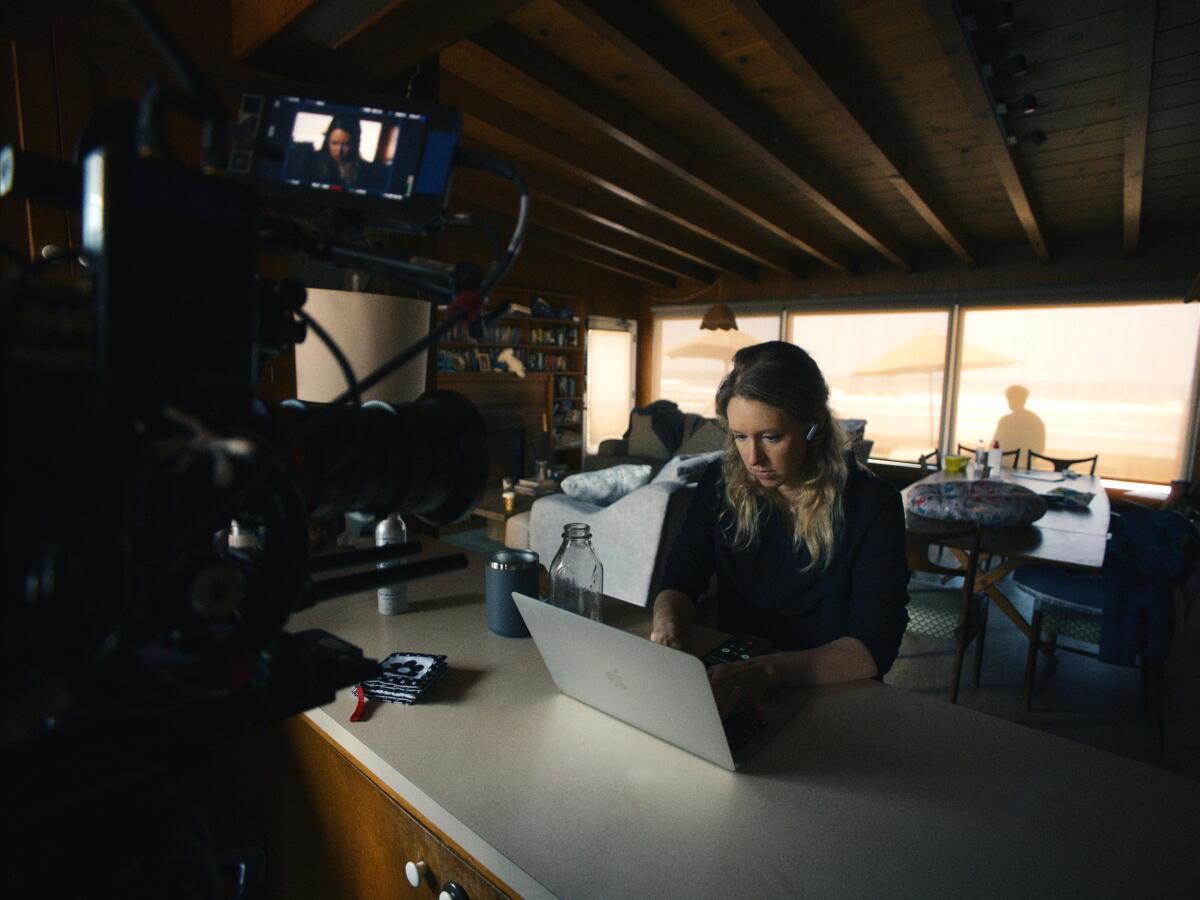
Holmes works on a laptop at the rented beachfront home in Del Mar, Calif., where she lived with her partner, Billy Evans, and their two children before entering prison, in a scene from “You Can See Everything.”
(A24)
But shortly before entering prison, Holmes tells Fielder on camera, “Obviously I’m not making any money or having any economic interest in this whatsoever.” Fielder is left wondering whether she’s genuinely unaware of the deal Evans negotiated or merely pretending not to know.
The real Evans later acknowledges withholding some details from Holmes, explaining that she had enough on her mind.
In the end, a title card reveals that Evans decided to forgo compensation.
Is it unusual for documentary subjects to get paid?
Generally, yes — at least in documentaries that follow traditional journalistic standards.
Paying subjects can create conflicts of interest, raising questions about their motives and credibility. Those concerns are particularly acute with someone like Holmes, who was convicted of defrauding investors through an elaborate web of deception.
“The optics are terrible,” Fielder warns Evans.
Evans counters that documentary subjects have been paid before, citing reports of a lucrative Netflix deal involving Prince Harry and Meghan Markle. Oppenheim dismisses the comparison, saying their series isn’t a conventional documentary.
The distinction isn’t always clear-cut. In 2019, competing documentaries about the disastrous Fyre Festival took different approaches to paying its disgraced organizer, Billy McFarland. The filmmakers behind Hulu’s “Fyre Fraud” acknowledged paying him for footage and other rights. But Chris Smith, director of Netflix’s “Fyre,” refused McFarland’s demand for payment, arguing that it would be unethical for him to profit after defrauding so many people.
Fielder says he considered abandoning the project rather than accepting Evans’ demands. Instead, he decided the negotiations might reveal something about how Holmes and Evans operate.
As Fielder later confides to Seyfried, “Either this is fully sincere and she actually has no clue about the deal Billy made, or she honestly might be the most manipulative person that’s ever lived.”
How much money does Holmes owe?
A lot.
In 2023, a federal judge ordered Holmes and former Theranos President Ramesh “Sunny” Balwani to pay more than $452 million in restitution to investors and companies defrauded by Theranos. The two are jointly responsible for the judgment, meaning the same losses cannot be collected twice. A federal appeals court upheld the order in 2025.

Holmes speaks at the Fortune Global Forum in 2015, when her blood-testing startup Theranos was valued at billions of dollars and she was celebrated as one of Silicon Valley’s most successful entrepreneurs.
(Jeff Chiu / Associated Press)
Holmes has maintained that she has little money left. In a court appearance shown in the documentary, she insists, “I don’t have any money,” explaining she is deeply in debt from legal fees associated with her criminal case.
During Fielder’s prison visit, as reenacted in the film, she tells him, “I don’t have the option to care about money. I owe hundreds of millions of dollars of restitution. Every dollar I make, they take from me.”
Would any profits from the documentary have gone toward Holmes’ restitution?
Not necessarily.
Although Holmes and Evans have two children together and refer to each other as husband and wife, Holmes told People in 2025 that they were not legally married. Evans isn’t personally responsible for her restitution debt simply because they’re a couple.
The government can seek payment from assets belonging to Holmes, but the documentary doesn’t disclose who would have received money under the proposed profit-sharing deal or whether Holmes would have had any financial interest in it. So it’s unclear whether any proceeds could have gone toward her restitution.
The proposed profit-sharing arrangement could have been lucrative. “You Can See Everything” grossed $15.6 million in its opening weekend and more than $20 million in its first five days. Those figures represent ticket sales, not profits, but illustrate the potential value of such an arrangement. And with the film still expanding into more theaters and generating strong buzz, its box-office haul is poised to grow further.
How are Holmes and Evans supporting themselves?
The documentary doesn’t fully answer that question either.
Before Holmes entered prison, the couple lived with their two children — son William, now 5, and daughter Invicta, 3 — in a luxurious rented home near the beach in Del Mar, north of San Diego. Evans comes from a wealthy family whose hotel business includes the Bahia Resort Hotel, the Catamaran Resort Hotel and Spa and the Lodge at Torrey Pines. But in an Oct. 1 statement, Evans Hotels said he is neither an employee nor a shareholder in the company.
In the film, Fielder asks Evans whether Holmes might have been attracted to his family’s money. Evans grows visibly uncomfortable and shuts down the conversation when Fielder presses him about the extent of the family’s wealth.
Evans also has a biotech start-up, Haemanthus, which is developing laser-based technology to analyze biological samples, an undertaking with echoes of Holmes’ failed blood-testing company. According to Wired, the company has reported raising as much as $20 million in funding but has yet to release a product.
How much Evans personally earns from the venture — or whether his family helps support the couple — remains unclear.
In a later scene, Seyfried asks Evans who’s bringing in money while Holmes is in prison. He says she earns 30 cents an hour at the federal prison in Texas where she’s serving her sentence.
And what about his own income?
“I’ve got my own business,” he replies.