eligible voter

Trump signs executive order limiting mail-in ballots; California leaders say they’ll fight

President Trump signed an executive order Tuesday purporting to place new federal controls on voting by mail in states such as California, repeating his long-held but unsubstantiated claim that mail-in ballots are a source of widespread fraud in U.S. elections.

California leaders immediately responded with promises to fight the order in court. They said mail ballots are a safe and secure method for voting relied on by millions of Californians, that Trump’s order infringes on the state’s constitutional right to administer elections as it sees fit, and that it amounts to an “illegal power grab” ahead of midterm elections in which his party is poised to suffer substantial losses.

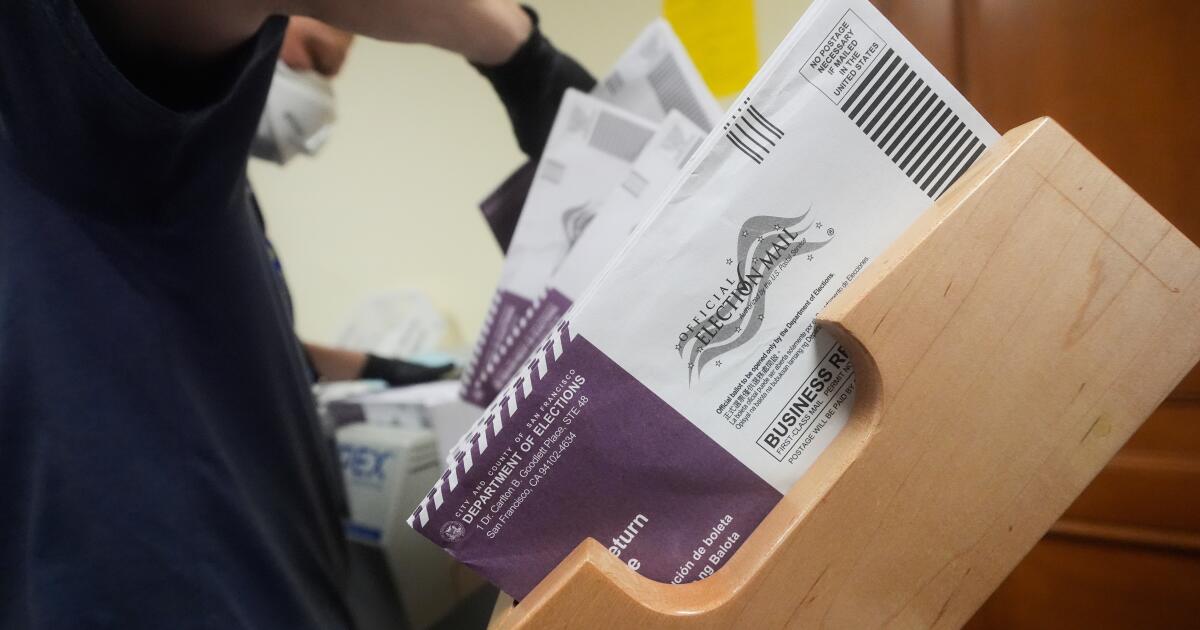
The order directs the United States Postal Service to take control of mail balloting by designing new envelopes with special bar codes that will allow the federal government to ensure that such ballots go out only to eligible voters, and that only eligible voters return such ballots.

It requires states to submit to the USPS process if they plan to use the federal mail system for sending or receiving ballots, and to submit to the USPS lists of eligible voters in advance of such ballots passing through the mail system.

It also requires the Department of Homeland Security, U.S. Citizenship and Immigration Services, and the Social Security Administration to “compile and transmit to the chief election official of each State a list of individuals confirmed to be United States citizens who will be above the age of 18 at the time of an upcoming Federal election and who maintain a residence in the subject State.”

Those lists will be drawn from federal citizenship and naturalization records, Social Security records and “other relevant Federal databases,” and the USPS will be barred from transmitting ballots that do not match those lists, the order says.

“Secure ballot envelope identifiers provide a reliable, auditable mechanism to enforce Federal law without unduly burdening or infringing on the rights of eligible voters,” the order reads. “Unique ballot envelope identifiers, such as bar codes, enable confirmation that only citizens receive and cast ballots, reducing the risk of fraud and protecting the integrity of Federal elections.”

Trump — who recently voted by mail himself in Florida — framed the order as a solution to “massive cheating” in U.S. elections currently, which he did not back up with evidence.

“The cheating on mail-in voting is legendary. It’s horrible what’s going on,” Trump said.

“He’s going to make sure that mail-in ballots are safe secure and accurate,” said Commerce Secretary Howard Lutnick, who appeared alongside Trump and whose agency the order requires to be involved in the coordination of the new voting measures.

California officials blasted the president for attacking and undermining election integrity, rather than shoring it up, and said they would fight the order from taking effect.

“President Trump’s Executive Order marks a dangerous and unprecedented escalation in his ongoing attacks on our elections. The power to regulate elections belongs to the States and to Congress — he has no role to play. We blocked his previous Executive Order on elections in court, and we are prepared to stop him again,” said California Atty. Gen. Rob Bonta.

“The reality is that President Trump and Congressional Republicans see the writing on the wall — that they are likely to lose in the upcoming midterms — and they are pushing to make it harder for people to vote,” Bonta added. “We won’t stand idly by.”

Sen. Alex Padilla (D-Calif.), in a statement to The Times, said Trump’s actions were “a clear and present threat to our democracy,” that he will “use every tool I can to stop him,” and that he expects “immediate legal challenges in order to protect our free and fair elections.”

“Instead of focusing on lowering the cost of energy, groceries, and health care, Donald Trump is desperately attempting to take over and rig our elections and avoid accountability in November. This executive order is a blatant, unconstitutional abuse of power,” said Padilla, the ranking Democrat on the Senate Committee on Rules and Administration.

“The President and the Department of Homeland Security have no authority to commandeer federal elections or direct the independent Postal Service to undermine mail and absentee voting that nearly 50 million Americans relied on in 2024,” he said. “A decade of lies about election fraud does not change the Constitution.”

“In the middle of an unauthorized war abroad and an escalating authoritarian crackdown by ICE here at home, Trump is attempting another illegal power grab,” Padilla said.

A vast majority of Californians vote by mail. In the state’s 2025 special election on Proposition 50, the state’s mid-decade redistricting measure, nearly 89% of votes were cast by mail, according to California Secretary of State Shirley Weber’s office — or nearly 10.3 million out of about 11.6 million votes cast.

Trump has long criticized mail-in ballots — without evidence — as a source of fraud and a factor in his losing the 2020 election to President Biden, which he still contends was illegitimate.

Election experts, voting rights advocates, local elections officials and other California leaders have all dismissed those claims as unfounded and inaccurate. They have also been preparing for Trump to act to curtail such voting.

Padilla previously warned colleagues that he would force a vote on any effort by Trump to declare a national emergency in order to seize control of this year’s midterm elections from the states, forcing them to either co-sign on the power grab or resist it.

Critics of mail ballots have also been actively working to end or curtail the practice. Just last week, the U.S. Supreme Court heard arguments in a case in which the Republican Party challenged a Mississippi law that allows ballots to be accepted and counted if they arrive up to five days after election day.

During those arguments, the court’s six conservatives sounded ready to rule that federal law requires ballots to be received by election day in order to be counted as legal.

Weber, California’s top elections official, has warned that attacks on mail-in voting risked undermining a system the state has spent years building around universal mail voting.

Trump’s executive order is the latest front in a years-long campaign he has led attacking the integrity of U.S. elections — which has contributed to a steep decline in voter trust in U.S. elections.

On Tuesday, Trump said his order was drafted by “great legal minds,” and will survive any legal challenges unless “rogue” judges rule against it inappropriately.

“We want to have honest voting in our country,” he said.

Rick Hasen, an election law expert and director of the Safeguarding Democracy Project at UCLA Law, argued otherwise in a post Tuesday, noting that an earlier executive order purporting to place new federal controls on elections was blocked in court, and “this one is likely to fare no better.”

“To put this in plain terms: the order would use the USPS, which is not under the direct control of the President, to interfere with a state’s lawful transmission of ballots. If the state does not comply with these rules, federal law would purport to interfere with a state’s conduct of its own elections,” Hasen wrote. “The President does not have the authority to do this.”
Source link

As Supreme Court hears mail ballot case, alarms are raised in far-flung Alaska

The tiny Alaska Native village of Beaver is about 40 minutes — by plane — from the nearest city. Its roughly 50 residents rely on weekday flights for mail and many of their basic supplies, including groceries and Amazon deliveries of everyday household items.

Air service plays an outsize role in the nation’s most expansive state, where most communities rely on flights for year-round access. Planes also play a crucial role in elections, getting voting materials and ballots to and from rural precincts such as Beaver and delivering ballots for thousands of Alaskans who vote by mail — some in places where in-person voting is not available.

The vast distances and relative isolation of so many communities make Alaska unique and are why its residents have a significant interest in arguments taking place Monday before the U.S. Supreme Court.

Many here worry that a case from Mississippi challenging whether ballots received after election day can be counted in federal elections could end Alaska’s practice of accepting late-arriving ballots. Alaska counts ballots if they are postmarked by election day and received within 10 days, or 15 days for overseas voters in general elections.

“These processes have been in place for a long time just to ensure that our ballots are counted,” said Rhonda Pitka, a poll worker and first chief in Beaver, which sits along the Yukon River 110 miles north of Fairbanks.

If the court decides ballots in all states must be received by election day, she said, “they’ll be disenfranchising thousands of people — thousands of people in these rural communities. It’s just basically saying that their votes don’t count, and that’s a real shame.”

The Supreme Court will hear arguments as the U.S. Senate is debating legislation being pushed by President Trump that would require people to show proof of citizenship to register to vote — an onerous burden for many — and a photo ID to cast a ballot.

Most Republicans argue that the bill is necessary to shore up voting integrity, but Democrats and voting rights advocates — and Alaska Republican U.S. Sen. Lisa Murkowski — contend that it amounts to voter suppression. Studies have consistently shown that voting fraud is exceedingly rare in the U.S., and courts have struck down similar measures after finding they prevented eligible voters from casting ballots.

Some ballots already arrive late

Alaska is one of 14 states that allow all mailed ballots postmarked by election day to arrive days or weeks later and be counted, according to the National Conference of State Legislatures and the Voting Rights Lab. An additional 15 provide grace periods for military and overseas ballots.

But Alaska’s geography, weather and great distances between communities — Alaska is more than twice the size of Texas, the nation’s second-largest state — raise the stakes for voters. The unusual way the state counts its votes also makes a grace period important, advocates say.

Under Alaska’s ranked-choice system for general elections, workers in small rural precincts call in voters’ first choices to a regional election office. All ballots, however, ultimately are flown to the state Division of Elections in the capital, Juneau. There, the races not won outright are tabulated to determine a winner.

Even with Alaska’s current 10-day grace period, ballots from some villages in 2022 were not fully counted because of mail delays. They arrived too late for tabulations in Juneau, 15 days after election day.

If the Supreme Court rules that ballots cannot be counted if they arrive at election offices after election day, many Alaska voters could be affected. About 50,000 Alaskans voted by mail in the 2024 presidential election.

“I think there’s probably no other state where this ruling could have a more detrimental impact than ours,” Murkowski, her state’s senior senator, said in an interview.

Murkowski sees the case — a challenge by the Republican National Committee and others to Mississippi’s allowance of late-arriving ballots — as an effort to end voting by mail nationwide.

‘Seeing a level of voter intimidation’

The RNC argues that such grace periods improperly extend elections for federal office, but Mississippi responded that no voting occurs after election day — only the delivery and counting of already completed ballots.

Taken together, Murkowski said, the Trump-backed voting bill and the Supreme Court case could discourage people from voting.

“I think we’re seeing a level of voter intimidation, I’ll just say it,” she said. “I feel very, very strongly that the effort that we should be making at the federal level is to do all that we can to make our elections accessible, fair and transparent for every lawful voter out there.”

Alaska’s other congressional members, Rep. Nick Begich and Sen. Dan Sullivan, both Republican allies of Trump who are seeking reelection this year, support the SAVE America Act now before the Senate. But they also said they want to ensure that ballots properly cast on or before election day get counted.

“We’ll see what the courts choose to do on that issue, but I do think that we need to allow for time for ballots to come in from the rural parts of our state,” Begich said during a recent visit to Juneau.

Alaska officials highlight challenges to the court

A court filing in the Mississippi case by Alaska Atty. Gen. Stephen Cox and Solicitor Gen. Jenna Lorence did not take sides but outlined geographic and logistical challenges to holding elections in Alaska.

In Atqasuk, on Alaska’s North Slope, poll workers counted votes on election night in 2024, tallies they would normally relay by phone to election division officials. But the filing said they could not get through and “chose what they saw as the next best solution — they placed the ballots and tally sheets into a secure package and mailed them to the Division, who did not receive them until nine days later.”

The filing seeks clarity from the Supreme Court, particularly around what it means for ballots to be received by election day.

While it is clear when a ballot is cast, “when certain ballots are actually ‘received’ is open to different interpretations, especially given the connectivity challenges for Alaska’s far-flung boroughs,” Cox and Lorence wrote.

Effect on Alaska Native voters

Lawyers with the Native American Rights Fund and Great Lakes Indigenous Law Center said in filings with the court that limited postal service in rural areas means that some ballots might not be postmarked until they reach Anchorage or Juneau, which can take days.

In the 2022 general election, between 55% and 78% of absentee ballots from the state House districts spanning from the Aleutian Islands up the western coast to the vast North Slope arrived at an election office after election day, they wrote. Statewide, about 20% of all absentee ballots in that election were received after election day.

Requiring ballots to be received by election day, they warned, would “disproportionately disenfranchise” Alaska Native voters. The lawyers represent the National Congress of American Indians, Native Vote Washington and the Alaska Federation of Natives.

Michelle Sparck, director of Get Out the Native Vote, a nonpartisan voting rights advocacy group affiliated with the Alaska Federation of Natives, worries about creating confusion and fear among voters.

She sees the case before the Supreme Court and the Republican SAVE Act as “a multipronged attempt to take control or wrest control of elections away from states.” Alaska, she said, already has enough inherent barriers for many voters.

“There is a minute record of election fraud — not at the rate that requires this heavy-handed response through the legislature and the Supreme Court,” she said.

Bohrer writes for the Associated Press.

Source link

Solutions to speed California vote count and make voting easy

Every two years, elite athletes compete in the Olympics, biennial plants — like carrots and onions — produce seeds and people across America look on with consternation and mounting impatience as California counts its election ballots.

The prolonged tally has become as much a part of electioneering in the Golden State as wall-to-wall advertising, high-flown promises and overstuffed mailboxes groaning beneath the weight of endless campaign fliers.

The tabulation — which can last weeks past election day — is the product, in large part, of a commendable objective: Encouraging as many people as possible to vote.

California, which mails a ballot to every eligible voter, ranks near the top of states in the ease of its elections. That’s something to be celebrated. Voting is a way to help steer the direction of our state and nation and invest, as an active participant, in its future.

Yay, participatory democracy!

Unfortunately, the lag time between election day and the final results has led to all sorts of wild, unfounded claims, peddled mainly by Republicans seeking to curry favor with the sore-losing President Trump by parroting his conspiratorial gabbling.

“They hold the elections open for weeks after election day,” House Speaker Mike Johnson said recently, falsely suggesting that chicanery cost the GOP three House seats in California in 2024. “It looks on its face to be fraudulent.”

That’s a lot of, um, hooey.

There is no rampant cheating or election fraud in California. Period. Full stop.

Still, those sorts of phony statements have deeply diminished faith in our elections and our increasingly rickety democracy.

So — what if it were possible to preserve California’s friendly voting system while, at the same time, speeding up the tabulation of its many millions of ballots?

Kim Alexander believes it’s possible to do both.

“We need to stop explaining why it’s taking so long and start figuring out how to [produce election results] in a more satisfying way,” she said. “There are a lot of things that we could do better and do differently. It just takes some creative thinking and some will.”

Simply put, “The longer it takes to count ballots, the more voter confidence erodes.”

Alexander, head of the nonpartisan California Voter Foundation, has spent more than three decades working to make the state’s elections more efficient, more transparent and more accountable.

Her interest in politics and election mechanics came about while growing up in Culver City, where her father served as a councilman and mayor.

As a 7-year-old, stationed in the garage, it was Alexander’s job to track the returns in her dad’s first campaign, toting up the numbers at an election night party while her mom, posted in the kitchen, called the city clerk for updates. Even at that young age, Alexander learned the importance of a fair and efficient tabulation process.

Over the years, she watched as her father’s political career was stymied by a Democratic gerrymander, which blocked any hopes he had of being elected to Congress or the Legislature as a moderate Republican. She saw firsthand the influence of money in politics. (Her father told her of turning away donations that came with strings attached.) That helped turn her into a political reformer.

After working as a legislative staffer and serving a stint at Common Cause, the good-government lobbying group, Alexander took over the California Voter Foundation in 1994.

As a political noncombatant, Alexander won’t say how it feels, and whether these days she’s more or less optimistic, watching as reckless attacks on our elections come from inside the White House. “I like to describe myself as a realist with high goals,” is all she’d allow.

There are good reasons why it takes California so long to count its ballots.

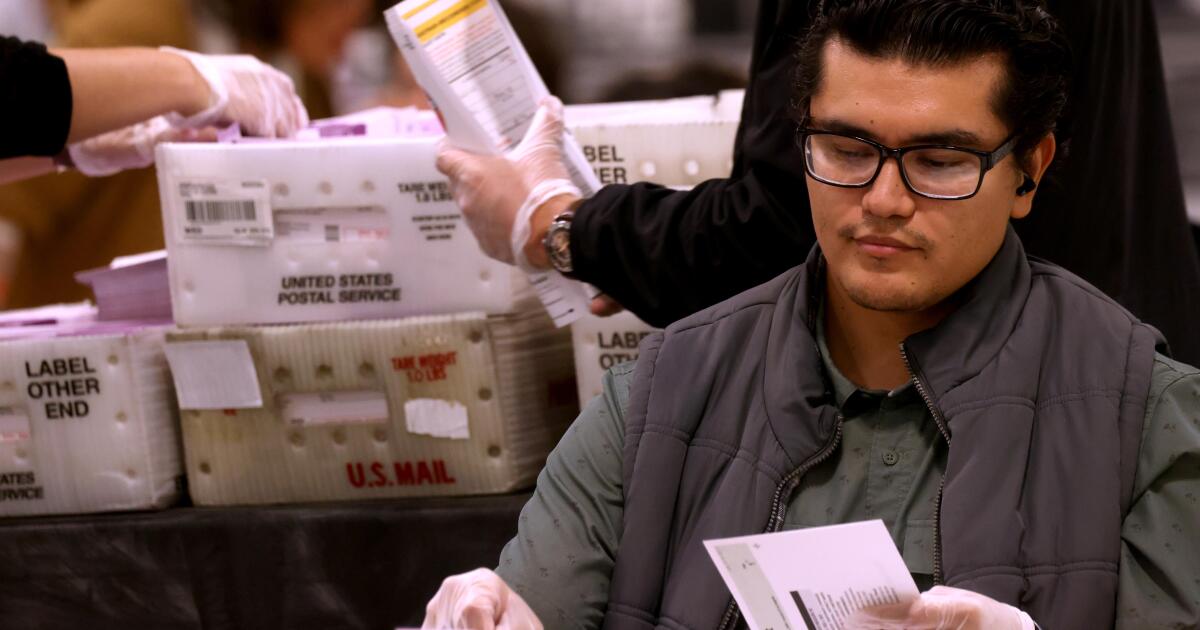
First off, there are a lot of them; more than 16 million residents voted in the last presidential election, more than the population of all but 10 states. Voting by mail has exploded in popularity and it takes longer to count those ballots, as many don’t arrive until after election day. Also, there are a number of safeguards to prevent fraud and ensure an accurate count. “We’re checking all the signatures,” Alexander said. “We’re making sure nobody votes twice.”

Simply explaining those facts can help build trust, she said. However, that won’t speed up the state’s vote counting. Here, Alexander suggested, are some things that can:

— Increase funding for California’s 58 counties to expand equipment, staff and the space needed to process ballots. In recent years, the state has been asking local election officials to do more and more without reimbursing their costs.

— Educate voters and encourage them to turn their ballots in earlier. Along those lines, a system called “sign, scan and go” allows voters to return their mail ballots in person at a designated polling place. A pilot program in Placer County found that that shaved three to four days off processing time. The system could be implemented statewide.

— Better manage California’s voter database, doing so from the top down in Sacramento, rather than having counties oversee their data and feed it into the system. That bottom-up approach creates delays and a lag time in processing ballots.

— Create “ballot swap” days to speed delivery of out-of-county ballots where they belong, also saving time. (Under California law, voters can return their ballot anywhere in the state, but it must be routed to their home county to be tabulated. That process can now take more than a week.)

The problem, apart from perennial budget pressures, is that interest in election mechanics — a technical and arcane subject if ever there was one — is episodic and fleeting. It’s like worrying about a leaky roof when the temperature is 95 degrees outside and the sun is blazing.

But even without voters clamoring to address California’s slow-poke vote count, lawmakers should act.

Gov. Gavin Newsom recently rose to defend the state’s “safe and secure elections” against one of Trump’s many unwarranted attacks. If he wants to burnish his credentials for a 2028 presidential run — which Newsom very much does — one way would be to speed up delivery of its election results.

That way the rest of the country won’t be asking again in November: What the heck’s with California?

Source link