
Samsung cuts U.S. consumer electronics jobs as headquarters moves to Texas
Samsung cuts U.S. consumer electronics jobs as headquarters moves to Texas
Source link
Samsung cuts U.S. consumer electronics jobs as headquarters moves to Texas
Source link
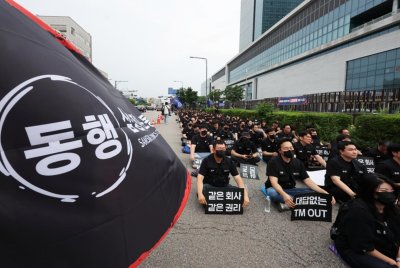

Union members of Samsung Electronics Co. hold a rally protesting against gaps in bonuses in front of its branch in Suwon, south of Seoul, South Korea, 16 July 2026. Photo by YONHAP / EPA
July 16 (Asia Today) — Divisions among Samsung Electronics labor unions are widening as unions representing different business units pursue separate compensation demands and bargaining strategies.
The Samsung Electronics Donghaeng Union, which primarily represents employees in the Device eXperience division, staged a rally Thursday demanding compensation equivalent to about 1,000 company shares per employee.
Meanwhile, the Samsung Electronics branch of the Samsung Group Super-Enterprise Union, whose membership is concentrated in the Device Solutions division, held its first policy committee meeting for the semiconductor business.
The divisions developed from a dispute over performance bonuses and have continued despite the conclusion of companywide wage negotiations.
The Donghaeng union held its rally near the main entrance of Samsung Electronics’ Suwon campus in Gyeonggi Province.
“We strongly condemn management for unilaterally excluding the DX division and reaching a closed-door agreement without transparency,” the union said.
More than 7,000 people were reported to have attended, more than twice the approximately 3,000 participants initially expected by organizers.
Participants wore black and carried signs reading “Same company, same rights,” “Rest in peace, DX” and “Discrimination off, fairness on.”
“Behind the company’s remarkable achievements are the dedication and hard work of DX employees,” the union said. “However, management created an extreme compensation gap between business divisions during the latest negotiations, leaving DX employees feeling excluded and relatively deprived.”
The union called on Samsung Electronics to immediately offer each DX employee compensation equivalent to about 1,000 company shares.
It also demanded that the company secure funding in advance for companywide employee compensation in 2027 and disclose the amount transparently.
The Donghaeng union said it would hold another rally in Seoul’s Seocho District unless the company takes additional action.
Lee Ho-seok, head of the Suwon branch of the National Samsung Electronics Union, attended Thursday’s rally and suggested his union could join forces with Donghaeng over what union leaders described as management’s exclusion of DX employees.
“To create one Samsung Electronics, rights, respect and compensation must be provided equally,” Lee said. “Management must answer our questions.”
The Super-Enterprise Union, meanwhile, held the kickoff meeting of its DS Division Policy Committee on Thursday.
The committee discussed its operating rules, plans for the 2027 wage and collective bargaining negotiations and its response to the company’s Mega Project initiative.
The union said the committee would meet monthly and hold regular consultations with management.
The union is also preparing to request separate bargaining units that would allow employees in the DS and DX divisions to negotiate independently with management.
Choi Seung-ho, chairman of the Super-Enterprise Union’s Samsung Electronics branch, said he intends to secure the change this year.
“The Super-Enterprise Union will responsibly lead the 2027 wage and collective bargaining negotiations rather than participate in joint negotiations,” Choi said. “With about four months remaining before negotiations begin in early December, we will use the policy committee to develop a thorough set of demands.”
The unions began moving separately after Samsung Electronics introduced a special performance bonus for the DS division in May.
As unions increasingly organized along business-unit lines, disputes among them intensified.
As of Thursday, the Super-Enterprise Union had 54,286 members, the Donghaeng union had 28,877 and the National Samsung Electronics Union had 22,826.
The Super-Enterprise Union previously represented a majority of Samsung Electronics’ unionized workforce. Its membership declined after large numbers of DX employees left, while membership in the Donghaeng union and the National Samsung Electronics Union increased.
— Reported by Asia Today; translated by UPI
© Asia Today. Unauthorized reproduction or redistribution prohibited.
Original Korean report: https://www.asiatoday.co.kr/kn/view.php?key=20260716010006332
Ukraine says facility a ‘critical component’ in defence production as local Russian authorities confirm attack.
Published On 22 Jun 202622 Jun 2026
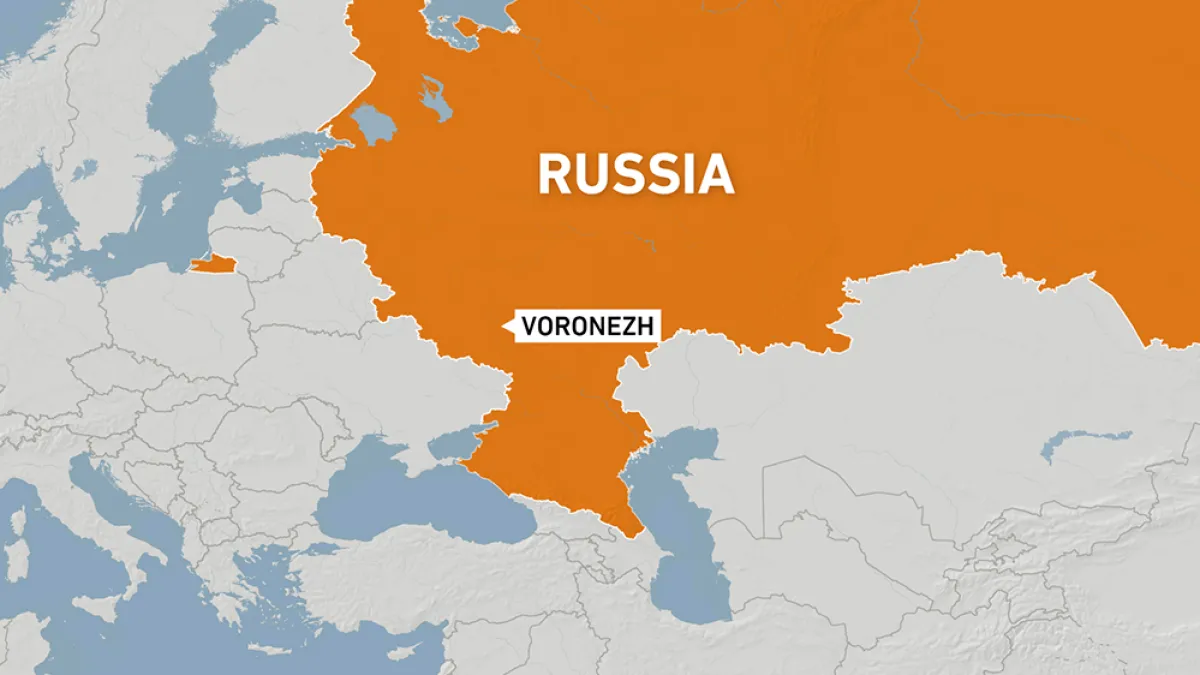
Ukraine’s military has said it struck a plant producing electronics for missiles in Russia’s Voronezh region, as well as the Dubna satellite communications centre in the Moscow region.
In a statement on Telegram on Monday, the Ukrainian General Staff said it had used air-launched cruise missiles to hit the plant in Voronezh, which it described as a “critical component” in Russia’s defence production.
list of 4 itemsend of list
Alexander Gusev, the Voronezh governor, said a production plant was damaged and three people were injured in the attack, without specifying the nature of the facilities.
Gusev said in a post on Telegram that air defence forces had destroyed several high-speed targets in the skies over Voronezh and warned residents of the danger of missile attacks.
The Ukrainian military also said it struck Russia’s Dubna satellite communications centre in the Moscow region, adding that heavy smoke was observed at the site and the extent of the damage was being assessed.
Eighty-four drones headed for Moscow were downed in the past 24 hours, the city’s Mayor Sergei Sobyanin said on Telegram.
He said emergency services had been dispatched to the areas where drones were downed, but gave no further information.
The airports of Sheremetyevo, Domodedovo and Vnukovo, as well as Zhukovskiy near the Russian capital, had temporarily suspended flights, the aviation watchdog said separately.
In total, Russian defence systems downed 301 drones overnight, local news agencies said, citing the Ministry of Defence. That tally included Russian-occupied areas of Ukraine.
The latest raids follow a drone attack that hit Moscow’s sole oil refinery last week, in one of the biggest air attacks on the city since Russia’s full-scale invasion of Ukraine in 2022.
In Ukraine, authorities said a Russian drone attack early on Monday in the Sumy region killed a 13-year-old boy, his 36-year-old father, and his 73-year-old grandmother.
Regional governor Oleh Hryhorov said the 73-year-old was the mother of the man’s roommate.
Russian drone attacks in the southeastern Ukrainian city of Zaporizhzhia overnight and early on Monday killed two people and injured a further seven, Ukraine’s emergency services said.
Russia also hit the southern Odesa region with an Iskander ballistic missile on Sunday evening, killing one and injuring three people, regional governor Oleh Kiper said on Telegram. Vehicles and fuel storage tanks caught fire after the strike hit an agricultural facility, he said.
Elsewhere, the city of Sevastopol in Russian-annexed Crimea cancelled all open-air public events on Monday and will keep streetlights switched off, its governor, Mikhail Razvozhayev said, as he called on people to curb electricity usage.
Russian drones hit a Turkish dry cargo vessel, the Victress, which was sailing under the Panamanian flag, Ukraine’s navy said.
Deputy Prime Minister Oleksii Kuleba said a 58-year-old Egyptian cook was killed and eight other crew members, including Turkish and Indian nationals, had to evacuate on a lifeboat.
The leaders of Europe’s top military powers will meet on Wednesday in Berlin to discuss the Ukraine conflict and an upcoming NATO summit.
Chancellor Friedrich Merz plans to host the leaders of France, Britain, Italy and Poland, a spokesman said Monday, adding that the resignation announcement of British Prime Minister Keir Starmer had not changed those plans.
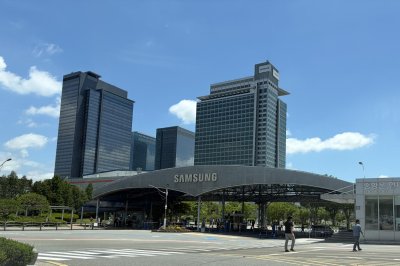

The entrance to Samsung Electronics’ Suwon campus in Suwon, South Korea, is seen under a clear sky. Photo by Hyojoon Jeon / UPI
June 5 (Asia Today) — Samsung Electronics said Friday it will launch a monthlong customer appreciation campaign worth 400 billion won, or about $261 million, as part of a broader social contribution plan linked to strong performance in its semiconductor business.
The campaign, called “Together With the People, Samsung Electronics Appreciation Festival,” will begin Monday. Customers who buy Samsung Electronics products during the event will receive Onnuri gift certificates equal to 20% of the purchase price, the company said.
Onnuri gift certificates can be used like cash at traditional markets and small neighborhood businesses across South Korea. Samsung said it chose the certificates instead of direct discounts to help stimulate local economies and support small merchants.
The event is part of Samsung Electronics’ earlier pledge to expand social contributions by 5 trillion won, or about $3.26 billion, over the next five years. The company announced the plan after reaching a labor-management agreement last month, saying it would invest in “mutual growth and a healthy ecosystem” as well as “future talent development.”
Samsung said soldiers, police officers, firefighters and correctional officers, which the company refers to as “K-heroes,” will receive a 30% benefit when buying products through the Samsung Electronics Family Mall. More than 700,000 people are expected to be eligible.
Samsung Electronics has operated a separate “K-Hero Family Festa” since 2024 to provide price benefits to members of the military, police, fire services and correctional service.
“The dedication and sacrifice of K-heroes made South Korea one of the safest countries in the world, and Samsung Electronics was able to achieve strong performance and growth thanks to that,” the company said. “The program is intended to honor the devotion and hard work of the heroes around us and express our gratitude and support.”
Samsung is also reviewing additional social contribution measures, including support for partner companies, inclusive finance and artificial intelligence talent development.
The company said those plans may include strengthening the competitiveness of industrial ecosystems through supplier support, expanding financial access for vulnerable groups and small business owners and increasing university-industry cooperation to train talent in AI and other future industries.
“We will continue to think deeply about what role a company should play in our society while considering the expectations of the people,” Samsung Electronics said. “As a company that grows together with society, we will faithfully carry out our responsibilities and role.”
— Reported by Asia Today; translated by UPI
© Asia Today. Unauthorized reproduction or redistribution prohibited.
Original Korean report: https://www.asiatoday.co.kr/kn/view.php?key=20260605010001833
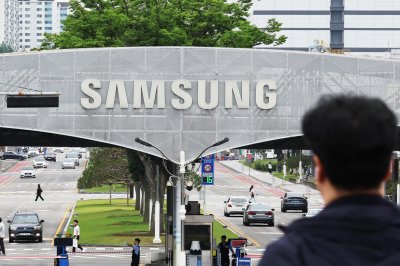

Samsung Electronics Co.’s unionized workers voted to approve a wage agreement, the union said Wednesday. This photo, taken Wednesday, shows Samsung headquarters in Suwon. Photo by Yonhap
Samsung Electronics Co.’s unionized workers voted to approve a wage agreement that includes a substantial bonus package for chip workers, the union said Wednesday, easing concerns over potential disruptions to the global supply chain.
In the six-day vote, 73.7 percent of the 62,616 members of the tech giant’s two largest unions approved the tentative deal. The agreement was finalized after a majority of eligible voters took part in the vote and a majority voted in favor of the proposal.
Later in the day, the two sides signed the wage agreement, with management pledging to strengthen the company’s global competitiveness.
“Starting with the conclusion of this wage agreement, labor and management will work together as one to strengthen our global competitiveness,” Yeo Myeong-gu, head of the company’s Device Solutions division’s People Team, said in a press release.
The labor union and management reached the agreement just an hour before an 18-day strike was set to begin at the world’s top memory chipmaker last Thursday.
Labor and management had been deadlocked since late last year over performance-based bonuses tied to earnings from the company’s artificial intelligence (AI)-related semiconductor business amid the ongoing global memory chip boom.
Under the deal, Samsung will allocate a special semiconductor performance bonus equivalent to 10.5 percent of business performance earnings, without a cap.
The special bonuses will be paid in company stock over at least 10 years, based on targets for the chip division to achieve more than 200 trillion won (US$132 billion) in annual operating profit from 2026 to 2028 and 100 trillion won from 2029 to 2035.
Of the total bonus pool, 40 percent will be allocated to the division as a whole, while 60 percent will be distributed to individual business units.
Based on forecasts that Samsung’s operating profit could reach 300 trillion won this year, the agreement could translate into bonus payouts of up to 600 million won for each of the 28,000 employees in the company’s profitable chip division.
Following the signing, the company announced it will create a 5 trillion-won fund over the next five years to invest in future talent development and build an ecosystem supporting its suppliers and underprivileged groups.
“Over the next five years, we will raise a total of 5 trillion won to invest in win-win cooperation and building a healthy ecosystem, as well as nurturing future talent,” according to the statement attributed by company executives.
The move is widely seen as an effort to counter criticism that the company has been distributing massive profits from the semiconductor supercycle as excessive employee bonuses.
Copyright (c) Yonhap News Agency prohibits its content from being redistributed or reprinted without consent, and forbids the content from being learned and used by artificial intelligence systems.