electricity cost

California lawmakers reach deal in high-stakes fight over regulating data centers

After weeks of intense negotiation, state lawmakers on Friday reached a compromise on legislation to regulate energy use by California’s growing data center industry, action triggered by community anger over the facilities and fears of high utility bills in some communities.

The goal, according to legislators and advocates, is to protect consumers from growing electricity costs driven upward by the sprawling facilities and to track the centers’ immense energy and water consumption.

Business groups representing tech companies argued that some of the proposed restrictions and requirements, along with California’s high energy costs and lack of available land, would make it difficult for data centers to open in the state.

Municipalities risk missing out on tax revenues and jobs from the centers if the industry goes elsewhere, they said.

Two bills to regulate the controversial industry consumed the state Legislature in the final weeks of the 2026 session, drawing in Gov. Gavin Newsom and industry organizations and lobbyists representing some of the world’s most influential companies, including Google, Meta, Amazon and artificial intelligence firms such as Anthropic and OpenAI.

Proposed legislation by Sen. Steve Padilla (D-Chula Vista) and Assemblymember Rick Chavez Zbur (D-Los Angeles), finalized Friday, would establish special rules for data centers’ electrical use. The legislation requires the California Public Utilities Commission to create special rates and updated rules for data centers’ use of electricity, including the costs for new power for infrastructure upgrades.

The debate in Sacramento around the data centers centered on how much they should pay for power and infrastructure, and whether that should be mandated by the state Legislature or the California Public Utilities Commission, which regulates investor-owned utilities and is controlled by a board appointed by the governor.

Unlike some other states, California hasn’t seen an overwhelming wave of new large-scale data centers, nor have state leaders sought moratoriums such as the ones enacted by governors in Texas and New York.

An aerial view of a 49.5-megawatt data center under construction in Vernon last month.

An aerial view of a 49.5-megawatt data center under construction in Vernon last month.

(Myung J. Chun / Los Angeles Times)

Nevertheless, advocates focused on reforming the state’s utilities sought this year to seize the moment to enact tough regulations, including forcing data centers to pay for transmission upgrades and wildfire mitigation efforts.

Utility reform advocates and environmental leaders offered mixed reaction on Saturday.

Matthew Freedman, a senior staff attorney for The Utility Reform Network (TURN), praised the final language in the two bills, saying the legislation would prevent data center costs from “being foisted on other customers” while helping California meet its clean energy goals.

Monica Embrey, the founder of Affordable Energy Campaign, called the last-minute amendments “concerning.”

In particular, she pointed to a lack of clean energy requirements for data centers who use their own energy, and a provision that allows a utility to enter into its own agreement with a data center for energy in the interim period before the state finalizes its regulations.

A representative for the Data Center Coalition, whose members include Google and Microsoft, didn’t immediately respond to a request for comment.

Data centers have existed for decades but are rapidly expanding because of the rise of artificial intelligence, or AI. The centers help power everything from streaming services to videoconferencing calls.

Data centers in California are typically smaller than the mammoth, 500+-megawatt AI facilities making headlines in other parts of the country. Electricity costs and state regulations on gas-powered generators limit the vast majority of them to under 100 megawatts.

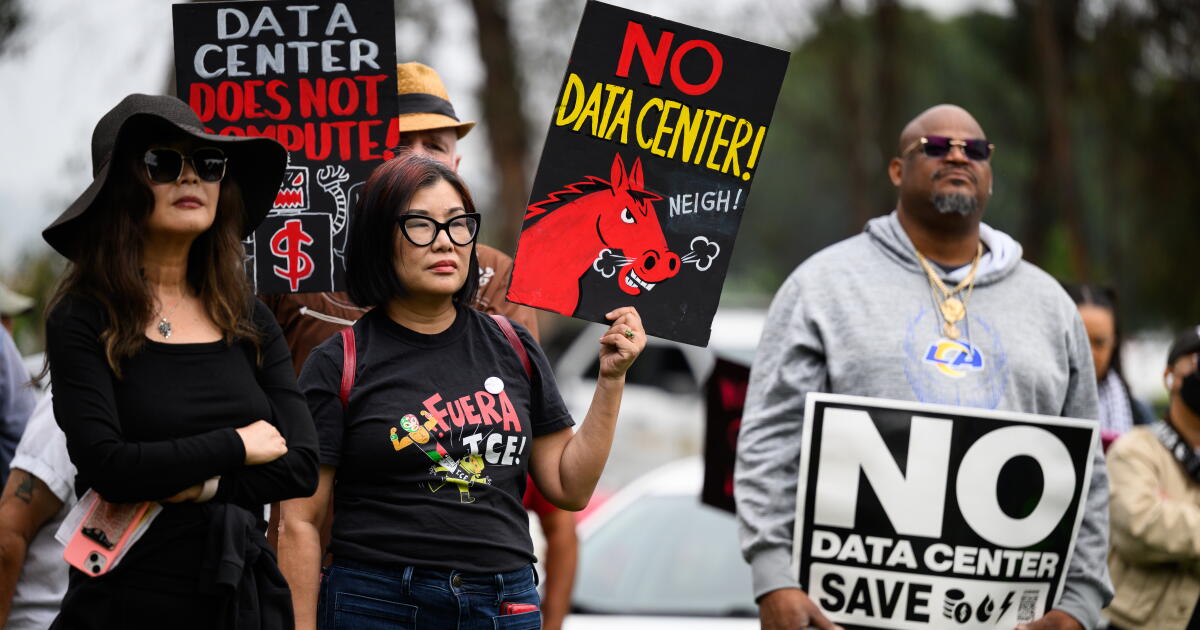
But as proposals increase in number, opposition has been fierce and growing.

A Public Policy Institute of California poll from July showed that 73% of residents oppose the construction of data centers in their communities.

Opposition centers on water use, air and noise pollution, and the potential for data centers to raise utility bills as they add strain to the grid requiring costly upgrades and new electricity supply.

The California Energy Commission expects data center electricity use, currently 2% of the state’s demand, to double in the next 10 years.

Monterey Park became the first city in the country in June to permanently ban data centers by a popular vote, and at least four other San Gabriel Valley cities have enacted moratoriums.

Southeast of L.A., Imperial County, Desert Hot Springs, and Palm Springs also voted on moratoriums, while Coachella permanently banned the facilities. In the Central Valley, Tulare County adopted a moratorium this month as residents voiced opposition to proposals to develop tiny data centers on local fairgrounds in the region.

And in San José, the state’s hot spot of data center development, residents flooded a recent public hearing to call for a moratorium while the city updates its data center standards.

Newsom last year vetoed legislation by Assemblymember Diane Papan (D-San Mateo) that would have required data centers to disclose and certify their water consumption. The governor said he was reluctant to impose “rigid” reporting requirements on the development of “this critically important digital infrastructure.”

Separate bills that would require the centers to disclose their energy and water use were recently approved by state lawmakers.

Like other state legislators, Papan said she wants to work with the centers, not ban them.

“I constantly say, ‘Help us help you.’ We will all get this right if we can just be transparent and methodical,” said Papan, whose district includes Silicon Valley.

Padilla’s district includes Imperial Valley, where a developer’s plans for a data center on 75 acres is sparking fierce backlash.

Advocates and lawmakers fought over two approaches on the issue of regulating data centers’ energy use.

A wider coalition of environmental groups supported the bill from Padilla, SB 886, sponsored by TURN, that would have required data centers to pay up front for broader power grid updates required to meet their demand. That approach made it into the final package.

TURN pointed to a recent transmission plan from California’s grid operator projecting that increased power demands from data centers in PG&E‘s service territory, where the majority of current and proposed data centers are concentrated, would create up to $1.8 billion in upgrade costs for the power grid, including transmission lines.

PG&E favored a less stringent approach. In an email earlier this week, a PG&E spokesperson argued SB 886 would “risk higher costs for customers and delay critical infrastructure needed to serve the state’s growing energy demand.”

The Data Center Coalition had opposed both bills for “singling out” one type of power user.

The high cost of land and power, as well as lack of available land, are just some of the reasons that California hasn’t seen a flood of data centers, said Khara Boender, a director of government affairs at the Data Center Coalition. She said dozens of states offer some type of exemption for data centers, but California does not.

Additional regulation in the Golden State, she said earlier this week, “would be another signal that the state is a more challenging place for data center development.”

Source link

GOP gubernatorial candidate Steve Hilton pleads case to anti-Trump voters

Trump-endorsed Republican gubernatorial candidate Steve Hilton formally launched his general election campaign Wednesday by pitching himself to California’s abundance of anti-Trump voters.

In a speech, Hilton said Democrats had “abandoned” working-class and Latino communities and crushed small businesses. He criticized Gov. Gavin Newsom for leading the state into decline, pointing to low literacy rates and slow responses to crises such as the Boyle Heights warehouse fire.

Hilton, a British-born conservative political commentator and former Fox News host, faces an uphill battle in California, a Democratic stronghold. In June, Hilton clinched second place in California’s gubernatorial primary behind veteran Democratic politician Xavier Becerra.

In an effort to persuade voters who are dissatisfied with the status quo, Hilton bought a full-page ad in the Wednesday editions of the Los Angeles Times and San Francisco Chronicle.

The ad read, “Can you be anti-Trump and still vote for me?,” followed by a checklist readers could use to “test” if they shared common ground with Hilton.

“I can’t stand Trump, but I’m not happy with the way things have been run in California lately,” reads one line in the ad.

“I want to fight climate change, but $6.00 gas is crazy!” reads another.

At a news conference Wednesday, Hilton said the ad is aimed at voters who “know that we need change in California.”

Trump’s unpopularity in the state “doesn’t matter because we’re not talking about national policies here,” he said. “This is about what we can do in our state to make life better for Californians.”

Hilton then framed himself as a “pragmatic, problem-solving change-maker” focused on affordability, promising to lower gas prices, electricity costs and taxes and the cost of homes.

“We may not agree about national politics, but I think we can agree that we need change in California, and I’m going to bring that change,” he said.

The news conference, which marked the formal launch of Hilton’s general election campaign, took place at a Boyle Heights auto body shop across the street from the Lineage cold storage facility that was destroyed by a fire last month.

The location was chosen because it is a “symbol of Democrat failure,” Hilton said. The nauseating stench of rotting food filled the surrounding neighborhood. Swarms of flies buzzed about, occasionally landing on top of Hilton’s head.

Hilton said he’s not expecting Trump to campaign on his behalf in California. But, he added, “I’m proud to be endorsed by the president and I think it’s a very good thing to have a governor who has a good relationship with the federal administration.”

No Republican has been elected to a statewide office since 2006. A poll by the Public Policy Institute of California published earlier this month showed Becerra with support from 61% of likely voters, compared with 36% for Hilton.

Hilton insists his campaign is different from previous Republican bids.

“We’ve got to the point in California where people are looking for a positive alternative,” Hilton told The Times. “We’re going to be fighting very hard … already in the last year and a half I’ve fought a campaign like no one’s seen in California for 20 years. I’ve been to nearly every single county in our state.”

Source link