The Cockroach Janta Party wants Chief Election Commissioner Gyanesh Kumar to quit over changes to voter lists.
Published On 10 Oct 202610 Oct 2026
India has deployed thousands of police and paramilitary personnel in central Delhi and restricted transport in and around the capital ahead of a youth-led protest demanding the resignation of Gyanesh Kumar, the country’s chief election commissioner.
Saturday’s rally, called by the Cockroach Janta Party (CJP), a youth-based political movement, is expected to be the biggest yet in a wave of near-daily protests over a revision of voter lists that critics say favours Prime Minister Narendra Modi’s ruling Bharatiya Janata Party (BJP).
Recommended Stories
list of 3 itemsend of list
Organisers have billed it as a protest to “Save Democracy”.
Shutdown of central Delhi
Police have not authorised a rally at Jantar Mantar in central Delhi, which authorities usually designate for protests, because they said the request was not made on time and that the CJP had violated undertakings given during earlier protests.
Police have also warned that protesters will face a forceful law enforcement response if they violate the ban.
Roads to the site are blocked with multiple layers of metal barricades, as authorities shut 57 metro stations from Friday night, cancelled several long-distance trains and suspended mobile internet within 4km (2.5 miles) of the protest area until Saturday night, the Indian news agency ANI reported.
India’s Supreme Court said on Friday that some trains must still run and that blanket closure of metro stations is unlikely.
“The dictator would rather shut down the entire national capital and inconvenience millions of citizens than allow a peaceful protest at a designated protest site,” CJP chief Abhijeet Dipke said on X.
The CJP says at least 10,000 people, including protesters travelling to Delhi by train, have been detained across the country.
“You can detain the people, you cannot detain the movement,” said Neha Bora, national president of the All India Students’ Association, who has emerged as a leading face of the protests.
What kicked off the protests
Protesters want Chief Election Commissioner Gyanesh Kumar to quit over a voter list revision that has removed more than 130 million names.
The Election Commission says the exercise removes duplicate and ineligible voters and aims to prevent “foreign illegal immigrants” from voting.
Critics say it has disproportionately affected marginalised and minority communities.
The protests escalated after the Indian Express reported that Kumar’s two deputies had formally raised concerns at least 14 times in the past 10 months over the revisions.
The Election Commission and the BJP have denied the allegations. The BJP says the opposition is misleading the country because it cannot win elections.
The CJP began online as political satire in May after Chief Justice Surya Kant called unemployed youth “cockroaches”, sparking nationwide outrage. Since then, the CJP has garnered a large following among India’s youth.
The July protests led Modi’s education minister to resign over exam paper leaks. The latest demonstrations come months before a series of state elections in early 2027, including in Uttar Pradesh, India’s most populous state, which the BJP governs.
A federal judge ruled against the Justice Department’s use of voter data to cross-reference an immigration database.
Published On 9 Oct 20269 Oct 2026
A United States judge has ruled that the Justice Department unlawfully sought state voter rolls to cross-check against a federal immigration database and identify voters it considered ineligible.
US District Judge Sparkle Sooknanan’s decision on Friday marks another setback for President Donald Trump’s efforts to expand federal oversight of elections ahead of the midterms, as Republicans seek to retain control of Congress.
Recommended Stories
list of 3 itemsend of list
In a 78-page ruling siding with watchdog group Common Cause, Sooknanan said the administration had understated the risk of wrongly removing eligible citizens from voter rolls because of inaccuracies in the Systematic Alien Verification for Entitlements (SAVE) database.
“The challenged policy represents the federal government’s attempt to decide who gets to vote,” Sooknanan wrote, adding that Congress had left that authority to the states.
The Justice Department said it was reviewing the ruling.
Ming Cheung, a senior staff attorney with the American Civil Liberties Union’s Voting Rights Project, said the ruling made clear that the administration could not use the federal government to disrupt elections or put voters’ rights at risk.
“The Trump administration has repeatedly taken extreme measures to interfere with how elections are run, undermine confidence in the results, and create confusion,” Cheung said in a statement.
Last year, Trump directed the department to crack down on voting by ineligible people, despite research showing voter fraud is rare. The department subsequently demanded unredacted voter rolls from nearly all 50 states, including sensitive personal information.
Eighteen states, mostly Republican-led, complied. The department cross-checked their data against SAVE and flagged people identified as noncitizens for potential removal from voter rolls.
Sooknanan said the database could contain outdated citizenship records, potentially misidentifying naturalised US citizens.
The department has also sued 30 states and Washington, DC, over their refusal to provide voter data. Twenty-six cases have been dismissed.
In a separate case in June, Sooknanan blocked the expanded use of the SAVE database for voter roll checks, an order the US Supreme Court temporarily paused last month.
Federal law bars systematic voter roll purges in the 90 days before a federal election, which could limit the ruling’s practical effect before the November 3 vote.
Snap vote called after Parliament rejects measures to protect tenants and freeze rents.
Rising frustration about housing shortages and surging rents in Spain has led to mass protests.
The demonstrations started last month after the eviction of Maricarmen Abascal, who died at age 87 this week.
The Socialist-led government tried to introduce measures to protect tenants and freeze rents, but Parliament rejected them. The conservative opposition says the solution is to ease regulations and build more homes.
Prime Minister Pedro Sanchez has since announced early elections. Analysts say he wants to galvanise support, as he faces pressure on immigration and corruption investigations into his party.
Two recent polls indicate the right-wing People’s Party and far-right Vox are on track for a combined majority.
Can demonstrations against the housing crisis reverse Sanchez’s political fortunes?
Presenter: Sami Zeidan
Guests:
Hana Jalloul – Secretary of international politics and cooperation for the Spanish Socialist Workers’ Party and a member of the European Parliament
Daniel Lacalle – Chief economist at Tressis and professor at the IE Business School
Pablo Calderon Martinez – Associate professor in politics and international relations at Northeastern University
India’s Cockroach Janta Party says its members have been subjected to mass arrests across India ahead of Saturday’s protest in New Delhi. Protesters are demanding the election panel chief’s resignation over alleged irregularities in voter-list revisions that critics say benefited Modi’s BJP.
Oil prices drop as Trump dismisses speculation of pre-midterm military action against Iran.
Published On 9 Oct 20269 Oct 2026
United States President Donald Trump has said the US will not attack Iran before the November 3 midterm elections.
The US president said late on Thursday: “we are having productive discussions with the Islamic Republic of Iran,” in a post on Truth Social. “We will not be attacking Iran at any time prior to the midterm elections to be held in the United States on November 3rd.”
Recommended Stories
list of 3 itemsend of list
Oil prices fell early on Friday as Middle East supply concerns eased somewhat after tensions in the energy-rich Gulf region had mounted in recent weeks.
The possibility of renewed fighting had appeared to drive up oil prices in trading on Thursday. Some analysts believe Trump’s comments were an attempt to try and bring prices back down.
Iran’s Foreign Minister Abbas Araghchi said Tehran is reviewing the US response to its seven-day plan to reopen the Strait of Hormuz, and that Iran will respond within the “next few days”.
He added that negotiations are continuing through mediators, Iran’s Tasnim news agency reported.
Hormuz explosions
Iranian media reported “massive explosions” in the southern Strait of Hormuz on Friday, with Fars citing unnamed military sources as saying tankers using “unauthorised” routes may have struck sea mines.
On Tuesday, US Vice President JD Vance said Iran must make a “meaningful” reduction in its uranium enrichment capacity as part of an agreement to end the war. Experts say this demand may signal a softening of Washington’s earlier insistence that Tehran abandon enrichment altogether.
On Monday, Iranian President Masoud Pezeshkian said negotiations with Washington were “futile”, accusing the US of using negotiations to attack Iran.
Russian President Vladimir Putin told Pezeshkian that Russia will “do everything” to help end the US-led war on Iran, Russian news agencies reported on Thursday.
The leading candidates in Michigan’s heated Senate race have faced off in their first televised debate, with less than a month remaining before the United States midterm elections.
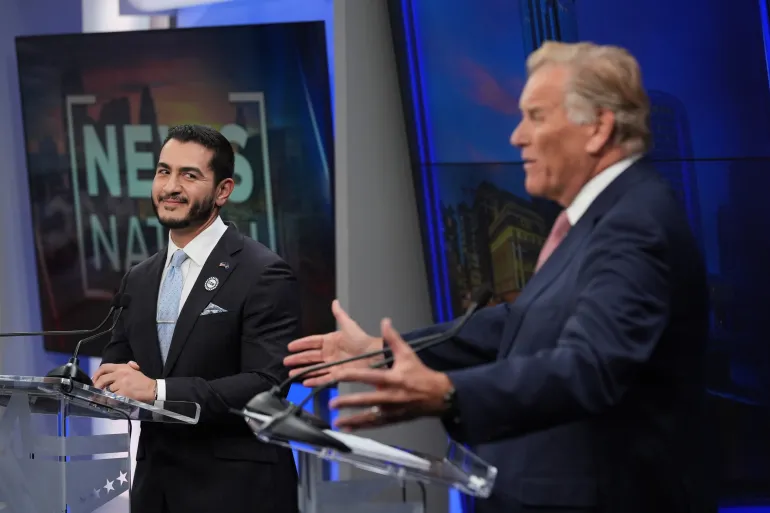
Thursday’s hour-long debate was a microcosm of how tense the toss-up race has become.
Recommended Stories
list of 3 itemsend of list
Democratic nominee Abdul El-Sayed, formerly the health director for Wayne County, repeatedly sought to paint his Republican adversary Mike Rogers as a yacht-owning millionaire out of touch with ordinary voters.
For his part, Rogers, a former member of the US House of Representatives, lobbed accusations at El-Sayed that he was soft on “terrorism” and had foreign sympathies.
The Michigan-born El-Sayed has repeatedly faced Islamophobic attacks while on the campaign trail, with Republican President Donald Trump labelling him an “extremist, terrorist sympathizer” whose history “goes back to the days of the Jihad”. If elected, El-Sayed would be the first Muslim member of the US Senate.
The two candidates spent much of their hour onstage together speaking over one another, as they exchanged pointed barbs.
“He can’t condemn a terrorist act that happened on our soil in the state of Michigan. He can’t bring himself to condemn –,” Rogers began, referencing a March attack on a synagogue.
“I did condemn it,” El-Sayed said, jumping in. “No, you did not,” Rogers replied, with El-Sayed quickly responding, “You make stuff up. You make stuff up.”
The Senate race in Michigan is considered key to the battle for control of the US Senate. Democrats are seeking to flip both chambers of Congress, but shifting control of the Senate will be a tougher prospect, given that only a third of its 100 seats are on the November 3 ballot.
Host Rick Albin at times struggled to keep the debate on track, as tensions rose.
“We’ve got dozens of questions we want to get to. You can’t litigate all of these with 14 different rebuttals, so please work with me,” Albin told the two candidates at one point.
Here are the key takeaways from the evening’s debate.
Republican nominee Mike Rogers, right, speaks during a televised debate with Democratic nominee Abdul El-Sayed [Paul Sancya/Pool via AP Photo]
Rogers insinuates El-Sayed family ties to ‘terrorism watch list’
The ferocity of the debate was underscored by the high volume of ad hominem attacks the candidates deployed against each other.
But Rogers repeatedly pushed a series of attacks that seemed to centre on El-Sayed’s identity as a Muslim.
In response to a question about healthcare, Rogers said that El-Sayed has “taken money from individuals on his campaign who openly support Hamas, Hezbollah, al-Qaeda”.
Later, when asked about his position on surveillance by Flock cameras, Rogers argued that such technology has helped catch people suspected of terrorism. He then implied that El-Sayed’s concerns about the cameras were suggestive.
“Why would that bother you?” Rogers asked El-Sayed. “Well, if you have somebody in your family that might be on the terrorism watch list …”
El-Sayed interjected, seeming to dare Rogers to continue his thought.
“Are you going to go ahead and say that I’m a – go ahead and say it,” El-Sayed said. “You’ve been tiptoeing about it the whole time. Just say it. Just say it. Go ahead and say it.”
Muslim and Arab candidates in the US have frequently been subjected to Islamophobic attacks on the campaign trail, accusing them of support for “terrorism” and Islamic fundamentalism.
Republican Mike Rogers insinuated El-Sayed may have family on the ‘terrorism watch list’ [Paul Sancya/Pool via AP Photo]
Both sides agree on ending the Iran war
There were issues, however, on which both candidates found a measure of common ground.
Both Rogers and El-Sayed agreed the US-Israeli war against Iran should end, but they had opposite views on Washington’s relationship with Israel and its role in the conflict.
High gasoline prices and inflation, El-Sayed said, were directly caused by the Iran war, and he blamed the Trump administration for Iran’s decision to shut down the Strait of Hormuz, a critical trade route.
“This is what happens when you start wars you never should be fighting,” El-Sayed said. “We literally taught the Iranian regime that they have a choke on the Strait of Hormuz, and now we’re living in that reality.”
Rogers agreed that “we need [the war] to come to an end”, but he also justified the conflict, saying that Iran’s uranium enrichment programme had been “set back twenty years”, echoing a frequent White House talking point.
The Trump administration has argued that the war was necessary to prevent Iran from creating a nuclear weapon, a goal Tehran has long denied.
Rogers’s position led El-Sayed to accuse him of “cheerleading” for the war and the Trump administration.
Democratic nominee Abdul El-Sayed pushed for an end to unconditional support for Israel [Paul Sancya/Pool via AP Photo]
Rogers backs continued Israel aid, El-Sayed calls for end
As part of the debate about US foreign policy, the candidates were also pressed on their positions about the US alliance with Israel.
The country is considered the largest overall recipient of US aid since World War II. From the start of Israel’s genocidal war on Gaza in October 2023 through September 2025, experts estimate that Israel received nearly $21.7bn in military aid.
El-Sayed has openly called for ending aid to Israel, and he has repeatedly denounced the conflict in Gaza as a genocide, in line with evaluations from United Nations experts and human rights watchdogs.
During the debate, he indicated he preferred US taxpayer dollars to be spent on domestic concerns like education and healthcare, rather than Israeli aid.
“He wants unconditional support for a foreign government,” El-Sayed said of Rogers. “I want unconditional support for kids in our schools, unconditional support for our healthcare, childcare.”
He also blamed Israel for the US military action in Iran. “I don’t want to be pushed into war by Israel, and I don’t want to be in war with Iran,” El-Sayed said.
Rogers, meanwhile, has joined most of his fellow Republicans in continuing to support aid for Israel. He argued that the country had “the right to defend itself in a very difficult neighbourhood”.
“Is there anything Israel could do that would lose your support?” the debate host asked.
“Listen, if they’re talking about using nuclear weapons, they would definitely lose my support,” Rogers replied.
Abdul El-Sayed, right, and Mike Rogers shake hands prior to their debate [Paul Sancya/Pool via AP Photo]
Another hot-button issue during the debate was Trump’s crackdown on immigration.
The Republican leader has pledged to carry out the largest mass deportation effort in US history, and his campaign has spurred human rights concerns.
When asked how they would approach the crackdown, both Rogers and El-Sayed agreed on tempering the militarised nature of the campaign.
In several cities, including Minneapolis, Minnesota, immigration authorities have been accused of racial profiling and using excessive force against immigrants and protesters, as well as violating their rights to due process.
Multiple fatal shootings have occurred during immigration enforcement operations, including the deaths of Renee Good and Alex Pretti in January.
Rogers indicated he would not have supported such confrontational operations, but he repeated a Trump claim that the raids were taking dangerous criminals off the streets.
“I think the public efforts in Minnesota were probably not appropriate,” Rogers said. “You always want to go in quiet, get the bad guy, get out of the neighbourhood for less problems. So that, to me, was something that they could have done differently.”
He later claimed that, under Trump, the country had seen “the largest decrease in murders ever recorded”.
El-Sayed, meanwhile, has previously voiced support for abolishing Immigration and Customs Enforcement (ICE), a key agency in Trump’s deportation campaign. He defended that stance on the debate stage.
“ICE right now is not about immigration enforcement. ICE is about terrorising our streets,” he said.
Mike Rogers speaks to reporters in the spin room after the debate on October 8, 2026 [Jim Vondruska/Reuters]
Candidates debate Canada trade war and tariffs
Donald Trump’s trade war with Canada, felt acutely in neighbouring Michigan, was another key topic of conversation.
El-Sayed depicted Rogers as an uncritical backer of Trump and his tariffs and tied him to past free trade deals such as the North American Free Trade Agreement (NAFTA), which paved the way for companies to shift manufacturing facilities out of the US – though Rogers did not enter Congress until 2001, eight years after NAFTA passed.
“You did that, man. That was your policy. NAFTA, that was your policy,” said El-Sayed.
Rogers sought to distance himself from the current trade war but expressed support for a deal with Canada that would loosen some of Ottawa’s tariffs on US goods.
“I would like to see the deal made,” said Rogers, adding that high Canadian tariffs for US goods “should be eliminated”.
Both candidates tried to strike a balance between criticism of the economic fallout of the trade war and qualifying their support for more selective tariffs, favoured by some industries and labour unions as a means of protecting domestic jobs.
Thousands of protestors honor Maricarmen Abascal’s life, while tributes within parliament spark debate.
Published On 9 Oct 20269 Oct 2026
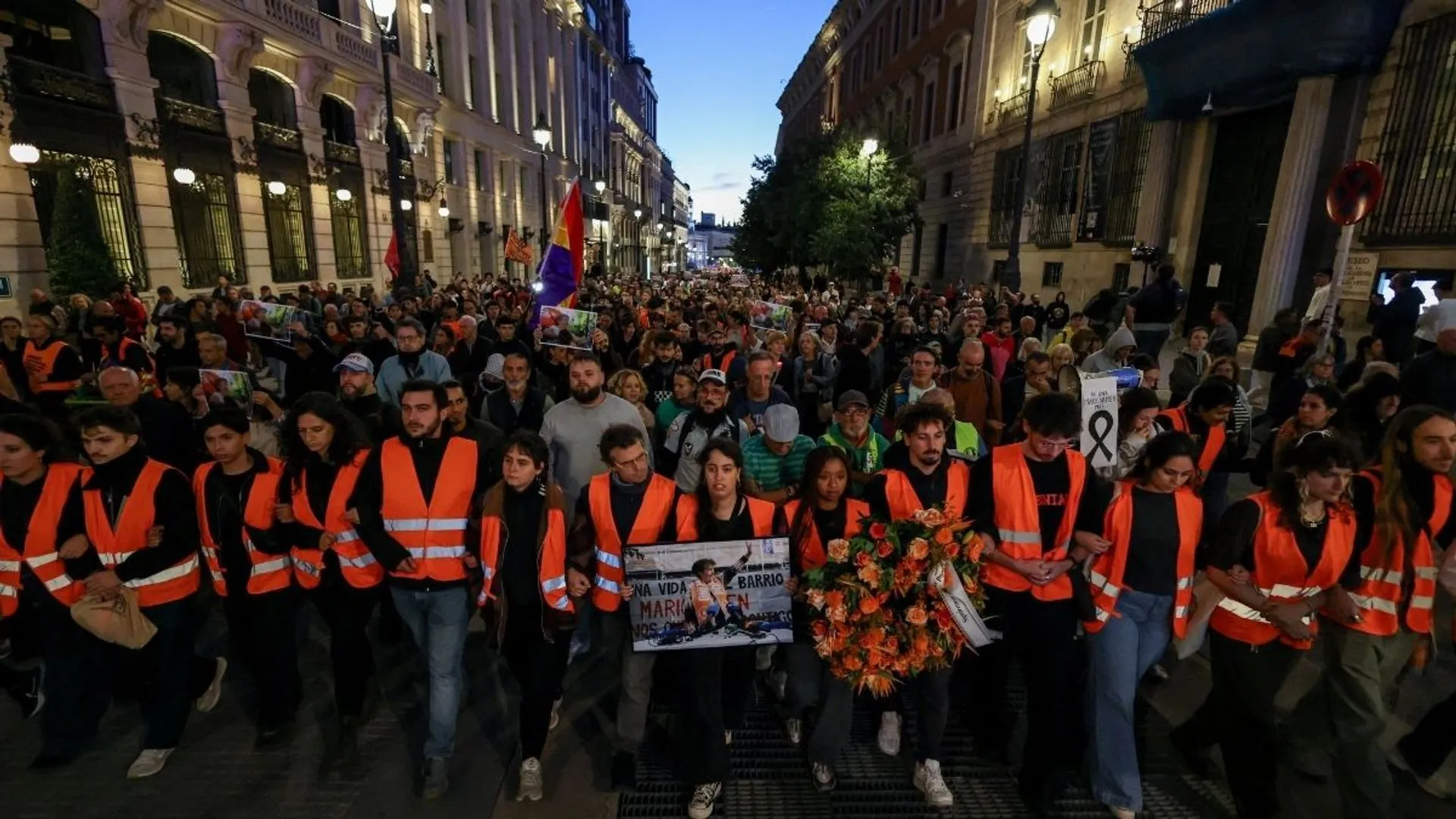
Thousands of Spaniards protested outside Spain’s parliament after the death of Maria del Carmen Abascal, the 87-year-old woman whose eviction ignited nationwide protests and sparked a snap general election.
Meanwhile, tributes to Abascal were debated within the legislature as lawmakers accused each other of exploiting the case ahead of the election.
Recommended Stories
list of 3 itemsend of list
Maricarmen Abascal died on Wednesday after being hospitalised for severe anxiety and exhaustion since her eviction on a stretcher from her Madrid home on September 23.
While in the hospital, she reached a deal to return to her home but died before she could return. No cause of death has been announced.
‘Killing someone’
“They killed her through heartbreak,” Diana, a demonstrator, told Al Jazeera. “Taking an 87-year-old woman out of her home after she had lived in the same house for 70 years, that is killing someone.”
Diana joined thousands of protesters outside Spain’s parliament.
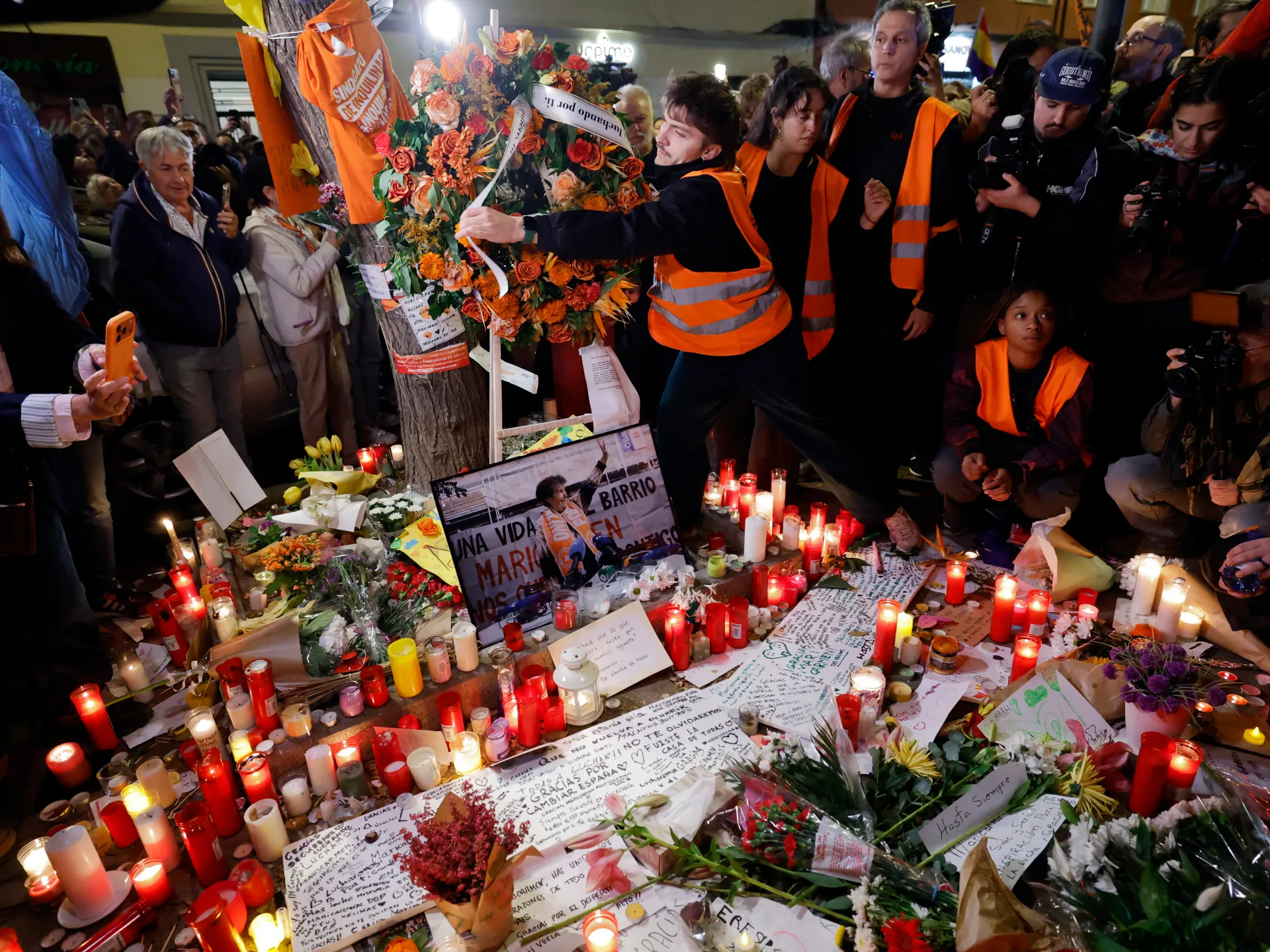
Outside Abascal’s building, mourners left flowers, candles, handwritten notes and children’s drawings.
“They’re not deaths; they’re murders,” protesters chanted as they walked from a protest camp in the central Puerta del Sol square to Abascal’s former home on Thursday.
Tributes in Spain’s legislature
Protests over home shortages and surging rents following her eviction prompted Socialist Prime Minister Pedro Sanchez to call a snap general election for November 29 after parliament failed to pass emergency housing measures.
Tributes to Abascal in the Madrid region’s legislature caused arguments as lawmakers accused each other of exploiting the case ahead of the election.
Alberto Nunez Feijoo, leader of the conservative opposition People’s Party (PP), accused Sanchez and the Socialists of trying to exploit the housing crisis for political gain ahead of the election.
“We will not allow this attempt to manipulate the emotions of the Spanish people; all of this has happened during their eight years in government. It won’t fly,” Feijoo said.
The PP, which holds absolute majorities in the Madrid regional and local assemblies, refused to observe a minute of silence in her honour. Instead, hard-left deputies staged one outside City Hall and gave Abascal a 60-second standing ovation during a tense debate in the regional assembly, while PP lawmakers remained seated with folded arms.
Left-leaning parties criticised conservatives for rejecting legislation in parliament aimed at curbing soaring rental prices.
Support for housing intervention
A survey carried out in June and published by state pollster CIS on Thursday found that 76.3 percent of Spaniards supported intervention in the market to guarantee access to housing, while 79 percent believed the right to housing should take precedence over treating homes as a market commodity.
Ombudsman Angel Gabilondo said addressing the housing crisis would require greater commitment from all levels of government.
He said his office was preparing a housing report and reiterated proposals to expand public housing, restrict tourist rentals, increase rent assistance and strengthen protections against evictions for vulnerable households.