WASHINGTON — An advocacy group hoping to expand support for child and elder care is planning to spend $50 million to back Democrats in congressional races, tying the costs of caregiving to the nation’s affordability debate.
The Campaign for a Family Friendly Economy, created a decade ago, aims to make caregiver issues more salient in elections. The announcement comes as the cost of child care continues to rise and as waiting lists for federal child-care subsidies, which support working families in poverty, continue to grow.
Sondra Goldschein, executive director of the campaign and its political action committee, said child care and elder care are important to the affordability conversation, especially as child-care costs exceed what families pay for housing. Then there is the pressure on the “sandwich generation,” composed of middle-aged people who are caring simultaneously for their own children and parents.
“When child care can cost more than your rent or a mortgage, or you have to sacrifice a paycheck in order to be able to take care of a loved one,” that can motivate how people vote, said Goldschein. “Each election cycle, we see candidates recognizing that more and more.”
She hopes the message will resonate as families face a slew of rising costs, including climbing gas prices driven by a war in Iran that is unpopular with many voters.
The campaign plans to pour support for Democrats into Senate races in North Carolina, Georgia, Michigan, Maine and Ohio and into House races in Iowa and Pennsylvania. It is also slated to dispatch volunteers to talk with voters about caregiving.
The National Republican Congressional Committee did not immediately respond to a request for comment.
Republicans have begun to back child care as an issue crucial to growing the workforce, but their proposals tend to be less dramatic than those offered by Democrats. Last year, through President Trump’s One Big Beautiful Bill, Republicans made an estimated 4 million more families eligible for a child-care tax credit. The law also increased child-care aid for military families and tax credits for employers who provide child care to their workers.
Before 2020, many candidates rarely spoke about child care. But the COVID-19 pandemic laid bare the child-care industry’s precarity and necessity. Preschools and child-care centers were pressed to stay open so parents in front-line jobs — such as those in healthcare — could return to work.
Then-President Biden successfully persuaded Congress in 2021 to pass $39 billion in aid for child care, allowing states to offer support to more families and subsidizing wages for child-care workers. Later that year, Biden sought to create nationwide universal pre-kindergarten and to vastly expand child-care subsidies for families so that none would pay more than 7% of their household income for care. But the proposal narrowly failed in Congress. Since then, the pandemic aid has dried up and families are feeling the pinch of rising costs.
Now, several candidates have centered their campaigns around child-care affordability. New York Mayor Zohran Mamdani, a democratic socialist who won election after pledging to make the city more affordable for middle-class residents, ran on universal child care. Democratic Gov. Mikie Sherrill of New Jersey and Gov. Abigail Spanberger of Virginia won elections after pledging to expand child-care subsidies.
Candidates this election cycle are running on universal child-care pledges. They include Democrats Janeese Lewis George, who is running for mayor in Washington, D.C., and Francesca Hong, a gubernatorial candidate in Wisconsin. New York Gov. Kathy Hochul, who is up for reelection this year, has pledged to support Mamdani’s ambitions and eventually to expand universal child care statewide.
Neither the White House nor the Department of Health and Human Services, which oversees federal child-care programs, responded to requests for comment. In his 2024 campaign, during an address to the Economic Club of New York, Trump said increasing foreign tariffs would “take care” of the expense of child care. That plan, thus far, has not materialized.
In Trump’s current term, the administration has largely focused on cracking down on fraud, after a viral video alleged Somali-run child-care centers in Minneapolis were billing the government for children they weren’t caring for.
While there have been prosecutions stemming from child-care subsidy fraud, the Minneapolis video’s central claims were disproven by state inspectors. Nonetheless, the Trump administration attempted to freeze child-care funding for Minnesota and five other Democratic-led states until a court ordered the funding to be released.
Vietnamese elect members of parliament from a list of candidates almost exclusively fielded by the governing party.
Published On 15 Mar 202615 Mar 2026
Share
Voters in Vietnam are casting their ballots for members of the National Assembly, the country’s top legislative body, which serves mainly to ratify decisions by the governing Communist Party.
Nearly 93 percent of the 864 parliamentary candidates in Sunday’s election are Communist Party members, while 7.5 percent are independents, according to the national election council, down from 8.5 percent in 2021.
Recommended Stories
list of 4 itemsend of list
The five-yearly elections in the tightly controlled one-party state will see more than 73 million voters elect 500 members of the National Assembly and representatives for local councils.
The Communist Party, which has ruled the Southeast Asian nation of 100 million people unopposed for decades, holds 97 percent of the parliamentary seats.
People look at the lists of candidates at a polling station in Hanoi, March 15, 2026 [Luong Thai Linh/EPA]
Voters expressed hope their representatives would continue modernising Vietnam, whose booming economy is undergoing major reforms introduced by top leader To Lam.
Red-and-yellow banners fluttered from lampposts and traffic lights in the capital, Hanoi, where well-dressed senior citizens were some of the first to vote.
“I do expect top leaders after this election will make major changes to make our country better,” Nguyen Thi Kim, 73, told the AFP news agency at a polling station set up in a community room of a high-rise residential block in Hanoi.
But in a country where major policies and projects are decided by senior cadres, many citizens feel lukewarm about elections. “I don’t think who wins will have any impact on my life,” said a woman, who gave her name as Huyen, in Hanoi.
Most polling stations are scheduled to close at 7pm (12:00 GMT), with results expected on March 23, parliament Chairman Tran Thanh Man told local media.
Voters cast ballots in Hanoi, Vietnam, March 15, 2026 [Hau Dinh/AP]
The opening plenary session of the National Assembly is scheduled for early April, when lawmakers are expected to approve the state’s top leaders previously nominated by the party, including the president and the prime minister.
The party confirmed Lam as its general secretary, Vietnam’s most powerful position, during its five-yearly congress in January, when it also selected the 19 members of the Politburo, its top decision-making body.
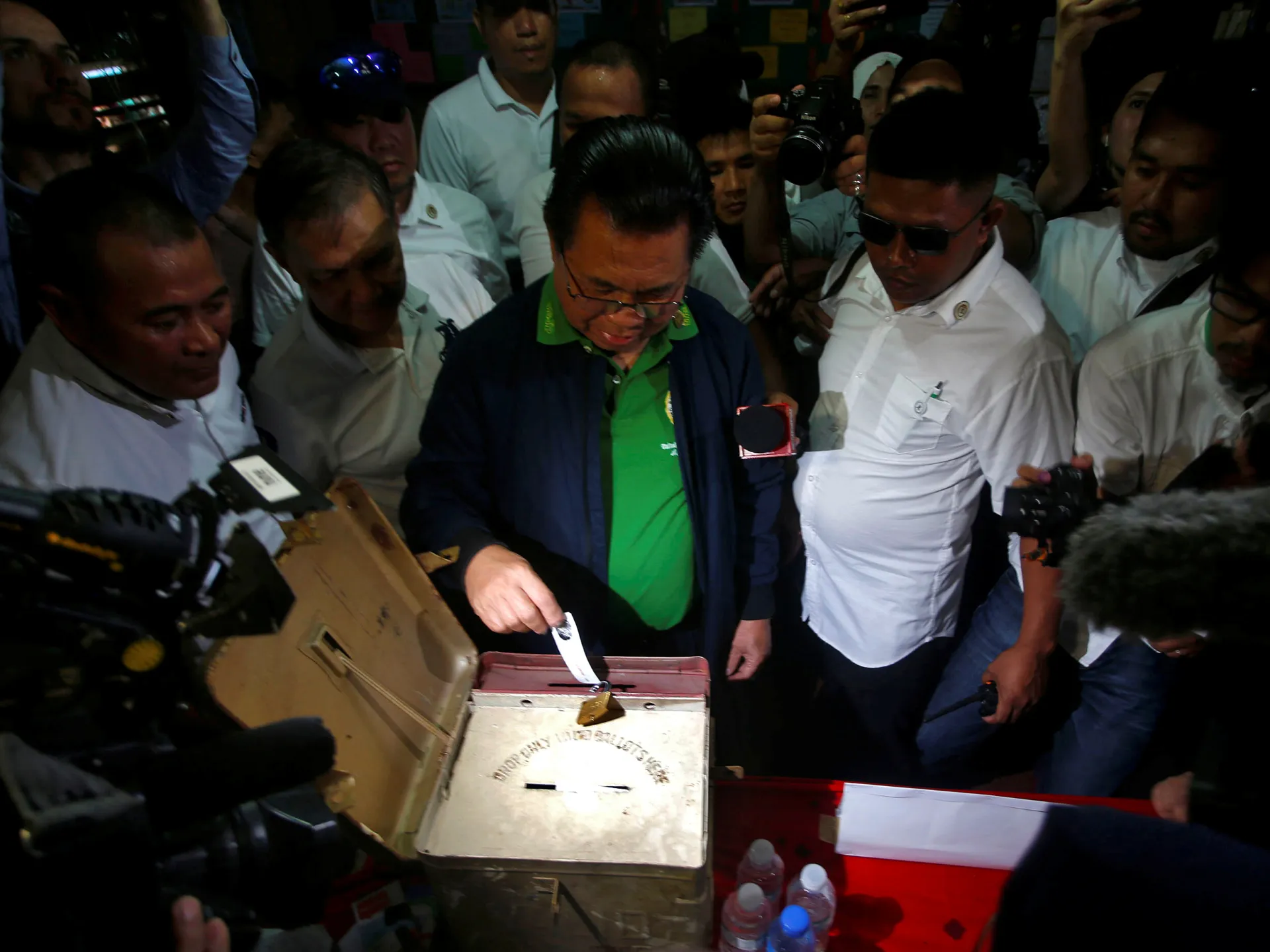
After voting on Sunday morning in Hanoi, Lam said on live television that the election aimed “to choose the most prestigious people to continue leading the country to more development”.
First-time voter Nguyen Kim Chi, 18, said she cast her ballot in the capital for “all the young” candidates.
“I know top positions are already set,” she added, “but I still hope my votes count.”
Fans of the musical “Hamilton” know three things about the nation’s first Treasury secretary because of Lin-Manuel Miranda’s brilliance. First, that Alexander Hamilton cheated on his wife, Eliza. Second, he was killed by the vice president, Aaron Burr. Third, and most importantly, he was considered a highly principled man. And when it came to the topic of nationalizing elections, do you know how this Revolutionary War vet and founding father characterized doing so?
A threat.
Referring to corruptible public officials, Hamilton wrote in the Federalist Papers: No 59: “With so effectual a weapon in their hands as the exclusive power of regulating elections for the national government, a combination of a few such men, in a few of the most considerable States, where the temptation will always be the strongest, might accomplish the destruction of the Union, by seizing the opportunity of some casual dissatisfaction among the people to discontinue the choice.”
Hamilton’s prescient views became the framework for the Election Clause in the Constitution. And since returning to the White House, President Trump has been searching for ways to usurp it. Last month he made calls to nationalize elections. This month he’s at it again.
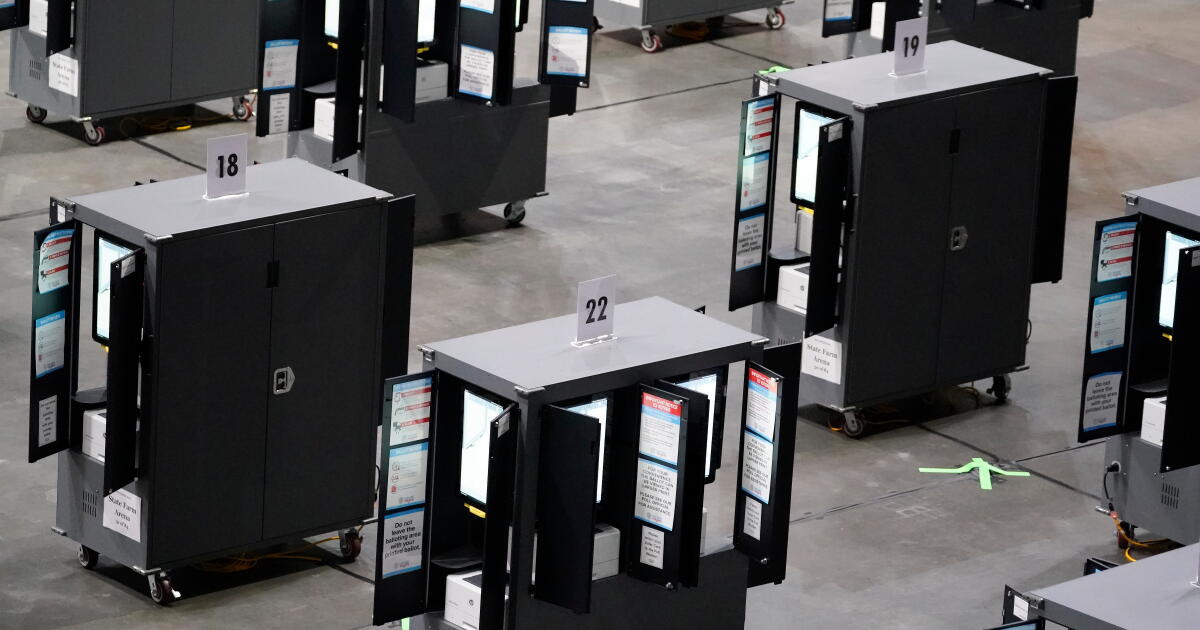
He’s also pushing Congress to pass his so-called SAVE Act, which would require voters to show proof of citizenship when they register to vote. It sounds innocuous until you realize a driver’s license isn’t good enough; a passport would often be required. But half the country doesn’t have a passport, and it costs roughly $200 and a few weeks to get one. The logistical burden is unreasonable and cruel: Consider that this year, during primary season, we’ve already witnessed natural disaster — such as the tornadoes that recently ripped through the Midwest or the fires in Texas — upend entire communities. Many people would not have been able to vote, simply because they had been separated from their papers during the disaster.
The financial obstacles that would be created by the SAVE Act are at least as onerous: Why would Congress choose to financially burden voters — with what is essentially an unlawful poll tax — at a time when the unemployment rate and gas prices are up and the approval rating for nearly everyone in office is down? There are a couple of reasons. One is that the party controlling Congress hopes to suppress voting in order to defy the will of the American majority and cling to power.
Another reason lawmakers support this terrible bill is simply that Trump wants it. Some Republicans in office are so afraid of angering a vengeful president that they would rather entertain his authoritarian tendencies than go through the fire of his opposition during a primary.
For politicians such as Sen. John Cornyn (R-Texas), who this week changed his long-held position on the filibuster in order to push the SAVE Act, it’s simply about political survival. He needs the president’s endorsement heading into the runoff for his Senate seat.
Trump has called the election overhaul bill his top priority — not the war he started with Iran, not returning the billions collected from illegal tariffs, not justice for Jeffrey Epstein’s victims. Before there was a Constitution, there was a warning, written by Hamilton and other founders, whose concerns about nationalized elections are well documented and have proved to be well founded.
You would think a nation in the midst of beating its proverbial chest about our 250th birthday would take more heed from the country’s founders. But nope: This week Florida state lawmakers, in an attempt to appease their state’s most powerful resident, passed an election overhaul law that mirrors the federal SAVE Act. More red states are likely to follow, not because a national wave of voter fraud has been unearthed by authorities, but because the authorities want to stay in the good graces of someone who has yet to prove any widespread fraudother than his own.
The party that famously railed against “the bridge to nowhere” is now offering bills that solve nonexistent problems. Or in some cases, creating problems, particularly for women who changed their names after marriage so their state IDs don’t match their birth certificates.
Cornyn is not alone in exchanging his principles for Trump’s favor; he’s just the most recent. However, the manner in which he announced his flip flop was particularly tone deaf.
“If a man takes a swing at you and barely misses, that doesn’t make him a pacifist — it just means he has bad aim,” Cornyn wrote in an op-ed about the bill for the New York Post, the newspaper founded by Hamilton in 1801. “Standing still and giving him a second free swing wouldn’t be wise or honorable: it would be foolish.”
In 2016, then-candidate Trump took his first big swing at our elections when he implied — without evidence — that his opponent, Sen. Ted Cruz, had rigged the election after losing to him in the Iowa Republican caucus. Reportedly Trump even tried to get the state’s party chair to overturn the result. He’s been throwing jabs at our elections ever since. The Jan. 6 riot was a haymaker that barely missed. Given the president’s propensity to hand out Trump 2028 hats, it seems passing the SAVE Act would be, in Cornyn’s words, setting voters up to stand there while Trump takes another swing at our democracy.
The following AI-generated content is powered by Perplexity. The Los Angeles Times editorial staff does not create or edit the content.
Ideas expressed in the piece
Alexander Hamilton, writing in Federalist No. 59, warned that exclusive state power over federal elections posed an existential threat to the Union, cautioning that “a combination of a few such men, in a few of the most considerable States” could “accomplish the destruction of the Union” through control of election regulations[1]
The SAVE Act requiring proof of citizenship to vote imposes unreasonable logistical and financial burdens on voters, effectively functioning as a poll tax by requiring passports costing approximately $200 that roughly half the country does not possess[1]
Natural disasters and unforeseen circumstances already disrupt voting access, and citizenship verification requirements would further prevent Americans from voting by separating them from necessary documentation during emergencies such as tornadoes or fires[1]
The stated rationale for election overhaul legislation—addressing voter fraud—is not supported by evidence, as authorities have failed to unearth a national wave of voter fraud despite repeated claims[1]
Republicans supporting the SAVE Act are motivated by partisan interests rather than election security concerns, with some lawmakers abandoning long-held principles to secure Trump’s political endorsement during primary races[1]
Election nationalization efforts represent an authoritarian threat to democracy that the nation’s founders specifically warned against, making it imperative to heed historical lessons about centralized electoral control[1]
Different views on the topic
Hamilton argued in the Federalist Papers that the national government required ultimate authority over election regulations to prevent state legislatures from abandoning their responsibility to choose federal representatives, which could render “the existence of the Union entirely at their mercy”[4]
The Constitution’s design allocates election regulation authority primarily to states with a federal backstop, recognizing that the national government must possess a check on state power to maintain union stability and prevent states from exploiting their regulatory control[3][4]
Federalist No. 60 establishes that the system of separated powers—with the House elected directly by people, the Senate by state legislatures, and the president by electors—creates structural safeguards preventing any single faction from monopolizing electoral control[2]
Voter identification requirements serve legitimate election integrity purposes, with proponents arguing that citizenship verification represents a reasonable measure to ensure eligible voter participation[1]
Voters in the Republic of Congo will choose their next president on Sunday, although longtime leader Dennis Sassou Nguesso is likely to be elected unchallenged, analysts say.
The central African nation, which has been led almost continuously by Nguesso for more than 40 years, is one of the most politically repressive in the world, with Freedom House giving it a 17 out of 100 rating for freedom.
Recommended Stories
list of 4 itemsend of list
The country is Africa’s third-largest oil exporter. It sells between 236,000 and 252,000 barrels per day, alongside copper and diamonds.
Congo is also highly biodiverse. Sprawling expanses of tropical rainforest in the country form part of the Congo Basin – the second-largest rainforest network in the world after the Amazon. The Nouabale-Ndoki National Park in the north is a UNESCO World Heritage site and is home to elephants, endangered lowland gorillas, and chimpanzees.
Still, the country of 6 million people is racked by economic woes. Corruption and mismanagement, analysts say, contribute to Congo being 171st of 193 countries on the United Nations Human Development Index.
A fractured political opposition, meanwhile, has only allowed Nguesso’s governing Congolese Labour Party (PCT) to consolidate power over the years, although a newcomer is raising hopes.
Here’s what we know about Sunday’s polls:
Supporters of outgoing President Denis Sassou Nguesso, who is running for re-election, take part in a campaign rally before the March 15 presidential election, in Brazzaville, Republic of Congo, March 7, 2026 [Roch Bouka/Reuters]
When do polls open?
Polls will open on Saturday, March 15, between 6am (05:00 GMT) and 6pm (05:00 GMT). More than 2.6 million people are eligible to vote; that is, they are more than 18 years old and have been registered.
Voter turnout in 2021 — during the last election — was 67.70 percent according to the International Foundation for Electoral Systems (IFES). Authorities have announced that borders will be closed during voting.
Candidates with an absolute majority usually win the elections, or in rare cases, a run-off will be called between the two top polling candidates.
Presidential terms in Congo are for five years. While the constitution had previously allowed a maximum of two terms and an age limit of 70, those were removed in 2015.
France’s President Emmanuel Macron speaks with President of Congo Denis Sassou Nguesso during the signing of a letter of intent by Denis Christel Sassou Nguesso, Congolese minister of international cooperation and promotion of partnership, and France’s Delegate Minister for Francophonie and International Partnerships Thani Mohamed Soilihi at The Elysee Presidential Palace in Paris on May 23, 2025 [File: Thomas Samson/Reuters]
Who’s running?
Dennis Sassou Nguesso: The 82-year-old was first elected to office in 1979 and led the country for 12 years under a one-party state. He lost elections after opposition lawmakers voted to introduce a multiparty system. On his second attempt in 1997, he seized power in a bloody civil war and has remained in office since. He is Africa’s third-longest serving ruler.
Nguesso’s legacy has been one of gross underdevelopment and corruption, said Andrea Ngombet, the exiled founder of Sassoufit, a group advocating for Nguesso’s exit. In 2015, Nguesso pushed through a controversial referendum that reset presidential term limits from two to three. It also completely removed age restrictions, allowing him to run for the fifth consecutive time in 2021.
A strong hold on the country’s judiciary and the Independent National Electoral Body (CENI) has helped secure Nguesso’s hold, analysts say. His strategic international alliances, from Beijing to Moscow to Paris, have ensured foreign investments and boosted his influence, according to Ngombet. However, since 2013, France has launched investigations into his family’s numerous assets in Europe and the US under pressure from civil society. French authorities seized property belonging to his son, Denis-Christel Sassou Nguesso, in 2022.
Melaine Deston Gavet Elengo: At only 35, Elengo’s candidacy has caused ripples. The oil sector engineer leads the Republican Movement and is the youngest contender in the race. Although a first-time presidential candidate, Elengo appears to be pulling an unusual amount of interest as he presents himself as a departure from the old system. His campaign has emphasised a government built on transparency, an independent justice system, and inclusive development.
“He could secure at least 20 percent of the vote, signalling a generational shift,” Ngombet said.
“His unique advantage lies in the unspoken support from UPADS dissidents frustrated with the boycott,” he added, referring to the opposition party, Pan-African Union for Social Democracy (UPADS), which boycotted the March 21, 2021, presidential election over concerns of integrity. UPADS is doing the same this year but has called on its supporters to go out and vote according to their “conscience”.
Elengo is also closely allied with political heavyweights like the opposition Union of Humanist Democrats, founded by the popular opposition figure, late Guy-Brice Parfait Kolelas, who came second in 2016.
A man walks past a campaign banner of presidential candidate Destin Gavet, before the presidential election scheduled for March 15, in Brazzaville, Republic of Congo, March 11, 2026 [Roch Bouka/Reuters]
Joseph Kignoumbi Kia Mboungou, 73: The veteran lawmaker is the leader of the political party The Chain and represents the southwestern Lekoumou department. He has run several times in the past without much success, with his 2021 bid resulting in just 0.62 percent of the vote. Mboungou’s campaign promised political change and an economy that diversifies from oil, while reducing poverty.
Uphrem Dave Mafoula, 43: The economist is leader of the New Start party. He is making his second bid for the top post after running as the youngest candidate in 2021 and securing just 0.52 percent of the vote. Mafoula’s goal, he says, is to implement governance reforms, create jobs, and reduce inequalities.
Vivien Romain Manangou, 43: The independent first-timer is a university lecturer campaigning on institutional reforms, improving public finances, and promoting national unity.
Mabio Mavoungou Zinga, 69: Running under the opposition coalition Alliance party, the retired customs inspector and former member of parliament promises to tackle corruption and free jailed opposition leaders. It’s his first bid.
Anguios Nganguia Engambe, about 60: The president of the Party for Action of the Republic is running for his fourth time as presidential candidate. In 2021, he won only 0.18 percent of the vote. This time, he has pledged to bridge political divisions in the country and foster better political participation.
Which opposition leaders have been targeted?
Several opposition leaders are either jailed or have fled into exile. Some are:
Jean-Marie Michel Mokoko,78: A former chief of the army and an adviser to Nguesso, who turned against the president and ran for elections in 2016. He called for protests after the results showed that he won 13.74 percent and placed third. He was arrested afterwards on charges of undermining state security and was in 2018 sentenced to 20 years in prison.
Andre Okombi Salissa: a one-time leading member of the governing Congolese Labour Party, and a former minister, Salissa also switched to the opposition in 2016 to contest the polls. He was arrested shortly after, also on security charges. In 2019, he was sentenced to 20 years of hard labour.
What are the key issues?
Poverty despite oil riches
Analysts have long warned that a lack of economic diversification hurts the country’s prospects. As Africa’s third-largest oil producer, Congo earns more than 80 percent of its export revenue from oil, according to the World Bank, making the economy vulnerable to shocks.
Government investment in hydrocarbons has only intensified in recent years. In 2015, authorities aimed to boost daily output to 500,000 barrels of oil per day within three years. Liquefied natural gas (LNG) production and export also began in 2024.
Despite this, around half the population lives below the poverty line. Most live in the main cities of Brazzaville and Pointe-Noire where access to electricity and roads is available but dismal. The situation is even worse in rural areas, analysts say.
While the population is young, with nearly half under 18, job creation is weak. Many young people with degrees have to turn to menial work for survival. The unemployment rate hovers at approximately 40 percent, with inadequate electricity being one of the major barriers for business, according to the World Bank.
Forests and agriculture
Before it began extracting oil in the 1970s, agricultural produce and timber were the biggest revenue generators in Congo.
However, Congo has become reliant on food imports amid the shift to oil.
Although the country has up to 10 million hectares (24 milllion acres) of arable land, only a small percentage is being cultivated, and that’s mostly for low-yield subsistence farming.
The government has touted plans to boost cassava, maize, sorghum, and soy farming, along with developing fisheries and poultry.
Meanwhile, deforestation in the Congo Basin, which encompasses parts of Congo and five neighbouring countries, nearly doubled between 2010 and 2020, compared to the previous decade.
Political freedom and post-Nguesso race
Protests are rare in the country as authorities don’t provide permits and respond with violence when demonstrators gather, according to the Africa Center for Strategic Studies.
Opposition members are routinely jailed. Nguesso appoints national judges himself, meaning the judiciary is not independent.
Many Congolese expect Nguesso to win Sunday’s elections, so much attention is now on who will likely take over leadership in the country in the coming years.
Analysts say an intense succession race is already brewing behind the scenes.
Denis-Christel Nguesso, the president’s son and minister of international cooperation, is the clear favourite, but he faces challenges from the president’s nephew and Head of National Security Jean-Dominique Okemba.
The Nguessos’ cousin, Jean-Jacques Bouya, who is currently the minister of planning and works, is another contender.
Rastriya Swatantra Party, founded just four years ago, set to dominate new parliament with near two-thirds majority.
Published On 12 Mar 202612 Mar 2026
Share
A political party led by a rapper-turned-politician has won a sweeping parliamentary majority in Nepal, official results show, capping one of the most dramatic elections in the country’s recent history.
The Rastriya Swatantra Party of Balendra Shah, a 35-year-old former civil engineer and hip-hop artist known simply as “Balen”, secured 182 seats in the 275-member lower house of parliament, the Election Commission said on Thursday, with 125 won directly and a further 57 through proportional representation.
Recommended Stories
list of 2 itemsend of list
The Nepali Congress party finished in second place, with 38 seats. The Marxist party of veteran four-time Prime Minister Khadga Prasad Sharma Oli, whose government was ousted in a youth-led uprising last year, won just 25 seats.
Shah himself defeated the 74-year-old Oli in his own constituency.
Oli, who had dominated Nepali politics for years, congratulated his rival on X, wishing him a “smooth and successful” term.
The September 2025 protests that reshaped the country’s political landscape were initially set off by a government ban on social media, but rapidly swelled into a mass movement against corruption and economic stagnation, leaving at least 77 people dead.
Shah, whose music had long targeted those same grievances, emerged as a figurehead of the unrest, his song Nepal Haseko, or Nepal Smiling, accumulating more than 10 million YouTube views during the turmoil.
His path to likely prime minister, from engineer to rapper to Kathmandu’s first independent mayor in 2022, reflects a generational shift in a country where more than 40 percent of the nearly 30 million population is under 35, yet whose established party leadership has long remained in its 70s.
Shah said his victory was a signal of refusal to take “the easy way out” and a reckoning with the “problems and betrayals that have affected the country.”
The RSP, founded the same year as his mayoral win, ran a highly organised campaign backed by diaspora funding, particularly from Nepali communities in the United States.
Nepalese journalist Pranaya Rana described Shah to Al Jazeera as embodying “the outsider spirit that many young Nepalis are looking for to shake up the status quo.”
India’s Prime Minister Narendra Modi called the vote a “proud moment” in Nepal’s democratic journey, pledging close cooperation with the incoming government.
Under Nepal’s constitutional process, parties must now submit names to fill proportionally allocated seats before parliament is formally summoned by the president. A new prime minister, who will need the support of at least half of all members, is not expected to be confirmed for several days.
COLUMBIA, S.C. — U.S. Rep. Jim Clyburn, the dean of South Carolina’s Democrats, said Thursday that he will run for an 18th House term, a move that could position him as an influential elder statesman in Congress if his party regains the majority in November.
The decision by the 85-year-old lawmaker cuts against calls for generational change within the party. Clyburn is one of several veteran Democrats running again instead of stepping aside for younger politicians whose frustration increased in the wake of President Biden’s failed reelection campaign.
“I’m here today to say I do believe that I’m very well equipped and healthy enough to move into the next term, trying to do the things that are necessary to continue that pursuit of perfection,” Clyburn said at state party headquarters in Columbia. “And so I will run a very vigorous campaign.”
Clyburn is among the oldest Democrats serving in Washington, and the only member of the last Democratic leadership team who is looking to stick around. Former Speaker Nancy Pelosi of California and former Majority Leader Steny Hoyer of Maryland both plan to retire at the end of their current terms.
Clyburn said that he sought counsel from his three daughters before making his announcement. One of them — Mignon Clyburn, a former member of the Federal Communications Commission — said she was concerned about the political vitriol that her father would face in Washington.
“Her interest was in her daddy and what she thought I might be subjected to,” Clyburn said. “When Mignon finally had decided that she could live with it, I’m here.”
Clyburn said he heard from another woman that “‘we don’t listen to them people up there, and you should not. You should listen to the people down here, and we don’t want you to leave.’ And so I’m responding to the people that are here.”
Clyburn served as majority whip and assistant Democratic leader. Remaining in Congress for another term could give him a chance to serve alongside the first Black speaker of the House as Rep. Hakeem Jeffries of New York is in line for the gavel should Democrats win control. Clyburn for many years was the highest-ranking Black lawmaker in the House.
On Thursday, asked about the prospect of being able to advise Jeffries, Clyburn said the two spoke recently about a possible working relationship in the next Congress.
“He expressed an interest in my being a part of his leadership, if we were to take the House back,” Clyburn said. “It made me feel necessary.”
Four years ago, when Clyburn announced his bid for a 16th term, he told the Associated Press that he intended to keep campaigning as long as his health and support from his family remained stalwart.
“I’ve told them, if you ever see that I need to go to the rocking chair or spend my spare time on the golf course, let me know,” he said describing his daughters’ counsel.
Clyburn won his 2024 reelection by more than 20 percentage points. First elected in 1992, he represents the district that sweeps from areas around the capital of Columbia through rural central and eastern counties down to Charleston.
Should he serve an 18th term, Clyburn would become the longest-serving South Carolinian ever in the U.S. House. Time horizons are longer for the state’s U.S. senators, two of whom — Republican Strom Thurmond and Democrat Fritz Hollings — served 48 years and nearly 39 years, respectively.
Filing for election in this year’s elections in South Carolina opens Monday and closes March 30. South Carolina’s primary elections will be held June 9.
Whenever Clyburn does leave office, the competition to be his successor will be fierce. He is the only Democrat representing his state in Washington.
As to whether his 18th term could be his last, Clyburn called that an “open question.”
“I’m looking forward to the day that I can spend more time reading, writing and playing golf, and so this could very well be to my last term,” he said. “And it could very well not be.”
SANTA FE, N.M. — Democratic-led states alarmed by the prospect of federal immigration officers patrolling the polls during this year’s midterm elections are taking steps to counter what they see as a potential tactic to intimidate voters.
New Mexico this week became the first state to bar armed agents from polling locations in response to President Trump’s immigration crackdown, a step being considered in at least half a dozen other Democratic-led states.
The moves highlight a deep distrust toward the Trump administration from blue states, which have been the target of his aggressive immigration tactics while threatened with military deployments and deep cuts in federal funding. Their concerns were heightened after the president suggested he wants to nationalize U.S. elections, even though the Constitution says it’s the states that run elections.
The Trump administration said it has no plans to deploy immigration agents to polling locations. Last month, the heads of Immigration and Customs Enforcement and Border Patrol told a congressional committee “No, sir” when asked if they had any plans to guard polling places. The Department of Homeland Security’s deputy assistant secretary for election integrity, Heather Honey, recently told secretaries of state it “is simply not true” that immigration agents will be at the polls this year.
But a group of eight secretaries of state wants that in writing from the nominee to succeed Kristi Noem as secretary of the Department of Homeland Security. In a letter Monday to Trump’s new pick to lead the agency, Markwayne Mullin, the group pressed for assurances “that ICE will not have a presence at polling locations during the 2026 election cycle.”
Federal law already prohibits the deployment of armed federal forces to election locations unless “necessary to repel armed enemies of the United States,” but Democratic lawmakers, election officials and governors remain concerned.
“The fear is that the Trump administration will attempt to evoke a national emergency or execute some other deployment of federal agents or military troops in order to interfere with elections and intimidate voters,” said Connecticut Democratic state Rep. Matt Blumenthal, co-author of a state bill to establish a 250-foot buffer from federal agents at local polls and other restrictions on federal intervention. “And we’re not going to let that happen.”
A potential clash between states and the federal government
Other bills seeking to ban immigration agents at the polls are pending in Democratic-led states, large and small, from California to Rhode Island.
In Virginia, lawmakers are weighing legislation that could prevent federal civil immigration officials from making arrests within 40 feet of any polling place or courthouse. But the provision on polling sites remains under negotiation, and it’s unclear whether it will be in the final bill.
The newly signed law in New Mexico prohibits orders that put any armed person in the “civil, military or naval service of the United States” at local polling locations and related parking areas, or within 50 feet of a monitored ballot box, from the start of early voting.
Under New Mexico’s new law, which takes effect in May and will be in place for the state’s June 2 primary, people who experience intimidation or obstruction at the polls from federal agents or military personnel can file a civil lawsuit seeking relief in state courts. State prosecutors and local and state election officials also can sue, and the courts can apply fines of up to $50,000 per violation.
It also prohibits changes to voting qualifications and election rules and procedures that conflict with New Mexico law, as Trump prods the U.S. Senate to approve a bill to impose strict new proof-of-citizenship requirements in elections nationwide.
Any state measures intended to counter federal election law will face legal hurdles because of the supremacy clause in the U.S. Constitution, which says federal law supersedes state law.
“It could set up a direct clash between state governments and the federal government. We don’t know exactly how that’s going to go,” said Richard Hasen, director of the Safeguarding Democracy Project at the UCLA School of Law. “Given the supremacy clause, there’s only so much states can do.”
‘We will hold free and fair elections’
New Mexico Gov. Michelle Lujan Grisham said her own distrust of the Trump administration in election oversight stems from ongoing Department of Justice efforts to get detailed state voter data without explaining why and Trump’s continuing false claims of widespread fraud in the 2020 presidential election.
“Do I believe the federal government and people in the White House? No,” said Lujan Grisham, who terms out of office at the end of 2026.
“We are sending a message to everyone: We will hold free and fair elections, and New Mexicans will be safe in every ballot location and that’s our responsibility,” the Democrat said Tuesday during a news conference. “The Constitution says the states run their elections, and that bill makes that painfully re-clear to the federal government.”
Federal seizure of ballots and election records is a growing concern
New Mexico Republicans, who are in the minority in the legislature, voted in unison against the bill.
“I would question strongly why we have to do this other than just to have to poke the president in the eye,” state GOP Sen. Bill Sharer of Farmington said during floor debate.
State Sen. Katy Duhigg, an Albuquerque Democrat who was a co-sponsor of the legislation, said it’s “better safe than sorry with democracy.” She said she wanted to “make sure that there was some sort of tool that our local law enforcement would have at their disposal if something does happen, if the federal government does in some manner try to interfere with our elections.”
Connecticut’s bill, scheduled for a hearing later this week, also takes aim at federal attempts to seize ballots or other election material. It would require that state officials receive notification of such a move.
Blumenthal said state lawmakers can’t prevent seizures such as the January search by the FBI on an election center in Fulton County, Ga., a Democratic stronghold that includes Atlanta. But he said, “there might be an opportunity for our state attorney general’s office or the secretary of the state’s office to challenge that.”
Lee and Haigh write for the Associated Press. Haigh reported from Hartford, Conn. AP writer Oliva Diaz in Richmond, Va., and David A. Lieb in Jefferson City, Mo., contributed to this report.
When Brazilian journalist Tatiana Merlino watched “The Secret Agent” — one of this year’s Oscar nominees for best picture — it felt like seeing scattered scenes from her own life.
As the movie follows Marcelo (played by Wagner Moura) — a professor fleeing from a vindictive businessman during Brazil’s military dictatorship (1964-1985), the story skims through old audio tapes and newspapers, reviewed by a researcher looking into how he died. Like her, Merlino also dug into the past to piece together how her uncle, Luiz Eduardo Merlino, a communist activist, was killed by the right-wing regime in 1971. Though it was initially reported as a suicide, the family soon found his corpse with torture marks in a morgue.
“It became necessary to fight for memory, truth, and justice, because these crimes committed by dictatorship agents weren’t punished at that time, and have not been to this day,” says the 49-year-old journalist, who first saw “The Secret Agent” in São Paulo, and made a career from investigating human rights abuses.
“When a country does not come to terms with its past,” she adds, “its ghosts resurface.”
Recent dictatorship-themed movies like “The Secret Agent” and “I’m Still Here,” which won the Oscar for best international film in 2025, were instant blockbusters back home in Brazil. While both films honor those who, like Merlino, still seek justice for the regime victims, their popularity also got boosted by the country’s zeitgeist.
To many Brazilians, these movies served as reminders of what could have been had former far-right President Jair Bolsonaro, himself a retired Army captain and a dictatorship nostalgic, succeeded in his 2022 attempt at a coup d’etat.
On Jan. 8, 2023, encouraged by Bolsonaro, hundreds of vandals stormed into the Three Powers Plaza, a square in the country’s capital, Brasília, that gathers the congress, the supreme court and the presidential palace. Neither he nor the vandals accepted the 2022 election — won by the veteran leftist Luiz Inácio Lula da Silva, better known as “Lula.”
The uprising followed the same blueprint as the pro-Trump rioters behind the Jan. 6 insurrection in the United States. Although President Trump himself was federally prosecuted for election obstruction, the case was dismissed after his reelection in 2024.
Unlike the U.S., however, Brazil has charged, judged and arrested the conspirators — including Bolsonaro and members of his staff who participated in the coup plot.
“Bolsonaro doesn’t come from Mars,” said “The Secret Agent” star Wagner Moura to the L.A. Times in February. “He’s deeply grounded in the history of the country.”
In 1964, a U.S.-backed coup enacted a violent, 21-year autocracy run by the military, whose effects still resonate today, says Alessandra Gasparotto, a professor at the Federal University of Pelotas (UFPEL).
“It was a dictatorship that worked from a perspective of building certain legitimacy, keeping the congress functioning, but of course, after purging dissent,” explains the Brazilian historian.
“I’m Still Here,” for example, dramatizes the real-life quest of Eunice Paiva, a housewife whose husband Rubens Paiva, a former leftist congressman who had his tenure revoked after the coup, then disappeared in the hands of the military in 1971. To this day, his body still hasn’t been recovered.
In 2014, Bolsonaro, then just a congressman, spit on a bust of Paiva erected to honor his memory during the coup’s 50th anniversary in Congress.
“The cinema of all countries has the role of preserving memory, so if you take a look at the Holocaust, the American Civil War, or World War II movies, it has this role of almost an ally of history,” says writer Marcelo Rubens Paiva, son of Rubens Paiva and author of the book from which “I’m Still Here” is based. “There’s an old saying: History is the narrative of winners, while art is of the defeated.”
In the case of Brazil, the militaries who led the repressive apparatus of the dictatorship got away with torture and murder through a 1979 amnesty law. It was initially enacted to pardon alleged “political crimes” committed by the regime opposition and allow a transition to democracy — but it was also used to pardon the dictatorship’s human rights violations. Then, in the late 1980s, the military oversaw a slow, gradual shift to democracy, stepping down from power only in 1985.
“This new republic had more continuity than novelty, since many politicians who were central to the dictatorship moved to central roles in the democratic government,” explains Gasparotto. “That’s why they built this pact [to forgive the regime’s crimes].”
For that reason, these movies still feel contemporary. “The Secret Agent,” for example, blends past and future through the records analyzed by a researcher, while “I’m Still Here” highlights Eunice Paiva’s post-regime fight for the recognition of Rubens Paiva’s death; without any corpse to officialize his death, he was just deemed disappeared.
When Merlino watched the movie, for example, Eunice reminded her of her grandmother, Iracema Merlino.
“I’m the third generation of my family fighting for memory, truth and justice,” says Merlino. “It started with my grandmother, who passed away, then it was handed to my mother, who’s now very ill, then to me.”
Nowadays, she awaits trial for the third lawsuit attempt of the family to hold her uncle’s torturer, Col. Carlos Alberto Brilhante Ustra, accountable — the two other cases against the accused were dismissed over the years.
Since Ustra’s death in 2015, the Merlino family is now suing his estate for reparations. Yet he still remains a hero to some; in 2016, while Bolsonaro was still a congressman, he shouted a dedication to the memory of the torturer during the voting of the impeachment of Brazil’s former President Dilma Rousseff — herself one of the victims of Ustra in the 1970s, but among the few who survived.
“These films make connections with the present because understanding the past is important for understanding today’s contradictions,” says Marcelo Rubens Paiva. “What happened before interferes in the conflicts a country lives in today.”
So if authoritarians like Bolsonaro don’t come out of the blue, the same goes for other autocratic leaders, like President Trump.
Although founded on democratic principles, the U.S. itself has a long, muddled history with the concept. The authoritarian turn the country is reckoning with is part of a long legacy of inequality that stemmed from the 246-year institution of slavery. Following its abolishment in 1865 came a near-centurylong period of tension marked by racial segregation that we now refer to as “Jim Crow.”
“With some exceptions, the South was governed by a then-segregationist Democrat party — with [rampant] electoral fraud, authoritarianism, use of local police for political repression, and no chance for opposition, even [by] moderates,” says Arthur Avila, a history professor at the Federal University of Rio Grande do Sul (UFRGS) in Brazil.
Although the Civil Rights Act of 1964 and the Voting Rights Act of 1965 ended segregation and granted voting rights to people of all races — signed by then-President Lyndon B. Johnson, a Southern Democrat who broke away from the party’s history to spearhead progressive domestic policy — the decades that followed were ridden with manipulations of the electoral system. For example gerrymandering, or the practice of manipulating electoral district boundaries to favor one political party, is an ongoing, albeit controversial tactic among both Democrats and Republicans.
President Trump himself was federally prosecuted for election obstruction. The indictment alleged that, upon losing the 2020 election, Trump conspired to overturn the results and manipulate the public by spreading false claims of election fraud on social media. It argued that this, in turn, stoked a mob of his supporters into leading the deadly Jan. 6 attacks on the Capitol; but the case was dismissed upon his reelection in 2024.
In the lead-up to the midterm elections in November, Trump has pushed for federal control over elections, restrictions on mail-in voting and the addition of citizenship documents to vote, despite an existing federal law that already prohibits noncitizens from voting in U.S. elections. (He tried implementing the latter through an executive order in 2025, but it was permanently blocked by a federal court; a voter ID bill called the “SAVE America Act” is currently stalling in the Senate.)
“There’s a strong local authoritarian tradition in the U.S. that Trump himself feeds from,” says Avila.
Besides that, according to Avila, the country faces a growing “de-democratization” process from within. This shows in the rising control and dismantling of institutions by reactionary sectors — including efforts to block professional, educational and athletic programs promoting DEI, or diversity, equity and inclusion — from what many critics and scholars have cited as lingering resentment from desegregation, he says.
“We may see it as a slow authoritarian turn in North American politics that didn’t overturn the democratic regime yet,” Arthur considers. “But if this process goes on, and that’s a conjecture, in the next decade the U.S. may become a state of exception that keeps democratic appearances but has been stripped of any democracy’s substance whatsoever.”
As movies such as “The Secret Agent and “I’m Still Here” remind us, a great deal of maintaining a democracy has to do with keeping a good memory.