Democrats and activist groups plan to push back if Trump tries to interfere in midterm elections
Democratic state parties announced Monday that they are launching an operation for the midterm elections they’re calling the “New Battlefield Project,” intended to recruit 10,000 volunteers to guard polling places in case armed federal officers show up.
Activists are planning mass protests if the Trump administration tries to interfere with voting or ballot counting. And legal scholars are distributing white papers advising judges what they should do if the government tries to seize ballots.
The unprecedented efforts are in response to President Trump’s equally unprecedented moves to interfere in this year’s midterm elections, which include attempts to impose proof-of-citizenship requirements to register to vote and directing the Postal Service to play a central role in deciding which voters should get a mail ballot.
The anxious contingency planning as voting gets underway has become a marker for how fraught democracy has become in the country that once stood as an example to the world.
“We have never prepared for an election sabotage event like we have now,” said Ezra Levin of the left-leaning group Indivisible.
Trump has given Democrats plenty of reasons to organize a resistance
Democrats say they have reason to plan for doomsday scenarios. During his first term, Trump refused to accept his 2020 loss to Democrat Joe Biden and attempted to overturn the vote, only to be defied by career officials and more establishment Republicans. Upon returning to power, Trump has stocked his administration with those who helped his 2020 efforts, has used the federal government to target his political enemies and pardoned more than 1,000 people prosecuted for the Jan. 6, 2021, attack on the U.S. Capitol that was intended to halt the certification of Biden’s win.
Incumbent presidents’ parties usually lose ground in the midterms, but Trump has pulled out the stops to try to keep that from happening this time. He’s demanded Republicans redraw maps to create more safe seats for themselves in the House of Representatives, held last week’s unusual midterm convention and tried to change election rules even as states begin to send out ballots.
The advice for judges asked to approve search warrants for ballots, for example, was inspired by the Trump administration’s seizure of 2020 ballots and other election records in Fulton County, Georgia, which includes Atlanta, based on old, disproven conspiracy theories.
Rick Hasen, a UCLA Law professor and director of the school’s Safeguarding Democracy Project, noted that Trump has expressed regret that he didn’t take more aggressive action to overturn the 2020 results, such as ordering voting machines to be seized.
“All these things take what was off the wall and put it on the wall,” Hasen said. He said that while it is important not to unduly scare voters about what might happen, it’s “hard to walk the line between alarmism and complacency.”
Trump’s actions worry Democrats. Administration calls them common sense
Last year, Democrats worried that Trump might intervene in off-year elections in California, Virginia and elsewhere, only to have voting go smoothly with no clashes with the federal government.
“The only ‘fears’ Americans have about our elections are being fueled by extreme liberal Democrats who refuse to support commonsense legislation that ensures Americans, and Americans only, decide our elections and other basic election security measures like Voter ID,” White House spokeswoman Lauren Blis said in a statement.
Still, the stakes are far higher in the midterms, which will determine whether Republicans continue to control both houses of Congress. So far Trump has been unable to change voting procedures before the midterms.
Courts halted Trump’s first attempt to reshape election rules via executive order last year. The president backed a bill in Congress to make even more sweeping changes but it’s stalled in the Senate because of opposition from Democrats and some Republicans.
Then Trump tried to limit mail voting by executive order, but the courts again blocked it, saying the changes couldn’t happen before the midterms. That case is before the Supreme Court. Election officials warn that it would be impossible to implement Trump’s requirements in time for this election.
Litigation about election rules has reached such a pitch that the National Bar Association last week announced an initiative to help voters of both parties understand last-minute election rule changes and to create a hotline for those who encounter trouble casting ballots.
Concerns that polling places will become targets for immigration agents
Every election, the two major parties mobilize massive operations of attorneys, staffers and volunteers to monitor polling places and ballot counting. The Republican National Committee said it’s already recruited a record number of poll watchers.
“The RNC has spent this entire cycle preparing not just to defy history in November, but to protect it,” spokeswoman Ally Triolo said. “We’ve built the largest election integrity operation in Republican Party history because our mission is simple: secure every legal vote and ensure Americans can trust the outcome of our elections.”
Democrats also have expanded their operations, and the Association of State Democratic Parties is adding to that effort with its “battlefield” recruitment project. That also will include a network to share information about online threats and manipulation, said Jane Kleeb, the chair of the group and of the Nebraska Democratic Party.
“If they’re saying they’re going to put armed people outside polling places, we should put friendly people outside polling locations to film them,” Kleeb said in an interview. “There’s a whole new battlefield we have now.”
Kleeb was referring to widespread fears among Democrats that U.S. Immigration and Customs Enforcement officers will be deployed to the polls, something that multiple administration officials for months have denied will happen. There have been scattered instances of ICE officers at polling places over the past year, usually saying they’re in pursuit of or investigating a specific person. Homeland Security Secretary Markwayne Mullin said this month it’s possible that could happen again in November.
In an indication of the distrust of the administration’s reassurances, civil rights groups and the city of Denver last week filed a lawsuit asking a federal judge to formally bar ICE from polling places. They cited a law dating to the Civil War era prohibiting armed federal agents at election sites.
“This administration is basically using the rhetoric that undocumented citizens are voting and that they’re going to have DHS and ICE at the polls to try and intimidate and suppress the Latino vote,” said Juan Proaño, CEO of the League of United Latin American Citizens, one of the plaintiffs.
Activists see Minneapolis immigration protests as a midterms model
A staple of the election buildup is a series of tabletop exercises in which each side runs hypothetical scenarios to practice its response. As part of that, Democrats and civil rights groups are rehearsing for the possible deployment of ICE agents or the National Guard to polling sites, although the Pentagon has said it has no plans to deploy troops to the polls.
Levin, of Indivisible, said his group has run 17 different scenarios preparing for what could happen in November. But the first priority, he said, is to boost turnout.
The No Kings network, which has spearheaded large anti-Trump protests over the president’s second term and includes Indivisible, is launching a campaign encouraging early voting that will peak with rallies Oct. 17.
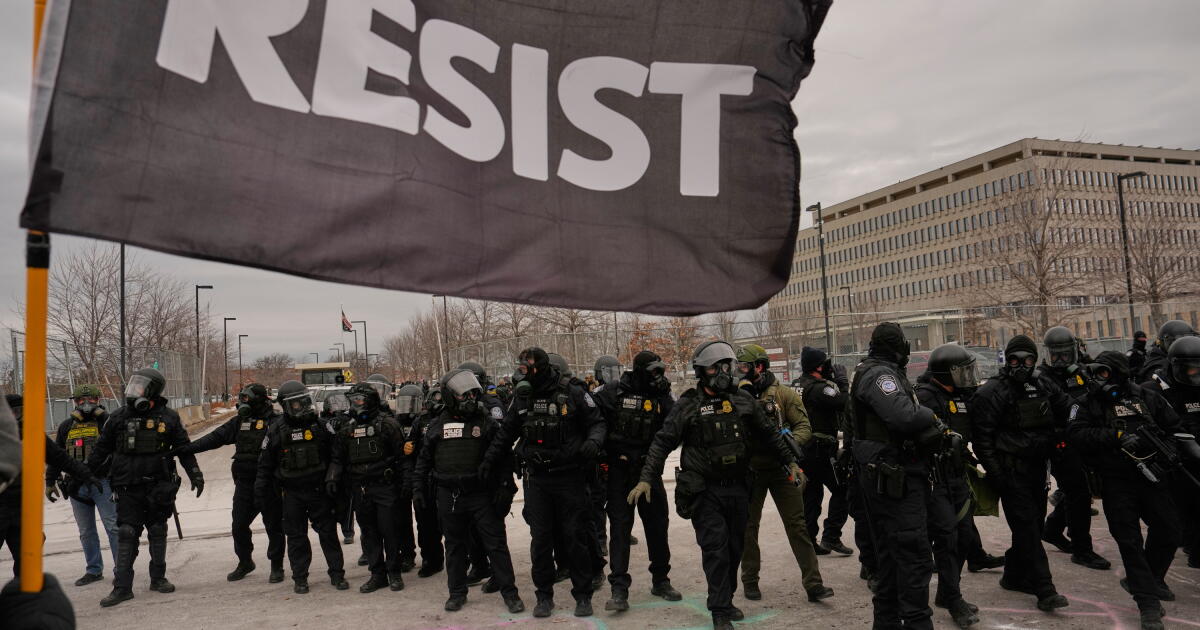
Others are organizing among both left-wing and more traditional groups to push back if the administration is aggressive in November. Some look to the anti-ICE protests in Minneapolis as a possible model.
Two activists were shot and killed by ICE agents during those January demonstrations, and the administration eventually backed off the aggressive crackdown the president had launched against the city.
“We recognize there might be a similar moment in November, where Trump attempts to do that again, where everyday working people and students need to band together and say, ‘Actually, no, this is our country, you don’t get to decide who gets elected or who gets to take office,’” said Kidus Girma of the left-wing Sunrise Movement.
Riccardi and Brown write for the Associated Press.