election expert

Trump seeks prime-time spotlight for election claims, raising concerns

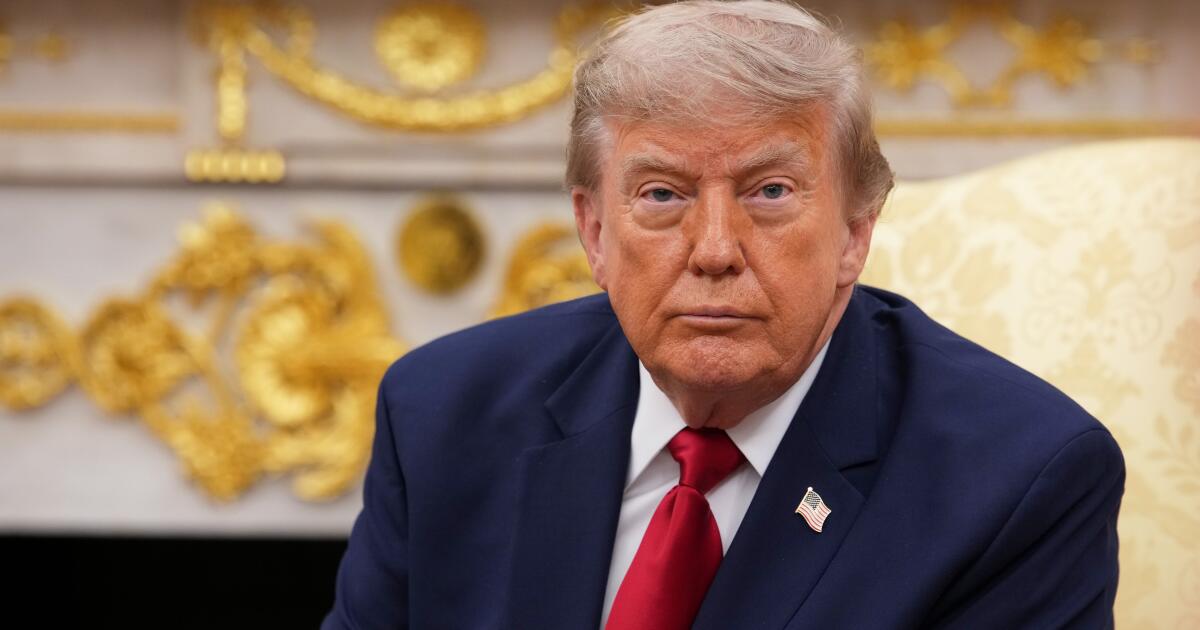
President Trump appeared poised to question the security of U.S. elections with a planned prime-time speech Thursday night, eliciting fears from Democrats and voting rights advocates that he is planning yet another play for federal control over voting in November’s midterms.

The exact reason for the speech has not been disclosed by the White House, with Trump only characterizing it to reporters this week as “really, really big news.” He confirmed it would have to do with “free and fair elections.”

The Washington Post reported, citing sources, that Trump planned to argue that there are vulnerabilities in the nation’s election infrastructure and claim that China had accessed U.S. voter data. The White House declined to confirm any such details Wednesday.

The announcement of the speech set off concerns among the president’s political opponents, as well as elections experts and voting rights advocates, that Trump could again escalate claims that the nation’s voting system is vulnerable to domestic fraud and foreign attacks.

He has previously said that Republicans should “nationalize” election administration, a job that falls to the states under the Constitution, and has pressured his party to tighten federal voting rules.

“We don’t know anything about what he might say … or what he might try to do with his very limited powers, as the president, over elections,” said David Becker, executive director of the nonpartisan Center for Election Innovation and Research. “I expect we’re going to hear a lot of rehashed and debunked claims.”

The president could potentially use new claims to argue that the nation is facing an emergency in upcoming elections that necessitates further federal intervention into voting, Rep. Joseph Morelle of New York, the ranking Democrat on the House Administration Committee, which has oversight of elections, said in an interview with The Times.

“This is going to be the rationale for declaring a national emergency,” Morelle said. “It’s transparent that he is creating the emergency and he’s creating the evidence out of whole cloth to suggest there is an emergency.”

Sen. Alex Padilla (D-Calif.), the top Democrat on the Senate Rules Committee, which oversees federal elections, told The Times on Wednesday that Trump was using a known playbook to “[sow] doubt about the outcome before a single vote has been cast.”

“All signs show that tomorrow’s speech will be more of the same: debunked conspiracy theories offered up not because they’re true, but because chaos and doubt are the only cards he has left to play,” Padilla said.

The speech, which Trump announced on social media Monday, comes four months ahead of midterm elections that will determine whether his party retains legislative control in Washington.

White House spokesperson Karoline Leavitt dismissed news reports about what Trump might say in the 6 p.m. PDT speech as speculation, and said “nobody knows yet what President Trump will ultimately say.”

The address also comes as Trump’s ceasefire with Iran has fallen apart, renewing expectations for increased gas prices, and his approval rating on the economy has steadily dropped. On Tuesday, it also became public that Trump had paid $5.6 million to the writer E. Jean Carroll, as ordered by a jury that in 2023 found Trump liable for sexually abusing and defaming her.

“What we’re going to be talking about Thursday is, it doesn’t get bigger,” Trump told reporters who asked Tuesday about the speech. “Because without free and fair elections you don’t have a country.”

Trump has spread baseless claims of widespread election fraud for years. But his prioritization of his claims about the voting system — even as much of the nation’s attention is on cost-of-living issues — has been on particularly clear display in recent days.

He has aggressively lobbied reluctant Republican senators to pass his voter ID legislation, refusing to sign a bipartisan housing bill over it; he fired all remaining members of the bipartisan U.S. Elections Assistance Commission; and his Justice Department said it would send election monitors to six states.

Since the midterm primaries began, Trump has also sown doubt about election security — chiefly in California, where he suggested Democrats had cheated or attempted to in the gubernatorial and Los Angeles mayoral primaries.

Georgia Democratic Sen. Jon Ossoff, whose state was often at the center of Trump’s 2020 fraud claims, said the president’s speech posed a threat to voting rights.

“I expect him to use whatever he puts out there on Thursday as a pretext, either for some attempted unconstitutional use of federal power to interfere in the election,” Ossoff said Tuesday on MS Now, “or to give his proxies and loyalists in state and local jurisdictions some cover for whatever they might attempt, or to lay the groundwork for challenging the result.”

Any effort to federalize or take over elections would face serious legal obstacles, said Nahal Kazemi, a Chapman University law professor. Although Congress can pass laws regarding election administration, as it did with the Voting Rights Act, the executive branch doesn’t play a role in running elections.

“You run into essentially a brick wall that is the Constitution, which makes very plain that states run elections,” Kazemi said.

When it comes to concerns about foreign interference, experts say there is little evidence of other countries attempting to hack systems or change votes. Instead, foreign actors have largely operated via disinformation campaigns, as the U.S. determined had occurred in the 2016 and 2020 elections.

“Of the information that is available to us now, there’s no reason to be alarmed about the possibility that a foreign adversary is going to take over election systems,” said Kazemi, who has studied foreign election interference.

One of the things that helps make American elections generally secure, she said, is that they are not centralized but are run by thousands of counties. Hacking into so many voting systems would be extraordinarily difficult for a foreign adversary, she said.

Jenny Farrell, executive director of the League of Women Voters of California, said California “takes elections security extremely seriously” and has one of the most secure systems in the country, subject to strict voter verification measures and intense chain of custody and auditing procedures.

Democrats have worked with elections experts in recent months on attempts to assure the public that U.S. elections are safe and secure. They have also tried to counter claims by Trump that mail ballots and voting machines are unreliable.

A slew of 2020 election reviews, including by Trump’s first administration, concluded that Trump lost and Biden won. Election experts say there is no evidence that widespread fraud determined the outcome of the election.

A judge also found that claims pushed by Trump and his attorneys that the company Dominion Voting Systems manipulated votes cast through its machines in favor of Biden were untrue.
Source link

Trump, without proof, claims ‘cheating’ in California vote, says federal probe underway

To the surprise of few, President Trump has once again claimed without evidence that Democrats are somehow cheating to win California’s primary elections — writing on social media late Wednesday that federal prosecutors in Los Angeles are investigating the matter.

“The Dumocrats are at it again! They are trying to STEAL THE GOVERNOR OF CALIFORNIA PRIMARY, AND THE MAYOR OF LOS ANGELES, PRIMARY, AWAY FROM TWO GREAT REPUBLICAN CANDIDATES. Here we go with the very late and massive numbers of MAIL IN BALLOTS,” Trump posted to his social media platform Truth Social.

“There’s BIG cheating by the Dumocrats in California. Votes are all tied up. May not be in for weeks. Under investigation by the U.S. Attorney’s Office in Los Angeles,” he wrote in a second post. “Why the vote counting DELAY???”

A spokesperson for the U.S. attorney’s office in Los Angeles — run by Trump loyalist First Assistant U.S. Atty. Bill Essayli — declined to comment Thursday morning on Trump’s claims of an investigation.

California Secretary of State Shirley Weber’s office also did not immediately respond to a request for comment.

Gov. Gavin Newsom’s office responded directly to Trump late Wednesday with its own social media post, writing, “Trump is lying about California again — time to take the phone away from grandpa and put him to sleep.”

On Thursday morning, Newsom’s office wrote that there “is a lot of misinformation floating around about California’s election — including from the President,” and recommended people watch a CNN video about California’s election process. It concluded that delays in vote counting in the state are essentially a result of state leaders deciding that providing voters with “last minute options” for casting ballots is more important than a quick count.

“And yes, for the record: we wish the votes were counted faster, too,” Newsom’s office wrote — a nod to the fact that the issue isn’t new.

In an email, Brandon Richards, Newsom’s deputy director for rapid response, said Trump’s claims are part of “a tinfoil hat level conspiracy theory that has been debunked repeatedly.”

The president’s claims of cheating were predicted before the election by both elections experts and Democratic leaders in California, who dismissed them in advance as more baseless bluster from a president beset by low approval ratings.

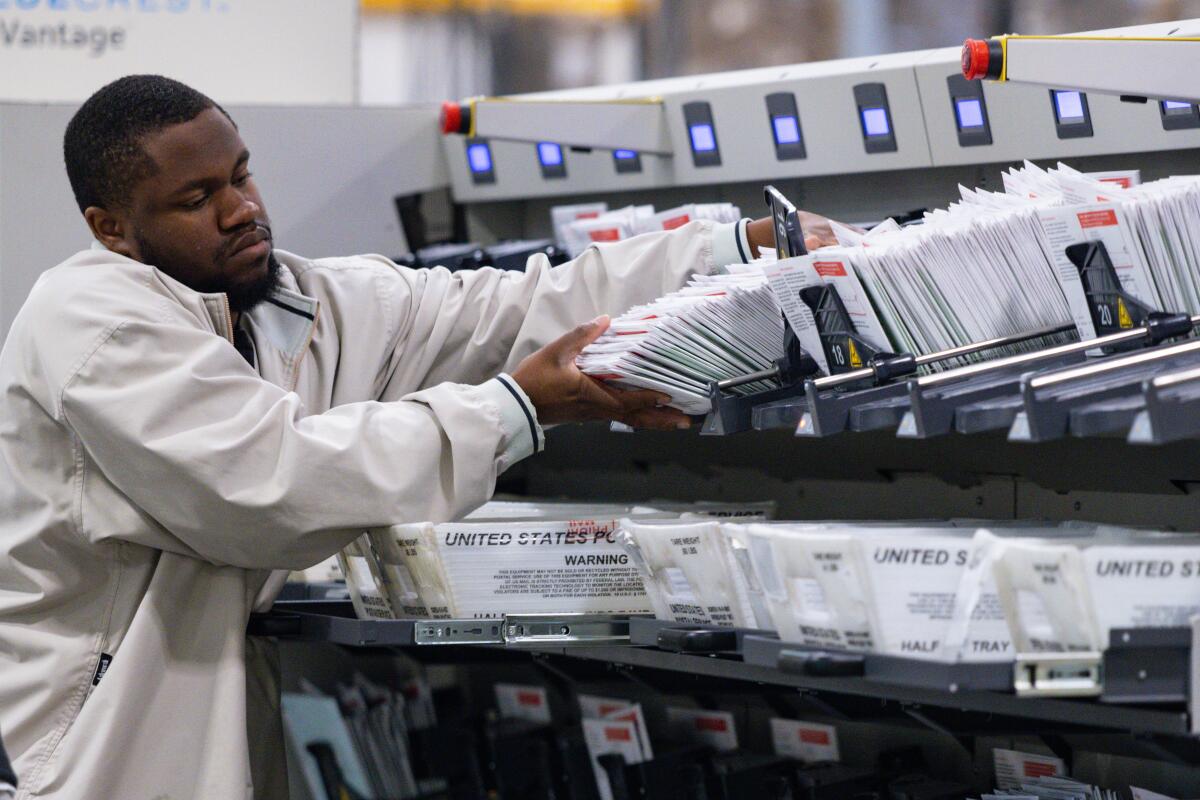
A worker counts ballots

A worker puts ballots in a counting machine at the Los Angeles County Ballot Processing Center on Wednesdayin City of Industry.

(Kayla Bartkowski/Los Angeles Times)

Those same experts and Democratic leaders acknowledge that California’s system for counting votes takes a long time and should be quickened, but stress that is not because of anything nefarious. Rather, it is because California allows voters to cast ballots by mail up until election day — and then has to count those ballots, which can number in the millions and are subject to manual signature verification.

Trump has long dismissed such explanations. An election denier since he first entered politics more than a decade ago, Trump has pushed skepticism about elections he and his party lose time and again since — most notably when he claimed, again without evidence, that the 2020 election he lost to Joe Biden was stolen.

Trump even challenged Biden’s victory in court, but his claims were rejected completely because neither he nor his attorneys could produce any evidence substantiating them.

He has combined his tactic of targeting undocumented immigrants for political gain with his skepticism of election integrity by claiming, again without evidence, that such immigrants somehow vote in large numbers, particularly in big blue states such as California, despite experts saying there is no evidence of that.

He has alleged that mail ballots — such as those used by the majority of California voters — are a particularly rich source of voter fraud, despite again having no basis for the claim and it being disputed by experts.

A consistent feature of his election fraud claims is that they arise and target races only when Republicans lose or lose ground.

And, he has tried to use the power of his administration to make sweeping changes to election laws to bar mail ballots and require strict voter ID and proof of citizenship measures, despite the control of elections and their rules being constitutionally given to the states.

Those efforts have prompted a wave of litigation between the Trump administration and California and other blue states, with multiple cases pending in the courts over voter ID, proof of citizenship, mail balloting and the role that the U.S. Postal Service may be allowed to play in processing such ballots.

Trump’s latest remarks came as additional vote counting on Wednesday narrowed the advantage of Republican Steve Hilton over his Democratic challengers in the California governor’s race and closed the gap in the L.A. mayoral race between the MAGA-aligned candidate Spencer Pratt, currently running second, and City Councilmember Nithya Raman, who is running third.

The trend was anticipated. Elections experts warned before vote counting began of the potential for a “red mirage,” wherein earlier voting among Republicans and late voting among Democrats — many of whom were unsure of whom to vote for in the two high-profile races — would create an early illusion of Republican victories despite large volumes of liberal votes from major population centers still to be counted.

It is a trend that has played out repeatedly in past elections, and one that does not come as a surprise to careful elections watchers.

Elections officials in California knew such claims were going to be made, as they’ve been made in the past. Some local elections officials made a point of preparing their staffs for baseless claims of election fraud in advance of this year’s primaries. State officials made repeated efforts to explain the reasons why California elections take time, precisely to undercut claims amid counting that the delays were the result of fraud.

But those claims have come regardless, and not just from Trump.

Above an X post Wednesday suggesting Pratt was losing ground to Raman as more counts came in, Florida Gov. Ron DeSantis wrote, “California keeps dumping votes. Odds are shifting because the vote dumps always seem to go one way. Count until you get the result you want?”

Above another X post Wednesday noting that the California count would take time, Katie Miller, a former Trump administration official and conservative podcaster married to Trump’s top advisor Stephen Miller, wrote, “The Democrats are about to steal the LA mayoral race once again using mail-in voting.”

Both of the posts that DeSantis and Miller were responding to were from Polymarket, a prediction market where people can bet on the outcomes of political races, pop culture events and a slew of other subjects.

Such emerging financial markets, which process billions of dollars in bets, are causing rising concerns about political meddling for profit — including by campaign staffers and other individuals with insider knowledge of polling and other campaign information, or by politicians and their operatives, whose public remarks about politics can swing those markets.

Source link