Column: California isn’t so cutting-edge when it comes to electing governors
SACRAMENTO — Across America, 53 women have served as state governors. But not one in California. What gives? Aren’t we supposed to be enlightened out here in this cutting-edge state?
In fact, 14 women currently are governors in all sorts of states — north, south, flyover and Pacific coast. Big, midsize and small. Red, blue and purple.
We stand out with a huge black mark.
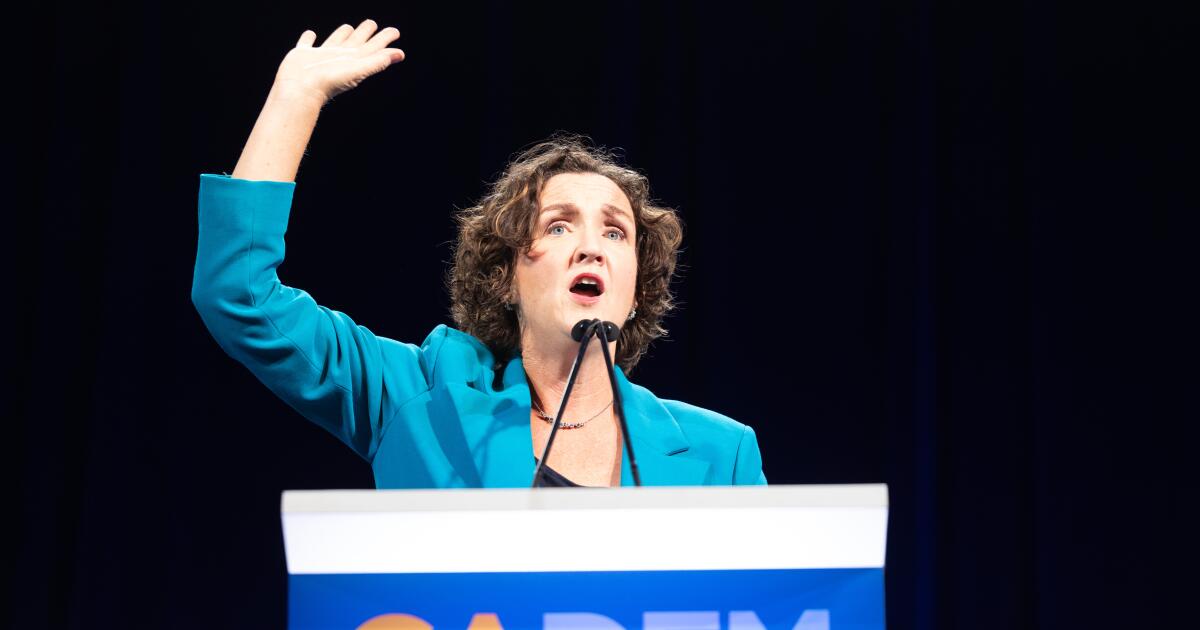
Voters have a chance to erase the ugly spot this year with Katie Porter in position to possibly be elected California’s first female governor.
Don’t get me wrong. I’m not saying Porter should be elected just because she’s a woman.
What I’m saying is that this is an opportunity to elect a perfectly qualified woman. If a male opponent is considered better suited for the job, fine. But first, let’s give her a good hard look and listen to her ideas. Maybe she’s too liberal — or not liberal enough. Perhaps too feisty and brusque than some unfairly find acceptable in a woman.
Independent polling shows that Porter basically isn’t getting any more support from women voters than she is from men.
I queried my best source on such matters: my daughter, Karen Skelton, a longtime political operative who has served stints in the Clinton and Biden White Houses. Why aren’t more women rallying around Porter?
“There was a time when women were excited to support women just because they were women, fueled by the historic prospect of electing ‘the first,’” she said. “But if anything has been proven in the last two presidential elections where women ran, it’s that identity politics does not work….
“It has to be more than her identity as a woman to get her elected.”
Yep. In my view, Democrat Hillary Clinton wasn’t very likable in 2016 and ran a lousy campaign. In 2024, Vice President Kamala Harris also lacked popularity. And she was dealt a losing hand by aging President Biden when he took too long to step aside.
Harris, a former U.S. senator with a long history of electoral success in California, would have been the heavy favorite to become the state’s first female governor if she had run. But she declined, opting for a possible third presidential bid in 2028.
Porter, 52, is a UC Irvine consumer law professor and former Orange County congresswoman who increased her statewide name familiarity by running unsuccessfully for the Senate in 2024.
Running for governor, she has been forthright and specific on what she’d try to achieve in Sacramento. She’d probably shake up the place.
One goal that should appeal to young families is free childcare. How’d she pay for that, I asked.
“Well, how do we afford public schools, roads, everything else, right?” the single mother of three answered, implying it’s about priorities. “The reason we don’t fund childcare, but we do fund other things, is because we expect women and mothers to do childcare for free or for pennies.”
She was scurrying along leading the Democrat pack last fall until tripping over two videos that displayed a hot temper.
In one, she threatened to walk out of a TV interview when a female reporter repeatedly asked how she expected to gain the votes of President Trump’s supporters. An irritated Porter said she didn’t need their votes, and she was right — but also rude.
In the other video — an oldie — then-Rep. Porter was shown yelling at a young female aide to “get out of my f— shot” during a videoconference with a Cabinet secretary.
Porter says she apologized to the staffer that day and they worked together for years afterward. And following a recent televised debate, Porter says, the former aide texted her congratulations and added that if she still lived in California, she’d vote for her.
The TV reporter, Julie Watts of CBS, was a moderator of a campaign debate last week and tossed some prickly questions at Porter and the other candidates.
“I was very calm and answered all the questions,” Porter notes. “I showed people I can do better” than the TV interview she has apologized for many times.
Porter has never completely recovered from the harmful videos. But she’s running close to two other Democrats — billionaire Tom Steyer and former U.S. Health and Human Services Secretary Xavier Becerra — in the June 2 primary.
“If a man had done the same thing, we wouldn’t be talking about it,” asserts Valerie McGinty, founder and president of Fund Her, an organization dedicated to electing women.
Several women agreed.
Assemblymember Cottie Petrie-Norris (D-Irvine), who has endorsed Porter, points to the late beloved, oft-profane legislative leader John Burton of San Francisco as an example of a double standard.
“Not a woman in American politics could get away with titling their autobiography ‘I Yell Because I Care,’” she says. On the book’s jacket cover, Burton is pictured speaking to a crowd with two raised middle fingers.
“People expect women to be strong but not too harsh,” Petrie-Norris says.
OK, but why do women get elected governor in other states, but not in California?
Mindy Romero, director of the Center for Inclusive Democracy at USC, says the vast amounts of money and human resources needed to win in humongous California make it especially difficult for women. They usually haven’t been included in the political pipeline long enough, she says, to build a hefty donor base, acquire elective office experience and gain statewide name recognition.
Three women have dropped out of the current race because they weren’t gaining ground. But it’s hard to argue it was because of any gender hurdles.
Previously, three women won their party nominations for governor but lost in November: Democrats Dianne Feinstein and Kathleen Brown in 1990 and 1994, respectively, and Republican Meg Whitman in 2010. None lost because of any double standard. It just wasn’t their year politically.
But California has elected three female U.S. senators — Democrats Feinstein, Barbara Boxer and Harris.
And nearly half the state Legislative seats are held by women.
It’s conceivable this year that California finally enters the 20th century — let alone the 21st — by electing our first female governor.
What else you should be reading
The must-read: Coded messages, ‘red boxing’ and other allegations in California’s testy race for governor
Money (That’s what I want): Billionaire-tax backers say they have enough signatures to qualify for ballot
The L.A. Times Special: Voter guide to the 2026 California primary election
Until next week,
George Skelton
—
Was this newsletter forwarded to you? Sign up here to get it in your inbox.