Hilton proposes eliminating DMV, slashing vehicle registration fee if elected governor
If elected governor in November, Republican Steve Hilton said Tuesday he would eliminate the state Department of Motor Vehicles and slash registration fees for car owners — expressing confidence that the Democratic-controlled Legislature would embrace the plan.
“My starting expectation would be, they would be with me on things to reduce the cost of living, so let’s work together,” he told The Times on Tuesday.
Hilton said that once state lawmakers met with him and realized he was not the “caricature” his critics portray, they would realize that he is “not a particularly tribal person. I’m just looking to solve problems, and we all agree about the cost of living.”
Eliminating a state agency would require approval from the state Legislature, where Democrats hold super majorities in both chambers. Assembly Speaker Robert Rivas (D-Hollister) and Senate President Pro Tem Monique Limón (D-Santa Barbara) have both endorsed Hilton’s Democratic rival in the governor’s race, former Biden cabinet member Xavier Becerra.
The Becerra campaign scoffed at Hilton’s confidence.
“You can’t spend a year calling Democrats a failure and then expect two-thirds of both chambers to take your calls,” said Becerra spokesperson Jonathan Underland. “Steve is in for a very rude awakening, and the fact that he can’t see it coming just shows how little he understands the job he’s asking for.“
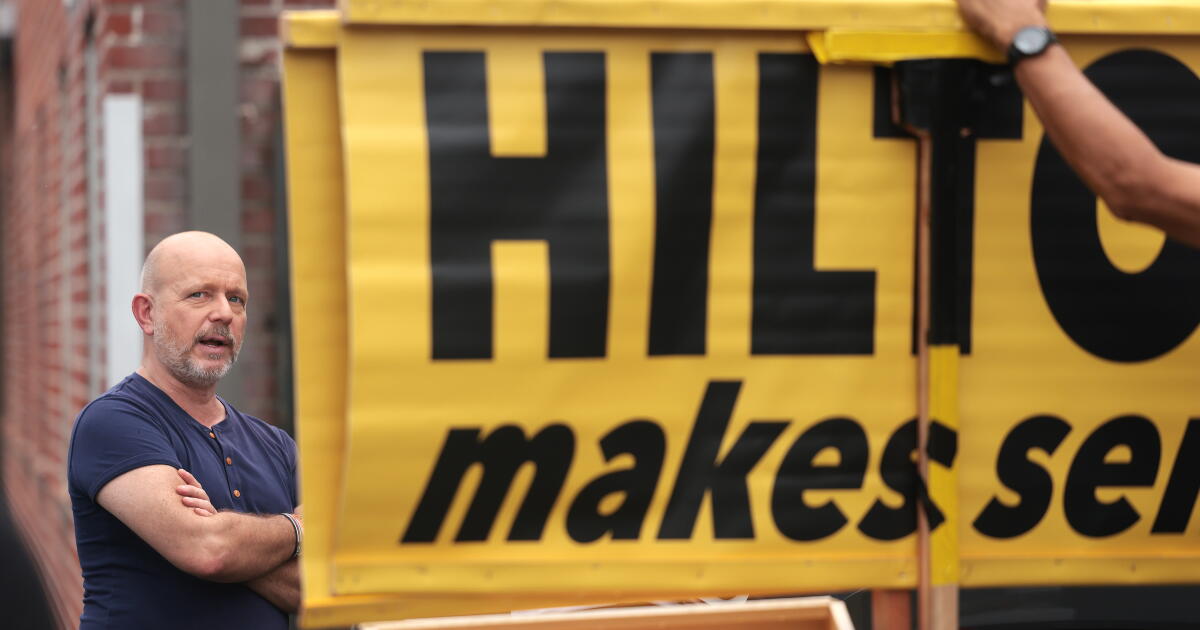
Hilton announced his plan at a news conference outside of a DMV office in West Hollywood, where he touted proposals to eliminate the state agency, which has a $1.6-billion budget, and reduce the annual vehicle registration fee to $73 per year.
“We are going to shut down this bloated, nanny-state bureaucratic agency that treats Californians with complete contempt,” he said to cheers at the event. “We are done with it. Enough is enough with the DMV. Enough is enough with sky-high registration rates. We are done.”
Hilton said he could issue an executive order to reduce the vehicle licensing fees, as Gov. Arnold Schwarzenegger did less than an hour after being sworn into office upon winning the 2003 recall election. While the fee is set by state tax code, governors can waive it in specific circumstances, as Schwarzenegger did.
Californians currently register more than 36 million vehicles with the DMV each year, and the average annual fee paid for each is $329, according to the state Legislative Analyst’s Office. The registration fees, along with driver’s license costs and other fees related to the California Highway Patrol and identification cards collected by the DMV, are the primary funding sources of the CHP and DMV.
Hilton said the state currently reaps $11 billion to $12 billion per year from vehicle registration fees, and that his proposal would reduce the revenue to roughly $2.7 billion. He said he would make up for the revenue shortfall created by the proposal — and other plans, including eliminating state taxes on the first $150,000 of income — by reducing the state’s workforce by 10% and agency budgets by 5%.
To eliminate a state agency, Hilton would need legislative approval, although he says that if Sacramento lawmakers were to rebuff his efforts, he could use the budget to slash the DMV’s operations.
Hilton cited a discussion he had with Schwarzenegger at an August dinner at the movie star’s Brentwood estate.
“Arnold said the Democrats who led the Legislature when he was there much preferred” having a Republican governor to a Democratic one, Hilton said.
Hilton lacks Schwarzenegger’s worldwide fame, and the nation and Sacramento are far more polarized than when the Austrian bodybuilder turned action movie star took office. Still, Hilton’s vehicle registration proposal is reminiscent of a major plank of Schwarzenegger’s successful 2003 campaign to recall and replace Democratic Gov. Gray Davis.
Davis had tripled the state’s annual vehicle license fee shortly after being reelected in 2002 to help address a state budget shortfall. Schwarzenegger seized upon the issue during the recall campaign, at one point dropping a wrecking ball from a five-story crane onto a car spray-painted with the words “Davis Car Tax” in front of a cheering crowd in Costa Mesa.
“We had the biggest action star in the world. He’s going to show action,” said Rob Stutzman, who worked as one of Schwarzenegger’s top advisors. “Arnold demanded it. It was always a production to tell a story. He was genius at it.”
“Californians got a huge increase in their vehicle license fee and it was being done to backfill a deficit arguably revealed to them by surprise after the [2002] election,” Stutzman said.
Stutzman said the fee created a backlash that fueled the recall campaign against Davis, along with rolling blackouts during the energy crisis of 2000 to 2001.
Schwarzenegger’s executive order reducing the license fee to its former rate resulted in billions of dollars of losses to the state’s general fund. The Republican had to respond with spending cuts as well as issuing bonds to make up for the shortfall.