El Salvador

Trump rallies Shield of the Americas coalition against drug cartels | United Nations News

US-led anti-cartel alliance backs sanctions against crime groups after Trump urges stronger action.

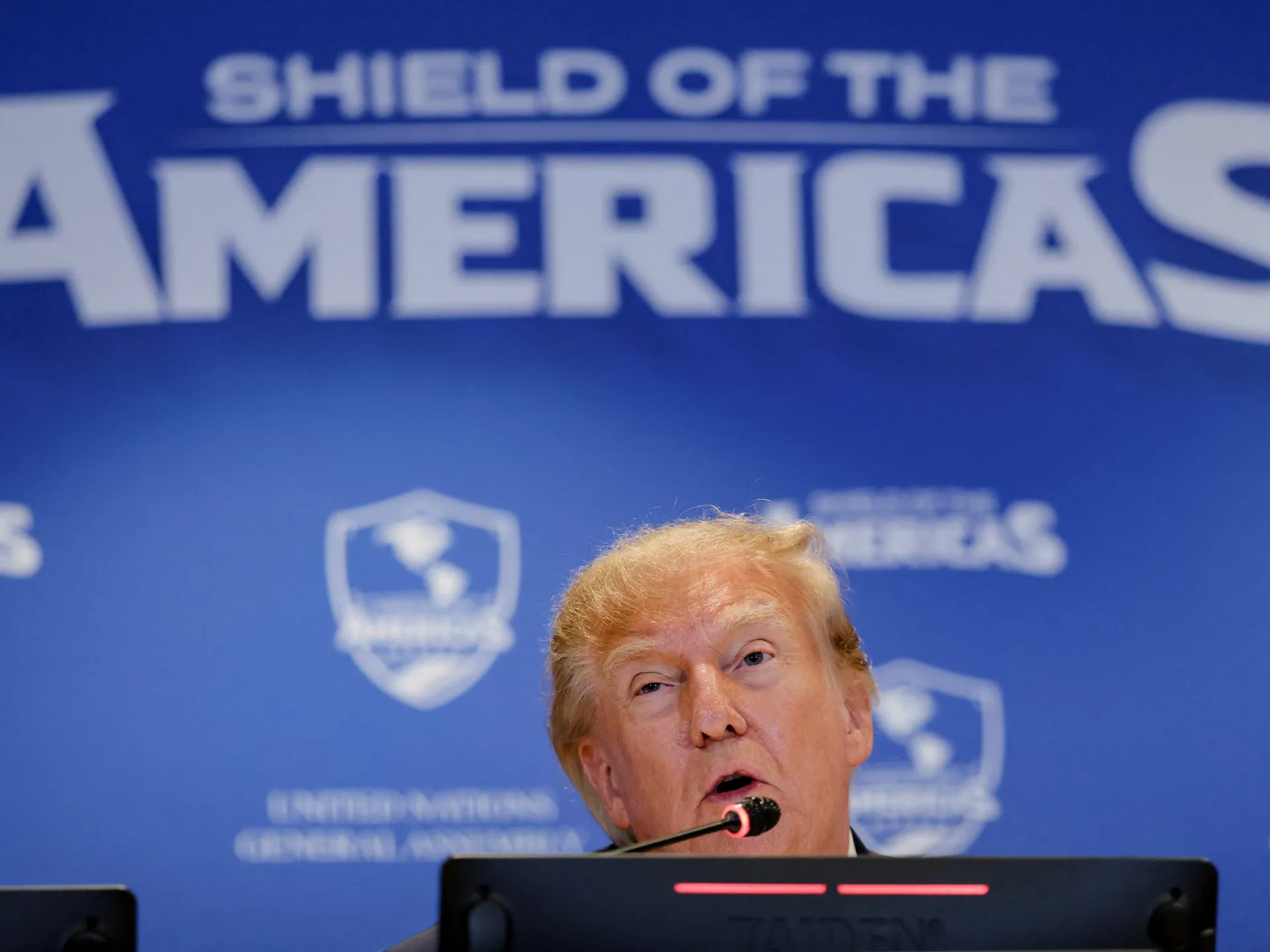
United States President Donald Trump has pledged to use “unmatched military might” against drug cartels in the Western Hemisphere during a meeting of the Washington-led Shield of the Americas coalition in New York City.

In a meeting with leaders and foreign ministers from the anti-cartel alliance, Trump on Tuesday urged member countries to join the US in targeting 24 criminal organisations, which he earlier described as the “ISIS of the Western Hemisphere”.

Recommended Stories

list of 3 itemsend of list

He said he was asking “all nations in the Shield of the Americas to formally designate narco-terrorists as common threats to stability and apply crushing sanctions” against all of the groups. The meeting took place on the sidelines of the annual United Nations General Assembly (UNGA) in New York City.

The coalition’s 15 governments later issued a joint statement saying they intended to impose asset freezes and visa restrictions on members and supporters of the groups and to pursue criminal charges against them.

At the top of the list are two groups that have been declared “terrorist” organisations by Washington: Mara Salvatrucha (MS-13) – one of Central America’s most powerful criminal gangs – and Tren de Aragua, a Venezuelan gang that is also active in Colombia, Peru and Chile.

The list also includes major Mexican cartels, Colombian armed groups such as the National Liberation Army, Brazil’s Primeiro Comando da Capital and Comando Vermelho groups, and Peru’s Shining Path.

Al Jazeera’s Alessandro Rampietti, reporting from Bogota, Colombia, said the statement was largely symbolic for now, because each country must follow its own legal procedures.

“For example, here in Colombia, it will require a law to pass in Congress. We understand that the government here has asked Congress to move forward in drafting such a law. So while the consequences may not be immediate, this is clearly an important step towards building what the US has been trying to do in Latin America [through] this alliance,” he added.

The coalition is made up of governments closely aligned with Trump, including Argentina, Ecuador and El Salvador, whose leaders he has praised or endorsed. Colombia and Peru joined after Trump-aligned presidents took office in recent months.

Brazil and Mexico have not joined.

US Secretary of State Marco Rubio, who also attended, praised “the emergence of strong leaders who are committed to the challenge of taking on transnational terrorism”.

The gathering was the administration’s latest effort to rally the region behind a more aggressive approach to drug trafficking. Since returning to office last year, Trump has designated cartels as foreign terrorist organisations and ordered dozens of strikes on boats in the Caribbean and eastern Pacific that US officials say were carrying narcotics bound for the US.

The strikes have killed more than 223 people, and UN experts say they violate international law and could amount to crimes against humanity.

The Trump administration’s National Security Strategy, released late last year, laid out plans for a revamped Monroe Doctrine, the 19th-century policy asserting US primacy in the hemisphere that critics associate with decades of US intervention.

Trump has also spoken of retaking the Panama Canal and annexing Greenland and Canada. On Tuesday, he signed an agreement on Greenland that stopped short of his demand that the island become US territory.

The focus on the hemisphere has raised concerns across the region.

Brazilian President Luiz Inacio Lula da Silva, in his UN speech, bristled ⁠at the approach, warning countries in Latin America and the Caribbean of “renewed hegemonic temptations”.

“Brazil is nobody’s back yard,” Lula said.

Source link

Confusion over protected status leaves employers and Salvadoran immigrants scrambling

Thousands of Salvadoran immigrants nationwide faced uncertainty after the federal government failed to decide by a Wednesday deadline whether to extend or terminate their longtime temporary protections against deportation.

Those protections, known as Temporary Protected Status or TPS, allow immigrants to obtain work permits and by Thursday some Salvadorans had already been fired from their jobs. Others who had been let go were reinstated after the Trump administration clarified that an announcement on TPS for Salvadorans would come “at the appropriate time” and that they would retain work authorization in the meantime.

Employers also expressed uncertainty about whether the statement was enough to legally keep Salvadoran employees on their payroll. Those who lost their jobs worked across the U.S. in construction, at hotels and as janitors.

Some took the announcement that work authorizations remained in place — made late Wednesday by U.S. Citizenship and Immigration Services — as a cause for hope, while others saw it as prolonged mental torture. There are 170,000 Salvadoran TPS holders, including 36,000 living in California.

Asked for further guidance on Thursday, Homeland Security sent a link to the USCIS website.

Advocates with the National TPS Alliance distributed a letter including the administration’s announcement for TPS holders to share with their employers and stating that “any decision to terminate could not take effect for a minimum of 60 days.” The letter seemed to help, as advocates reported that some fired employees had been able to return to work.

Not everyone was reinstated. Jose Ramirez reported to his construction job in Santa Monica for the last time on Wednesday.

The 63-year-old had been legally working in the U.S. since 2001, when TPS was first extended to Salvadoran immigrants.

Jose Ramirez speaks during a press conference in Los Angeles.

Jose Ramirez, a TPS holder from El Salvador, speaks during a news conference in Los Angeles on Thursday.

(Genaro Molina/Los Angeles Times)

He had been in the country for six years before that, and constantly struggled to find stable work. The work permit was a lifeline. He’d dedicated the last 25 years to construction, during which he fathered three daughters and set roots in Compton.

Still, his boss said Ramirez could no longer present for work Thursday.

“I’ve worked on buildings that reach the skies of Los Angeles,” Ramirez said. “I’ve contributed economically and lent my labor to this great country.”

Ramirez’s boss said his job would be available to him, but he’d need to show proof of an active work permit. A notice or a letter is not enough, Ramirez said.

The USCIS announcement was “a ray of hope that they will give us an extension,” Ramirez said. “But, it’s just not certain. Anything can happen. We’re just praying to God that the government will make it official.”

Signs at a news conference to provide an update on the status of TPS designation for Salvadoran immigrants.

Signs at a news conference to provide an update on the status of TPS designation for Salvadoran immigrants.

(Genaro Molina/Los Angeles Times)

Ending TPS would be a shock to El Salvador’s economy, where remittances from Salvadorans in the U.S. make up nearly a quarter of the nation’s GDP — nearly $10 billion last year. In 2019, President Nayib Bukele, an ally of President Trump, publicly called on the U.S. to extend TPS for Salvadoran immigrants.

More recently, Bukele has embraced Trump’s deportation agenda, including by accepting controversial deals to house foreign detainees in the country’s mega-prison. The number of people deported to El Salvador nearly doubled in the first three months of 2026.

The decision by the Department of Homeland Security to extend or terminate TPS typically has been made at least 60 days before the designation was set to expire. DHS can extend the program for a six, 12 or 18-month period or decide to cancel the designation.

But the Trump administration has delayed announcements, including some made days after the designation expired. A Supreme Court ruling in June determined that the Homeland Security secretary has final authority over the program and cut down the ability for advocates to sue.

Lauren Truslow, CEO of 3D Enviro, a Virginia company that does identification and abatement of hazardous materials, said the lack of a decision on TPS has been stressful and costly. Three of her 30 employees are TPS holders from El Salvador. Another, who is married to a Salvadoran TPS holder, told her his family plans to leave the country if the program is canceled.

3D Enviro is a federal contractor, and Truslow said that her employees’ driver’s licenses and federal badges expired on Wednesday.

“How do they continue to work for me?” she said. “No one seems to know the answer to that. They can’t get into federal facilities without valid ID. Them showing a memo from USCIS is not going to cut it.”

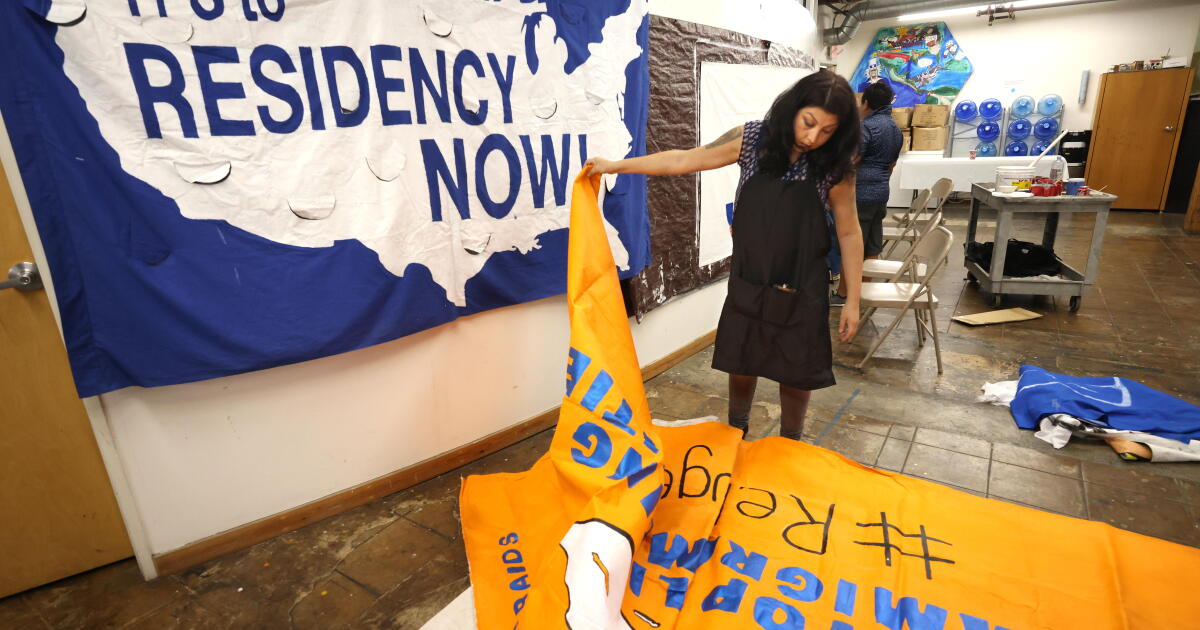
During a news conference organized on Thursday by the Central American Resource Center of Los Angeles, other immigrant rights groups and local elected officials, speakers urged TPS holders to form a plan for their families and schedule a legal consultation with a trusted lawyer. They also called on the administration to issue a decision on TPS for El Salvador and a pathway to permanent legal status.

“Salvadoran families deserve clear, timely and trustworthy information from the government,” said Martha Arévalo, CARECEN’s executive director. “As we gather this morning, we don’t have an extension for TPS. … What we have is another waiting game and a renewed limbo for families.”

“We are going to fight this,” vowed Los Angeles Mayor Karen Bass.

In a statement, Sen. Alex Padilla (D-Calif.) called the USCIS announcement “clear as mud.”

“Once again, the Trump Administration is punishing immigrants who have followed the rules with chaos, uncertainty, and cruelty,” he wrote.

Also in attendance at the news conference was Carmen Sanchez, 49, who works the night janitorial shift cleaning offices in Los Angeles. She said many of her co-workers who were also protected under TPS were told not to return to work after Wednesday.

Sanchez planned to report to work Thursday evening, but was sure she’d suffer the same fate. She said she has three adult children in El Salvador and is helping two of them pay for college.

“If we lose our work permit, we lose our job. We lose our stability. We lose everything,” Sanchez said. “We’re being kept on this thread of extensions, and we don’t know when that thread is going to break.”

Source link

Salvadorans anxiously await news on whether TPS protections will end

Thousands of longtime immigrants from El Salvador and their loved ones are anxiously awaiting word from the Trump administration about whether they will face the possibility of deportation if their temporary legal protections expire as scheduled Wednesday.

The Department of Homeland Security has not yet announced whether it will end or extend Temporary Protected Status for some 170,000 Salvadorans, including 36,000 in California. But federal officials have targeted for arrest other immigrant groups whose TPS expired.

Since their status ended in July, many Haitians have been outfitted with ankle monitors and some have already been sent back to the politically unstable country plagued by gang violence.

As federal officials have whittled down the countries that still qualify for Temporary Protected Status, Salvadorans make up the largest population of remaining beneficiaries.

Just over 100,000 people from Sudan, Ukraine and Lebanon still have TPS protections until later this year, the vast majority of them Ukrainians.

Under TPS, recipients are able to obtain permits allowing them to work legally in the country. More than 150,000 U.S. citizen children nationwide have Salvadoran parents with TPS.

Asked by The Times on Tuesday about the administration’s plans regarding TPS for Salvadorans, border advisor Tom Homan said he does not know and that the decision is up to Homeland Security Secretary Markwayne Mullin.

Later Tuesday, Homeland Security released a statement that left the long-term outlook for Salvadorans with TPS uncertain: “An announcement on El Salvador’s TPS will be made at the appropriate time. Until such announcement is made, Salvadoran individuals present in the U.S. under TPS retain protection.”

Homan, for his part, noted that El Salvador is a “much safer country” now, perhaps suggesting the conditions that prompted people to leave El Salvador had improved.

Addressing the administration’s handling of TPS in general, he said, “I’m glad they’re finally sticking to what the statute says — temporary means temporary.”

The looming deadline set off a wave of alarm among communities in Los Angeles and beyond.

Lorena Zepeda of Los Angeles spent most of Friday with tears in her eyes as she waited for news about the fate of the program that has spared her, for nearly half her lifetime, from being deported back to El Salvador.

“Even though my work permit has been temporary, my life here is not temporary,” said Zepeda, 57. “From the second I stepped foot in the U.S., I have lived. And, I want to continue to live here. I’ve set down my roots here.”

California has the highest concentration of Salvadoran TPS holders in the nation, with smaller concentrations in Texas, Maryland and New York, according to the immigrant advocacy organization FWD.us. Most work in construction, groundskeeping and in transportation, the organization said, and they pay an estimated $1.5 billion in combined taxes.

About 1.3 million people from 17 countries were enrolled in the program when President Trump returned to office last year. The Supreme Court ruled in June that Trump can, without judicial review, end temporary legal protections for hundreds of thousands of immigrants from Haiti and Syria, a decision that also cleared the way for further TPS terminations.

The administration has now ended TPS for more than 1 million immigrants from 13 countries.

Some terminations were announced at or after the expiration date. For instance, the administration announced the terminations for Nicaragua and Honduras three days after they were set to expire on July 8, 2025, but provided a 60-day extension.

A termination for citizens of El Salvador in particular stands to upend the lives of people with deep roots in the U.S. because they have had TPS for 25 years — the longest of any country. Trump administration officials and other conservatives have argued that the program has gone far beyond its original intent as a temporary means of reprieve.

Originally established in 1990 under the George H.W. Bush administration, TPS has been used in the years since under Democratic and Republican administrations alike. Congress authorized the emergency relief for immigrants whose countries had been racked by armed conflict or natural disasters and who could not safely return home.

Trump tried to terminate TPS for Salvadorans during his first term, but an appeal kept the protections in place until President Biden took office and reversed the decision. Biden then substantially expanded the number of immigrants who qualified for protections under the program.

For Zepeda, who came to the U.S. in the early 1990s, saving TPS has been a years-long pursuit.

Zepeda works as a community coordinator for the Los Angeles-based Central American Resource Center, or CARECEN, the largest Central American organization in the country that provides low-cost immigration legal services and policy advocacy. She has gone to Sacramento and Washington to persuade lawmakers to keep the program alive.

She began receiving calls Tuesday morning from frantic TPS holders asking whether they should still attend medical appointments or how they will pay their rent without work permits. Aging Salvadorans fear losing their retirement benefits, she said.

“We’ve marched. We’ve led hunger strikes. We’ve done it all…No matter what happens, the fight does not end,” Zepeda said. “We will continue pushing to find legal stability in this country.”

Castillo reported from Washington and Luna from Los Angeles. Staff writer Ana Ceballos contributed to this report.

Source link