Einstein

Review: Philip Glass’ ‘Akhnaten’ is back at L.A. Opera, this time with a magnificent John Holiday

By my count, Philip Glass has written 28 operas, the same number as Verdi. The count is iffy because Glass pushes the boundaries between what we tend to call opera and the fuzzier idea of music theater. His first, “Einstein on the Beach” in 1976 — a collaboration between the composer and the late, innovative theater maker Robert Wilson — is a non-narrative effusion of imagery, movement, music and text, each a brilliantly independent entity that somehow excites a hard-to-pin-down purpose.

His latest (and probably his last, Glass turns 90 this year) is “Circus Days and Nights” — a touching and thrilling opera for a circus and staged at a circus in Mälmo, Sweden, in 2021 — caps a wondrous 45 years of operatic advancement. You would have to go back to Handel’s 42 operas, Mozart’s 22 or Verdi’s oeuvre for operatic equivalence.

Glass’ subject matter varies widely in epochs and ethoses, from ancient Egypt to Walt Disney’s Hollywood. Taken as a whole, these 28 operas reveal how we got to be who we are historically, artistically, spiritually, politically and fancifully, often including more than one of those categories, as in his third opera, “Akhnaten,” which Los Angeles Opera has now remounted at the Dorothy Chandler Pavilion. The instantly recognizable musical style has remained, over the years, consistently abstract and refreshing. It doesn’t tell you how to think, how to feel, even how to understand. It simply grabs your attention; you do the interpreting.

Still, America knows little of Glass’ operatic enormity. The early “portrait” operas — “Einstein,” “Satyagraha” (about Gandhi) and “Akhnaten” (the 14th century BC Egyptian pharaoh) — appear in repertory here and there (meaning mostly in Europe) as do a trio of operas based on Jean Cocteau films. The rest remain little mounted, while several but not all have been recorded. The Metropolitan Opera, for instance, commissioned “The Voyage” in 1992 to celebrate the 500th anniversary of Columbus’ arrival in the Americas, but the epic opera is nowhere to be found in our semisesquicentennial year. It is sadly no longer even thinkable that “Appomattox,” Glass’ revelatory reminder of an America that once honored goodwill negotiation over political self-interest, return to the Kennedy Center, where its final version had its premiere 11 years ago.

L.A. Opera has been better than most American companies in its attention to Glass. It has excellently presented the three portrait operas on its main stage, beginning with “Einstein” in the final and most brilliant revival of the original Wilson staging. The “Satyagraha” and “Akhnaten” revivals have been the designed-to-dazzle inventions of quirky director Phelim McDermott, a co-founder of Impossible, an eccentric British theater company. When new in the last decade, they felt the most arresting productions of these operas since Achim Freyer’s in Stuttgart, Germany, in the early 1980s. Almost every performance at the Dorothy Chandler Pavilion has sold out.

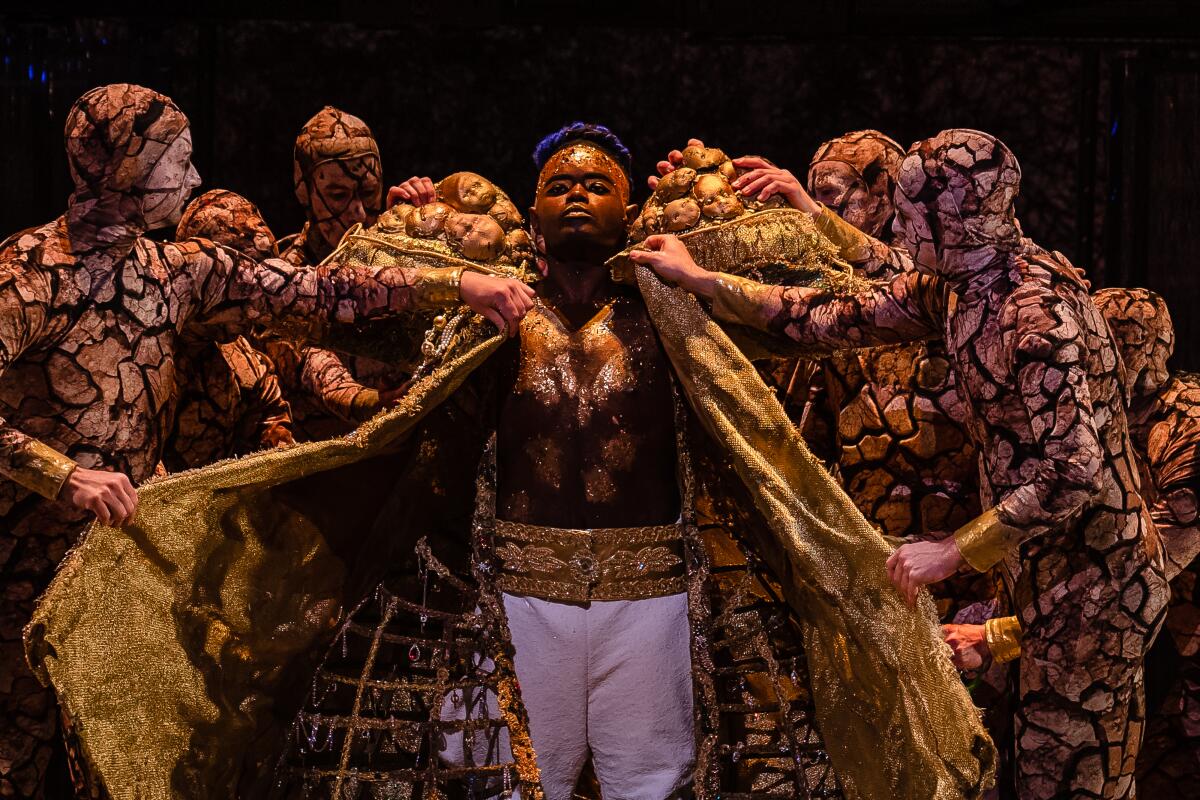
John Holiday as the titular ruler in Philip Glass' "Akhnaten" at the Dorothy Chandler Pavilion.

John Holiday as the titular ruler in Philip Glass’ “Akhnaten” at the Dorothy Chandler Pavilion.

(Ariana Drehsler / For The Times)

McDermott’s “Akhnaten” got the most attention thanks to breathtaking jugglers and lavish costumes, along with a touch of full-frontal novelty as Akhnaten gets clothed in his kitschy, glittery getup for his inauguration. Glass had chosen the pharaoh because he is thought to have been the first monotheistic ruler.

Akhnaten is revealed in episodes of his life that are not fleshed out but presented as ritual, including the ravishing love duet with his wife, Nefertiti. The revolutionary pharoah builds a great city and reduces spiritual chaos by focusing on a single-minded form of worship. He looks androgenous in portraits, which led Glass to create the role for countertenor.

The sung texts are in ancient languages, and there are no projected song titles. Instead, a narrator gives a somewhat notion of what’s what in the language of the audience, as is Akhnaten’s great aria, a hymn to Aten (god of the sun).

Ultimately, the pharaoh’s prescient spiritual optimism comes in conflict with the all-powerful establishment priests, who kill Akhnaten and Nefertiti. The opera ends with Akhnaten’s son, presumably Tutankhamun, restoring polytheism, and then, once the staging jumps millennia into the future, it’s rediscovered by modern-day tourists. The currency couldn’t be missed Saturday, the Shia cleric and Iran’s supreme leader Ali Khamenei having just been assassinated along with his wife at the start of America’s and Israel’s Iran war.

Sun-Ly Pierce as Nefertiti and John Holiday as Akhnaten in Philip Glass' "Akhnaten" at the Dorothy Chandler Pavilion

Sun-Ly Pierce as Nefertiti and John Holiday as Akhnaten in Philip Glass’ “Akhnaten” at the Dorothy Chandler Pavilion.

(Ariana Drehsler / For The Times)

In the opera, it so happens, the ghosts of Akhnaten, his wife and mother, have the last word in a glorious trio.

When first performed at L.A. Opera a decade ago, the lavish production, co-produced with English National Opera, helped recover a neglected opera. In the meantime, “Akhnaten” has gone practically mainstream. The Metropolitan Opera, which also mounted McDermott’s production, released it on CD and DVD, winning a Grammy for best opera recording.

Since then, the choreographer Lucinda Childs, veteran of “Einstein on the Beach,” has staged a stunningly chic “Akhnaten” in Nice, France, that is available on YouTube. Last year, director Barrie Kosky created a sensation with his staging at Komische Oper Berlin, which starred American countertenor John Holiday.

Holiday happens to be the Akhnaten in the L.A. Opera revival, and he is magnificent. McDermott had built his production around the gracefully emotive Anthony Roth Costanzo, slight and luminous in voice and build and game for nudity. If Costanzo’s disarming enthusiasm for the role has been significant in mainstreaming “Akhnaten,” Holiday, who is a very different presence, may be the next step.

Although he can be a popularly gregarious crossover performer, here he suggests a ruler of profound, unflappable dignity, rather than vulnerability. His hymn to Aten is an exercise in majesty, an ode not just to the sun but to the expanses in which our solar system circulates.

In general, the singers class up the production. Sun-Ly Pierce as Nefertiti and So Young Park as Queen Tye add allure. The large cast of smaller roles and chorus is excellent. Zachary James returns as both Amenhotep III, Akhnaten’s father, and the engaging narrator who occasionally threatens to get carried away. McDermott had perfectly employed James as the droll animatronic Disneyland Lincoln in his animation-friendly, slightly goofy production of “Perfect American” in Madrid, where the opera premiered. Here McDermott’s inspired staging demonstrated that Glass’ forgiving personal portrait of Walt Disney makes it the quintessential Hollywood opera that no one dares bring to squeamish Hollywood.

Zachary James as Amenhotep III in Philip Glass' "Akhnaten" at the Dorothy Chandler Pavilion.

Zachary James as Amenhotep III in Philip Glass’ “Akhnaten” at the Dorothy Chandler Pavilion.

(Ariana Drehsler / For The Times)

Hollywood, however, is hardly squeamish when it comes to synchronized jugglers. For McDermott, they suggest somber ritual and were, in fact, known in Akhnaten’s Egypt. For the audience, they are a thrill a minute. For Glass, they may take on deeper meaning now that the circus is where he landed 26 operas later.

As for Finnish conductor Dalia Stasevska, making her L.A. opera debut, she keenly keeps score and bounding balls together with cinematic flair. Glass removed violins from the orchestra to achieve a dark, primordial orchestral sound along with pounding percussion. Stasevska finds light, color and action. She conducts for the moment. Picturesque wind instruments suddenly burst forth as if a flock of birds were flying over the pyramids. Solo brass can sound momentous. The percussion pounds like nobody’s business, opening the score up to all the implied emotion and glitter on an over-stuffed stage.

Childs’ exalted use of dance and Kosky’s dazzling theatrical imagination may have moved us into a sleeker, more sophisticated and paradisal Glassian realm, but the sheer passion McDermott and Stasevska bring continues its own attraction.

In the meantime, McDermott has worked with Glass on a theatrical show, “The Tao of Glass,” that has been seen in New York and will run throughout much of the summer in London. In a better world of Glass, it would be running alongside “Akhnaten” at the Ahmanson. But the Labèque sisters will be at Walt Disney Concert Hall at the end of the month with a two-piano program based on Glass’ operatic Cocteau trilogy. Also check out L.A. Opera’s several excellent podcasts on “Ahkhnaten” — the company has quietly become a leader in the medium.

‘Akhnaten’

Where: Dorothy Chandler Pavilion, 135 Grand Ave., L.A.

When: Through March 22

Tickets: $33.50-$415

Running time: About 3 hours, 40 minutes, with 2 intermissions.

Info: (213) 972-8001, laopera.org
Source link

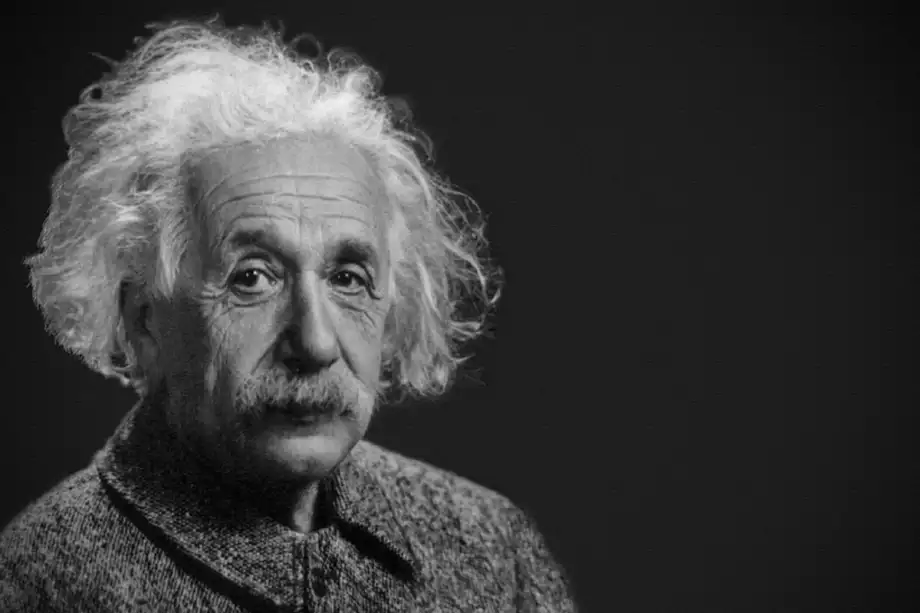
If Einstein spoke out today, he would be accused of anti-Semitism – Middle East Monitor

In 1948, as the foundations of the Israeli state were being laid upon the ruins of hundreds of Palestinian villages, Albert Einstein wrote a letter to the American Friends of the Fighters for the Freedom of Israel (AFFFI), condemning the growing Zionist militancy within the settler Jewish community. “When a real and final catastrophe should befall us in Palestine the first responsible for it would be the British and the second responsible for it the terrorist organisations built up from our own ranks. I am not willing to see anybody associated with those misled and criminal people.”

Einstein — perhaps the most celebrated Jewish intellectual of the 20th century — refused to conflate his Jewish identity with the violence of Zionism. He turned down the offer to become Israel’s president, rejecting the notion that Jewish survival and self-determination should come at the cost of another people’s displacement and suffering. And yet, if Einstein were alive today, his words would likely be condemned under the current definitions of anti-Semitism adopted by many Western governments and institutions, including the controversial International Holocaust Remembrance Alliance (IHRA) definition, now endorsed by most Australian universities.

Under the IHRA definition, Einstein’s outspoken criticism of Israel — he called its founding actors “terrorists” and denounced their betrayal of Jewish ethics — would render him suspect. He would be accused not only of delegitimising Israel, but also of anti-Semitism. His moral clarity, once visionary, would today be vilified.

That is why we must untangle the threads of Zionism, colonialism and human rights.

Einstein’s resistance to Zionism was not about denying Jewish belonging or rights; it was about refusing to build those rights on ethno-nationalist violence. He understood what too many people fail to grasp today: that Zionism and Judaism are not synonymous.

Zionism is a political ideology rooted in European colonial logics, one that enforces Jewish supremacy in a land shared historically by Palestinian and other Levantine peoples. To criticise this ideology is not anti-Semitic; it is, rather, a necessary act of justice and a moral act of bearing witness. The religious symbolism that Israel uses is irrelevant in this respect. And yet, in today’s political climate, any critique of Israel — no matter how grounded it might be in international law, historical fact or humanitarian concern — is increasingly branded as anti-Semitism. This conflation shields from accountability a settler-colonial state, and it silences Palestinians and their allies from speaking out on the reality of their oppression. Billions in arms sales, stolen resources and apartheid infrastructure don’t just happen; they’re the reason that legitimate “criticism” gets rebranded as “hate”.

READ: Ex-Israel PM accuses Netanyahu of waging war on Israel

To understand Einstein’s critique, we must confront the truth about Zionism itself. While often framed as a movement for Jewish liberation, Zionism in practice has operated as a colonial project of erasure and domination. The Nakba was not a tragic consequence of war, it was a deliberate blueprint for dispossession and disappearance. Israeli historian Ilan Pappé has detailed how David Ben-Gurion, Israel’s first Prime Minister, approved “Plan Dalet” on 10 March, 1948. This included the mass expulsion and execution of Palestinians to create a Jewish-majority state. As Ben-Gurion himself declared chillingly: “Every attack has to end with occupation, destruction and expulsion.

This is the basis of the Zionist state that we are told not to critique.

Einstein saw this unfolding and recoiled. In another 1948 open letter to the New York Times, he and other Jewish intellectuals described Israel’s newly formed political parties — like Herut (the precursor to Likud) — as “closely akin in… organisation, methods, political philosophy and social appeal to the Nazi and Fascist parties.”

Einstein’s words were not hyperbole, they were a warning. Having fled Nazi Germany, he had direct experience with the defining traits of Nazi fascism. “From Israel’s past actions,” he wrote, “we can judge what it may be expected to do in the future.”

Today, we are living in the very future that Einstein feared, a reality marked by massacres in Gaza, the destruction of civilian infrastructure, and the denial of basic essentials such as water, electricity and medical aid. This is not about “self-defence”; it is the logic of colonial domination whereby the land theft continues and the violence escalates.

Einstein warned about what many still refuse to see: a state established on principles of ethnic supremacy and expulsion could never transcend its foundation ethos. Israel’s creation in occupied Palestine is Zionism in practice; it cannot endure without employing repression until resistance is erased entirely. Hence, the Nakba wasn’t a one-off event in 1948; it evolved, funded by Washington, armed by Berlin and enabled by every government that trades Palestinian blood for political favours.

Zionism cannot be separated from the broader history of European settler-colonialism. As Patrick Wolfe explains, the ideology hijacked the rhetoric of Jewish liberation to mask its colonial reality of re-nativism, with the settlers recasting themselves as “indigenous” while painting resistance as terrorism.

READ: Illegal Israeli settlers attack Palestinian school in occupied West Bank

The father of political Zionism, Theodor Herzl, stated in his manifesto-novel Altneuland, “To build anew, I must demolish before I construct.” To him, Palestine was not seen as a shared homeland, but as a house to be razed to the ground and rebuilt by and for Jews alone. His ideology was made possible by British imperial interests to divide and dominate post-Ottoman territories. Through ethnic partition and military alliances embellished under the 1917 Balfour Declaration to the ironic Zionist-Nazi 1933 Haavara Agreement, the Zionist project aligned perfectly with the West’s goal, as per the 1916 Sykes-Picot Agreement.

Israel is thus criticised because of its political ideology rooted in ethnonationalism and settler colonialism. Equating anti-Zionism to anti-Semitism is a disservice not only to Palestinians, but also to Jews, especially those who, like Einstein, refuse to have their identity weaponised in the service of war crimes. Zionism today includes Christian Zionists, military allies and Western politicians who benefit from Israel’s imperial reach through arms deals, surveillance technology and geostrategic partnerships.

Zionism is a global power structure, not a monolithic ethnic identity.

Many Jews around the world — rabbis, scholars, students and Holocaust survivors and their descendants — continue Einstein’s legacy by saying “Not in our name”. They reject the co-option of Holocaust memory to justify genocide in Gaza. They refuse to be complicit in what the Torah forbids: the theft of land and the murder of innocents. They are not “self-hating Jews”. They are the inheritors of a prophetic tradition of justice. And they are being silenced.

Perhaps the most dangerous development today is, therefore, Israel’s insistence on linking its crimes to Jewish identity. It frames civilian massacres, apartheid policies and violations of international law as acts done in the name of all Jews and Judaism. By tying the Jewish people to the crimes of a state, Israel risks exposing Jews around the world to collective blame and retaliation.

Einstein warned against this. And if Einstein’s vision teaches us anything, it is this: Justice cannot be compromised for comfort and profit. Truth must outlast repression. And freedom must belong to all. In the end, no amount of Israel’s militarisation of terminology, propaganda or geopolitical alliances can suppress a people’s resistance forever or outlast global condemnation. The only question left is: how much more blood will be spilled before justice prevails?

The struggle for clarity today is not just academic, it is existential. Without the ability to distinguish anti-Semitism from anti-Zionism, we cannot build a future where Jews and Palestinians all live in dignity, safety and peace. Reclaiming the term “Semite” in its full meaning, encompassing both Jews and Arabs, is critical. Further isolation of Arabs from their Semitic identity has enabled the dehumanisation of Palestinians and the erasure of shared Jewish-Arab histories, especially the centuries of coexistence, the Jewish-Muslim golden ages in places like Baghdad, Granada/Andalusia, Istanbul, Damascus and Cairo.

Einstein stood up for the future for us to reclaim it.

The way forward must be rooted in truth, justice and accountability. That means unequivocally opposing anti-Semitism in all its forms, but refusing to allow the term to be manipulated as a shield for apartheid, ethnic cleansing and colonial domination. It means affirming that Jewish safety must never come at the price of Palestinian freedom, and that Palestinian resistance is not hatred; it is survival.

And if Einstein would be silenced today, who will speak tomorrow?

OPINION: Palestinian voices are throttled by the promotion of foreign agendas

The views expressed in this article belong to the author and do not necessarily reflect the editorial policy of Middle East Monitor.

Source link