Eid

Eid without toys: Israeli restrictions drive up prices in Gaza | Israel-Palestine conflict News

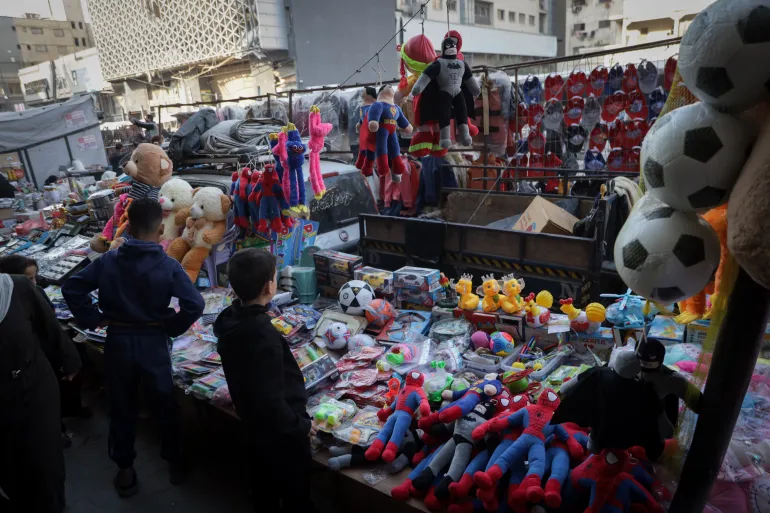
Gaza City – In front of a toy stall in Gaza City’s central al-Rimal market, Rania al-Saudi stands with her two young daughters, looking bewildered at the unusually high prices of toys.

Al-Saudi had promised her daughters she would buy them two dolls to celebrate Eid, but the exorbitant toy prices mean she simply can’t afford them.

Recommended Stories

list of 3 itemsend of list

Her elder daughter, six-year-old Razan, didn’t understand her mother’s worried expressions as Rania asked the vendor for the price of each toy. With every price, Rania gasped and said, “Oh my God, it’s so expensive… this used to be much cheaper.”

Faced with her daughter’s insistence, Rania pleaded with the vendor to lower the prices, but he apologised, saying he could not because getting hold of toys to sell was incredibly difficult, considering Israeli restrictions on importing items into Gaza.

Rania was not alone. Other parents and children repeatedly came to the vendor’s stall to ask about toys, but not one of them made a purchase. In Gaza’s current war-driven economic crisis, the prices are simply unaffordable.

Rania, 43, is originally from Shujayea in eastern Gaza, but has been displaced by the war to the west of the city. She told Al Jazeera that she came looking for toys in an attempt to put smiles on her daughters’ faces before the holiday, but her wish was not fulfilled.

“The prices are extremely high, and the vendors tell us that toys have not entered Gaza since the start of the war. But what did our children do to deserve this?”

Rania recalled the many toys her daughters had in their home before it was destroyed, and how she used to make sure they had toys for every occasion and every holiday.

“Eid holidays are for children’s joy, and children are happy with toys and entertainment. But our children are deprived of everything.”

While speaking to Al Jazeera, Rania tried to calm her daughter Lulwa, who had begun to cry after realising from her mother’s words that she would not get the doll she wanted.

“This doll used to cost no more than 15 shekels ($5) before the war; now it costs 60 shekels ($20),” she said to Al Jazeera, frustrated. “This is something I cannot afford. Everything is expensive and overpriced.”

Rania’s voice grew heavier as she explained that she was unable to even buy new Eid clothes for her daughters – a tradition across the Muslim world – due to the high prices.

“My daughters will not be happy this Eid. I wanted to compensate by getting them dolls, but even that is impossible.”

Toys have been in short supply during the war, which began in October 2023, with bombing and displacement meaning that most children either had their toys destroyed, lost, or left behind. Rania says that her children have been bored, and have had to develop their own ways of playing.

“All the children in the camp face the same situation, so they spend their time playing simple street games like hopscotch, hide-and-seek, or drawing in the sand,” she said.

“But my daughters always wished for a doll. I once tried to make one for them, but they didn’t like it.”

A toy stall in Gaza
Israel restricts the entry of many non-essential goods into Gaza, including toys [Abdelhakim Abu Riash/Al Jazeera]

Rising prices and market impact

Toy sellers say they are not to blame for the high prices.

Anwar al-Huwaity has been in the business for 20 years. He told Al Jazeera that his stall is still operating despite Israel’s devastation of Gaza, but that business has become extremely difficult.

“Before the war, toys were widely available,” Anwar said. “Today, we go from one trader to another, searching. Sometimes we find toys with someone who had them stored, but they sell it at a very high price, up to three times its normal price.”

He added that most toys that now reach Gaza do not enter through official crossings, but in limited quantities via unofficial routes, making them very difficult to obtain.

The cost of bringing toys into Gaza has become extremely high. Anwar said some middlemen demand up to 12,000 shekels ($3,870) for a small shipment, and if it is confiscated or destroyed, the loss falls entirely on the trader.

“We buy merchandise at high prices, so we have to sell it at high prices as well,” Anwar said apologetically.

Anwar said that toys were now up to 300 percent more expensive compared to pre-war prices. The holiday season, the main income generator for toy sellers, used to bring in between $6,500 and $10,000, he explained. Now, he’d be lucky to sell $1,000 of stock – and most of that is bulk sales to other traders, rather than regular customers.

Anwar may be a businessman, but he shared that the hardest part of his job was seeing children ask for toys that their parents cannot afford.

“Many parents can’t buy toys due to the economic situation. People are barely able to secure food,” he said.

Anwar’s job has gone from providing children joy, to seeing them disappointed.

“I have started hating my workday because I know the prices are exorbitant, and when the children and families see the toys, they get upset, especially during the holidays.”

“People come to buy toys and beg me to lower the price,” he said. “They say, ‘This child is an orphan, that child is an orphan … his parents were killed in the war’. It feels like all children in Gaza have become orphans.”

A toy seller in Gaza
Toy sellers say they are forced to pass on high prices to customers [Abdelhakim Abu Riash/Al Jazeera]

Restrictions on recreational goods during the Gaza war

Since the outbreak of the war on Gaza in October 2023, trade has been heavily restricted due to the closure of commercial crossings by Israel, especially Karem Abu Salem (Kerem Shalom), the main entry point for goods into Gaza from Israel.

Israel imposed a total blockade on Gaza in 2023, and again for several months in 2025, leading to the declaration of a famine in northern Gaza.

Conditions have improved since a “ceasefire” was declared in October, but Israel is continuing regular strikes – and continuing to heavily restrict the entry of non-essential commercial goods, including toys and recreational materials.

Although no official law or declaration explicitly bans toys from entering Gaza, administrative and security restrictions, combined with the prioritisation of humanitarian goods, have effectively made entry of these items almost impossible.

The United Nations has noted that restrictions on commercial goods, including toys, have affected the availability of both essential and non-essential goods in Gaza.

Near Anwar’s toy stall is another run by Ahmed Ziara. The 24-year-old has been selling toys for several years, but the war has forced him to periodically stop trading.

“Before the war, I worked in major toy exhibitions,” Ahmed explained. “Now toys rarely enter, and we often have to smuggle them, sometimes hidden inside clothes or other goods.”

Ahmed confirmed that most of the toys he acquires are old stock already in Gaza, sold at high prices due to scarcity.

He mentioned that popular Eid holiday toys, which were once inexpensive, now cost triple or even quadruple their previous prices: a small toy car that sold for 40 shekels ($13) last year now costs 150 shekels ($48), a small ball that once cost 3 shekels ($1) is now 30 shekels ($10), building blocks are nearly unavailable, and dolls cost more than 70 shekels ($22.50).

“Buying from traders is hard, and selling is hard due to the economic situation,” Ahmed told Al Jazeera.

“Sometimes I have to sell below the expected price just to clear stock, but most of the time we must raise prices due to high costs and difficulty obtaining toys.”

“If conditions improve and toys are allowed in normally, prices will return to normal, and children and families will be able to enjoy the holiday as before,” he said.

“This work is not easy,” he added, contemplating. “Sometimes I sit alone and tell myself what I am doing is unfair because prices are extremely high. But despite everything, we love to bring joy to children, even for a short time.”
Source link

Eid celebrations dimmed by war and displacement across Middle East | US-Israel war on Iran News

Beirut, Lebanon and Gaza City, Palestine – Along Beirut’s downtown waterfront, Alaa is looking for somewhere to rest his head.

The Syrian refugee, originally from the occupied Golan Heights, is now homeless. He explained that he had already spent the day wandering around the Lebanese capital trying to find shelter.

Recommended Stories

list of 3 itemsend of list

He used to live in Dahiyeh – the southern suburbs of Beirut that have been pummelled by Israeli attacks, which have now killed more than 1,000 across Lebanon.

Now, he’s just looking for somewhere he can be safe. And in that context, Eid al-Fitr, the Muslim festival that began on Friday, is far from his mind.

When asked if he had any plans for Eid, he replied in the negative. Instead, his focus was on getting a tent.

“I got rejected from staying in a school, then I went to sleep on the corniche,” Alaa said. “Then people from the municipality told me to come here to downtown Beirut’s waterfront.”

Alaa wasn’t able to find a tent and is sleeping in the open air for now. But others in the area have, transforming a downtown more famous for its expensive restaurants and bars into a tent city for those displaced by the fighting. Across Lebanon, more than a million people have been displaced.

Lebanese are uncertain when this war will end, particularly as they have barely recovered from the conflict with Israel that ran between October 2023 and November 2024.

It makes celebrations difficult – a common theme across the countries affected by the current conflict.

In Iran, now in its third week of US-Israeli attacks – with no sign of an immediate end and an economic crisis that preceded the conflict, people are struggling to afford any of the items typically bought during the holiday season.

And it is potentially dangerous for people to shop at places like Tehran’s grand bazaar, which has been damaged by the bombing.

The religious element of Eid adds an extra sensitivity for antigovernment Iranians, some of whom now see any sign of religiosity as support for the Islamic Republic. The fact that Nowruz – the Persian New Year – falls on Friday this year means that some in the antigovernment camp will be focused on that celebration instead, and eschewing any events to mark Eid.

Struggling in Gaza

Many Palestinians in Gaza want to celebrate Eid, but the enclave’s economic crisis, brought on by Israel’s genocidal war, makes it difficult.

Israeli restrictions on the entry of goods into Gaza, which have increased since the war against Iran started, have driven up prices further, including the cost of children’s toys.

Khaled Deeb, a 62-year-old living in a partially destroyed home in Gaza City, had ventured into the central Remal market, curious to see how expensive fruit and vegetables had gotten in the run-up to Eid.

“From the outside, the Eid atmosphere looks lively and vibrant,” Khaled said, pointing to the crowded market. “But financially, things are extremely bad. People have all left their homes and are now living in tents and displacement. Everyone has lost everything during the war.”

Khaled says he can’t afford the fruit and vegetables, and will have to go without. Only “kings” could buy them, he said, not “poor and exhausted people” like him.

What makes it worse is his memory of what things were like before the war, when he owned a supermarket.

“During Eid, I would give my daughters and sisters gifts of more than 3,000 shekels ($950) when visiting them, not to mention preparing the house, buying Eid clothes for my children, and sweets and chocolates to welcome the holiday,” Khaled said. None of that is going to happen this Eid, even with a ceasefire in Gaza.

His sentiment was echoed by Shireen Shreim, a mother of three.

“Our joy in Eid is incomplete,” she said, as she wandered through the market. “We have come out of two years of war with immense hardship, only to face a life where even the most basic necessities are unavailable.”

And with Israel showing few signs that it is willing to stop violently attacking Palestinians, as well as other countries in the region, Shireen has no idea when Gaza will ever be rebuilt.

“I live in an apartment with completely hollowed-out walls,” she explained. “My husband and I put up tarps and wood, and we are continuing our lives. We are much better off than others.”

“Every time I return home, I feel sad,” she added. “As you can see, people are living in nylon and cloth tents in the streets, without any humane shelter. How will these people celebrate Eid?”

Back in Beirut, Karim Safieddine, a political researcher and organiser, is stoic. He said he would be celebrating Eid with his extended family, despite the difficult circumstances.

“Although we have been displaced by the war, we believe that consolidating these family bonds and creating a sense of communal solidarity is the first and foremost condition to survive this war,” Karim said.

“Without solidarity, we won’t be able to build a society, a country,” he said. “I think that’s a starting point for many people attempting to really create a sense of forward-looking vision for a country under bombs, without any form of toxic positivity, of course.”

Source link

Eid under siege: Little to celebrate in Gaza as Israel tightens chokehold | Opinions

As attention shifts to the Iran war, tighter restrictions on Gaza are driving shortages, price hikes and growing suffering, turning a time of celebration into one of anxiety for millions.

While the world’s attention is fixed on the Iran war, Israel has quietly tightened its chokehold on Gaza, further restricting the flow of goods and aid. As Eid al-Fitr begins, a time meant to be marked by joy and family gatherings, millions in Gaza are struggling under deepening shortages and rising hardship. What should be a moment of celebration has instead become one of anxiety, as the worsening crisis strips Eid of even its simplest pleasures.

The economic crisis is not merely a case of ordinary inflation or a temporary shortage of goods, but the result of a complex interplay between the Israeli occupation, local market dynamics, and broader regional and international strategies. Israel has repeatedly taken advantage of external tensions, such as those involving Iran or Lebanon, to justify tightening restrictions on the movement of goods through crossings while intensifying military pressure on Gaza. This leaves residents directly exposed to soaring prices and shortages of essential commodities.

Even when goods are available in the markets, some traders have taken advantage of the crisis to make excessive profits by raising prices unjustifiably. Tomatoes, for example, which used to be 3 shekels ($0.97) before the recent events, now cost 20 shekels ($6.48). Essential canned goods have increased at similar rates. Cooking gas now costs 80 shekels ($25.92) for an 8kg cylinder, meaning that a family may need about 640 shekels ($207.37) per month just to secure cooking gas. Electricity prices have also increased from 18 shekels ($5.83) per unit to 25 shekels ($8.10), while the cost of living for families who often rely on alternatives such as kerosene stoves (babur) for cooking instead of wood has risen sharply.

Price hikes do not stop here. Meat has become prohibitively expensive, essential medicines are increasingly inaccessible at reasonable prices, and even the simplest Eid traditions are now out of reach for many. This price manipulation reflects how some traders exploit the economic fragility and psychological pressure faced by residents, intensifying feelings of injustice and frustration among the population.

The ongoing war, repeated violations of ceasefire arrangements, and Israel’s broader strategy of using external conflicts as justification for military pressure have turned the narrative of “continuous security threats from Gaza” into a recurring pretext for closing crossings or using them as a tool of control. In this way, Gaza has increasingly become entangled in wider regional tensions and military calculations.

Under these circumstances, Eid al-Fitr in Gaza has become a symbol of daily hardship. Families are forced to choose between basic necessities and the traditions of the holiday. Meat, vegetables and cooking gas have become luxuries for many, while the majority struggle simply to secure the essentials of daily life.

Even when supplies exist, the monopolisation of goods and unjustified price hikes make the local market fragile and expose the weakness of Gaza’s economic structure. Every attempt to stabilise prices or increase supply faces strict restrictions linked to the blockade, creating opportunities for traders to secure quick profits at the expense of ordinary civilians.

In the end, Gaza’s crisis is not merely an economic issue; it reflects a complex intersection of occupation, blockade, commercial exploitation, and regional and international policies that have left the territory marginalised.

Eid al-Fitr, once a symbol of joy, has become a reminder of a lost celebration, but also a call for the international community to take meaningful action: to ensure the flow of humanitarian aid, protect civilians from exploitation and prevent human suffering from being turned into an opportunity for profit.

Source link