Economy

Strategic oil release may calm markets but cannot fix Hormuz disruption | Conflict News

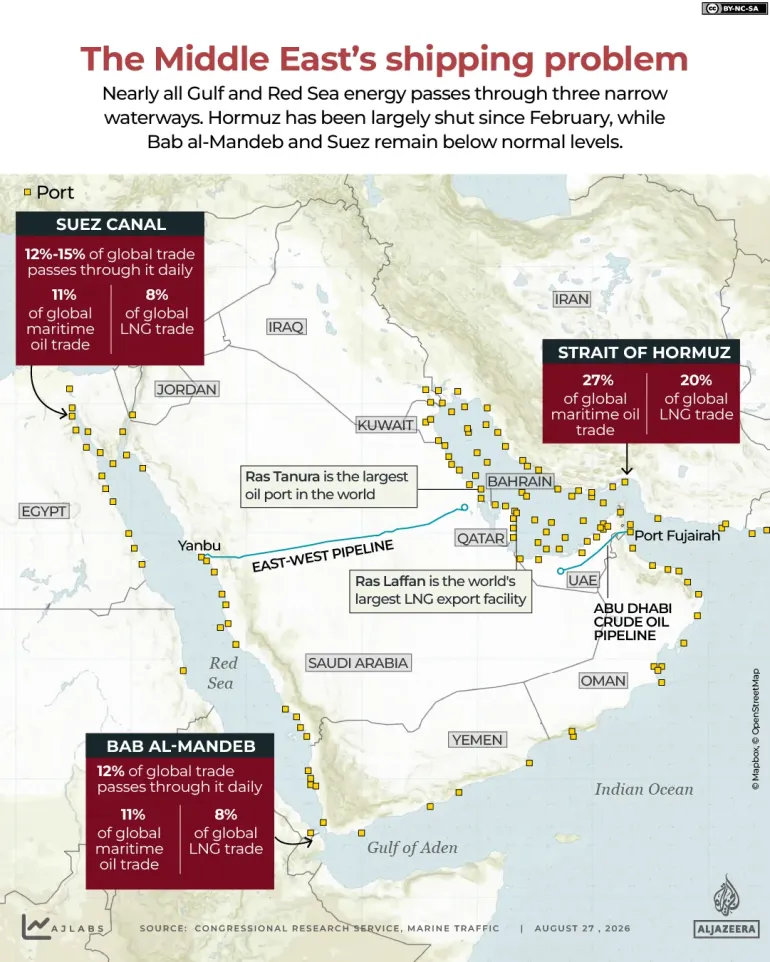
Hundreds of tankers sit idle on both sides of the Strait of Hormuz as Iran has effectively closed the waterway, pushing oil prices above $100 – the highest since 2022, after the start of the Russia-Ukraine war.

Oil tanker traffic in the strait, through which one-fifth of global oil passes, has plunged after Israel and the United States launched attacks on Tehran on February 28. Asian countries, including India, China and Japan, as well as some European countries, source large portions of their energy needs from the Gulf. A disruption in supply will rattle the global economy.

With an aim to cushion from the shock, the International Energy Agency (IEA) has decided to release 400 million barrels of oil from emergency reserves, the largest coordinated drawdown in the agency’s history. But it has failed to push the prices down.

The agency had released about 182 million barrels after Russia’s invasion of Ukraine to stablise the oil prices.

According to the agency, oil shipments through the strategic waterway have fallen to less than 10 percent of pre-war levels, threatening one of the most critical arteries in the global energy system.

IEA members collectively hold about 1.25 billion barrels in government-controlled emergency reserves, alongside roughly 600 million barrels in industry stocks tied to government obligations.

A large number in a massive market

The figure may appear vast, but it shrinks quickly against the scale of global energy demand.

“This feels like a small bandage on a large wound,” energy strategist Naif Aldandeni said, describing the world’s largest coordinated emergency oil release as governments scramble to steady markets shaken by war.

The US Energy Information Administration (EIA) estimates world consumption of petroleum and other liquids will average 105.17 million barrels per day in 2026. At that rate, 400 million barrels would theoretically cover just four days of global consumption.

Even when compared with normal traffic through the Strait of Hormuz – around 20 million barrels per day – the released oil equals only about 20 days of typical flows.

Aldandeni told Al Jazeera that emergency reserves can calm panic in markets but cannot replace the lost function of a disrupted shipping corridor.

“The release may soften the shock and calm nerves temporarily,” he said, “but it will remain limited as long as the fundamental problem — the freedom of supply and tanker movement through Hormuz – remains unresolved.”

Oil prices reflect those anxieties. Brent crude ended trading on Friday at $103.14 per barrel, after surging to nearly $120 earlier as fears of disrupted production and shipping intensified.

Geopolitical risk premium

Oil expert Nabil al-Marsoumi said the price surge cannot be explained by supply fundamentals alone.

“The closure of the Strait of Hormuz added roughly $40 per barrel as a geopolitical risk premium above what market fundamentals would normally dictate,” he told Al Jazeera.

From that perspective, releasing strategic reserves serves primarily as a temporary tool to dampen that premium rather than fundamentally rebalance the market.

Prices above $100 per barrel are uncomfortable for major consuming economies already struggling to curb inflation and protect economic growth.

Recent EIA projections suggest global demand has not yet declined significantly because of the war, remaining close to 105 million barrels per day. The market pressure, therefore, stems less from falling consumption and more from fears of supply shortages and delays in deliveries to refineries and consumers.

Threats to oil infrastructure

The latest escalation could deepen those fears.

United States President Donald Trump said on Friday that the US Central Command (CENTCOM) had “executed one of the most powerful bombing raids in the History of the Middle East and totally obliterated every MILITARY target in Iran’s crown jewel, Kharg Island”.

He added that “for reasons of decency” he had “chosen NOT to wipe out the Oil Infrastructure on the Island”, but warned Washington could reconsider that restraint if Iran continues to disrupt shipping through the Strait of Hormuz.

CENTCOM confirmed the operation, stating US forces had struck “more than 90 Iranian military targets on Kharg Island, while preserving the oil infrastructure”.

Iranian officials have meanwhile warned they would target energy facilities linked to the US across the region if Iranian oil infrastructure comes under direct attack.

Kharg Island is not simply a military location. It serves as the primary export terminal for Iranian crude, making it a critical node in the country’s oil supply network.

If attacks move from obstructing shipping to targeting export infrastructure itself, the crisis could shift from a chokepoint disruption scenario to one involving direct losses of production and export capacity.

In such circumstances, the oil released from emergency reserves would act only as a temporary bridge rather than a lasting solution to lost supply.

Major oil companies such as QatarEnergy, the world’s largest producer of liquefied natural gas (LNG), Kuwait Petroleum Corporation and Bahrain state oil company Bapco have shut production and declared force majeure, while Saudi Aramco, the world’s largest oil producer, and UAE state oil company ADNOC have shut down their refineries.

Limits of emergency reserves

Even under a less severe scenario – where maritime disruption persists but infrastructure remains intact — the ability of strategic reserves to stabilise markets remains constrained by logistics.

The US Department of Energy said the US Strategic Petroleum Reserve held 415.4 million barrels as of 18 February 2026. Its maximum drawdown capacity is 4.4 million barrels per day, and oil requires about 13 days to reach US markets after a presidential release order.

That means even the world’s largest emergency stockpile cannot flood the market with crude immediately. The release must move through pipelines, shipping networks and refining capacity before reaching consumers.

Aldandeni said the current intervention would likely produce only a temporary stabilising effect, while al-Marsoumi warned that prolonged disruption in the Strait of Hormuz – or the spread of threats to other chokepoints such as the Bab al-Mandeb Strait in the Red Sea could quickly send prices further higher.

Source link

How Carney’s ‘build fast’ push divides Canada’s Indigenous peoples | Business and Economy

Vancouver, Canada – Prime Minister Mark Carney’s efforts to unite Canadians around protecting the nation’s economy from the US are hitting roadblocks as he nears one year in power.

Indigenous peoples across Canada are increasingly divided over Carney’s aggressive push to expand resource extraction and projects on their ancestral lands.

Recommended Stories

list of 4 itemsend of list

Some experts question how his government can advance its agenda while respecting Indigenous rights enshrined in the country’s constitution.

March 14 will mark one year since Carney, former head of Canada’s central bank, was sworn into office.

After an election last year, his centrist Liberal party formed a minority government with the highest share of the popular vote in 40 years.

A key to Carney’s victory was his pledge to “stand strong” against US trade threats and grow Canada’s economic sovereignty, an assertive approach the prime minister has called “elbows up”.

“In the face of global trade shifts … we will build big and build fast to create a stronger, more sustainable, more independent economy,” Carney said in a statement on March 6.

Part of that push was to create a Major Projects Office to speed up approvals of economic developments, starting by fast-tracking 10 mega-projects.

They include two massive liquefied natural gas (LNG) plants and an open-pit mine in British Columbia, a nuclear plant in Ontario, a Quebec shipping terminal, and wind power in Atlantic Canada.

Those developments are worth 116 billion Canadian dollars ($85bn), the government estimates.

‘Our rights get pushed to the side’

Carney’s approach to the US trade war has gained support from Canadians, according to recent opinion surveys.

A March 3 poll of 1,500 citizens by Abacus Data found that 50 percent say Carney is protecting Canada’s core interests when dealing with Trump — compared with 36 percent with negative views.

“Whenever Canada is threatened, the protectionist nature of the state kind of re-emerges,” said Shady Hafez, assistant politics professor at Toronto Metropolitan University.

“Self-preservation of Canada becomes the priority.”

Hafez, a research associate with the Yellowhead Institute, is a member of the Kitigan Zibi Anishinabeg First Nation in Quebec.

He said there are growing concerns in his community and others about Carney’s push to accelerate mega-projects across the country.

“For that to happen, Canada needs land, and it needs resources,” Hafez said, “and it takes those lands and resources from us.”

Blowback was swift after Carney pledged to build a highly controversial oil pipeline to the west coast in a late November deal signed with Alberta, Canada’s oil powerhouse.

Carney’s culture minister swiftly resigned, decrying “no consultation” with Indigenous nations and “major environmental impacts”.

And the Assembly of First Nations (AFN), which represents more than 600 Indigenous chiefs, unanimously passed an emergency resolution opposing a new pipeline.

“First Nations people, we stand with Canada against Trump’s illegal tariffs, but not at the expense of our rights,” AFN National Chief Cindy Woodhouse Nepinak told Al Jazeera in an interview. “If you want to fast-track anything, you better make sure that First Nations are being included right off the bat.

“Trying to sideswipe or push aside First Nations people when there’s agreements between provinces and the feds — they have to remember that First Nations are here … and they are to be respected in their own homelands.”

The rights of Indigenous people in the country are enshrined in Canada’s constitution.

But too often, Hafez said, in the name of national prosperity, “Indigenous communities have to suffer.”

“Whenever there’s somewhat of an emergency, our rights get pushed to the side.”

But the resistance to the major projects push isn’t universal.

The First Nations Natural Gas Alliance praised Carney’s “much more aggressive” approach compared with his predecessor on developing energy resources.

But the group’s CEO, Karen Ogen, acknowledged there’s a “highly charged environment” on such issues.

“First Nations communities continue to face significant socioeconomic barriers”, stated the former chief of Wet’suwet’en First Nation. “LNG and natural gas development are not just an opportunity; they are a national imperative.

“Billions of dollars in procurement benefits and revenues are flowing to First Nations.”

Call for collaboration ‘on all major projects’

The trade war with the US has galvanised and united many Canadians — but with little acknowledgement of the impacts on Indigenous communities, said Sheryl Lightfoot, political science professor at the University of Toronto.

Lightfoot is vice-chair of the UN Expert Mechanism on the Rights of Indigenous Peoples.

“These projects, by many accounts, are advancing without full consultation or transparency”, she told Al Jazeera.

“It appears that economic or geopolitical pressures … are being used to justify bypassing Indigenous rights and environmental safeguards.”

But Canada’s Major Projects Office insists it will “seek input, hear concerns and ideas, and work in partnership moving forward” with Indigenous communities — and “will not be skipping over vital project steps including consultations with Indigenous Peoples,” an agency spokesperson wrote in an emailed statement.

“We are unlocking Canada’s economic potential, while respecting our environmental responsibilities and the rights of Indigenous Peoples,”

A significant number of projects on Carney’s fast-track list are concentrated in British Columbia (BC).

Those include two liquefied natural gas (LNG) terminals on the Pacific coast — LNG Canada and Ksi Lisims LNG — as well as the electric transmission line to power the sector, and a copper and gold mine.

BC is unique in the country because, historically, very little of its land was subject to treaties between the Crown and First Nations. Canada’s top court has repeatedly ruled in favour of First Nations rights and title in the westernmost province.

All four major projects in the province have proven divisive among the region’s Indigenous peoples — even though several have the backing of individual First Nations governments.

One of those is the massive Ksi Lisims LNG plant, in which the Nisga’a Nation is a direct partner.

Co-developed with Texas-based Western LNG, the mega-project will “benefit all Canadians,” said Nisga’a President Eva Clayton.

In 2000, her nation became the first in BC to reach a modern self-government treaty.

“We are co-developing the Ksi Lisims LNG project on land that our nation owns under our treaty,” she told a parliamentary committee on February 24.

“This project is expected to bring in 30 billion [Canadian] dollars [$22bn] in investment, create thousands of skilled careers, and strengthen Canada’s leadership in low-emission LNG.”

‘Elbows up’ meets opposition

But LNG is fiercely opposed by other nearby First Nations.

Tara Marsden is Wilp sustainability director for the Gitanyow Hereditary Chiefs, traditional leaders of the 900-member Gitanyow community.

“We have a lot more concerns and evidence regarding impacts in our territory,” she said.

“The federal government has done zero consultation on their fast-track list and the projects that actually affect our territory.”

Gitanyow oppose the BC projects on the fast-track list as harming their interests.

She said Ottawa cannot ignore First Nations opposition, even if there is support from others like the Nisga’a.

“They have a right to develop in their own territories”, said Marsden. “But if you have maybe 20 to 30 First Nations whose territory would be crossed — and you get maybe three on board — that’s not a resounding consensus.

“They’re just trying to use this small handful of nations to steamroll over everybody else.”

If Canada truly wants to strengthen its sovereignty and economy, she said, it must do so alongside Indigenous people.

“This is something that First Nations across the country have been saying since Carney took the ‘elbows up’ approach,” Marsden said.

“The government has really just ignored that … and actually now back-stopping these mega-projects with taxpayer dollars.”

McGill University economics lecturer Julian Karaguesian served for decades in the Department of Finance and Canada’s Embassy in Washington, DC.

He agreed that most Canadians support Carney’s attempt to boost the economy with “nation-building” projects.

“I think they’re a fantastic idea”, he told Al Jazeera. “But we’ve committed to consultations with First Nations, Metis and Inuit people.

“Once we’ve started compromising on economic and social justice … we can create bitterness. First Nations leaders understand the situation we’re in, and I think [Ottawa] can work with them.”

Even on projects endorsed by some First Nations, the international legal principle of “free, prior and informed consent” must still apply to other communities impacted, said Lightfoot.

That’s “not simply a procedural requirement” to rubber-stamp projects, she said.

“It is a substantive right, anchored in Indigenous peoples’ self-determination and their ability to make decisions about matters that affect their lands, communities, and futures.”

And that could risk slowing down Carney’s hopes to speed through projects if there is no Indigenous consensus — potentially tying more divisive ones up in the courts.

“Failure to include Indigenous knowledge and decision-making early in the process,” Lightfoot said, “can undermine the legitimacy and fairness of project approvals.”

Carney’s ratings among First Nations are “mixed,” says AFN’s national chief. One positive, she noted, is his openness to meeting Indigenous leaders raising concerns.

But with many of the prime minister’s economic hopes dependent on building “national interest” infrastructure on First Nations homelands, Woodhouse Nepinak said the relationship needs care.

“Carney is at a crossroads in his personal relationship with First Nations,” she said.

“And we understand First Nations rights are under threat in new ways by this government.”

Source link

Yemeni ports face shipping fee hike amid Iran conflict | US-Israel war on Iran News

Mukalla, Yemen – A reported decision to impose thousands of dollars in fees on shipping headed for Yemen has experts worried that the price of imported goods and food will increase in the war-torn country, as it starts to feel the economic impact of the United States and Israel’s conflict with Iran.

Local traders and officials have said that international shipping companies informed importers earlier this month of the imposition of new fees of about $3,000 on each container bound for Yemen, described as “war risk” fees. The surprise move prompted government officials to scramble to assess and address its potential repercussions.

Recommended Stories

list of 3 itemsend of list

Because Yemen imports nearly 90 percent of its food and other essential commodities, economists and humanitarian organisations warn that the rise in shipping and insurance costs could quickly translate into higher prices for fuel, food and other goods, further worsening an already dire humanitarian situation.

Mohsen al-Amri, transport minister in Yemen’s internationally-recognised government based in the southern city of Aden, said he had instructed that the fees not be paid by ships already docked at Yemeni ports or those bound for the country, insisting that the ports remain safe.

“Our ports are far from the areas of geopolitical tension in the Gulf and the Strait of Hormuz, making the imposition of ‘risk’ fees on shipments to these relatively safe areas unjustified from both operational and security perspectives,” he said in a social media post last week.

Al Jazeera has reached out to shipping companies to confirm details of the fee, but has yet to receive responses.

For more than a decade, Yemen has been gripped by a bloody war between the Saudi-backed government, based in Aden, and the Iran-aligned Houthi movement, which controls the capital, Sanaa. The conflict has killed and wounded thousands of people and displaced millions, creating what the United Nations once described as the world’s worst humanitarian crisis. Hostilities have significantly declined since April 2022, when the warring parties agreed to a temporary United Nations-brokered truce.

‘High-risk’

Abdulrab al-Khulaqui, deputy chairman of the Yemen Gulf of Aden Ports Corporation, said Yemeni ports have long been classified as high-risk, prompting shipping companies to impose war-risk surcharges. These can reach about $500 per each 20-foot container and $1,000 per each 40-foot container, on top of regular shipping costs.

Al-Khulaqui said that the $3,000 fee now being demanded was “very high and unusual”, but was justified by shipping companies because they regard Yemeni ports as unsafe, despite their distance from Iran.

Although the Houthis are allied to Iran and previously attacked shipping in the Red Sea following Israel’s genocidal war on Gaza, the Yemeni group has yet to intervene in the US-Israel-Iran conflict. Other Yemeni parties are also not involved, making Yemen one of the few regional countries yet to see any violence related to the fighting.

In addition to barring local traders from paying the new charges, the Yemeni government is considering other measures to pressure shipping companies to cancel the fees, including threatening to stop vessels belonging to those companies from docking at Yemeni ports. Authorities may also allow traders to contact exporters directly in countries of origin to negotiate any additional charges.

The new surcharges come as the United Nations has again sounded the alarm over Yemen’s worsening humanitarian situation, saying nearly 65.4 percent of the population – about 23.1 million people – will require urgent humanitarian assistance and protection services this year. This marks an increase of roughly 3.5 million people compared with 2025.

“Yemen continues to face an escalating food security crisis entering 2026,” the World Food Program said in its February Yemen Food Security Update, released on March 5. “January data revealed that 63 percent of households nationwide are struggling to meet their minimum food needs, including 36 percent facing severe food deprivation.”

Bypassing Yemen’s ports

In addition to rising insurance fees on shipments to Yemen, the war in Iran and potential disruptions in the Strait of Hormuz could cut vital supply routes from regional hub ports such as Jebel Ali in the United Arab Emirates.

Mustafa Nasr, head of the Studies and Economic Media Center, told Al Jazeera that shipping companies may begin seeking alternative hub ports to deliver goods to Yemen, which could increase costs and cause delays.

“The closure of Jebel Ali port would force shipping lines to seek alternative ports that may be farther away and involve significantly higher transportation costs,” he said.

Nabil Abdullah Bin Aifan, manager of the government-run Maritime Affairs Authority in Hadramout province and a maritime researcher, said most goods arriving at Mukalla port – the province’s main seaport – are transported on wooden dhows from Dubai.

He said that if disruptions occur in the Strait of Hormuz, traders may turn to alternative regional hub ports such as Salalah in Oman or Jeddah in Saudi Arabia.

“Large ships come to Dubai to unload their containers, and traders then unload the goods from the containers and load them onto those primitive ships, which have no insurance,” Bin Aifan told Al Jazeera.

For now, wheat shipments from Ukraine and goods transported from China to Yemen may see price increases due to rising insurance costs, while products imported from Gulf countries could disappear from the market.

Shipping lines may also consider routing cargo through the Cape of Good Hope rather than the Gulf, Bin Aifan said.

“Even before the recent developments involving Iran, ports in our region were considered high risk. However, after the relative calm that followed the halt to Houthi attacks in the Red Sea, confidence gradually returned and ships began sailing back to the region. Now, the war has brought the problem back again,” he said.

All of this means that Yemenis, already struggling with poverty and hunger after years of war, will likely have to pay more for imported food and goods.

Abdullah al-Hadad, an English teacher from the city of Taiz with 40 years of experience in the profession, said that his monthly salary – less than $80 – is already not enough to cover his basic needs. Meat and fish have become luxuries for his family, and he still owes nearly one million Yemeni riyals (about $670) to a local grocery shop.

To make ends meet, he works additional jobs as a taxi driver and in a grocery store, while his children also work after school to help support the family and pay for medication for his 10-year-old son, who has autism.

“What I suffer from as a government employee is the extremely low salary, which does not even cover basic necessities such as bread, tea, salt and sugar,” al-Hadad told Al Jazeera.

“Other foods that are essential for a healthy diet, like meat or fish, have become a distant dream.”

Source link

Force majeure: What is it and why have some Gulf countries invoked it? | US-Israel war on Iran News

Gulf countries, including Qatar, Bahrain and Kuwait, have declared force majeure on gas exports following the United States-Israel war on Iran, now in its third week, and the disruptions to shipping through the Strait of Hormuz, as Tehran has retaliated across the region, targeting US assets.

QatarEnergy was among the first to halt production, shutting down gas liquefaction on March 2 and sending ripples through global energy markets. Kuwait Petroleum Corporation and Bahrain’s Bapco Energies followed days later, while India invoked emergency measures to redirect gas supplies to priority sectors.

Oil prices also soared to more $100 a barrel as war intensified and uncertainty grew over energy shipments through one of the world’s most critical maritime chokepoints.

Here’s what we know about force majeure and what Gulf countries invoking it means for global oil and gas markets.

What is force majeure?

Force majeure, from the French meaning “superior force”, is a clause in contracts that allows a party to be excused from its obligations when an event beyond its control prevents performance.

This legal move can allow a party to suspend its obligations temporarily, be released from them partially or fully, or adjust them to reflect the new circumstances.

Why are Gulf countries invoking force majeure?

Companies in Qatar, Kuwait and Bahrain have invoked it following severe disruptions to shipping through the Strait of Hormuz caused by US-Israeli military strikes against Iran that started on February 28.

Following these attacks, a commander in Iran’s Islamic Revolutionary Guard Corps (IRGC) said on March 2 that the Strait of Hormuz was closed and warned that any vessel attempting to pass through would be attacked, a statement echoed by Iran’s new supreme leader, Mojtaba Khamenei, on Thursday.

As a result, Gulf companies started invoking force majeure, in order “to avoid paying damages or other financial penalties under their contracts”, Ilias Bantekas, a professor of transnational law at Hamad bin Khalifa University in Qatar, told Al Jazeera.

“These companies are most likely unable to fulfil their obligations, for example, to deliver shipments of oil and gas to other countries, or for shippers to transport them across the Arabian Gulf,” he said.

Does war automatically qualify as force majeure?

No. For war to qualify as force majeure, it must either be covered by the contract or actually prevent one or both parties from performing their obligations.

Companies and states typically include force majeure clauses that define which events qualify, meaning that when force majeure is invoked, the parties rely on provisions they previously agreed upon.

“War can always be foreseen, but perhaps not at the level at which it is being waged right now,” Bantekas said, adding that under general contract provisions, ships carrying goods are usually expected to find another route, “even if it is more costly to them”.

“What we could never have foreseen is that the Strait of Hormuz could be closed to shipping altogether, even if Iran were attacked in the brutal way it is now. I think that, on its own, could be sufficient to constitute a force majeure event,” he said.

“However, only a court would have the authority to make a definitive determination as to whether this kind of war, under these particular circumstances, amounts to force majeure,” he added.

Will LNG and oil markets be affected?

Yes. QatarEnergy’s declaration of force majeure alone has already significantly disrupted the global LNG market, as Qatar accounts for nearly 20% of global supply.

Gas prices soared immediately following the country’s halt of gas production, and global gas markets are expected to experience shortages for weeks, if not longer.

“The lack of visibility over the likely duration of force majeure, and of the broader military conflict, is injecting extreme uncertainty into global oil, gas and LNG prices,” Seb Kennedy, global gas and LNG analyst, told Al Jazeera.

“Prices will necessarily keep rising as volumes are withheld from the market, until price pain triggers demand destruction in price-sensitive areas of the economy,” he noted.

Which other countries have invoked force majeure?

On Tuesday, India invoked force majeure to redirect gas supplies from non-priority sectors to key users after disruptions to liquefied natural gas shipments through the Strait of Hormuz, according to a government notification.

But India’s measures are a “domestic demand-management response”, Kennedy said, as its government is relocating its limited gas supplies internally “to protect critical sectors such as households, small businesses, power generation and city gas distribution”.

INTERACTIVE - Oil soars past $100 a barrel - March 9 , 2025-1773125106
(Al Jazeera)

Kennedy said the move reflects the difficult choices facing LNG-dependent economies, where governments may prioritise households and power generation over industrial users.

This prioritisation of LNG for domestic use “highlights the tough choices facing LNG-dependent countries”, he noted.

Aside from India, Omani trading house OQ also declared force majeure to a customer in Bangladesh after the Qatari supply was halted.

How will this affect US and European markets?

US LNG exporters are likely to benefit from the disruption. Analysis by Energy Flux estimates that US LNG exporters could generate about $4bn in windfall profits in the first month of the disruption alone.

If the situation persists, “US LNG windfall profits could reach $33bn above the pre-Iran average within four months. Over eight months, that figure rises to $108bn,” says Kennedy.

INTERACTIVE-CRUDE OIL-USED-MARCH 9-2026-1773138980
(Al Jazeera)

These gains largely come at the expense of European consumers, Kennedy notes, as Europe is the main destination for US LNG and remains heavily reliant on those supplies to refill gas storage and ensure winter supply security.

European stock markets fell last week, while the region’s natural gas prices rose sharply again.

What does this mean for Asian markets?

Major Asian economies such as India, China and South Korea rely heavily on imported LNG.

On the other hand, Southeast Asia alone has significant fossil fuel resources, but the region still depends heavily on imported oil and gas, much of which is transported through the Strait of Hormuz.

“Wealthier buyers such as Japan and South Korea can generally outbid others to secure cargoes during periods of extreme scarcity,” Kennedy said, noting that price-sensitive importers, especially in South and Southeast Asia, tend to be “forced out of the market” whenever prices soar, “leading to demand destruction, fuel switching, or industrial curtailment”.

“In that sense, the crisis does not hit all LNG importers equally: It becomes a contest of balance sheets as much as a question of physical supply.”

Can force majeure be challenged?

If a force majeure clause is written in the contract, then it stands because the parties have consented to it.

Contrary to that, if it has not been written in the contract, then any unforeseen event would potentially be open to legal challenge, and it becomes a matter of convincing the courts that the event could never have been foreseen and that it makes obligations on one of the parties impossible to perform.

“However, in the present circumstances, the stronger parties – the ones waiting for deliveries of oil and gas elsewhere in the world – may actually be harming themselves if they refuse to accept force majeure,” Bantekas said.

“Doing business with Gulf countries could become more difficult in the future, and premiums would likely rise significantly. So, I do not think they will be taking these matters to court,” he noted.

Source link

Oil stays above $100 a barrel amid Iran’s stranglehold on Strait of Hormuz | US-Israel war on Iran News

Energy markets remain on tenterhooks as the prospect of prolonged war in the Middle East grows.

Oil prices have again risen above $100 per barrel as energy markets see little relief amid the biggest disruption to global energy supplies in a generation.

Brent crude, the international benchmark, surged more than 9 percent on Thursday as traders weighed the prospect of weeks, or even months, of turmoil in energy markets as the United States and Israel wage war on Iran.

Recommended Stories

list of 4 itemsend of list

Brent futures, which are traded outside of regular market hours, were priced at $101.13 as of 03:00 GMT.

Asian stock markets, including exchanges in Tokyo, Seoul and Hong Kong, opened sharply lower on Friday, following steep losses on Wall Street overnight.

The latest surge in oil prices came after Iran’s Supreme Leader Mojtaba Khamenei pledged to maintain the effective closure of the Strait of Hormuz, which normally transports about one-fifth of global oil supplies.

In a statement read out on his behalf on Iranian state television, Khamenei described Tehran’s threats against shipping in the waterway as a “lever” that “must continue to be used”.

US President Donald Trump struck a similarly defiant tone on Thursday, posting on Truth Social that stopping Iran from getting nuclear weapons was of “far greater interest and importance” than rising oil prices.

‘Lack of tangible goals in this war’

Traffic through the strait has effectively ground to a halt due to Iranian threats, with only a handful of vessels passing through each day, many of them claiming links to China, Iran’s key economic partner.

According to the United Kingdom Maritime Trade Operations (UKMTO) centre, no more than five ships have passed through the waterway each day since the US and Israel launched joint strikes on Iran on February 28, compared with an average of 138 daily transits before the war. At least 16 commercial vessels have been attacked in the region since the start of the conflict, according to the UKMTO.

Tehran has claimed responsibility for several of the attacks, including a strike on Wednesday that crippled a Thai-flagged vessel off the coast of Oman.

Efforts to bring calm to the market have so far done little to tame prices, which are up nearly 40 percent compared with before the start of the war.

The International Energy Agency’s (IEA) announcement on Wednesday that member countries would release 400 million barrels of oil from emergency stockpiles drew a tepid response among traders eyeing a daily shortfall in global supplies estimated at 15-20 million barrels.

The US Department of the Treasury’s issuance on Thursday of a temporary licence authorising countries to purchase sanctioned Russian oil that has been stranded at sea also failed to move the market, with Brent crude staying above $100 a barrel after the Treasury announcement.

“The key problem is a lack of tangible goals in this war,” said Adi Imsirovic, an energy security expert at the University of Oxford.

“It makes it hard for oil traders to see the light at the end of the tunnel,” he said.

Trump has repeatedly floated the possibility of using the US Navy to escort commercial shipping through the strait, but the Pentagon has yet to conduct such operations amid concerns about the risks posed by Iranian attacks in the narrow waterway.

In an interview with CNBC on Thursday, US Energy Secretary Chris Wright said that Washington was “not ready” to provide navy escorts but that such operations could begin by the end of the month.

“It’ll happen relatively soon but it can’t happen now,” Wright said.

Source link

How will the war on Iran impact the US economy? | US-Israel war on Iran News

New York City, United States – Rising prices on the back of US-Israel strikes on Iran are adding to the economic pressure facing US consumers despite efforts by US President Donald Trump to paint the war as a success.

On Wednesday, Trump declared, “We won – in the first hour it was over.”

Recommended Stories

list of 4 itemsend of list

Trump’s declaration comes even as the Strait of Hormuz remains closed, cutting off oil from the Gulf amid warnings from Iran, which continues to strike ships, that oil could reach $200 per barrel.

Oil prices spiked above $100 per barrel on Sunday and again today.

The magnitude of the economic pressure on consumers will depend on how long the war lasts and, crucially, how soon shipping traffic can return to the Gulf.

“If it drags on and especially if it remains at this intensity, prices will be higher, and more volatile for consumers,” said Rachel Ziemba, an adjunct senior fellow at the think tank Center for a New American Security.

“If it ends quickly, and it’s a credible and stable end, then we could see prices fairly quickly normalising”.

If the war lasts more than a few weeks, however, observers say the US economy is more likely to see deepening impacts, like 1970s-style “stagflation” or a recession.

When might we see a recession?

On Thursday, the International Energy Agency said in a report that “the war in the Middle East is creating the largest supply disruption in the history of the global oil market.”

According to Sam Ori, who directs the Energy Policy Institute at the University of Chicago, in the past, when oil prices have reached 4 percent to 5 percent of gross domestic product and stayed elevated, “that’s always triggered a recession.”

The US will not hit that threshold as quickly as it would have in the 1970s, when its economy was more deeply dependent on foreign oil, Ori said, but added he expected a recession if prices remained about $140 a barrel for most of the year.

Alternatively, “the indefinite closure of the Strait of Hormuz would so vastly exceed that number, it would not take a year,” he said.

Ori, who used to run an oil shock war game for US officials, said he would have been “laughed out of the room” if he had proposed a scenario where the strait was closed for six months, because many analysts see it as “too big to fail”.

Ori says that assessment is still likely, but recent developments “are chipping away at that level of certainty”.

The Gulf, which separates the Arabian Peninsula and Iran, provides more than one-fifth of the world’s oil supply via tanker ships through the Strait of Hormuz.

The severity of that threat to the global economy is the “strongest indicator that this is going to get resolved pretty fast, because it’s impossible to fathom what would happen if it didn’t”, Ori said.

He added that the conflict has now entered a phase in which it may be moving out of US control, especially as some countries have turned off the oil wells as they run out of storage.

While those events have now been baked into oil prices, the things that he is on the lookout for include “successful mining of the strait, some kind of structural blockage, or a battlespace development that binds the US into a longer, drawn out conflict”, outcomes that could signal a total loss of the strait for an unknown amount of time and create the “conditions for a complete meltdown”.

Higher prices

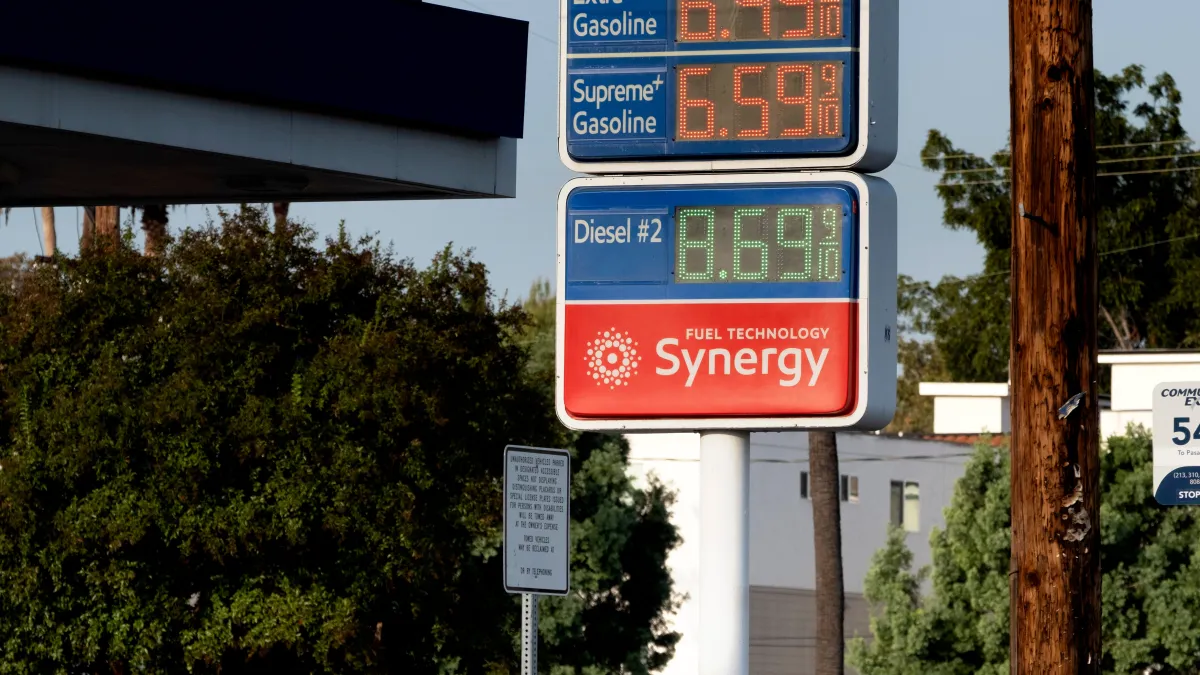
The war is already driving petrol prices up for US consumers.

Patrick DeHaan, who leads petroleum analysis for the app GasBuddy, said that the national average as of Wednesday is now $3.59 per gallon ($0.95 per litre) – up 65 cents since February.

The highest increases are near the coasts, where US petrol, diesel and jet fuel supplies are more easily diverted to meet global demand, according to DeHaan.

An end to the conflict could lower petrol prices within weeks, DeHaan said, but “every week that this goes on, we could see another 25 to 40 cent increase”.

Robert Rogowsky, an adjunct professor at Georgetown University’s School of Foreign Service, said lower-income people in particular, “will pay the price for this inflationary burst”.

As the war continues, it will also nudge up prices for consumer goods.

Peter Sand, chief analyst for freight intelligence platform Xeneta, said the backup at the Strait of Hormuz is already causing congestion at ports worldwide.

In the short term, consumers should not feel much of a pinch, Sand said. But if the conflict lasts for a month, some goods will be delayed, “and of course, the price tag on those goods also goes up.”

The war also means that the Red Sea, mostly closed in 2025 due to Houthi attacks, will likely stay closed throughout 2026, Sand said. It was expected to reopen, which could have lowered consumer prices.

Oil and oil byproducts from the Gulf are also used directly in consumer goods, like plastics, pharmaceuticals and fertilisers. Shortages now may mean higher prices later.

Fertilisers from the Gulf, for example, are needed soon for spring planting. Delays could affect crops next year.

A shortage of helium from the Gulf could also impact semiconductor manufacturing, delaying car manufacturing and other industries, Ziemba said.

The spectre of 1970’s-style ‘stagflation’

Higher consumer prices could increase the risk of “stagflation”, when stagnant economic growth occurs alongside high unemployment and high inflation.

That is how the US economy responded to the oil price shocks of the 1970s.

Severin Borenstein, faculty director of the Energy Institute at the University of California, Berkeley’s Haas School of Business, said, “There’s certainly concern about stagflation again.”

That combination of high inflation plus high unemployment, Borenstein said, “is just really tough for the Fed to deal with”.

“They can either juice the economy or slow it down, and the two problems call for opposite solutions”, Borenstein said.

The Fed can lower interest rates to prompt spending and hiring, which can make inflation worse, or it can raise interest rates to lower inflation, which can slow hiring.

Ziemba said higher oil prices likely point to “inflation remaining stickier, which means it’s harder for the Fed to cut interest rates.”

As a result, “mortgage rates and other long-term interest rates might be stuck at their current levels,” Ziemba said. Mortgage rates, which were at 5.99 percent on February 27, are up to 6.29 percent as of March 12.

Even if the war ends tomorrow, it may already be accelerating longer-term shifts.

Rogowsky called US attacks on Iran “an injection of adrenaline” into a realignment already under way, as middle powers seek to reduce their reliance on the US.

That realignment “will affect our terms of trade, which will have a distinct impact on our economy”, Rogowsky said.

Logistics consultant David Coffey said for some businesses, the war is expediting conversations about risk. “They may have been assuming ‘Yes, there’s risk in the Middle East,’ but they may not have been assuming that this would kick off”, Coffee said.

Making supply chains more secure could raise costs for consumers, he said.

Military spending and the US budget

Meanwhile, Heidi Peltier, a senior researcher at Brown University’s Costs of War Project, said war also means long-term expenses around debt payments and veterans’ healthcare.

“We have spent at least $1 trillion in interest on the Iraq and Afghanistan wars – and rising, because it’s not like we’ve paid off any of that principal”, Peltier said.

Military spending, she said, also tends to create fewer jobs than government investment in education or healthcare. “If we’re spending money on this, what are we not spending money on?” Peltier asked.

Source link

Who wins and loses in the global energy crisis? | Business and Economy

As oil prices surge, some economies benefit while others face rising costs.

The war in the Middle East is exposing how dependent the world is on a handful of strategic chokepoints.

The Strait of Hormuz – a narrow waterway in the Gulf – is closed.

The longer this goes on, the faster the global energy map could be reshaped.

From Europe to Asia, countries are facing mounting supply risks and the threat of an inflation shock.

If the conflict between the US, Israel and Iran drags on, alternatives will be hard to find.

But, Russia is shaping up to be a major beneficiary, with soaring prices filling Moscow’s coffers despite Western sanctions.

Source link

Not ‘a litre of oil’ to pass Strait of Hormuz, expect $200 price tag: Iran | US-Israel war on Iran News

Warning comes as 400 million barrels of oil are being released from global reserves during waterway’s closure.

Iran’s Islamic Revolutionary Guard Corps (IRGC) says it will not allow “a litre of oil” through the Strait of Hormuz as the closure of the key Gulf waterway continues to roil global energy markets during the US-Israeli war on Iran.

A spokesperson for the IRGC’s Khatam al-Anbiya Headquarters said on Wednesday that any vessel linked to the United States and Israel or their allies “will be considered a legitimate target”.

Recommended Stories

list of 3 itemsend of list

“You will not be able to artificially lower the price of oil. Expect oil at $200 per barrel,” the spokesperson said in a statement. “The price of oil depends on regional security, and you are the main source of insecurity in the region.”

Global oil prices have fluctuated wildly this week during continued US-Israeli attacks against Iran, which has retaliated by firing missiles and drones at targets across the wider Middle East.

The closure of the Strait of Hormuz, through which about one-fifth of the world’s oil supplies transit, and production slowdowns in some Gulf countries have raised concerns of further disruptions.

Concerns around the duration of the war, which began on February 28 and has shown no sign of abating, are also adding to uncertainty, sending oil prices soaring.

On Wednesday, three ships were hit by projectiles in the Strait of Hormuz, maritime security and risk firms said, including a Thai-flagged cargo vessel that came under attack about 11 nautical miles (18km) north of Oman.

Release of oil reserves

World leaders, including members of the Group of Seven (G7) and the European Union, have been mulling what action to take in response to the war’s impact on global economies.

Christian Bueger, a professor of international relations at the University of Copenhagen and an expert in maritime security, said Europe will be facing “a major energy supply crisis” if the Strait of Hormuz is not reopened.

“For the shipping industry right now, it’s impossible to go through the Strait of Hormuz,” Bueger told Al Jazeera. “And if there are not stronger signals in the near future that they can at least try to go through the strait, then we are looking at a major shipping crisis, which can last weeks if not months.”

On Wednesday, the International Energy Agency (IEA) announced that its 32 member countries had unanimously agreed to release 400 million barrels of oil from their emergency reserves to try to lower prices.

“This is a major action aiming to alleviate the immediate impacts of the disruption in markets,” IEA Executive Director Fatih Birol said during an address from the agency’s headquarters in Paris.

“But to be clear, the most important thing for a return to stable flows of oil and gas is the resumption of transit through the Strait of Hormuz,” he added.

The reserve supplies will be made available “over a timeframe that is appropriate” for each member state, the IEA said in a statement without providing details.

German Economy and Energy Minister Katherina Reiche said earlier in the day that the country would comply with the release while Austria also said it would make part of its emergency oil reserve available and extend its national strategic gas reserve.

Meanwhile, Japan’s Ministry of Economy, Trade and Industry said it would release about 80 million barrels from its private and national oil reserves.

Japanese Prime Minister Sanae Takaichi said the country, which gets about 70 percent of its oil imports through the Strait of Hormuz, would begin releasing the reserves on Monday.

Source link