earning

LeBron James borrowed $300 million from insurers arranged by Guggenheim

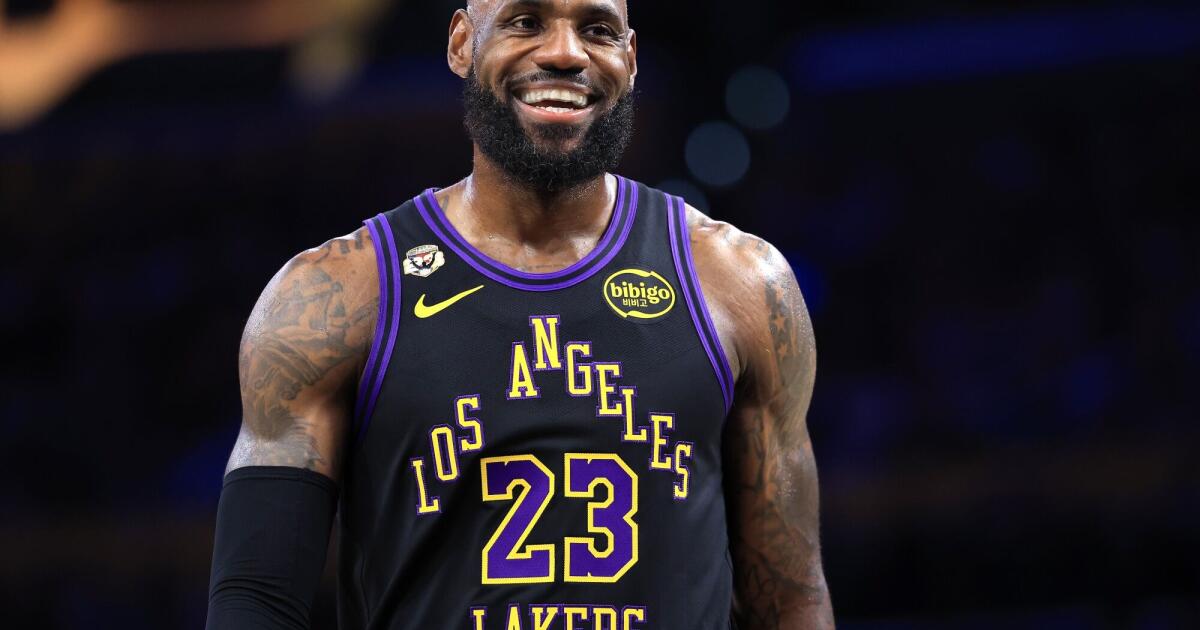
When LeBron James signed up to lead the Los Angeles Lakers to NBA glory with a $154 million contract in 2018, it wasn’t the biggest deal he did that year.

Just months before he joined, a limited liability company he controls borrowed almost $300 million from a pair of Midwestern life insurers advised by an arm of Guggenheim Partners, according to insurance industry records reviewed by Bloomberg.

The previously unreported bonds, which are due in 2049, were structured to provide immediate cash to James and backed by a stream of future revenue tied to his earnings outside basketball such as a lifetime Nike Inc. sponsorship, people with knowledge of the matter said.

The burst of lending began before Guggenheim leader Mark Walter started acquiring the storied basketball team. In an abrupt turn this month, the billionaire mogul agreed to sell the Lakers amid a federal probe into parts of his business empire. There’s no indication that the loans to James have anything to do with those inquiries.

Athletes and artists are increasingly using future earnings like royalties and licensing deals to structure deals that help them unlock immediate capital. David Bowie was famously the first recording artist to go to Wall Street to tap the future earnings of his music, paving the way for a thriving market for esoteric securities.

But James’ deal offers another look at how Walter and fellow Wall Street money managers have tectonically shifted the once-boring business of life insurance, steering policyholder premiums into more unusual investments. Guggenheim has moved insurers’ money deeper into private credit, sports franchises and — with James — financing for a star player. That’s far outside the industry’s traditional focus on plain-vanilla assets to reliably pay out future claims.

The two insurers — North American Company for Life and Health Insurance and Midland National Life Insurance Co. — are both owned by Sammons Financial Group. During a call with investors this week, Sammons said Guggenheim was the sole manager in charge of picking assets for the firm’s portfolios until 2021, according to people who heard the remarks and, like others in this story, asked not to be identified describing confidential dealings.

Sammons has been distancing itself from Guggenheim recently. Walter’s firm had long counted Sammons’ parent company among its biggest investors. During the call, though, Sammons’ representatives said it has been selling down that stake, the people said.

The “transactions were a securitization done by Mr. James with his personal, non-NBA salary, assets and income which is a very common financial structure for an individual with this level of earnings and assets,” a spokesperson for James said.

Spokespeople for Sammons and Guggenheim declined to comment.

The scrutiny of Walter’s empire by the Justice Department and Securities and Exchange Commission has turned up the spotlight on the intermingling of asset managers and insurers.

Wall Street power players have used insurance balance sheets to pursue their quest for higher returns, steering the savings of everyday Americans into more opaque and complex investments. The approach lets asset managers originate and structure deals, and then find uncomplaining buyers by parking such investments on the balance sheets of insurers they influence.

King James Funding

James’ borrowing from the two Midwestern insurers — structured as sales of asset-backed bonds — began when he was at the Cleveland Cavaliers and his career was poised for new heights.

The two companies bought almost $300 million bonds issued by an LLC he controlled called King James Funding, the records show. Within a few years, the LLC paid down some of that debt, then sold more bonds to the insurers, leaving them with about $245 million on their books by the end of last year, the records show.

The initial bonds from 2018 had a 4.8% interest rate and aren’t due until late 2049, the industry filings show. Terms are otherwise scant in the records reviewed by Bloomberg.

A few months after the deal, James started looking for another team as a free agent, ultimately picking the Lakers. In an oft-retold moment, he received a visit at home from Walter’s longtime business partner Magic Johnson, then a top executive for the Lakers. James ultimately signed a four-year contract.

Then in mid-August 2022, James signed a $97 million contract extension with the Lakers. Around that same time, the same Midwestern insurers provided his LLC with more cash, buying almost $60 million of 34-year bonds with a 5.75% interest rate, the insurers’ records show.

“Both transactions were independently credit rated by a third party and the 2022 transaction was fully approved by NBA,” James’ spokesperson said, noting the athlete had no affiliation with Guggenheim, Sammons, North American Co. or Midland National beyond their participation in the transactions.

Guggenheim also got involved in some of James’ other personal ventures. As the Covid pandemic took hold in 2020, he and his childhood friend and business partner, Maverick Carter, announced that they had raised $100 million for their media venture called SpringHill Co. Guggenheim was listed among investors in that company.

Leaving the Lakers

For more than a decade, Walter has mixed money from insurers with investments in sports. His 2012 acquisition of the Los Angeles Dodgers with business partners including Johnson relied heavily on the insurance industry.

Afterward, the new team’s owners ramped up spending on players to turn the franchise into a jewel of professional baseball, appearing in five of the past nine World Series. But that playbook isn’t as feasible in the NBA, which has stricter caps on team salaries.

Walter’s acquisition of the Lakers began in 2021 when he purchased a minority stake, granting him rights that paved the way for him to take a majority stake last year.

The sale of the team came as Walter has been reshaping his empire to unwind more than $20 billion of loans on his insurers’ books that should have been marked as funding affiliated businesses, but weren’t. While regulations allow insurers to lend money to such parties, they require that the dealings be disclosed.

James, meanwhile, announced that he’s leaving the Lakers and he signed a two-year deal with the Philadelphia 76ers. His new team is co-owned by Josh Harris, whose 26North Partners invests across middle-market private equity, credit and insurance.

Li, Sridhar Natarajan and Rajbhandari write for Bloomberg.
Source link

Peacock streaming service finally turns a profit as Comcast moves to spin off NBCUniversal

Peacock, NBCUniversal’s streaming service, reached profitability for the first time, boosted by FIFA World Cup, NBA playoffs and reality dating show “Love Island USA.”

The milestone comes as Comcast Corp. prepares to spin off NBCUniversal entertainment and news media businesses into a separate company. Peacock, which launched in 2020, grew its paid subscribers by 4% to 48 million in the second quarter, compared to the previous quarter. The company said Peacock’s earnings before interest, taxes, depreciation and amortization was $189 million.

“In just six years, we built Peacock into a streaming business with real scale in the U.S.,” said Brian Roberts, chairman and co-CEO of Comcast on Thursday in an earnings call, adding that Peacock has added 2 million paid subscribers in each of the last two quarters.

Co-CEO Mike Cavanagh said that performance “reinforces the value of NBC, Telemundo, Bravo, and Peacock together as one integrated media business with continued opportunity to drive stronger engagement, advertising, and profitability into the future.”

Comcast plans to spin off Peacock, NBC and Telemundo broadcast networks, Bravo, Universal film, television studios and theme parks and British TV service Sky into its own separate company, with a goal of completing the separation in about a year.

Michael J. Wolf, CEO of Activate Consulting, said Peacock’s first profit proves that live sports and premium programming “remain the single most powerful anchors for consumer attention and subscriber growth.”

“As Comcast prepares to spin off NBCUniversal, freeing it from legacy cable, a standalone NBCU is now structurally positioned to compete at the highest level of streaming,” Wolf said in a statement.

Peacock was the last major premium subscription video-on-demand service launched by a legacy studio to reach profitability, said Brandon Katz, director of insights and content strategy at Greenlight Analytics. The streaming service is available only in the U.S. and certain U.S. territories. Its reach is much smaller than other rivals like Netflix, which has about 80 million households in the U.S. and Canada.

“It was a long and arduous process for Peacock to reach profitability, and this is obviously a very important step for their business, but one small step in a much larger journey,” Katz said.

The Peacock news was part of Comcast’s earnings results. Comcast said revenue declined 1% to $29.9 billion in the second quarter, compared to a year ago, hurt by the loss of broadband residential customers.

Net income was $3.5 billion, down 68% from a year ago, when its profit was boosted by a $9.4 billion gain from Comcast’s sale of its share in Hulu.

Content and experiences revenue increased 22.9% to $10.7 billion, thanks to increases in advertising and theatrical revenue from popular movies including “The Super Mario Galaxy Movie,” horror movie “Obsession” and the international distribution of “Michael.”

Comcast’s stock closed Thursday at $21.92 a share, down about 7%.

Source link

Ally outlines 3%-5% average earning asset growth while keeping 3.6%-3.7% NIM guide (NYSE:ALLY)

Earnings Call Insights: Ally Financial (ALLY) Q2 2026

Management View

  • “Second quarter results were solid and reflect the progress we’ve made over the past several years to build a more focused, higher performing company.” (CEO & Director Michael Rhodes)
  • “For

Seeking Alpha’s Disclaimer: This article was automatically generated by an AI tool based on content available on the Seeking Alpha website, and has not been curated or reviewed by humans. Due to inherent limitations in using AI-based tools, the accuracy, completeness, or timeliness of such articles cannot be guaranteed. This article is intended for informational purposes only. Seeking Alpha does not take account of your objectives or your financial situation and does not offer any personalized investment advice. Seeking Alpha is not a licensed securities dealer, broker or US investment adviser or investment bank.

Source link

Emmerdale legend’s epic rise from being homeless to ‘earning thousands’ on ITV soap

From being homeless to becoming one of Emmerdale’s most adored stars, one cast member has an incredible backstory

An Emmerdale icon has an off-screen story even more remarkable than some of the soap’s biggest storylines.

Over the years, viewers have been introduced to several stars who have joined the long-running programme. And while plenty have left, several have remained in the Dales, including Bob Hope actor Tony Audenshaw.

Tony shot to fame playing Bob Hope on the ITV soap back in 2000. Since then, he’s become a firm favourite and has been involved in a ton of memorable soap moments.

And in Wednesday’s episode (July 15) episode, the Woolpack Batman was seen spilling the beans to newcomer Serena Sugden (Casey Al-Shaqsy) about her newfound family.

However, for actor Tony, life hasn’t always been plain sailing as he has endured tough times trying to make ends meet while chasing his dream of acting.

Tony’s real-life homeless experience

In 2019, Tony opened up about being homeless back in the day, before having his big break in the TV world. The actor revealed he could not afford to stay in a BnB when he worked in Thorpe Park back in the 1980s, so was forced to sleep in his car in order to make ends meet.

“There were occasions where I didn’t have enough for a B&B, so I just parked up and tried to get some kip. It wasn’t easy, but you do what you have to do,” he said on Loose Women.

“I used to work at Thorpe Park, the theme park, I used to be the Thorpe Park rangers and do the voices. Up North things are much cheaper. I came down here in the 80s, and it was £70 for a BNB.

“If I was down for five nights I would sleep in the car, because I didn’t have much money coming in. I’d never do it two nights on the trot because you couldn’t really function well. It was Monday in a B&B, Tuesday in the car – the things you saw in those car parks, torches in the window.”

Tony’s reported soap earnings

Bob’s perseverance paid off as after an early stint in Brookside in the mid-90s, he was first seen on Emmerdale in 1996 in a minor role before landing the part of Bob Hope four years later.

Since then, he has clocked up more than 2,500 episodes, making him one of the soap’s longest-serving cast members.

Due to his status on the show, it’s believed Tony. could be earning thousands. Cast members earn between £400 and £2,000 per episode, which translates to annual salaries ranging from roughly £12,000 for newer cast members to over £200,000 for top, long-standing stars, like Tony.

Tony’s world record

Away from the Yorkshire set, Tony is renowned for his love of running; a hobby that has taken him all around the world, from London to Amsterdam and New York.

In 2010, he entered the London Marathon in a giant baby outfit — and crossed the line in just 3 hours and 13 minutes. The remarkable time earned him a Guinness World Record for the fastest marathon dressed as a baby, but the record has since been broken.

Running was also a hobby he shared with his late wife Ruth, who died from cancer in April 2017, when she was 43 years old, after a 16-month battle with the disease. Tony and Ruth had been married since 1996 and had two children together, a son George and a daughter Emily.

Emmerdale airs Monday to Friday at 8:00pm on ITV1 and ITVX

Source link