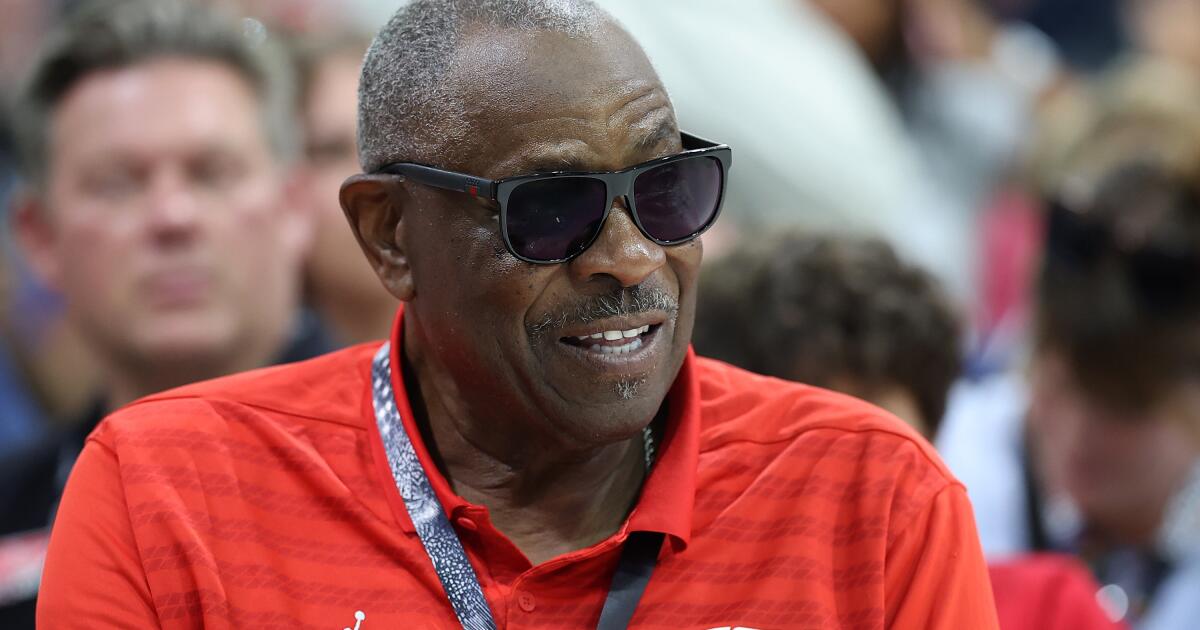
dusty baker

Why Dusty Baker will become first Black manager in the Hall of Fame

Dusty Baker could sense a portion of his life as he entered the National Baseball Hall of Fame’s Plaque Gallery on Saturday night. He couldn’t help but notice that some of his contemporaries from when he played with the Braves and Dodgers were walking slower, in some cases with the help of a cane or an assistant.

“I’m glad to see everybody,” said Baker, 77. “But you know, we’re getting old. I see guys in walkers who used to run fast, (and) their kids that are grown. You kind of see your life flash before your eyes.”

A record 60 Baseball Hall of Famers were in Cooperstown as Jeff Kent, Carlos Beltran and Andruw Jones were inducted Sunday. Baker traveled with the San Francisco Giants’ contingent to celebrate Kent, who credits Baker with helping transform him into the National League MVP, All-Star and eventually a Hall of Famer.

As much as Baker tried to keep his focus on Kent, however, many kept telling him that this visit was a prelude to his induction next summer. They reminded him that he’s expected to be on the Hall’s Era Committee ballot in December.

If Baker receives at least 12 votes from the 16-member committee, he’ll become the first Black manager elected into the Hall.

“I know the history,” Baker said. “I was fortunate enough to be around Hank (Aaron) in the beginning.”

Baker grew up idolizing Jackie Robinson, who broke baseball’s color barrier on April 15, 1947, 26 months before Johnnie B. “Dusty” Baker was born in Riverside.

Through 1953 National League Rookie of the Year Jim Gilliam, who spent three seasons with the Baltimore Elite Giants of the Negro Leagues before joining the Brooklyn Dodgers, Baker met several Negro League greats.

Gilliam once took Baker to eat lunch at Negro League legend Cool Papa Bell’s home in St. Louis. He also spent time with Satchel Paige and Ted “Double Duty” Radcliffe. Because of his friendship with Aaron, his Braves mentor, and his time with the Dodgers, he met Hall of Famer Roy Campanella and Don Newcombe, who spent time in the Negro Leagues before joining the Brooklyn Dodgers.

Bell, Paige and Campanella were all inducted into the Hall. Paige was the first Negro Leaguer inducted into the Hall of Fame in 1971, five years after Ted Williams used his induction speech to advocate for Negro Leaguers.

“Baseball gives every American boy a chance to excel, not just to be as good as someone else, but to be better than someone else,” Williams said on July 25, 1966. “This is the nature of man and the name of the game, and I’ve always been a very lucky guy to have worn a baseball uniform, to have struck out or hit a tape-measure home run.

“And I hope that someday the names of Satchell Page and Josh Gibson in some way can be added as a symbol of the great Negro players that are not here, only because they were not given a chance.”

Robinson became the first Black player elected into the Hall by the Baseball Writers’ Association of America in 1962. Negro Leaguers weren’t considered for the Hall until Paige was elected into the 1971 class. A year later, Gibson was inducted.

Baker first visited the Hall of Fame to play an exhibition in 1974. He made his third trip to Cooperstown this weekend, which marked his first visit for an induction weekend.

Exactly 60 years after Williams induction speech on the steps of the Hall of Fame, Baker walked into the Hall and was greeted by the loud roars of another Boston Red Sox legend, David Ortiz. Baker smiled widely, nodded his head, greeted Ortiz in Spanish, chuckled and walked over to Ortiz and Vladimir Guerrero, giving each of them hugs and pats on the back.

A few seconds later, Dave Winfield joined the trio for a picture before Baker and his wife began to mingle with other Hall of Famers and guests.

Later that night at a party the Giants held in Kent’s honor, Kent paid tribute to his family, Baker and a few teammates during a short speech.

Then Kent predicted that Baker will return next year to take his place among baseball’s immortals. Baker won a World Series title and three pennants as a manager while leading a record five teams to the playoffs over 26 seasons as a manager.

He’s eighth on baseball’s all-time managerial wins list with 2,183 as the only Black manager in baseball history with 2,000 victories.

While sipping on his coffee and munching on extra crispy bacon and blueberry pancakes Sunday morning, Baker sat at the Otesaga Resort where the Hall of Famers stay during induction weekend. He looked out at Otsego Lake while several Hall of Famer stopped to say hello.

Chipper Jones stopped by and said, “You dusting off that chair for next year, Dusty?”

Baker laughed and shook his head before calling Chipper by his first name, Larry.

“There ain’t no guarantees, so why am I going to look forward if there ain’t no guarantees?” Baker said. “I’m serious. People think I’m kidding when I’m saying that. When Bill Belichick did not get in the (Pro Football) Hall of Fame anybody has a chance to not get in the Hall of Fame.

“Am I right? That’s how I look at it. I was shocked. They can talk about Deflategate, they can talk about the media. What about the other six (Super Bowls) he won?”

Nonetheless, Baker appreciates what it would mean for a Black manager to finally be elected to the Hall.

“But most of my life had been full of ‘First Black Guy stories, Black man stories’ from the time I was in high school,” he said. “The two blacks at my high school were me and my brother in my last year of high school.

“That’s some of the reasons I went into the wine business. There’s not many Blacks in the wine business. One reason why I started but stopped in the energy business was because there’s not many Blacks in the energy business.”

There have been 354 inductees into the Baseball Hall of Fame, 23 of them as managers.

Baker will likely be the first Black manager next summer.

“I was taught pride from my mom and dad in culture about being Black,” he said. “My mom was really big (on Black history) because she was a Black Studies teacher, so we had books that I read. …

“I’m hoping I can motivate other young brothers and sisters to achieve some things that don’t seem achievable. It’s a little bit disheartening when I see regression of Black coaches, Black players, Blacks in baseball.”
Source link

Dodgers show courage, honor LGBTQ+ pioneers Glenn Burke, Billy Bean

Let’s go Dodgers. High fives all around.

Because this time, with the newest historical exhibit at Dodger Stadium, the team got it right.

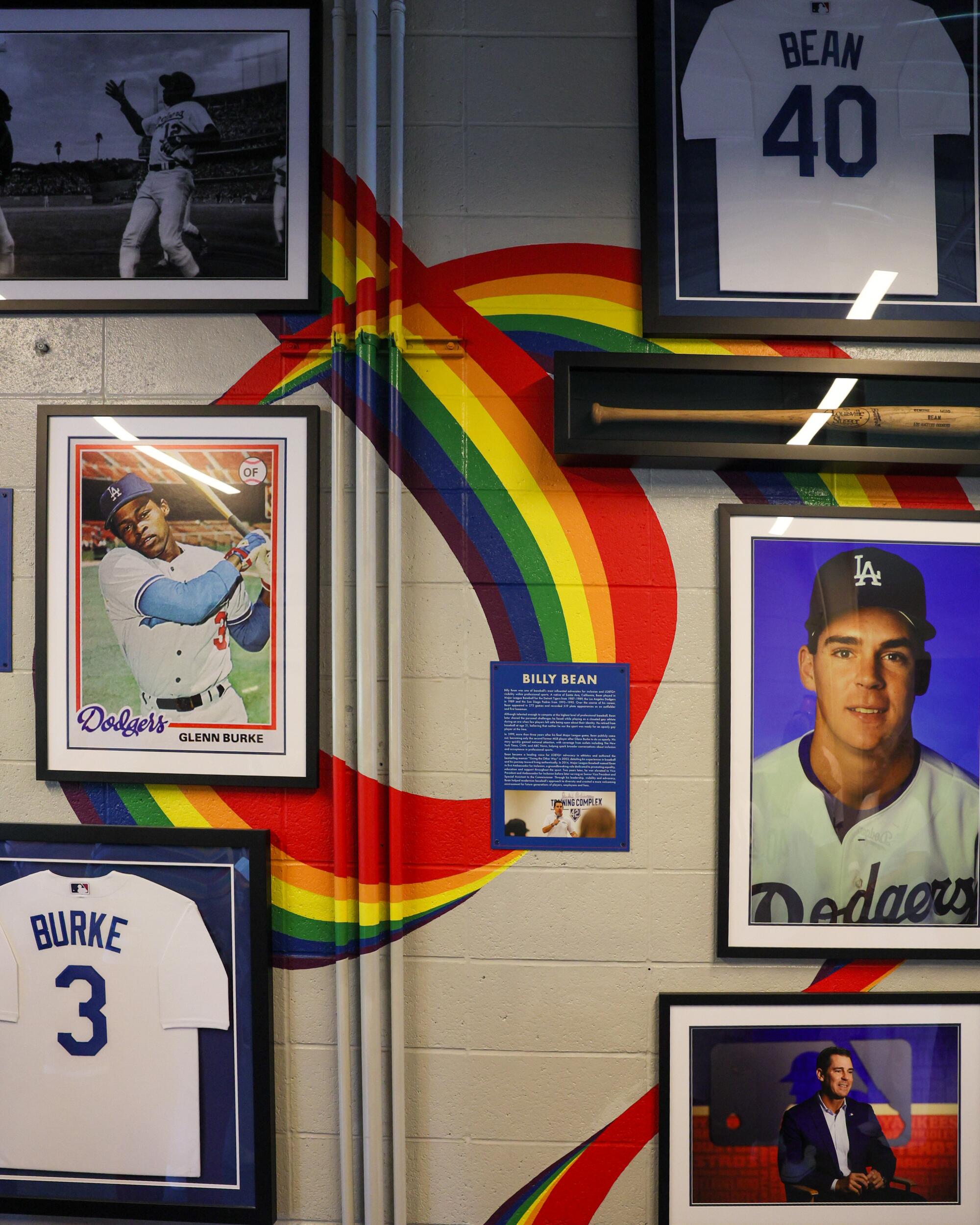
Amid all the historical installations and tributes in the open-air museum that is the Centerfield Plaza, and just a few feet from a Fernando Valenzuela mural, a new display honors Glenn Burke and Billy Bean, two former Dodgers outfielders who were the first and second professional baseball players to come out as gay.

It’s not a fleeting mention on Pride night, it’s a permanent record. A static reminder of progress made — and still to be made. And a much-deserved thank-you.

A wall inside Dodger Stadium features photos honoring former Dodgers and LGBTQ+ pioneers Billy Bean and Glenn Burke.

A wall inside Dodger Stadium honors former Dodgers and LGBTQ+ pioneers Billy Bean and Glenn Burke.

(Ronaldo Bolanos/Los Angeles Times)

“It’ll be here tomorrow, it’ll be here on the weekend and if you come next month, it’ll be here,” said the Dodgers’ team historian Mark Langill, who pointed to a spot just down the hall where in 1976 he was an 11-year-old getting Burke’s autograph.

Baseball is steeped in such history. The personal, the statistical, the societal. And the Dodgers’ is incomplete without their stories — Burke’s and Bean’s.

But the Dodgers have not, of course, always gotten this stuff right.

In 1978, they did Burke wrong, trading him — he believed — after management learned he was gay.

In his three seasons in L.A., Burke had proved himself a capable reserve outfielder who was popular with his teammates.

As far as we know, in 1977, he was the first guy to initiate a high five — spontaneously reaching above his head to slap hands with Dusty Baker after the home run that made Baker the fourth Dodger, along with Ron Cey, Steve Garvey and Reggie Smith, to hit at least 30 home runs that season, a MLB first.

Glenn Burke, left, goes to give a high-five to teammate Dusty Baker after Baker hit a home run in 1977.

Glenn Burke, left, goes to give a high-five to teammate Dusty Baker after Baker hit a home run in 1977. It is believed to be the first instance a high five was exchanged.

(Los Angeles Times)

There’s a fantastic photo of the historic high five included in the tribute to Burke and Bean, which is situated on a hallway wall beneath the left-field bleachers, beside the “Dodger Dugout” augmented reality photo booth.

Burke was also the first guy in that Dodgers clubhouse to crack a joke when the team needed it, his former teammate Rick Monday said.

“When called upon, he could play really well,” Monday said before the Dodgers took the field against the Angels on Friday, when the Dodgers and many of their rainbow-sporting fans celebrated the team’s 13th annual LGBTQ+ Pride Night. “And when we needed a moment of levity, Glenn was not afraid to come forward and put a smile on people’s face.”

But shortly before he died of AIDS in 1995 at 42, Burke published an autobiography, “Out at Home,” in which he described the team’s management being “afraid of my sexual orientation, even though I never flaunted it. To this day, the Dodgers deny trading me because I was gay. But it was painfully obvious.”

“Oh, what he had to deal with and keep it hid,” said Joyce Burke-Henderson, one of Glenn’s sisters at Friday’s pregame unveiling, where family members of both players gasped and cried and cheered the installation’s reveal.

“But as time went on, people did know. And then I think he came to the point where he just didn’t care and he just told it like it was.”

Joyce Henderson, sister of Glenn Burke, speaks about her brother during a ceremony honoring the former Dodger.

Joyce Henderson, sister of Glenn Burke, speaks about her brother during a ceremony honoring the former Dodger and LGBTQ+ pioneer at Dodger Stadium Friday.

(Ronaldo Bolanos/Los Angeles Times)

Burke came out in 1982, three years after playing his 225th and final big league game, in an Inside Sports article, “The Double Life of a Gay Dodger.”

“We just appreciate that now people are opening their eyes and just trusting in the Lord,” Burke-Henderson said Friday, “that things will go forward and work out and everybody will be loved regardless of their situation.”

The Dodgers first honored Burke in 2022, at their ninth Pride Night.

The next season, they made a mess of the Pride festivities, inviting and uninviting and then reinviting the Sisters of Perpetual Indulgence, a group known for its work in support of AIDS patients and whose members dress in drag, as nuns.

In 2023, the Dodgers also invited Bean — who was MLB’s senior vice president for Diversity, Equity and Inclusion. He appeared in a pregame ceremony on the field while protesters gathered outside the stadium.

Bean died the next year, at 60, 11 months after being diagnosed with acute myeloid leukemia.

Greg Baker, husband of the late Billy Bean, wipes away tears during a tribute honor Bean as a LGBTQ+ pioneer.

Greg Baker, husband of the late Billy Bean, wipes away tears during a tribute honor Bean as a LGBTQ+ pioneer at Dodger Stadium on Friday.

(Ronaldo Bolanos/Los Angeles Times)

Once a Northeast Santa Ana Little Leaguer, Bean became valedictorian at Santa Ana High, played for Loyola Marymount and went on to appear in 272 big-league games — including 51 for the Dodgers in 1989 — before abruptly walking away from baseball in 1995.

It got to be too much, he’d explain later, continuing to hustle to keep his baseball career afloat while keeping his sexuality secret, acutely aware of the blowback he’d get if it got out.

“For nine years,” he told the New York Times, “I felt as though I had one foot in the major leagues and one on a banana peel.”

“When he left baseball suddenly, I knew something was wrong,” Bean’s mother, Linda Kovac, said Friday, pausing to wipe away tears. “He was playing very well, it wasn’t like he was kicked out or anything. And it just didn’t make any sense.”

When Bean finally told his family he was gay, in 1996 — three years before clueing in an unsuspecting public via a Miami Herald article — none of his loved ones blinked. That included his stepfather, Ed Kovac, the homicide cop and former Marine who’d had a partner on the force who was gay.

“He worked with someone that he respected, side by side, on criminal cases,” Linda said. “We’re still friends with that guy.”

Linda and Ed Kovac, parents of Billy Bean, hold hands in front of a tribute dedicated to their son at Dodger Stadium.

Linda and Ed Kovac, parents of Billy Bean, hold hands in front of a tribute dedicated to their son at Dodger Stadium on Friday.

(Ronaldo Bolanos/Los Angeles Times)

Knowing someone — or of someone — who is gay or lesbian has long tended to dispel falsehoods and quell fears that might exist.

“One of the most important things any one of us can do in our community is be out, to be proud,” said Greg Baker, Bean’s husband. “The fact that someone can be out in a world that typically doesn’t have a lot of role models of the same ilk, it’s a brave thing to stick your neck out. It’s also very important.”

And it’s not a surprise, Baker said, that more athletes aren’t out in sports like baseball. Not with Gallup polling released last week telling us that with public acceptance of same-sex marriage and relationships in the U.S. has flattened after two-plus decades of growing support — down from 71% to about 65%.

“I want to thank the Dodgers organization,” Baker said. “It’s brave of them in this day and age to spotlight someone in our community when other organizations are trying to erase us.”

The Dodgers have done the opposite, putting up a permanent marker. A long time coming, a tribute to last.

Source link