dudamel

Dudamel’s ‘Resurrection’ in Salzburg serves as symbol of optimism

“Optimism doesn’t mean pretending everything is fine,” the Belarusian flutist and political activist Maria Kalesnikava said in this year’s Salzburg Festival keynote address. “It means deciding to step up and act, even in the face of uncertainty.”

Picture-perfect, Mozart-drunk Salzburg can’t pretend everything is fine. Temperatures are rising and normally rainy Salzburg now worries about water shortage and the environmental ravage of over-tourism. The artistically and culturally exceptional six-week Salzburg Festival, which began mid-July with a two-week Ouverture Spirituelle this year titled “miserere” (mercy), is facing its own political and administrative turmoil and uncertainty.

Salzburg’s worries are our worries; its triumphs can be ours as well. Los Angeles and the Salzburg Festival have been cultural and political soulmates for close to a century, beginning when playwright, director and filmmaker Max Reinhardt, who co-founded the Salzburg Festival in 1920, found mercy in L.A. as refuge from the Nazis.

Reinhardt’s star-studded 1934 music-theater production of “Midsummer Night’s Dream” at the Hollywood Bowl offered a template for spectacle in the young amphitheater, and the Los Angeles Philharmonic’s participation crucially reinforced a young orchestra’s early venturesome ambition following an avant-garde Bowl season the previous summer that nearly bankrupted the Bowl. Over the next decade this Salzburger’s influence on Hollywood dramaturgy would become legend.

L.A. has reciprocated by sending our visionaries to Salzburg, where director Peter Sellars and conductor Esa-Pekka Salonen, for instance, have been given the license and means to inspire a reinvention of musical and theatrical thinking. L.A. arts patrons Betty Freeman and Richard Colburn provided important support for Salzburg during their lifetimes that included commissioning new work.

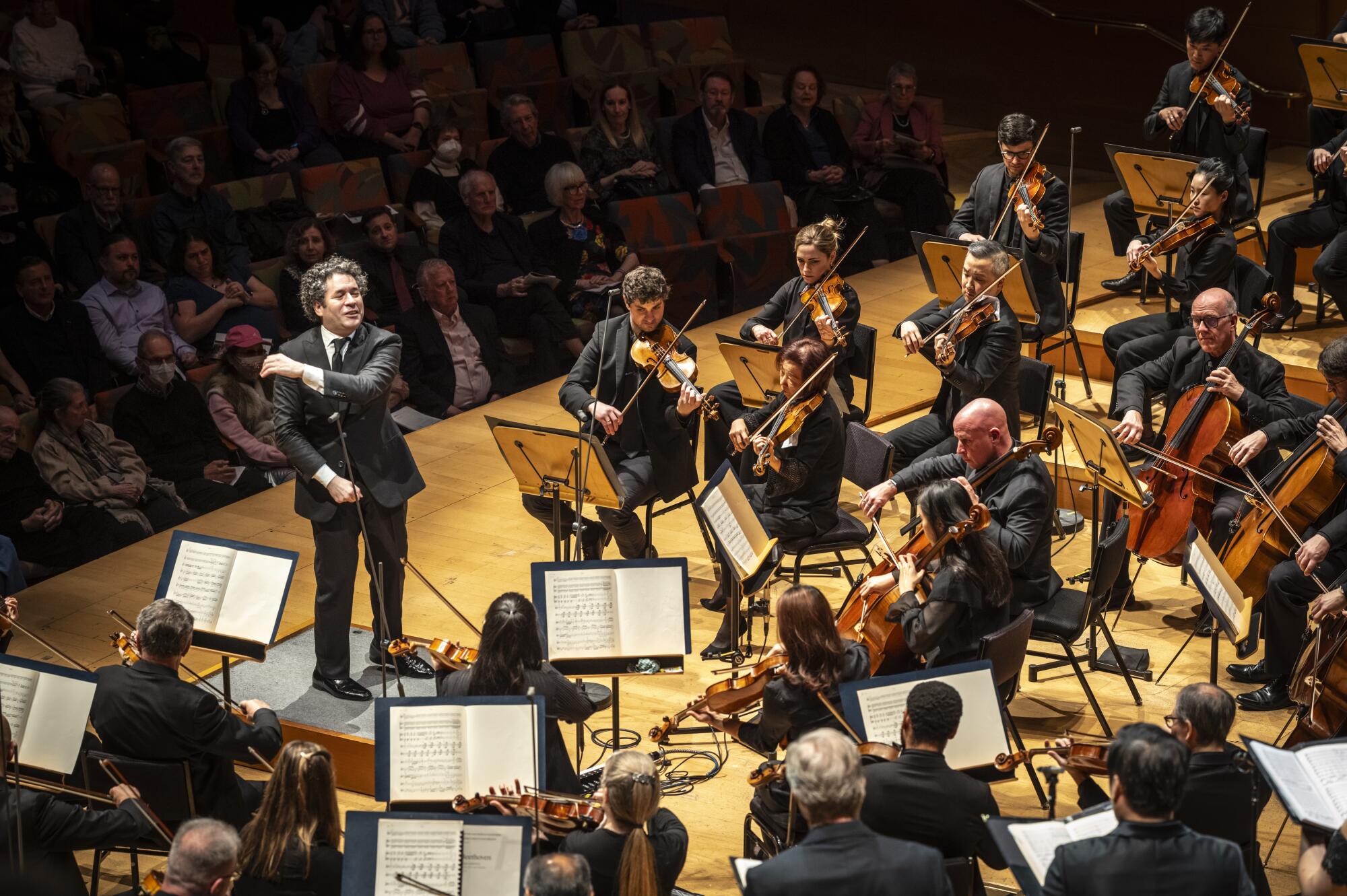
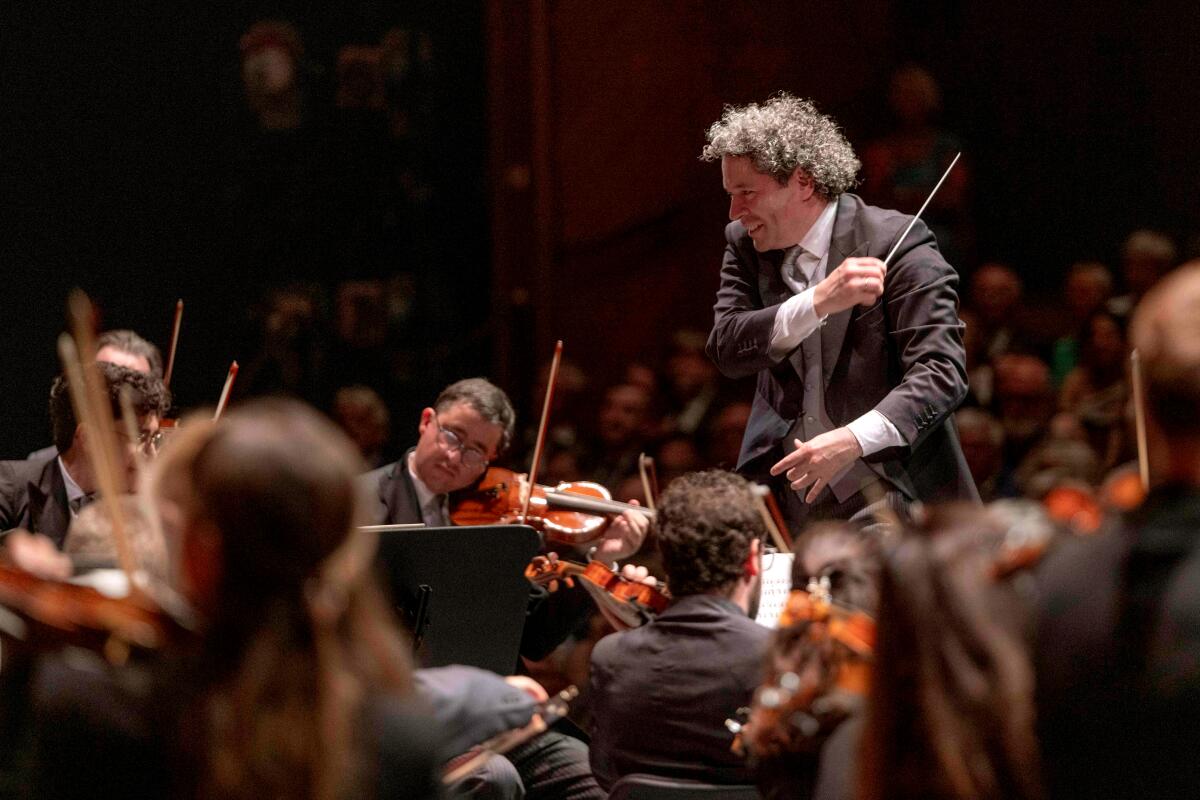
Gustavo Dudamel conducts Strauss' 'Alpine Symphony' with the Vienna Philharmonic in Salzburg Aug. 25, 2024.

Gustavo Dudamel conducts Strauss’ ‘Alpine Symphony’ with the Vienna Philharmonic at the Grosses Festspielhaus in Salzburg Aug. 25, 2024.

(Marco Borrelli / Salzburg Festival)

Gustavo Dudamel, L.A. Phil’s optimist these 17 seasons, has long been a Salzburg regular as well, and he arrived last week just in time to take up Kalesnikava’s challenge. Her proclamation of optimism comes on the heels of her having been released in December from a brutal Belarusian prison for supporting an opposition candidate running against the country’s authoritarian leader.

In Dudamel’s case, his life has been turned around by the recent earthquakes that devastated Venezuela just two weeks after his last concerts in Walt Disney Concert Hall as L.A. Phil music and artistic director. His activities this summer now revolve around partnering with the United Nations Development Program to gather global support for Venezuela’s recovery, which is estimated at $6.7 billion.

Although little noted, Dudamel’s buoyant World Cup halftime appearance with 20 members of the Simón Bolívar Symphony Orchestra and 20 from the New York Philharmonic was as a FIFA fundraiser supporting children affected by global crises, in this case earthquake relief in Venezuela. Dudamel has further turned his last Hollywood Bowl program as L.A. Phil music director into a benefit on Aug. 23.

Prophetically, Dudamel had months ago been invited to close this summer’s Ouverture Spirituelle by leading the Vienna Philharmonic in Mahler’s Second Symphony, known as the “Resurrection.” One way to think about Mahler’s extravagant 90-minute exercise in his search for life’s meaning is as an exercise in attaining optimism in the face of tragedy.

“Rise again, yes, you shall rise again,” Mahler extols in a final ecstatic climax, and it is with the “Resurrection,” which includes chorus and a pair of vocal soloists, that Dudamel began his “Gracias Gustavo” L.A. Phil season last fall. Raising roof, the message was clear: optimism is the native language of Walt Disney Concert Hall.

In Salzburg, where Dudamel’s two Vienna Philharmonic performances were dedicated to the people of Venezuela, those lines took on obvious new meaning. Earlier in the day, Dudamel gave a public talk with a lively German journalist, Marco Frei, in which he described himself as a “resurrectionist” in more ways than one.

The symphony has been a been a musical and spiritual guide for him since his boyhood. He became so excited about a new sense of freedom he feels in the second movement that he leaned back in his chair and kicked his white sneakers in the air.

After the talk, I walked with Dudamel back to his hotel as he displayed a different, more solemn passion describing the toll the earthquakes have taken on El Sistema, the Venezuelan youth program that has been behind his educational activism in L.A.

“At least 140 members of the El Sistema staff and educators were killed or are unaccounted for,” Dudamel said, and that’s not counting what may have happened to a great many children and their families. But remarkably, Dudamel noted, in places where few structures remain, the nucleos (the small El Sistema community schools) are surprisingly still standing. They have become centers for food, aid and shelter.

In Salzburg, Dudamel indulged the Vienna Philharmonic’s incomparable lushness, those plush strings, glowing winds, golden brass, voluminous timpani. The symphony received mixed reviews, with critics complaining of a lack of transparency, argument and depth. Had they been in Disney Hall, they would have had it all.

But here Dudamel became more simply an architect of awe, unfazed by Mahlerian uncertainty as he worked his way to an inevitable cosmic grandeur unfazed by uncertainty. An enthralled audience left opening its collective wallets. Ushers stood at all the exits of Great Festival Hall with baskets for donations for Venezuela. I did not see a single member of the audience leave without throwing in a bill or several.

Dudamel’s “Resurrection” might also be read as a message from L.A. to Salzburg. In the spring the festival board dismissed its artistic director of the past decade, Markus Hinterhäuser, saying there is a difference in vision. Hinterhäuser’s penetrating and uncompromising vision is what has made the modern festival matter. Hinterhäuser has implied political meddling.

It is a huge festival, with more than 200 performances. Last year’s audience exceeded 200,000, with visitors from 88 countries. The arts as a vehicle for coming together can be cliché. In Salzburg, sharing becomes essence, not the kind of narcissism that appears to be adopted by our upcoming LA28 cultural Olympiad, in which Angelenos are invited to submit entrees that show off our goods rather than a cultural exchange.

Over 100 artists have protested Hinterhäuser’s removal, including two Nobel Prize laureates. Hinterhäuser is also an insightful pianist, and he joined baritone Matthias Goerne in a chilling performance of Schubert’s existential song cycle, “Winterreise.” Hinterhäuser got thunderous ovations.

Salzburg’s future is anyone’s guess, but even with Hinterhäuser on the sidelines, this summer is still his festival, meaningful as ever.

A new production of “Carmen” could not be darker, nor more brilliant. It is the latest project of conductor Teodor Currentzis, who has worked extensively with Peter Sellars in Salzburg and elsewhere, and who brings electricity to every moment with his Utopia Orchestra and Choir. Argentine choreographer Gabriela Carrizo makes her debut directing opera and utilizes her alarmingly vibrant Belgian dance company, Peeping Tom. Performing in a vast empty space, two gripping singers — Asmik Grigorian plays an understated Carmen as a survivor in a hostile society, while Jonathan Teltelman’s Don José is unable to cope with that society — turn Bizet’s opera into revelatory existential theater in which survival is toleration.

A scene in director Yuval Sharon's "The Excursions of Mr. Broucek to the Moon and the 15th Century" at the Bregenz Festival.

A scene on the moon in director Yuval Sharon’s magical new production of Janacek’s neglected opera “The Excursions of Mr. Broucek to the Moon and the 15th Century” at the Bregenz Festival.

(Daniel Ammann / Bregenz Festival)

Something similar happens in “Faust, Part 1,” in which the actors spend the entire four hours in a new production by German director Ulrich Rasche walking against the direction of of a revolving disc. To remain in front of the audience, they must remain in motion. They’re dressed in modern business attire, but as they bare their souls, they bare their torsos as they step against forces that prevent progress. The backdrop is brightly illumined screens that hurt your eyes.

This, however, can serve as a reminder of a “Faust” staged by Reinhardt at the Pilgrimage Theater (now John Anson Ford Theater) when it was designed to look like the gates of ancient Jerusalem in 1935. Practically all of Hollywood celebrity showed up for what was the theatrical event of the season.

I asked Lukas Crepaz, who directs the Salzburg Festival’s administrative and business operations, whether it would be possible and whether there still is time for the Salzburg and L.A. to collaboration on an opera production. He said yes, if funding could be found. In fact, the L.A. Phil will mount in February “One Morning Turns Into an Eternity,” a Salonen/Sellars essay in intensity from Salzburg last summer.

Another option: The Bregenz Festival, also in Austria, has just staged a new production by Yuval Sharon of Janacek’s little-known opera, “The Excursions of Mr. Broucek to the Moon and the 15th Century.”

Sharon — who was responsible for the fabulous excursions of his L.A. experimental company, the Industry — supplies his characteristic wit, imagination and insight into a hard-to-please opera about a beer-besotted philistine landlord, who comes to no good in his drunken dreams of going to the moon and back in history, as he does as an angry old man stumbling home from the bar or sitting watching TV (Sharon’s invention).

L.A. optimism may matter more to Austria this summer than it does to L.A. We have two years to step up and act, even in the face of uncertainty.
Source link

Los Tigres del Norte to perform with Gustavo Dudamel at Hollywood Bowl

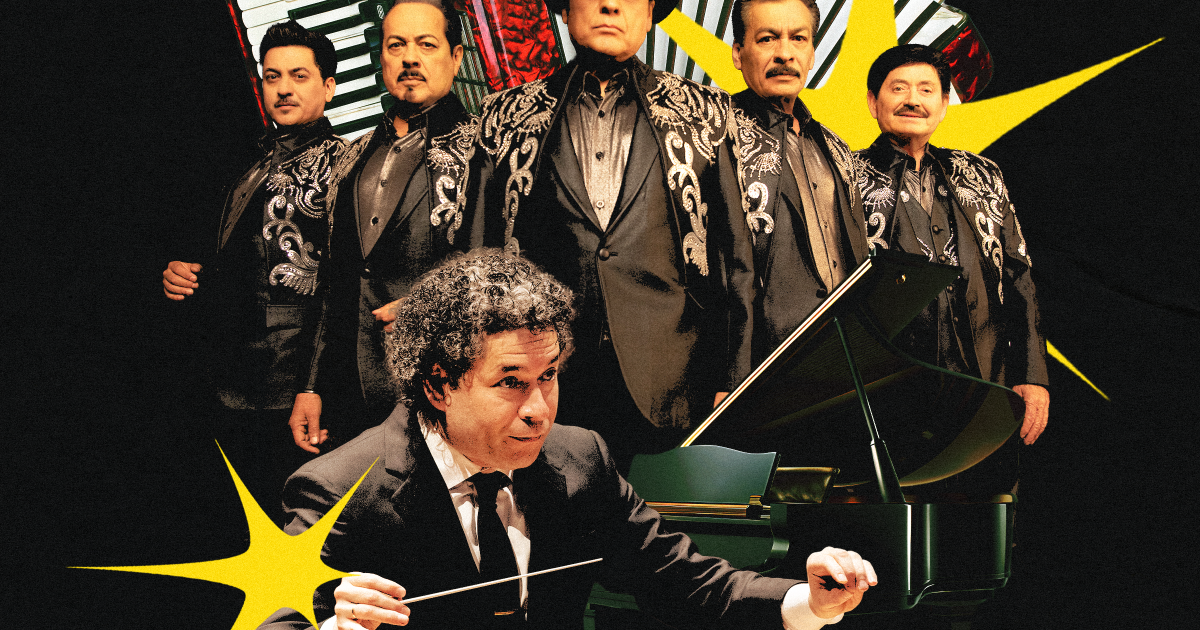
Storied norteño group Los Tigres del Norte announced Tuesday that they are teaming up with departing L.A. Philharmonic conductor Gustavo Dudamel for a special performance Aug. 21 at the Hollywood Bowl.

The show is part of a series titled “Celebrating Gustavo at the Bowl,” which looks to send off Dudamel in style as he transitions into his new role as the music and artistic director of the New York Philharmonic. The “Jaula de Oro” artist’s appearance is part of “Gustavo’s Fiesta,” which will also feature performances by other prominent Latino artists.

The norteño act has sold 37 million albums and recorded 500 songs over a career that’s spanned five decades. They have seven Grammy Awards, eight Latin Grammys and have had 66 songs land on Billboard’s Hot Latin Songs chart, the most of any Latin music act ever.

In 2018, Los Tigres del Norte became the first norteño act to headline at the Hollywood Bowl.

Recently, the “La Puerta Negra” hitmakers were immortalized in U.S. pop culture history when its members appeared in animated form in a December 2025 episode of “The Simpsons” and performed an original corrido about the escapades of Homer Simpson and Pedro Chespirito (also known as the Bumblebee Man).

Also featured on the Aug. 21 lineup are Grammy-winning singer Lila Downs, the all-female Mariachi Reyna de Los Ángeles, the explosive cumbia group La Sonora Dinamita and the legendary Mexican bolero trio Los Panchos.

The show will serve as Dudamel’s third-to-last performance as the music and artistic director of L.A. Philharmonic. On Aug. 22, he will be in concert with Foo Fighters. His farewell weekend will conclude Aug. 23 and will serve as a benefit for his homeland of Venezuela, which suffered catastrophic losses from twin earthquakes in late June.

Donations will benefit Dudamel’s Earthquake Recovery to Support Venezuelan Communities fund, in partnership with the United Nations Development Programme and the Development Bank of Latin America and the Caribbean fund.

Source link

Gustavo Dudamel sets Hollywood Bowl concert to benefit Venezuela

Gustavo Dudamel’s farewell to Los Angeles will also function as a benefit for his homeland of Venezuela, which suffered catastrophic losses from twin earthquakes in late June.

Dudamel and the Los Angeles Philharmonic announced Monday that the beloved composer’s final Hollywood Bowl performance as the orchestra’s music and artistic director, originally programmed as “Celebrating Gustavo at the Bowl: A Musical Legacy,” will instead be called “A Concert for Venezuela.” Still scheduled for Aug. 23, the show will raise funds for communities affected by the earthquakes.

“Venezuela will always be my home, and every moment, my thoughts are with the families whose lives have been forever changed by this tragedy,” Dudamel said in a statement. “The suffering is immense, but so is the strength and resilience of our people. This concert at the Hollywood Bowl is an invitation to stand together and transform our compassion into action.”

A full program and special guests will be announced later. Dudamel and the musicians will contribute their time and services free of charge.

Donations will benefit Dudamel’s Earthquake Recovery to Support Venezuelan Communities fund, in partnership with the United Nations Development Programme and the Development Bank of Latin America and the Caribbean fund. The L.A. Phil will contribute $50,000 to the fund, announced President and Chief Executive Kim Noltemy.

“In moments of profound need, our responsibility as an institution extends beyond the stage,” she said. “We are grateful for the opportunity to provide direct financial support to relief efforts for communities in Venezuela with a $50,000 charitable donation and to stand alongside Gustavo in bringing this concert to life at the Bowl.”

Twin earthquakes on June 24 devastated Venezuela, with more than 3,300 deaths and more than 30,000 people reported missing. As international rescue teams depart and locals are left to search through rubble, Venezuelans abroad, including L.A. restaurants, have looked for ways to send support.

Dudamel, who was born and raised in Barquisimeto, Venezuela, wrote in a 2015 op-ed for The Times that he is a “product” of El Sistema, the country’s government-funded youth music program. He has been the music director of the Simón Bolívar Symphony Orchestra since 1999.

Source link

Dudamel on his life as he prepares to leave L.A. Phil for New York

On the second weekend of May, Gustavo Dudamel gave the New York Philharmonic a salsa shock. He gleefully brought the startled players together with the Spanish Harlem Orchestra, an uptown salsa and jazz band, for concerts at Lincoln Center and Washington Heights. The city‘s classical music fans treated it as a cultural breakthrough; Dudamel is expected to transform the orchestra as a cultural institution when he returns in the fall as its music and artistic director.

A day later he was back in Los Angeles to begin rehearsals at a Walt Disney Concert Hall that had been fantastically transformed by Frank Gehry for the Los Angeles Philharmonic’s staging of “Die Walküre.” Transformation — be it cultural, orchestral, personal — has marked Dudamel’s 17 years as music (and more recently artistic) director of the L.A. Phil, which is now coming to an end with his three weeks of concerts in Disney to close the season June 7, followed by a celebratory weekend at the Hollywood Bowl in late August.

But meeting with Dudamel in his dressing room after a “Walküre” rehearsal (the opera begins Tuesday night at Disney and runs for six nights, an act a night, the full opera performed twice) , he says as he has said before, he does not think of this as a culmination, merely the beginning of a new adventure. He’s apartment shopping in New York. But he is keeping his house in Los Angeles.

He’s also departing with two very long new titles as “Die Walküre” premieres: the Diane and M. David Paul Artistic Cultural Laureate of the L.A. Phil and Jane and Michael Eisner Founding Director and Conductor Laureate of Youth Orchestra Los Angeles (YOLA).

Gustavo Dudamel stands on stage with the L.A. Philharmonic orchestra.

Gustavo Dudamel conducts the Los Angeles Philharmonic in a performance of Beethoven’s Missa Solemnis at the Walt Disney Concert Hall on Feb. 22.

(David Butow / For The Times)

“We are talking about projects,” he says. “Look, I’m coming back for two weeks in December,” when he will lead Beethoven programs. He returns in the spring. The Bowl will always be a second home.

“I’m living here and I’m not living here,” he explains. “The connection will always be here.”

The energy in New York is, he continues, “super exciting.” And what excites him the most is how comfortable he feels with the very real differences between L.A. and New York.

“As a Latino from Venezuela,” he says, “I have an immediate connection with the New York that is home of salsa. When I was in the womb I was hearing salsa.” His father, Oscar Dudamel, is a trombonist and salsa musician.

But he adds that mariachi, ubiquitous in Mexico and L.A., is also an integral part of Venezuelan culture. “What I have to say is that I am blessed. I’m blessed that both cities are now part of my life.”

Bringing ‘crazy’ ideas to Los Angeles

L.A., of course, has been the major part of his adult life. At 24, an unknown, he made his dazzling U.S. debut in 2005 leading the L.A. Phil at the Hollywood Bowl. Four years later, he became the orchestra’s music director and caught the world’s attention.

There is no doubt that Dudamel’s extraordinary talents would have meant a major career wherever he landed. But, here, he inherited the world’s most culturally open major orchestra, where fresh thinking and new music thrive. Disney Hall allowed him the extraordinary freedom to dream. Being back at Disney, Dudamel admits, is very emotional, especially conducting “Walküre” with Gehry’s sets of billowy, sumptuous clouds and fanciful white papery horses.

“Frank is here with us,” Dudamel exclaims about the architect, who died in December and with whom he had become close. Conducting Wagner’s opera, in many ways, sums up Dudamel’s ambitions, the way he has connected with more sides of L.A.’s cultural landscape than possibly any other artist.

In L.A., Dudamel grew as an artist and a person, he says, through his relationship with an orchestra that is uniquely flexible and a welcoming community. This allowed Dudamel to be what he likes to call “crazy.”

“I remember the first time I came here. I didn’t have a chance to do or see anything,” he says of his Bowl debut. “So, I remember driving from the airport to Sunset Boulevard, where my hotel was, and I didn’t understand anything. But immediately it was the connection with the orchestra.”

Singers stand on a golden lighted stage with screens behind them and a full orchestra below.

Frank Gehry designed the sets for a Jan. 18, 2024, performance of Wagner’s opera, “Das Rheingold,” with Gustavo Dudamel leading the Los Angeles Philharmonic at Walt Disney Concert Hall.

(Allen J. Schaben / Los Angeles Times)

Flash forward 20 years from 2005 to 2025. In what seemed like a truly crazy idea, he brought the L.A. Phil to the Coachella Valley Music and Arts Festival, where he led a varied set of classical favorites and appearances with pop stars, for 150,000 people shouting “L.A. Phil! L.A Phil.” Among the highlights was “Ride of the Valkyries,” the English title of “Walküre.”

The symbolism of doing “Walküre” is, for Dudamel, unmistakable. Wagner’s four-part “Ring” cycle, of which “Die Walküre” is the second opera, strongly influenced the “Star Wars” films Dudamel grew up with. The saga’s composer John Williams is another L.A. legend who became for Dudamel like family. Williams has, in fact, written a fanfare, “Bravo Gustavo!” that Dudamel will premiere on June 4 in a concert in which he celebrates the musicians of the L.A. Phil.

The “Walküre” production, moreover, further expresses his desire to remain connected with L.A. When asked whether he still plans to complete the “Ring” cycle with the L.A. Phil, which he began two seasons ago with “Das Rheingold,” he says, “completely.”

It’s a radical notion, to say nothing of an extraordinarily expensive and time-consuming challenge for any orchestra given to a former music director, but Dudamel has never been one to take no for an answer. “At my last conversation with Frank,” he recalls, “I said I was coming to talk about ‘Siegfried’ [the next opera in the cycle], and he said, ‘You are crazy.’”

“That was Frank. He freaked out about the operas every time I talked to him about them. And then he came up with fabulous ideas.

“You know I never dreamed about coming to the L.A. Phil. I was happy in Venezuela and guest conducting elsewhere. But when I met Frank and John [Williams], I knew I had come to the right place.”

One reason Dudamel was happy in Venezuela was his position as music director of the Simón Bolívar Youth Orchestra, part of El Sistema, the country’s famed music education program. He brought a version of that to Los Angeles with YOLA, which offers free musical education to students. Bringing young people together to learn — and not just to play music but to listen to each other — has grown increasingly essential to him.

Gustavo Dudamel and John Williams hold lightsabers on stage at the Hollywood Bowl.

Gustavo Dudamel has fun with John Williams at the Hollywood Bowl as he conducts the L.A. Phil during “Maestro of the Movies: John Williams with the LA Phil” on July 9, 2023.

(Emil Ravelo / For The Times)

On Thursday evening, USC awarded Dudamel an honorary doctorate during its graduation ceremonies at the Coliseum, where Dudamel also gave the commencement speech.

“I will never tire of repeating this: music, art and beauty are universal rights,” he told the graduates, urging them to go out into the world listening to others, seeing others, paying attention to everything. These are the practices he has long championed as the essential need for youth orchestras.

This was, in fact, almost precisely what he said when he first arrived in L.A. “I was very young, but I grew up with these ideas,” he told me.

“You have to say to the students, ‘Stop! Let’s pause. Just listen.’”

“It’s a way to really connect with what surrounds you, but also connect with yourself. That’s the beauty of all the layers of listening we do as musicians. I now think that is our main tool. In the end it’s not listening only to sounds. It’s listening as connecting with others.”

Practicing what he preaches

As Dudamel plans for his next chapter, he indicates that the advice he gives students is what he is also saying to himself.

Children, wearing blue YOLA shirts, play instruments in an orchestra.

YOLA students perform on stage during a “Gracias Gustavo Community Block Party” at the Judith and Thomas L. Beckmen YOLA Center in Inglewood on Oct. 11, 2025.

(Etienne Laurent / For The Times)

What L.A. gave him, he concludes, is a greater depth of his own listening. There was the guidance of Deborah Borda, who, as the orchestra’s president and CEO, hired and mentored him. There were the opera productions with Peter Sellars, who made him look deeply inside himself. There were the communities to discover and with which to collaborate.

New York, he insists, will be a further continuation of this process. “There are a lot of things to do. As I did here, that will be not only conducting but spending a big amount of time doing other things. I will have to listen to the community. Every place is different.”

And every place needs to be, for Dudamel, connected. He began his last season in Disney in the fall with the world premiere of Ellen Reid’s “Earth Between Oceans,” a bicoastal co-commission between the L.A. Phil and the New York Philharmonic, sonically evoking the environmental difference between L.A. and New York. He recently repeated it with his new orchestra in David Geffen Hall in New York.

In L.A., Reid’s score felt like a vast, moving, spiritual soundscape of our fires’ fury as well as our coastal fancy. At Geffen, it became a gripping showpiece, like attempting to zoom in a Ferrari through Manhattan streets, were they ever empty — the thrill of taking it all in.

Dudamel says his favorite place in New York so far is the orchestra’s archives. Becoming absorbed in the history of America’s oldest orchestra gives him new ideas. He wants simultaneously the old, the new and the many.

He also insists on ever more connections. ”We are making, many, many projects together,” he says of the L.A. Phil and the New York Philharmonic. That includes bringing the two orchestras together in a further experiment in listening.

“That‘s very important to me, one of my dreams. And it’s not difficult,” he says. “We have plans and it’s beautiful. We have to do that.”

Source link