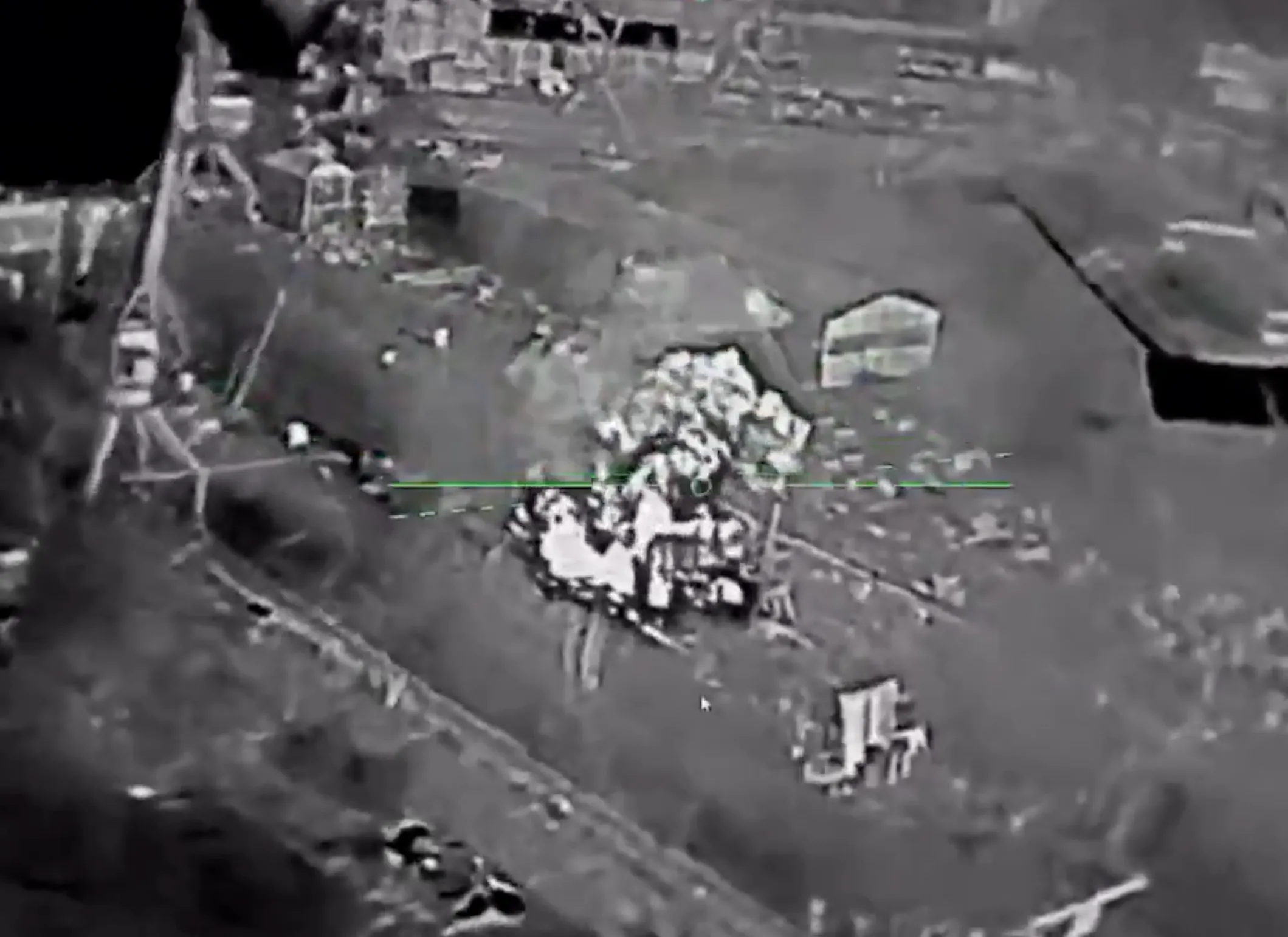
Bahrain released video of damage in Manama after debris from intercepted Iranian drones fell in populated areas, damaging homes, burning vehicles and scattering wreckage. Officials said an 11-year-old girl sustained minor injuries in the incident.
June 10 (UPI) — Iran said it launched strikes against U.S. military bases in neighboring countries in and around the Persian Gulf early Wednesday in retaliation for American “aggression” after U.S. forces conducted strikes on targets in southern Iran.
Khatam al-Anbiya Central Headquarters, Iran’s central command, said in a statement published by the state-run Islamic Republic News Agency that the “brave Army of the Islamic Republic and the Islamic Revolutionary Guard Corps” carried out a “powerful assault” on U.S. military assets in the region.
“The criminal U.S. military should know that if aggression against the Islamic Republic of Iran is repeated, even more severe and widespread attacks will be carried out against the designated target bank in the region, it added.
The statement was accompanied by a photo showing six ground-launched ballistic missiles blasting off from an undisclosed desert location but it was unclear if it was of Wednesday’s strikes as the image was undated and uncredited.
The IRGC claimed missiles were fired at Jordan’s Muwaffaq Salti airbase, where U.S. F-35 fighter jets and other aircraft operate out of, and that facilities in Kuwait and Bahrain were also attacked.
It said that the U.S. Fifth Fleet in Bahrain was targeted with drones.
The attacks had yet to be verified but Jordan’s armed forces said they downed five Iranian missiles targeting the country’s al-Azraq district, 60 miles east of the capital, Amman.
The Kuwaiti military, in a post on X just after 3 a.m. local time, said its air defenses were “currently intercepting hostile aerial targets.”
Bahrain’s interior ministry issued multiple alerts around the same time, advising residents that the air-raid siren had been sounded, urging them not to panic and to move to the nearest safe place to shelter immediately.
No deaths or injuries were reported.
The escalation came almost immediately after U.S. Central Command announced that it had completed “self-defense strikes” ordered by President Donald Trump in response to the downing of a U.S. Army Apache helicopter earlier Tuesday.
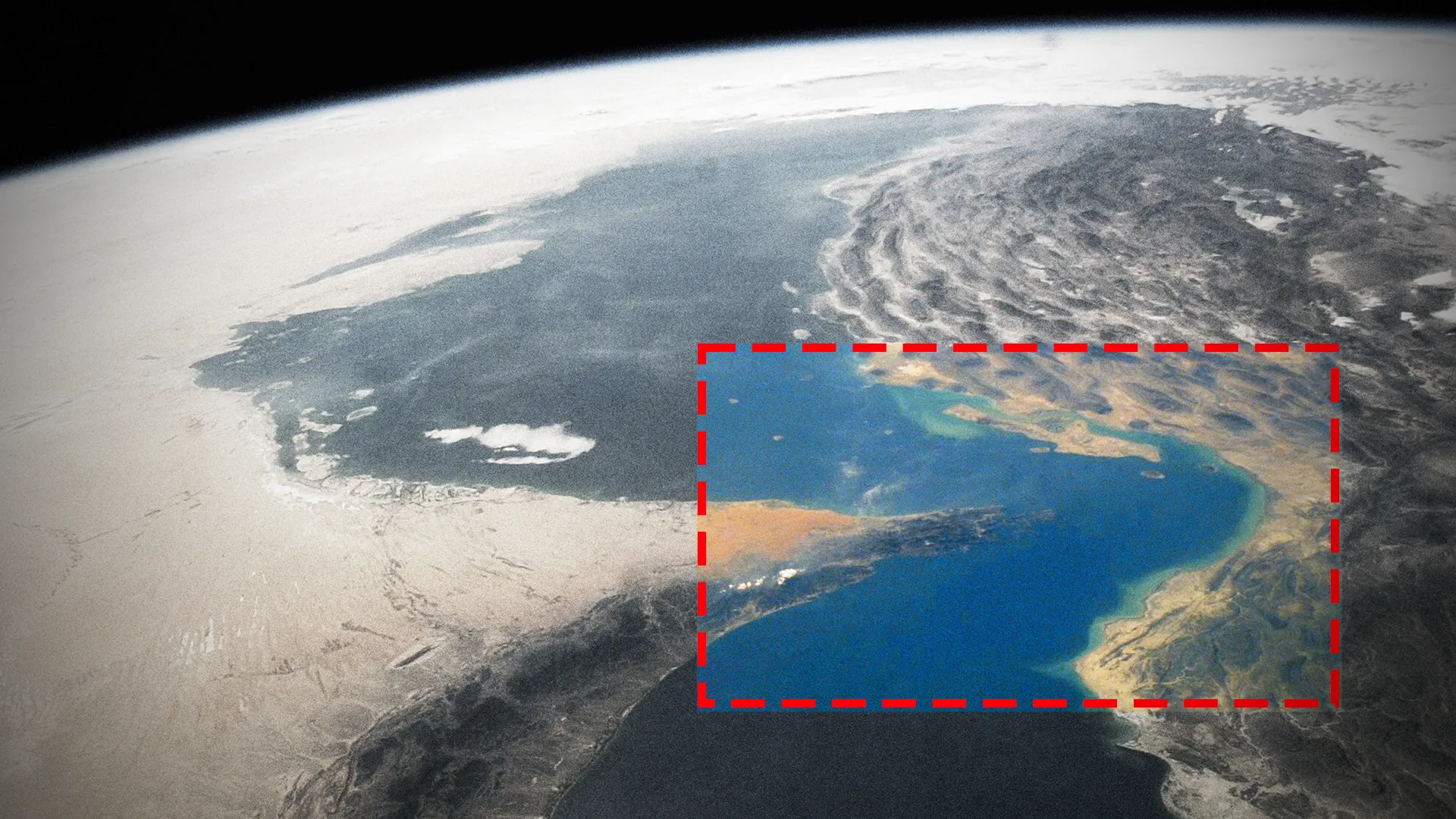
CENTCOM said in a statement early Wednesday that U.S. Air Force and Navy fighter jets struck Iranian air defense, ground control stations, and surveillance radar sites near the Strait of Hormuz “with precision munitions’ in an approximately four-hour-long operation.
“The operation was a proportional response to recent attacks on U.S. forces and international commercial ships transiting regional water,” said CENTCOM.
The ratcheting up of tensions prompted Beijing and Moscow to call on both sides to apply the brakes.
“China is deeply concerned over the latest developments regarding Iran. Relevant parties need to remain calm, exercise restraint, stop exacerbating confrontation and escalating tensions, take concrete actions to ease the situation, stick to political and diplomatic means for resolving disputes, and work for an early realization of a comprehensive and lasting cease-fire,” Chinese foreign ministry spokesman Lin Jian told reporters on Wednesday.
In a post on X, Russian Foreign Ministry spokesperson Maria Zakharova said Moscow was very worried about what she called “the new spiral of U.S.-Iran armed confrontation.”
She called on both parties to show restraint and halt military attacks immediately, adding that Russia stood ready to assist in finding and implementing “mutually acceptable negotiated solutions” to the crisis.
President Donald Trump discusses renovations to the Lincoln Reflecting Pool and makes an announcement on coal in the Oval Office at the White House on Thursday. Photo by Samuel Corum/UPI | License Photo
June 9 (UPI) — Two U.S. Army helicopter crew members were rescued and brought to safety within two hours after their Apache gunship crashed near the Strait of Hormuz.
U.S. President Donald Trump said early Tuesday that the two service personnel were “fine” and promised a report on the incident would be released in the next 24 hours or so.
U.S. Central Command said the pair were in a stable condition with spokesperson Capt. Tim Hawkins telling NBC News that a Task Force 59 unmanned surface vessel found and recovered the soldiers — the first time the U.S. military had carried out such an operation with a drone boat.
A source told the New York Times that it was yet to be established whether the aircraft came under Iranian fire, sustained a technical malfunction or encountered another issue.
The loss of a Hellfire missile-armed AH-64 Apache — which patrol the strait, downing Iranian drones and preventing small boats from attacking shipping — is a first for the U.S. military since the conflict started Feb. 28.
At least eight U.S. fighter jets and other military aircraft, plus more than two dozen uncrewed aerial vehicles, have been lost in both enemy and friendly-fire incidents but Monday’s crash was the first loss of a helicopter.
The Apaches play a key tactical role alongside F/A-18 and F-35s fighter aircraft in U.S. Central Command’s mission to counter the blockade of the vital international shipping route, which Iran has effectively put out of bounds to the vast majority of oil tankers and other commercial vessels.
However, the helicopters have been patrolling closer to Iran, including its islands in the Hormuz Strait and Persian Gulf, as part of Centcom’s effort to maintain the pressure on Tehran amid protracted negotiations to resolve the 100-day-long conflict.
Tehran did not immediately claim responsibility for the incident, according to Iran’s semi-official Mehr News Agency.
The confirmation from the U.S. side came hours after Iran and Israel sides paused airstrikes on each other at the request of U.S. President Donald Trump, who urged them to “stop shooting” because an agreement with Tehran to end the war was very close.
“We’re in the final throes of what will be a very, very good deal that will not allow in any way, shape, or form nuclear weapons. The strait will open up right away.
Trump said the Strait of Hormuz would reopen to international shipping immediately after the agreement was signed, which could be before the weekend, adding that there was a chance it could be far earlier, “in one hour, if you want to know the truth.”
President Donald Trump discusses renovations to the Lincoln Reflecting Pool and makes an announcement on coal in the Oval Office at the White House on Thursday. Photo by Samuel Corum/UPI | License Photo
Ukrainian President Volodymyr Zelenskyy arrives at No.10 Downing Street in London on March 17. On Monday, Ukrainian forces said they attacked several Russian locations overnight, including multiple oil depots. File Photo by Hugo Philpott/UPI | License Photo
June 8 (UPI) — Ukrainian forces struck oil depots in Russian-occupied Crimea as well as other command and ammunition locations in Russia, the Ukrainian military said.
The strikes took place late Sunday, the general staff of Ukraine‘s military said in a Facebook post Monday, according to a translation by Ukrinform.
The Grushevaya oil depot in Krasnodar Krai and the Feodosia and Semikolodezyanskaya oil depots in Crimea were among the targets hit during the attacks, The Kyiv Independent and Ukrinform reported. Ukraine also struck the Krasny Line Production Dispatch Station in Volgograd oblast, which supplies oil to the Volgograd refinery and the Sheskharis export terminal.
Ukrainska Pravda reported that the Grushevaya oil depot is one of the largest oil storage facilities in the Caucasus, holding between 1.3 tons to 1.5 tons of petroleum. The site is used to store and transport oil for maritime export and generates a large amount of revenue for Russia.
There were large fires and billowing smoke reported at the oil depots said to be hit.
The strikes hit Russian drone command posts in various locations in Zaporizhzhia, Donetsk and Kursk oblasts. The military also said it hit areas with concentrations of Russian personnel in Donetsk, Zaporizhizhia and Sumy oblasts.
The Russian military said it struck down 310 Ukrainian drones overnight throughout Russia, Crimea, and the Black and Azov Seas.
Troops in landing craft approach Omaha Beach on D-Day in Normandy, France, on June 6, 1944. D-Day was the largest seaborne invasion in history and turned the tide of World War II. Photo by UPI | License Photo
Saturday is the last day of Russian President Vladimir Putin’s St. Petersburt International Economic Forum. Ukraine struck military targets near the city overnight Friday. Photo by Anatoly Maltsev/EPA
June 6 (UPI) — A drone attack launched by Ukraine hit St. Petersburg, Russia, overnight as Russian President Vladimir Putin wraps up an economic forum there.
Ukrainian President Volodymyr Zelinsky had asked Putin to meet face to face and discuss peace talks, but Putin responded that there was no point.
“It is time to end this war. But Russia’s ruler wants to keep fighting,” Zelensky wrote on X early Saturday. “That is why Ukrainian sanctions against this aggression are working. Last night, our drones covered a distance of about 1,000 kilometers to the St. Petersburg region — to the enemy navy’s arsenals and a base in Kronstadt. Our long-range sanctions also reached about 500 kilometers into the Krasnodar region — and hit an oil depot.”
It is time to end this war. But Russia’s ruler wants to keep fighting. That is why Ukrainian sanctions against this aggression are working. Last night, our drones covered a distance of about 1,000 kilometers to the St. Petersburg region – to the enemy navy’s arsenals and a base… pic.twitter.com/IkdN8UE3QD— Volodymyr Zelenskyy / Володимир Зеленський (@ZelenskyyUa) June 6, 2026
Kronstadt is home to a naval academy and is the main base, repair and supply hub for the Russian navy in the Eastern Baltic.
Leningrad Governor Aleksandr Drozdenko said more than 140 drones were shot down in his region. St. Petersburg Governor Alexander Beglov told residents to stay indoors, CNN reported. He also said three people were injured.
Drozdenko said more than 600 people were evacuated from Bolshaya Izhora, a village on the Gulf of Finland near St. Petersburg, as efforts continued to put out a fire. The area is also home to a Russian naval arsenal, CNN reported.
St. Petersburg is Russia’s second-largest city, behind Moscow.
The New York Times reported that St. Petersburg’s main airport, Pulkovo, suspended operations for almost five hours, according to Rosaviatsia, the Russian aviation authority. Residents reported smoke in the sky and roaring noises and bangs, according to Fontanka, a local news website.
Ukrainian Foreign Minister Andrii Sybiha said on X Saturday that “Things will only get worse for Russia. Battlefield losses will continue to grow. Failures will get more humiliating. … “The international pressure will not ease. It will only get stronger. Including the use of frozen assets, travel bans and inevitable accountability for crimes,” Sybiha said.
Zelensky is scheduled to meet with leaders of France, Germany and Great Britain in London Sunday to discuss support for Ukraine and peace talks, Politico reported.
President Donald Trump discusses renovations to the Lincoln Reflecting Pool and makes an announcement on coal in the Oval Office at the White House on Thursday. Photo by Samuel Corum/UPI | License Photo
June 6 (UPI) — The United States said it intercepted several Iranian ballistic missiles and drones shot toward the Strait of Hormuz, the Persian Gulf, Bahrain and Kuwait Friday night.
The U.S. Central Command said seven missiles were fired toward Kuwait and Bahrain Friday after it shot down four Iranian drones headed toward the strait. It said six of the missiles were intercepted and one didn’t reach its target.
Bahrain and Kuwait said there were no injuries, but Kuwait said there was some “material damage.”
The Kuwaiti Army, attributed to the official spokesperson for its defense ministry Brigadier General Saud Abdulaziz Al-Otaibi, posted on X: “The armed forces detected and responded at dawn today to 7 hostile ballistic missiles within Kuwaiti airspace, which were intercepted over several residential areas, resulting in the fall of some debris.
“The Iranian criminal aggression caused material damage with no human casualties.”
CENTCOM also said there were no American casualties.
“There are currently no reports of harm to U.S. personnel, and Iranian claims of damaging U.S. 5th fleet headquarters in Bahrain are false,” CENTCOM said in a press release.
Kuwait and Bahrain called the strikes a violation of their sovereignty and a threat to regional security. Egypt, Jordan and Qatar also condemned the strikes Saturday.
Iran said it launched the strikes against U.S. military bases in the region after the United States struck Iran. CENTCOM said it hit coastal surveillance radar sites in Goruk and Queshm Island “to defend against further maritime attacks.”
Iran called the U.S. attacks a “flagrant” violation of the cease-fire, which has been in place since April. It said the American side “not only lacks the will to reduce tensions,” but “seriously endangers the security of the region.”
“These facilities are tasked with safeguarding the country’s border security and ensuring the security of navigation in international waterways,” the Iranian Foreign Ministry said in a statement. “The attack constitutes a clear violation of the April 8 ceasefire and an act of military aggression against the national sovereignty and territorial integrity of the Islamic Republic of Iran.”
Iran said the U.S. strikes violate international law.
“This action, which comes as a continuation of the hostile and provocative conduct of the U.S. regime against the Islamic Republic of Iran, demonstrates the complete disregard of the U.S. ruling establishment for the fundamental principles of international law and the Charter of the United Nations,” the foreign ministry said.
Tehran also said the U.S. is responsible for “all the effects and consequences of these illegal actions, as well as any possible escalation of tension.”
Iran’s Revolutionary Guard claimed the clash started when the U.S. military tried to “illegally” escort oil tankers through the waterway, which Iran has largely closed off during the war.
The Gulf Cooperation Council condemned the Iranian missile attacks Saturday.
“These treacherous Iranian terrorist acts represent a dangerous and irresponsible escalation, a blatant violation of all international laws and norms, and a direct threat to regional stability,” Jasem Mohamed Albudaiwi, secretary general of the Gulf Cooperation Council, said in a statement.
The Gulf Cooperation Council, formed in the 1980s, is an economic pact that includes Bahrain, Kuwait, Oman, Qatar, Saudi Arabia and the United Arab Emirates.
“The Council countries stand in a united and steadfast position alongside the Kingdom of Bahrain and the State of Kuwait, fully supporting all measures and steps they undertake to protect their security, safeguard their sovereignty and territorial integrity, as well as ensure the safety of their peoples,” Albudaiwi said.
Weekly insights and analysis on the latest developments in military technology, strategy, and foreign policy.
In the latest flare-up of tension during a very shaky ‘ceasefire,’ “Iran has launched multiple drones towards the Strait of Hormuz,” a U.S. official told us. “U.S. forces have taken out at least four of them.”
The statement comes as unconfirmed reports are emerging online of explosions on Iran’s Kharg Island. The official, who spoke to us on condition of anonymity to discuss operational issues, declined comment about those claims.
Big Development
The United States Airforce just launched an intense airstrike on Kharg Island of Iran. Reportedly Air Defence & missile launch site of IRGC has been targeted. pic.twitter.com/qseXJ5g6B7
Kharg Island, which has come under attack before during Epic Fury, is Iran’s main oil export facility. An attack on the oil infrastructure would represent a major escalation.
News of the U.S. takedown of the drones is the latest kinetic incident in the Strait and comes amid sputtering peace talks. As we wrote last week, the U.S. struck Iranian targets and Iran launched missiles and drones at Kuwait and Bahrain in an exchange that severely damaged Kuwait International Airport, killed several people and injured scores more.
You can see video and images of damage from the June 3 attack below.
This is what Iran did in my country, Kuwait: it killed innocent civilians by bombing Kuwait International Airport. Violating all international norms
— حمد عبدالكريم السعيد (@Hamad_Alsaid) June 4, 2026
Other exchanges have occurred around the strait, where U.S. Navy ships says vessels, including their own, were fired upon, which resulted in reprisal attacks on shore targets.
UPDATE: 6:56 PM EDT –
CENTCOM confirmed U.S. forces attacked Iranian facilities and shot down Iranian drones..
“Moments ago, CENTCOM forces shot down four Iranian one-way attack drones that were launched toward the Strait of Hormuz,” the command stated on X. “The attack drones posed an immediate threat to regional maritime traffic. U.S. forces subsequently struck Iranian coastal surveillance radar sites in Goruk and on Qeshm Island to defend against further attacks. American forces remain vigilant and postured to respond to unjustified Iranian aggression in self-defense.”
Moments ago, CENTCOM forces shot down four Iranian one-way attack drones that were launched toward the Strait of Hormuz. The attack drones posed an immediate threat to regional maritime traffic. U.S. forces subsequently struck Iranian coastal surveillance radar sites in Goruk and…
In a post on X, CENTCOM claimed that “U.S. forces intercepted multiple Iranian ballistic missiles and drones launched by Iran toward the Strait of Hormuz and Gulf neighbors, June 5. “
“Iran fired seven ballistic missiles toward Kuwait and Bahrain,” the command stated. “Initial assessments indicate six of the missiles launched by Iran were intercepted and a seventh did not reach its intended target. There are currently no reports of harm to U.S. personnel, and Iranian claims of damaging U.S. 5th fleet headquarters in Bahrain are false. CENTCOM forces remain vigilant and postured to continue responding to unwarranted Iranian aggression in self-defense.
The Iranian attack took place hours after the previously mentioned CENTCOM strikes on Iranian coastal targets.
The CENTCOM post included a video showing those strikes.
June 5 (UPI) — Ukrainian President Volodymyr Zelensky challenged Russian President Vladimir Putin to meet him face-to-face to try to bring the four-year-long war between their two countries to an end.
In an open letter to Putin late Thursday, Zelensky said Ukraine wanted to end the conflict through “direct engagement,” adding that it was incumbent on the sides to act, rather than waiting for Washington to take the lead — but other agreed participants such as the United States and European nations “could join the bilateral track” once it was established.
“We see that the United States is fully focused on the issue of Iran, and it would be wrong to simply wait until the war in Europe returns to the center of its attention. Ukraine proposes ending this war through direct engagement between us — and you. This must be done honestly, with dignity, and with guarantees that the war will not be reignited. I am proposing a meeting,” wrote Zelensky.
Russia was on the back foot, on the front and from daily Ukrainian drone and missile strikes, and Putin was running out of time and resources while fuel shortages and constantly rising prices from his endless war were testing the patience of the Russian people, Zelensky said.
“Life without war is infinitely better. And we want to achieve that. I am convinced that the majority of Russians would respond positively to this as well — and you know it. Do not be afraid to take the path out of this war,” he added.
Zelensky rejected suggestions made by Russian officials that he was welcome in Moscow any time, saying any meeting should be held in a country with a track record of mediating in conflicts such as Switzerland, Turkey or nations in the Arab world.
In a wind-ranging 1,800-word missive, the bulk of which was a critique of Putin’s 26-year rule, Zelensky said he wanted to set a clear date for the meeting and that there should be a cease-fire for the duration of the negotiations.
Putin, responding before he had seen the letter, said he was “certainly prepared and willing to reach an agreement with Ukraine,” provided there were compromises, but rejected the idea of a cease-fire.
That was in line with his long-standing position that Russia would only sign up to a fully-formed peace agreement and that it would not stop the fighting until such time as it came into force.
At the same time, Putin reiterated doubts regarding Zelensky’s legitimacy, due to the fact he remains in office two years after his presidential term expired in May 2024.
Elections cannot be held in Ukraine due to martial law, which was declared on the day Russia launched its full-scale invasion in February 2022.
Speaking to reporters in the Oval Office on Thursday, U.S. President Donald Trump endorsed the possibility of a Zelensky-Putin summit but didn’t address Zelensky’s claim he was too busy with Iran.
“I’m glad they’re maybe talking about meeting. I think we had a lot to do with it. I think it would be great if they met. They should get it done,” said Trump.
Wreathes are seen amongst the statues at the Korean War Veterans Memorial during Memorial Day weekend in Washington on May 27, 2023. Memorial Day, which honors U.S. military personnel who died while in service, is held on the last Monday of May. Photo by Bonnie Cash/UPI | License Photo
When Nick Antosca was a kid, he didn’t like having good dreams.
“With good dreams, I’d wake up and think, ‘Well, that didn’t happen’ and be disappointed,’” he recalled in a recent video interview. “But with a nightmare I’d wake up with my pulse racing and think, ‘I’m OK, I survived.’ I loved nightmares.”
Chasing that excitement and “healthy” catharsis in his daily life, Antosca has built a career on telling crime and horror stories: “Channel Zero,” “The Act,” “Brand New Cherry Flavor,” “Candy” and “A Friend of the Family.”
His newest project is a 10-episode remake of “Cape Fear” for Apple TV, starring Javier Bardem as Max Cady along with Amy Adams and Patrick Wilson as Anna and Tom Bowden.
“I think everything I’ve done is kind of a psychological horror story about the characters and their relationships,” he says, noting that this is true of the best horror tales like “Rosemary’s Baby,” “The Shining” and “Cape Fear.”
Antosca was a fan of both the original 1962 “Cape Fear” starring Robert Mitchum and Martin Scorsese’s 1991 remake starring Robert De Niro. But he felt it was time for a modern revision, a Southern Gothic fever dream that reflects the complexities of life today.
“The terror in ‘Cape Fear’ is about the destruction of the family,” he says. The story was originally about Cady, a rapist released from prison stalking Sam Bowden, who had interrupted his crime and testified against him. In Scorsese’s version, Bowden had been Cady’s defense attorney who, knowing Cady was guilty, had hidden evidence about the victim’s promiscuity to ensure a conviction and long sentence.
The original features “an all-American archetype of a virtuous family pitted against a monster,” while Scorsese depicted a “broken and dysfunctional family and the monster is even more extreme, he’s like a swamp creature.”
“The previous versions of ‘Cape Fear’ are pretty cut and dry,” Antosca says.
The Bowdens are portrayed by Amy Adams as Anna, Patrick Wilson as Tom and Lily Collias as daughter Natalie.
(Apple)
The new iteration features a sexting scandal, social media eruptions and drones — “there’s more ways to terrorize a family in 2026 and the world is scarier today than it was before” — but that’s not what makes it feel different.
“In our version the truth is more complicated, the past is more mysterious and both the family and the monster are more complicated,” he says. “The truth is murkier and that feels current.”
In this adaptation, Anna Bowden had been Cady’s defense attorney, and he’s no longer an illiterate rube but a successful restaurateur who was convicted of murdering his wife and unborn son. After the trial, Anna scandalously married Cady’s prosecutor Tom; he became stepfather to her newborn daughter Natalie (Lily Collias) and they later had a son Zack (Joe Anders).
“The foundation of their happiness is Max’s suffering,” he says, adding that while the crime was local in the previous versions, Cady’s conviction had been a national sensation in this one.
On the surface, the Bowdens are a perfect family, but cracks are rippling with increasing intensity just beneath, a fragility that will soon be exploited by Cady.
“In the first episodes, the family is permeable and a threat could be coming from anywhere,” he says. “Even if in your gut you think it’s Max Cady, it feels like it’s seeping into the family from all different directions.”
When Cady is suddenly exonerated and set free, he shows up to insinuate himself in the Bowdens’ life. Anna, ironically, works for a nonprofit that seeks to exonerate the wrongly convicted.
“All the versions ask, ‘What would you do to protect your family?’ but this also asks, ‘If an injustice was done to somebody, then what are they justified doing in return,’” he says. “I don’t want the audience rooting for Max, necessarily, but I want to trick them into having sympathy for somebody they didn’t expect to have sympathy for.”
To pull that off, “Cape Fear” needed a star as charismatic as Mitchum and De Niro.
Antosca always dreamed of Bardem as Cady: “When I’d pitch networks before there was a script, I’d say, ‘Picture Javier Bardem in this role.’” But this time, his dream came to vivid life.
The two developed the character together, everything from the explanation for Cady’s Spanish background to his exposure to Santería and prison and his “mutated version of the real religion” to the tattoos adorning Cady’s body to an early scene with a panther and the idea of the “psychological jungle,” which inspired Bardem to incorporate a panther’s physicality into his movement and his eyes.
Antosca always dreamed of Javier Bardem as Max Cady: “When I’d pitch networks before there was a script, I’d say, ‘Picture Javier Bardem in this role.’”
(Apple)
“Javier also asked questions about Max’s emotional history that was useful in shaping his character,” he says. “We wanted to show a little more authentic vulnerability, which we see very much in the previous versions intentionally.”
To make this series, Antosca first approached Scorsese and Steven Spielberg, who had initially developed the 1991 version. “They were incredibly generous and quite involved,” Antosca says. “They encouraged us to forge our own path.”
The one place they urged some fidelity to the past versions was in the score. “They said the Bernard Herrmann score is part of the DNA and feels like a character in both movies,” says Antosca, noting that Elmer Bernstein adapted the original in Scorsese’s version and Jeff Russo used the same starting point this time around.
Scorsese discussed episodes over FaceTime and Zoom, spending time dissecting a vicious fight scene while Antosca was editing it; shot in color but shown in black-and-white, the blood splattering may make you think of “Raging Bull,” but Antosca says the visceral violence was meant to call up “Casino’s” vise scene.
It may be nearly too much to handle, but Antosca is from New Orleans and says he found it easy to exploit the Southern Gothic sensibilities. “Everything is heightened in the Deep South and we were going for that energy, where something is adjacent to the real world but more saturated, sweatier, more feverish,” he says, noting that while the first episode is “cinematically pretty grounded and traditional, when the family gets shocked out of their comfort zone, things get a little crazy.”
That meant handheld cameras, flares, saturated colors, distortions, negative imagery and odd angles to reflect the growing sense of terror. Antosca promises that in the back half of the series, the show will get even wilder and more destabilizing.
“It just feels like there’s violence in the humidity in the South,” he says.
Subconsciously hearkening back to his childhood sleep experiences, he adds, “I wanted this story to feel like a nightmare that just keeps getting worse and worse and worse and worse.”
People gather during a protest in a street in Mogadishu, Somalia, on Thursday after fighting erupted between opposition-led protesters and Somali state security forces during a planned protest against the federal government’s mandate extension for President Hassan Sheikh Mohamud. Photo by Said Yusuf Warsame/EPA
June 4 (UPI) — The Somalian military and opposition militias opposed to an extension of President Hassan Sheikh Mohamud’s term by the country’s parliament skirmished Thursday in its capital.
After the opposing sides set up positions within Mogadishu late Wednesday, gunfire and fighting broke out in the city ahead of planned demonstrations today, The Guardian and The New York Times reported.
Mohamud was due to leave office May 15, but the country’s parliament voted to extend his term by one year, prompting opposition leaders — including former President Sharif Sheikh Ahmed and former Prime Minister Hassan Khayre — to announce demonstrations against what they said is a constitutional crisis.
Ahmed said that government forces had targeted his home intending to kill him because he has spoken out against the extended term and is leading resistance to it.
Ahmed and Khayre each have their own security, as do other clans throughout the country, and the alleged targeting of the leaders by government military forces led to ongoing skirmishes that have left Mogadishu residents fleeing for their safety.
Ahmed, in a video statement, said that government forces had “encircled and attacked my house.”
“I am never scared of their aggressive attack — I will fight back,” he said.
Khayre said in a statement that the government had deployed anti-tank weapons and drones in the attack, endangering civilians in the area.
At a press conference Thursday, Col. Mahdi Omar Mumin said that government forces staged “an operation in which security agencies neutralized armed militia members who yesterday attacked police forces in the Hodan District,” Somalia’s Ministry of Defense said in a statement on X.
“The militia had caused harm to Somali civilians and disrupted security in the capital,” the ministry said.
Mohamud and members of the parliament who support him said the effort is to move from indirect elections to individuals voting specifically for their chosen candidates.
Opposition members have said they fear the change could prevent many people in the country from having a voice in the government and potentially enable greater power for Mohamud.
Weekly insights and analysis on the latest developments in military technology, strategy, and foreign policy.
The prestigious Russian Navy base at Kronstadt, near St. Petersburg, came under Ukrainian drone attack overnight, in what may well be the first strike of its kind against the Baltic Fleet. Ukrainian drones targeted the naval base, including the Project 20380 Steregushchiy class corvette Boikiy, highlighting the fact that Russian warships are vulnerable even when hundreds of miles from Ukraine’s borders.
According to the official account of the Ukrainian 414th Separate Unmanned Strike Aviation System Brigade on X, the corvette was set ablaze while in the Veleshchynskyi dry dock in Kronstadt, where it is said to have entered scheduled maintenance in February of this year. The same account posted a video showing the attack. While we are used to kamikaze drone video feeds cutting out just before detonation, the fact that multiple drones were involved means we can see the burning vessel from several angles.
KRONSTADT (St. Petersburg), June 3. Birds of the @1usc_army, @usf_army hunted down and set ablaze the corvette Boikiy, a guided missile weapons carrier.
06:35, 03.06.26. Veleshchynskyi Dry Dock, Kronstadt (St. Petersburg) – the cradle of the russian Navy.
— 414 Magyar’s Birds (@414magyarbirds) June 3, 2026
Reportedly, the drones that hit the corvette were from the 1st Separate Center of Ukraine’s Unmanned Systems Forces. Considering the long distance to the target, it is interesting to note that video from the seekers was available. This indicates that either a local operator on the ground was involved in targeting and recording the feed, or otherwise a satcom link was used to do the same. While it is conceivable that the drones used autonomous guidance, they would still have needed someone nearby or connected via satcom to record the seeker’s view. Another possibility is that shorter-range drones were used for the attack, something that Ukraine has done before for attacks deep in Russia, although this seems less likely here.
A drone’s eye view of the Russian corvette Boikiy ablaze in the Veleshchynskyi dry dock in Kronstadt. Ukrainian Ministry of Defense screencap
Ukraine’s Unmanned Systems Forces stated that the Boikiy was involved in escorting ships associated with Russia’s so-called shadow fleet, the collection of older tankers operating under foreign flags that Moscow relies on to export oil despite Western sanctions. According to Ukrainian officials, Russia has increasingly tasked Baltic Fleet vessels with escort, monitoring, and security missions for these tankers as they transit the Baltic Sea carrying sanctioned Russian oil to markets prepared to bypass Western restrictions.
The Steregushchiy class ships are among Russia’s more modern corvettes. With a standard displacement of 1,800 tons, a length of 343 feet, and a flight deck for a helicopter, the corvettes are closer to frigates, according to some classification systems. Their primary armament consists of two quadruple launchers for Uran anti-ship missiles, a 12-cell Redut vertical launch system for various air defense missiles, and two quadruple tubes for Paket-NK anti-torpedo/anti-submarine torpedoes.
The British offshore patrol vessels HMS Mersey and HMS Severn shadow the Russian corvette Boikiy in the English Channel in 2017.
The attack on the naval base was part of a wider Ukrainian drone barrage directed against other military and energy sites in and around St. Petersburg early on Wednesday. Footage of the attacks showed drones, reportedly FP-1/2 types, low over the Gulf of Finland and in the skies above the city.
A video published online shows a Ukrainian FP-1 drone flying just a few meters above the water in the Gulf of Finland during the morning attack on Saint Petersburg. pic.twitter.com/ZTtGb71zdT
The attacks occurred just hours before international guests gathered for the city’s flagship economic forum. “The Petersburg forum is opening with a nice plume of black smoke in the background after Ukrainian strikes,” posted Serhiy Sternenko, an adviser to the Ukrainian defence minister.
Several long-range drones also crashed into oil storage facilities in St. Petersburg after Russian air defenses reportedly tried unsuccessfully to shoot them down. Loud explosions were heard, and black smoke could be seen rising from the blazing oil terminal, one of the largest on Russia’s Baltic Sea coast.
In this footage you can even see two Ukrainian drones flying in formation over the oil terminal in Saint Petersburg, Russia, with one dive-bombing into the oil terminal. pic.twitter.com/eMUdpwsDiz
The entire city of Saint Petersburg, Russia, received a front row seat for the destruction of the local oil terminal. This includes also the attendees of St. Petersburg International Economic Forum (SPIEF), which will start today. pic.twitter.com/HxDsF6kQ6p
Russian authorities confirmed that the attacks had taken place, with St. Petersburg’s governor, Alexander Beglov, saying that the Kirovsky and Krasnoselsky districts had been targeted.
Ukrainian President Volodymyr Zelensky, writing on social media, said that drones had hit “important facilities on Russian territory,” including the St. Petersburg oil terminal, the Kronstadt base, and a weapons factory in the Tambov region.
“I thank our warriors for their precision. Ukraine’s plan for long-range sanctions is being implemented exactly as needed to bring peace closer,” Zelensky said.
Our long-range sanctions carried out by the warriors of the Security Service of Ukraine, the Unmanned Systems Forces, the Special Operations Forces, the Defense Intelligence of Ukraine, and the State Border Guard Service of Ukraine have yielded good results. Important facilities… pic.twitter.com/esxYMexU8d
— Volodymyr Zelenskyy / Володимир Зеленський (@ZelenskyyUa) June 3, 2026
The significance of the strikes is manifold.
First off, the drone strikes have a highly symbolic value, and will be especially embarrassing for the Kremlin, since they come immediately in advance of the three-day annual summit being held in St. Petersburg, and billed as Russia’s answer to Davos.
The Saint Petersburg International Economic Forum of 2026 (SPIEF 2026) in Russia has started with a very fiery keynote speech by the Ukrainian surprise guests. pic.twitter.com/VVIuGcQCO7
Guests arrived for today’s opening ceremony under a pall of thick smoke, and Russian President Vladimir Putin is due to make a keynote speech at the event on Friday. There was further disruption for arriving guests as St. Petersburg’s airport was temporarily closed.
Secondly, the drone strikes underscore Ukraine’s ability to strike targets deep within Russia, using a growing array of long-range one-way attack drones and cruise missiles. The targets are around 680 miles from the nearest Ukrainian border.
The approximate location of Kronstadt and St. Petersburg in relation to Ukraine. Google Earth
Finally, by targeting Kronstadt, the attacks also signify the opening up of a new front in the drone war, namely against the Baltic Fleet while it is in port.
A fire has reportedly broken out aboard the Russian warship Boykiy in Kronstadt near St. Petersburg following Ukraine’s latest drone attack.
The corvette repeatedly escorted vessels from Russia’s shadow oil fleet through the English Channel in recent years. pic.twitter.com/Zhsn3nVsVp
Located on Kotlin Island in the Gulf of Finland, about 18 miles west of St. Petersburg, Kronstadt is one of the principal bases associated with the Baltic Fleet. Today, it primarily hosts corvettes and patrol vessels, naval support ships, training units, as well as repair and maintenance facilities. Since any naval threat approaching St. Petersburg from the Gulf of Finland must pass near Kronstadt, the base effectively acts as the maritime gateway to Russia’s second-largest city.
The approximate location of Kronstadt, at the gateway to St. Petersburg, and at the far east end of the Baltic. Google Earth
There have been very few confirmed Ukrainian attacks of any kind on the Baltic Fleet compared with the extensive campaign waged against Russia’s Black Sea Fleet.
In April 2024, there was a fire on a Russian warship at Baltiysk in Kaliningrad. The fire damaged communications and electronic systems aboard the Buyan class corvette Serpukhov. A Ukrainian military intelligence official subsequently claimed that this was the result of a covert joint operation conducted by his GUR agency and a pro-Kyiv Russian military group.
📹 For the first time in the war, an attack took place in the Baltic Sea, the Russian Serpukhov missile ship was burned in Kaliningrad. The Buyan-M class Serpukhov corvette belonging to the Russian navy was burned by Ukrainian sabotage teams. The ship was severely damaged. pic.twitter.com/Isl9sVWF1R
So far, of course, Ukraine’s naval campaign has focused overwhelmingly on the Russian Black Sea Fleet. Many successful attacks have been recorded against Black Sea Fleet vessels and facilities, forcing the general evacuation of Russian naval assets from occupied Crimea and to bases in Russia proper.
In recent months, Ukraine has waged an aerial campaign to disrupt Russia’s economy. Long-range drones have hit ports and oil storage facilities, military factories, and airbases. There has also been an uptick in attacks against tankers and trucks moving between occupied southern Ukraine and Crimea, leading to fuel shortages across the peninsula.
Meanwhile, the scale of Russian missile and drone attacks on Ukraine remains undiminished. On Monday, a barrage of Russian strikes killed 23 people across Ukraine and injured many more. This led Zelenskyy to renew his plea for the U.S. government to provide Kyiv with more Patriot missiles. Today, he said that “an agreement at the highest political level on the purchase of Patriot systems […] is awaiting implementation at the financial, legal, and technical levels.”
I held a meeting on additional ways to supply air defense to Ukraine – both systems and interceptors. We have an agreement at the highest political level on the purchase of Patriot systems, and this agreement is awaiting implementation at the financial, legal, and technical…
— Volodymyr Zelenskyy / Володимир Зеленський (@ZelenskyyUa) June 3, 2026
Whether or not the overnight strike caused significant damage, its strategic message was unmistakable. By reaching Kronstadt, one of Russia’s most historic naval bases, Ukraine demonstrated that even the Baltic Fleet is no longer beyond its reach. The attack highlights Kyiv’s growing long-range capabilities and signals that Russia’s efforts to protect both its regular fleet and its shadow oil-export network may face increasing pressure, even far from the front lines.
Clashes between Israel and Iran-backed Hezbollah militias in southern Lebanon continued unabated on Thursday, a day after the United States announced a new cease-fire. File photo by Atef Safadi/EPA
June 4 (UPI) — Israel and Lebanon signed up to a fresh U.S.-brokered cease-fire to clear the path for negotiations toward “a comprehensive peace and security agreement” between the two countries.
The truce, predicated on Iran-backed Hezbollah halting all attacks and withdrawing from south of the Litani River in southern Lebanon, involves the setting up of Lebanese Army exclusion zones out-of-bounds to all non-state actors, the parties said Wednesday in a statement released by the U.S. State Department.
“These steps will enable progress towards a comprehensive peace and security agreement. All countries reaffirmed that the future of the relationship between Israel and Lebanon must be decided by the two sovereign governments. They rejected any attempt, by any state or non-state actor, to hold Lebanon’s future hostage,” said the State Department.
The area Hezbollah must vacate is an approximately 20-mile wide strip of land between the Lebanon-Israel border and the Litani River in Lebanon’s south.
The announcement came after a fourth round of ambassador-level negotiations in Washington on Tuesday and Wednesday. Hezbollah was not represented at the talks, which the State Department said were scheduled to reconvene June 22 to try to reach “a comprehensive agreement.”
Israeli Defense Minister Israel Katz said Israel’s military would not halt hostilities in the south and retained the right, with American backing, to carry out retaliatory strikes on Beirut “in response to fire on Israeli communities or territory.”
“The IDF will, at this stage, continue its fire and ground operations, remain in the security zone in Lebanon up to the yellow line — including in the Beaufort area — and without the return of the population, while continuing to dismantle terrorist infrastructure on the ground,” he said.
Hostilities on the ground continued Thursday with at least one person killed and several injured in Israeli strikes in southern Lebanon with Israeli warplanes in the skies over a dozen towns while Hezbollah fired rockets and drones at Israeli forces in southern Lebanon.
The incidents came after Israeli strikes killed nine people across southern Lebanon on Wednesday and Hezbollah fired rockets into northern Israel.
The latest initiative followed a truce agreement announced by U.S. President Donald Trump on Monday to head off pending Israeli strikes on a Hezbollah stronghold in the Beirut suburbs in exchange for Hezbollah halting attacks on Israel.
The fighting in Lebanon has complicated U.S.-Iran peace negotiations with Iran insisting Lebanon is included in a fragile cease-fire that came into force on April 8. Trump’s intervention came after Tehran threatened to pull out of the talks, saying Israel’s ongoing military operations in Lebanon violated the terms of the cease-fire, warning it would shut the Strait of Hormuz and was looking to “activate” its “resistance front” in other parts of the region.
All flights in and out of Kuwait Airport were suspended until further notice Wednesday after it was hit by Iranian missiles and drones, injuring several people and causing extensive damage amid an escalation in the U.S.-Iran war after the flared up again at the weekend. File photo by Stringer/EPA
June 3 (UPI) — Kuwait closed its main airport in Kuwait City on Wednesday after Iranian missile and drone strikes injured several people and caused “significant damage” to its main terminal building as renewed hostilities between the Iran and the United States escalated.
The airport activated its emergency plan, suspending all flights indefinitely after its Terminal 1 building was the target of “Iranian aggression, resulting in significant damage to several airport facilities, in addition to recording human injuries,” the Directorate General of Civil Aviation said in an update on X.
DGCA spokesman Abdullah Al-Rajhi said it has been decided to suspend air traffic and divert flights to alternative airports until further notice pending the completion of repair work to enable the airport to resume operations, saying that inspection and comprehensive assessment by technical and specialized teams was already underway.
Kuwait International Airport only fully reopened on Monday after being closed on and off since the start of the war on Feb. 28.
The attack came hours after Iran and the United States and Iran exchanged fire across the region Tuesday with Iranian forces attacking its Gulf neighbors and the American military striking a vessel attempting to evade its naval blockade and launching “self-defense” strikes on Iran’s Qeshm Island.
The airport was hit in the early hours, shortly after U.S. Central Command said a series of Iranian missiles and drones directed at its regional neighbors had either failed to reach their targets or been repelled by U.S. forces, including two Iranian missiles fired at Kuwait that “fell short or broke apart enroute,” and three others launched at Bahrain that were intercepted by U.S. and Bahrain air defense forces.
CENTCOM said later that an additional wave of Iranian drones targeting U.S. forces in Kuwait was downed by air defenses with no American personnel or assets harmed and dismissed as fake Islamic Revolutionary Guard Corps claims they struck U.S. 5th Fleet headquarters in Bahrain and a U.S. air base in the region with missiles and drones.
No U.S. personnel were harmed. CENTCOM forces remain vigilant and ready to defend against unwarranted Iranian aggression during the ongoing ceasefire.
Moments earlier, U.S. Central Command (CENTCOM) forces shot down three one-way attack drones launched by Iran toward civilian mariners that were rightfully transiting regional waters. American forces also conducted self-defense strikes on an Iranian military ground control station on Qeshm Island.
The American military also downed three attack drones launched by Iran toward civilian mariners that CENTCOM said were sailing legitimately in regional waters and struck on an Iranian military ground control station on Qeshm Island.
“No U.S. personnel were harmed. CENTCOM forces remain vigilant and ready to defend against unwarranted Iranian aggression during the ongoing cease-fire,” it said.
CENTCOM also released footage of a U.S. warplane firing a Hellcat missile at an empty Iran-bound oil tanker in the Strait of Hormuz that it said ignored warnings to stop.
“U.S. Central Command enforced blockade measures against Botswana-flagged M/T Lexie as it transited international waters toward Kharg Island. The ship’s crew ignored repeated warnings, failing to comply with directions from U.S. forces multiple times over a 24-hour period. A U.S. aircraft ultimately disabled the vessel by firing a Hellfire missile into the ship’s engine room, preventing the tanker from reaching Iran,” CENTCOM said.
Wreathes are seen amongst the statues at the Korean War Veterans Memorial during Memorial Day weekend in Washington on May 27, 2023. Memorial Day, which honors U.S. military personnel who died while in service, is held on the last Monday of May. Photo by Bonnie Cash/UPI | License Photo
A swarm of drones lit up the evening sky near Taiwan’s Taipei 101 skyscraper in a dazzling display depicting a giant robot, a sports car, and Earth. The light show was part of Computex Taipei, one of Asia’s largest technology exhibitions.
Weekly insights and analysis on the latest developments in military technology, strategy, and foreign policy.
The U.S. military has confirmed the loss of an “MQ-1” drone to Iranian fire this weekend. This has led many to question whether American forces are flying the venerable Predator again, some eight years after the type’s official retirement. It is also very possible, if not likely, that the uncrewed aircraft in question was an MQ-1C Gray Eagle, a related but different design still in active U.S. Army service. Regardless, rebooting U.S. Predator operations might still be an attractive course of action, especially to help plug gaps left by dozens of MQ-9 Reaper losses to Iran and the Houthis in Yemen, but actually doing it may be harder than it seems.
American forces “conducted self-defense strikes on Iranian radar and command and control sites for drones in Goruk, Iran, and Qeshm Island this weekend,” according to a brief press release that U.S. Central Command (CENTCOM) issued late yesterday. “The measured and deliberate strikes occurred on Saturday and Sunday in response to aggressive Iranian actions that included the shootdown of a U.S. MQ-1 drone that was operating over international waters. U.S. fighter aircraft swiftly responded by eliminating Iranian air defenses, a ground control station, and two one-way attack drones that posed clear threats to ships transiting regional waters.”
Thousands of U.S. service members at sea, in the skies, and from land are supporting the ongoing U.S. blockade against Iran. As of June 1, CENTCOM forces have redirected 121 commercial vessels and disabled 5 to ensure compliance. pic.twitter.com/BDtAjp0qOF
“No American service members were harmed,” yesterday’s release added. “CENTCOM will continue to protect U.S. assets and interests in response to unwarranted Iranian aggression during the ongoing ceasefire.”
What did Iran actually shoot down?
In response to a direct query from TWZ, CENTCOM declined to say whether the “MQ-1” mentioned in the release was a Predator or Gray Eagle. We also reached out to the U.S. Air Force to ask if it had lost a Predator over the weekend, and were directed to contact CENTCOM. We contacted the Army to ask if one of its Gray Eagles was shot down, as well, and were redirected to the Pentagon.
Army aviation units with MQ-1Cs are known to be deployed in the Middle East. In April, the Air Force notably released several pictures of Gray Eagles somewhere in the region, which misidentified them as Predators.
A U.S. Army MQ-1C seen being prepared for a mission somewhere in the Middle East on April 18, 2026. The official caption for this picture erroneously says the drone is an MQ-1 Predator. USAF/Master Sgt. James Cason
The AP initially reported that the drone Iran shot down was a Predator, but this appears to have been based on CENTCOM’s use of the MQ-1 designation in the press release and not confirmed. The outlet’s story originally said “the U.S. Air Force no longer flies the MQ-1 Predator, the U.S. Army still does,” which was inaccurate, and that passage no longer appears in the piece. While the Gray Eagle is derived from the Predator and has the related MQ-1C designation, it is a distinctly different design more tailored to the Army’s needs. This includes the ability to operate with a smaller logistical footprint and lower crew training requirements.
The U.S. military says it is targeting Iranian radar and drone control sites after Tehran shot down an American MQ-1 Predator drone over the weekend. Meanwhile, Kuwait says its air defenses opened fire to intercept incoming drone and missile fire. https://t.co/b6JyHHBCLa
A stock picture of a U.S. Army MQ-1C Gray Eagle. US Army
For its part, Iran has also described what it shot down simply as an “MQ-1,” and has released a video below that it says shows the engagement, as seen through an infrared camera. However, the footage is extremely low resolution, and it is impossible to tell what type of drone it might show. Iranian authorities (as well as the Houthis) routinely release similar, but generally higher-quality clips after claimed shootdowns.
Iran’s IRGC Aerospace Force Downs US MQ-1 Drone Over Territorial Waters
Iran’s IRGC Aerospace Force released the video of detection and elimination of a US MQ-1 drone on early Sunday, after it entered Iranian territorial waters with hostile intent. https://t.co/h8cEPiBKde
— Tasnim News Agency (@Tasnimnews_EN) June 1, 2026
Officially, the Air Force stopped operating the MQ-1 Predator in 2018. As of September 2024, there were 15 MQ-1Bs in storage at the boneyard at Davis-Monthan Air Force Base in Arizona, according to data the 309th Aerospace Maintenance and Regeneration Group (AMARG) previously released. TWZ has also reached out to the Air Force for an updated inventory of Predators in storage, and to ask whether or not any retired examples have been returned to service.
A stock picture of an MQ-1 Predator in U.S. Air Force service. USAF
In addition, TWZ has asked General Atomics, the company behind the Predator and the Gray Eagle, as well as the MQ-9 Reaper, for comment.
Factoring in MQ-9 Reaper losses
Despite not yet having an official confirmation one way or the other, it still seems more likely that what Iran shot down was a Gray Eagle, not a Predator. Still, there remains the potential for the U.S. to have resumed Predator operations, possibly on a contractor-owned and/or operated basis, or that it may be considering doing so in the near future. There is one factor in particular that could be a key driver here now, and that is MQ-9 losses.
A stock picture of a U.S. Air Force MQ-9 Reaper. USAF
At a recent hearing, Air Force Chief of Staff Gen. Kenneth Wilsbach had called the Reaper “perhaps the most valuable player” in the latest conflict with Iran. In early March, we commented on how it appeared MQ-9 strikes were by far the most numerous attacks featured in CENTCOM’s ‘highlight’ reels during the conflict.
MQ-9 Reapers appear do be doing a LOT of the heavy lifting against mobile ground targets and vessels in Epic Fury.
However, in May, Air & Space Forces Magazine reported that “nearly 30 MQ-9 Reapers have been lost in the course of those operations,” citing “people familiar with the matter.” On April 9, CBS News said that tally had already risen to “up to 24” Reapers since the fighting began in February, citing unnamed U.S. officials.
This is all on top of the loss of dozens more MQ-9s to Iranian-backed Houthi militants in Yemen in recent years. The Houthis separately claimed to have shot down another U.S. Reaper just this past weekend.
pic.twitter.com/9R4F0eBdHQ Fresh video evidence is circulating of a US MQ-9 Reaper drone being intercepted and brought down over Yemen’s Marib Governorate. Houthi sources claim responsibility. This is developing rapidly today. 🧵👇🏻
Air Force Lt. Gen. David Tabor, Deputy Chief of Staff for Plans and Programs, told members of Congress at a hearing on May 13 that the service’s MQ-9 fleet had dwindled to 135 aircraft. This is down from the 165 Reapers the service said were in inventory as of the start of Fiscal Year 2026, according to official budget documents. The size of the fleet had already shrunk from 231 at the start of Fiscal Year 2025.
“We are concerned about how they’ve attrited,” Tabor said at that time, according to Air & Space Forces Magazine. “We’re looking at options to buy back as many of the MQ-9As as we possibly can right now, so there’s a bit of a short-term effort to buy back things immediately, in this fiscal year.”
“We are not divesting the MQ-9,” Secretary of the Air Force Troy Meink also said separately on May 20, per the same report from Air & Space Forces Magazine. “We have had some losses in that aircraft, and we’re working to fill those losses, but in parallel, we are looking at what is the follow-on to the MQ-9 aircraft.”
It is also worth noting here that the U.S. Marine Corps has acquired its own much smaller fleet of Reapers in recent years, and plans to operate the type for the foreseeable future. The Central Intelligence Agency (CIA) also operates Reapers, and has flown Predators, at least in the past.
An MQ-9 Reaper in U.S. Marine Corps service. USMC
Last month, Air & Space Forces Magazine reported that General Atomics had “less than 10 new or company-owned MQ-9As to offer to the Air Force,” but that “there are a number of decommissioned Reapers that could be brought back online and refurbished by the company,” citing company spokesperson C. Mark Brinkley.
The Reaper, also more formally known as the MQ-9A, is otherwise out of production. General Atomics has moved on to the MQ-9B, an evolved design with significant differences from its predecessor. Any new Air Force purchases of drones in this family would have to be of the new version.
TWZ has also reached out to the Air Force with questions about Reapers in storage and any efforts to return them to service.
Could Reaper losses prompt a Predator comeback?
The scale of MQ-9 losses, as well as the continued heavy use of those drones, brings us back to the possibility of returning Predators to service, even if this has not happened as of yet. Before their official retirement in 2018, questions had been increasingly raised about the risks of flying Predators in anything but permissive airspace.
An MQ-9 seen carrying a self-protection pod under its central fuselage during a test. General Atomics
More recently, the Air Force has shown a willingness to accept significant MQ-9 losses. Furthermore, many of the missions that Reapers are tasked with today could still be performed, at least to a degree, by Predators with an equivalent level of risk.
The piston-engined Predator is a smaller, shorter-ranged, lighter payload, and lower-performance design overall compared to the turboprop Reaper. At the same time, this would also be mitigated by the geography of the current operating environment in the Middle East vis-a-vis Iran, where the distances between available bases and likely operating areas wouldn’t be too far. This would be especially true for sorties in airspace over and around the Strait of Hormuz. As CENTCOM said, the “MQ-1” shootdown this weekend occurred somewhere over “international waters.”
The U.S. military previously used Predators exactly this way to monitor Iranian activities in and around the Persian Gulf from bases in the region. An Iranian Su-25 Frogfoot ground attack jet notably shot at an MQ-1 flying over that body of water back in 2012. That is just one example of Iranian harassment of U.S. drone operations in that timeframe, which got to be so bad that F-22 Raptors had to be called in to ward off Tehran’s tactical jet crews.
Beyond their continued ability to conduct surveillance and reconnaissance missions, Predators can carry a pair of AGM-114 Hellfire missiles. The Hellfire continues to be a very relevant weapon, including for use against small Iranian boats, including ones capable of firing anti-ship cruise missiles or laying mines. Predators could fire them at missile and drone launchers, road-mobile air defense systems, and other Iranian assets on land, too.
A picture of a Hellfire-armed MQ-1 Predator from circa the late 2000s. USAF
Though the MQ-9 can carry a wider selection of precision-guided munitions, Hellfire has remained a key element of that drone’s arsenal, too, including in recent operations against Iran.
The video below includes a clip of an Iranian Ghadir class diesel-electric midget submarine being struck by what has been confirmed to be an AGM-114 Hellfire missile, likely fired by an MQ-9.
U.S. forces are degrading the Iranian regime’s ability to project power at sea and harass international shipping. For years, Iranian forces have threatened freedom of navigation in waters essential to American, regional and global security and prosperity. pic.twitter.com/gIBN02mowh
Reapers can carry much more ordnance per sortie than the Predator, but the latter could still provide a useful boost in interdiction capacity even with a smaller payload. There is an argument to be made that interdiction would actually be a better role than surveillance and reconnaissance for any remaining Predators. The older drones could be treated as being more expendable than their Reaper cousins, and more readily sent to hunt targets in higher-risk environments as a result.
There is a question of what kinds of upgrades might be necessary in order to return Predators to active duty, such as new datalinks to connect to more modern networks and ground stations. We also do not know what new training might be required to operate them within the context of currently available infrastructure in the Middle East, or anywhere else.
It’s also worth noting that other branches of the U.S. military beyond the Air Force could support a return of Predators to operational service, as well. The Army was actually originally the main operator of the MQ-1, as you can read more about here.
Back in the late 2010s around the Predator’s retirement, the Air Force confirmed to TWZ that there were active discussions about transferring retired MQ-1s to the Navy, either for use by that service or the U.S. Marine Corps. There is no clear indication the Navy or the Marines operated Predators in the end. At around the same time, the Navy was helping lay the groundwork for what ultimately became the Marines’ MQ-9 fleet.
An early variant of the Predator drone flies near the U.S. Navy’s Nimitz class aircraft carrier USS Carl Vinson during a test in 1995. U.S. military
That being said, as TWZ wrote at the time, the Air Force’s engagement with the Navy underscored how the Predator still offered relevant capability in a variety of operational contexts. We also noted that the steady miniaturization of sensors and other systems could open up new possibilities for the older MQ-1s.
If it is true that there were only 15 MQ-1Bs left in storage as of 2024, there is a separate question of what happened to the many dozens of other Predators the Air Force had in inventory when the type was retired. TWZ had previously raised the additional possibility that Predators could be employed as targets for live-fire training, as well as research and development and test and evaluation activities, or even converted into one way attack munitions.
What we do know is that MQ-9 remains in very high demand in the Middle East, now further driven by operations against Iran that continue to grind on. We also know that the Air Force has sustained what it has itself described as a concerning level of Reaper losses in recent years. It is unclear how many MQ-9s are out there for the service to ‘buy back’ or when its latest plans for a successor to the Reaper might bear fruit.
Even if the U.S. military has not currently put any Predator drones back on active duty, returning even a relatively small fleet of them to service might still be worth considering as a way to meet operational needs and ease pressure on the hard-hit MQ-9 fleet.
Weekly insights and analysis on the latest developments in military technology, strategy, and foreign policy.
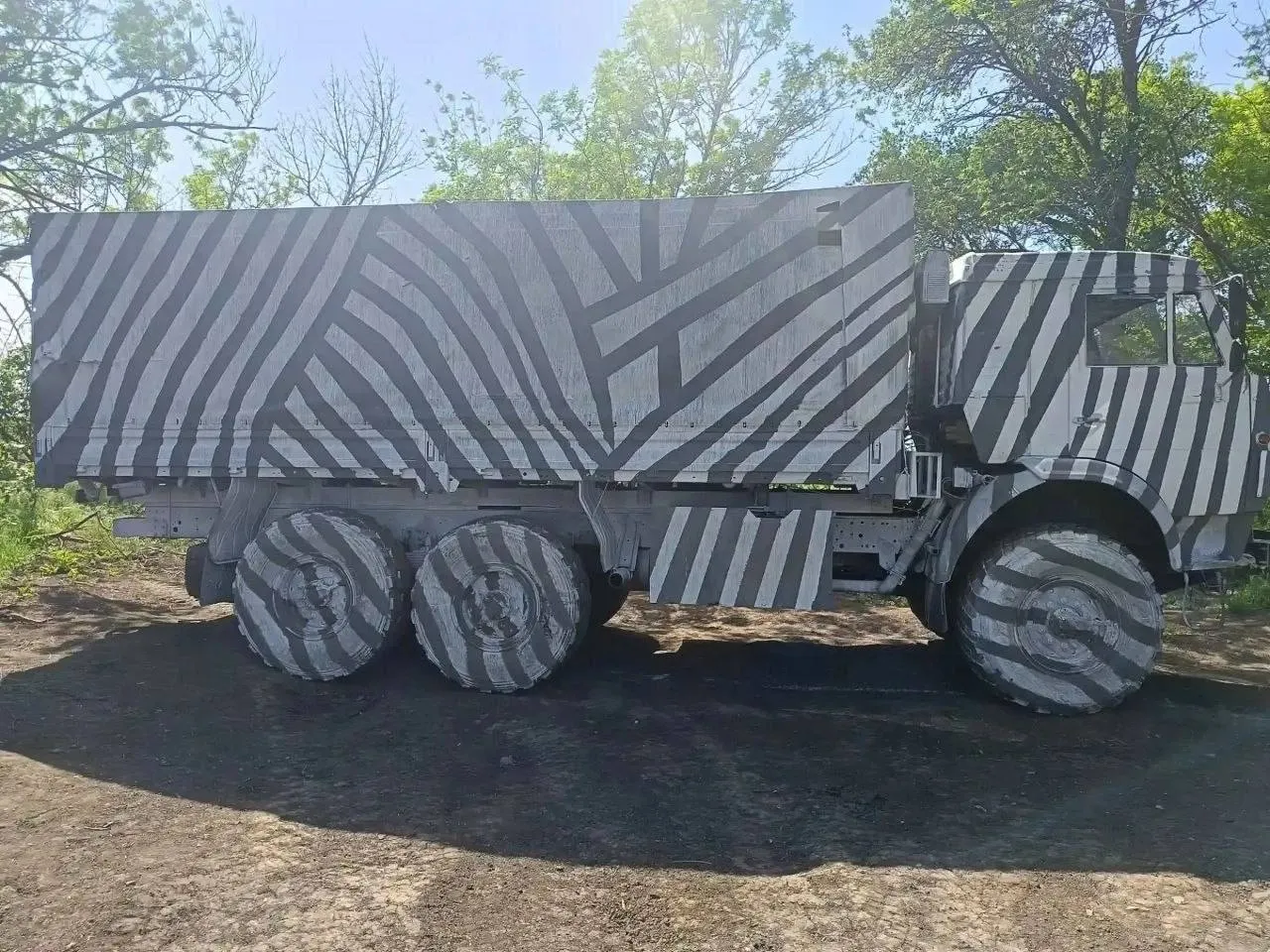
From an early point in the Russian war in Ukraine, we’ve seen many unorthodox efforts to try to improve the chances of survival of fighting vehicles. Now, Russian trucks are receiving ‘dazzle paint,’ borrowing the same kind of tactic Russia has used for some of its most important military aircraft, to try to confuse seekers on standoff weaponry that use image-matching capability.
KAMAZ truck with zebra-style pattern. via Xvia Xvia X
Several images showing the unusually painted Russian trucks have appeared on social media channels in recent days. So far, examples of Ural and KAMAZ heavy-duty truck designs have surfaced. There are at least two distinct patterns so far: a zebra-style application of broadly straight lines, and a more organic, leaf-like, swirling design. In both cases, they extend over most external surfaces, including the wheels and tires. It is not entirely clear if the white paint is applied over a layer of black, or portions of black, or if the white is simply coated over the standard base color of very dark green. It could be a mix of both application concepts, as well.
Ural truck with leaf-like pattern. via Xvia Xvia X
At first sight, the truck patterns recall the iconic paint scheme that the U.K. Royal Navy pioneered for its warships back in World War I. ‘Dazzle paint’ or ‘dazzle camouflage’ was devised in 1917 by official War Artist Norman Wilkinson, as a means of reducing losses to attacks by German submarines, or U-boats. The geometric patterns work by using highly contrasting color blocks, often heavily featuring black and white, as part of a carefully constructed pattern that breaks up the form of the ship and makes it harder to judge range and perspective.
British aircraft carrier HMS Argus wearing dazzle camouflage in 1918. Crown Copyright
As you can read about here, this kind of naval camouflage scheme appeared again during World War II, and on several occasions since then.
The Canadian frigate HMCS Regina, carrying a dazzle camouflage scheme, takes part in an exercise in 2020. Canadian Forces
When first introduced, dazzle paint was intended to trick the human eye, normally looking through a periscope. There was still a benefit to be had in protecting vessels after the introduction of improved rangefinders and radar. For the eye, it made it harder to judge a ship’s course and speed, as well as simply identifying it reliably.
The same basic principle is at work on the dazzle-painted Russian trucks, although now it’s an artificial eye — chiefly using electro-optical and/or infrared cameras — that is supposed to be fooled.
Increasingly, Ukrainian drones are using artificial intelligence (AI) to boost their combat effectiveness. The revolutions that are coming as a result of embedding of AI into lower-end drones is something you can read about in our past feature here. This includes machine vision: a process of the drone learning object recognition, identification, classification, and tracking, as well as providing recommendations for the operator on what to do, provided there is an operator at all and the drone is not running autonomously.
An HX-2 drone in flight. The HX-2 has some capabilities enabled by AI. Helsing
AI-enabled capabilities make lower-end drones more resistant to electronic warfare systems and make it easier for them to be employed in networked swarms. Above all else, they can result in the cutting of the invisible radio frequency tether of constant man-in-the-loop control that in many ways hampers the potential of this class of drones.
The drawback of machine vision that the Russian countermeasure is supposed to exploit is the onboard AI agent’s capacity for learning object recognition. While it may be able to recognize a 6×6 Ural, for example, out of a wide range of potential truck targets, if the appearance of the vehicle is distorted enough, it will not be positively identified, or at least meet the threshold of corroboration that would result in a kinetic act. However, still with many drones that feature AI assistance, a human operator stays in or on the loop for all critical decisions.
This raises the question of how successful the dazzle-painted trucks might be, although the thinking here presumably stresses avoidance of detection during the autonomous target-search phase, rather than the endgame of an engagement. It is also worth noting that these kinds of paint schemes only really have value in areas where they are unlikely to be seen by any Ukrainian human eyes, even remotely via a sensor; after all, they are far more conspicuous than their standard-painted counterparts. It’s also possible that a drone could be taught to specifically hunt these patterns, as nothing else on the battlefield would look like them and they would be confirmed hostile by default.
Overall, paint schemes are another logical, if extemporized response to a growing threat in the Russian rear areas, following the example of the Russian trucks loaded with logs as makeshift armor to protect against kinetic threats in the early phases of the war.
A Russian truck with improvised armor made of logs, in 2023. via X
This has been followed by successive counter-drone measures, best exemplified by the increasingly complicated ‘cope cages,’ ‘turtle tanks,’ nets, and arrays of spikes that have appeared on a range of vehicles on both sides of the war.
Russian ‘turtle tank’ seen operating with additional cage armor and an attached mine roller. via X
Perhaps most apposite, however, is the example of Russian bombers and strike aircraft being covered with disused tires, something that first appeared in around August 2023. TWZwas first to postulate that these were most likely intended to confuse the seekers on Ukrainian cruise missiles and drones that use image-matching capability. This was subsequently confirmed by a senior U.S. military technologist.
A “sort of classic unclassified example that exists is like a picture of a plane from the top, and you’re looking for a plane, and then if you put tires on top of the wings, all of a sudden, a lot of computer vision models have difficulty identifying that that’s a plane,” Schuyler Moore, U.S. Central Command’s first-ever Chief Technology Officer, explained in September 2024.
Moore said this as part of a larger discussion about AI models and data sets.
It’s also worth noting that Russian combat ships based in Crimea also received unique shading to break up their silhouettes for the same purpose during this period.
As well as the possibility of operating in large groups or fully networked swarms, it means long-range one-way attack drones can conduct dynamic targeting deep in contested territory. Trucks, for example, can be hunted and struck far behind the front lines, where once they were safe and where air defenses are sparse.
“Waves of similar drones could be sent to their own individual geographical ‘kill boxes,’ or defined areas of engagement. Collectively, they could put enemy targets at risk over a huge area persistently without ‘doubling up’ and attacking the same target twice. Using machine learning/AI and associated hardware, they could not just identify targets of interest, but also differentiate moving from still targets, to ensure they are indeed active (not destroyed or already damaged) vehicles. Meanwhile, they can be set to engage other target types, such as surface-to-air missile systems or other high-priority targets, regardless of whether they are static or not. Even troop movements on the ground could potentially be recognized and attacked. All the parameters as to what the drone can engage, and where it can do so, can be defined and tailored to each mission before launch.”
A man with a bicycle passes by a burned-out KAMAZ truck, part of a display of Russian military equipment destroyed in the fighting in Ukraine. Photo by Viacheslav Onyshchenko/SOPA Images/LightRocket via Getty Images SOPA Images
It is also worth noting that different types of sensors will be affected to different degrees by passive countermeasures like complex paint jobs. While electro-optical sensors may have issues with the patterns, infrared may not, especially at longer wavelengths.
TWZ has previously highlighted how AI algorithms can be rapidly trained in a digital environment, as well as incorporate data collected from actual real-world employment, to improve their ability to spot, categorize, and engage targets. It is, however, unclear how hard it would be to overcome infinite dazzle patterns. It could, as Schuyler Moore observed, lead to software programmers spending inordinate amounts of time on computer vision with very little to gain, once a new pattern arrived.
While it remains to be seen how effective the dazzle-painted trucks might be, they are another sign of drones, especially AI-enabled ones, being one of the key drivers of innovation on the modern battlefield.
Iranian Commander of the Mohammad Rasoolullah Corps Hassan Hassanzadeh attends an event with Iranian officials, military commanders, families of war victims and their supporters at the Imam Khomeini Mosque in Tehran, Iran on May 24. Photo by Behnam Tofighi/UPI | License Photo
June 1 (UPI) — Iran has stopped peace negotiations with the United States as it alleges the terms of its cease-fire agreement have been violated, Iran state media reported Monday.
The Tasnim News Agency cited Israel’s continued military operations in Lebanon as a violation of its cease-fire terms, calling for a cease-fire in Lebanon.
The Iranian news agency added that Iran will block the Strait of Hormuz and is looking to “activate” its “resistance front” in other areas.
“The United States and Israel bear responsibility for the consequences of any breach of the truce,” Abbas Araghchi, Iranian foreign minister, wrote on social media.
Despite the cease-fire between the United States and Iran, both sides have continued to exchange fire through the weekend. U.S. Central Command reports striking down two Iranian drones that were threatening ships. The United States has also been enforcing a blockade on the Strait of Hormuz, confronting any ships going to and from Iranian ports.
While Iranian news reports Iran is ending peace talks, President Donald Trump claimed early Monday morning that Iran “really wants to make a deal,” in a post on social media.
“Just sit back and relax, it will all work out well in the end — It always does!” Trump wrote.
Secretary of State Marco Rubio and President Donald Trump participate in a Cabinet meeting in the Cabinet Room of the White House on Wednesday. Photo by Samuel Corum/UPI | License Photo
Reuters first reported on the price increase to connect the datalinks on LUCAS drones to SpaceX’s space-based networks earlier today. The story cites anonymous sources, as well as Pentagon documents the outlet says it reviewed. This follows the recent announcement that the Pentagon is working to make LUCAS more autonomous with new artificial intelligence (AI) driven swarming capabilities, which could impact future connectivity demands.
In the video in the social media post below, the satellite communications terminal can be seen hanging from a cord on a LUCAS drone said to have been recovered largely intact in Iraq.
Local Iraqi residents are taking the newly deployed, nearly intact American LUCAS drone for themselves. pic.twitter.com/fbx411iAYU
— Special Kherson Cat 🐈🇺🇦 (@bayraktar_1love) March 2, 2026
What we know about SpaceX’s reported upcharge for LUCAS
“Within weeks of the United States launching its bombing campaign, SpaceX executives met Pentagon officials and argued the military had been paying about $5,000 for connection per terminal while effectively using a higher tier of service worth closer to $25,000,” according to Reuters. “SpaceX argued the LUCAS drones were operating under conditions that aligned more closely with its aviation tier subscription rather than a lower priced land or mobility service. Pentagon officials argued that the $25,000 price tag – a monthly fee – was designed for aircraft, not kamikaze drones that used Starlink connection for a matter of minutes or hours.”
“The Pentagon, which was ramping up strikes on Iran, ultimately agreed to pay SpaceX’s proposed price increase,” Reuters‘ report added.
The story also said this reflected broader “tensions” between the Pentagon and SpaceX that have been growing recently over Starlink fees.
“The Fake News media has the story wrong, again,” top Pentagon spokesperson Sean Parnell subsequently wrote in a post on X. “The claims in this article are simply not based in reality and do not reflect the close, effective collaboration between our teams.”
The Fake News media has the story wrong, again. @SpaceX remains a strong and valued partner to the Department of War.
The claims in this article are simply not based in reality and do not reflect the close, effective collaboration between our teams. https://t.co/872Maa5FX2
When reached for comment by TWZ earlier today before Parnell’s post, the Pentagon did not directly address Reuters‘ report.
“The Department of War is committed to fostering a competitive environment for commercial satellite communications and is conducting comprehensive market research to continuously monitor commercial offerings that align with government requirements,” a Pentagon official told us. “We are actively engaging with industry to identify innovative solutions and new entrants, ensuring acquisitions are inclusive of a diverse range of capable vendors.”
“The Commercial Satellite Communications Office is working on additional options with other proliferated low earth orbit partners as part of its strategy to leverage the unprecedented capabilities provided by the commercial SATCOM industry,” that same official added. “The U.S. Space Force is operating in accordance with the terms and conditions of its contracts.”
TWZ has also reached out to SpaceX for more information.
“It is a violation of commercial Starlink terms of service to use the terminal for weapon systems. This applies to all users and is shut down when discovered,” Elon Musk, who is the founder and CEO of SpaceX among his other endeavors, had written on X on March 1 in response to a post about LUCAS making use of Starlink. “There is a separate network called Starshield, which is operated by the US government. This is not under SpaceX control.”
It is a violation of commercial Starlink terms of service to use the terminal for weapon systems. This applies to all users and is shut down when discovered.
There is a separate network called Starshield, which is operated by the US government. This is not under SpaceX control.
Though described as a “monthly fee,” Reuters‘ report indicates that the U.S. military pays the $25,000 only once to employ a LUCAS drone. As the piece points out, the Pentagon reportedly argued that it should get to pay the lower $5,000 rate because it was only using the network to support LUCAS in timeframes measured in “minutes or hours.” This is also in line with Reuters describing the added cost as effectively approaching doubling the LUCAS drone’s $35,000 unit price.
The entire point of these one-way-attack drones is to offer a lower-cost complement to traditional exquisite long-range strike munitions. The Tomahawk cruise missile, the unit cost of a current-generation version of which is generally said to be in the $2 to $2.5 million range, is often used as a point of comparison, although they are far from equal in many ways. The underlying argument for LUCAS also relies on the drone being relatively cheap and easy to produce, as well as employ in large volumes. TWZ laid all of this out in a detailed case for the Pentagon acquiring exactly these kinds of drones in mass, which we published just three months before LUCAS was confirmed to be in operational service.
A combined price tag of some $60,000 (the unit cost plus one month’s fee to connect to Starshield, as reported by Reuters) would still be far less expensive than the cost of a single Tomahawk. Using Starlink/Starshield terminals to begin with, beyond their connectivity advantages, offers the benefit of miniaturized high-bandwidth hardware that is being produced at a commercial scale.
A close-up look at a LUCAS drone, with its square-shaped satellite communications antenna seen at the rear of the main body. CENTCOM
Plans to make LUCAS more autonomous through the addition of new swarming capabilities could affect future network connectivity requirements for the drones. This will be enabled by the integration of Shield AI’s Hivemind autonomy software, as you can read more about here.
Shield AI flies Hivemind AI Pilot on 6th Aircraft
As TWZ recently wrote:
“For the time being, the U.S. military demands a human operator is ‘in or on the loop’ for kinetic or otherwise potentially deadly actions, as opposed to letting autonomous weapons choose what targets to attack on their own without any extra authorization. While less controversial morally, this can also be a tactical hindrance, slowing the swarm’s potential and adding complexity and vulnerabilities to its operations. The debate around this choice will only get more heated as adversaries bypass this elected restriction in order to get an upper hand in future combat scenarios.”
“As we pointed out in our initial reporting on LUCAS’s emergence, the fact that some of the LUCAS drones already include miniature SATCOM terminals is very noteworthy. After all, ‘human in the loop’ swarming would not be possible without this form of communications at the beyond line-of-sight ranges these drones fly. At the same time, an entire swarm can be controlled in this manner, even if just a handful are equipped with SATCOM terminals. While a swarm can be mesh networked within line-of-sight, it has to relay all the important information back to an operator. By using some of the drones as SATCOM relay nodes, the entire swarm can be controlled remotely from most places on the planet.”
“Regardless, the Hivemind AI pilot will allow appropriately equipped LUCAS drones to perceive their environment, make decisions, and act autonomously without continuous human input. Unlike conventional autopilots tied to fixed flight paths, Hivemind is designed to dynamically adjust mission plans, react to unforeseen conditions, avoid obstacles, and carry out complex tasks with minimal operator oversight.”
A LUCAS drone seen being tested at the Yuma Proving Ground in Arizona. Mark Schauer/US Army
An increase in fees to connect individual SATCOM terminals to SpaceX’s networks, as well as cost savings on hardware, might further push the Pentagon toward a hub-and-spoke mesh-like networking arrangement like the one described above. LUCAS drones could also be employed in other contexts where satellite connectivity throughout the course of a mission might not be required, including if used essentially as fire-and-forget missiles aimed at fixed target coordinates. A SATCOM terminal would not be necessary at all for this kind of mission set, although it would be beneficial.
There is also a question about the total bandwidth that might be required to support swarms of LUCAS drones. From Reuters‘ reporting today, the increased load on its networks was a central factor in SpaceX’s demands for higher fees after strikes on Iran began. That being said, as already mentioned, Starlink/Starshield terminals are already designed with relatively high bandwidth use in mind.
These same considerations will apply to current and future programs that rely heavily on SpaceX’s satellite communications networks.
Dependence on SpaceX and U.S. national security
Specific cost figures aside, the LUCAS drone’s reliance on Starlink/Starshield underscores SpaceX’s dominance in the satellite communications market globally. It also highlights how essential the company’s space-based networks have already become for the U.S. military. TWZ explored this reality in detail amid open feuding between President Donald Trump and Elon Musk last year. The relationship between Trump and Musk has since rebounded, with the latter accompanying the President on his recent state visit to China.
Reuters reported today that there are some 10,000 satellites in SpaceX’s constellation supporting Starlink and Starshield, and that this represents more than 60 percent of all satellites currently in orbit. The company’s space-based networks, far and away, dominate the commercial satellite communications space globally. Offerings from competitors like OneWeb and Amazon Leo are more limited in scale and scope.
Watch SpaceX deploy Starlink satellites into space
This is reflected in the U.S. government’s ever-growing use of Starlink/Starshield on aircraft, ships, and in settings on land. This includes integration on some very high-value assets, including the U.S. Marine Corps’ VH-92 Patriot presidential helicopters and U.S. Navy aircraft carriers. There has also been a steadily growing push to use these networks to support tactical operations, as now highlighted by the link to LUCAS. The U.S. military had first demonstrated the ability to use Starlink to transmit targeting data years ago.
The U.S. government’s increasing use of Starlink/Starshield has already prompted operational security questions, even just in the context of supporting day-to-day peacetime operations, as you can read more about here. Starshield is designed to be more secure to help address these concerns for government customers.
At the same time, heavy use of Starlink on both sides of the conflict in Ukraine, including as a means of guiding one-way attackers in the air and at sea, has further underscored potential risks associated with the use of the networks in tactical scenarios. SpaceX and CEO Musk have faced particularly significant criticism in the past over limiting some Ukrainian use of the network. Actions SpaceX took earlier this year to block unregistered Starlink terminals also had major consequences for Russian forces, which were sent scrambling to find alternatives to fill the massive resulting communications gaps.
The very first Ukrainian kamikaze uncrewed surface vessel to emerge in 2022, seen here, very prominently had a Starlink antenna mounted toward the stern. via X
What SpaceX might have been prepared to do if the Pentagon did not agree to pay increased fees to support LUCAS is unknown. We also do not know what kind of protections are currently baked into U.S. contracts with SpaceX to prevent government users from being suddenly disconnected without warning. Regardless, as noted earlier, the Pentagon could deploy LUCAS swarms with just a handful of drones equipped with terminals to relay the critical info needed to control the rest of the formation, and LUCAS can still be used as a fire-and-forget weapon without any beyond line-of-sight connectivity, although this would greatly curtail its flexibility and, in some cases, its efficacy.
A LUCAS drone is prepared for launch from the Independence class Littoral Combat Ship (LCS) USS Santa Barbara during a test. Courtesy photo/Naval Air Warfare Center Weapons Division
As the Pentagon official noted to TWZ today, there is a push to explore commercial alternatives to Starlink/Starshield and promote further competition in this space. At the same time, part of the attractiveness of Starlink/Starshield for the U.S. government has been the relatively low costs and other benefits associated with leveraging such well-established networks, as well as the knowledge base that comes along with that pedigree. Just today, the U.S. Space Force announced it had finalized a new Other Transaction Authority (OTA) agreement with SpaceX, valued at $2.29 billion, for work on the Space Data Network (SDN) Backbone program. The SDN is tied to work on new space-based sensing and targeting capabilities, particularly for missile defense, which could now feed into the Golden Dome initiative.
On top of all this, SpaceX is also by far the top provider of space launch services globally, as well as other space-related services, including for the U.S. government. The core elements of Golden Dome, including the sustainment of planned batteries of space-based interceptors, require reliable, routine access to space at a frequency that only SpaceX can provide within budget constraints.
SpaceX looks set to remain a dominant force in this market space worldwide for the foreseeable future, and it continues to expand its presence, driven heavily by commercial demand. The company’s government contracts, though substantial, only account for around a fifth of its annual revenue, according to Reuters.
Despite the Pentagon’s response to the particulars of Reuters’ story today, being so heavily reliant on one provider for critical technologies still raises important questions not just for LUCAS, but for other efforts across the U.S. military that rely on robust and secure satellite communications connectivity.
Ukrainian President Volodymyr Zelensky warned citizens of his country that Russia is planning an attack, based on their intelligence reports, and to hunker down on Friday night. File Photo by Aaron Schwartz/UPI | License Photo
May 29 (UPI) —Ukraine on Friday evening said that it expects Russia to launch ‘big attacks’ against it sometime on Friday or Saturday, and warned its citizens to take cover.
Ukrainian President Volodymir Zelynsky told CBS News on Friday evening that it expects Russia to launch new attacks at the country in the next 24 to 48 hours, and advised his citizens to take cover.
“Our people have to be very, very careful, cautious and children – they have to use bomb shelters,” he told the news organization.
“Today, at night or tomorrow night, high percent – of course, nobody knows 100% – but there is high percent,” he said.
Russia on Friday evening already launched missiles toward Ukraine, with explosions reported in Kyiv and nearby regions, among other parts of the country, The Kyiv Post reported.
“We have intel that Russia is preparing a new massive attack,” Zelensky said in the post.
“Please pay attention to air raid alerts and stay safe,” he said.
The warnings follow an alleged drone hitting the roof of an apartment building in Romania, which was reportedly aimed at nearby location in Ukraine, which is neighbors the country.
Secretary of State Marco Rubio and President Donald Trump participate in a Cabinet meeting in the Cabinet Room of the White House on Wednesday. Photo by Samuel Corum/UPI | License Photo
May 29 (UPI) — A Russian drone carrying explosives struck the roof of an apartment building in NATO ally Romania overnight, risking a dangerous escalation in Moscow’s four-year-old war in Ukraine.
The drone had entered Romanian airspace during a Russian attack on neighboring Ukraine and struck the building in the eastern city of Galati, located near the Romania-Ukraine border, Romania’s Defense Ministry said in a statement Friday.
Two people were “slightly injured,” according to Romania’s Ministry of Foreign Affairs. The two victims were transported to the Galati County Emergency Clinical Hospital, officials said.
The drone sparked a fire on the 10th floor of the building, according to the Department for Emergency Situations, which said online that 70 people were evacuated from the building.
Video of the scene shared by Galati County emergency services officials shows firefighters responding and debris littering the residential street.
“This represents a serious and irresponsible escalation by the Russian Federation,” Romanian Foreign Minister Oana Toiu said online.
According to the Defense Ministry, radars had detected drones flying near Romanian airspace, prompting two F-16 fighter jets and an IAR-330 SOCAT helicopter to deploy at 1:19 a.m., with authorization to engage targets.
The aircraft followed the drone in Romanian airspace, but the decision was made to not engage over heightened risk to the safety of the civilian population, Romanian President Nicusor Dan said in a statement.
Dan said he convened a meeting of the Supreme Council of National Defense for 11 a.m. Friday to discuss what he called “the most serious incident to have affected national territory” since Russia invaded Ukraine on Feb. 24, 2022, igniting the war.
“The unprecedented nature of the event requires a firm, coordinated and commensurate response — at the national, allied and international levels,” he said.
He said he holds the Kremlin wholly responsible.
“What happened today in Galati is the direct consequence of Russia’s war of aggression unleashed against Ukraine, of the irresponsible and indiscriminate manner in which Moscow operates these weapons systems in the immediate vicinity of NATO borders, as well as of its systematic disregard for international law,” he said.
“There is no ambiguity regarding the perpetrator and the cause of this aggression.”
All NATO and European Union allies have been informed of the incident, and the U.N. Security Council has been informed, he said, adding that Romania has formally requested that allies deploy additional anti-drone capabilities to NATO’s eastern flank.
Romania also summoned the Russian ambassador to officially communicate “the effects that this lack of responsibility on the part of the Russian Federation will have on the diplomatic relations between our countries and the next steps at the European level regarding packages of sanctions,” Toiu said.
Numerous heads of state and ministers of foreign affairs condemned the attack, including European Commission President Ursula von der Leyen and NATO Secretary General Mark Rutte, who said he spoke with Dan and assured him that the alliance “stands ready to defend every inch of allied territory.”
“Russia’s reckless behavior is a danger to us all,” he said in a statement. “They continue to target civilians and civilian infrastructure across Ukraine. And last night showed yet again that the implications of their illegal war of aggression don’t stop at the border.”
Russian drones have repeatedly entered NATO airspace amid Russia’s war in Ukraine, but Friday’s incident appeared to be the most severe involving Romania.
May 28 (UPI) — The U.S. military attacked Iran, Tehran confirmed early Thursday, as Iran announced retaliatory strikes of its own.
Iran targeted a U.S. air base at about 4:50 a.m. local time in response to the U.S. military striking presumed Iranian military assets near Bandar Abbas Airport in southern Iran.
“This response is a serious warning so that the enemy knows aggression will not go unanswered, and that in the event of a repeat, our response will be more decisive and the responsibility and consequences will lie with the aggressor,” Iran’s Islamic Revolutionary Guard Corps said in a statement carried by Iranian state media.
The air base targeted and whether it sustained damage were not known. The U.S. military has yet to comment.
The announcement came as the Kuwait Army said its air defenses were confronting “hostile missile and drone attacks.” While the United States maintains a significant military presence in Kuwait, it was not immediately clear whether those attacks were related to the U.S.-Iran exchange.
Explosions were heard near Bandar Abbas, Iranian state news agency Tasnim reported earlier Thursday.
Citing an unidentified military source, the news agency said the U.S. attack followed the Iranian Navy firing shots toward a U.S. oil tanker that had turned off its radar system and intended to pass through the Strait of Hormuz.
The oil tanker reportedly ended its attempt to transit the vital energy maritime trade route.
Iran has been enforcing has been restricting access through the Strait of Hormuz since the start of the war, permitting only certain vessels through. The United States responded with a military blockade of Iran’s ports, cutting it off from sea-based trade.
The two sides have been in talks since a fragile cease-fire was agreed to last month, with Thursday’s U.S. strikes on Iran the second time it has attacked the country so far this week.
On Monday, the U.S. military attacked southern Iran, describing the strikes as “self-defensive” in nature.
The Trump administration has repeatedly stated that it intends to secure free navigation of the Strait of Hormuz, one way or another, though it would prefer to do so through diplomacy.
Iran’s control of Hormuz is reportedly one of its conditions in negotiations on ending the war. In response to reports carried by Iranian state media that Iran and Oman, which border either side of the Strait of Hormuz, are in talks over control of the choke point, President Donald Trump said the transit route will be open to all countries and under no government’s control.
“It’s international waters. Nobody’s going to control it. We’re going to watch over it. We’ll watch over it, but nobody’s going to control it. That’s part of the negotiation that we’re having,” he told reporters during a Cabinet meeting on Wednesday.
“And Oman will behave just like everybody else or we’ll have to blow them up. They understand that. They’ll be fine.”
Muslims perform Eid al-Adha prayers at sunrise in Cairo, Egypt, on May 27, 2026. Photo by Ismael Mohamad/UPI | License Photo
Weekly insights and analysis on the latest developments in military technology, strategy, and foreign policy.
For more than 2,000 years, fishermen in Israel’s Sea of Galilee were famous for using nets to catch St. Peter’s Fish, a form of tilapia with a biblical backstory. Now these anglers have gained new notoriety, helping keep some Israeli troops safe from Hezbollah first-person view (FPV) kamikaze drones. TWZ was among the first to highlight the danger these weapons have posed to Israeli forces in southern Lebanon and how the IDF was racing to install passive defenses, including nets, on its combat vehicles for protection.
The threat is so great and countermeasures so far limited, that some IDF troops are resorting to obtaining nets on their own from fishermen for protection, a senior IDF official confirmed to TWZ on Monday. The issue was first reported by Israel’s KAN public broadcasting network. This is in addition to netting the IDF itself is working to procure, which we will talk more about later in this story.
The IDF’s improvised countermeasure: going to Israeli fishermen and asking to use their nets.
— The Jerusalem Post (@Jerusalem_Post) May 26, 2026
“Indeed, IDF soldiers are equipping themselves with fishing nets, most of which are being purchased in the city of Tiberias on the shores of the Sea of Galilee,” a senior IDF official told us. The troops are also buying nets from fishermen at Akko and Haifa on the Mediterranean, the official added.
“The drone threat has become a nightmare for the fighters on the ground,” the high-ranking official explained.
Fishing on the Sea of Galilee! Joshua Aaron / Rather Be in the Galilee
In our past reporting, we explained that the idea behind netting is that drones will get caught up in these barriers and become disabled, or, in some cases, the nets will help keep the drones far enough from the troops or equipment before exploding to keep personnel within the vehicles from being killed.
Israel, as we have previously noted, started using netting on vehicles and other equipment as the FPV threat grew.
You can see one example of this in the following video.
Israeli Defense Forces testing a folded anti-drone net installed on a Humvee.
The video emerged amid a surge of Hezbollah strikes with FPV drones against the IDF in Lebanon. pic.twitter.com/PwIyuJQVs4
— Status-6 (War & Military News) (@Archer83Able) April 29, 2026
The use of nets as a defensive measure was first employed in Ukraine as FPV drones became the ubiquitous weapon of choice for both sides.
You can see an early example of Russians using netting in the video below.
To protect themselves from Ukrainian drone attacks, the Russians have fenced off the road from Bakhmut to Chasiv Yar, creating a 2-km mesh tunnel. In this way, the Russians are trying to rescue their equipment and personnel from threats from drones. pic.twitter.com/qbtFvwrAcx
In our initial stories about Hezbollah’s FPV arsenal, we noted that the Iranian-backed proxy group was adding a challenge to the IDF by increasing the percentage of FPV drones guided by fiber optic cables. These wires mitigate the effect of electronic warfare efforts to jam radio signals as well as some of the limitations imposed by geographical features that can impede the line-of-sight radio connection between drone and operator.
Videos of these attacks began to emerge online last month, which you can see below.
Hezbollah conducted more fiber-optic FPV strikes on Israeli vehicles in Lebanon, including two ‘Merkava’ Mk.4 tanks, a D9 Caterpillar armored bulldozer, and what appears to be a rare ‘Namer’ heavy IFV equipped with a turret mounting a 30 mm Bushmaster Mk 2 cannon. 1/ https://t.co/ms2nagNHrDpic.twitter.com/WDs6M3SpwW
Now there’s a new problem for Israel to solve when it comes to FPV drones. Hezbollah has begun using thermal cameras on these munitions so they can be deployed in night attacks, the IDF official told us. Thermal cameras register heat signatures, turning them into thermal images using differences in temperature.
By adding thermal cameras to the FPV drone, Hezbollah “severely restricts [our] movement both during the day and at night,” he postulated.
#Lebanon / #Israel / #Iran / #USA 🇱🇧🇮🇱🇮🇷🇺🇸: Hezbollah’s “THERMAL Ababil” FPV Drone struck an Israeli Army (#IDF) soldiers in Al-Bayada.
Group used FPV Kamikaze Drone with equipped with Thermal Sight and carrying PG-7 / IED —which is a quite significant development. pic.twitter.com/pSHy4JriVA
Combined with fiber-optic guidance, the use of thermal cameras on FPV drones “creates an extraordinary level of deterrence against the forces operating inside Lebanon and along the border,” the senior IDF official bemoaned. “It is terrifying, dangerous, and frightening in equal measure.”
“The forces are essentially static,” the official added. “They cannot advance toward the drone-launch areas, nor can they effectively target the drone logistics and operational chain extending through the Beqaa Valley, Tyre, Sidon, and even Beirut.”
“Our operational doctrine must change,” he added. “We need to shift from completely exposed operations, where our soldiers become easy targets for Hezbollah, to covert and concealed activity.”
Israeli tanks and military vehicles standing along the road between destroyed houses in southern Lebanon. (Photo by Jalaa MAREY / AFP) JALAA MAREY
Making matters worse, “the political-security cabinet, and more specifically [Israeli Prime Minister Benjamin] Netanyahu, is pushing for overt operations in order to demonstrate an Israeli presence in southern Lebanon,” the senior IDF official posited. “At the same time, due to commitments and demands made by [U.S. President Donald] Trump, the operational freedom of the forces is being heavily restricted. It is a classic Catch-22 situation.”
“The result is severe harm to our soldiers and a weakening of the IDF against an enemy that is bound by no rules or constraints,” our source continued. “This is a dangerous and absurd asymmetry – sheer recklessness.”
His comments came a day before Netanyahu officially ordered a much larger Israeli push into southern Lebanon, despite the ongoing ceasefire, which you can read more about in our story from earlier today here.
Prime Minister Benjamin Netanyahu, today, at the start of the Security Cabinet meeting: “As per the directive of myself, the Defense Minister and the IDF Chief of Staff, we are deepening our operation in Lebanon. The IDF is operating with large forces on the ground and seizing… pic.twitter.com/GBLuWgEbyl
— Prime Minister of Israel (@IsraeliPM) May 26, 2026
The IDF says about 158,000 square meters of protective nets have already been distributed to units in the field, Israel’s I24News reported.
“The army says it is in the process of acquiring an additional roughly two million square feet of netting,” the outlet added. “Altogether, the total area ordered is equivalent to roughly 20 football fields, highlighting the scale of Israel’s efforts to adapt its defenses to a rapidly evolving battlefield threat along the northern front.”
Even that much netting does not appear to be enough, given the scope of Israel’s push into southern Lebanon. That may be way some soldiers are looking to fishing nets to fill in the gaps.
Since the war in Ukraine began, troops have done whatever they could, often out of desperation, to develop improvised workarounds to protect against drones, from stacking logs on their vehicles to welding on layers of steel to create so-called “turtle tanks.” These and many other ad-hoc improvements have led to major innovations and a long list of dead-ends. Often times, even simple solutions can be hard to realize due to bureaucracy. Israel’s troops are no different, and their work to find their own solutions is yet another example of even the world’s most capable militaries underestimating and being unprepared for the realities of drones on the modern battlefield.