Weekly insights and analysis on the latest developments in military technology, strategy, and foreign policy.
A newly emerged video offers what appears to be a first look at China’s R6000 uncrewed tiltrotor aircraft in free flight, marking a significant step beyond the tethered hover tests that had been seen previously. The design has attracted interest on account of its similarities to Bell’s MV-75A Cheyenne II, America’s crewed second-generation tiltrotor. More broadly, the development of this aircraft could have very significant implications for the People’s Liberation Army as well as civilian operators.
The footage, which first appeared on Chinese social media, shows the large drone in vertical flight, making a pedal turn (rotating around its vertical axis in the hover), and in sustained forward flight with its twin proprotors fully tilted. Previous imagery was limited to tethered evaluations that demonstrated basic hover capability. Now, with flight testing advancing, more could be revealed about the aircraft’s performance envelope.
As in the previous imagery, the aircraft’s engines are unshrouded, with their streamlined fairings removed. Like the MV-75, the R6000 features fixed engine nacelles with hinged proprotors, in contrast to the first-generation tiltrotor design found on the V-22 Osprey, in which the entire nacelle pivots up and down as a complete unit.
Previous imagery showing the R6000 conducting a tethered hover test had begun to circulate last November, as we discussed at the time.
An R6000 prototype seen undergoing tethered hover testing. United Aircraft via Chinese internet
While no details have been released about the scope of the current trials, the ability to conduct sustained untethered flight is a key milestone for any tiltrotor program, given the complexity of the aircraft’s aerodynamics and flight-control systems. Tiltrotor designs are especially challenging, as evidenced by the V-22’s checkered record through the years.
In October 2024, a photo emerged showing the first completed prototype of the R6000 at the Wuhu United Aircraft Production Workshop in China’s eastern Anhui province. United Aircraft had unveiled the design, also referred to as the UR6000 and Zhang Ying (or Steel Shadow), at the 2024 Singapore Airshow.
A photo shows what is said to be the first completed UR6000 prototype on the production line at the Wuhu United Aircraft Production Workshop in the Wuhu Aviation Industrial Park in China’s eastern Anhui province. United Aircraft
Developed by the Chinese firm United Aircraft, the R6000 is one of the largest uncrewed tiltrotor designs currently in development anywhere in the world. Combining the vertical takeoff and landing capabilities of a helicopter with the speed and range advantages of a fixed-wing aircraft, it is — officially, at least — aimed at logistics, disaster relief, offshore support, and other missions requiring access to areas without prepared runways. United Aircraft has presented both crewed and uncrewed versions of the R6000 in the past.
As we have outlined previously, a crewed or uncrewed tiltrotor in the R6000 class could fulfill various military applications for the People’s Liberation Army (PLA).
Concept artwork of an apparent crewed version of the UR6000 in a generic civil-type color scheme. United Aircraft
This kind of aircraft could support overseas deployments and regional contingencies, including a potential operation against Taiwan, by moving troops, supplies, and equipment between dispersed locations without relying on prepared runways.
In particular, the R6000 would be well suited to operating from the Type 076 amphibious assault ship and other large People’s Liberation Army Navy (PLAN) amphibious ships, greatly extending their reach for logistics, reconnaissance, and other missions.
China’s first super-sized Type 076 amphibious assault ship, the Sichuan.
As well as logistics, a fully developed R6000 has clear potential as a multi-mission platform. Its payload capacity could also accommodate intelligence, surveillance, and reconnaissance (ISR) equipment, electronic warfare payloads, communications relay systems, or potentially even precision-strike weapons. It is worth noting at this point that a special operations version of the MV-75 is already in the works, with a gunship variant likely, and a sea control concept has been displayed, too. China is likely to at least explore similar development paths for its tiltrotors.
A view of Bell’s MV-75 sea control concept model at this year’s Modern Day Marine exhibition. Eric Tegler
In this respect, the R6000 also makes for an interesting comparison with Bell’s V-247 Vigilant, which was originally pitched to meet the U.S. Marine Corps multirole, VTOL-capable drone program, known as MUX. The V-247 has also been pitched to the U.S. Navy, while Bell has presented renderings showing V-247s operating together with the crewed V-280 Valor tiltrotor design, which the U.S. Army’s MV-75 is based on.
Concept artwork depicting V-247s operating together with a version of the V-280 Valor tiltrotor. Bell
At least one picture on United Aircraft’s website shows the UR6000 in People’s Liberation Army markings. United Aircraft
In the vertical-lift segment, China is also busily exploring crewed tiltrotor designs.
Earlier this month, new footage emerged showing what is understood to be China’s first crewed tiltrotor aircraft during flight trials. That aircraft had first broken cover in August of last year, as we wrote about at the time.
A photo that appeared on June 1, showing the crewed tiltrotor aircraft while in flight. Chinese internet via X
Although the R6000 has, in the past, been pitched primarily for civilian applications, the technology has obvious military relevance. Large autonomous tiltrotors could provide rapid resupply to dispersed forces, support operations in remote regions, or deliver cargo to ships and austere bases without the need for conventional runways. Tiltrotors have huge potential for the PLA, which has major littoral mission demands and a growing fleet of amphibious warships to which these kinds of aircraft are especially well suited.
As such, the R6000 is worth watching as another indicator of the Chinese military’s increasingly ambitious vertical-lift programs, as well as its diverse and growing series of uncrewed aircraft.
Weekly insights and analysis on the latest developments in military technology, strategy, and foreign policy.
A plan to attack the UFC America 250 event at the White House on June 14 with explosive drones was thwarted by the FBI, according to federal records. Exactly how capable those involved were of actually pulling it off remains unclear. However, the alleged plot amplifies concerns that TWZhas been documenting for years about threats posed by drones to critical facilities in the homeland and how they continue to change the national security picture at home and abroad.
The long-standing potential for a drone attack on the White House was something we recently discussed last month in an examination of President Donald Trump’s plans to fortify the under-construction ballroom. More on that later in this story.
WASHINGTON, DC – JUNE 14: Guests, including members of the U.S. military, attend the Ultimate Fighting Championship (UFC) Freedom 250 mixed martial arts event under the open-air “Claw” on the South Lawn of the White House on June 14, 2026 in Washington, DC. On his 80th birthday, President Donald Trump hosted a series of seven mixed martial arts fights on the South Lawn, which the White House is calling “a once-in-a-generation celebration of the American fighting spirit.” (Photo by Chip Somodevilla/Getty Images) Chip Somodevilla
The plot involved a group of individuals who wanted to “attack the UFC event and involved staging a ‘demonstration’ on the north side of the White House,” CBS News reported, citing the court filings. “The group would then fly drones ‘laden with unspecified explosive devices which would detonate over the north side of the UFC arena,’” according to the filing in the case of one of the five people arrested, 19-year-old Tycen Proper.
When the drones exploded, “the group then planned to force attendees of the UFC event and ‘high value targets’ to evacuate to the south,” Proper’s affidavit read. The suspect told investigators that the plan was for group members to “act as snipers and additional shooters,” shooting fight attendees and the “high value targets” as they fled from the explosions.
The affidavit said the “high value targets” were “wealthy people” and politicians, CBS noted.
Proper allegedly told investigators the goal of the attack was to “jumpstart” a revolution in the U.S. He was interviewed from a hospital, according to the document, where he was admitted on an emergency basis due to “homicidal ideations.”
NEW: Tycen Proper, one of five suspects arrested in the White House UFC drone attack plot, allegedly wanted to target Sen. Marsha Blackburn because she received money from “the pro Israel lobby and supports them.”
In addition to Proper, Bryan Omar Roa, 24, of Calimesa, California; Michael Alan Thomas, 32, of Pinon Hills, California; Daniel K. Eskridge, 32, of Kidder, Missouri; and Abraham Hermosillo Alvarez, 31, of Omaha, Nebraska were also charged, according to the Justice Department.
BREAKING: Details via federal arrest affidavit reveal that a California man named Michael Alan Thomas was one of the alleged organizers of the alleged UFC White House terror plot. Feds say he admitted he believes the U.S. government is run by elites who sacrifice and eat… pic.twitter.com/L8i1bTR9Em
BREAKING: FBI, law enforcement partners disrupt alleged plot against UFC Freedom 250 event at White House; 5 in custody, officials say https://t.co/CEBKJA5zPt
TWZ cannot independently verify any of these details at this time and it remains publicly unclear what capabilities, training, funding and equipment the suspects had to actually carry out a complex attack like the one described. Proper’s mother said her son “began interacting with a group online that was comprised of individuals who claimed to be ex-military and Christian-based,” according to the court documents. They espoused anti-government and anti-Semitic sentiments.
At the very least, it would have taken unique skills and some level of discipline, coordination and operational security to pull off this kind of a plot. It would have also required funding and time. The FBI and other law enforcement agencies disrupt attack plans long before they get close to becoming operational, and many of those have a low chance they could actually been implemented as dreamed-up. That does not mean the individuals involved or their plans are not still a significant threat. In this case, there is no information available on whether anyone involved had the means and ability to stage an attack like the one described.
Guests, including members of the U.S. military, attend the Ultimate Fighting Championship (UFC) Freedom 250 mixed martial arts event under the open-air “Claw” on the South Lawn of the White House on June 14, 2026 in Washington, DC. (Photo by Chip Somodevilla/Getty Images) Chip Somodevilla
Regardless, it is important to note it would be a challenge to stop people simply from bringing weaponized uncrewed aircraft into range of the White House without law enforcement having prior knowledge. Actually employing those drones as weapons successfully is another story. Still, the danger of such an attack looms large and is growing by the day.
As we have frequently highlighted, two incidents last year highlight the alarming danger of near-field drone attacks that raised lingering concerns in the U.S.
The following video shows one of the Ukrainian drone attacks on Russian bombers during Operation Spider Web.
In both Russia and Iran, the drones were set up undetected deep in enemy territory during armed conflict against military targets. The plot on the White House, as characterized in the court documents, is of course different on many levels and was to be planned and executed by citizens, not sponsored by another nation at war with its neighbor. At the same time, both presents a host of challenges to defend against, many of which overlap.
Given the presence of the president, his family and thousands of VIP guests on the White House lawn at the time, as well as the event’s extremely high-profile nature, UFC Freedom 250 was “designated a Special Event Assessment Review 1 event, like the Super Bowl, Indianapolis 500, Kentucky Derby and college football games, according to the Department of Homeland Security,” ABC News reported last week.
Security was also tightened at the Ellipse outside the White House, where thousands more watched the event on large screens.
Security forces take security measures as preparations continue on the South Lawn of the White House ahead of the Ultimate Fighting Championship (UFC) Freedom 250 event, part of the America 250 celebrations, in Washington, D.C. (Photo by Mehmet Eser/Anadolu via Getty Images) Anadolu
The increased precautions included concern about drones, said Tara McLeese, special agent in charge of the Secret Service’s Washington Field Office.
Federal law prohibits flying drones in the airspace over the National Capital Region, so McLeese advised fans ahead of the event to “leave their drones at home.”
“We will have law enforcement drones for overwatch, but just to make it simple for the public, if they see a drone, we want them to report that,” she said, according to ABC.
The Secret Service declined to talk about its concerns over drone threats, instead pointing us to its post on X.
Protective intelligence cases are on the rise, and our teams work tirelessly behind the scenes to investigate threats, identify those responsible, and ensure accountability. Statement from Director Curran on the events of this past weekend: pic.twitter.com/Oca3QVLg9o
— U.S. Secret Service Office of Communications (@SecretSvcSpox) June 16, 2026
While we don’t know the extent of the counter-drone measures deployed by the FBI, Secret Service or even the military, they certainly included devices to detect and, if needed, jam the signals of threatening drones. However, as the war in Ukraine and Israel’s push into Lebanon have proven, the efficacy of these methods is far from assured. This is especially so since the introduction of drones controlled via fiber optic cables, which mitigate the effects of radio frequency passive detection and active jamming with a direct hardwired link between a drone and its operator.
First Person View (FPV) drone controlled via fibre optic cables have been widely used in Ukraine, Lebanon and elsewhere in the world to counter the effects of radio frequency jamming. (Photo by Mykhaylo Palinchak/SOPA Images/LightRocket via Getty Images) SOPA Images
Meanwhile, as we noted in our story about Trump using the ballroom he is building as a kind of defensive fortification, using traditional kinetic protection from drones and other aerial threats in and around the White House is limited and risky. The advent of interceptor drones, many that are hit-to-kill or use electromagnetic pulses and other low collateral damage means instead of explosive warheads, is starting to mitigate some of those concerns.
“Clearly, the drone issue is a massive one and has been for many years. This structure will serve as a secure place to do daily business if needed. Based on Trump’s comments, it will also act as a critical active defense node with its roof hosting air defenses, and apparently ones that are capable of at least a limited degree of area defense, not just highly-localized point defense. This is where drones could come into play. Drone interceptors (drones that intercept other drones) are well suited for the unique challenges of defending the White House and the Mall area as a whole, where collateral damage is a huge concern. Some of these systems use warheads, while others do not, physically smashing into their targets or blasting them with electrical pulses and other non-traditional effects instead. Drone interceptor capabilities are expanding rapidly now, equipping forward bases and warships. They proved critical in defending U.S. interests against Iranian attacks during the recent war. In Ukraine, they have proven indispensable in countering waves of Russian Shaheds.”
U.S. President Donald Trump speaks to the media alongside posters of his proposed White House ballroom amid construction at the White House on May 19, 2026 in Washington, DC. (Photo by Chip Somodevilla/Getty Images) Chip Somodevilla
Directed energy, such as lasers and high-power microwave weapons are another potential countermeasure, but these systems remain somewhat in their infancy and have very short range. Above all else, using them in dense urban areas, especially those with nearby low-flying air traffic, can be extremely problematic. They are not widely deployed for the counter drone role in the United States and won’t be in the near term.
It’s also worth remembering that the alleged plan did not necessarily rely on the accuracy of the drones or the damage they could inflict. The goal was to induce panic by their very presence and drive people into a field of fire to be attacked by snipers.
Even if counter-drone measures were able to provide a relatively robust protective bubble over UFC 250 at the White House, the plot as described in the documents further highlights the vulnerability large events have from even the lowliest of drone attack attempts.
The U.S. at the moment is protecting several facilities across the country with huge crowds during the World Cup soccer tournament at a time of heightened global tensions. Countering drone attacks was a central component of pre-event security measures as well as ongoing efforts.
Players and match officials walk into the pitch before the FIFA World Cup 2026 Group G match between IR Iran and New Zealand at Los Angeles Stadium on June 15, 2026 in Los Angeles, California. (Photo by Stu Forster/Getty Images) Stu Forster
This all comes as the U.S. is working to increase authorities to allow the military and law enforcement to better protect against drone threats.
Officials have already taken action against drone operators using these new authorities. Last week, FBI Los Angeles said it seized drones and issued citations to pilots near SoFi Stadium for alleged violations of temporary flight restrictions during last Friday’s World Cup match, The Los Angeles Times reported. The bureau “shared photos showing confiscated drones as well as an image of a drone operator being cited,” the newspaper noted. “However, it did not specify how many drones were taken or how many pilots were issued citations. It also did not provide details on the technology used to locate or track the drone operators.”
The bureau did not say if the operators of these drones had nefarious intent or whether they were armed, though neither of those are prerequisites for violating the no-drone-zone rules.
The FBI’s Counter Drone Enforcement Team has been busy around last night’s #WorldCup game and related events ensuring drone pilots aren’t violating @FAA Temporary Flight Restrictions. But some were, and as promised, they were cited and had their drones seized. Meanwhile,… pic.twitter.com/s0vy75E73E
While the actual ability of the alleged perpetrators to pull off the combined drone and sniper attack on the White House like what’s described remains unknown, the threats to the homeland from uncrewed aircraft are only growing by the day, as are nefarious actors’ experience and creativity with the technology.
A suspected Russian drone attack on a residential building in Ukraine has injured at least seven people. Emergency services responded as fire ripped through the building in Zaporizhzhia.
Seoul court sentences former leader for sending military drones into North Korea.
Published On 12 Jun 202612 Jun 2026
South Korea’s ex-President Yoon Suk Yeol has been sentenced to 30 years in prison for sending military drones into North Korea, a move prosecutors argued was aimed at creating a pretext for his disastrous martial law declaration in 2024.
The drone flights, which Pyongyang said included the dropping of propaganda leaflets, triggered a spike in military tensions between the nations in October 2024.
Recommended Stories
list of 4 itemsend of list
Special prosecutors, who had sought a 30-year prison term for Yoon, said in April that the ex-leader’s effort to “fabricate wartime conditions” with the drones had undermined state security.
Yoon was “given 30 years in jail” for the charges involving the drones, a spokesperson for the Seoul Central District Court told the AFP news agency on Friday, without giving further details.
Yoon had denied wrongdoing.
The ruling adds to a series of judgements against the ousted conservative leader, once South Korea’s top prosecutor, whose martial law order plunged Asia’s fourth-largest economy into its deepest political turmoil in decades.
In February, a South Korean court sentenced Yoon to life in prison after finding him guilty of leading an insurrection linked to the martial law attempt.
He was removed from office last year after the Constitutional Court upheld his impeachment, triggering a snap election that was won by liberal President Lee Jae Myung.
Yoon’s lawyers said he neither ordered nor later approved the drone operation, which they said was unrelated to martial law and instead a response to months of North Korean launches across the border of balloons stuffed with rubbish.
Yoon, who is already in custody, can appeal Friday’s lower court ruling.
Drone flights remain a flashpoint in tensions between the two Koreas, which remain technically at war.
Lee expressed regret earlier this year after an investigation found government officials had sent drones into the nuclear-armed North Korea in January.
North Korean leader Kim Jong Un’s powerful sister called Lee’s statement “wise behaviour”, but hopes for a rapprochement faded after the diplomatically isolated nation returned to calling South Korea its “most hostile” enemy.
Weekly insights and analysis on the latest developments in military technology, strategy, and foreign policy.
A novel kind of drone-based air defense system has been shown for the first time by German weapon manufacturer Diehl Defence. The Cobra 600, which has not previously been seen in public, combines a jet-powered drone platform with a missile rail armed with one of the company’s IRIS-T missiles, a weapon already used in short-range air defense systems and air-to-air applications. The new system immediately recalls recent Russian developments, which add short-range air defense missiles to its versions of the Shahed-136 long-range one-way attack drone, known locally as the Geran.
A rendering of the Cobra 600 in four-engine configuration. Polaris Raumflugzeuge
Cobra 600 is being presented at the ILA Berlin airshow, taking place this week in the German capital. The Cobra 600 is also known as the Airborne Launching and Attack System (AirLAS), and the program was launched last year.
The concept behind the Cobra 600 is that of a ‘missile taxi,’ in which the drone platform carries the IRIS-T missile over a considerable distance. All the while, the drone is meshed with a ground-based air defense system. Typically, this would be one of Diehl’s IRIS-T SLM or IRIS-T SLS systems. Of these, the IRIS-T SLS employs the same missile as the air-to-air variant — and therefore the same missile as the Cobra 600. The physical interface between the drone and the missile is a standard pylon as used on the Eurofighter jet.
A ground-based IRIS-T SLS system. Diehl DefenseAn IRIS-T air defense missile. Diehl Defense
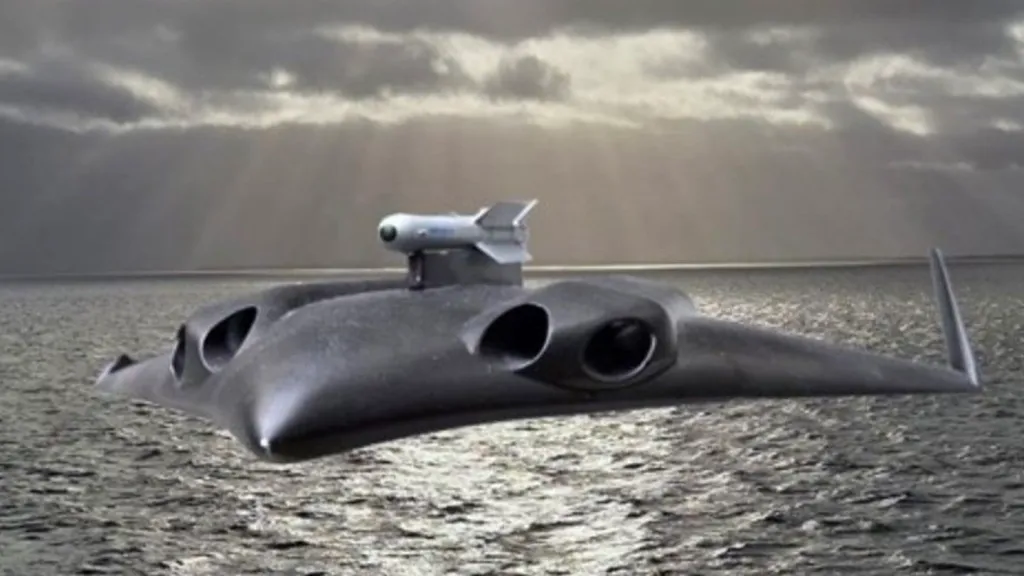
As for the drone platform, this is provided by another German firm, the Polaris Raumflugzeuge aerospace start-up. It has a similar kind of efficient delta planform as the Shahed-136, with a modified flying-wing-like design. On the wingtips are mounted endplate vertical stabilizers. As displayed, the drone is powered by a pair of JetCat-P1000-PRO micro turbojet engines, each of which provides a maximum thrust of 20 pounds. However, the drone has intake ports for another two engines. It’s not clear if these are only intended to be fitted if heavier payloads are being carried, but it’s certainly a possibility. Concept artwork released by Polaris, as seen at the top of this story, shows a four-engine configuration, with the turbojets buried in the airframe and fed by much longer intakes, helping to shield them from detection.
The two JetCat-P1000-PRO micro turbojet engines on the Cobra 600. Thomas Newdick
Polaris Raumflugzeuge has already built a variety of drones in the same configuration, and the company eventually aims to scale this up to produce a spaceplane.
The MIRA II, an experimental drone powered by four turbojets and designed to test an aerospike rocket engine. The landing gear configuration may well point to that used on the Cobra 600. Polaris Raumflugzeuge
Drawing on its design heritage, the Cobra 600 drone has retractable wheeled tricycle landing gear, meaning that it can be reused in some scenarios. The drone therefore takes off and lands from runways, although it is also able to operate from suitable shorter airstrips, such as stretches of highway. It’s also intended to be cheap enough that commanders will also be willing to risk losing it in combat, or after it runs out of fuel.
The concept of operations has the Cobra 600 serving as an adjunct to a ground-based air defense system, extending its range considerably.
With the missile fitted, the Cobra 600 has a range of around 250 miles. This compares to around 25 miles for the ground-launched missile used in the IRIS-T SLM, or approximately eight miles for the missile used in the IRIS-T SLS.
An IRIS-T SLM system deployed. The radar vehicle is seen in the background. Diehl Defense
As such, the Cobra 600 has the potential to turn the ground-based IRIS-T into something a little closer to a long-range surface-to-air missile, in terms of the distance it can cover. Of course, this is only true in terms of absolute range, with the speed and maneuverability of the drone being far inferior to a long-range missile. Unless the target is nearby, or the Cobra 600 has been pre-positioned based on known target vectors, the reaction time it offers is strictly limited. The missile itself is also able to tackle a more limited range of potential targets than a dedicated long-range surface-to-air missile, some of which offer an anti-ballistic missile capability, for example.
On the other hand, the Cobra 600 offers the distinct advantage of being able to loiter in a given area, waiting for threats to emerge, or to perform combat air patrols to screen certain sectors. It is best viewed as a forward-positioned additional launcher for the ground-based IRIS-T, and is also entirely reliant upon that system (or a similar one) for its effectiveness. At the same time, leveraging existing ground-based air defense systems as a force multiplier is a clear advantage. Another possible operational scenario would involve setting the Cobra 600s up as interceptors on a runway, sitting ready for launch on a runway to defend against lower-end threats.
A close-up of the IRIS-T on the Cobra 600 drone. Thomas Newdick
In its current form, the Cobra 600 has no onboard sensors to detect targets other than the imaging infrared seeker head that’s integral to the standard IRIS-T missile.
In an operational scenario, a target for the Cobra 600 would be detected and identified by the ground-based air defense system to which it is ‘tethered.’ Connected via datalink, the ground-based system would vector the drone to the appropriate location. Using its own seeker, the IRIS-T would lock onto the target and be commanded to launch by the operator of the ground-based system. Of course, this presupposes that the datalink is not compromised by hostile interference or due to line-of-sight limitations, although SATCOM capability, like Starlink, would help keep redundant control over the drone beyond line-of-sight.
At this point, the mode of engagement is not dissimilar to the ground-based IRIS-T SLS, which features a lock-on-after-launch (LOAL) capability. This means it can fire missiles without first establishing the weapon’s lock on the target. After receiving target information in the form of three-dimensional coordinates, the missile uses inertial guidance during the initial stage of flight. Upon reaching the designated engagement altitude, its imaging infrared seeker activates and begins searching the predicted target area.
Another conceivable option would be to add some kind of sensor, such as an infrared camera, to the Cobra 600 drone platform, meaning that a ‘person in the loop’ could establish that the missile had locked onto the correct target.
A further option could be to ‘uncage’ the missile seeker and let it search across its field of view only when the Cobra 600 is in a designated ‘kill box,’ within which it would have authority to engage any target it acquires, reactively, and autonomously. Issues such as this clearly need to be addressed, based on combat requirements and ethical concerns.
As well as operating the Cobra 600 in conjunction with the IRIS-T SLM/SLS, it could also be integrated with other ground-based air defenses. According to Polaris, it could also be embedded with aircraft or in a maritime environment.
A rendering of the Cobra 600 in a maritime environment. Polaris Raumflugzeuge
The Cobra 600 has already completed its first flight tests, with a dummy IRIS-T missile fitted. Currently, the development effort is mainly funded by the company, but there has also been investment from at least one interested nation.
With the IRIS-T SLM/SLS combat-proven in Ukraine, experiences from this conflict have almost certainly helped inform the development of the Cobra 600.
The war in Ukraine also provides an interesting parallel to the Cobra 600, in Russia’s missile-armed adaptations of its Shahed/Geran drones.
According to Ukrainian accounts, as well as the rail-mounted missile on the top, these drones are equipped with a camera and a radio-frequency modem.
Russian forces are mounting Igla MANPADS on Shahed drones to target Ukrainian helicopters that intercept them. The drones carry a camera and radio modem, and the missile is launched remotely by an operator in Russian territory. pic.twitter.com/T5TKPHyhVu
However, the concept of operations for the missile-armed Russian drones is very different. While it gives the drones a means to engage Ukrainian fixed-wing aircraft and helicopters, it works more as a deterrent than as a genuinely useful tactical application. As we have noted in the past, the difficulty in obtaining a high degree of situational awareness and the limited agility of the drone raises questions about the effectiveness of these solutions. On the other hand, Russia has been working on a man-in-the-loop (MITL) control capability for the Shahed/Geran, which could potentially be used to operate the missile.
Considerably larger than the Shahed-136 design, the Cobra 600 will provide a higher performance delta overall. It is also jet-powered, and, with up to four engines, this would give more impressive response times and maneuverability than the Russian system.
Dogfight between MQ-1 Predator drone and Mig-25 Foxbat.mp4
The fast pace of development of the Cobra 600 reflects a growing need for ground-based air defenses more generally, after decades of neglect. There is also a need for less-expensive, less-exquisite solutions in this area, something that the Cobra 600 also addresses, with a price point that is significantly lower than a long-range surface-to-air missile (although with the various disadvantages outlined above). At the same time, the Cobra 600 may well end up being used against even lower-cost drones, for which the IRIS-T is still a very expensive solution.
The Cobra 600 reflects a broader shift in air defense thinking driven by the lessons of recent conflicts, particularly in Ukraine and the Middle East, where persistent drone threats, as well as cruise missiles, have exposed the limitations of traditional ground-based air defense architectures.
By combining the endurance and flexibility of a drone with the proven, off-the-shelf IRIS-T interceptor, the Cobra 600 offers a potentially cost-effective way to extend defensive coverage over greater distances and to put ‘shooters’ into contested areas that crewed systems would not be able to venture. While some questions remain about how the Cobra 600 would be integrated with existing operational doctrine, the concept highlights the growing demand for innovative, layered, and resilient air defenses as militaries seek to counter increasingly varied and numerous aerial threats.
Weekly insights and analysis on the latest developments in military technology, strategy, and foreign policy.
Airbus has pulled the wraps off the U760 Ravenstorm, a combat drone designed to operate alongside fighter aircraft in air-to-air combat, strike missions, and electronic warfare roles. The new uncrewed aircraft is part of a revamped drone portfolio from the company, which also includes a Europeanized version of the stealthy XQ-58A Valkyrie, a medium-altitude long-endurance (MALE) platform, various tactical solutions, counter-drone systems, as well as the U145 uncrewed helicopter that you can read more about here.
The timing of the announcement — and the unveiling of the Ravenstorm, in particular — is especially notable given the recent collapse of the Franco-German-led plan to build a crewed New Generation Fighter (NGF) aircraft, as part of the broader, pan-European Future Combat Air System (FCAS) initiative. You can read more about this development here.
Concept artwork of the NGF, the crewed combat jet once intended to operate alongside various classes of drones. Dassault Aviation
On the eve of the ILA Berlin airshow, starting in the German capital tomorrow, Airbus showcased what it describes as “Europe’s most versatile drone portfolio.” The various products have been newly assigned a “U” prefix for uncrewed systems. This reflects the company’s policy of prefixing with an “A” for crewed fixed-wing aircraft, and an “H” for crewed helicopters.
“Whatever uncrewed or ‘drone’ capability our customers need to strengthen sovereign air power, we deliver,” said Mike Schoellhorn, CEO of Airbus Defence and Space, in a company press release. “Our portfolio ranges from rapid-response drone interceptors and various tactical drones, autonomous cargo helicopters to uncrewed fighter aircraft UCCAs (uncrewed collaborative combat aircraft) operating co-operatively with crewed fighter jets.”
A graphic showing the new Airbus drone portfolio includes a Eurofighter (at far left) controlling examples of the U740 Valkyrie and U760 Ravenstorm. Airbus
“On the other side of the spectrum we have the Eurodrone, our very high payload and very long endurance ISTAR (intelligence, surveillance, target acquisition, and reconnaissance) platform,” Schoellhorn continued. “Airbus provides the entire envelope of uncrewed capabilities required for modern multi-domain warfare. All our systems come with open architectures and a European mission system compatible with the wider European and international defence ecosystem.”
The most significant new arrival in the “U”-product line is the Ravenstorm combat drone, or U760.
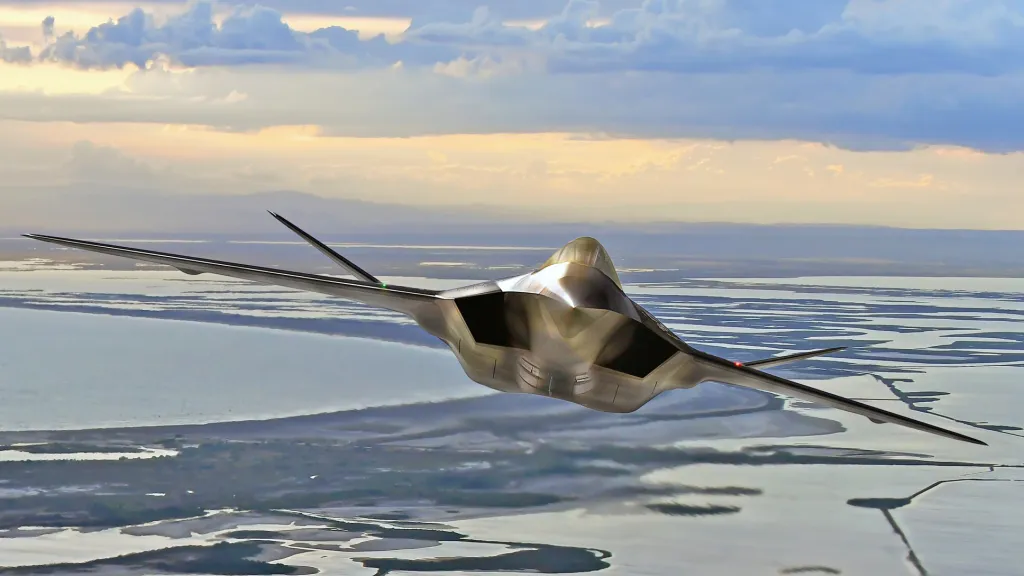
A 1:1 model of the Ravenstorm will be on display at ILA. The drone is approximately 43 feet long and has a wingspan of 33 feet. In terms of rough size and general appearance, the drone strongly recalls General Atomics’ YFQ-42A ‘fighter drone’ prototype, now flying under the first phase of the U.S. Air Force’s Collaborative Combat Aircraft (CCA) program. Like the U.S. drone, the Ravenstorm features a swept, mid-wing configuration optimized for stealth and maneuverability. It also has the same twin-tail configuration. Like the YFQ-42, the Ravenstorm has a dorsal inlet, although this is closer to that which appeared on the EADS Barracuda demonstrator that flew for the first time 20 years ago. The drone is clearly optimized with low-observable (stealthy) characteristics, although the inlet is notably large and lacks the trapezoidal shape found on the YFQ-42.
Ground crew working on the Barracuda technology demonstrator. Airbus
At the same time, it should be noted that, when it comes to combat drones in general, many of them take on a relatively familiar form driven by similar requirements.
Airbus describes the Ravenstorm as “the next evolution” in its “roadmap towards a scalable family of uncrewed collaborative combat aircraft.” It is not clear how many related designs might be planned, and in what kinds of sizes they may come, but the company has highlighted the kinds of missions they will be expected to fly. These include air-to-surface strikes using precision-guided munitions, air-to-air defense with long and medium-range air-to-air missiles, and electronic warfare for suppressing enemy air defenses. Further offensive counter-air missions will involve UCCAs providing non-kinetic jamming.
Ravenstorm will be available in the early 2030s, according to the manufacturer, which is, interestingly, offering the new design alongside a version of the XQ-58. In Airbus parlance, the Valkyrie is designated U740 and combines the Kratos-designed airframe with Airbus’ proprietary Multiplatform Autonomous Reconfigurable and Secure (MARS) Mission System.
A U.S. Air Force XQ-58A deploying an ALTIUS-600 UAV from a Common Launch Tube. U.S. Air Force
For the U740, Airbus provides a notably precise planned date of service entry: 2029, with the German Air Force. This would appear to reflect a specific Luftwaffe requirement for a drone in this class, although it remains unclear if the Valkyrie has been formally selected by the German military. Airbus furthermore expects the U740 to be used in operational experimentation teamed with the Luftwaffe’s Eurofighter combat jet, including demonstrating initial air-to-ground capabilities.
The U740 Valkyrie on its launcher. Airbus
Returning to MARS, this is Airbus’ sovereign mission system, consisting of an AI-supported software core to enable platform autonomy. The system is scalable so that it can be used across the entire Airbus drone portfolio. It is also planned for use on the U950 Eurodrone — the new designation for the Eurodrone MALE platform. This twin-turboprop drone is now in development for missions including ISTAR, early warning, and anti-submarine warfare, and is planned to make its first flight in 2029.
A rendering of the Eurodrone MALE conducting a maritime mission. Airbus
As for Airbus’s two-track approach to UCCAs — U740 Valkyrie and U760 Ravenstorm — the thinking behind the two offerings, also of broadly similar sizes, likely reflects different cost points. The Valkyrie was designed from the ground up as a lower-cost aircraft and is runway-independent in its original form (since then, Kratos has announced a version with wheeled landing gear and there also exists the ability to launch the Valkyrie from a wheeled launch trolley, if required). Meanwhile, the Ravenstorm appears to be a more capable and costly platform, making it a closer match to Increment 1, the first phase of the U.S. Air Force’s CCA program.
The Anduril YFQ-44, produced for Increment 1, the first phase of the U.S. Air Force’s CCA program. U.S. Air Force
It could be that the company has already identified specific national or service requirements (such as the Valkyrie for the Luftwaffe) that it aims to capitalize on. There could also be a plan to use the Valkyrie more for operational experimentation of the UCCA concept before focusing more on the fully sovereign Ravenstorm, including potentially scaling it up or incorporating other significant airframe changes — like higher performance, larger payload, improved low-observable characteristics.
Also unclear is the status of Airbus’s stealthy Wingman, a CCA-like concept that was unveiled at the last ILA Berlin airshow in 2024. This was also presented in the form of a 1:1 model, with a length of 51 feet and a wingspan of 39 feet. The drone was planned to be powered by the same Eurojet EJ200 turbofan as the Eurofighter, providing a proven powerplant and useful commonality.
The Airbus Wingman concept aircraft, which Airbus leadership said should provide a unit cost that’s equivalent to one-third that of a modern crewed fighter. Thomas Newdick
At the time, Airbus noted that the German Air Force had “expressed a clear need” for a drone that would be able to operate in conjunction with crewed fighters before the arrival in service of the NGF, which was then slated for some time in the 2040s.
Whether the Wingman has now been abandoned entirely is unclear, but the Luftwaffe still has a requirement for an uncrewed companion that can work alongside its forthcoming Eurofighter EK electronic warfare jets. This is a role for which Airbus is earmarking the Ravenstorm, in particular, although it should be noted that the U.S. Marine Corps is also focusing heavily on the electronic warfare mission for the Valkyrie drone.
A rendering of a Eurofighter EK for the German Air Force. Airbus
All of these Airbus efforts are being informed by experience testing the Barracuda, work on which began in 2003, initially as a ‘black program.’ After six test campaigns, the Barracuda was retired.
The company will also be leveraging prior work from the Airbus Low Observable UAV Testbed (LOUT) program. A stealthy demonstrator, LOUT was not flown but was run by the company in strict secrecy until finally it was publicly disclosed in 2019, as you can read about here.
A four-ton LOUT model used for aerodynamic and anechoic chamber testing. Airbus
Undoubtedly, the significance of Airbus’s new-look drone roster, and above all the appearance of the U760 Ravenstorm alongside the U740 Valkyrie, is greater now that the FCAS program’s crewed New Generation Fighter is seemingly defunct.
It was always anticipated that the NGF would be operated as part of a wider ecosystem that also included CCA-like drones — what Airbus now refers to as UCCAs. Indeed, there were already efforts in place to start integrating combat drones with crewed fourth-generation-plus fighters like the Eurofighter and Rafale. Now that FCAS, or at least the NGF component of it, has been thwarted, Ravenstorm and Valkyrie offer a glimpse of where Europe’s combat aviation ambitions may be headed instead.
Collaborative combat aircraft like these emerged as a higher-mass, force-multiplying capability for current and future crewed fighters. In the interim, at least, the demise of the NGF means that these kinds of combat drones could be in even greater demand within Europe, where there is already a pressing need for larger tactical air combat fleets, while resources are limited. At the same time, CCA-like drones promise to make existing fourth- and fifth-generation fighters even more potent, further driving demand both in Europe and elsewhere.
Estonia, the smallest of the Baltic states, has experienced some dramatic incidents.
In September, Tallinn said Russian MiG-31 fighter jets entered its airspace for 12 minutes. NATO scrambled Italian F-35s stationed in Estonia as part of the Baltic Air Policing mission. Russia denied violating Estonian airspace.
In March, a stray Ukrainian military drone crashed into Estonia’s Auvere power station.
In April and May, Estonian authorities said drones entered their airspace, grounding flights and prompting warnings issued to citizens.
Estonia’s intelligence services have said that the country does not believe Russia is preparing an imminent military attack on NATO, but that Moscow may be rebuilding its forces for the long term while engaging in hybrid attacks through drones, cyber operations, and sabotage.
Tallinn claims one such hybrid method is the so-called “Narva People’s Republic”, a pro-Russian separatist narrative that casts Estonia’s Russian-speaking border region as a distinct political entity, echoing the Donetsk and Luhansk “people’s republics” used by Moscow as a pretext for intervention in Ukraine.
Estonian authorities say it is part of a disinformation campaign rather than a credible separatist movement.
Its military has, at times, been bellicose in its statements.
In May, Estonia’s Lieutenant General Andrus Merilo argued that Russia is rebuilding its military much faster than many Europeans realise and that Estonia must be ready for a renewed military threat within the next few years, marking 2027 as a critical benchmark for readiness.
In September 2024, in an interview with the Estonian public broadcaster ERR, Estonian General Vahur Karus stated that if Moscow showed signs of preparing for an attack, Estonia could strike the Russians first.
“Our capability to neutralise the enemy on its own territory is crucial,” he said.
However, the government’s rhetoric has been more measured.
In April, Ukrainian President Volodomyr Zelenskyy suggested in an interview that a new wave of Russian mobilisation may be used to launch an attack on the Baltic states.
But Estonian politicians, including the foreign minister, warned that the remarks echoed Moscow’s objective of stoking fears and made cooperation difficult.
“We do not see Russia concentrating its forces or preparing in any way militarily to attack NATO or the Baltic states; rather, it is the opposite. Russia is not in a very strong position on the Ukrainian front, and economically as well,” Estonian Foreign Minister Margus Tsahkna told ERR.
“No one is in the streets panicking,” Tony Lawrence, a research fellow at the International Centre for Defence and Security in Tallinn, told Al Jazeera.
The air incursions have “put people on edge”, but there is a sense that Russian forces are too preoccupied in Ukraine, he said.
To learn more about this campaign, we reached out to one of the soldiers leading this effort from the unit that created it. In an exclusive interview, an Unmanned Systems Department Officer for the First Corps Azov of the National Guard of Ukraine offered us unique insights into how the program began, how it’s going, where it is headed and how AI is helping to identify and hit targets deep behind the lines. It’s a capability we described in great detail — about how it was rapidly gestating and would arrive on the battlefield around now. The officer spoke on condition of anonymity to discuss operational details.
Some of the questions and answers have been edited for clarity.
Azov patrols the border areas around Mariupol.
Ukrainian territory must be free of Russian forces. The surest path to achieving this is pushing the “sanitization zone” for enemy logistics closer to Russia itself and occupied Crimea.
— First Corps Azov of the National Guard of Ukraine (@azov_media) May 25, 2026
Q: Walk me through the genesis of the mid-range strike campaign.
A: I will first of all start with answering the question of why. So the reason why we are currently conducting this campaign is to hunt enemy logistics capabilities, and currently we have a lot of quite cheap assets that can strike enemy targets at quite a deep range. So the overall meaning, the overall sense of this campaign is to strike enemy concentrations of cargo in the places where this concentration is the highest and the protection of those enemy logistical assets is at the lowest level.
So, if we’re talking about enemy logistics very close to the front line, to the line of contact, we are mostly talking about a person with a backpack. Then, if we are moving deeper into the enemy controlled area, further from the front line, then we’re talking about cars. Then even deeper we’re talking about trucks. Even deeper we’re talking about long haulers with trailers, so a higher concentration of cargo. Even deeper into the enemy controlled area, we’re talking about the railroads, the trains that are carrying supplies. So the deeper we go from the line of contact, the higher is the concentration of enemy cargo.
Russian rail logistics are now also the target of Midstrike drones, with lines to Crimea being particularly affected. pic.twitter.com/K1BFd0QVov
The other part of answering this question is basically about how the enemy protects their logistical assets. So the deeper we go from the line of contact, not only is the distance larger, but also the areas that the enemy needs to protect. So just simple mathematical calculations show us that the distance of 50 kilometers deep from the line of contact is usually the most concentrated area the enemy has to defend against our strike assets. But if we go to the depths of 300 kilometers, then the areas that the enemy should protect are much larger, and it’s basically impossible to saturate that area with all the necessary protection assets that the enemy needs to strike down our drones.
The point I would like to make is that we conduct those strike operations at deeper ranges with basically the same assets that we use for the tactical depths, for example, at the depths of 50 kilometers. That means we do not increase the cost of our assets. We just introduced some technical modifications, and we can use the same assets to strike in the deep area.
How Ukraine Uses the US-made Hornet AI Strike Drone To Disrupt And Cut Russian Logistics Lines
Q: What drones are you using to carry out these attacks and how are you increasing the ranges?
A: Basically, we’re using fixed-wing kamikaze drones with some modifications in terms of communication systems. We’ve installed Starlink systems on those drones, and we have also introduced a number of modifications in terms of the engine of the drones – in terms of the overall propelling unit. And this allowed us to increase the range of the assets that we used previously for the range up to 50 kilometers, with some modifications for longer distances.
Q: What kinds of drones are you using?
A: Just the simple fixed-wing chemical drones, such as Hornet systems, such as the Darts systems, and also some other assets that, for now, we prefer not to mention.
Darts
Q: Can you provide additional details about the modifications you have made to these drones and what is their maximum range?
A: Well, I would say that these are quite technical things, and I wouldn’t want to disclose those, because I would want to avoid the situation where the enemy is going to do the same modifications.
Q: Are you reaching as far as 100 kilometers?
A: From what we can say now, we can cover distances of up to 250 kilometers, but as you might understand, with time we will cover longer and longer distances.
Q: Can you describe how these attacks work? Do you operate these as first-person view drones through a video feed? Do they have a terminal seeker?
A: The process is really simple. So, for example, we select a section of the road, or the road as a whole and we distribute that road or the sections among our units. And I would like to mention that this is an all Ukrainian operation. It’s not a task for just one single unit, and basically each unit has its own area of responsibility and its own section of the road.
And then we just send drones there in hunting mode, and I cannot disclose how this works from the standpoint of intelligence, but the overall principle is that the intelligence just gives us the priorities for the targets. For example, they say that you need to target this type of vehicle with these types of cargo.
And in terms of the targeting, I remember that you were also asking the question about how the targets are selected. For this we use both the AI tools and also the operator himself, so we’re using both methods for that.
Q: I want to get back to AI in a bit, but what area of operations do you cover?
A: Our area of interest and area of responsibility is related to all the roads that the enemy is using to bring in supplies to the area of operations of our corps, which is roughly in the area of the town of Dobropillia in eastern Ukraine, and for example, this may be the route from Rostov that goes to Mariupol and then goes to Donetsk, and this could be any other route that the enemy might use to bring military cargo to the area of operations of our corps.
First Corps Azov works in and around the area of Dobropillia in the Donetsk region of Eastern Ukraine. (Google Earth)
Q: What were some of the more successful mid-range drone strike missions you carried out?
A: That’s basically an easy principle. When I said that we are hunting the enemy’s logistics, I mean that this is a daily process. This is a continuous process, and this is not about one standalone mission, when we fly somewhere, when we hit a target and the mission is over.
Last night, Ukraine expanded its mid-range strike campaign to the Sea of Azov, hitting at least 5 vessels carrying Russian cargo.
At least two of the cargo vessels were hit at the occupied ports of Berdyansk and Mariupol, as Ukrainian forces seek to cut off Russian logistics. pic.twitter.com/NoXeAO7Ca6
Q: How are these mid-range strikes on Russian logistics affecting their ability to fight?
A: This is causing shortages of fuel for the enemy. This was already commented on by our media, and also the media resources of the enemy, and now we understand that this is true, not only for Crimea, where there is a severe shortage of fuel now, but also this is true about the other Russian-controlled territories. And basically, when we are striking enemy logistical supplies of fuel, this affects the overall situation, because what is fuel? Fuel is basically the blood of war, which is necessary to fuel the generators that the enemy is using for the FPV operations. The fuel is used for the vehicles that basically bring in those FPVs to the combat zone.
I’d like to add an additional explanation of how this works. If we destroy a car that brings fuel to the line of contact, then we’re talking about destroying like two canisters, so that’s approximately 40 liters of fuel. But if we strike a fuel tank and a tank vehicle, which is bringing fuel to the overall area, so then we can talk about several tons of materials.
Gas stations across Russian-occupied Crimea are facing worsening fuel shortages, with long queues, rationing, and voucher-based distribution reported by residents. Some locals say fuel has become so scarce that it is treated as a luxury, while Moscow insists there is no cause for… pic.twitter.com/0LSYWEqiDH
— Radio Free Europe/Radio Liberty (@RFERL) June 5, 2026
Q: Is this setting the stage for a Ukrainian advance in the east or Zaporizhia?
A: I would say that blocking the logistical supplies to the Zaporizhia Oblast and also to Crimea is a byproduct of our attacks aimed at cutting enemy logistics to our area of operations. Because we’re targeting the roads that go through Mariupol, also to Crimea, to supply the Zaporizhia region, and as well our area of operations. But as for the most strategic aspect of this question of whether this might influence some counter-offensive capabilities of the Ukrainian Defense Forces, I think that is not the question within my scope of responsibility, because I’m an officer responsible for the UAS component of the corps, and I think that this is more of a question that should be directed to the general staff of the Armed Forces of Ukraine.
Ukraine 🇺🇦 continues to launch an important number of mid-range strike, targeting Russian 🇷🇺 logistics in occupied territories
Since early may, more than 270 trucks have been hit, together with multiple fuel depots and trains.
Q: Tell me how you came to use the U.S.-made Hornet drones.
A: I would say that this is also a question that should be directed at one level up from my level. We get those drones, we deploy those drones, but the questions of how we get them and what are the specifics of their supply, this is not a question that I can answer.
A U.S.-made Hornet drone. (U.S. Army photo by Spc. Thomas Dixon) Spc. Thomas Dixon
Q: When did you start getting them?
A: We have been receiving these drones for almost a year.
Q: When you got the Hornet drones, were you given any instructions on what missions to accomplish with them or what targets to pursue?
A: I think that the principle thing to explain here is that the Hornet drone is a tactical level UAV system. It can be used at the maximum range of 50 kilometers – the maximum range of the basic configuration of this drone. The drones we are currently using are the modification of the Hornet drone, but the basic configuration of this drone is only a tactical-level UAV. This is why our mid-strike operations, which have started only recently, are using modified drones.
I think that it is important to add that these modifications are conducted by the units themselves.
The First Corps Azov of the National Guard of Ukraine maintains control over enemy logistics near Donetsk.
Strike UAV pilots are targeting Russian logistics deep in the operational rear. Drone units maintain constant surveillance and fire control over all supply routes around… pic.twitter.com/i4TYOWJBg4
— First Corps Azov of the National Guard of Ukraine (@azov_media) April 16, 2026
Q: When did you begin to make the modifications and was the mid-range strike concept something that Azov developed?
A: Yeah, I would say that basically that was Azov development. So the first tests of these new modifications started in early winter. After approximately a month of testing, we started combat deployment of those drones approximately in January or February of this year. And we use those new modifications to ensure our middle strike operations. In terms of the tactics, I would also like to say that Azov developed new tactics of the deployment of middle strike drones, because the previous tactics they were mostly concentrated on the use of very expensive assets, which are available in limited numbers, so the targeting cycle was different, which is why we needed to develop new tactics and change this targeting cycle.
Q: What systems were you using before that were so expensive?
A: Well I’m not really talking about some specific assets here. I’m mostly talking about the overall tactics and the targeting cycle. So, the tactics of middle strikes were developed for expensive assets that the Corps didn’t have at the moment. So, this is basically why we started developing our own assets that could ensure that we have those middle strike capabilities, and we can also engage targets at the operational level.
Magyar claims a reduction from 3,800 cargo journeys to 1,100 cargo journey (71.05%) along the E-58 Mariupol -Berdiansk – Melitopol – Simferopol highway in the past two weeks
— Ukraine Control Map (@UAControlMap) June 9, 2026
Q: When you added Starlink, did you have to seek permission from SpaceX to use their system for these weapons?
A: The first thing that I would like to say is that we do not use only Starlink. It is just one of the possible communication systems and communication solutions that we’re using. And the second thing that I would like to add is that all the international issues, international cooperation questions, are the issues that should be dealt with at the level of our ministries and at the level of our central government, so once again, this is not a question that I can answer.
Una parte vital de la efectividad de los drones Hornet con los que Ucrania está atacando las rutas logísticas rusas entre 80 y 120km del frente es la recopilacion de datos para que el algoritmo aprenda. Por eso algunos modelos llevan grandes terminales Starlink. https://t.co/yGePjoPo2Kpic.twitter.com/iWu2bLrwq5
Q: Can you tell me what other communications systems you use?
A: No, this information is still secret, because none of those assets have been taken by the enemy, so the enemy doesn’t know yet that we’re using those. But I think that in some time we will be able to go public with those assets and tell more about what we use, apart from Starlink.
Q: Are you using Starlink and the other systems on the Darts drones as well, or just Hornet?
A: Yes, we are using Darts for those middle strike attacks. So, basically, the overall tactics of those mid-strike attacks with small UAV systems, it can use any fixed wing kamikaze drones with modifications which is why we are using Hornets, we are using Darts and also the other types of drones.
While the Ukrainian “Hornet” strike UAV is receiving a lot of attention recently, the “Darts” UAV remains a workhorse for mid-range strike. It, too, has AI terminal targeting and control capabilities to defeat Russian jamming. https://t.co/cNcQytap1Dpic.twitter.com/C8nYJ20Uer
A: Unfortunately, no. The enemy has not yet got hold of those assets, and if one of them will be shot down, or if one of them will be captured by the enemy, then I think that we will be able to go public with those assets.
Q: Can you talk more about how you are using AI for the Hornets and Darts?
A: The AI is used for the so-called last-mile system. I’m talking about the terminal guidance here, and also the AI can also be used to identify the targets, especially when the drone is flying in the autonomous mode. It can recognize the type of the target and it can automatically engage the target. So all of these processes can happen without the involvement of the operator. This allows us to launch several drones at the same time, and this also allows us to ensure a higher level of coordination for those attacks.
I think that one of the examples of these attacks was captured by one of our videos that you might have seen when one fixed-wing drone is observing the target and the other drone is actually hitting it.
1-й корпус НГУ «Азов» контролює ворожу логістику під Донецьком. Знищення російської техніки
Q: Is there a man in the loop or a man on the loop during the terminal phase of the attack or is it fully autonomous?
A: Since we are trying to control the whole process, usually it is the person who takes the final decision and actually makes this decision to strike the target, because we do not want to over rely on the artificial intelligence. If necessary, this whole process can also happen without human involvement, but as I have already mentioned, our policy is that the decision should be made exclusively by the operator.
Q: So this is man in the loop?
A: Yes, so technically men can be out of this loop, but in our case we involve humans in this system, so that’s man in the loop.
Visual look of Hornet UI. Not much new, can mark soldiers individually. Seems aiming is done by either by lock a target (red) or manually aiming by continusly clicking (green) https://t.co/d2LGtV2aON
Q: Have the Russians developed countermeasures for this effort?
A: Since the overall intent was to go to the massive deployment of those drones against the enemy logistics at once, as for now, the enemy has not yet had enough time to adapt to these tactics of ours. And now they’re desperately trying to find some countermeasures to find some ways to react to this.
Images showing unusually painted Russian trucks have appeared on social media channels in recent days with a paint scheme designed to throw off Ukraine’s AI-assisted mid-range strike drones. (Via X) via X
They are putting on anti-drone nets deep into their controlled territory. They are placing people armed with shotguns every 50 meters of their critical roads, but basically, as for now, there is no Russian tactic that would be effective in protecting their logistics. I do not say that they will not come up with this tactic in a month or so, but as for now, they do not have an effective countermeasure for that.
The only thing that I would like to add is that we approximately know the direction in which the enemy is moving to ensure counter measures to this tactic of ours, and we already have countermeasures for their countermeasures.
The current Ukrainian superiority in mid-range drone warfare is a brilliant advantage that comes with an expiration date.
Failing to prepare for the day Russia matches this capability guarantees a catastrophic collapse of front line logistics for Ukraine.
Q: Is the AI enhancement helping to mitigate Russian jamming and electronic warfare measures?
A: Well, I would like to say that EW is not the only way to counter UAVs. So, in addition to EW assets, there are other counter drone methods. Nets can be used. Air observation posts can be used. The drones can be shot down with enemy interceptor drones, and also there are hundreds and hundreds of people armed with shotguns who can also try to shoot the drones down. So the EW systems are just a small part of this overall system of drone countermeasures, and it is a general misconception that all anti-drone efforts are from the EW system. I would say that EW accounts for approximately 10% of overall counter drone efforts.
The main idea of the use of the AI systems is not only to help operators to counter enemy drone countermeasures, but the AI also helps the operator with navigation, with orientation, with the identification of the targets. So this is a complex system that helps the operator with many tasks.
Here: strike by the Ukrainian-American “Hornet” drone on occupier positions. Two Russians confirmed as “gruz 200” (KIA). Interestingly, the Russians call this drone “Martian-2” because its capabilities seem “out of this world” to them.
Q: What are the lessons that the U.S. can learn from your mid-range drone strike campaign, given the importance of logistics everywhere.
A: Well, I would say that the main lesson that the U.S. can learn from our experience is that drones in their basic configuration, right out of the box, is not something that can work, and this is not something that can bring you the best results at once. This is why every unit should have their own drone laboratory that can reconfigure those drones and modify them, and I’m not only talking about reconfiguring tactical level drones to turn them into middle strike capacities. I’m talking about all warfare in general.
U.S. soldier Sgt. Kevin Tran, assigned to 173rd Airborne Brigade, sets up a one-way attack Hornet drone during a demonstration in the 7th Army Training Command’s Grafenwoehr Training Area, Germany, March 25, 2026. The demonstration provided leaders with insight into how AI-enabled one-way attack systems operate alongside Army fires formations. (U.S. Army photo by Spc. Thomas Dixon) Spc. Thomas Dixon
Assets become obsolete very quickly and in three months everything can change, starting from the navigation systems and ending with the control systems. For example, today the GPS signal works, in a month it doesn’t work anymore. Today we use this set of frequency ranges, and in a month all those frequency ranges are jammed by the enemy. So I’m saying this for you to understand that for example, if the U.S. government purchases Hornet drones for their units, then the units are going to have good tactical level drones. But if you want to squeeze all of the possible benefits from those drones, then you will need to modify the structure of your units and include the departments, include the sections that will deal with the modification and reconfiguration of those drones to ensure the most efficient results that can be achieved.
From what I see now, the U.S. is mostly just giving the unit some assets, but they are not thinking about re-configuring or repurposing those drones.
Q: Is there anything I haven’t asked you that you would like to address?
A: I think that we have covered all the topics. The only thing that I would like to add is that I would like your audience to see that Ukraine introduces new innovations that can basically change the battlefield, and this is why trying to forecast the outcome of the war based on the number of tanks or aircraft or bombs that would be incorrect, so the victory will belong to the side capable of adapting faster and not to the side that has more resources.
Weekly insights and analysis on the latest developments in military technology, strategy, and foreign policy.
U.S. Central Command (CENTCOM) has confirmed a Saronic Corsair was the uncrewed surface vessel (USV) that rescued the crew of a U.S. Army AH-64 Apache out of the Gulf of Oman overnight. President Donald Trump has also now said Iranian forces downed the attack helicopter, and promised a response. This is the first known instance of a drone boat being used to recover personnel as part of a search and rescue mission, and has major implications for these operations going forward. Readers can otherwise get up to speed on what is already known about this incident in our initial reporting here.
“The surface drone that assisted in last night’s rescue of the Apache crew off the coast of Oman was a U.S. Navy Corsair unmanned surface vessel operated by U.S. 5th Fleet’s Task Force 59,” U.S. Navy Capt. Tim Hawkins, a CENTCOM spokesman, told TWZ. “The task force began fielding these drones in theater in late March.”
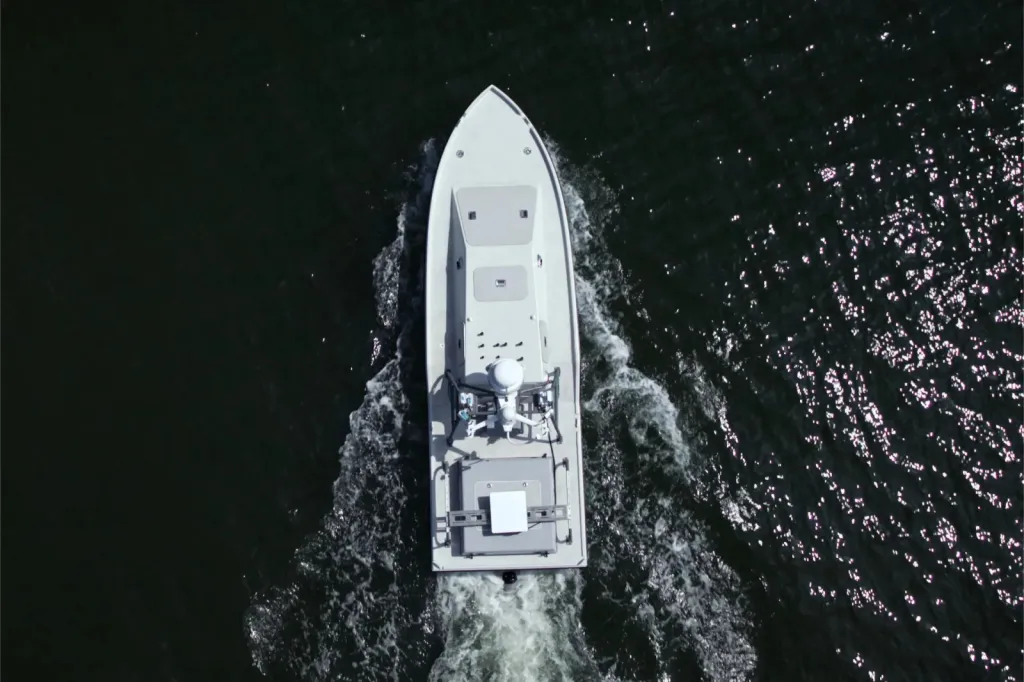
A top-down look at a Saronic Corsair USV. Saronic
The Navy confirmed last December that it had signed an Other Transaction Authority (OTA) deal with Saronic, valued at $392 million, for the production of Corsair USVs. The Corsair, which the manufacturer also calls an autonomous surface vessel (ASV), is a 24-foot-long drone boat with a speedboat-like design that was first unveiled in 2024. The manufacturer says it has a maximum range of 1,000 nautical miles, a top speed of 35 knots, and a 1,000-pound payload capacity.
Prototype to production in under 12 months. The @Saronic OTA proves how we’ll build a hybrid manned–unmanned Fleet: open competition, real contracts, real hardware for Sailors and Marines not slides. This is now the standard. pic.twitter.com/cC9DG7jTiW
— Archive: Secretary of the Navy John C. Phelan (@SecNavPhelan) December 8, 2025
The Corsair “picked them [the Apache crew] up and transported them to another location on the water where they were then hoisted up to a helicopter for further transport,” Capt. Hawkins, the CENTCOM spokesperson, added.
CENTCOM had already confirmed to TWZ and others that an unspecified USV found and rescued the two aircrew from the downed Apache. The Wall Street Journal was first to report the specific type of drone boat employed.
The Army aviators spent approximately two hours in the water before being recovered safely, according to a previous CENTCOM statement. As mentioned, President Donald Trump has also now separately said that Iranian forces were responsible for bringing down the Apache, and that a U.S. response will be forthcoming.
Trump says that Iranian forces shot down the Army AH-64 Apache attack helicopter that went down over Hormuz yesterday.
Since its establishment in 2021, the Navy’s Task Force 59 has been charged with helping expand the service’s operational use of uncrewed platforms, as well as artificial intelligence (AI) and machine learning-driven capabilities, across the Middle East. It has operated an array of different types of USVs, as well as uncrewed aerial systems, over the years.
How many Corsairs Task Force 59 has currently, as well as their exact configuration, is unclear. Pictures and videos that Saronic has released to date have shown Corsairs fitted out primarily for surveillance and reconnaissance missions, with a camera turret on top of a central mast-like frame. A commercial navigation radar, additional cameras to help provide extra situational awareness, and various other antennas have also been seen fitted to that frame. Saronic has talked about integrating other capabilities to enable additional mission sets, including launchers for loitering munitions, in the past.
A picture showing the most typical configuration of the Corsair USV that has been seen to date. Saronic
Saronic also says Corsair has a high degree of autonomy, with the type having logged more than 100,000 nautical miles of total travel to date, including multi-day missions. The SUV is designed to be employed independently or in networked swarms, according to the company. Human operators are in the loop during these operations via datalink.
Corsair, our 24ft Autonomous Surface Vessel (ASV), has officially crossed 100,000 nautical miles traveled — that’s nearly five times around the Earth or almost halfway to the Moon!
This milestone represents more than distance. It reflects relentless testing across diverse… pic.twitter.com/opXtX6jSfO
“Corsair can be given a mission, alone or as part of a collaborative swarm, and execute with minimal human interaction to deter or counter adversarial threats at a range of 1,000 nautical miles,” Saronic said in a press release back in 2024. “Employing redundant communications and passive perception capabilities, Corsair can autonomously identify, track, follow, and intercept targets in contested and communications denied environments.”
These are all capabilities well suited to the U.S. Navy’s immediate needs in the Middle East, especially in support of the current blockade of Iranian ports. Corsair would notably offer a lower-risk way to closely shadow vessels that might be attempting a run into or out of the area. Corsair’s ability to automatically spot and track objects of interest would have helped in finding and rescuing the downed Apache crew, too. It is worth noting here that automated target detection is also a key part of Corsair’s ability to safely navigate autonomously, day or night, especially in congested waterways, as seen in the video below.
In 2025, we logged more than 79,000 nautical miles and over 15,000 hours of total operations with Corsair, our 24-ft ASV. Much of this was done on our own dime, operating 6 days a week at our test sites on the West Coast, East Coast, Gulf Coast, and beyond, allowing us to… pic.twitter.com/PZETeJia17
Corsair’s overall performance in the Middle East could easily translate to further operational use of this USV by the Navy globally. The service has particularly significant demands for persistent maritime surveillance and reconnaissance capacity, as well as just general presence, across the broad expanses of the Pacific. One of the key benefits that USVs offer is the ability to provide additional distributed ‘mass’ at relatively low cost. This can help bolster the capabilities of crewed platforms they are networked together with or just ease the operational strain on those assets.
The Navy has now also clearly demonstrated how valuable USVs could be in future maritime search-and-rescue operations worldwide. This, in turn, underscores the benefits uncrewed platforms bring to these missions, especially in the face of growing anti-air and other threats.
As we already wrote today:
“As TWZ regularly highlights, search and rescue operations present inherent complexities and risks, especially when conducted in or near hostile territory. The F-15E rescue effort in Iran put a particular spotlight on the immense risks that combat search and rescue (CSAR) forces take, with helicopters and C-130 variants sent into areas where even a high-end fighter aircraft didn’t survive.”
“Open-water recoveries can present distinct additional challenges. There is always the possibility of the loss of additional assets and personnel in the process, no matter where a CSAR mission occurs.”
US Air Force HH-60W Jolly Green II search-and-rescue helicopters refuel from an HC-130J Combat King II aircraft. USAF
“The use of a Navy drone boat in the rescue overnight highlights a new dimension for maritime CSAR going forward. These uncrewed assets can be more readily pre-positioned in a distributed manner. For example, in the broad expanse of the Pacific, USVs could be forward-deployed at multiple points along certain flight paths for this exact purpose. USVs could offer other distinct advantages in certain scenarios where they might be able to get into areas where traditional assets cannot and without risking additional personnel. These realities extend well beyond the maritime domain, and we are only likely to see uncrewed platforms of all kinds increasingly taking part in rescue efforts, especially in denied areas. The U.S. military is coming to terms with just how vulnerable their CSAR assets are and the ranges that would be needed to access highly defended areas, especially during a peer fight. Using drones to execute personnel recovery is being viewed as one part of a larger set of solutions to this pressing problem.“
The additional detail we have now that the Corsair USV brought the downed aircraft to a territorial location, where they were then hoisted into a helicopter, is notable, too. This further shows how uncrewed platforms could be used as part of a distributed hub-and-spoke-style concept of operations for future rescue missions, which could increase flexibility and total area covered. USVs could be used to penetrate into especially high-threat areas, recover personnel, and then bring them to crewed assets at safer locations to the rear, as well.
“When it comes to search and rescue, you utilize the best asset that is the closest and the quickest, and that was the case in this instance,” CENTCOM’s Hawkins also told The Wall Street Journal today. “We’ve practiced this scenario in exercises, but not quite necessarily like this.”
The first Marauder prototype seen being launched earlier this year. Saronic
The Navy is already set to evaluate Marauder, as well as designs from six other companies, as part of the first round of prototyping under its latest Medium Unmanned Surface Vessel (MUSV) effort. This is part of a larger strategy the service rolled out in March to try to field more USVs and do so faster, as you can read more about here.
In the meantime, Saronic’s Corsair is already being employed operationally in the Middle East and demonstrating its ability to perform complex missions.
Weekly insights and analysis on the latest developments in military technology, strategy, and foreign policy.
A U.S. Navy uncrewed surface vessel (USV) found and rescued the crew of a U.S. Army Apache that went down overnight near the Strait of Hormuz, in the Gulf of Oman. This is the first known use of a drone boat executing a personnel recovery action as part of a military search and rescue operation, and it’s likely a glimpse of what’s to come. The cause of the incident is otherwise under investigation.
Navy Capt. Tim Hawkins, a U.S. Central Command (CENTCOM) spokesman, has confirmed the use of the Navy USV in the rescue effort to TWZ. This had already been hinted at by mention of Task Force 59, the Navy’s main drone force in the Middle East, in an official CENTCOM statement. What specific type of drone boat was utilized in this case is not yet known. Task Force 59 operates a variety of USVs, including speedboat-like types. The Task Force has been experimenting with all types of new uncrewed naval technologies and this rescue is clearly a major win for the forward-looking unit.
One of several types of speedboat-type USVs Task Force 59 operates, seen here during an exercise. USN
“At 7:33 p.m. ET on June 8, two crew members from a U.S. Army AH-64 Apache were rescued by American forces after their helicopter went down near the coast of Oman while patrolling regional waters,” per CENTCOM’s statement. “The Soldiers were safely rescued within approximately two hours and are in stable condition. The cause of the incident is under investigation.”
“Rescue efforts were led by U.S. Naval Forces Central Command and the 82nd Airborne Division, with support from U.S. Air Force and Navy units including U.S. 5th Fleet’s Task Force 59,” the statement added.
A flight of U.S. Army AH-64 Apache attack helicopters, armed with rockets and Hellfire missiles, taxi out to conduct a scheduled flight in the U.S. Central Command area of responsibility. In addition to rockets and missiles, the Apache is additionally armed with a 30mm chain gun. (U.S. Army photo) U.S. Army Central
The New York Times was first to report that an Apache had gone down near the Strait of Hormuz. President Donald Trump had also confirmed the crew was safe while speaking to reporters earlier this morning.
“We are going to issue a report tomorrow, but the pilots are fine,” Trump said after returning to Washington from the NBA Finals in New York.
A US Army Apache helicopter went down near the Strait of Hormuz and it wasn’t clear if the aircraft suffered mechanical troubles or had been shot down by Iran, the New York Times reported.
Asked about the episode by @jendlouhyhc, Trump said the pilots were fine and that a report…
As we have reported in the past, Army AH-64s have been part of an effort by the U.S. military to enforce the ongoing blockade of Iran and protect commercial shipping. Last month, Apaches and U.S. Navy MH-60 Seahawk helicopters destroyed six small Iranian boats that were threatening commercial ships in and around the Strait of Hormuz, according to Navy Adm. Brad Cooper, head of CENTCOM. Apaches had already been conducting missions targeting Iranian naval assets in and around the Strait of Hormuz before the announcement of the ceasefire in April. All of this has shown that armed helicopters remain important assets in maritime operations, especially for defending against swarms of small boats.
As TWZ regularly highlights, search and rescue operations present inherent complexities and risks, especially when conducted in or near hostile territory. The F-15E rescue effort in Iran put a particular spotlight on the immense risks that combat search and rescue (CSAR) forces take, with helicopters and C-130 variants sent into areas where even a high-end fighter aircraft didn’t survive.
Open-water recoveries can present distinct additional challenges. There is always the possibility of the loss of additional assets and personnel in the process, no matter where a CSAR mission occurs.
HH-60Ws refuel from an HH-130J. (USAF)
The use of Navy drone boat in the rescue overnight highlights a new dimension for maritime CSAR going forward. These uncrewed assets can be more readily pre-positioned in a distributed manner. For example, in the broad expanse of the Pacific, USVs could be forward-deployed at multiple points along certain flight paths for this exact purpose. USVs could offer other distinct advantages in certain scenarios where they might be able to get into areas where traditional assets cannot and without risking additional personnel. These realities extend well beyond the maritime domain, and we are only likely to see uncrewed platforms of all kinds increasingly taking part in rescue efforts, especially in denied areas. The U.S. military is coming to terms with just how vulnerable their CSAR assets are and the ranges that would be needed to access highly defended areas, especially during a peer fight. Using drones to execute personnel recovery is being viewed as one part of a larger set of solutions to this pressing problem.
With the Apache going down near the Strait of Hormuz, the U.S. military has now lost at least seven crewed fixed-wing aircraft and helicopters since the start of the latest operations against Iran in February. In addition, several aircraft have been damaged in the air and on the ground, including by Iranian fire. The TWZ graphic below offers a visual tally of damaged and destroyed aircraft as of April 10.
TWZ
Despite the loss of the Apache, the use of a USV in the rescue effort is a major development and a sign of things to come.
Weekly insights and analysis on the latest developments in military technology, strategy, and foreign policy.
A U.S. Navy uncrewed surface vessel (USV) found and rescued the crew of a U.S. Army Apache that went down overnight near the Strait of Hormuz, in the Gulf of Oman. This is the first known use of a drone boat executing a personnel recovery action as part of a military search and rescue operation, and it’s likely a glimpse of what’s to come. The cause of the incident is otherwise under investigation.
Navy Capt. Tim Hawkins, a U.S. Central Command (CENTCOM) spokesman, has confirmed the use of the Navy USV in the rescue effort to TWZ. This had already been hinted at by mention of Task Force 59, the Navy’s main drone force in the Middle East, in an official CENTCOM statement. What specific type of drone boat was utilized in this case is not yet known. Task Force 59 operates a variety of USVs, including speedboat-like types. The Task Force has been experimenting with all types of new uncrewed naval technologies and this rescue is clearly a major win for the forward-looking unit.
One of several types of speedboat-type USVs Task Force 59 operates, seen here during an exercise. USN
“At 7:33 p.m. ET on June 8, two crew members from a U.S. Army AH-64 Apache were rescued by American forces after their helicopter went down near the coast of Oman while patrolling regional waters,” per CENTCOM’s statement. “The Soldiers were safely rescued within approximately two hours and are in stable condition. The cause of the incident is under investigation.”
“Rescue efforts were led by U.S. Naval Forces Central Command and the 82nd Airborne Division, with support from U.S. Air Force and Navy units including U.S. 5th Fleet’s Task Force 59,” the statement added.
A flight of U.S. Army AH-64 Apache attack helicopters, armed with rockets and Hellfire missiles, taxi out to conduct a scheduled flight in the U.S. Central Command area of responsibility. In addition to rockets and missiles, the Apache is additionally armed with a 30mm chain gun. (U.S. Army photo) U.S. Army Central
The New York Times was first to report that an Apache had gone down near the Strait of Hormuz. President Donald Trump had also confirmed the crew was safe while speaking to reporters earlier this morning.
“We are going to issue a report tomorrow, but the pilots are fine,” Trump said after returning to Washington from the NBA Finals in New York.
A US Army Apache helicopter went down near the Strait of Hormuz and it wasn’t clear if the aircraft suffered mechanical troubles or had been shot down by Iran, the New York Times reported.
Asked about the episode by @jendlouhyhc, Trump said the pilots were fine and that a report…
As we have reported in the past, Army AH-64s have been part of an effort by the U.S. military to enforce the ongoing blockade of Iran and protect commercial shipping. Last month, Apaches and U.S. Navy MH-60 Seahawk helicopters destroyed six small Iranian boats that were threatening commercial ships in and around the Strait of Hormuz, according to Navy Adm. Brad Cooper, head of CENTCOM. Apaches had already been conducting missions targeting Iranian naval assets in and around the Strait of Hormuz before the announcement of the ceasefire in April. All of this has shown that armed helicopters remain important assets in maritime operations, especially for defending against swarms of small boats.
As TWZ regularly highlights, search and rescue operations present inherent complexities and risks, especially when conducted in or near hostile territory. The F-15E rescue effort in Iran put a particular spotlight on the immense risks that combat search and rescue (CSAR) forces take, with helicopters and C-130 variants sent into areas where even a high-end fighter aircraft didn’t survive.
Open-water recoveries can present distinct additional challenges. There is always the possibility of the loss of additional assets and personnel in the process, no matter where a CSAR mission occurs.
HH-60Ws refuel from an HH-130J. (USAF)
The use of Navy drone boat in the rescue overnight highlights a new dimension for maritime CSAR going forward. These uncrewed assets can be more readily pre-positioned in a distributed manner. For example, in the broad expanse of the Pacific, USVs could be forward-deployed at multiple points along certain flight paths for this exact purpose. USVs could offer other distinct advantages in certain scenarios where they might be able to get into areas where traditional assets cannot and without risking additional personnel. These realities extend well beyond the maritime domain, and we are only likely to see uncrewed platforms of all kinds increasingly taking part in rescue efforts, especially in denied areas. The U.S. military is coming to terms with just how vulnerable their CSAR assets are and the ranges that would be needed to access highly defended areas, especially during a peer fight. Using drones to execute personnel recovery is being viewed as one part of a larger set of solutions to this pressing problem.
With the Apache going down near the Strait of Hormuz, the U.S. military has now lost at least seven crewed fixed-wing aircraft and helicopters since the start of the latest operations against Iran in February. In addition, several aircraft have been damaged in the air and on the ground, including by Iranian fire. The TWZ graphic below offers a visual tally of damaged and destroyed aircraft as of April 10.
TWZ
Despite the loss of the Apache, the use of a USV in the rescue effort is a major development and a sign of things to come.
The drone entered Latvian airspace due to ‘Russian electronic warfare’, the military says.
Published On 8 Jun 20268 Jun 2026
NATO fighters have scrambled to shoot down a drone that entered Latvian airspace from Russia.
The Latvian military said on Monday that French aircraft had destroyed “a foreign unmanned aerial vehicle that had entered Latvian airspace as a result of Russian electronic warfare”, without saying where the drone originated.
Recommended Stories
list of 4 itemsend of list
The incident adds a growing list of incursions from the Russia-Ukraine war into neighbouring countries that are part of the NATO alliance, sparking fears of escalating spillover effects as Moscow’s siege on Ukraine continues apace.
“Thank you to our French allies for shooting down the drone that penetrated Latvian airspace!” Riga’s Foreign Minister Baiba Braze wrote on social media.
Latvian Prime Minister Andris Kulbergs heralded the “swift decision-making and professional action”.
Defence Minister Raivis Melnis told reporters the drone was shot down just after 9am local time (07:00 GMT) near the village of Berzgale, located about 30km (18 miles) from the Russian border. No one was hurt, and no property was damaged, Melnis said.
The French military said in a statement that the jets took off from Siauliai airbase in northern Lithuania and destroyed the drone “over an uninhabited area”.
It added that the incident demonstrated France’s “commitment to contributing to the security of Europe’s eastern flank”.
Authorities had previously warned residents in some parts of eastern Latvia to shelter in place because of the threat.
Ongoing threat
Countries in the region have reported repeated drone incursions from air and sea in recent months, spawning concerns over the widening impact of Russia’s war on Ukraine.
The issue has raised the political pressure in Latvia, leading to the resignation of Prime Minister Evika Silina last month.
The increased frequency of the reports comes as Ukraine has increased its attacks on Russia, with Moscow deflecting drones using electronic jamming. The statement from the Latvian military regarding “Russian electronic warfare” appears to suggest the drone shot down likely came from Ukraine.
Fragments of a Ukrainian drone were also found in a field in Moldova on Monday after it entered from Ukraine, an incident that officials also blamed on Moscow.
Last week, a maritime drone exploded in Romania’s Constanta port. Kyiv later confirmed it involved a Ukrainian drone that was knocked off course by Russian electronic interference.
However, it was a Russian drone that hit an apartment building in eastern Romania in late May, injuring two people and prompting Bucharest to call for NATO to speed up the transfer of anti-drone capabilities.
European Commission President Ursula von der Leyen warned after that crash that Russia’s war on Ukraine is “increasingly becoming a direct threat to countries on our Eastern border” and said solidarity with them was “absolute”.
The French military jet that shot down Monday’s drone is part of the NATO Baltic Air Policing mission, which has patrolled the skies of Latvia, Lithuania and Estonia since they became part of NATO in 2004.
Weekly insights and analysis on the latest developments in military technology, strategy, and foreign policy.
Footage has emerged showing the destruction of a drone by a French Rafale fighter over Latvia earlier today. The engagement underscores how the drone war unleashed by the Russian invasion of Ukraine is increasingly spilling over borders, as well as the growing reality of the drone threat to NATO.
The French Air and Space Force confirmed that its Rafales, currently deployed in neighboring Lithuania, were scrambled in response to the drone incursion. The drone was identified before one of the fighters shot it down over an uninhabited area. The incident was a “demonstration of the French Armed Forces’ commitment to contributing to the security of Europe’s eastern flank,” the service said in a statement on X.
📍Lettonie | Destruction d’un drone par les Rafale 🇫🇷💥
➡️ Survol d’un drone au dessus du territoire letton 🇱🇻 ➡️ Décollage sur alerte des chasseurs 🇫🇷 engagés dans la mission de l’OTAN Baltic Air Policing depuis la base aérienne de Šiauliai 🇱🇹 ➡️ Identification et destruction… pic.twitter.com/NFIMSP7Ibl
— Armée française – Opérations militaires (@EtatMajorFR) June 8, 2026
A detachment of French Air and Space Force Rafale jets is currently engaged in the NATO Baltic Air Policing mission from Šiauliai Air Base, Lithuania.
This morning, French fighter jets deployed to NATO Air Policing at Šiauliai Air Base shot down a drone that entered Latvian airspace.
Lithuania thanks our French allies for their swift and professional action in safeguarding the security of our region.
— Lithuanian MOD 🇱🇹 (@Lithuanian_MoD) June 8, 2026
This is not the first time that a NATO fighter has shot down a drone in the Baltic region as part of the Baltic Air Policing mission. On May 19 of this year, a Romanian F-16 shot down a Ukrainian drone over Estonia after it strayed into NATO airspace, reportedly due to Russian electronic warfare interference. Last September, NATO fighters shot down at least three, and likely four, Russian drones, after 19 reported violations of Polish airspace. Polish authorities assessed that the drones “did not veer off course but were deliberately targeted.”
However, this is the first time that an incident of this kind has been captured on camera.
At least two videos are now circulating on social media showing the engagement playing out.
One shows the moment that a Rafale launches an air-to-air missile, leaving a prominent trail of smoke, before detonating seconds later.
Another video, from a different angle, shows the immediate aftermath of the shootdown. Another trail is seen in the background of both videos, but it’s unclear if this is evidence of a previous missile launch, or a contrail from another aircraft that previously transited the airspace at a different altitude.
In a typical Baltic Air Policing configuration, the Rafale is armed with MICA air-to-air missiles. These beyond-visual-range weapons can be fitted with either an active radar seeker or an infrared seeker head, with a mix normally being loaded. The MICA uses a thrust-vectoring motor for improved agility and has a reported maximum range of around 37 miles.
📍 Lituanie | Le succès des vols conjoints commence au sol 🇫🇷🤝🇷🇴
➡️ Préparation d’un vol d’entraînement avec des avions de chasse 🇫🇷 et 🇷🇴 :
🔧 Montage d’armements entre mécaniciens des deux pays alliés
— Armée française – Opérations militaires (@EtatMajorFR) June 6, 2026
The Latvian Armed Forces provided more details of the shootdown, noting that a yellow alert was originally issued for the Ludza, Balvi, and Aluksne districts this morning at 9:20 a.m. local time. This led to NATO fighters being launched.
At 9:40 a.m., this alert level was increased to orange for the Ludza and Rēzekne districts. At this point, it was confirmed that some kind of drone was entering Latvian airspace. A military spokesperson told the Reuters news agency that the drone entered Latvian airspace from Russia.
🟠 Izsludināts gaisa telpas apdraudējums Krāslavas un Ludzas novados, informē Nacionālie bruņotie spēki.
Brīdinājums par iespējamu gaisa telpas apdraudējumu izsludināts Rēzeknes un Balvu novados. pic.twitter.com/PFcMZmhhga
The Latvian Armed Forces warned residents in these areas to “Seek shelter indoors, close windows and doors — follow the two-wall principle.” It added: “If you notice a low-flying, suspicious, or dangerous object, do not approach it and call 112.”
At 10:05 a.m., the Latvian Armed Forces confirmed that NATO fighters were over the Rēzekne district, and a “foreign” drone was shot down over the Berzgale parish.
Berzgale is less than 20 miles from the nearest Russian border, and around 340 miles from the closest Ukrainian border, with Belarus, a close Moscow ally, separating Latvia and Ukraine.
A map showing the approximate location of the drone shootdown in Berzgale, Latvia. Also marked is the Russian naval base at Kronstadt that came under Ukrainian drone attack last week. Google Earth
NATO’s Baltic Air Policing mission has safeguarded the airspace of Estonia, Latvia and Lithuania since the three countries joined the alliance in 2004. Because the Baltic states do not maintain fighter fleets capable of continuous air-defense duties, allied nations rotate detachments of combat aircraft to bases in Lithuania and Estonia, where they remain on quick-reaction alert around the clock.
The mission routinely scrambles fighters to identify and intercept Russian military aircraft operating near NATO airspace, particularly flights to and from Russia’s heavily militarized Kaliningrad exclave that often occur without flight plans, radio contact, or active transponders.
French Rafales recently encountered this Russian Navy Su-24M carrying free-fall bombs during a flight over the Baltic. French Armed ForcesOne of two Russian Navy Su-30SMs intercepted over the Baltic by French Rafales during the current Baltic Air Policing detachment. This example carries a Kh-31 series anti-ship or anti-radiation missile. French Armed Forces
Following Russia’s annexation of Crimea in 2014, NATO expanded the mission with additional aircraft and operating locations, making Baltic Air Policing one of the alliance’s most visible peacetime deterrence operations on its eastern flank.
Since Russia’s full-scale invasion of Ukraine, the expanding drone war between the two countries has provided another layer of responsibility to the Baltic Air Policing mission.
A Rafale B is ready for takeoff as part of an earlier Baltic Air Policing mission in Lithuania, in the Baltic States, December 2024. Photo by PETRAS MALUKAS / AFP PETRAS MALUKAS
For most of its history, Baltic Air Policing centered on scrambling fighters to identify Russian bombers, fighters, reconnaissance aircraft, and transports flying near NATO airspace. The war in Ukraine has seen the increasing proliferation of drones that can travel hundreds or even thousands of miles, creating a new challenge for NATO air defenses.
Since 2022, there have been several incidents, including drones and missile debris entering or crashing in NATO territory, including in Poland and Romania. Late last month, a Russian kamikaze drone strayed into Romanian airspace before striking a residential building, injuring civilians, in what appears to have been the first incident of its kind.
A russian drone carrying explosives, involved in the bombing of infrastructure in Ukraine crashed in Galați, Romania, causing a fire on the roof of a residential apartment building.
Two persons sustained minor injuries and several residents required medical attention, the… pic.twitter.com/P8jzYFrEEp
We asked NATO for more details of today’s incident, including whether it could confirm reports citing the Latvian military that the drone had entered its airspace as a result of Russian electronic warfare. This is a threat that is by now commonplace in the Baltic region.
“While the circumstances surrounding this incident are still under review, jamming is known to occur in this region, and can pose serious safety risks, including to civil aviation,” a spokesperson for the alliance told us.
In recent days, Ukraine has carried out a number of high-profile drone attacks against Russian targets in and around the Baltic region.
In the last week, Ukrainian drones appear to have hit the St. Petersburg oil terminal, the Baltic Fleet base at Kronstadt, and a weapons factory in the Tambov region.
As we observed in our previous reporting, there have been very few confirmed Ukrainian attacks of any kind against the Baltic Fleet. However, satellite and other imagery that emerged in the wake of the recent drone strike reveals extensive damage inflicted on the Steregushchiy class corvette Boikiy.
Footage of the Russian Navy Baltic Sea Fleet corvette Boikiy burning in its Kronstadt drydock after a Ukrainian drone strike yesterday. pic.twitter.com/9CHz4aLdY8
Another satellite image of the Russian corvette Boikiy following yesterday’s Ukrainian strike. What is interesting here is that the active fire was captured before firefighting crews managed to extinguish it. @planet image taken on June 3 at 16:30 local time. It burned for hours. pic.twitter.com/PzcHxoSxGk
Today’s incident provides visual evidence of advanced NATO fighters used to shoot down drones over alliance territory. While effective on this occasion, this kind of interception can be inefficient due to the mismatch in cost between the drone and missile. It is notable that the French Ministry of Defense has plans to introduce a lower-cost counter-drone capability on the Rafale by the summer. Trials of a pod loaded with 68mm laser-guided rockets have already begun.
Un Rafale équipé de roquettes guidées laser aperçu à Istres. Les essais ont donc enfin démarré. Ici une nacelle Thalès JF12, donc 24 roquettes 68mm au total. Une corde de plus à l’arc du Rafale, la chasse au Shahed est OUVERTE ! pic.twitter.com/6v0xSMkUJ1
As a result, NATO has accelerated work on layered defenses that include short-range ground-based air defenses, electronic warfare, and other counter-drone technologies.
Fighters, however, will always remain a critical last-resort option, especially when a drone poses an immediate threat or when a visual identification is required.
Today’s video not only illustrates the changing face of the Baltic Air Policing mission due to the Russian war in Ukraine, but highlights the growing threat posed by drones and cruise missiles that can cross borders with little warning, whether deliberately or not.
NEW YORK — The World Cup, a 48-team, 104-match behemoth kicking off this week in Los Angeles and across 15 other cities in the United States, Mexico and Canada, presents an unprecedented security challenge, with more countries, games and a larger footprint than ever before.
It also comes against the backdrop of the U.S. and Israel’s war with Iran, mounting political violence in President Trump’s orbit and growing fears of artificial intelligence-fueled disruptions, creating a complex threat environment for authorities.
Overseeing the sprawling security apparatus is a legion of federal agencies, state and local police departments and private entities. Their responsibilities range from securing stadiums and fan zones to escorting teams and protecting dignitaries.
Their tools include hunter drones that can shoot nets over objects in restricted airspace, bag-inspecting robot dogs, giant X-ray trucks and thousands of AI-powered cameras trained on public spaces soon to be thronged by fans.
In the U.S., it’s “78 Super Bowls over 39 days,” said Andrew Giuliani, executive director of Trump’s World Cup task force, which is overseeing the multiagency effort.
“There’s never been a summer like this in American history from a security angle,” said Giuliani, son of former New York City Mayor Rudolph W. Giuliani. “We’re as prepared as we can be.”
Collaborative effort
The tournament has the same high-level federal security designation as the Super Bowl, just below a presidential inauguration or a national political convention, ensuring federal, state and local coordination. It coincides with other major events linked to the 250th anniversary of America’s founding.
So far, Giuliani said, there are no credible threats.
The Department of Homeland Security, focused on Trump’s immigration enforcement crackdown and with a funding lapse only recently resolved, estimates that as many as 7 million people will visit the United States for the World Cup.
The U.S. Secret Service, under scrutiny after security breaches and attempts on Trump’s life, is in charge of protecting world leaders who show up to cheer on their countries. Trump has expressed interest in attending a match.
“I feel very comfortable where we’re at, and we feel like we have a zero-fail mission,” Homeland Security Secretary Markwayne Mullin told Congress last week, noting that the Secret Service was understaffed by about 860 agents. “But it’s going to be complicated.”
Officials have indicated they are confident they can keep Trump safe because they will be integrating his usual security into the robust World Cup plan on days he may watch a match.
The FBI has spent two years developing its security plan, incorporating lessons from other major events such as the Macy’s Thanksgiving Day Parade and New Year’s Eve ball drop in New York and testing them at smaller ones, including last weekend’s Israel Day parade in the city.
“We prepare for the worst day,” FBI Special Agent in Charge Amit Kachhia-Patel in New York told the Associated Press. “And that’s how we go into any single event.”
To help cover security costs, the Federal Emergency Management Agency has distributed $625 million to the 11 U.S. host cities. An additional $250 million is being directed toward tracking and neutralizing suspect drones.
The disbursement of those funds was held up by the department’s funding delay in Congress, which the Trump administration has argued hindered security planning.
Others involved in the planning effort said the federal government could have played a more hands-on role even before the partial shutdown.
John Cohen, a former senior Homeland Security official who has been briefing state leaders before the matches, said the government was largely absent from planning meetings last year and did not begin sharing threat intelligence with host regions until recently.
“With an event of this magnitude, one would expect the federal government would’ve played a more active role,” Cohen said. “It felt like a missed opportunity to showcase that collaboration.”
Evolving threats from drones and AI
In January, thousands of officials involved in World Cup security gathered for exercises simulating crowd surges, vehicle attacks and mass shootings.
A month later, the U.S. and Israel launched a war with Iran.
“The security picture fundamentally changed,” said Stefano Ritondale, chief intelligence officer at Artorias, a defense intelligence company not involved in the security preparations. “There’s a major difference in preparing for a lone-wolf radical who rams his car into a public place and a terrorist who is bankrolled by a foreign country we’re at war with.”
Among the greatest concerns are drones.
Since the last World Cup in Qatar in 2022, drones have become a prominent weapon in conflicts including Russia’s war in Ukraine and Hamas’ attack on Israel on Oct. 7, 2023.
“If there is one threat that keeps me up at night, it is from drones,” said New York City Police Commissioner Jessica Tisch, whose department is partnering with the FBI on drone mitigation.
Drones are prohibited over stadiums and fan zones, and Kachhia-Patel said the FBI has a “full suite of options” to thwart incursions. They include agents monitoring the sky and a “variety of means” to safely down the devices, he said without elaborating.
Before this year’s World Cup, the growing sophistication of AI videos was a particular concern, with officials warning that state actors can harness the technology to sow misinformation and panic.
On match days, the FBI will activate joint operations centers in each host city, bringing together local, state and federal law enforcement agencies to monitor and investigate threats.
“If there’s a video that shows an explosion going off at a site, and it’s AI-generated, we have people on the ground who can validate whether or not that’s true,” Kachhia-Patel said.
Opportunity for private tech
Some AI companies have pitched themselves to police departments in host cities, promising to comb through data and surveillance on game days to prevent threats, including unruly fan behavior.
“We know sports fanaticism around here in terms of the NFL and baseball to some extent, but nothing like international soccer,” said Jake Becchina, a police spokesperson in Kansas City, Mo., which is hosting six matches.
The department has contracted with Peregrine Technologies, which promises to sift through police data and publicly available information such as team practice locations and the country affiliation of popular bars, to get ahead of possible conflict.
In Dallas, a recent $120-million tech upgrade will give local police body cameras capable of real-time translations, helping law enforcement communicate with international visitors soon to descend on the region.
Several drone detection and mitigation companies are joining efforts to help federal agencies secure the skies.
One of those companies, Fortem, has claimed to have signed a multimillion-dollar contract with the Department of Homeland Security before the World Cup for an unusual drone mitigation strategy: quadcopters that can shoot nets at encroaching drones to trap them in midair. A Homeland Security spokesman declined to discuss the contract.
Just as the teams will aim to perform their best on the pitch, Giuliani said the security planning was a unique chance to “show off American exceptionalism.”
“If we do our job right,” Giuliani added, “nobody will be talking about security at the World Cup.”
Offenhartz, Sisak and Santana write for the Associated Press. Offenhartz and Sisak reported from New York, Santana from Washington. AP writer Alanna Durkin Richer in Washington contributed to this report.
Emergency Lawyers said dozens were also wounded in the strike that came less than 24 hours after similar drone attacks.
Published On 6 Jun 20266 Jun 2026
A drone strike on a market in central Sudan has killed at least 11 people and injured dozens more, according to a local rights group, as escalating aerial attacks further increase the death toll of one of the world’s worst humanitarian crises.
The attack on Saturday targeted the main market in Abu Zaeima, a paramilitary-controlled town in North Kordofan state, according to Emergency Lawyers, which has documented abuses since fighting erupted in April 2023 between the army and the paramilitary Rapid Support Forces (RSF).
Recommended Stories
list of 3 itemsend of list
The group said the casualty figures could rise, but did not specify who carried out the attack. Neither side has claimed responsibility.
Emergency Lawyers said the strike came less than 24 hours after similar drone attacks struck nearby villages and a civilian vehicle.
Condemning the attack, it said the repeated targeting of civilians, villages and public transport reflected a blatant disregard for human life and the basic principles of international humanitarian law.
The group added that the continued loss of civilian life should not be treated as routine and called for an end to such attacks, as well as accountability for those responsible.
Two witnesses told the AFP news agency that another drone hit a fuel station later on Saturday in el-Obeid, the capital of North Kordofan, which the RSF has partially encircled for months.
A medical source at a hospital there said four wounded civilians had been brought to the facility.
Drone warfare
Nearly 70 people were killed in two separate drone strikes in the West and North Kordofan states over the past week, according to Emergency Lawyers and a local leader.
Drone warfare has become increasingly more common in Sudan’s conflict.
The United Nations said in May that at least 880 civilians were killed in drone strikes nationwide between January and April.
Fighting has intensified in Kordofan and Blue Nile State near the Ethiopian border since the RSF captured el-Fasher last October, the military’s last major stronghold in western Darfur.
Since then, more than 300,000 people have fled front-line areas, including el-Fasher and parts of Kordofan and Blue Nile, according to the UN.
Kordofan, rich in oil and arable land, is strategically significant, linking RSF strongholds in the neighbouring Darfur region to the country’s army-controlled east. The region remains largely contested between the army and the RSF.
Now entering its fourth year, the war has killed tens of thousands of people and displaced nearly 13 million others, creating what the UN describes as the world’s largest displacement and hunger crises.
European Commission President Ursula von der Leyen warned that the maritime drone was a ‘direct consequence’ of the Russia-Ukraine war.
Published On 5 Jun 20265 Jun 2026
A maritime drone has exploded in Romania’s Constanta port, with several other drones discovered nearby.
The Romanian Ministry of National Defence said on Friday that the drone had self-detonated at 10:30am local time (07:30 GMT). The incident is just the latest incursion along NATO’s eastern flank, raising concern over the increasing spillover from Russia’s war on Ukraine to neighbouring states that are part of the Western military alliance.
Recommended Stories
list of 3 itemsend of list
The drone exploded near an oil terminal, without causing injuries. Interior Minister Raed Arafat said the port was evacuated after the detonation, and residents along the Black Sea coast were warned to take cover as helicopters surveyed the area for other vessels.
Kyiv later said it had informed Bucharest that Friday’s incident involved a Ukrainian maritime drone that was knocked off course by Russian electronic interference.
“While carrying out missions in the Black Sea operational area, one of the Ukrainian Navy’s unmanned surface vessels came under the influence of the enemy’s electronic warfare systems, lost control, and ended up near the coast of Romania,” the Ukrainian navy said.
Romanian President Nicusor Dan noted on Facebook that this was the “second security incident this week on the Romanian seaside”.
Earlier this week, Romania’s navy detonated a Russian YaRM-type anti-landing mine that had drifted to its Black Sea shore.
Last week, a Russian drone crashed into an apartment building in Romania, increasing fears that the war started by Russia’s invasion of Ukraine in February 2022 increasingly risks spilling over to the region.
European Commission President Ursula von der Leyen warned on Friday that the maritime drone was a “direct consequence” of the Russia-Ukraine war.
“It is increasingly becoming a direct threat to countries on our Eastern border. Our solidarity with every Member State exposed to these threats is absolute,” von der Leyen wrote.
“And our response must match the urgency. Europe is investing massively in anti-drone capabilities, air defence and early warning systems,” she added.
Romania, which shares a 650km (400-mile) land border with Ukraine, has reported dozens of airspace breaches amid the four-year war, generally blaming Russia, and has asked NATO to help it bolster air defences.
The spillover of the war is also affecting non-NATO countries.
Azerbaijan’s Ministry of Foreign Affairs reported on Friday that five of its citizens were killed and three injured after attacks on two cargo vessels, which did not belong to Baku, in the Sea of Azov.
Kyiv said earlier that its drones had hit five ships in the ports of Mariupol and Berdyansk – which sits between Russia and the Russian-occupied eastern regions of Ukraine.
Commander of the Ukrainian drone forces, Robert Brovdi, asserted that the vessels were involved in “stealing” Ukrainian grain and transferring military cargo.
When Nick Antosca was a kid, he didn’t like having good dreams.
“With good dreams, I’d wake up and think, ‘Well, that didn’t happen’ and be disappointed,’” he recalled in a recent video interview. “But with a nightmare I’d wake up with my pulse racing and think, ‘I’m OK, I survived.’ I loved nightmares.”
Chasing that excitement and “healthy” catharsis in his daily life, Antosca has built a career on telling crime and horror stories: “Channel Zero,” “The Act,” “Brand New Cherry Flavor,” “Candy” and “A Friend of the Family.”
His newest project is a 10-episode remake of “Cape Fear” for Apple TV, starring Javier Bardem as Max Cady along with Amy Adams and Patrick Wilson as Anna and Tom Bowden.
“I think everything I’ve done is kind of a psychological horror story about the characters and their relationships,” he says, noting that this is true of the best horror tales like “Rosemary’s Baby,” “The Shining” and “Cape Fear.”
Antosca was a fan of both the original 1962 “Cape Fear” starring Robert Mitchum and Martin Scorsese’s 1991 remake starring Robert De Niro. But he felt it was time for a modern revision, a Southern Gothic fever dream that reflects the complexities of life today.
“The terror in ‘Cape Fear’ is about the destruction of the family,” he says. The story was originally about Cady, a rapist released from prison stalking Sam Bowden, who had interrupted his crime and testified against him. In Scorsese’s version, Bowden had been Cady’s defense attorney who, knowing Cady was guilty, had hidden evidence about the victim’s promiscuity to ensure a conviction and long sentence.
The original features “an all-American archetype of a virtuous family pitted against a monster,” while Scorsese depicted a “broken and dysfunctional family and the monster is even more extreme, he’s like a swamp creature.”
“The previous versions of ‘Cape Fear’ are pretty cut and dry,” Antosca says.
The Bowdens are portrayed by Amy Adams as Anna, Patrick Wilson as Tom and Lily Collias as daughter Natalie.
(Apple)
The new iteration features a sexting scandal, social media eruptions and drones — “there’s more ways to terrorize a family in 2026 and the world is scarier today than it was before” — but that’s not what makes it feel different.
“In our version the truth is more complicated, the past is more mysterious and both the family and the monster are more complicated,” he says. “The truth is murkier and that feels current.”
In this adaptation, Anna Bowden had been Cady’s defense attorney, and he’s no longer an illiterate rube but a successful restaurateur who was convicted of murdering his wife and unborn son. After the trial, Anna scandalously married Cady’s prosecutor Tom; he became stepfather to her newborn daughter Natalie (Lily Collias) and they later had a son Zack (Joe Anders).
“The foundation of their happiness is Max’s suffering,” he says, adding that while the crime was local in the previous versions, Cady’s conviction had been a national sensation in this one.
On the surface, the Bowdens are a perfect family, but cracks are rippling with increasing intensity just beneath, a fragility that will soon be exploited by Cady.
“In the first episodes, the family is permeable and a threat could be coming from anywhere,” he says. “Even if in your gut you think it’s Max Cady, it feels like it’s seeping into the family from all different directions.”
When Cady is suddenly exonerated and set free, he shows up to insinuate himself in the Bowdens’ life. Anna, ironically, works for a nonprofit that seeks to exonerate the wrongly convicted.
“All the versions ask, ‘What would you do to protect your family?’ but this also asks, ‘If an injustice was done to somebody, then what are they justified doing in return,’” he says. “I don’t want the audience rooting for Max, necessarily, but I want to trick them into having sympathy for somebody they didn’t expect to have sympathy for.”
To pull that off, “Cape Fear” needed a star as charismatic as Mitchum and De Niro.
Antosca always dreamed of Bardem as Cady: “When I’d pitch networks before there was a script, I’d say, ‘Picture Javier Bardem in this role.’” But this time, his dream came to vivid life.
The two developed the character together, everything from the explanation for Cady’s Spanish background to his exposure to Santería and prison and his “mutated version of the real religion” to the tattoos adorning Cady’s body to an early scene with a panther and the idea of the “psychological jungle,” which inspired Bardem to incorporate a panther’s physicality into his movement and his eyes.
Antosca always dreamed of Javier Bardem as Max Cady: “When I’d pitch networks before there was a script, I’d say, ‘Picture Javier Bardem in this role.’”
(Apple)
“Javier also asked questions about Max’s emotional history that was useful in shaping his character,” he says. “We wanted to show a little more authentic vulnerability, which we see very much in the previous versions intentionally.”
To make this series, Antosca first approached Scorsese and Steven Spielberg, who had initially developed the 1991 version. “They were incredibly generous and quite involved,” Antosca says. “They encouraged us to forge our own path.”
The one place they urged some fidelity to the past versions was in the score. “They said the Bernard Herrmann score is part of the DNA and feels like a character in both movies,” says Antosca, noting that Elmer Bernstein adapted the original in Scorsese’s version and Jeff Russo used the same starting point this time around.
Scorsese discussed episodes over FaceTime and Zoom, spending time dissecting a vicious fight scene while Antosca was editing it; shot in color but shown in black-and-white, the blood splattering may make you think of “Raging Bull,” but Antosca says the visceral violence was meant to call up “Casino’s” vise scene.
It may be nearly too much to handle, but Antosca is from New Orleans and says he found it easy to exploit the Southern Gothic sensibilities. “Everything is heightened in the Deep South and we were going for that energy, where something is adjacent to the real world but more saturated, sweatier, more feverish,” he says, noting that while the first episode is “cinematically pretty grounded and traditional, when the family gets shocked out of their comfort zone, things get a little crazy.”
That meant handheld cameras, flares, saturated colors, distortions, negative imagery and odd angles to reflect the growing sense of terror. Antosca promises that in the back half of the series, the show will get even wilder and more destabilizing.
“It just feels like there’s violence in the humidity in the South,” he says.
Subconsciously hearkening back to his childhood sleep experiences, he adds, “I wanted this story to feel like a nightmare that just keeps getting worse and worse and worse and worse.”
Kuwait and Bahrain have condemned an Iranian missile and drone attack, which Tehran says targeted US military facilities in the Gulf. A strike hit Kuwait’s airport, causing at least one death, dozens of injuries and flight suspensions. Tehran says the strikes are retaliation for US attacks on Iran.
Weekly insights and analysis on the latest developments in military technology, strategy, and foreign policy.
In what appears to be the first incident of its kind, a Russian kamikaze drone strayed into Romanian airspace before striking a residential building, injuring civilians. While Russian drones flying into NATO airspace, whether accidental or deliberate, have become a feature of the war in Ukraine, this marks a notable milestone, although the nature of the repercussions remains unclear.
The Russian drone was part of a barrage involved in an overnight attack on Ukraine. It strayed into Romanian airspace before crashing into the roof of a residential building in Galați on the River Danube, in eastern Romania. The Romanian Ministry of Defense assesses that the drone was intended to attack one of several Ukrainian targets in the vicinity of the river border with Romania.
A russian drone carrying explosives, involved in the bombing of infrastructure in Ukraine crashed in Galați, Romania, causing a fire on the roof of a residential apartment building.
Two persons sustained minor injuries and several residents required medical attention, the… pic.twitter.com/P8jzYFrEEp
A senior NATO official confirmed to TWZ that it had detected and tracked the Russian drone, but it entered Romanian airspace only minutes before striking the apartment building. “To put this in context, you are talking about something that is travelling nearly 200km/h [124 miles per hour] over a populated area less than 15km [nine miles] from the border. Nonetheless, we are assessing what more can be done now to optimize Romania and NATO’s network of sensors and shooters to safely neutralize such threats,” the official added.
JUST IN: Images from inside the apartment hit by a Russian drone in Galați, Romania are now emerging. The images shows extensive damage, with the reinforced concrete ceiling completely perforated by the impact and explosion. A mother and her 14-year-old son were injured. pic.twitter.com/BRq9txK3QS
According to Ukrainian President Volodymyr Zelensky, the Shahed-type drone was involved in Russian strikes on the Odesa region, which borders Romania, targeting civilian container ships. Since the summer of 2023, Russia has embarked on a campaign to attack Ukrainian ports and other facilities on the Danube, with extensive use of drones. Overnight Russian strikes in the wider Black Sea region saw three foreign-flagged merchant vessels attacked, according to Kyiv, one of them being the Turkish-owned Ant, a dry cargo ship that was heading to Turkey from Odesa.
It is indeed necessary to step up pressure on Russia so that this war is not dragged out or expanded. Last night, the Russians carried out a deliberate strike on our southern region – Odesa region, which borders Romania. This was yet another cynical attack on civilian… https://t.co/lOcfhrwQAf
— Volodymyr Zelenskyy / Володимир Зеленський (@ZelenskyyUa) May 29, 2026
A map showing the approximate location of Galați on the River Danube, in eastern Romania, close to the borders with Ukraine and Moldova. Google Earth
The impact sparked a fire, injured two people, and forced the evacuation of several other residents.
The Romanian Ministry of Defense said the drone had been tracked by radar in Romanian airspace.
A Romanian Air Force F-16 fighter. U.S. Army National Guard photo by Staff Sgt. Jaccob Hearn Sgt. 1st Class Jaccob Hearn
There have been some mixed messages as to why the drone was not shot down.
The Romanian Ministry of Defense says that the pilots involved had authorization to engage targets throughout the alert.
President of Romania Nicușor Dan said that the decision not to engage the target was taken “because the conditions did not exist to destroy it without the heightened risk of endangering civilian safety.”
Regardless, Romania summoned Russia’s ambassador today, calling out the “irresponsible escalation” by Moscow.
“We will officially communicate the consequences that this lack of responsibility on the part of the Russian Federation will have for the diplomatic relations between our countries, as well as the next steps at the European level regarding sanctions packages,” the Romanian Foreign Minister Oana Țoiu wrote on X.
L-am convocat pe Ambasadorul Federației Ruse la sediul Ministerului Afacerilor Externe.
Siguranța României este prioritatea noastră absolută.
Avem confirmarea MAPN că drona care s-a prăbușit pe o clădire rezidențială din Galați este de proveniență rusească.
Meanwhile, Romania’s president, Nicușor Dan, said he had instructed the foreign ministry to prepare a package of measures regarding Romania’s relationship with Moscow, “proportionate to this very serious situation.”
Am avut o convorbire cu Secretarul General @NATO, @SecGenNATO , în urma celui mai grav incident de securitate produs pe teritoriul României de la începutul războiului de agresiune al Rusiei împotriva Ucrainei. Am condamnat ferm această încălcare inacceptabilă a suveranității…
Condemnation has also come from other NATO allies.
“I want to condemn this irresponsible act by Russia,” France’s foreign minister, Jean-Noël Barrot, said, adding that the drone had struck “a country of the European Union and a NATO country.”
A NATO spokesperson condemned “Russia’s recklessness” and said the alliance would strengthen its defences against all threats, including drones.
Meanwhile, UN Secretary General António Guterres has called for greater diplomacy, immediate de-escalation and “a full and unconditional ceasefire,” warning of “unknown and unintended consequences” from the escalation and intensification of Russian drone and missile attacks against Ukraine.
Russia’s war of aggression has crossed yet another line.
A Russian drone incursion struck a densely populated area in Romania, injuring civilians.
On EU territory.
We stand in full solidarity with Romania and its people.
As we continue strengthening our security and…
— Ursula von der Leyen (@vonderleyen) May 29, 2026
Romania has also called for the beefing up of its counter-drone capabilities to help prevent similar incidents in the future.
The Romanian Foreign Ministry today said it had asked NATO to accelerate the transfer of anti-drone capabilities in response to the drone strike.
PM @Bolojan: @GuvernulRo strongly condemns Russia’s violation of our airspace. We count on NATO Allies’ support and timely delivery of anti-drone capabilities. We are also focusing on rapid implementation of SAFE.
Romania already hosts several layers of NATO and NATO-linked air defense infrastructure, but most of these are designed to engage ballistic missiles and conventional aircraft, not large numbers of low, slow Shahed-type drones.
Air defense capabilities in Romania include the Aegis Ashore system at Deveselu, the most important NATO missile-defense installation in the region. It is a U.S.-operated land version of the naval Aegis ballistic missile defense system armed with SM-3 interceptors, integrated into NATO’s missile shield.
The U.S. Aegis Ashore site in Romania. U.S. Navy
Romania also operates Patriot PAC-3 systems, which are effective against aircraft, cruise missiles, and some ballistic missiles, but are an expensive option for routine drone interception.
A Romanian Army Patriot missile system during a live-fire exercise at the Capu Midia range in Romania, in November 2023. U.S. Department of Defense/Courtesy photo Tech. Sgt. Kristen Pittman
In addition, the country hosts rotational NATO fighter policing detachments, which provide additional air defense over the Black Sea and provide air policing patrols. Currently, a detachment of U.K. Royal Air Force Typhoons is in Romania as part of Operation Biloxi.
UK heatwave? ☀️
Still not as hot as a Typhoon afterburner on Op BILOXI.🔥✈️
🛫Typhoons from @RoyalAirForce continue to launch on BILOXI, sharpening combat edge alongside allies in support of @NATO enhanced Air Policing mission.
— Defence Operations 🇬🇧 (@DefenceOps) May 29, 2026
It should be pointed out that this is not the first incident in which a Russian drone flying from the Ukrainian side of the border has violated Romanian airspace. Drone wreckage was found in Romania, close to the border with Ukraine, in September and October of 2023, although there was no evidence that the NATO country was deliberately targeted. In December of the same year, NATO fighters deployed in Romania were scrambled to respond to a drone violation, with one of the drones exploding in Romanian territory, although it was not shot down. Since then, there have been multiple other Russian drone incursions, but no reported injuries as a result.
However, the overnight strike in Romania further underscores the potentially lethal risk of the war in Ukraine spilling over from Ukraine and into NATO territory.
It also coincides with Russian threats to step up its sustained assault on Ukraine. Moscow has continued using long-range missiles and drones to target Ukrainian cities and critical energy infrastructure, while Kyiv prepares for further waves of intense attacks.
Earlier this week, Zelensky said he was urging the United States to supply more Patriot systems to help defend against Russian ballistic missile strikes, amid an ongoing shortage of critical air defense systems. Speaking today, the Ukrainian leader said that Ukrainian intelligence has information indicating Russia is preparing a new large-scale attack on Ukraine.
As we have discussed in the past, Russian kamikaze drones heading toward population centers in NATO countries represent an entirely new level of threat to the alliance and one that NATO is currently not well-equipped to deal with.
Police and forensic investigators examine the location of impact over a damaged apartment after a Russian drone struck an apartment building in Galati, eastern Romania. Photo by Daniel MIHAILESCU / AFP DANIEL MIHAILESCU
Considering the intensity of Russian aerial bombardment of Ukraine, and the proximity of NATO borders, it was really only a matter of time until an incident like this occurred.
Already, Romania expanded its no-fly zone along a section of the border with Ukraine to up to 20 miles inside Romania and to a height of 4,000 feet. This was intended as a deterrent against Russian drones from deliberately entering Romanian airspace to reach enemy targets.
TWZ reached out to NATO for details of potential posture changes, and a senior official from the alliance confirmed that a NATO E-3A Sentry Airborne Warning and Control System (AWACS) aircraft was launched today to increase air-domain awareness.
A U.S Air Force E-3 Sentry taxis past a NATO E-3A Airborne Warning and Control System aircraft at NATO Air Base Geilenkirchen, Germany. U.S. Air Force photo/2nd Lt. Caleb Wanzer Capt. Caleb Wanzer
The same NATO official told us that one way to avoid similar incidents in the future would be to bring the MEROPS counter-drone system to Romania under NATO command and control.
“Another way is for Romania and other allies to continue the acquisition of more capabilities as part of the Eastern Flank Deterrence Initiative, which integrates sensing, decision-making and precision effects into a resilient, defense-in-depth concept,” the official added.
As you can read about here, MEROPS counter-drone systems, initially used in Ukraine, have also been deployed to protect U.S. troops from Iranian Shahed-136 munitions. The MEROPS is a small, relatively inexpensive drone built specifically to intercept long-range one-way attack drones.
A new system to identify and take down Russian drones is deployed to NATO’s eastern flank
Now that a Romanian residential building has been hit and people injured, this may push the needle further and lead to the more comprehensive deployment of counter-drone capabilities in this country and elsewhere on NATO’s eastern flank.
Romanian President Nicusor Dan says that the Russian consul in the southeastern city of Constanta will be expelled and the consulate shut down after a drone intended for Ukraine crashed into an apartment complex in the border town of Galati.
May 29 (UPI) — A Russian drone carrying explosives struck the roof of an apartment building in NATO ally Romania overnight, risking a dangerous escalation in Moscow’s four-year-old war in Ukraine.
The drone had entered Romanian airspace during a Russian attack on neighboring Ukraine and struck the building in the eastern city of Galati, located near the Romania-Ukraine border, Romania’s Defense Ministry said in a statement Friday.
Two people were “slightly injured,” according to Romania’s Ministry of Foreign Affairs. The two victims were transported to the Galati County Emergency Clinical Hospital, officials said.
The drone sparked a fire on the 10th floor of the building, according to the Department for Emergency Situations, which said online that 70 people were evacuated from the building.
Video of the scene shared by Galati County emergency services officials shows firefighters responding and debris littering the residential street.
“This represents a serious and irresponsible escalation by the Russian Federation,” Romanian Foreign Minister Oana Toiu said online.
According to the Defense Ministry, radars had detected drones flying near Romanian airspace, prompting two F-16 fighter jets and an IAR-330 SOCAT helicopter to deploy at 1:19 a.m., with authorization to engage targets.
The aircraft followed the drone in Romanian airspace, but the decision was made to not engage over heightened risk to the safety of the civilian population, Romanian President Nicusor Dan said in a statement.
Dan said he convened a meeting of the Supreme Council of National Defense for 11 a.m. Friday to discuss what he called “the most serious incident to have affected national territory” since Russia invaded Ukraine on Feb. 24, 2022, igniting the war.
“The unprecedented nature of the event requires a firm, coordinated and commensurate response — at the national, allied and international levels,” he said.
He said he holds the Kremlin wholly responsible.
“What happened today in Galati is the direct consequence of Russia’s war of aggression unleashed against Ukraine, of the irresponsible and indiscriminate manner in which Moscow operates these weapons systems in the immediate vicinity of NATO borders, as well as of its systematic disregard for international law,” he said.
“There is no ambiguity regarding the perpetrator and the cause of this aggression.”
All NATO and European Union allies have been informed of the incident, and the U.N. Security Council has been informed, he said, adding that Romania has formally requested that allies deploy additional anti-drone capabilities to NATO’s eastern flank.
Romania also summoned the Russian ambassador to officially communicate “the effects that this lack of responsibility on the part of the Russian Federation will have on the diplomatic relations between our countries and the next steps at the European level regarding packages of sanctions,” Toiu said.
Numerous heads of state and ministers of foreign affairs condemned the attack, including European Commission President Ursula von der Leyen and NATO Secretary General Mark Rutte, who said he spoke with Dan and assured him that the alliance “stands ready to defend every inch of allied territory.”
“Russia’s reckless behavior is a danger to us all,” he said in a statement. “They continue to target civilians and civilian infrastructure across Ukraine. And last night showed yet again that the implications of their illegal war of aggression don’t stop at the border.”
Russian drones have repeatedly entered NATO airspace amid Russia’s war in Ukraine, but Friday’s incident appeared to be the most severe involving Romania.