THIS is the moment Justin Timberlake is put in cuffs as the body cam footage of his arrest for drink driving is released.
The pop star, 45, was arrested in Sag Harbor, New York, in June 2024 after he failed to stop at a stop sign and could not stay in his lane.
Sign up for the Showbiz newsletter
Thank you!
This is the moment Justin Timberlake failed a sobriety test during a drink driving arrestCredit: Sag Harbour Police DepartmentThe pop star was arrested in June 2024 for driving while intoxicatedCredit: Sag Harbour Police DepartmentJustin Timberlake’s mugshot following his arrestCredit: Getty
Shortly after leaving The American Hotel following a night out with friends, the singer was pulled over while traveling southbound on Madison Street, a public highway in the Hamptons village.
Cops, often stationed nearby, noticed Justin swerving on the road and blowing through a stop sign.
They later smelled alcohol on his breath and noted that he was unsteady on his feet and also had slowed speech and glassy eyes.
The body cam footage of his arrest was released on Friday after the star’s legal team reportedly tried to previously prevent its release.
In the video, an officer can be seen shining a flashlight in Timberlake’s face at the roadside before the star performs poorly on sobriety tests.
He is asked to walk in a straight line but has difficulty with the instructions, appearing confused.
Timberlake tells them: “Guys, I’m just following my friends back to my house. I’m not doing anything.”
While attempting the sobriety test, he stumbles before apologising and saying ” I’m a little nervous”.
When asked to do the next test, the officers are forced to explain multiple times before Timberlake says “sorry, my heart is racing” while clutching his chest.
Looking unsteady on his feet, the singer is then heard saying: “By the way, these are like, really hard tests.”
After failing the roadside tests, an officer is then seen asking Timberlake “turn around for me please”.
Saying nothing and looking resigned, he slowly turns before he’s put in handcuffs.
A friend appears and is shocked when police tell her Justin is going with them, saying: “You’re arresting Justin Timberlake? Stop it. What?”
She pleads with the officers to speak with him and give him his phone before she takes his car home.
Timberlake was eventually put in handcuffsCredit: Sag Harbor Police DepartmentThe footage was released despite a challenge from his legal teamCredit: Sag Harbor Police Department
She begs: “Can you guys please do me a favour because you loved Bye Bye Bye or Sexy Back, do me one favour. This is insane.”
At the end of the footage, the 10-time Grammy winner can be seen in the back of a cop car behind bars.
He was taken into custody that night and arraigned in Sag Harbor Village Justice Court the following morning.
He was released without bail on his recognizance and was also charged with one count of DWI due to his refusal of the breathalyzer, according to Justin’s lawyer.
Timberlake’s lawyers previously sued the Village of Sag Harbor to prevent the release as it showed him “in an accutely vulnerable state”, reports CBS.
It was later agreed it would be released with redactions.
That September, Timberblake reached a plea deal to bring the case to an end.
The judge sentenced Justin to a $500 fine with a $260 surcharge, and 25 hours of community service at the nonprofit of his choosing.
After the sentencing, Justin said: “Even if you’ve had one drink, don’t get behind the wheel of a car.
“There are so many alternatives. You can call a friend [or] take an Uber.”
He added: “This is a mistake that I made, but I’m hoping that whoever is watching and listening right now can learn from this mistake. I know that I certainly have.”
During the proceedings the star remained standing throughout and gave a statement in which he expressed remorse for his actions.
He was unsteady on his feet when he was asked to walk in a straight lineCredit: Sag Harbor Police Department
An Oscars slugfest for the ages ran its course, with “Sinners” and “One Battle After Another” duking it out and tallying up wins while the low but steady hum of host Conan O’Brien’s patented brand of weirdness tied the room together. A few unnecessarily curt speech interruptions threatened the calm, but mainly, this was a smoothly run machine of a show, devoid of mishaps. Even the rare circumstance of a tie was handled expertly by live-action-short award presenter Kumail Nanjiani, never bringing to mind the immortal confusion of “Moonlight” vs. “La La Land.”
But what didn’t make it to the telecast? Here are some flavorful takeaways — small yet memorable — that stick in mind from our several reporters in the room on Sunday.
A parade of praise for Jessie Buckley
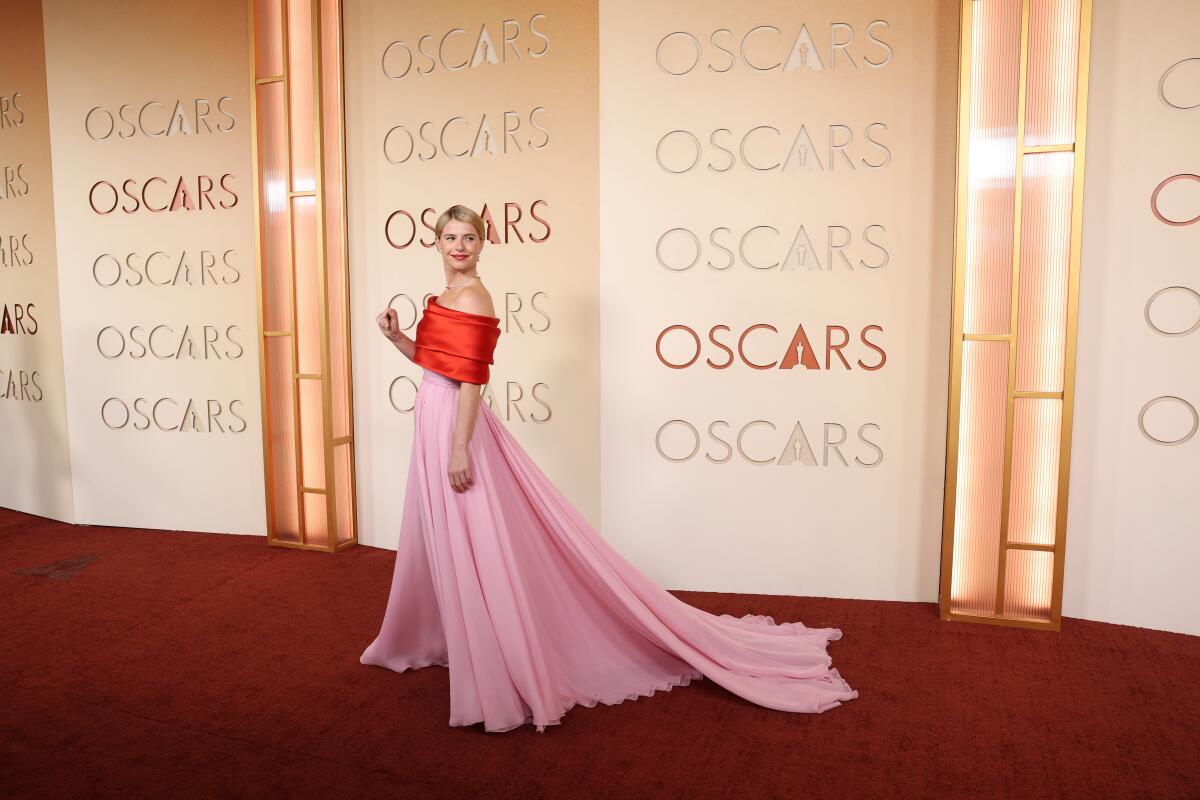
Jessie Buckley arrives on the red carpet at the 98th Annual Academy Awards.
(Myung J. Chun / Los Angeles Times)
As she strode through the lobby of the Dolby Theatre pre-show, Jessie Buckley, nominated for lead actress for her role in “Hamnet,” was fanned with praise by other attendees. Even in the restroom, she couldn’t escape the well-wishers. On her way back to the buzzing lobby, she held the train of her red and pink Chanel gown graciously saying, “Thank you, thank you.” — Brittany Levine Beckman
The pressure’s off for stars during commercial breaks
Elle Fanning and Demi Moore hug during the 98th Academy Awards.
(Robert Gauthier / Los Angeles Times)
During the telecast’s first commercial break, supporting actress nominee Elle Fanning of “Sentimental Value” took her loss in stride and leaned over her seat to chat with former “A Complete Unknown” costar Timothée Chalamet, nominated this year for “Marty Supreme,” and his partner, Kylie Jenner.
Across the aisle, “One Battle After Another’s” Leonardo DiCaprio stood up and reached over to lock fingers with Benicio Del Toro. — Yvonne Villarreal
The Oscars address inflation with a goodie box
A note from Conan O’Brien left for attendees in snack boxes.
(Jessica Gelt / Los Angeles Times)
Each year, guests at the Academy Awards are given a small cardboard box of snacks left beneath their seats to get them through the always lengthy ceremony. A note from the host is generally inside. This year’s note, signed by Conan O’Brien, read, “I hope you enjoy this Conan O’Brien ‘Moderately Happy Meal’ ™. These snacks may not look like much but in any movie theater they would run you $85.” The snacks in question were a box of Junior Mints (Times reporter Josh Rottenberg got Raisinets), a small bag of Skinny Pop and a tin bottle of water. — Jessica Gelt
Jesse Plemons won’t succumb to ‘peer pressure’
Kirsten Dunst and Jesse Plemons arrive at the 98th Academy Awards at the Dolby Theatre in Hollywood.
(Myung J. Chun / Los Angeles Times)
“Bugonia” star Jesse Plemons stood near the main lobby bar talking with friends and posing for pictures with fans while finishing the dregs of a drink. A server approached him and asked if he’d like another. Plemons politely declined and the server laughed, saying, “Sorry, I didn’t mean to give you any peer pressure.” — Jessica Gelt
Amy Madigan inquires about press room rules; ‘Is it like bingo?’
Amy Madigan after winning the Oscar for supporting actress for “Weapons.”
(Kayla Bartkowski / Los Angeles Times)
After taking the stage to accept her first Oscar win for “Weapons” on Sunday, Amy Madigan paused operations in the press room to ask how moderators decide who gets to ask questions of the night’s winners.
“Is it like bingo?” the actor asked. As laughter swelled across the crowd in response, she clarified hers was a “serious question.” — Malia Mendez
After a loss, Stellan Skarsgård knows the meaning of ‘Sentimental Value’
Megan Everett-Skarsgård and Stellan Skarsgård at the 98th Annual Academy Awards.
(Myung J. Chun / Los Angeles Times)
Stellan Skarsgård, of “Sentimental Value,” enjoyed a cocktail in a VIP room just off the main auditorium fresh off of losing the Oscar for supporting actor to Sean Penn for his performance in “One Battle After Another.”
Fans rushed Skarsgård anyway, shaking his hand and telling him how much his performance as a troubled alcoholic father and artist resonated with them. “We had four actor nominations on an international film,” Skarsgård told one of them. “That’s never happened before.” — Jessica Gelt
Two of this Oscar season’s tallest figures share a moment
During a commercial break, 6-foot-5 “Frankenstein” star Jacob Elordi and 6-foot-6 Oliver Laxe, director of international feature nominee “Sirāt,” greeted one another at the lobby bar. The pair, who have been impossible to miss as two of the tallest people at various events throughout awards season, shared a warm, high-altitude embrace and Elordi introduced the French-born Laxe to his date for the Oscars: his mother, Melissa. — Josh Rottenberg
‘The Singers’ and ‘Two People Exchanging Saliva’ winners are happy to share their Oscars success
From left, producer Jack Piatt and director Sam A. Davis, makers of “The Singers,” pose with Natalie Musteata and Alexandre Singh, co-directors of “Two People Exchanging Saliva.” All of them won Oscars for live-action short.
(Kayla Bartkowski / Los Angeles Times)
Gasps erupted in the press room after presenter Kumail Nanjiani announced the seventh-ever tie in Academy Awards history Sunday evening, between live-action shorts “The Singers,” directed by Sam A. Davis and produced by Jack Piatt, and “Two People Exchanging Saliva,” directed by Alexandre Singh and Natalie Musteata.
Speaking to the press room after the ultra-rare event, Piatt was unbothered and even enthused by the outcome, saying he wished there could be a “five-way tie” among all the category’s nominees.
Davis agreed, confiding that he’d previously told the “Two People Exchanging Saliva” team “in confidence, that if we lost, I hope we lost to them.”
Shortly thereafter, Musteata said tying with “The Singers” folks was “such a dream.”
“Someone on Reddit asked us if we would be happy to share the award, and we were like, ‘Heck yeah, we would love to share it with another film that is equally beautiful and totally different.’ ” — Malia Mendez
Elle Fanning soothes Timothée Chalamet after lead actor Oscar goes to Michael B. Jordan
Elle Fanning talks with Stellan Skarsgård during the 98th Academy Awards. Timothée Chalamet was seated in front of Fanning during the show.
(Robert Gauthier / Los Angeles Times)
When Michael B. Jordan walked off stage and the show went to commercial break, Timothée Chalamet, who was up against Jordan in the lead actor category, took a sip of his drink as Elle Fanning, sitting behind him, gave him a pat on the back.
Fanning talked to her “A Complete Unknown” co-star throughout the night, who barely turned around to look at her. Kylie Jenner kept rubbing and patting Chalamet’s hand while he nervously jiggled his right leg. — Yvonne Villarreal and Jessica Gelt
Autumn Durald Arkapaw receives standing ovation in press room after historic win
Autumn Durald Arkapaw accepts the Oscar for cinematography for “Sinners” — the first woman to win the award.
(Robert Gauthier / Los Angeles Times)
“Sinners” shooter Autumn Durald Arkapaw on Sunday became the first woman to win the Oscar for cinematography. As she arrived backstage following her historic win, the press room erupted into applause, with many reporters delivering a standing ovation.
Arkapaw was equally thrilled, telling the room, “A lot of little girls that look like me will sleep really well tonight.”
“I heard Karen O say once at a concert… ‘You have to see you to be you,’” she said. “Ryan gives us, the women on this film, and our heads of department, he gives us those opportunities to shine and be ourselves and work in a creative environment where we’re leading.”
Such trust is rarely extended by directors, Arkapaw said, and she is grateful. — Malia Mendez