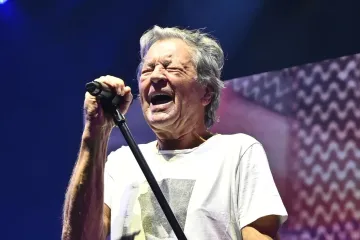
Shane MacGowan loved London. He ate and drank it, says his widow Victoria as she lifts lift on life with The Pogues star
RABBLE-ROUSING rogue and hopeless romantic, Shane MacGowan was a man of contradictions.
A genius songwriter, The Pogues frontman could switch emotions at the drop of a hat, often within the same song.
A prime example is his best-loved effort, Fairytale Of New York, which is sprinkled with tenderness: “I love you, baby. I can see a better time. When all our dreams come true.”
And unbridled fury: “You’re a bum, you’re a punk, you’re an old s*** on junk.”
Shane’s widow — and love of his life — Victoria Mary Clarke says he tapped into “those feelings of longing and heartbreak but also of frustration, anger and betrayal”.
With refreshing candour, she reveals a classic example of her man’s unpredictable nature: “I know Shane was very proud of Fairytale — but he got sick of it and he got sick of people talking about it!”


She talks of the “fierce fighting spirit” in his songs and of how, as someone who spent a lot of time in England, he viewed Ireland as “a magical landscape filled with heroes and heroines”.
She credits him with “taking Irish traditional music and modernising it, showing that you could write about junkies, hookers and rent boys — and anything else — in that same style”.
She notes that the staunch believer in a united Ireland “would rather have been executed” than accept an honorary knighthood like fellow countrymen Bob Geldof and Bono.
And she describes Shane as “someone who loved religion and was the most spiritual person I’ve ever met — and that includes all the priests”.
On a personal level, Victoria says Shane wrote “beautiful” The Song With No Name in the Nineties about “me dumping him because of heroin and him trying to get me back”.
“He rose to the challenge of heartbreak — and of all human emotion.
“I was aware from the beginning that his love language was writing a song or a poem.
“He would also leave notes and buy flowers. He wouldn’t wash the dishes or do the shopping — but he would be romantic.”
It is three years since the England-born Irish iconoclast died from pneumonia aged 65, succumbing to his legendary lifestyle involving industrial quantities of drugs, booze and fags.
By Shane’s side for nearly 40 of those years was Victoria, who he first met in 1982, just as The Pogues were taking off, but who didn’t strike up a relationship with him until four years later.
As a labour of love, she has assembled a fabulous tribute album called 20th Century Paddy: The Songs Of Shane MacGowan.
The 36 tracks represent an overwhelming outpouring of admiration and affection for Shane from, says Victoria, “the best to the least known artists of different ages and from different countries”, many of whom were his friends.
So we hear Bruce Springsteen, U2, Tom Waits, The Libertines, Primal Scream and Bob Geldof jostling with unsung Irish folk singers and even a Japanese punk band.
Johnny Depp pops up, accompanied by Imelda May, as does Depp’s one-time girlfriend, Kate Moss — not just a supermodel but an accomplished singer.
Chiming with the season, a sublime Fairytale Of New York is out as a single, with Hozier and Oscar-winning actress Jessie Buckley assuming the roles of MacGowan and Kirsty MacColl.
Proceeds from the album are going to a homelessness charity dear to Shane’s heart, the Dublin Simon Community.
“I’m doing something for Shane,” affirms Victoria. “It has given me a reason to get out of bed, get dressed, put on make-up, meet people, talk to people, answer emails.”
I’m meeting her at a pub in Primrose Hill, the posh part of one of Shane’s old stomping grounds, the London Borough Of Camden.
Before we take a deeper dive into the album and the myriad artists involved, the engaging Victoria talks openly about life with a complex yet endearing character.
She says: “It could be infuriating because Shane’s approach to everyday practical things got the same big romantic treatment as his songs.
“Can you imagine trying to get him to pay a gas bill or fill in a passport application?
“Even the very idea of owning a home seemed like complete anathema to him.
“He lived in his own world — a world of his imagination and creation — and surprisingly, he managed to get most people to fit in with it.”
Victoria well remembers her first fateful encounter with Shane in (where else?) a pub.
“I was 16 and had come to London looking for excitement. In my mind, it was just an extension of Ireland — but I knew important music and fashion was being created there.”
One night, she went to her local in Temple Fortune to discover Shane, Spider Stacy and the rest of The Pogues were in situ for a celebration.
“Shane came over to me and said, ‘It’s Spider’s birthday, get him a drink’. My initial reaction was, ‘F*** off’.
“But it didn’t take me long to figure out that there was some connection through a friend. A few days later, I saw The Pogues play and I was very impressed.”
Victoria was mesmerised by the band’s “ability to take Irish music and give it a different energy, vibe, look and attitude, which was very London”.
To her, their raw, fiddle-fuelled music was the “antithesis” of the synth pop which dominated the charts in the Eighties. But she says there was one area of common ground: “The Pogues were always very much into their look.
“Shane would take hours getting ready. His hair would be done, his shoes would be polished — the suits and shirts were no accident.”
Victoria says his image, like the music, had “a rockabilly vibe”, with inspiration coming from his Uncle Sean, who he regarded as a “style icon” in his crisp white shirts with his Elvis quiff.
She explains that when she and Shane became an item, they moved to Kentish Town “so every Saturday, we spent hours shopping in nearby Camden Market” — in those days, the destination for the hip, fashion-conscious crowd.
Though he regarded Tipperary, where his family hailed from, as his spiritual home, Shane liked nothing more than to explore the seedy underbelly of Britain’s capital city.
“He loved London,” says Victoria. “He almost ate and drank it. He walked everywhere, exploring it all, having experiences in places like King’s Cross, Soho and Camden that he never could in Ireland.
“He spent a lot of time in bars, clubs, betting shops and late night Greek restaurants. He’d chat to people of all types, including those on the street.”
Some of Shane’s most celebrated songs are set in London — including A Rainy Night In Soho, so elegantly and poignantly performed by Springsteen on the tribute album.
But now consider this line from another, The Old Main Drag, sung with poise and passion by David Gray, “And now I am lying here, I’ve had too much booze.”
Victoria tells me that in the early days, “Shane wasn’t drinking much at all and was quite sober”.
She says: “I drank maybe five times as much as he did. He was on white wine spritzers while I was on whiskies!”
In 1986, the year they got together, Victoria recalls proposing “straight away”.
“He turned me down immediately and said he wasn’t interested in getting married,” she continues.
“But that conversation went back and forth and at times, he would change his mind and say, ‘I do want to marry you’, and then I’d be like, ‘F**k off!’
“Around 2007, we finally got engaged but didn’t want the fuss of a big wedding with thousands of people.
“Eventually, we hit on the idea of doing it in a country where we didn’t know anyone, which was Denmark. So (in 2018), that’s what we did.”
I ask Victoria if it was hard dealing with Shane’s increasing alcohol dependency. “Oh, absolutely,” she replies. “There were spectacular ups and downs.
“Shane was a big personality with big emotions, so it was difficult at times.
“I didn’t really know how to deal with it and would get frustrated. I’d get angry — and shout and nag and cajole and blackmail, you name it.
“I tied him to a radiator once so he couldn’t touch the bottle. I’d smash bottles, hide them, throw stuff down the sink, everything you could think of.
“I managed to get him to rehab maybe five times but it didn’t make a difference when he got out.”
By way of explaining Shane’s wayward behaviour, she says: “He had an extremely addictive personality for everything, even Marmite.
“He would go through phases of eating nothing but Marmite with caviar.
“Also, he wasn’t equipped to handle pressure when Fairytale became successful. It was too much.
“He didn’t want to go on the road all the time but wanted to sing for fun.
“He was like a pub singer. He enjoyed having the audience join in and partying with them afterwards.
“He didn’t like interviews, he didn’t like having his picture taken, he didn’t like aeroplanes and he didn’t like being on time for anything. So, he got more and more anxious.”
Maybe it’s that vulnerability which shines through Shane’s songwriting, helping him find universal connections.
If you listen to 20th Century Paddy, you’ll sense the passion each act feels.
Near the end of his life, in 2023, Shane was visited by one of his admirers, Bruce Springsteen, who was in Ireland on tour.
When it came to getting The Boss to perform A Rainy Night In Soho, Victoria says she was pushing at an open door.
“When I text him, he always answers. If he says he’ll do something, he will.
“It was fantastic when he came to see us. We didn’t know Shane was going to die, so we didn’t have a sense of doom about it.
“As Bruce was leaving, he said, ‘I’ll see you next year’.”
Victoria adds that Shane had been a Springsteen fan since his early teens and that stripped back Nebraska “was his favourite Bruce album”.
The appearance of Johnny Depp is hardly a surprise, either.
Victoria says: “Early in Nineties, around the time Shane was sacked (from The Pogues), Johnny invited him to open the Viper Room club — a real morale boost.
“It made Shane aware that a lot of people in the US, including Johnny’s mates in the movie business, were enthusiastic about him and wanted him around.”
It was through Depp that they got to know his girlfriend at the time, Kate Moss. “Shane adored Kate, one of his favourite people,” says Victoria.
“We became close and when she and Johnny broke up, we kept on good terms with both of them.”
So, was Kate receptive to singing on the tribute album? I venture.
“Well yes,” answers Victoria. “I’ve heard her sing many, many times and she’s very good. She has a beautiful, unique voice with a sensitive quality to it. I thought she might be too shy to do it, but she wasn’t.”
Depp is also responsible for a rare appearance by Tom Waits, who growls his way through one of Shane’s own favourites, Summer In Siam, as only he knows how.
Victoria praises Primal Scream’s version of A Pair Of Brown Eyes with singer Bobby Gillespie’s “so different” delivery, and she says Lisa O’Neill on Dark Streets Of London sounds “like Shane’s mum”.
She’s thrilled with Bob Geldof’s gruff spoken-word masterclass on St John Of Gods and the original takes adopted by a younger generation of Irish sonic adventurers — The Murder Capital (The Song With No Name) and Madra Salach (Turkish Song Of The Damned).
Then there’s U2’s spirited version of Yeah, Yeah, Yeah, Yeah, Yeah.
“They just said yes,” says Victoria. “Didn’t ask for any details.”
She remembers The Pogues supporting U2 at Wembley Stadium (in 1987) “and that Shane always liked hanging out with Bono — someone to wind up and have really interesting conversations with”.
Finally, let’s spare a thought for absent friends — Fairytale foil Kirsty MacColl and a fellow Irish rebel, Sinead O’Connor.
Victoria says: “Shane loved Kirsty. He felt she was a million per cent on his side. I think she got him, almost like a sister.
“He would be enticed to go out and do things, just because she would be there.”
As for Sinead, Victoria says: “They were very close and used to have proper, vicious fights.
“But she would have done anything for him and vice versa. Their Nineties duet is one of the best things he ever did.”
It’s certain that had she lived, Sinead would have been first on the list to celebrate the riotous life of a 20th Century Paddy.