dozens

Russia’s jet-powered drones overwhelm Ukraine, killing dozens | Russia-Ukraine war News

As the war drags on in Ukraine, its civilians are again suffering.

Thirty-eight people were killed in the village of Myla on August 29, when a Russian drone attack struck an ammunition depot. Another 12 were killed in attacks across the country on September 1.

Recommended Stories

list of 4 itemsend of list

Civilian deaths have sharply increased this summer as Russia is using jet-powered drones, which fly at about half the speed of a passenger jet and are more difficult to intercept than propeller-powered drones.

Jet-powered drones numbered about 2,800 in August, said Ukraine Air Force spokesman Yurii Ihnat, compared with about 1,500 in July, several times the number launched in June. Ukraine has an interception rate of more than 90 percent against propeller-powered drones, but only 60 percent against the jet-powered variant, Ihnat said.

INTERACTIVE-WHO CONTROLS WHAT IN UKRAINE-1788437892
(Al Jazeera)

Ukraine said Russian forces suffered 42,020 casualties last month, as Moscow’s territorial gains dropped to a fraction of last year’s rate of advance.

Ukrainian armed forces figures showed Russia’s monthly casualties were only slightly below July’s 42,860 and well above the 39,290 in June.

Al Jazeera cannot independently verify casualty estimates by either side, but if accurate, those summer figures – 25.8 percent higher than the casualties Ukraine inflicted in the spring – suggest the high Russian casualty rate is not a passing event.

Russian recruitment rates are thought to be well below those totals, estimated by Ukraine at about 32,500 a month this year.

People visit a McDonald's restaurant which was the first to open in Ukraine in 1997, located in an area that was hit by numerous missile attacks, amid Russia's attack on Ukraine, in Kyiv, Ukraine, September 1, 2026. REUTERS/Gleb Garanich TPX IMAGES OF THE DAY
An area in Kyiv hit by numerous missile attacks, September 1, 2026 [Gleb Garanich/Reuters]

Ukrainian President Volodymyr Zelenskyy has publicly shared intelligence suggesting that Russian leader Vladimir Putin will conscript 300,000 or more troops next month.

Zelenskyy has said that up to 80 percent of Russian casualties were inflicted in Kostiantynivka, the southernmost of Ukraine’s “fortress belt” of cities in the eastern Donetsk region, whose capture Putin has repeatedly prioritised.

Russian forces are thought to control only a portion of the city, but have infiltrated more than 70 percent of it with scattered individual troops sent to drop supplies and await reinforcements. Ukrainian drone operators have been targeting the troops as Russia replenishes them.

This week it was revealed that Ukrainian commander-in-chief, Mykhailo Drapatyi, reinforced the Donetsk front around Sloviansk and Dobropillia, north and south of Kostiantynivka, respectively, but kept the Kostiantynivka front largely unchanged. That suggests Ukraine may be adopting the tactic of fighting a prolonged rearguard in the urban landscape to inflict attritional losses, as it did in the battles of Bakhmut, Pokrovsk and Chasiv Yar.

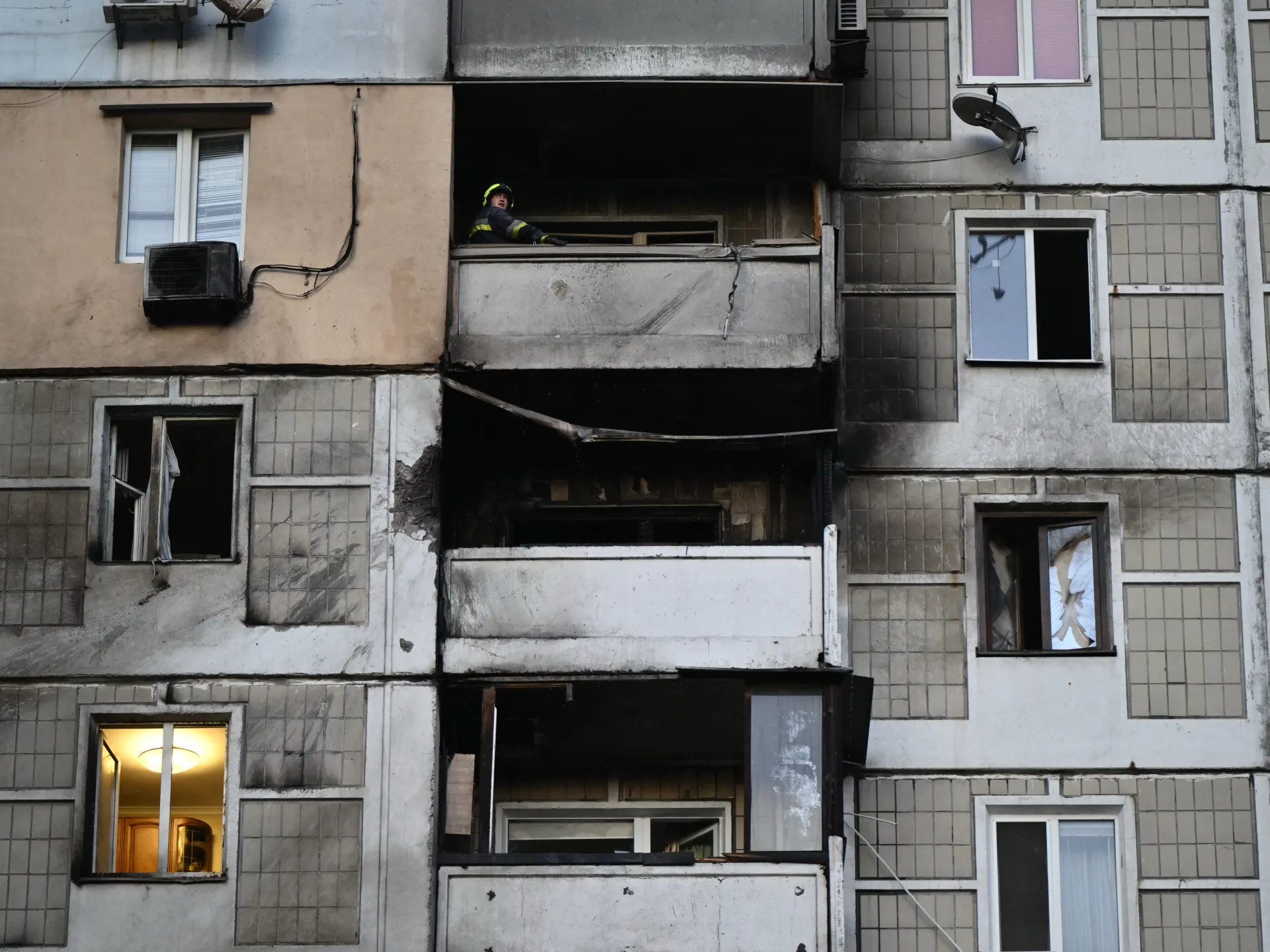
Police officers inspect parts of a Russian drone, at the site of an apartment building damaged by a Russian drone strike, amid Russia's attack on Ukraine, in Kyiv, Ukraine September 1, 2026. REUTERS/Gleb Garanich TPX IMAGES OF THE DAY
Police inspect parts of a Russian drone at an apartment building in Kyiv, September 1, 2026 [Gleb Garanich/Reuters]

The fight for Kostiantynivka has sapped troop strength elsewhere on the front line, where Ukraine liberated 130sq km (50 square miles) of its land in August, limiting Russia’s overall advance.

Russia seized just over 90sq km (35 square miles) in August, estimated the Institute for the Study of War, a Washington-based think tank that assesses territorial gains using open-source geolocated sources.

While still a net gain, that is less than a fifth of the land Russia seized in August last year.

During June, July and August this year, the ISW assessed that Russia gained firm control of 160sq km (60 square miles), compared with 1,440sq km in the summer months of 2025 (560 square miles) – a 90 percent decrease.

Family members attend the funeral of local villages’ community head Taras Didych, who was among 38 people killed in a Russian drone strike on the village of Myla on August 28, amid Russia's attack on Ukraine, in the village of Dmytrivka, Kyiv region, Ukraine August 31, 2026. REUTERS/Alina Smutko TPX IMAGES OF THE DAY
Family members attended the funeral on Monday of village leader Taras Didych, who was among 38 people killed in a Russian drone attack in Myla last week, August 31, 2026 [Alina Smutko/Reuters]

Ukraine’s response

Ukraine has turned its focus from Russian refineries to strikes against Russian air defences, radar systems and drone launch sites.

Ukraine’s Unmanned Systems Forces (SBS) destroyed 33 air defence elements in August, increasing the annual total to 263.

Ukraine also kept up some strikes on refineries, hitting 12 in August, along with two gas-processing plants and three oil transshipment terminals, according to its defence ministry.

During the past week, Ukraine struck the Yanos refinery in Yaroslavl and the Kirishi and Ust-Luga refineries near Leningrad, all 800km (500 miles) from its border.

Petro Ionov reacts near a grave of his son Yevhenii Ionov after a burial ceremony on a cemetery in the town of Bilohorodka, amid Russia's attack on Ukraine, in Kyiv region, Ukraine August 25, 2026. Yevhenii Ionov was among at least seventeen people killed by Russian missile and drone strikes towards Kyiv on August 20, according to mayor Vitali Klitschko. Civilian casualties from Russia's full-scale invasion rose sharply in July as missiles and drones struck cities far from the front lines, the United Nations said in a report published on August 14. The U.N. Human Rights Monitoring Mission in Ukraine said it had confirmed at least 437 civilians killed and 2,610 injured during the month, a 30% increase from June and the highest toll since May 2022.REUTERS/Anatolii Stepanov TPX IMAGES OF THE DAY
Petro Ionov mourns his son Yevhenii in the town of Bilohorodka, August 25, 2026 [Anatolii Stepanov/Reuters]

Those strikes have caused petrol shortages, further hurting Russia’s economy.

Ukraine’s military intelligence reported that certain Russian exports had fallen by 80 percent compared with pre-war levels. Oil has been among the hardest hit, as Ukraine has struck terminals and hundreds of tankers carrying Russian oil in the Black Sea and Sea of Azov.

Russian oil exports from the Black Sea port of Novorossiysk fell from 800,000 barrels a day in July to 350,000 barrels per day in August, said Ukraine’s Foreign Intelligence Service.

“The Russian side acknowledges that its Black Sea Fleet ships are effectively blockaded in Novorossiysk due to our drone strikes and are unable to operate at sea,” said Zelenskyy.

“Since the Russian fleet is unable to provide escorts for the commercial and shadow fleet …  one of the solutions being considered is to equip civilian ships with small arms, electronic warfare (EW) equipment and military personnel,” he said. “We will prepare appropriate countermeasures.”

The strikes on the oil industry have not only reduced exports. They have reverberated across the Russian economy, creating queues at petrol stations and raising prices for motorists.

This week, Russia extended its ban on diesel exports to the end of September to keep its army and transport industry supplied and sought to import petrol.

Occupied Crimea, where petrol distribution has been restricted to government-owned vehicles, has been hard hit.

The Russian-appointed governor of the region, Sergei Aksyonov, said on September 2: “Fuel supplies to the region are currently not fully meeting the needs of the residents. Unfortunately, some residents of Crimea will, at this stage, face limited access to gasoline”.

Source link

Thailand hit with dozens of coordinated arsons, bombs

Aug. 23 (UPI) — Thailand’s southern region has been hit by dozens of coordinated arson attacks and bombs “aimed at creating unrest,” officials said Sunday.

The Thai Military said there were more than 50 incendiary attacks overnight on Saturday, injuring at least two people, the BBC reported.

At least six of the attacks involved bombs.

A government office building, convenience store and vehicle were set on fire.

Car tires were burned and power poles were blown up, Xinhua reported.

The attacks happened in Narathiwat, Yala and Pattani provinces, the news agency reported.

The investigation into the incident continues, and no group has claimed responsibility yet, the BBC reported.

Source link

Armed men kidnap dozens in attacks on Nigerian villages | Armed Groups News

Police say three villages and a mosque were attacked, and worshippers kidnapped in central Niger State.

Armed men have kidnapped dozens of people during an attack on a mosque and surrounding villages in Nigeria’s central Niger State, survivors and police officials say.

The raiders stormed Kpenya Mosque in the Dekara district of Borgu Local Government Area at around 2pm (13:00 GMT) on Friday, after first attacking the villages of Gidan-Zana and Kpenya, police spokesperson Wasiu Abiodun said on Saturday.

Recommended Stories

list of 3 itemsend of list

Abiodun told the Reuters news agency that police were aware of the kidnappings but had not received reports of anyone being killed, and that a “joint security detachment has been deployed to the area for assessment and rescue operations”.

He said police could not yet confirm the number of people who were taken.

Local residents told Reuters that more than 60 worshippers were kidnapped, but the figure could not be independently verified.

Separately, residents told the AFP news agency that people were also killed, another claim that could not immediately be confirmed.

Jibril Ahmad, a survivor of the assault on Dekara, blamed members of the Lakurawa armed group.

“Soon after finishing the normal Friday prayer, the armed group of Lakurawa, in their hundreds, wielding guns, knives and machetes, began to attack us,” Ahmad told AFP, claiming that people were “slaughtered”.

During the attack, a third group, Mahmuda, intervened and clashed with the kidnappers, allowing some abductees to escape, he said.

Federal lawmaker Jafaru Mohammed told AFP that several nearby villages were also struck.

“Some members of the Mahmuda group were against the doctrine of the Lakurawa, and when they heard of what the Lakurawa were doing, they fought them,” Mohammed said.

The attack unfolded in a region near Nigeria’s western border with Benin that has seen growing activity from local armed groups and fighters from the neighbouring region, even as the country’s 17-year armed rebellion remains concentrated in the northeast.

The violence in Niger State continued into Saturday. Resident Abdullahi Ahmad said the group returned to the area to seize more people as a “bargaining chip” in advance of an expected troop deployment, and planted landmines on the road out of Dekara.

“A man and his family who were fleeing the town yesterday were killed when their car hit a landmine planted by the terrorists. Everyone is living in fear,” he said.

Mass abductions have been a hallmark tactic of the country’s armed groups and have evolved into a lucrative, multimillion-dollar industry involving networks of both ideological and nonideological gangs across Nigeria’s northwest and central regions.

Source link

Dozens of people across 15 states sickened by tainted alfalfa sprouts

Alfalfa sprouts under the brand names Calco and Everything Sprouts have sickened 55 people across 15 states, the Centers for Disease Control and Prevention warned Friday. Photo courtesy Centers for Disease Control and Prevention

Aug. 21 (UPI) — Dozens of people across 15 states have been sickened by alfalfa sprouts tainted with E. coli bacteria and salmonella, federal health officials said Friday.

The Centers for Disease Control and Prevention said in a safety alert that 55 people have suffered symptoms such as severe stomach cramps, diarrhea, fever, nausea and/or vomiting after consuming alfalfa sprout sold in grocery stores under the Calco and Everything Sprouts brands.

Four hospitalizations have resulted from the outbreak.

Some 38 of the 55 of the cases have been recorded in Minnesota and Wisconsin combined, with fewer cases reported in North and South Dakota, New York, Washington state, Iowa, Kansas, Michigan, Indiana, Pennsylvania, North and South Carolina, New Hampshire and Florida.

CDC officials warned that the number of illnesses is likely to increase as investigators continue their probe.

The tainted food was determined to originated from Everything Sprouts, a Minneapolis-based hydroponic grower.

“Traceback information from Minnesota and Wisconsin restaurants identified alfalfa sprouts distributed by Everything Sprouts as a source of illness in this outbreak,” the CDC said in a statement.”[The Food and Frug Administration] is working to determine if there are additional sources of contaminated sprouts and if there is a common seed supplier.”

The same company last year was issued a warning letter by the FDA following an inspection that produced what it called “serious violations” of the Produce Safety Rule, Minnesota Public Radio reported.

Inspectors documented roof leaks that allowed water to drip near or onto exposed mung bean sprouts while condensation from refrigeration equipment was also found dripping in areas where sprouts were grown or stored.

Source link

Morocco detains dozens of migrants trying to cross into Ceuta – reports

Moroccan authorities intercepted dozens of migrants seeking to cross into the Spanish North African exclave of Ceuta on Saturday, reports say.

More than 100 people were blocked trying to make their way to the border on the outskirts of the town of Fnideq, according to Moroccan security sources cited by Spanish media and the Reuters news agency.

It comes a fortnight after roughly 78,000 migrants arrived in the exclave by sea in a matter of hours – 100 of whom died, according to the city’s mayor, who also said the vast majority of arrivals had returned to Morocco.

Security had been stepped up in the area after the influx and amid suggestions on social media of a second mass crossing attempt this weekend.

The security sources said 111 people had been detained in or around Fnideq – known in Spanish as Castillejos – about 3km (1.8 miles) from the border, the majority of whom were from sub-Saharan Africa.

Moroccan police – including some in riot gear – reportedly used tear gas to disperse groups of migrants gathered on nearby hills.

Earlier this week, Rabat said it was monitoring “the circulation of social media posts and messages of unknown origin” calling for a mass crossing Saturday, warning it would prosecute organisers and participants.

Source link

US says dozens of countries helped China dodge Trump’s tariffs

The White House said in a report on Thursday that more than 40 countries have helped China sidestep US tariffs by routing exports through nations that face lower American import duties.

The countries named include Canada, India, Mexico, Japan and South Korea, which the White House said had helped China evade tens of billions of dollars in tariffs.

White House trade adviser Peter Navarro said it had cost “American jobs and billions in revenue”.

A spokesperson for the Chinese embassy in Washington said in response to BBC queries that “trade wars have no winners” and that it opposes the US’ tariff measures and the use of state power to target China’s companies.

The spokesperson added that “any unilateral actions or agreements concerning transshipped goods must not target or harm the interests of third parties.”

The BBC has contacted the US embassies of Canada, India, Mexico, Japan, South Korea and other trading partners listed in the report for comment.

The report follows a wave of sanctions between the US and China and comes weeks before President Donald Trump will meet Chinese leader Xi Jinping in Washington.

According to government and private sector estimates quoted by the White House, between $30bn (£22.2bn) and roughly $300bn in goods have been moved from countries with higher tariff through those with lower rates.

The process is known as transshipping, which refers to the practice of transferring cargo through another country while en route to a final destination.

The US accused China of “taking advantage” of the practice by moving goods through nations that have lower duties.

China has used third countries as a stopover and has repackaged goods to hide their real origin to obtain lower tariffs, said the White House in its report, describing the process as “fraud cloaked in paperwork”.

“What has changed in today’s Great Transshipment Scam is not merely the speed and scale of this modern form of smuggling, but the breadth, depth, and sophistication of the global Shadow Transshipment Network through which China’s tariff evasion now moves,” the White House wrote.

The US has deployed artificial intelligence (AI) tools to catch transshipment efforts, it added.

The report is expected to add to key sticking points between the sides as Trump and Xi prepare to meet in the US in September.

Despite a pause in most tariffs following talks in May 2025, Washington and Beijing have continued to exchange sanctions, including restrictions on humanoid robots shipped to the US and tighter Chinese curbs on drone exports.

In April 2025, Trump unveiled sweeping levies on dozens of US trading partners based on a long-held belief that tariffs will help boost American jobs and the economy.

Those sanctions have since been struck down by the US Supreme Court, but Trump has repeatedly introduced new tariffs using alternative legal levers to continue his signature policy.

Source link

Pakistan coal mine explosion kills dozens

Bodies of the victims are transported to a hospital after a methane gas explosion in the Sorange coalfield on the outskirts of Quetta, Pakistan, on Friday. Photo by Fayyaz Ahmad/EPA

July 31 (UPI) — A coal mine explosion in Pakistan’s Balochistan province left at least 34 people dead and rescue workers scrambling to reach those trapped underground Friday, local officials said.

The gas explosion happened Thursday on the outskirts of Quetta, the capital of the province in the Shangla district. Pakistan’s provincial disaster management authority said the miners were working 4,000 below the surface at the time of the blast.

It’s unclear how many people might still be trapped in the mine, The New York Times reported.

Abid Yaar, president of the Shangla Coal Mine Workers Association, said most of those killed came from Mian Kaly, and most were members of the same extended families. He told Dawn News the workers were between the ages of 17 and 25, some the orphans of miners who had died in previous coal mine incidents.

“It is not just an accident but a lifelong trauma for the families, orphans, widows and mothers who lost their loved ones,” Yaar said. “These young men had gone there only to earn a livelihood and support their families back home.”

Mir Shoaib Nosherwani, Balochistan’s top mining official, said there would be an investigation into the cause of the explosion. He said the victims’ families would also receive $1,800 for each killed worker and $1,100 for each injured worker.

Source link

Dozens of Spanish beaches closed as extreme heat alert threatens thermal blowout

Brits heading out to Spain may want to rethink their travel plans ahead of soaring temperatures, as they experience a different kind of holiday without a safe trip to the beach

Tourists hoping to catch a tan on the beach in Spain may be disappointed to learn that close to 27 beaches so far will in fact be a tourist-free zone as the scorching heat takes a hold.

The Costa Blanca is set to see a huge beach ban this week amidst dangerous weather warnings to protect locals’ and tourists’ safety.

Spain’s national weather agency, AEMET, has predicted strong storms and gusts of wind, which have the potential to cause thermal blowouts. As a result, local councils are forcing shutdowns as Alicante is set to see its most dangerous weather days of the summer in the final week of July.

Thermal bursts, or blowouts, are a phenomenon in which precipitation evaporates as it crosses dry air in warm environments. This phenomenon causes a sudden spike in temperature and strong winds.

Inland temperatures are forecast to reach up to 45 degrees, and the province remains under a yellow weather warning, as thunderstorms could bring hazardous conditions to the area.

Three municipalities in total, including Alicante, Guardamar del Segura, and Orihuela, have decided to raise red flags on their beaches to prevent the potential risks caused by the extreme shift in weather, Mercia Today suggests.

Orihulea City Council confirmed that all beaches along the coast will be closed from 5pm, July 23, with the red flags banning all swimming activity.

This restriction affects the likes of Punta Prima Beach, Cala Mosca, Cala Estaca, Cala Bosque, Cala Capitan and Cala Cerrada, as well as any coves in the area.

Meanwhile, Alicante City Council has also activated emergency measures, where all municipal beaches will be closed for visitors, along with parks, gardens and wooded areas.

The ban affects popular tourist beaches such as Postiguet, San Juan Beach, Urbanova-El Saladar, Aguamarga, La Almadraba and Albufereta, according to the Olive Press.

All three councils have supposedly asked that beachgoers remove the likes of umbrellas and any other objects that have the potential to be thrown around by the strong gusts of wind.

Authorities are advising tourists to avoid unnecessary travel and steer clear of beaches and exposed coastal areas for their own safety. Although, as things stand, there is no official statement that advises against travel to any parts of Spain due to the heatwave.

If you are someone travelling out to Spain amidst these extreme temperatures or travelling around the country during the hottest days, you should take general precautions to avoid the sun.

Typically, the hottest hours are from 11am to 3pm, so it’s best to avoid this time if possible, all while staying hydrated and wearing sunscreen and light, breathable clothing.

As for your villa, holiday home or hotel space, be sure to bring inside any parasols, outdoor furniture, plant pots and loose objects that live on any balconies or terraces. If the thunderstorms develop, it is best to stay indoors where possible and most definitely avoid walking near exposed costal spots.

The adjoining municipalities of Santa Pola and Torrevieja have yet to make a statement over their beaches, but this could change.

Source link

Trump imposes new double-digit tariffs on dozens of countries | Donald Trump News

With existing 10 percent levies set to expire, Trump issues new tariffs on 60 countries under forced labour provision.

President Donald Trump is going ahead with new double-digit tariffs on dozens of trading partners of the United States just as the clock runs out on Friday on stopgap levies he announced after a stinging defeat at the Supreme Court.

The US will slap levies of 10 to 12.5 percent on imports from 60 countries accounting for 99 percent of US imports, charging that they have inadequately enforced bans on goods produced by forced labour.

Recommended Stories

list of 4 itemsend of list

“The United States has had a forced labor import ban for nearly a century, and rigorously enforces it; it’s well past time for our trading partners to do the same,” US Trade Representative Jamieson Greer said in a statement on Thursday.

“Today’s action will begin to correct what is both a human rights abuse and distortive trade practice to improve the welfare of workers everywhere.”

The new tariffs will take effect just as the temporary 10 percent worldwide tariffs expire at 12:01am on Friday in Washington, DC (04:01 GMT). Trump had turned to the temporary levies after the Supreme Court struck down his biggest and boldest tariffs in February.

Now he is tapping more durable tariffs under Section 301 of the Trade Act of 1974, which permits the president to impose import taxes and other sanctions against countries found to engage in “unjustifiable”, “unreasonable”, or “discriminatory” trade practices.

Trump used Section 301 to impose big tariffs on China in his first term, and they survived court challenges.

More Section 301 tariffs are likely coming: Greer’s office has launched a probe into whether 16 countries — accounting for 70 percent of US imports — have overproduced goods, pushing down prices and putting US companies at a disadvantage in global markets.

The administration has yet to complete that investigation.

Trump, who argues that high tariffs will revive US manufacturing, last year overturned decades of US policy that favoured lower tariffs and freer trade.

Invoking the 1977 International Emergency Economic Powers Act (IEEPA), he imposed double-digit tariffs on imports from almost every country, saying that the US’s longstanding trade deficit amounted to a national emergency.

But the Supreme Court ruled that IEEPA did not authorise tariffs. The decision forced the Trump administration to pay refunds to importers that had paid the levies.

In response, Trump announced 10 percent worldwide tariffs under Section 122 of the Trade Act of 1974. But he can only use Section 122 levies for 150 days, and the time runs out on Friday.

Source link

iHeartMedia is cutting dozens of on-air radio personalities nationwide

Riverside-based radio station, 99.1 KGGI, has lost its last local on-air host.

Longtime radio personalities Evelyn Erives, Nick Nack and Garrison King were all cut from the Inland Empire station last week as part of iHeartMedia’s latest round of national layoffs. In an internal memo, the media giant said it would restructure its radio programming to better “leverage” the company’s technology.

iHeartMedia declined to comment on how many people lost their jobs, but dozens of on-air and other staff positions have reportedly been cut across the country.

The memo — attributed to Chief Programming Officer Tom Poleman and Ann Marie Licata, the chief executive of the company’s multiplatform group — framed the changes as a way to “move faster and operate with greater precision across markets,” and to “position us not just to adapt to the future, but to lead it.”

The cuts are part of a broader push to reduce costs. In May, iHeartMedia launched a new savings program, set to begin in the second half of 2026, aimed at trimming an additional $50 million on top of the $100 million in savings the company had already announced.

iHeartMedia is the nation’s largest radio operator, with more than 850 stations across 160 markets and a sizable presence in Burbank. Its Los Angeles–area stations include KFI-AM 640, KLAC-AM 570, KOST-FM 103.5 and KIIS-FM 102.7.

As the media landscape continues to evolve, the company has leaned harder into podcasting, home to hallmark shows like “Stuff You Should Know,” “Questlove Supreme” and “Las Culturistas.”

Last year, iHeartMedia introduced its “Guaranteed Human” campaign, an ongoing pledge that no iHeartMedia station or podcast will feature an AI-generated personality or AI-generated music.

How that promise squares with the layoffs is unclear. With stations like Riverside’s 99.1 now stripped of their local hosts, the company has said nothing about who — or what — will replace them.

Source link

Israeli military: Dozens of Hezbollah fighters trapped in underground complex

Smoke rises in late May as a result of an Israeli strike in the south of Lebanon as seen from the Israeli side of the border in the Upper Galilee, Israel. The Israeli military says it has trapped dozens of Hezbollah fighters in an underground complex in southern Lebanon. Photo by Atef Safadi/EPA

June 24 (UPI) — The Israeli military has surrounded an underground base in southern Lebanon in which dozens of Hezbollah militants are trapped, Israeli officials said.

The base is located under the village of Tebnit, in an area where fighting taken place despite an Israel-Hezbollah cease-fire, The New York Times reported. The standoff, if it escalates, could disrupt ongoing peace negotiations between the United States, which backs Israel, and Iran, which backs Hezbollah.

Israeli officials said the trapped militants were running out of supplies. On Tuesday, Israeli troops killed at least two people in the area. Israel said those targeted were Hezbollah operatives, while Hezbollah said they were civilians.

The underground base is beneath the Ali al-Taher ridge, not far from the border with Israel and a strategic point. Israeli officials said Hezbollah built the complex of tunnels over 20 years with Iran’s help.

“From this place, you can launch missiles and munitions at Israel,” Sarit Zehavi, president of the Alma Research and Education Center, said to The New York Times.

The Jerusalem Post reported that Israeli leaders are concerned that operatives in the area could carry out a kidnapping attack against Israel’s forces to help their negotiations for those trapped. Soldiers have been told to stay in pairs or groups at all times.

Israel once occupied the ridge after its 1982 invasion of Lebanon. It was once outside the “buffer zone” that Israel established in Lebanon near the border, but Israeli redrew the line last week to include the ridge, The New York Times reported. Israel considers any armed fighter south of the line a threat and a target.

Source link

Explosion at gas plant kills at least 13, injures dozens in Qatar

The logo of state-owned petroleum company QatarEnergy is shown in front of its headquarters in Doha, Qatar. An explosion at a liquefied natural gas plant in Qatar killed 13 and injured dozens Sunday. Photo by Hannibal Hanschke/EPA

June 22 (UPI) — An explosion at Qatar’s largest natural gas plant killed 13 people and injured about 66, authorities said.

The blast, caused by a technical malfunction, took place Sunday as the facility restarted its natural gas production after a shutdown caused by the Iran-U.S. war, authorities from the interior ministry said. It took place in the Ras Laffan industrial zone. The nearby Ras Laffan Port is the largest artificial harbor in the world and was targeted by Iranian strikes earlier this year, BBC News reported.

Saad Sherida al-Kaabi, Qatar’s energy minister, said that the explosion would not affect the country’s exports and that it was an accident and “not sabotage or hostile in nature.”

All of those killed were workers at the plant, The New York Times reported. They were all from India or Pakistan, BBC News said.

“We convey our deepest condolences to the families of those who have unfortunately passed away in the sad incident at Ras Laffan Industrial City last night,” the Embassy of India in Doha said in a social media post.

Liquified natural gas is important to Qatar’s economy, and the country is one of the world’s largest exporters of it. Ras Laffan is the largest site in the country for producing LNG. Qatar had ceased production earlier in the Iran-U.S. war and has said damage from attacks during the conflict could take years to repair.

The blast turned the city’s skyline orange and was felt by residents more than 43 miles away, BBC News said.

Source link

How to visit dozens of state historic parks for free through 2026

From now through July 6, residents and tourists alike can download the California State Parks Historian Passport for free, allowing them access to more than 30 state historic parks across the state through the end of 2026.

Gov. Gavin Newsom announced the initiative Wednesday in honor of both Juneteenth and the the 250th anniversary of the signing of the Declaration of Independence.

“California’s state historic parks preserve some of our nation’s most powerful and meaningful stories, and I’m proud to live in a state that celebrates diversity to connect more people with those stories through this limited-time free pass,” California State Parks director Armando Quintero said in a statement. “I hope the free Historian Passport introduces more Californians to the state’s historic gems and sparks a curiosity and thirst for knowledge that leads to many return visits.”

The pass typically costs $50 and allows unlimited entry for up to four people to state historic parks and museums that charge a per-person admission fee or a vehicle day-use fee.

Historic parks in and around L.A. County that accept the Historian Passport include:

Colonel Allensworth State Historic Park

Colonel Allensworth State Historic Park

(Courtesy of California State Parks, 2026)

Other parks that accept the pass are:

A full list is available at parks.ca.gov.

To download a free pass, visit ReserveCalifornia.com and click “Passes” in the upper main menu. From here, you’ll be prompted to either create a new account or log into your existing account. Once logged in, you can use the dropdown menu on the page to select “Special Edition Historian Passport 2026 – $0.00.” You can then check out with your pass and will quickly have it added to your list of passes within your account.

Leaders with the California State Parks Foundation and the California State Railroad Museum Foundation, which helped finance the initiative, said they hope the free Historian pass opens up access to more people to see our public lands.

“California state parks help us understand the history of California, the United States, and the ongoing work of building a more inclusive democracy,” said Rachel Norton, executive director of California State Parks Foundation. “The special edition Historian Passport is a great opportunity to explore state parks for free. We hope access to the Historian Passport encourages more Californians to visit a historic state park and learn about, and reflect on, our shared history.”

Source link