Doomsday

Navy’s New ‘Doomsday Plane’ Delayed As Watchdog Says Developmental Concerns Are Now Realities

The U.S. Government Accountability Office (GAO) says concerns it raised last year about the U.S. Navy’s E-130J Phoenix II program “have morphed into realities.” The timeline for moving from the development of the aircraft to putting it into actual production has already slipped by approximately one year. The E-130Js are set to supplant aging E-6B Mercury jets in support of the Take Charge And Move Out (TACAMO) mission. This involves providing aerial command and control support for nuclear ballistic missile submarines, including the ability to send them orders to launch strikes while they are submerged. Platforms tasked with nuclear support missions like TACAMO are commonly called ‘doomsday planes.’

GAO has provided a new update on the E-130J effort in its latest annual assessment of multiple high-profile U.S. military procurement programs. The Congressional watchdog released this report earlier today.

In last year’s iteration of this report, GAO explicitly called into question the choice of C-130J-30 Hercules aircraft, a four-engine turboprop transport plane, as the basis for the E-130J, warning that it might “not meet operational availability requirements.” The existing 16 E-6B aircraft are based on the larger, jet-engined Boeing 707 airliner, which is now long out of production. It is important to note that the Mercury fleet also supports a U.S. Air Force nuclear mission set called the Airborne Command Post (ABNCP), and more commonly known by the nickname Looking Glass. In that role, the planes provide aerial command and control support to nuclear-capable bombers and silo-based Minuteman III intercontinental ballistic missiles. They are equipped to initiate the launch of Minuteman IIIs while in flight. The forthcoming Phoenix IIs will only be tasked with the TACAMO mission, something we will come back to later on.

An E-6B Mercury ‘doomsday plane.’ USAF

“As we reported in last year’s assessment, the Navy awarded its contract despite significant technical risks it acknowledged the E-130J program faced. A September 2024 independent technical risk assessment highlighted the complexity associated with the program’s planned integration effort, which officials acknowledged could increase as they integrate additional technologies,” per GAO’s latest assessment. “Since our 2024 report, the program has delayed its low-rate production decision by approximately a year as these system integration risks have morphed into realities.”

“For example, program officials said that contractors are now focused on modifying already-existing mission systems to reduce their weight, which the independent assessment anticipated would be necessary to accommodate them on the C-130J-30 airframe,” the report released today adds.

The first C-130J-30 Hercules airframe destined to be converted into a pre-production E-130J is rolled out in 2025. USN

“The program office stated that the E-130J program remains on track to recapitalize TACAMO capability through developing an MVP [minimum viable product], iterating system capabilities through software improvements, and establishing digital frameworks,” according to GAO. “The program office also stated that it is aligned with Secretary of Defense guidance through an acquisition approach that allows for tradeoffs and implementation of a modular open systems approach. The program office did not provide any documentation to substantiate any of these claims, which run counter to our own analyses of E-130J program documentation.”

In its annual assessment last year, GAO said the Navy “acknowledges technical risk,” but also that the service had highlighted “risk reduction contracts with subcontractors to address obsolescence and size, weight, and power-cooling risks.”

The Navy’s Fiscal Year 2027 budget request provides some additional context about the suite of systems the E-130J will need to perform the TACAMO mission.

“A dedicated communications platform, TACAMO aircraft features the ability to communicate on virtually every radio frequency band from very low frequency (VLF) up through Advanced Extremely High Frequency (AEHF) using a variety of modulations, encryptions and networks, maximizing the likelihood an emergency message is received by U.S. strategic forces,” per the Navy’s budget documents. “Included in these efforts are Government and Contractor Systems Integration Laboratories, Contractor System Test Integration Laboratory, Government Furnished Property (National Security Agency approved encryption devices, Ultra High Frequency modems), High Frequency and the Advanced Extremely High Frequency solutions, Top Secret network development and building required infrastructure includes power generation systems, cooling, flight deck avionics, Electric Magnetic Pulse (EMP) hardening, cyber hardening, and structural modifications to support integration of E-130J mission system equipment.”

A particularly notable and critical capability found on the existing E-6Bs is the ability to extend a five-mile-long antenna to communicate with submerged submarines. The E-130J will have a very similar, if not identical, antenna system to support the TACAMO mission.

A rendering of an E-130J Phoenix II. Note the antennas trailing behind. Northrop Grumman

As it stands now, the Navy plans to acquire six pre-production E-130Js in Fiscal Year 2027 to support different aspects of the aircraft’s ongoing development. At least one initial example is already being built. Some portion of those test aircraft might eventually take on operational roles. In its latest report, GAO says a critical design review is expected to come at the end of next year. With the aforementioned delay, the decision to then move into low-rate initial production (LRIP) is now projected to occur in April 2029. The initial LRIP lot is expected to be between three and six aircraft, but the total expected size of the E-130J fleet is unclear.

It is worth remembering that the Navy did previously operate modified C-130s in the TACAMO role before the first E-6A arrived in 1989. The Navy subsequently upgraded those aircraft in the late 1990s and early 2000s to the E-6B standard.

The US Navy operated a fleet of EC-130Q TACAMO aircraft like the one seen here before the arrival of the E-6As. USN

TWZ has previously explored the pros and cons of going back to a C-130-based platform for this critical Navy mission set, writing:

“It’s certainly worth pointing out that the E-6Bs, conversions of what were some of the last and most modern 707 airliners built, were larger and higher performance platforms than the EC-130Qs. The C-130J-30 is certainly a more capable aircraft than the C-130H on which the EC-130Q was based, but it won’t have the base speed and altitude capabilities of an airliner-sized multi-engine jet. Compared to the Mercuries, any TACAMO-configured C-130J-30 would not be able to get on station as quickly, or fly as high, limiting its ability to get above bad weather or establish a better line of sight for its communications systems.”

“At the same time, as the Navy itself has noted, the C-130J-30 platform does immediately open up the ability to use a larger number of air bases, airports, and airfields, including austere ones that the E-6B cannot operate from. This could be very useful in a contingency scenario where an opponent may have destroyed or otherwise rendered unusable many well-established bases, as well as larger secondary dispersal sites, which include large commercial airports. Being able to fly from smaller, tertiary locations could help to ensure that the TACAMO mission continues without significant disruption under such circumstances. This is also true during peacetime as targeting the TACAMOs on the ground would be much harder if they could easily operate from and sit alert at a much larger number of airports.”

“A C-130J-30 configured for the TACAMO mission would certainly have a mid-air refueling capability and the Hercules is already a platform that has demonstrated the ability to loiter over particular areas for long periods of time. Unlike the Boeing 707, the C-130J is still in production, as well, meaning that TACAMO aircraft based on this plane would be inherently easier to maintain and support logistically, and may also be easier to convert to this specialized configuration begin with. As time goes on, the J looks set to increasingly become the default base C-130 model across the U.S. military, as well. Compared to the long out of production 707-based E-6, support for the C-130J is already distributed across the U.S., and beyond. Training C-130J crews is even an easier proposition.”

Another look at one of the current E-6B Mercury aircraft. USN An E-6B Mercury. USN

The issue increasingly looming now is the age of the existing E-6Bs, which are becoming increasingly more challenging to operate and sustain. As noted, the Mercury fleet represents some of the very last 707s ever built before Boeing shuttered that line for good in 1991. The Navy’s plans to phase out the E-6Bs as the E-130Js arrive to help avoid any capacity gaps, which means the Mercury fleet will have to soldier on until that happens.

Last year, the Navy confirmed that it had scrapped plans to convert an ex-Royal Air Force E-3D Sentry airborne early warning and control aircraft, another Boeing 707-based type, into a dedicated TE-6B crew trainer, something TWZ was first to report. The TE-6B was explicitly intended to help relieve strain on operational E-6Bs. The Navy is now utilizing a contractor-owned, but government-operated (COGO) Boeing 737NG airliner to help meet pilot training demands.

The ex-Royal Air Force E-3D seen in the proess of being converted into the TE-6B trainer before that effort was abandoned. USN

To reiterate, the current plan is also for the E-130J to only perform the TACAMO mission. The Air Force is now in the very early stages of a separate effort to acquire what it is currently calling Looking Glass-Next (LG-N) to take over that mission from the E-6B fleet.

Part of that solution may entail integrating ABNCP-specific capabilities onto its future Boeing 747-based E-4C Survivable Airborne Operations Center (SAOC) jets. The E-4Cs are set to replace the service’s four E-4B Nightwatch aircraft, as you can read more about here. The existing E-4Bs already have a ‘doomsday plane’ role, but do not have the exact same mix of capabilities as the E-6B. The Nightwatch jets notably lack the ability to order launches of Minuteman III IBCMs while in flight.

For the Air Force, the LG-N program is tied to larger nuclear command and control modernization plans, which might see more of these functions move to space-based assets, as well. All of this is also heavily intertwined with the ongoing development of the new LGM-35A Sentinel ICBM. Sentinel suffered huge setbacks, delays, and cost overruns, but primarily with the infrastructure side of the program, not the missile, as you can read more about here.

Enabling Peace Through Deterrence thumbnail

Enabling Peace Through Deterrence


When it comes to the Navy’s TACAMO modernization plans, challenges in integrating the necessary capabilities onto the C-130J-30 platform have now set back these efforts at least by a year.

Contact the author: joe@twz.com

Joseph is TWZ’s Deputy Editor, helping to oversee the site’s highly experienced and dedicated team, while also writing informative and impactful defense and national security content. He lives right in the thick of it in the Washington, D.C. area.


Source link

HH-60W Combat Rescue Helicopters To Take On Doomsday Evacuation Role In The Nation’s Capital

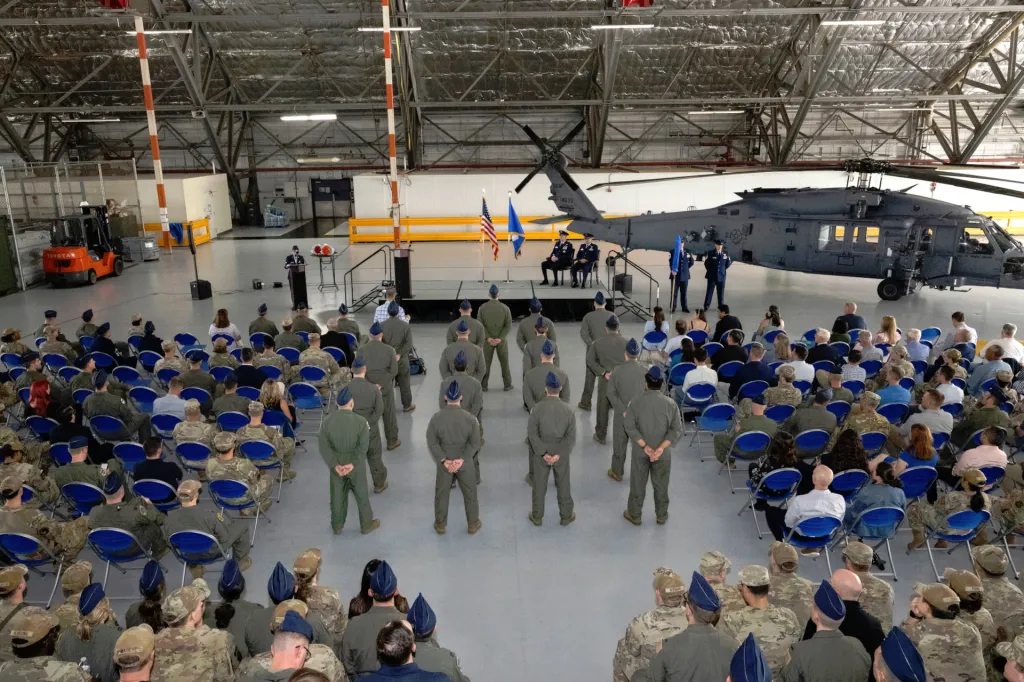
The U.S. Air Force has shared new details about how it will modify a subset of HH-60W Jolly Green II combat search and rescue (CSAR) helicopters to perform the so-called Air Force District of Washington (AFDW) mission set. AFDW HH-60Ws will be tasked with ferrying VIPs around the nation’s capital, as well as supporting continuity of government plans. In the latter role, the Jolly Green IIs will be poised to spirit senior U.S. officials and lawmakers to safety at a moment’s notice to ensure the federal government can continue to function even in the event of an attack or a similarly serious contingency. HH-60Ws were just in the news recently in relation to their primary CSAR mission, having taken part in efforts to rescue the crew of an F-15E Strike Eagle shot down in Iran.

The Air Force currently uses a fleet of aging UH-1N Twin Huey helicopters based at Andrews Air Force Base (technically now part of Joint Base Andrews) to perform AFDW missions. The service had initially planned to replace them with new MH-139A Grey Wolf helicopters, but revealed last year it was considering using HH-60Ws for this role instead. The Air Force’s proposed budget for the 2027 Fiscal Year, which was rolled out earlier this week, confirms that it is officially moving ahead with plans to supplant the UH-1Ns at Andrews with Jolly Green IIs. The service is still procuring and fielding MH-139s, primarily to help provide security around Minuteman III intercontinental ballistic missile (ICBM) silos.

A stock picture of UH-1N Twin Hueys assigned to the 1st Helicopter Squadron at Andrews Air Force Base. USAF
One of the US Air Force’s new MH-139A Grey Wolf helicopters. One of the service’s UH-1Ns in a configuration used to provide security around ICBM silos is seen in the background. USAF The first AFGSC MH-139A at Malmstrom Air Force Base in Montana, with a UH-1N seen flying in the background. USAF

“26 HH-60Ws will replace the UH-1Ns at Air Force District Washington (AFDW) to execute continuity of operations / continuity of government missions in the National Capital Region,” according to the Air Force budget documents. The term National Capital Region (NCR) refers to a larger area that surrounds Washington, D.C., proper.

The baseline HH-60W is a member of the extended H-60/S-70 Black Hawk family produced by Sikorsky, now a wholly-owned subsidiary of Lockheed Martin. The Jolly Green II has a number of distinct features in line with its primary CSAR mission, including a nose-mounted radar, an in-flight refueling probe, and a main cabin with a configuration optimized for the recovery of personnel, including individuals who may be injured. It also has provisions for mounted machine guns for self-defense, as well as launchers for decoy flares and chaff. The first HH-60Ws began entering Air Force service in 2022.

Up close with the HH-60W Combat Rescue Helicopter at Nellis AFB for The War Zone. thumbnail

Up close with the HH-60W Combat Rescue Helicopter at Nellis AFB for The War Zone.


The AFDW “modifications include possible removal of components including, but not limited to, the following: Rescue Team Seat, Isolated Personnel Litter, Gun System, Chaff/Flare Buckets, and Doors/Floor Armor,” per the Air Force’s latest budget request. “In addition, this effort may include, but not limited to, the following modifications to the baseline HH-60W: ARC 210 Gen 6 radios, Infrared Countermeasure (IRCM) system, and alternate seating arrangement.”

Mention here of an IRCM system is worth highlighting. The integration of a built-in infrared countermeasure system onto the HH-60W, in general, has been a particular point of interest for the Air Force for years now. Various IRCM system designs are available on the open market today, all of which are intended to provide added protection against heat-seeking anti-air missiles. For helicopters, these systems provide a particularly valuable extra layer of defense against threats posed by shoulder-fired surface-to-air missiles, also known as man-portable air defense systems (MANPADS).

Earlier this month, the Air Force put out a contracting notice seeking information from contractors about their capacity to integrate either the Common Infrared Countermeasure (CIRCM) system or the AN/AAQ-45 Distributed Aperture Infrared Countermeasure (DAIRCM) system onto the HH-60W fleet. CIRCM is a U.S. Army-managed system now being installed on the service’s UH-60 Black Hawks, as well as other helicopter types within that service. The U.S. Navy manages the DAIRCM program, with those systems being integrated on a variety of helicopters across the U.S. military, including MH-60S Seahawks and VH-60Ns, the latter of which serve in the “Marine One” presidential airlift role. Northrop Grumman and Leonardo DRS are the prime contractors for CIRCM and DAIRM, respectively.

Common Infrared Countermeasures (CIRCM) thumbnail

Common Infrared Countermeasures (CIRCM)


Leonardo DRS: IRCM Technology thumbnail

Leonardo DRS: IRCM Technology


As TWZ has pointed out in the past, it has also been curious that HH-60Ws did not come with an IRCM capability from the start, given the explicit dangers the helicopters have been expected to face when performing CSAR missions. The AN/AAQ-45 system was even previously integrated into the Air Force’s older HH-60G Pave Hawks, which the Jolly Green IIs are replacing.

The risks HH-60Ws face when performing their primary mission were put on full display during the recent rescue efforts in Iran following the F-15E shoot-down. Questions have been raised in the past about the continued utility of traditional helicopters like the Jolly Green II in the CSAR role, broadly speaking, especially in potential future high-end fights, such as one between the United States and China in the Pacific. Air Force officials have said previously that they have been exploring alternatives for retrieving downed aircrew from deep within contested environments, but details about what that might consist of have remained limited.

Wild footage from a USAF C-130 fueling two helicopters over Iran shared by telegram channels. The cars & the dialect are Iranian and from southwest. pic.twitter.com/K9cufOOY26

— Ramin Khanizadeh (@RKhanizadeh) April 3, 2026

Footage of Iranian police firing small arms at a pair of USAF HH-60Ws searching for the downed F-15E crew earlier today. pic.twitter.com/9SwhyhY1Aw

— OSINTtechnical (@Osinttechnical) April 3, 2026

A separate Air Force contracting notice put out earlier this month also provides additional details about the planned AFDW cabin configuration for the HH-60W.

“The AF [Air Force] will remove several components from the baseline 60W to allow for the installation of passenger seats for AFDW. Seating is required for 11 passengers,” that notice explains. “Seating must meet applicable crash and safety requirements including emergency egress.”

The “reconfiguration of [the] interior layout to accommodate [the] seating” will also be done in a way that allows for “preserving critical CSAR equipment (rescue hoist, defensive weapons, medical stations)” that the helicopters will still need for their new role.

Graphics depicting how the HH-60W’s cabin can be configured now for CSAR missions. Lockheed Martin

Just in terms of general speed, range, and payload capacity, the HH-60W will offer a major boost in capability over the UH-1Ns that perform AFDW missions today. The Jolly Green IIs also offer advantages in this regard over the smaller and lighter MH-139s.

In addition, the Air Force has not indicated any plans to eliminate the HH-60W’s aerial refueling capability as part of the AFDW modifications. Neither the UH-1N nor the MH-139 is capable of being refueled in flight.

Combat Rescue Helicopter Successfully Executes Major Test Milestone: Aerial Refueling thumbnail

Combat Rescue Helicopter Successfully Executes Major Test Milestone: Aerial Refueling


All of this could be particularly valuable during continuity of government taskings in the very busy and otherwise complex skies over the NCR. The airspace around Washington, D.C., is also the most densely defended and heavily monitored anywhere in the United States. This was all highlighted in the fatal mid-air collision involving an Army UH-60 Black Hawk and a PSA Airlines Bombardier CRJ700 regional jet in January 2025. The Black Hawk, assigned to a unit at Davison Army Airfield in Virginia, had been conducting a continuity of government training flight.

As TWZ wrote at the time:

The flights could come at any time, including in the dead of night, and, depending on the circumstances, might face a host of other complex environmental factors and other challenging conditions. Power outages could put additional emphasis on the need to use night vision goggles, which impose limits on situational awareness. Attacks involving nuclear, chemical, or biological weapons would prompt the need to wear other bulky protective gear. In the outright rush to evacuate key personnel, the airspace would be filled with large numbers of aircraft, as highlighted by large COG exercises the 12th Aviation Battalion regularly conducts involving dozens of its helicopters.

As is made clear here, Air Force HH-60Ws would not be the only helicopters zooming around the NCR during a continuity of government scenario, either. Marine Helicopter Squadron One (HMX-1), best known for operating helicopters in the Marine One role, would also be involved. Helicopters belonging to the U.S. Park Police, as well as various other law enforcement and civilian agencies, would also have a role to play. You can read more about this here.

Military and police helicopters land at the US Capitol this evening. thumbnail

Military and police helicopters land at the US Capitol this evening.


As mentioned earlier, the AFDW mission set also includes performing more routine VIP airlift sorties on a daily basis.

There is a question of what modifying 26 HH-60Ws for the AFDW role might mean for the operational capacity of the rest of the CSAR-focused fleet. The Air Force’s 2027 Fiscal Year budget request does not show any plans to procure additional Jolly Green IIs to meet this new need in the nation’s capital. Years ago, the service already made the decision to scale back purchases of HH-60Ws, down from an original program of record for 113 of the helicopters. The total planned fleet size now looks to be 91, per the recently released budget documents. Without the acquisition of more Jolly Green IIs, this would mean that roughly 30 percent of the entire fleet is set to be re-roled away from the dedicated CSAR mission.

“It is more cost effective to modify previously procured HH-60Ws contained in back up inventory than to procure additional MH-139A aircraft,” an Air Force spokesperson had told Air & Space Forces Magazine last year when asked about the Air Force’s evolving plans for the AFDW mission set.

As it stands now, per the service’s latest budget request, the Air Force is looking to kick off formal development of the AFDW configuration for the HH-60W in Fiscal Year 2027, which begins on October 1 of this year. The goal is then to start refitting Jolly Green IIs for this role in the 2028 Fiscal Year.

Once modified, the specifically configured HH-60Ws will then begin taking over critical AFDW missions from the aging UH-1Ns at Andrews.

Contact the author: joe@twz.com

Joseph has been a member of The War Zone team since early 2017. Prior to that, he was an Associate Editor at War Is Boring, and his byline has appeared in other publications, including Small Arms Review, Small Arms Defense Journal, Reuters, We Are the Mighty, and Task & Purpose.


Source link