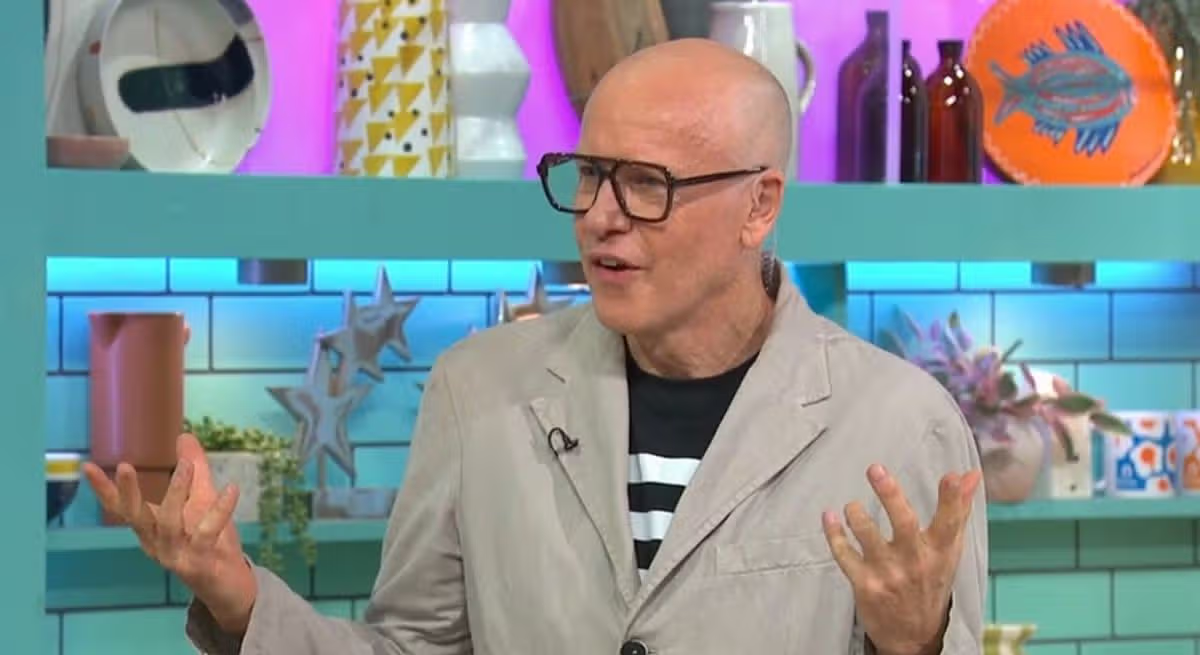
EXCLUSIVE: Kieran McCartney has revealed what fans don’t see on The Apprentice including what Lord Alan Sugar, Baroness Karren Brady and Tim Campbell are really like
Dan Laurie Deputy Editor of Screen Time
07:00, 02 Apr 2026
The Apprentice has been on our screens for over two decades(Image: PA)
Kieran McCartney has revealed what the BBC bosses don’t show on The Apprentice.
The estate agent from East London is one of the eight remaining candidates in the running to become Lord Alan Sugar’s next business partner.
Last week, he put his neck on the line by cutting a dramatic “win or walk” deal with the business tycoon to save himself from being fired.
He’s the first contestant in the BBC show’s 21-year history to make a pact with Lord Sugar that he would lead the next task to victory – or walk away.
As fans wait to see the outcome of the bold move, Kieran’s shared some behind-the-scenes secrets including what Lord Sugar and his aides Baroness Karren Brady and Tim Campbell are really like.
“Those boardroom showdowns are as real as it gets,” he explained, before adding: “Everything is done in one take and they film everything once and once only. It’s all real and raw.
“What you see is what you get. Karren’s [Brady’s] very strong but a big softy and she grows on you.
“[Lord Alan] Sugar had lots of banter and I love that so I was giving it back to him. I don’t think anyone’s ever given back to the way I did and Tim’s just a lovely guy.”
Baroness Brady joined The Apprentice as one of Lord Sugar’s aides in 2010 replacing Margaret Mountford and Tim won the first series of The Apprentice in 2005 taking over Claude Littner in 2022.
Kieran went on to share exactly how much time he spent with Lord Sugar’s trusted advisors during the process.
He added: “When you split into your two teams, you then go into further two teams so there’s four groups overall.
“Karren and Tim spend the morning with one group and the afternoon with the other and then you see them in the boardroom.
“They kind of just sit there but I’m not sure they actually write anything down like you see on camera.”
To remember his ultimatum, Kieran has had a tattoo on his leg of Lord Sugar, Baroness Brady and Tim’s faces with the words “The Apprentice 2026” and catchphrase “win or walk”.
Addressing his thinking process behind his bold offer, he joked: “Lord Sugar will either love my tattoo or send me a legal letter.”
He continued: “I’d love to sit here and say it was all part of a bigger plan but it was a total impulse.
“I thought I was a goner and was going home, it was a last resort and I just came out with it.
“I had to make that deal with Lord Sugar to survive and I put my neck on the line. It was a one-off, never been done and that’s a bit of me.”
Kieran McCartney was speaking to BestBettingSites.co.uk – the leading comparison site for casino sites and The Apprentice airs Thursdays on BBC One and BBC iPlayer at 9pm
Imagine waking up early, eager to peep dazzling carpets of brilliant orange flowers at the Antelope Valley California Poppy Reserve. Instagram posts promised a spectacle.
You drive to the reserve north of Los Angeles, but the rolling hills aren’t alive with color.
Bummer. The bloom is over.
Thanks to AI, and a local scientist, such disappointment may soon be a thing of the past.
This year, Steve Klosterman, a biologist who works on natural climate solutions, launched a “wildflower forecast,” powered by a deep-learning model, satellite imagery and weather data.
In a sense, Klosterman, of Santa Monica, developed the tool to meet his own need.
Last spring, the Midwest transplant was hankering to see some wildflowers. He assumed there was some online resource that offered predictions or leveraged satellite images.
“Surely, there must be something,” he recalled thinking. “But there was nothing.”
There are tools. The state reserve operates a live cam trained on one swath of land. Theodore Payne, a California native plant nursery and education center, runs a wildflower hotline, where people can call in and hear weekly recorded reports on hot spots.
“These are all essential resources,” Klosterman said. “At the same time, they’re limited.”
Klosterman isn’t green when it comes to plants. His PhD, at Harvard, focused on the timing of new leaves on trees in the spring and color change in the fall.
For a class project, a team he was part of built a website that predicted those leaf changes in the Boston area. It was a hit.
California poppies bloom in Lancaster, near the state natural reserve, in mid-March.
(Kayla Bartkowski / Los Angeles Times)
To create the poppy bloom predictor, Klosterman turned to AI initially developed for medical imaging. He has harnessed it to instead analyze satellite images of the Antelope Valley.
The model scans 10-by-10-meter squares of land to determine whether poppies are present by their telltale orange color. (It also identifies tiny yellow flowers called goldfields.)
The model is trained on satellite images — which go back nine years — along with past weather data.
It then uses the current forecast, and recent flower status, to peer into the future.
If the mercury is going to hit 100 degrees and wind is picking up — and in previous years that led to withering flowers — that will guide the prediction.
Right now, the model can forecast five days out and is, as Klosterman puts it, “very much a work in progress.” It would be better, more powerful, if it had 100 years to learn from.
As more data are collected, it might someday be able to forecast a week or two out.
Right now, poppies are popping at the reserve in the western Mojave Desert.
It rained throughout the fall and into winter, and poppies need at least seven inches of rain to make a good showing, said Lori Wear, an interpreter at the reserve.
Snowfall in January seems to push them to another level, but that didn’t happen this season. So it’s a good bloom, but not extraordinary, she said.
Still, poppies — California’s state flower — blanket swaths of the protected land.
“It almost looks like Cheeto dust,” she said, “like somebody had Cheetos on their fingers and just smeared it on the landscape.”
Poppies here have typically peaked around mid-April, but variable weather in recent years has made it hard to predict, she said. Klosterman believes right now is likely the zenith.
Also blooming now: goldfields, purple grape soda lupine and owl’s clover. Wear described the latter, also purple, as looking like a “short owl with little eyes looking at you and a little beak.”
An SUV drives through blooms near the reserve. “It almost looks like … somebody had Cheetos on their fingers and just smeared it on the landscape,” said Lori Wear, an interpreter at the reserve.
(Kayla Bartkowski / Los Angeles Times)
On Sunday, Klosterman experienced the blooms for himself, using his technology as a guide.
It offers predictions in two forms. The first is the amount of the valley — shown in a satellite image — covered in poppies and goldfields, expressed as a percentage. The other is an overlay of orange and yellow splotches on the land.
The map showed a fairly high concentration of poppies near a stretch of Highway 138. He went there and, lo and behold, vibrant flowers awaited him. He sent proof: a smiling selfie in front of a sea of blossoms.
Klosterman’s tool may help answer arguably more complex questions than poppy or no poppy, such as a more precise understanding of the conditions the flowers need to thrive.
Experts know rain is key, but it’s more complicated than that.
Steve Klosterman takes a selfie in a field of California poppies.
(Steve Klosterman)
Heavy rain can supercharge invasive grasses, crowding out the blooms. Natives actually tend to do better after several years of drought, once invasives not adapted to the arid climate die out. That’s what led to an epic superbloom in 2017, Joan Dudney, an assistant professor of forest ecology at UC Santa Barbara, told The Times in 2024.
Klosterman wondered if the recent heatwave would desiccate them. But his model didn’t show that, and neither did his trip. So it’s possible other factors play a significant role in their persistence, such as length of day.
The model could also shed light on what could happen to the flowers as the climate warms. Will they migrate to the north? Will there be fewer blooms?
To game that out, Klosterman said you could invent and plug in a weather forecast with higher temperatures.
For now, Klosterman’s forecast is limited to the Antelope Valley. But if it expands to other areas, and other flower types, it could help people like Karina Silva.
Silva woke up at 5 a.m. last Wednesday to travel from her Las Vegas home to Death Valley National Park, hoping to beat the heat and the crowds to the superbloom.
But several hours later, she and her husband, David, were still trying to find it.
The hillside behind her was sprinkled with desert golds, but the display fell short of the riotous eruption of flowers posted on social media. The superbloom ended in early March, according to park officials.
“I was just thinking it was going to be this explosion of different colors,” Silva said by the side of the road overlooking Badwater Basin.
WITH new travel requirements in action at airports across Europe, EES is set to cause travel chaos this summer.
While you’re likely to be caught up in the chaos and lengthy queues, there are a few ways to make it more manageable.
Sign up for the Travel newsletter
Thank you!
If you’re heading on holiday – you might get caught up in EES delaysCredit: AlamyThere have been reports of queues up to four-hours long to get through passport controlCredit: Alamy
With many Brits yet to register for EES, it’s predicted that those heading abroad for the summerholidays will be privy to delays.
Some destinations even out of season have reported queues of up to four hours.
These include airports at Brussels, Lisbon, Prague and Lanzarote.
So while you might not beat the queues – here are some tips from Sun Travel to make your next trip easier.
So if you get an early flight, there’s less likely to be a backlog.
Whereas if you’re travelling in the early evening, there could still be passengers being processed who are plenty ahead of you.
Anticipate delays
If you are taking a connecting flight, we’d advise to anticipate delays.
Of course this varies from airport to airport, but some travellers might find it will take longer to get through because of the EES requirements.
Similarly, if someone’s collecting you perhaps give them a bit more time – especially if they’re in one of the pick-up zones that costs money.
Queues at Lanzarote Airport were up to 3-hours long for one Sun Travel reporter
Go for a bigger airport
If you can go to a bigger airport and take a longer road transfer, it could be worth it.
At a larger airport there’s likely to be more EES machines than at one of the smaller ones.
For example, Assistant Travel Editor Sophie Swietochowski found there were plenty more of the machines in Spain‘s Alicante Airport than in Austria‘s Salzburg.
So if you can fly into to a main hub and then continue from there, it could make your journey through the airport quicker.
Bring entertainment
If you have children, or are generally just bored of queues (and who can blame you?) – think about entertainment.
It could be worth setting the kids up with an iPad or something that will keep them occupied.
Also, bring a reserve of snacks because standing in line means no access to the airport’s cafes and shops.
Get into the priority lane
For those who are disabled, make sure to let the airline know in advance as you would usually.
After landing, staff should escort you straight through to the front of border control queues.
Many major airports offer priority family lanes at passport control for families with young children (usually under 12 years old).
Use the plane facilities
Quite simply, if you are going to be waiting in line for yours, then you want to be comfortable.
So before landing, go to the toilet on the plane.
If you’re queueing along corridors before heading into border control, then the chances are there won’t be access to toilets.
Here’s what you should expect to find when you get to an EES machine…
Select your language
Put your passport into the machine
Place your fingers onto the scanner
Look into the camera
Answer series of short questions about the trip e.g. where you’ll be staying, if you have a return journey booked and confirmation of travel insurance
Davina McCall and Joel Dommett hosted BBC Comic Relief’s Red Nose Day special, with the TV presenter forced to caution viewers
Davina was forced to issue a warning to viewers(Image: BBC)
BBC Comic Relief’s Davina McCall found herself compelled to issue a warning to viewers just moments into the programme.
The charity fundraiser made its annual return to our telly screens on Friday (March 20) evening, as the Red Nose Day squad tackled the biggest night in comedy and entertainment.
TV favourite Davina took on presenting responsibilities, joined by co-host and close mate Joel Dommett for the entire evening’s entertainment.
They were joined by comedic luminaries such as Katherine Ryan, Nick Mohammed and Catherine Tate (reprising her role as Nan from The Catherine Tate Show).
This year’s live broadcast once again brought more energy and enthusiasm than ever before. The three-hour extravaganza kicked off with a special message from Sir Lenny Henry, who retired from his hosting duties back in 2024, and a musical number from Catherine Tate, reports Wales Online.
However, early into the proceedings, Davina found herself obliged to issue a warning to viewers when the cast of The Play that Goes Wrong provided a step-by-step guide on how to donate to Comic Relief during the show.
The programme switched to a clip of the cast performing a skit involving some perilous stunts. Following the clip, Davina began by saying: “Thank you so much to the cast of the Play that Goes Wrong. Smashing… literally.
“The actors used specially designed fake props and are all professionally trained in the art of tomfoolery.”
She cautioned: “Please do not try anything that you saw at home, especially taking a swig from the bottle marked with a warning and skull and cross bones label.” Joel chimed in: “Don’t do that.”
The charity event, held at Salford’s MediaCity, showcased sketches from Amandaland, the Bank Job featuring the dynamic This Morning pair Dermot O’Leary and Alison Hammond, and The Traitors: The Movie – The Sequel.
Communities, workplaces, schools and families have contributed to raising more than £1.6 billion over the past 41 years, benefiting over 100 million people, according to Comic Relief.
The charity has been instrumental in supporting communities by offering food, healthcare and shelter to those most in need. Meanwhile, Greg James participated in a colossal Comic Relief challenge, which saw him raise over £4million.
He embarked on his journey from Weymouth on Friday 13 March. The star endured eight gruelling days of pushing himself to the extreme, cycling through England and Wales before crossing the finish line in Edinburgh on Friday 20 March.
Comic Relief: Funny For Money is available to watch on BBC iPlayer.
Experts say people should be checking their passports immediately to make sure they are still valid, as the window for standard renewals is already beginning to tighten. With Easter Sunday falling on April 5 this year, travellers who have not yet checked their passports may already be close to the usual processing deadline for standard applications.
According to official government guidance, most UK passport applications are usually processed within three weeks or less, although travellers are advised to apply well before their trip whenever possible. A standard adult passport renewal currently costs £94.50 when applying online, while applications submitted using a paper form cost £107.
However, if you leave this too late, urgent processing services mean prices rise sharply. The government’s Premium one-day passport service, used for urgent adult renewals, now costs £222, more than twice the price of a standard online application.
Andrea Platania, travel expert at Transfeero, says the weeks leading up to Easter are a common moment when travellers suddenly realise their documents may need attention. It is then a race against time to make sure they can still travel.
He says: “Easter trips often creep up on people. Many families book their flights weeks or even months earlier, then only check their passports when they start preparing for the journey.”
According to Andrea, discovering a passport issue close to departure can quickly complicate travel plans. “Renewing a passport is normally straightforward if you give yourself enough time,” he says. “But when travellers realise just a few weeks before departure that their passport has expired or does not meet entry requirements, the situation becomes much more stressful.”
Because standard applications can take around three weeks to process, travellers who are planning to leave the UK around the Easter period may now be close to the point where urgent services become the only realistic option. Urgent passport services require travellers to attend an appointment at a passport office.
The Premium one-day service can provide a renewed passport within hours of the appointment, but the convenience comes at a significantly higher cost. Andrea says this situation is surprisingly common during busy travel periods.
“People often assume passport renewals can be sorted out quickly at the last minute,” he explains. “But if the departure date is already approaching, travellers may find themselves forced to use urgent services that cost far more than the standard application.”
He advises travellers to treat passport checks as one of the very first steps when planning any international trip. He said: ” “When you start looking at flights and accommodation, that is the moment to check your passport. If it needs renewing, doing it early keeps the process simple and affordable.”
He also notes that some countries require passports to remain valid for several months beyond the date of travel, meaning a passport that appears valid may still not meet entry rules, warning: “That is another detail people often overlook. A passport might technically still be valid, but it may not meet the entry requirements of the country you are visiting.”
With Easter travel approaching quickly, Andrea says travellers who have not yet checked their passports should do so as soon as possible. “A quick check today can prevent a lot of stress later,” he says. “If your passport needs renewing, acting early helps you avoid both the pressure and the much higher cost of urgent processing.”
March 13 (UPI) — Secretary of Defense Pete Hegseth downplayed the shutdown of the Strait of Hormuz during a press briefing Friday and claimed 15,000 Iranian targets have been struck.
Hegseth said the U.S. and Israeli air forces are flying over Iran and Tehran Friday, the 13th day of the operation. He claimed that Iran’s air defenses, navy and munitions supply have been defeated.
Iran’s missile volume was down by 90% and its one-way attack drones were down by 95% on Thursday, Hegseth said.
“Today as we speak we fly over the top of Iran and Tehran,” Hegseth said. “Fighters and bombers, all day picking targets as they choose.”
The defense secretary opened Friday’s briefing at the Pentagon, joined again by Gen. Dan Caine, saying that the United States is “decimating the radical Iranian regime’s military in a way the world has never seen before.”
“We said it would not be a fair fight and it has not been,” he said.
Caine lauded the use of the first precision-strike missiles used in combat by the United States, praising the troops that fired them. One of those soldiers was 20 years old and has only been in the U.S. Army for six months.
Caine’s comments on the precision of U.S. strikes come as the military is investigating a deadly strike on an elementary school for girls in Iran that took place on Feb. 28. The preliminary investigation has found that the United States is likely responsible for the attack that killed more than 170 people, most of them children.
“They’ve done all of this with the precision and determination that comes from relentless training and trust in each other and their weapons systems,” Caine said.
Hegseth said the United States is “dealing with” Iran’s attacks on vessels on the Strait of Hormuz, which has dramatically disrupted the oil trade.
“It’s something we’re dealing with, we have been dealing with it and don’t need to worry about it,” Hegseth said. “We’re on plan to defeat, destroy and disable all of their meaningful military capabilities on a pace the world has never seen before.”
Caine later said that there is some traffic moving through the strait.
As Iran’s military capabilities weaken, Hegseth said, more importantly, it does not possess the capability to build more weapons.
“Soon and very soon all of Iran’s defense companies will be destroyed,” Hegseth. “For example, as of two days ago, all of Iran’s ballistic missile production capacity, every company that builds every component of those missiles, has been functionally defeated, destroyed.”
As for Iran’s new supreme leader, Mojtaba Khamenei, Hegseth said he is “likely disfigured.” Khamenei was wounded during the initial strikes by the United States and Israel on Tehran on Feb. 28, which killed his father, former supreme leader Ali Khamenei.
President Donald Trump shared similar speculation about the new supreme leader on Fox News on Friday, saying he believes he is alive but “damaged.”
“I think he probably is,” Trump said. “I think he’s damaged but I think he’s probably alive in some form.”
President Donald Trump speaks during an event celebrating Women’s History Month in the East Room of the White House on Thursday. Photo by Bonnie Cash/UPI | License Photo
The armed wing of Hamas, Al-Qassam Brigades, released a video message on Wednesday afternoon showing an Israeli captive currently held in Gaza, the Palestinian Information Centre has reported. The footage shows Omri Miran lighting a candle on what he described as his “second birthday” in captivity.
“This is my second birthday here. I can’t say I’m celebrating; it’s just another day in captivity,” said Miran. “I made this cake for the occasion, but there is no joy. It’s been a year and a half. I miss my daughters and my wife terribly.”
He addressed the Israeli public directly, including his family and friends. “Conditions here are extremely tough. Thank you to everyone demonstrating to bring us home safely.”
The captive also urged Israelis to stage a mass protest outside Prime Minister Benjamin Netanyahu’s residence. “Bring my daughters so I can see them on TV. Do everything you can now to get us home. Netanyahu’s supporters don’t care about us, they’d rather see us dead.”
Screengrab from footage shows Israeli captive Omri Miran
He asked captives released in previous prisoner exchange deals to protest and speak to the media. “Let the people know how bad it is for us. We live in constant fear of bombings. A deal must be reached soon before we return home in coffins.
Miran urged demonstrators to appeal to US President Donald Trump to put pressure on Netanyahu: “Do not believe Netanyahu. Military pressure is only killing us. A deal — only a deal — will bring us home. Turn to Trump. He seems to be the only powerful person in the world who could push Netanyahu to agree to a deal.”
He also mentioned the worsening humanitarian situation: “The captors told me the crossings are closed; no food or supplies are coming in. As a result, we’re receiving even less food than before.”
In conclusion, the captive sent a pointed message to the Israeli leadership: “Netanyahu, Dermer, Smotrich, Ben Gvir — you are the reason for 7 October. Because of you, I am here. Because of you, we’re all here. You’re bringing the state to collapse.”
HILARY Duff broke down in tears as she laid bare the heartbreaking feud with her sister.
The So Yesterday hitmaker – who is in the midst of a huge pop revival with new album Luck … Or Something – admitted the pair “don’t speak”.
Sign up for the Showbiz newsletter
Thank you!
The heartbreaking moment Hilary Duff broke down in tears over her years-long feud with her sister has been captured on a new podcastCredit: YouTube/Jay Shetty PodcastThe So Yesterday chart star admitted she and elder sibling Haylie Duff ‘don’t speak’Credit: GettyHilary opened up on the ‘raw’ nature of their bond on Jay Shetty’s On Purpose podcastCredit: YouTube/Jay Shetty Podcast
Hilary, 38, first referenced bad blood with her actress and singer sibling Haylie, 41, in her album track We Don’t Talk.
The track also tellingly samples Gotye song Somebody That I Used To Know.
In a new podcast chat with Jay Shetty, she explained the delicate situation and how the ongoing drama is a “raw part of my existence”.
Hilary, who previously starred with her big sister on the pair’s infamous Lizzie McGuire TV show, fought back tears as she told the On Purpose podcast: “My sister and I don’t speak.
“And I think in my adulthood I’ve come across more and more people that are having this experience”.
She branded the situation as “a very raw part of my existence’ before she added: “I hope it’s not forever, but it’s for right now”.
Hilary said: “As painful as it feels to share, when I decided to make this record, I could only talk about the things that I’ve gone through.
“Like there would be no purpose to make a record after 10 years than to face, you know, what it’s been like.
“That’s my truth.
“And I really worked hard to lyrically make sure that I’m just speaking about my experience, you know?”
The sisters haven’t been seen together in public since 2019.
Mum of four Hilary is re launching her pop careerCredit: GettyHer new album Luck … or something features track We Don’t TalkCredit: GettyShe has confirmed the track centres on their strained relationsCredit: Getty
During her recent concert in London, Hilary introduced fans to the new song, We Don’t Talk.
In a clip of her performing the song on stage, she sung: “Don’t know when it happened / Not even sure what it was about,” alluding to their broken down relationship.
She continued: “Cause we come from the same home, same blood.
“People ask me how you’re doing / I wanna say amazing, but the truth is that I don’t know / What I always end up saying is how … ”
For the chorus, Hilary sung: “We don’t talk, we don’t talk about it / We don’t talk about anything anymore.”
It is in the second verse that Hilary alluded to sibling rivalry.
“And if it’s ’cause you’re jealous / God knows I would sell it all, then break you off the bigger half,” she sung.
A fan then took to social media to put: “WOWW… Hilary Duff just sung We don’t talk and it’s 100% about Haylie. But not mean at all. Basically telling her to reach out.”
Another agreed and put: “I think Hilary misses her sister!”
In another interview, she confirmed the spat was the source material for her track.
“Yeah, it is. It’s definitely about my sister,” Hilary admitted.
After years of silence, back in November Hilary seemingly addressed the feud between her and her sister while chatting about “family drama”.
Speaking to Rolling Stone about her musical comeback, the star said she feels “ready to fill in the blanks and share with people and connect with them on the level of now”.
She then told the outlet how she and her fans have gone through twists and turns and “have gone through a lot of the same things”.
“Whether that’s complicated relationships, anxiety, raising kids, divorces, trying to find yourself in adulthood, family drama…
“Finally I felt safe enough and comfortable in my own family to step outside and open that part of myself up again,” she explained.
Chatter previously swirled that the pair, who were once very close, weren’t getting along because of differing political views.
However, social media gossip page DeuxMoi claimed that the sisters fought over Hilary’s husband,Matthew Koma, butting heads with Haylie’s husband, Matthew Rosenberg.
The pair haven’t been seen together in public for yearsCredit: GettyRumours have suggested Hilary’s husband Matthew Koma does not get on with her sister’s spouseCredit: GettyThe bubblegum pop singer has released a new album and tourCredit: Getty
Holloway, 34, first did the point-down against Ricardo Lamas in 2016, while he repeated it against Dustin Poirier last year in becoming the first fighter to defend the BMF title.
In every fight Holloway has initiated the point-down, he has been up on the judges’ scorecards and closing in on a win, meaning he has given opponents one final opportunity to steal victory.
“My coaches aren’t a fan of it, they want me to circle away, stay away and be smart for the 10 seconds,” said Holloway.
“But they come up with great game plans and we execute it to that point. So let me have my 10 seconds of fun, you know. If I’m on the wrong end, then so be it.”
Fans imitate the gesture during meet-and-greets with Holloway, while fellow fighters have also copied it during bouts.
Charles Oliveira, who faces Holloway for the BMF title at UFC 326 in Las Vegas on Saturday, has even been filmed training for the edge-of-your-seat exchange which follows the point-down.
Holloway has created a set of rules for any fighter, including Oliveira, planning to initiate the point-down.
“If you’re winning the fight, you are the person who can call the 10 seconds. And then when you call the 10 seconds, you cannot step back, or shoot or clinch,” said Holloway.
“The other guy, if he obliges and then shoots or clinches, whatever, because he’s on the losing side already.”
Her gleeful cruelty was matched only by the audacity of her incompetence.
Packaged in cosplay costumes — cowgirl, solider, even firefighter and pilot — we were supposed to see her as strong. But far from the mother of dragons she seems to envision herself as, she came across as the killer of Cricket (poor pup), a childish narcissist in a deadly serious job.
From late-night talk shows to the halls of power, there was more than a bit of celebration, and some actually reasonable schadenfreude. Normally, the misfortune of others isn’t something I pile on, but oh, did that woman earn some scorn.
But while I’m not one to discourage a moment of joy in these troubling days, Noem’s unceremonious firing and what comes next likely won’t provide the relief and reset many are hoping for — or are claiming this is. For all the chaos and pain that federal agents from various departments have caused under Noem’s leadership, there’s every reason to believe Trump has plans to continue and even expand his deportation efforts, and maybe even use these poorly trained, poorly vetted troops to impose his will on the next election.
What we are witnessing, rather than any acknowledgment of policy gone awry, is spotlight envy from a petty president who doesn’t like to share attention, and a backroom concession that maybe optics do matter when you’re attempting to cram white nationalism onto a pluralist country.
It was, according to Fox News and other media, a claim under oath that Trump authorized Noem to spend more than $200 million on commercials promoting herself instead of him that got her canned. Pointing to just how deeply unpopular Noem made herself even within the Trump-verse, this death knell came courtesy of a set-up by a GOP senator, John Kennedy (R-La.), who walked Noem to her own demise with awe-inspiring political skill.
After forcing Noem to claim on the record multiple times that Trump knew about and approved the mega-spend on Noem’s ludicrously over-produced ads (while also raising questions about the contract and who benefited), Kennedy — almost certainly knowing Trump would see it — laid this dig on her with dripping Southern knife-in-the-back charm.
“To me, it puts the president in a terribly awkward spot,” Kennedy drawled, likely implanting grievance directly into the president’s brain. “I’m not saying you’re not telling the truth. It’s just hard for me to believe, knowing the president as I do, that you said, ‘Mr. President, here’s some ads I’ve cut, and I’m going to spend $220 million … running them,’ that he would have agreed to that.”
Soon after, Trump posted on social media that Noem was out. I bring this up because it wasn’t, after all, the substance of Noem’s actions that ultimately got her fired. In that same hearing on Capitol Hill, Democrats blasted Noem for the deaths of Alex Pretti and Renee Good in Minneapolis and her subsequent false portrayal of them as domestic terrorists; the conditions inside our ever-expanding network of detention centers that have led to deaths; and even her mile-high airplane bedroom where she may or may not be conducting an extramarital affair.
None of that seems to have bothered Trump. It was her self-promotion. And it was that same self-promotion, the constant demanding of attention, that likely also ultimately convinced those around Trump to dump her — because it was adding to the deep unpopularity of immigration roundups that have been dragging down Trump’s approval ratings and which therefore could hurt the midterm chances of down-ballot Trumpers.
Last month, a Quinnipiac poll found that 58% of voters wanted Noem removed, and almost 60% of voters disapproved of Trump’s immigration policies.
Noem was the public face of that disapproval, strutting forward with arrogance in the face of public censure, a veritable clown show of ineptitude. With her ouster, and the possible replacement by another Trump stalwart, Oklahoma first-term Sen. Markwayne Mullin, Trump removes the most visible and annoying sign of the unpopularity of his policies.
While pugnacious (he’s a former MMA fighter) and happy to create his own questionable headlines, Mullin is also far more low-key than Noem, and knows who the spotlight belongs to. He is almost certain to put a more palatable face on deportations and detentions (for some anyway) simply by not being so thirsty for press. A low bar, but there you have it.
But Mullin has made it clear that he backs the most extreme immigration policies Trump world can offer, and has little difference of opinion from Stephen Miller, the architect of this bleak moment, who seems to be running things slightly off screen.
The risk now is that Mullin can continue these policies, even expand them, with less scrutiny simply because he’s less offensive than Noem. Detention centers are being built at breakneck speed. In Arizona, ICE has begun charging legal immigrants with a Cold War-era law if they don’t carry their papers with them at all times. The Department of Justice is gutting the ability to appeal deportations, in an effort to hasten them without recourse. Nothing is changing — except the speed and force with which ICE is moving forward.
And Trump has doubled down on claims that illegal immigrants are responsible for massive voter fraud, laying the groundwork for some sort of intervention in the upcoming election. Election deniers have been installed in key positions — Mullin himself is one of them.
So far from a reset, Noem’s removal is a retrenching — an effort to remove our focus from the deeply troubling link between immigration policy and the threat to democracy while actually grinding forward on that dark path.
Because Noem was a train wreck we couldn’t help but watch, at a moment when the government would prefer we stop looking.