California loses a ‘hummingbird’ but the movement lives on
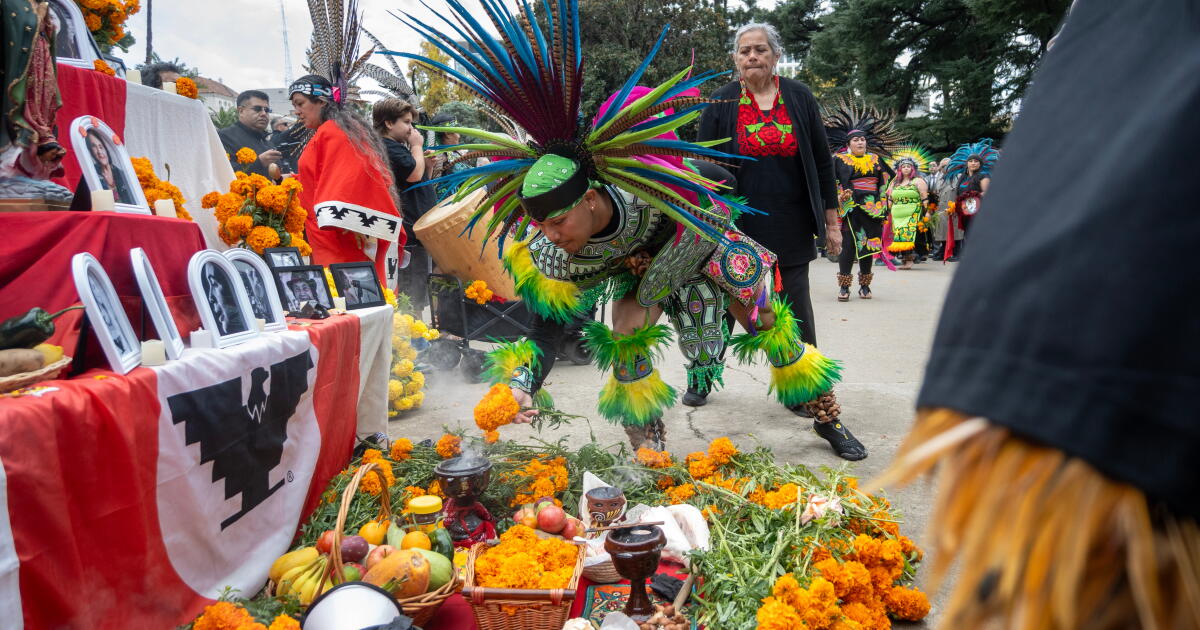
SACRAMENTO — The scent of marigolds filled the Sacramento park where family and friends gathered Monday to honor Dolores Huerta, union icon and mother of the “¡Sí, se puede!” rallying cry that shaped modern civil rights fights in California and across the country.
Somehow, this sweet, sad perfume — so powerful not even a stormy breeze carried it away — was the perfect tribute for a woman whose courage, beauty and resolve changed the course of history, time and again.
“We felt like she was a hummingbird,” her youngest daughter, Camila Chavez, told me. “You know, really small, but a force of energy.”
The bright orange flowers were stacked nearly a foot high on the lawn, waiting to be collected one at a time by mourners walking to the Capitol, where later in the day Huerta was honored in a ceremony. There, her casket was placed before 14 wreaths in the rotunda, the only woman in California history to be given that honor.
Rep. Nancy Pelosi spoke and said some nice, solemn things, as did the leaders of the Legislature and Gov.-elect Xavier Becerra. But it was in the park where Becerra spoke from the heart.
“For me, Dolores Huerta means much more than a woman who fought,” Becerra said in Spanish — a reminder that his title as the first elected Latino governor of the state is more than just trivia. It’s a history built on fighters like Huerta.
“From the time I was a boy, I only knew her as Lola, my Tía Lola, until I learned her real name was Dolores,” Becerra said, still in Spanish. “I started to wonder why anyone would name a person Dolores, which means ‘sorrows.’”
Then, he said, he began to understand that the ability to bear sorrow, hers and others, was her power and her gift.
“She was a leader who never stopped,” Becerra said. “To me she represents the sorrows of so many, carried so that all of us could move forward. What she left us is the ability to absorb that pain, because the struggle has to go on.”
After a gubernatorial campaign of safe blandness, it was the truest glimpse of Becerra I have seen, as if speaking of Tía Lola under the pensive gray sky that would release a thunderous downpour hours later was too real a moment for political patina.
This group that came to walk with Huerta to the Capitol one last time wanted nothing of pomp, but only the simple camaraderie that true grief brings, the straightforward truth and dignity that Huerta embodied.
“I think it’s just important to acknowledge how she was able to create a community and stand up for other people’s rights and hers,” Tola Shear told me. She’s a middle-schooler from Dolores Huerta Middle School, a few miles away. She held a sign with an image of Huerta with her famous “Huelga” sign above her head and a quote: “We must use our lives to make the world a better place to live, not just to acquire things.”
Huerta, Camila Chavez said, had first walked into the Capitol 60 years ago, as a 25-year-old woman when you could count the number of elected women on one hand. She was a lobbyist, one of only two women to hold that job at the time, Chavez said. She remembers her mother running for the Greyhound bus in Stockton where they lived, trying to catch it in time to make it to Sacramento after pushing her kids out the door for school.
Chavez, who is now the executive director of the Dolores Huerta Foundation, said life with a mom like Huerta, constantly on the go, wasn’t always easy.
“As children, it was very challenging, right, to be raised by a mother who was often absent,” Chavez told me. “It wasn’t until we became adults that we really understood the reason and the sacrifice and came to terms with the sacrifice that we also made.”
By 1966, Huerta had learned how power works and wasn’t content just asking for rights. On Easter that year, she arrived on the Capitol steps with thousands of workers after a 300-mile, history-making march. Then-Gov. Pat Brown had decamped for Palm Springs, but Huerta spoke to him anyway.
“You cannot close your eyes and your ears to us any longer,” she said in her speech, though only snippets of it have been saved. “You cannot pretend that we do not exist.”
Sixty years later, in August, she made her last pilgrimage to the Capitol at age 96.
It’s no longer a Capitol, or a state, where there is any question that Latinos exist. Besides Becerra, Robert Rivas, the grandson of a farmworker, heads the Assembly, and Monique Limon, daughter of Mexican immigrants, leads the Senate.
When the new class of legislators is sworn in next year, half will be women — the first time there has ever been gender parity.
I remember seeing Huerta on the steps during that last visit at the end of summer. She was speaking in favor of a bill that would break up healthcare monopolies, jaunty in a bright blue suit and black sneakers. She was vibrant and strong, and it seemed like she would live forever.
Of course, no one does. But sometimes, what we build survives.
“By creating the saying “Si se puede,” that’s going to go a long way,” Ronnie Lopstain told me as he gathered marigolds for the march.
Lopstain was in the farmworkers union in the 1970s, he said, and wore a vest covered in buttons from those days. As it is for so many, si se puede is more than a chant to him. It’s a way of life that encompasses a “mentality and the motivation” to fight for change, he said.
“It’s going live forever,” Lopstain said.
Three words that embody every underdog’s battle for something better, every fight too important lose, every impossible cause that can’t be stopped once it’s started.
Three lasting words that Huerta gave us, to hold our sorrow and our strength, even when she’s gone.