dollar

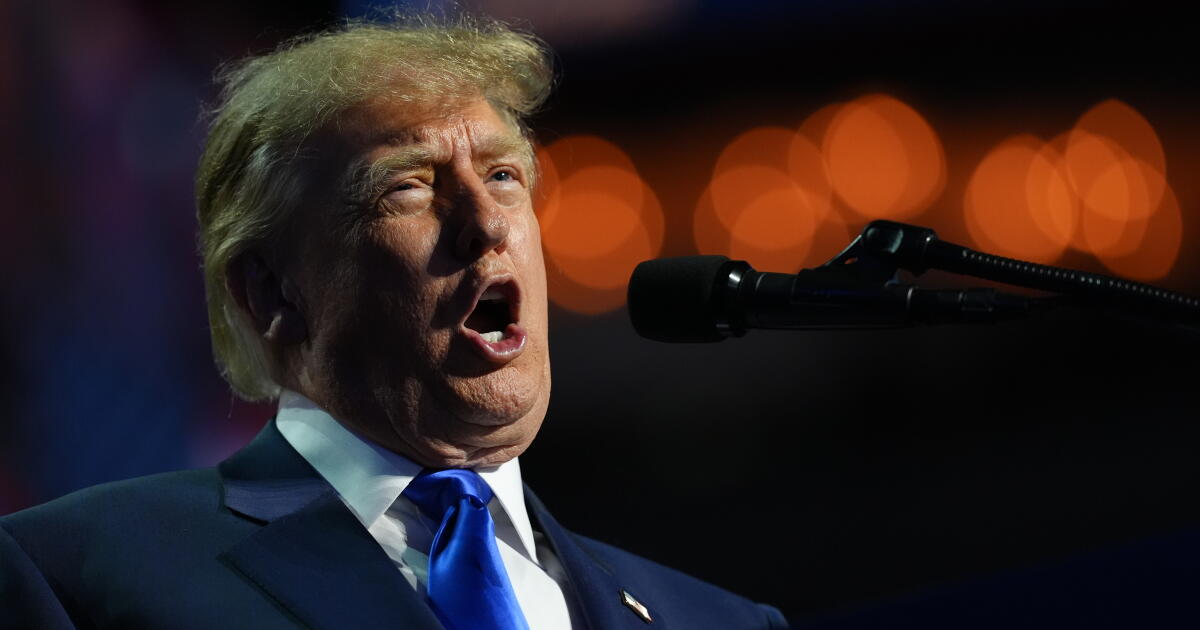
Column: Trump loves to throw around taxpayers’ money

Donald Trump Jr. has a lot more in common with his dad than just a name, sharing the president’s penchant for shady dealings and for kleptocratic Russians. Sometimes the two proclivities go together. That was the case in May, we learned this week from ProPublica, when Don Jr. married his second wife during a three-day Bahamian bacchanal bankrolled partly with hundreds of thousands of dollars from a Putin-allied oligarch the Trump scion met only recently.

I had to wonder — recalling Don Jr.’s response in 2016 on learning Russia helpfully wanted to dump dirt on Hillary Clinton — whether he replied in kind when his new Russian friend, Umar Kremlev, offered the wedding grift, er, gift: “If it’s what you say I love it.”

My second thought was that Don Jr. is just like his dad in wanting to spend other people’s money, even as the Trump family has accrued billions since President Trump has been back in office. (Cue the continued silence from the sleuths of Hunter Biden’s laptop.)

Just days before ProPublica’s exposé, at last week’s midterm Republican convention in Dallas, the elder Trump proffered a gift of $5,000 to every one of the roughly 270 million adult Americans. But the eponymous “Trump dividend” would come only if Republicans keep their House and Senate majorities after the November midterm elections.

The tab? More than $1 trillion, roughly $1.3 trillion. How generous Trump is with the U.S. Treasury, despite the news just last month that rattled bond markets and raised interest rates: The United States’ gross debt has exceeded $40 trillion. As Trump told CNBC in 2016: “I love debt. I love playing with it.” We can’t say he didn’t warn us. Even before his proposed 5K giveaway, Trump was on track to break his first-term record for adding to the unsustainable U.S. debt ($8.4 trillion).

Trump’s unprecedented offer of a post-election payout provoked predictable cries of “bribery” from Democrats and other critics. But legality aside, even the appearance of a bribe isn’t what bothers me most about the proposal.

For one thing, it won’t happen. No one will be receiving a $5,000 Trump dividend, just like no one received the DOGE dividend or $2,000 tariff refund he previously promised. Even if Republicans pull off a miracle and retain control of Congress, those in power show no zeal for his budget-buster, not after their complicity in adding trillions to the debt since last year with tax cuts, war costs and this, that and the other Trump pet project. And Congress indeed would have to act, under the Constitution, despite suggestions from the obsequious Treasury secretary, Scott Bessent, that Trump could act alone. (But “I’m not ready to discuss it at present,” Bessent told a House committee on Tuesday.)

No, what bothers me most about Trump’s idea — what outrages me — is the damnable fiscal irresponsibility of it.

Trump has turned much of historical Republican orthodoxy on its head, including on immigration, trade and policy toward Russia. But his utter disregard for annual deficits — a record $2 trillion for this fiscal year that ends Sept. 30 — and his shameful profligacy with taxpayers’ money is something Americans haven’t seen in their lifetimes, in either party. Worse, Trump implies otherwise, that he is fiscally responsible, and he does it with lies that are so easily refuted, so often contradicted by his own words, that it’s a marvel that even such a chronic prevaricator as himself can utter them.

This week Trump is still claiming that the $5,000 dividend will be paid for because “we’re taking in trillions and trillions of dollars” in revenue from his inflationary tariffs on more than half of the goods imported into the country. The actual number isn’t even close to that, and he should know it: The data that nonpartisan analysts are crunching are from the government he supposedly runs.

In 2026, tariff revenue through August was just under $200 billion, but more than half of that already has been spent on refunds to big corporations including Amazon, Walmart and Home Depot, in keeping with a Supreme Court ruling against some of Trump’s tariffs. And as if Trump’s dividend proposal weren’t mendacious enough, in making it he seems to have forgotten his claim in his State of the Union address in February that he would use the tsunami of tariff revenue to abolish the federal income tax.

And one last thing: Even if each adult American got $5,000, subtract from that the nearly $2,000 that each household has paid, on average, because of higher tariffs since Trump took office, according to the nonpartisan Tax Foundation.

In this one dumb idea, in sum, the giveaway manifests just about all that is wrong with Trump as president: The lying, of course. Fiscal recklessness. The trashing of commendable Republican doctrines. The Trump bubble of sycophantic yay-sayers. And, in turn, the seat-of-his-pants policy idiocy, from war-making to White House demolishing.

The lack of any actual policy deliberation behind Trump’s $5,000 shocker was clear in his lackeys’ flailing and contradictory reactions — not just Bessent’s specious claim of presidential authority, but also Commerce Secretary Howard Lutnick’s inane insistence the administration could somehow “earn the money that Donald Trump wants to pay out” and National Economic Council Director Kevin Hassett’s comment, contrary to Bessent’s, that the White House is indeed looking to Congress for funds.

The good news? Americans get it. Recent polls have the percentage approving of Trump’s handling of the economy as low as 28%. Significant majorities say they are worse off since he became president again.

Such numbers portend an election result that isn’t likely to be changed by a promise of $5,000. Especially from a serial promise-breaker.

Bluesky: @jackiecalmes
Threads: @jkcalmes
X: @jackiekcalmes

Source link

European markets open higher after Fed hike as US dollar hits seven-week high

Published on Updated

Investors in Europe took the Federal Reserve rate hike in their stride.


ADVERTISEMENT


ADVERTISEMENT

Both the Euro Stoxx 50 and the broader pan-European Stoxx 600 traded over 0.6% higher at the start of Thursday’s session.

France’s CAC 40, Germany’s DAX 30, Italy’s FTSE MIB, Spain’s IBEX 35, the Netherlands’ AEX and Switzerland’s CH20, all traded between 0.2% and 0.7% higher than their Wednesday close.

The UK’s FTSE 100 led the pack and rose more than 1%.

Carmakers and industrials led the Paris index, with Renault gaining more than 2%, Stellantis 1.6% and Schneider Electric 1.3%. Technology went the other way, with Dassault Systèmes falling 2.4%.

The calm followed a rougher session in New York, where the Dow Jones Industrial Average closed 1.2% lower on Wednesday and the S&P 500 fell 0.4%, while the Nasdaq was broadly flat.

Asian markets were mixed overnight with Tokyo’s Nikkei 225 rising 0.2%, Seoul’s Kospi gaining 0.9%, while Hong Kong’s Hang Seng lost 0.7% and the Shanghai Composite 0.4%.

Reactions were “pretty much expected since the rate hike was also in line with market expectations”, said Lorraine Tan, director of equity research for Asia at Morningstar, adding that the Iran war is likely to keep pressure on inflation.

A stronger US dollar and higher yields

The more consequential moves were in currencies and bonds.

The US dollar climbed to its highest in seven weeks against a basket of major currencies, lifted by the jump in short-dated Treasury yields that followed the decision.

The euro was trading around $1.146, down 0.5% from Wednesday’s open.

A stronger US dollar makes European exports more competitive in American markets, but it also raises the cost of anything priced in dollars, which includes oil and gas, which compounds Europe’s energy bill at a difficult moment.

In bond markets, the two-year Treasury yield, the maturity most sensitive to rate expectations, jumped to around 4.72% from 4.67% before the decision, holding near that level on Thursday.

The 10-year sat close to 5%, reflecting both the war-driven energy shock and mounting investor concern about American government debt.

Traders now fully expect another rate hike by December and put the odds of a move as soon as October at around 50%. Goldman Sachs became one of the first major Wall Street banks to forecast consecutive hikes, reversing its previous view that this month’s move would be the only one.

Attention turns next to the Bank of England, which announces its decision later on Thursday and is expected to hold rates steady, and to the Bank of Japan on Friday, where a hike is anticipated.

Additional sources • AP

Source link

Fix the Deficit and Venezuela’s Dollar Question Answers Itself

Folks confuse the medicine with the symptoms when they ask for dollarization or argue against it, as if the magic wand of switching to the dollar would cure the deep debt and the fiscal imbalances of the broken State-led model that crippled Venezuela.

Marcos Planchart wrote on this site last week that “it is certainly not the paper where the bolívar is printed the element that corrupts people or destroys the economy: it is the system behind it.” I agree with that sentence entirely. However, dollarization is not the first decision. There is a sequence that comes before it, and it is the sequence, not the currency, that determines whether any of this holds.

Antonio Ecarri and Steve Hanke want to change the unit of account. Planchart wants to keep it and repair the institutions standing behind it. Both are arguing about the currency. The currency is the second question, and it answers itself once you have answered how to fix the fiscal imbalance. 

Those imbalances have four fixes: a legitimate and credible government, a closed deficit, restored conditions for private investment, and an open and transparent market for trading bolívares and dollars. Or you can dollarize. Notice that the first four require no change in the unit of account at all.

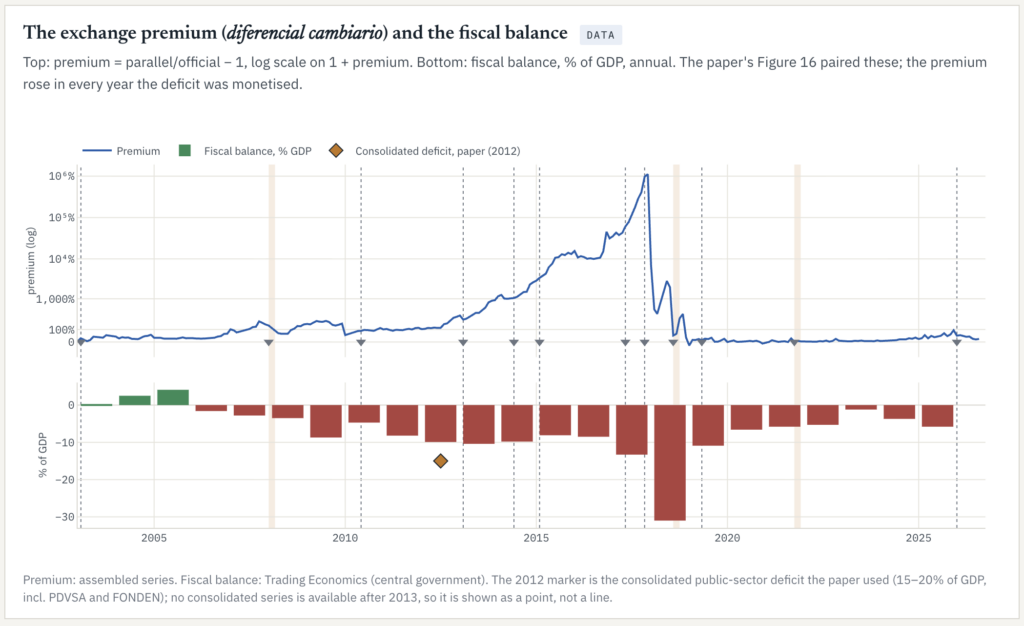
Here is the simplified mechanism: A government running a deficit it cannot finance has the Central Bank issue bolívares to cover it. The new money goes looking for dollars and for hard assets, and the rate moves. Running an official rate alongside the market one does not stop that. It only decides who captures the difference.

Top: Venezuela’s exchange premium, the parallel rate over the official rate, on a log scale, rising from near zero to over a million percent in 2017 and back down. Bottom: the fiscal balance as a share of GDP, in deficit every year from 2006.
The exchange premium and the fiscal balance. The premium rose every year the deficit was monetized. Premium from the assembled official and parallel series. Fiscal balance from Trading Economics, central government. The 2012 diamond is the consolidated public sector deficit used in the 2013 paper, which included PDVSA and FONDEN; no consolidated series is published after 2013.

Dollarization is a reasonable destination after the fiscal work and a ruinous substitute for it. Do the work and you may not need it, because the inflation it was sold to cure will already be gone. Skip the work and it will cost you more than the bolívar does. Redundant or ruinous. There is no third case.

The three consequences, one at a time

Planchart lists what the case for dollarization claims: eliminating inflation, forcing fiscal discipline, eradicating corruption. Take them in that order.

First: it does eliminate inflation. This is Hanke’s most popular claim, and it is true. Ecuador dollarized in January 2000. Inflation averaged 39% a year through the 1990s and 2.9% from 2003 to 2024. The policy does achieve inflation reduction, and it does so quite fast.

Top: Venezuela’s exchange premium, the parallel rate over the official rate, on a log scale, rising from near zero to over a million percent in 2017 and back down. Bottom: the fiscal balance as a share of GDP, in deficit every year from 2006.
The exchange premium and the fiscal balance. The premium rose every year the deficit was monetized. Premium from the assembled official and parallel series. Fiscal balance from Trading Economics, central government. The 2012 diamond is the consolidated public sector deficit used in the 2013 paper, which included PDVSA and FONDEN; no consolidated series is published after 2013.

Now notice what that concession costs the other side. Inflation is the entire platform. It is why the argument is popular in Caracas, and why anyone is listening to Ecarri in 2026. The harder thing to see is this: if we stabilize the fiscal accounts and jump-start private investment, inflation can be tamed and the case for dollarization goes with it. You cannot sell a cure for a disease the patient no longer has.

Second, it does not force fiscal discipline. Ecuador ran deficits in twelve of the thirteen years from 2013. The one exception was 2022, by four hundredths of a percentage point. Public debt went from 19% of GDP in 2011 to 64% in 2020, and Ecuador defaulted that year. It is 54% now. Growth averaged 6.4% a year from 2011 to 2014 and 1.4% from 2015 to 2019.

The mechanism is the one Planchart names himself. He warns that dollarization leaves a country “even more vulnerable to external shocks, such as a sudden plunge in oil prices.” That is precisely what happened to Ecuador after 2014. Oil fell, Ecuador could not devalue, and the shock had nowhere to go except the budget, and from the budget into debt and into lost growth. He states the fear and never uses the country it happened to. It is the best evidence in his own case and he leaves it on the table.

The deficit does not disappear when the currency changes. It simply has to be paid in a currency you cannot print.

Dollarization took away the printing machine, not the deficit, so the adjustment fell on debt instead of on prices. Ecuador does not show that dollarization is harmful. It shows that it is not enough. Of its two defaults, 2008 is the weaker example: it fell in a surplus year and was a choice rather than a financing crisis.

Third, regarding corruption, Planchart has already answered it, and I will not repeat a good argument badly. The exchange differential was never an oversight. It was an instrument. Change the currency and the people who built it still hold the pen.

What getting the sequence wrong costs

Planchart says a failed dollarization would force the government into more debt and severe cash shortages. He is right. Here is the size of it.

We ran the model with the same economy twice from the same starting position, $13.4 billion of reserves in 2026, changing one thing. Dollarize now on today’s deficit, alter nothing else, and the state’s dollar position will fall through zero in the third year and reach minus $24 billion by 2034. Dollarize after fiscal consolidation, with private investment recovering, and the same position accumulates to plus $127 billion. Same reserves, same model, one difference.

The deficit does not disappear when the currency changes. It simply has to be paid in a currency you cannot print.

Two lines from the same starting point of $13.4 billion in 2026. The green line, dollarization after the deficit is closed, rises steadily to about $80 billion by 2031. The red line, dollarization alone with the deficit unchanged, falls steadily and crosses zero in 2029, marked “dollars run out, 2029”.
Dollarizing without fiscal reform is a recipe for disaster. Shown to 2031; the simulation runs to 2034, by which point the red path is minus $24 billion and the green one plus $127 billion. Every assumption behind it is a control the reader can move at https://www.bolivarjesus.com/KangarooPegRevisited2026/

Why 576% inflation sits on a deficit near 6%

Planchart gives the number: inflation reached 576% year on year in July. The mechanism above explains the direction. It does not explain the size, and the size is the interesting part.

The bolívar base has collapsed; measured at the parallel rate, it was around $15 billion in 2011 and 2012. In July 2026, it was $1.7 billion. The base that can be monetised is a ninth of what it was.

In 2013, Gino Bettocchi and I wrote about a State running a consolidated deficit of 15% to 20% of GDP, including PDVSA and FONDEN. On the narrower central government measure that is still published, the deficit has roughly halved since then, from 9.9% in 2012 to 5.8% last year. A far smaller deficit now carries the inflationary force that an enormous one carried then, because there is so little left to dilute. That cuts against both camps. It is not evidence that the bolívar is cursed, and it is not evidence that only the dollar can fix it. It is arithmetic about a very small base.

Where I actually disagree

Planchart wants to keep the bolívar permanently, in part to preserve room for industrial policy. The unit of account does not carry that weight, in either direction.

What breaks or holds a monetary regime is the deficit, private investment, and the institutions behind them. Those three decide the outcome, whether prices are quoted in bolívares or in dollars.

The argument about maintaining the unit of account in bolívares is about the State’s capacity to protect and nurture strategic industries. But industrial policy is paid for by a State with fiscal room, and Venezuela has neither. It becomes possible after stabilization, not instead of it.

Without credible rules, there is no private investment. Without investment, there is no oil and no tax base. Without revenue, there is a deficit. And a deficit breaks any exchange rate regime, whether it is denominated in bolívares or in dollars.

Planchart may well be right. His is a claim about what Venezuela becomes over the medium and long term; mine is about what stops the bleeding now. Our hope is that between the two visions, readers get the order of operations.

His best line is that starting dollarization under chavista rule is like handing the reconstruction of the oil sector to a man who helped destroy the electricity grid. I would make it structural rather than personal, because it is an argument about order.

Stage one is not monetary. It is a legal framework credible enough that private capital comes back. Without credible rules, there is no private investment. Without investment, there is no oil and no tax base. Without revenue, there is a deficit. And a deficit breaks any exchange rate regime, whether it is denominated in bolívares or in dollars. Once those policies are in place, they will open the market and the premium will close on its own. Then, the decision about Venezuela adopting the dollar formally can be taken calmly, from strength, rather than desperately as a rescue.

In 2013 we wrote that the choice was reform or hyperinflation. Maduro chose hyperinflation, and it ran from 2017 to 2021. The 2026 version of that choice is not dollar or bolívar. A currency is imported. A State is built.

“The Kangaroo Peg” was written by Gino Bettocchi and Jesús Bolívar, Second Year Policy Analysis, Harvard Kennedy School, 2013, advised by Ricardo Hausmann. The thirteenth year update, with both figures, the model and its sources, is available here.

You can also track all macroeconomic metrics in the UnoPago monitoring website.

Source link

Why the US Dollar Won’t Fix Venezuela’s Economy

A few weeks ago, non-chavista politician Antonio Ecarri and American economist Steve Hanke managed to unearth one of Venezuela’s longstanding and unsettling debates: whether the country’s economy should be formally dollarized. After decades of economic hardship brought by repeated devaluations, hyperinflation and scarcity, the country’s monetary regime is heavily fragmented. 

De facto dollarization rules most of the transactions, while the bolívar, crypto stablecoins, euros and the currencies of neighboring countries split the rest of the monetary market share used to maneuver through Venezuela’s complex economy. With the US pushing for the country’s economic stabilization to increase trust in foreign investors, the fragmented monetary ecosystem can be detrimental to the process made so far.

Venezuela’s economic outlook has improved after Maduro’s capture and since the US took control over Delcy’s decisions. Mainly because of a sharp recovery of oil exports to the US recovered sharply; by April, these were up 192% from their 2025 average. The energy sector is spearheading the recovery while attempting to partially compensate for the devastation caused by the twin earthquakes. GDP growth projections for Venezuela are forecasted at 5.8%, almost four times the country’s 2025 growth (1.5%). Yet the threat of inflation and instability compounds investors’ worries about entering the country. After repeated announcements by the interim regime promising to close the exchange gap and tackle inflation, their actions show otherwise.

Delcy continues to erode the bolívar by stimulating the money printer needed to feed chavismo’s patronage system. Exchange rate controls, which have long incentivized corruption and inflation, are still there. On the dollar side, credit loans and transactions remain “officially” forbidden, creating an artificial tax on USD transactions and fear amongst businesses who can be punished for their use.

Eliminating inflation would require abolishing all existing exchange rates and creating a new one based on an agreed technocratic approach.

The result of this unaddressed monetary disaster has been a persistent rise in inflation, which increased by 6.1% in July, bringing year-on-year inflation to 576% and 2026 cumulative inflation to 175.5%.

This is not the first time the call for dollarization has been in the spotlight in Venezuela. Nonetheless, US control over the country’s economy may increase the possibility of it becoming a reality. While dollarizing might be an effective measure to rapidly generate trust and reduce inflation, it raises important questions about its implementation under the interim regime and the future of Venezuela’s monetary sovereignty. Similar to Trump’s oil deal or the post-earthquake reconstruction, all discussions and actions are taking place behind the scenes, sidelining the very population that will have to deal with its consequences. 

The US dollar is not the solution

Discussions regarding dollarization have primarily focused on three benefits: eliminating inflation, forcing fiscal discipline, and eradicating corruption. However, as long as those managing the dollarization process are the same ones who have guided Venezuela to the worst economic crisis in the region’s history, the result might be equally as bad but with a different set of consequences. 

Hanke asserts that no preexisting institutional, fiscal or political conditions are necessary for dollarization to be successful. However, this process requires the willingness of all three areas to move forward. Eliminating inflation would require abolishing all existing exchange rates and creating a new one based on an agreed technocratic approach. Currently, there is no incentive for anyone in the interim regime’s leadership to converge the exchange rates.

A struggling or failed dollarization plan could further erode trust while leaving the country even more vulnerable to external shocks.

The exchange rate differentials have not been an economic policy mistake overlooked by chavismo. These have been an integral part of chavismo’s strategy to undermine and replace old political elites with select, loyal ones. Long ago, they became crucial to maintain the status quo. There are no signs in favour of change in this area, as economist Juan Comella argued in May. Doing so would compromise the structure that keeps her in power.

A struggling or failed dollarization plan—which forces the government to take on further debt, experience severe cash shortages and fundamentally depend on its commodity exports—could further erode trust while leaving the country even more vulnerable to external shocks, such as a sudden plunge in oil prices. The neoliberal constraints posed by dollarization, like an extremely limited Central Bank to aid the government, will not fix decades of institutional erosion, but only try to avoid it while possibly unleashing a fresh round of obstacles that menace an already fragile economic recovery.

The bolívar is not the problem

Decades of monetary policy failures made the population skeptical of the bolívar. For long enough, the system and institutions have incentivised and even rewarded the wrong people to take advantage of its vulnerabilities at the expense of the population and evading any personal consequences.

It is certainly not the paper where the bolívar is printed the element that corrupts people or destroys the economy: it is the system behind it. It is not far-fetched to think of a plan that grants the Venezuelan Central Bank complete independence, empowering the correct people to safeguard the economy from the risks of inflation while maintaining government spending in line and preparing for external shocks.

Relinquishing our monetary sovereignty would be a mistake in a world where governments actively participate and spend to tackle modern challenges, including AI and natural disaster relief. China’s rise as a global power has been, in part, a consequence of decades of industrial policy under intense government intervention. The US and EU have started to catch up in recent years. The US has done so with the CHIPS and Inflation Reduction Act under Biden and, most recently, with the Trump administration imposing protectionist tariffs and taking equity stakes in major companies with the aim of safeguarding US interests in key sectors. The EU aims to increase competitiveness under the Clean Industrial Deal and the Industrial Accelerator Act. If Venezuelan leaders seek to move past the country’s commodity dependence, climb up in the global value chain, become competitive and diversify the economy, industrial policy will be crucial. Dollarization would compromise those goals.

Starting a dollarization process under chavista rule is similar to entrusting the reconstruction of Venezuela’s oil sector to a businessman who contributed to the destruction of the country’s electricity grid.

Foreign investment will be the driver of short- and medium-term recovery and growth for Venezuela. However, industrial policy will be crucial to guide the long-term objectives of the country. For this, Venezuela needs the bolívar, even if it’s in an open and competitive currency market where the people decide which currency earns their trust.

The Ecarri-Hanke duo surprised public opinion not only because of their proposal but also because of the odd pairing. Ecarri represents the efforts of Venezuelan politicians with limited legitimacy to enter the spheres of influence in Washington, and also chavismo’s ability to neutralize them. Hanke only views Venezuela as part of a larger plan to promote and deepen the use of the dollar internationally, in a global context that increasingly mistrusts the US currency and is hedging against it.

Ecarri is the result of a system that empowers the wrong people. Hanke represents the oversight of the reality on the ground and the impact Venezuelans will have to absorb. Both display the same shortcomings of Venezuela’s monetary institutions over the past decades. Their proposal simply tries to hide the sun with one finger instead of addressing the historical root causes of Venezuela’s monetary instability.

Starting a dollarization process under chavista rule is similar to entrusting the reconstruction of Venezuela’s oil sector to a businessman who contributed to the destruction of the country’s electricity grid. Policy should depart from both trauma-instilled calls for complete dollarization and a patriotic defense of the bolívar. Instead, it should focus on economic stability and our capacity to meet the challenges of tomorrow.

Source link

Iranian rial in freefall as dollar breaks 2.1 million mark

By Euronews Persian

Published on Updated

The US dollar broke above 2.1 million Iranian rials on Tehran’s free market on Wednesday, setting a new record as the rial lost around 60% of its value against the dollar since the start of the Iranian calendar year in March — when the dollar traded at approximately 1.35 million rials.


ADVERTISEMENT


ADVERTISEMENT

The rial’s slide has accelerated since the US reimposed a naval blockade on Iranian ports in July, following the collapse of a short-lived ceasefire.

The euro hit an unprecedented 2.55 million rials, and the UK pound reached 2,976,000 rials.

The UAE dirham, which serves as the benchmark for pricing the rial on regional markets, reached 600,000 rials for the first time.

One gram of 18-carat gold climbed above 225.7 million rials, and the Imami gold coin — a standard unit of value in Iran — changed hands at 2.26 billion rials.

Iran operates a dual exchange rate system. The official rate, set by the Central Bank and used for state transactions and subsidised imports of essential goods, is significantly stronger than the free market rate available to ordinary Iranians and businesses.

The gap between the two has widened sharply since the war began, with the free market rate now more than double the official rate.

The rial has been in freefall since the US-Israeli strikes against Iran on 28 February launched the ongoing war, now in its seventh month, and has accelerated as Washington has tightened its economic pressure campaign.

The US Treasury has cut off Iran’s access to regional banks, severing one of the Islamic Republic’s main channels for accessing foreign currency and clearing import payments.

The naval blockade of Iranian ports has compounded the pressure by restricting trade routes and reducing Iran’s oil export revenues.

Abdolnaser Hemmati, governor of the Central Bank of Iran, said the bank was ready to inject $2 billion into the foreign exchange market to stabilise the rial. He attributed the latest slide primarily to psychological factors rather than fundamental economic ones.

“The dust created in the foreign exchange market will settle, and the recent increase in exchange rates is driven more by psychological factors than by real economic factors,” he said.

Hemmati acknowledged that inflation had placed heavy pressure on households.

“Although inflation and rising prices have placed heavy pressure on people’s livelihoods and daily lives, and these difficulties are tangible, the Central Bank has been able to control the accelerating pace of inflation by using monetary, supervisory and prudential tools,” he said.

He rejected US claims that Tehran lacked access to financial reserves.

“These claims are completely baseless. The reserves have not been frozen, and the Central Bank has access to stable resources as well as multiple oil and non-oil revenues,” he said, claiming that more than $18 billion in foreign currency had been provided for imports of essential goods, medicines, animal feed and raw materials since March.

He provided no further details to support the figure.

The rial’s collapse is feeding directly into consumer prices. Iran was already experiencing high inflation before the war, while the currency’s further depreciation has raised the cost of all imported goods, raw materials and energy inputs.

Iranians who hold savings in rials have seen their purchasing power roughly halved in less than six months. Gold and hard currency have become the primary store of value for those who can access them.

Iran’s official currency is the rial, although most Iranians conduct everyday transactions in tomans — a colloquial unit equal to 10 rials that is so deeply embedded in daily use that shops, restaurants and property listings quote prices almost exclusively in tomans.

At Wednesday’s free-market rate, the US dollar traded at about 220,000 tomans. The government announced plans in 2020 to formally replace the rial with the toman and remove four zeros from the currency, a redenomination that has not yet been fully implemented.

Source link

Iran, Oil and a Hawkish Fed: Why the Dollar Is Winning the Week and Losing the Decade

TODAY’S NUMBERS 99.73 Dollar Index (DXY)   ·  4.81% US 10-year Treasury yield   ·  $4,304 Gold, per ounce All three are rising together — the market pricing a Fed rate hike into a war, not a slowdown, a combination not seen in years.

THE HOOK

Late Monday, Donald Trump signaled the ceasefire with Iran was effectively over, threatening fresh strikes and casting doubt on the reopening of the Strait of Hormuz. Brent crude jumped past $90 a barrel. By Wednesday morning, the US Dollar Index had climbed to 99.73 — its highest in nearly three weeks — and the 10-year Treasury yield touched 4.81%, just shy of a 52-week high. The reason: traders now put the odds of a September Fed rate hike near 65–70%, not a cut.

THE MECHANISM

The chain runs cleanly enough to name. Iran’s conflict with the US raises the odds of a shipping disruption through Hormuz, which carries roughly a fifth of global oil supply; oil-price risk feeds straight into headline inflation; and a Fed under Chair Kevin Warsh — already fighting credibility questions after an ambiguous hold in July — cannot afford to look soft on prices while a war pushes them up. That is why futures markets have swung from pricing no move in 2026 to pricing a hike at the September 15–16 meeting.

Stay ahead of the geopolitical week.

MD Briefing delivers expert analysis across five global fronts — the Indo-Pacific, energy, geoeconomics, European security, and the Middle East — every Monday morning. Free.

Higher US rates make dollar assets pay more relative to everywhere else, which is the direct channel behind both the stronger DXY and the 4.81% ten-year. The winners are near-term and narrow: holders of short-dated Treasury bills, whose yields rise with the policy rate; US money-market funds; and, oddly, the stablecoin issuers whose reserves sit almost entirely in T-bills and now earn more for holding them. The losers are broader and slower-moving: emerging markets carrying dollar-denominated debt face a double bill, since a stronger dollar raises the local-currency cost of repayment at the same moment their own borrowing costs rise in sympathy with Washington’s. Oil-importing economies — India, Turkey, Japan, the eurozone — take a second hit, paying more for crude in a currency that is simultaneously getting more expensive to buy. Gold, meanwhile, is caught between two forces: safe-haven demand from the war pulls it up, rate-hike expectations pull it down, which is why it sits near $4,304, off its recent peak but still up 21% over the year.

WHY IT MATTERS

The apparent contradiction — dollar strong this week, dollar weaker for the decade — is really two different clocks running at once. Reserve managers make multi-year diversification bets; traders react to a war in hours. The IMF’s COFER data put the dollar at 57.13% of allocated reserves in the first quarter of 2026, down from 72% in 2000, and a recent survey of reserve managers found roughly three-quarters expect that share to keep falling over the next five years. None of that is undone by one hawkish week from Kevin Warsh.

What is new is where the dollar’s reach is actually growing: not in central bank vaults but in stablecoins. The GENIUS Act framework — now the subject of a Treasury rulemaking comment period that closes in October — has pushed issuers to back their tokens almost entirely with short-dated Treasuries, and forecasts from Standard Chartered and Senator Bill Hagerty put potential T-bill demand from stablecoins as high as $2–2.3 trillion. That is dollarization happening retail-first, in emerging-market wallets and crypto exchanges, invisible to COFER. For Washington, a Fed hike timed to a war raises borrowing costs precisely when the deficit needs cheap financing, and when the countries least able to absorb dearer dollars — many of them US partners, not adversaries — get hit hardest. That is a form of collateral leverage no sanctions list ever names.

WATCH FOR

The September 15–16 FOMC meeting is the date that resolves this. A 25-basis-point hike would confirm markets are right to treat this as an inflation fight, not a growth scare, and would likely push the dollar and yields higher still. A hold — especially if Hormuz tensions ease and oil retreats from $90 — would suggest Warsh blinked, and could send gold back toward its highs faster than the dollar can catch up. Either way, watch the Fed funds futures curve shift in the two weeks before the meeting.

Source link

Canada says it will match US tariffs ‘dollar for dollar’ as trade talks break down

A fresh wave of US tariffs on a wide array of Canadian goods has come into effect as of midnight on Saturday after a last minute break down in trade talks.

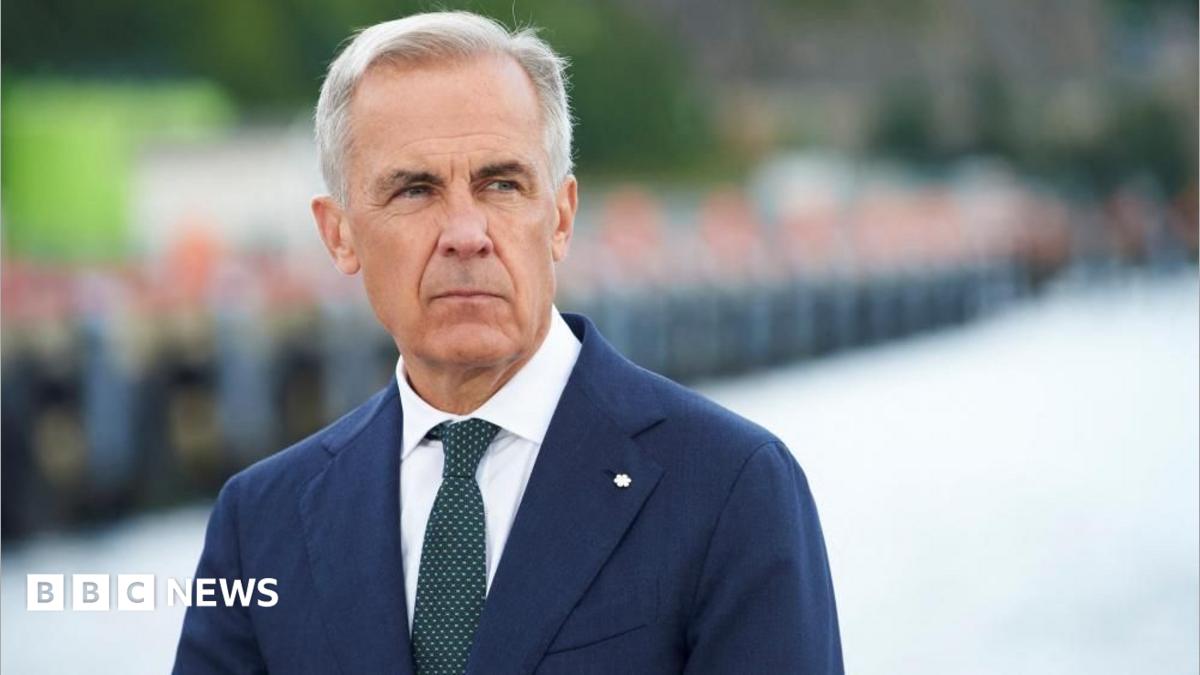
Announcing the suspension of negotiations shortly before the Friday night deadline, Canadian Prime Minister Mark Carney said he would impose reciprocal tariffs on US goods “dollar for dollar”.

Carney said “last-minute changes in the US proposed terms were unfair, uneconomic, and called into question the reliability of any deal”.

Trade negotiators had been engaged in intense talks since July, after President Donald Trump threatened to impose a 50% levy on nearly $20bn (C$28bn) of Canadian imports by 19 August.

Trump had temporarily paused those tariffs earlier in the week, saying the two sides were close to signing a trade deal that was “very good” for both countries.

But minutes before a deadline for a deal, Carney said that while “important progress” had been made in the talks it was “not enough to meet our objectives for Canadians”.

“As a result, this evening, I have decided to suspend trade negotiations with the U.S. and have directed negotiators to return to Ottawa,” he said.

“Last-minute changes in the US proposed terms were unfair, uneconomic, and called into question the reliability of any deal.”

After Carney’s announcement US trade representative Jamieson Greer said in a statement: “Tonight, Canada declined to finalize the trade deal under the terms agreed earlier this week.

“Despite the US offer to Canada to receive the best treatment of any major exporter to our market, new demands and walk backs of other commitments by Canada have upended the careful balance reached in the past days,” the statement on X said.

The breakdown in talks marks a significant shift in tone from earlier in the week, when both US and Canadian officials sounded optimistic that a trade deal beneficial for both countries was within reach.

Negotiators were reportedly discussing a deal that would reduce US tariffs on Canadian steel and aluminium from 50% to 25%, and on Canadian autos from 25% to 15%.

In exchange, Carney had asked Canadian provinces to restore US alcohol to store shelves.

Tensions between the two major trading partners have been simmering since Trump returned to office in January last year and unleashed a wide-ranging global programme of tariffs, upending decades of free trade between Canada and the US.

Now that talks have broken down, Canada will be hit with new 50% US tariffs imposed by Trump using a Depression-era law called the Tariff Act of 1930.

They will be applied on a range of goods, including wine, dairy, cement, clothing and hockey equipment.

They are in addition to existing tariffs the US had already imposed on Canadian steel and aluminium, autos and lumber.

Doug Ford, the traditionally outspoken premier of Canada’s largest province Ontario, said “the prime minister has my full support for a strong response—tariff for tariff, dollar for dollar,” following Carney’s announcement.

Canada has been engaged in on-again, off-again trade negotiations with the US for over a year in pursuit of a deal that would see the US drop or reduce tariffs on these key sectors.

The US, meanwhile, has been asking for a number of concessions from Canada, including removing its remaining retaliatory tariffs on American autos and adjusting its dairy quotas to allow greater access for US cheese producers.

It has also asked for the ban on US alcohol sales, imposed last year by most Canadian provinces in retaliation to Trump’s tariffs, be removed.

Businesses and stakeholders on both sides of the border had pushed for a deal to be reached, arguing that the new US tariffs on Canada will be harmful to both countries.

The US Chamber of Commerce said earlier in the week in a statement that “higher tariffs would damage both economies, drive up costs for US families, further disrupt critical supply chains, and risk the 13 million American jobs that depend on trade under the US-Mexico-Canada Trade Agreement”.

A recent poll by Canadian firm Abacus Data suggested that around 36% of Canadian would support retaliating to US tariffs, while another 30% would want the Carney government to continue negotiating.

Retaliation risks upsetting the Trump administration, with trade representative Jamieson Greer saying the US is “not going to tolerate” counter-tariffs.

“We’ll take action,” he told reporters last week.

Source link