Tehran, Iran – Iranian authorities and state media have praised the Houthis’ capture of Yemen’s Red Sea coast, which some see as giving Tehran more leverage against the United States.
The Houthis, a political and armed group dominated by Zaidi Shia Muslims, have been fighting against the Western-backed Yemeni government since capturing the capital, Sanaa, in 2014.
The Houthis captured a series of Red Sea coastal cities and islands this week, essentially giving them control over the vital Bab al-Mandeb strait.
The Iran-allied group’s recent victories have been praised in Iran, and are viewed by some as part of Tehran’s wider war against the US, ongoing since February 28.
“The victories of Yemen’s Ansar Allah in the western coast is a narrative of a divine triumph and the fruit of years of steadfastness in the most difficult of battlefields,” Hossein Mohebbi, spokesman of the Islamic Revolutionary Guard Corps (IRGC), wrote on X on Saturday.
Amid the Houthis’ recent battlefield wins against the fragmented Saudi-backed forces, senior Iranian officials have cheered their Yemeni allies on.
The Houthis’ capture of the port city of Mocha on Friday delivered a huge blow for the Yemeni government, which now has no direct access to the Red Sea.
Mohammad Bagher Ghalibaf, Iranian parliament speaker and chief negotiator with Washington, reposted a comment made by slain Supreme Leader Ayatollah Ali Khamenei in 2024, saying the “resistance” of the Houthis will inevitably lead to victory.
“The brave Yemeni people will certainly triumph, by permission of God Almighty,” Ghalibaf added on Thursday, in Arabic.
Iran’s First Vice President Mohammad Reza Aref said the government is happy with the Houthi advances, and urged leaders in the region to pursue “the rationality of liberation from dependency [from the US and the West], and unity under the banner of Islam”.
The “grand victory” of the Houthis once again proved that “security is not a commodity that can be bought,” added Mohammad Mokhber, an adviser to Iran’s Supreme Leader Mojtaba Khamenei.
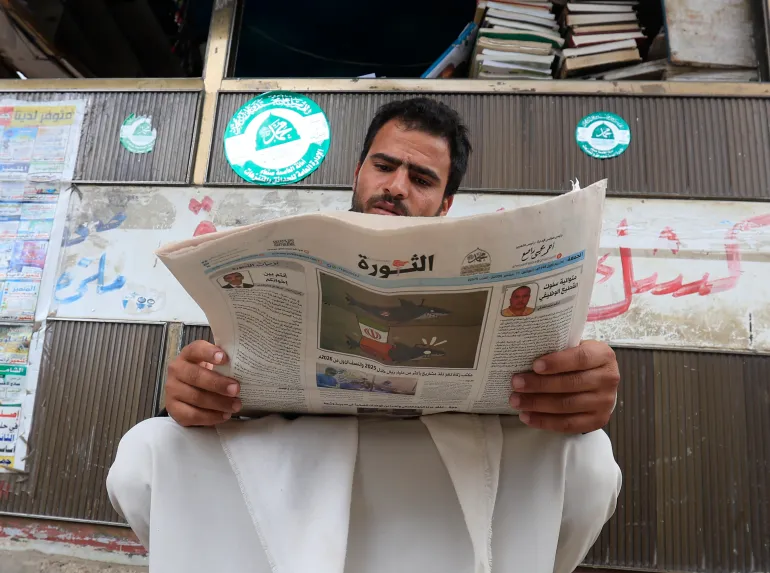
A man reads a local newspaper featuring news of the escalating fighting in the country, in Sanaa, Yemen, September 11, 2026. Yemen’s Houthi group said navigation in the Red Sea and Bab al-Mandeb strait remained safe except for Saudi vessels, which it says remain subject to a blockade, after seizing the port city of Mocha on September 10 and making further gains around the strategic strait the following day [Yahya Arhab/EPA]
How could this benefit Iran?
The Houthis began to attack several vessels in the Red Sea they claimed were linked to Israel in 2023, as part of their stated aim to pressure Israel to end the genocidal war on Gaza.
This prompted bombing campaigns by the US, United Kingdom and Israel against Houthi positions in Sanaa, Hodeidah and other areas.
Saudi Arabia, which joined the war against the Houthis in 2015, has largely stayed out of the current eruption in fighting in Yemen.
After their recent victories, the Yemeni group can now exercise more control over the Red Sea and the Bab al-Mandeb strait.
The Houthis’ control of Yemen’s Red Sea coastline and multiple islands – including the island of Mayun, also known as Perim, sitting about 3km (1.9 miles) off Yemen’s mainland – provides the group with close-range access to the Bab al-Mandeb strait.
A video published on Friday showed a Houthi commander telling soldiers they will no longer need missiles and drones to threaten shipping in the crucial waterway. They could simply position artillery along the coast and fire in all directions at ships, he said.
The Houthis have not declared the strait closed, but the group’s military spokesperson, Yahya Saree, said on Friday that “maritime navigation is safe for all companies except for Saudi vessels.”
Likewise, Iran’s partial control of the Strait of Hormuz on the other side of the Arabian Peninsula has been a key tool of leverage for Tehran in the war against the US.
The prospect of closing down the strait could potentially be used by Tehran in future negotiations over ending the war with the US.
Iranian officials are expected to meet regional Arab representatives on Monday for talks over how to facilitate shipping through the Strait of Hormuz, which Tehran maintains remains closed.
They have said they favour a collective regional approach on passage through the strategic waterway.
A person watches Houthi military spokesman Yahya Saree delivering a televised statement, in Sanaa, Yemen, September 11, 2026 [Yahya Arhab/EPA]
The US, which has continued its naval blockade of Iran’s ports and intensified sanctions on Tehran, reportedly opposes the agreement.
Authorities in Tehran have signalled there will be no talks with Washington under the current circumstances.
“As long as the American side does not accept all of Iran’s conditions, dialogue and negotiation are of no use,” Ebrahim Azizi, head of the hardline Iranian parliament’s national security commission, wrote on X on Saturday.
‘Lord of the straits’
At the start of the working week in Iran on Saturday, hardline and IRGC-linked newspapers and media outlets celebrated the recent Houthi advances.
Keyhan, whose editor-in-chief was appointed by Ali Khamenei, called the advances “the miracle of resistance” and said they had “put the US and Israel in a bind”.
The Quds newspaper, published by the influential Astan-e Quds Razavi in Mashhad, called Iran and the Houthis “the lord of the straits”.
But even though Tehran has repeatedly threatened that Bab al-Mandeb could be further disrupted if the war continues, Iran’s diplomatic apparatus did not immediately link the Houthi advances with the current fight against the US.
As has often been the case, Iran’s Ministry of Foreign Affairs insisted that the Houthis make their decisions independent of Tehran, with their own interests at heart, including ending Saudi Arabia’s blockade on Yemen.
The Iranian Foreign Ministry also called for an end to the Saudi siege on Houthi-controlled areas, an immediate return to negotiations between the group and Riyadh, and respect for Yemen’s sovereignty and territorial integrity.
The ministry also pushed back on the idea that the Houthis act merely as a proxy for Tehran.
“What is happening now in Yemen is the result of the Yemenis losing patience,” Foreign Ministry spokesman Esmaeil Baghaei told state television on Friday night.
“It is not fair to ignore the fact that they were under a cruel blockade for years, and concluded that the United Nations and regional mechanisms could not resolve the issues.”
Yayoi Kusama, the Japanese artist known for her hypnotic, repetitive polka dot artworks, died earlier this week at the age of 97. Hers was the third in a string of deaths this week that left me feeling quite melancholy. First Dolly Parton, then Tim Curry and finally, Kusama.
The silver lining in the death of an artist, whether they be musician, actor, writer or visual artist, is that they leave a trail of comfort for fans through their work. I can (and did) sit in my breakfast nook weeping to the sound of Parton’s voice in songs including 1971’s “Coat of Many Colors.” When it comes to mourning Kusama, I am planning a trip to the Broad museum in downtown L.A., which houses two of her famous Infinity Mirror Rooms.
“Longing for Eternity” (2017) is on view on the third floor and can be accessed with a free general admission ticket. “Infinity Mirrored Room —The Souls of Millions of Light Years Away” (2013), however, requires a separate free reservation. A rep for the museum said reservations are currently available through September with many time slots already completely full. The museum is also accommodating as many walk-ups as capacity allows — and these walk-ups have increased in the wake of Kusama’s death.
In an email to The Times, Broad founding President and Director Joanne Heyler wrote that Kusama’s Infinity Mirror Rooms, “have been among the most beloved works at The Broad since we opened in 2015.”
Heyler noted that the Broad’s 2017 exhibition, “Yayoi Kusama: Infinity Mirrors,” “was an incredible moment in the museum’s early history. It was a beautiful show, and unprecedented operationally: the only time our ticketing system broke down due to demand, minutes after release. Her work is both wildly popular and conceptually rigorous; her journey as an artist is complex, full of resilience and a refusal to be limited. Visitors have found deep connection inside the Infinity Mirror Rooms at The Broad — smiles, tears, even marriage proposals. We’re grateful to be one of the places where people can go to spend time with her work and remember her, and we’ll keep working to ensure her art is experienced as she intended: by everyone, infinitely.”
This is welcome news, and the devoted interest makes sense. In many ways, these physically small but emotionally vast rooms encapsulate the essence of Kusama’s practice throughout her life. Built in a distinctively analog way, the rooms create the illusion of endless space through the use of light, mirrors and splashes of color. Kusama incorporated hand-sewn cloth, and later, multimedia video projections, but at their core the rooms remained largely technology-free.
It’s a pity because all the people who stepped into those rooms with their cellphone cameras at the ready missed a profound opportunity to inhabit a floating dreamscape of true peace and quiet — the kind we rarely grasp in our digital-notification suffocated world.
I can still remember the first time I had the opportunity to experience one of Kusama’s Infinity Mirror Rooms. It was dark and glittering with tiny pinpricks of colored light. I felt as if I were suspended in a deep, black pool of energy that extended beyond me in all directions. I could hear my blood rushing in my ears and briefly wondered if this could be what it felt like in the womb.
I got dizzy and recovered, and then — for what felt like a long time but was only a matter of seconds — I was free.
I’m Arts editor Jessica Gelt taking moments of solace where I can get them. This is your arts and culture news for the week.
You’re reading Essential Arts
Our critics and reporters guide you through events and happenings in the SoCal arts scene. In your inbox every Friday.
By continuing, you agree to our Terms of Service, which include arbitration and a class action waiver. You agree that we and our third-party vendors may collect and use your information, including through cookies, pixels and similar technologies, for the purposes set forth in our Privacy Policy such as personalizing your experience and ads.
The week ahead: A curated calendar
FRIDAY
Babatunde Akinboboye The baritone fuses classical opera with hip-hop on “Toreador,” “Funiculi, Funicula,” “O Sole Mio” and more. 8 p.m. Friday and Saturday. Sierra Madre Playhouse, 87 W. Sierra Madre Blvd. sierramadreplayhouse.org
Director Richard Linklater at the 2023 Toronto Film Festival.
(Jay L. Clendenin / Los Angeles Times)
Richard Linklater A three-movie American Cinematheque tribute featuring Q&As with the Texas filmmaker. In a recent interview, Times film writer Mark Olsen asked Linklater what it’s like to reflect on his work: “What resonates with me in my mind is the experience of making the movie more than the movie itself — all the people you worked with and the cast and all those good feelings.” “Boyhood,” 7:30 p.m. Friday; “Waking Life,” 4 p.m. Saturday. Aero Theatre, 1328 Montana Ave., Santa Monica; “Dazed & Confused,” 7:30 p.m. Saturday. Directors Village, 961 Broxton Ave. Westwood. americancinematheque.com
Pericles Boston Court, in partnership with Play On Shakespeare, presents the West Coast premiere of Ellen McLaughlin’s modern verse translation of Shakespeare’s rarely performed adventure tale. Directed by Margaret Shigeko Starbuck. Through Sept. 27. Boston Court Pasadena, 70 N. Mentor Ave. bostoncourtpasadena.org
Romeo & Juliet A site-specific, immersive, queer adaptation of Shakespeare’s tragedy. 7:30 p.m. Friday and Saturday; 1 p.m. Saturday and Sunday. Sassafras Saloon, 1233 Vine St. eventbrite.com
SATURDAY
Place Is the Space A four-hour immersive performance experience created by artist Edgar Arceneaux and co-creator Frank Lawson employs live jazz improvisation, theatrical storytelling and multimedia design inspired by Sun Ra’s philosophy and his film “Space Is the Place.” Presented by CAP UCLA, the event includes an audience procession to the Hammer Museum in conjunction with the current exhibition, “Space Is the Place,” for a final performance. 1 p.m. UCLA Nimoy Theater, 1262 Westwood Blvd. cap.ucla.edu
Joshua Smith Untitled (Yellow Heart), 2026 Acrylic on canvas 14 ¾ x 14 ½ in.
(839 Gallery)
Joshua Smith: Hearts and Triangles The artist’s first Los Angeles solo show includes brightly colored monochrome paintings on shaped canvases. Opening reception, 5-8 p.m. Saturday; exhibition continues through Oct. 17. 839, 839 N. Cherokee Ave. 839gallery.com
Winter’s Bench The world premiere of Mike Kenny’s play about a woman who returns to a park where she thinks a tree once spoke to her. Starring Anne Gee Byrd and Shih-wei Wu. Directed by Debbie Devine. All performances will feature Spanish supertitles. Previews, 8 p.m. Saturday; 2 p.m. Sunday; 7:30 p.m. Wednesday, Thursday and Sept. 4; 8 p.m. Saturdays, 2 p.m.; Sundays, 8 p.m.; Sept. 7 and 14; through Oct. 25. 24th Street Theatre, 1117 W. 24th St. 24thstreet.org
SUNDAY
Element Band Led by Ara Dabandjian, the ensemble features 12 musicians and vocalists, including Soseh Aramouni Keshishyan and Natalie Avunjian, in a celebration of Armenian heritage, creativity and live music. 7:30 p.m. The Ford, 2580 Cahuenga Blvd. East. theford.com
TUESDAY
Dvořák & Bruch Conductor Anja Bihlmaier and violinist Bomsori join the Los Angeles Philharmonic. 8 p.m. Hollywood Bowl, 2301 N Highland Ave. hollywoodbowl.com
THURSDAY
Amadeus in Concert The Los Angeles Philharmonic, led by conductor Norman Huynh, conductor, and the Pacific Chorale perform live to Milos Forman’s 1984 Oscar-winning best picture starring Tom Hulce and F. Murray Abraham. 8 p.m. Hollywood Bowl, 2301 N Highland Ave. hollywoodbowl.com
The Arsonists Max Frisch’s 1953 absurdist satire, translated by Alastair Beaton and directed by Luke Harlan. 8 p.m. Thursdays through Saturdays; 5 p.m. Saturdays; 2 p.m. Sunday; through Sept. 20. Skylight Theatre, 1816 1/2 N. Vermont Ave. skylighttheatre.org
Under the Oaks A weekly salon series featuring performance and music: “Currents: Composers in Concert” (Sept. 3); “Beer! A New Musical-in-Development” (Sept. 10); “Cabaret Theatricum Sings Marvin Gaye” (Sept. 17); and “The Voice of Dr. King” (Sept. 24. 7:30 p.m. Thursdays through Sept. 24. Will Geer Theatricum Botanicum, 1419 N. Topanga Canyon Blvd. Topanga. theatricum.com
Arts everywhere
Sarah Bareilles in the documentary “Sarah Bareilles: Good Grief.”
(A Group Effort Films / Naked Edge Films)
Sara Bareilles: Good Grief The Grammy-winning Broadway star and pop singer’s return to the recording studio for the first time in seven years is captured in this intimate documentary directed by Josh Alexander receiving a one-night-only theatrical release. The film looks at Bareilles’ experience of channeling her own pain to create art and the healing journey that accompanied it. Bareilles will perform at the Dolby Theatre, Oct. 12-14. 7 p.m. Wednesday. Laemmle and AMC theaters. sarabmusic.com
Culture news and the SoCal scene
Dolores Huerta photographed at Dolores Huerta “Help Wanted/Leave Now” exhibit at California Museum.
(Beth Baugher / California Museum)
Dolores Huerta has prioritized involving herself in projects relating to labor and women’s rights in the wake of going public with sexual abuse allegations against former labor leader Cesar Chavez. One of those projects can now be seen at the California Museum in Sacramento in an exhibition called “Help Wanted/Leave Now: ‘Operation Wetback’ and the Revolving Door of Mass Deportation,” which, according to a story by contributor Isa Farfan, “examines decades of the federal government’s deportation campaigns against Mexican immigrants even while it recruited millions of these farmworkers and rail workers to fill labor shortages during and after World War II.”
Contributor Leah Ollman reviews a new Eileen Cowin retrospective called “Between Panic and Paradise” at Los Angeles County Museum of Art. Labeling Cowin a “wry disruptor,” Ollman notes that over the artist’s nearly six-decade career, she has toyed with time in a novel way: “By deviating from straightforward chronology, the installation resonates smartly with one of Cowin’s key operating principles — that we don’t experience time as a continuous line moving in one direction, but as episodic, fragmented, interrupted, layered.”
Gustavo Dudamel at the end of the first half his show at the Hollywood Bowl on Aug. 20.
(Jason Armond / Los Angeles Times)
Gustavo Dudamel is really leaving — although it feels as if the city has been mourning the eventuality for years. Times classical music critic Mark Swed was, of course, on hand to bear witness to Dudamel’s final farewell: a four-night Hollywood Bowl extravaganza. “Dudamel addressed the audience, sounding very much like he had 17 years ago at the Bowl, extolling in our being a crowd of many types together for many musics. L.A., he said, made him an Angeleno,” Swed wrote.
Swed also attended a Tuesday night show at the Hollywood Bowl after the Dudamel farewell extravaganza and found it rather empty and a bit “forlorn,” a situation, he writes in a review, that “left Anna Handler, who becomes the Los Angeles Philharmonic’s conductor-in-residence this fall, with the trickiest conducting assignment of the summer anywhere.”
Theater Director Bart DeLorenzo on the set of “Enemy of the People” at the Odyssey Theatre on Friday, Aug. 21, 2026.
(Ariana Drehsler / For The Times)
Times theater critic Charles McNulty recently sat down for a lunchtime conversation with Bart DeLorenzo, “L.A.’s most playfully provocative theater auteur,” about his decision to direct (and adapt) Henrik Ibsen’s “Enemy of the People” at Odyssey Theatre. “If ever there was a moment to revive ‘An Enemy of the People,’ it’s now,” McNulty writes. “The demoralizing spectacle of the U.S. Senate’s inquisition of Dr. Anthony Fauci last month, led by Sen. Rand Paul (R-Ky.) in unapologetic witch-hunt mode, was yet another reminder that Ibsen’s drama about a public health crusader being targeted by politicians and business leaders when his medical advice goes counter to their interests hasn’t lost its punch.”
The drama never stops at the beleaguered Kennedy Center as it deals with the continued tumult resulting from President Trump’s takeover early last year. Most recently the Justice Department claimed in a recent court filing that Trump’s “efforts and prestige provide the sole hope for the Center’s financial survival, and structural renewal.” If the center isn’t shut down for the two-year renovation Trump demands, it may need to be demolished, the filing reads.
Enjoying this newsletter? Consider subscribing to the Los Angeles Times
Visitors line up outside the Japanese American National Museum for a 2022 event recalling World War II incarceration camps.
(Genaro Molina / Los Angeles Times)
After closing in early January, 2024, the Japanese American National Museum has announced it will reopen its newly renovated Pavilion on Jan. 23, 2027. Renovations include a new main entrance and new first-floor galleries for a brand new exhibition titled “In the Future We Call Now: Realities of Racism, Forging Democracy.” The special exhibition galleries on the second floor have also been updated and will feature the inaugural exhibition, “Pictures of Belonging: Miki Hayakawa, Hisako Hibi, and Miné Okubo.”
The Broad has announced its next fall exhibition, “Has the myth been shattered,” opening Nov. 21. The exhibition is set to include recent acquisitions by Guadalupe Rosales, Hank Willis Thomas and Mickalene Thomas. “Gathered together, works in the exhibition create unexpected connections across six decades, prompting an examination of how media has shaped history, memory, and collective experience,” a news release notes.