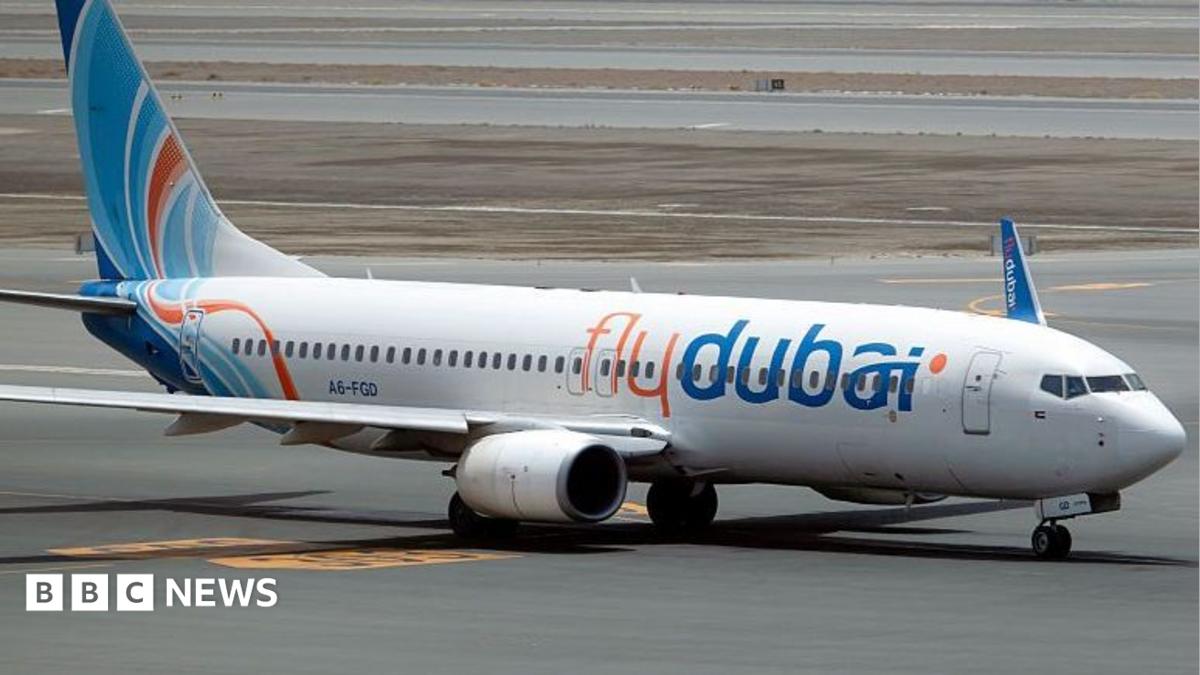
Wales’ preparations for Friday’s Women’s World Cup qualifier in Montenegro have been badly disrupted after the team flight was forced to divert to Italy due to bad weather.
Rhian Wilkinson’s squad took off from Cardiff at 16:30 BST on Wednesday and had been due to arrive in Montenegro around three hours later.
However, they were unable to land in Podgorica due to electrical storms around the Montenegrin capital and eventually diverted to the Italian port city of Brindisi.
After more than three hours on the tarmac in southern Italy, during which Wales had hoped weather conditions would ease, the decision was taken to stay in Brindisi on Wednesday night.
That left Football Association of Wales (FAW) officials scrambling to secure hotel rooms for the travelling party, as well as trying to arrange travel plans for Thursday.
“Due to storms in Podgorica, the Cymru women’s national team flight was diverted this evening, landing safely in Brindisi airport in south Italy,” the FAW said on social media.
“The team will stay overnight in Italy and will arrange alternative travel to Montenegro ahead of Friday evening’s match.”
Wales take on Montenegro in Podgorica in their penultimate Group B1 fixture at 17:00 BST on Friday.
They then host Czech Republic, their rivals to finish top of the group, in their final fixture in Cardiff on Tuesday.
May 30 (UPI) — A United Airlines flight traveling from Chicago to Minneapolis had to be diverted after an unruly passenger attempted to breach the cockpit.
The Minnesota-bound flight instead safely landed at Dane County Regional Airport near Madison, Wisc., “to address a security concern with an unruly passenger,” the airline told The Guardian and NBC News.
The Federal Bureau of Investigation and local police responded to reports about the passenger, who was detained at the airport after the flight landed.
“I do not believe they ever cuffed him, but they were able to finally get control of him after multiple attempts to try to breach the cockpit,” a crew member told air traffic controllers.
“I believe at this point he is seated in a seat and flanked with law enforcement officers on either side,” the crew member said.
The Dane County sheriff’s office told USA Today that the 75-year-old passenger who attempted to breach the cockpit several times appeared to be having a mental health crisis and seemed to be confused.
None of the 147 passengers and six crew members aboard the Boeing 747 was hurt in the incident.
Police said that the man’s family was traveling to Madison from Minneapolis to meet him and that no criminal charges are expected to be filed against him.
Secretary of State Marco Rubio and President Donald Trump participate in a Cabinet meeting in the Cabinet Room of the White House on Wednesday. Photo by Samuel Corum/UPI | License Photo
The rule reminder comes after a flight was forced to divert and deal with the issue
The flight was forced to make an emergency landing(Image: Adam Klis via Getty Images)
An EasyJet plane had to make an emergency landing in Rome over the weekend because there was a potential fire risk linked to a passenger’s luggage. The captain told all 180 passengers that a restricted item in the cargo hold posed a serious danger and had to be dealt with on the ground.
Reports suggest that a passenger had left their phone charging in their checked baggage using a power bank. It is claimed that a woman told a flight attendant the location of her power bank, prompting the aircraft to be diverted due to a possible fire risk.
The emergency landing happened at 11.30pm on Saturday, May 23. Passengers were reportedly provided with hotel rooms, though some chose to sleep in the airport terminals, as the next EasyJet flight back to the UK wasn’t available until 2pm the following day (May 24).
On EasyJet’s website, the airline sets out its regulations regarding lithium batteries, including what is classed as “prohibited”. It said: “Power banks are accepted on EasyJet aircraft with a Wh rating not exceeding 160Wh for lithium batteries. Power banks are prohibited from use on EasyJet aircraft and must not be used to charge other devices.
“Power banks must be carried in carry-on baggage only. It is recommended that power banks be carried where they can be monitored (i.e. on your person)”
The airline also restricts people to bringing no more than two power banks per person. All power banks “must be individually protected”, according to EasyJet, such as placing them back in original retail packaging or a plastic bag.
These power bank regulations apply to virtually all major airlines, including Ryanair, Jet2, TUI and British Airways. Travellers should check with their individual airline for any specific rules and requirements concerning travelling with a power bank, reports the Express.
Why are power banks considered such a risk?
Power banks are forbidden from use or storage in specific areas on aircraft because they contain lithium-ion batteries. These batteries are extremely combustible and can suffer “thermal runaway,” a chain reaction that may cause them to overheat or ignite.
While they aren’t completely ‘banned’, power banks must be stored in hand luggage and cannot be used while airborne. This is because, should a battery overheat, cabin crew can quickly reach, identify, and put out the flames.
Charging gadgets through them generates additional heat, increasing the fire risk. Some carriers have rules stating that power banks cannot be placed in overhead lockers and must remain visible (such as in the seatback pocket or beneath the seat ahead of you) so that passengers and crew can immediately notice if smoke or flames appear.
Your entitlements if an aircraft is forced to make an emergency landing
If your aircraft makes an emergency landing or diversion, your entitlement to compensation, a refund, or an alternative booking depends entirely on the cause of the emergency. You are legally entitled to specific help during the delay, whatever the reason for the diversion.
Regardless of whether the emergency came from an airline problem or an unforeseeable circumstance, the carrier is legally required to care for you while you wait. This includes vouchers or reimbursement for reasonable meals and beverages, hotel accommodation and transport (if delayed overnight).
If your flight experiences substantial delays or is eventually cancelled, you have the right to select between alternative travel under similar conditions at the earliest opportunity or a refund. Check specific refund entitlements with your selected airline.
The Civil Aviation Authority today said ‘more awareness’ was needed as travellers ‘not aware’
The Civil Aviation Authority said portable chargers carry ‘serious risks’ of overheating or catching fire in luggage(Image: Getty)
Airlines have banned very common electrical items from flights – as news emerged of a surge in problems on flights caused by the items. Some carriers have begun to completely ban power banks that people use to charge their phones and tablets due to safety concerns. Generally, power banks are only permitted in carry-on, not checked luggage, amid fears they could explode and catch fire mid-flight.
The Civil Aviation Authority (CAA) today said ‘more awareness’ was needed as portable chargers carry ‘serious risks’ of overheating or catching fire. Jonathan Nicholson from the CAA told BBC News that restrictions such as not putting the devices in checked luggage were not “somebody being pedantic” or “for the sake of it”, with passengers urged “to do the right thing”.
Concerns are rising that people are ignoring the bans and simply taking the devices on board. Power banks have become popular because they offer essential, portable, and fast-charging power for smartphones and other devices while on the move, easing battery anxiety. They are affordable, compact, and versatile, enabling users to remain connected without needing a wall outlet, making them perfect for travel.
It comes after a UK-bound easyJet flight was diverted to Rome last week because a passenger had packed a charging power bank in hold luggage. The airline said the captain had decided to divert “in line with safety regulations” after a passenger informed crew during the flight that the portable charger was in the hold of the aircraft. Many airlines have toughened rules on power banks, often requiring that they be stored in hand luggage because of the risk of lithium-ion batteries catching fire.
The flight touched down safely at Rome Fiumicino and was rescheduled to the next day. A survey by the CAA of 1,000 UK passengers in November 2025 suggested more than a third know what lithium batteries are and are aware rules exist, but are unsure what the rules involve. Over-55s typically knew the rules better.
Mr Nicholson said the “basic set of international rules” all passengers must follow on power banks are:
Take them with you on board the aircraft, not in checked luggage
A maximum of two power banks per passenger
When on board the aircraft, don’t use them and “absolutely do not charge the power bank itself because that’s when they become really hot and most susceptible to having an issue”
Mr Nicholson said incidents involving power banks were “certainly on the rise” as portable chargers grow in popularity, alongside vapes which are not allowed in checked luggage either.
Vietnam Airlines, Vietjet Air and now Emirates have banned the batteries. Emirates states, like many airlines, the devices cannot be used during flight. In certain circumstances, they will be permitted on planes provided they are switched off and stored under your seat – not in the overhead cabin – with these rules coming into effect in October.
According to UK Civil Aviation Authority (CAA) safety experts, lithium batteries pose a danger on planes primarily because of their potential to enter “thermal runaway,” a phenomenon where a battery undergoes a rapid, uncontrollable rise in temperature, leading to fire, explosion, and the release of toxic fumes. Ryanair, easyJet and TUI all have regulations in place concerning power banks, batteries and electrical devices.
Ryanair
You may carry up to 15 personal electronic devices (this includes but not limited to: smartphones, tablets, laptops, cameras, handheld game consoles, headphones, power banks). Spare lithium batteries (including power banks) must be individually protected to prevent short circuits by placement in the original retail packaging or by otherwise insulating terminals by taping over exposed terminals or placing each battery in a separate plastic bag or protective pouch and carried in carry-on luggage only.
You may also carry up to 20 spare lithium batteries, provided they do not exceed 100Wh each.
Spare lithium batteries including power banks brought into the cabin should not be used to charge or power other portable electronic devices during taxi, take-off, or landing, not exceed 100Wh. They should not be placed in the cabin baggage loaded in the overhead storage locker. Be placed in cabin baggage under the seat in front, or on your person. Devices or batteries over 100Wh are not permitted in the cabin or the hold with the exception of Electric Wheelchair batteries.
Spare batteries, including power banks are not permitted in checked baggage.
EasyJet strictly requires all lithium-ion batteries, spare batteries, and power banks to be carried in cabin hand luggage only, prohibited in hold luggage due to fire risks. Power banks under 100Wh (roughly 27,000mAh) are allowed without approval; items between 100-160Wh require airline approval. Batteries contained in portable electronic devices should be carried as carry-on baggage.
Should these items be packed in checked baggage, steps must be taken to prevent accidental activation and to safeguard the devices against damage; all devices must be completely switched off (not in sleep or hibernation mode). EasyJet imposes a limit of 15 portable electronic devices per passenger. Portable electronic devices containing non-spillable batteries must not exceed 12V or 100Wh, and passengers may carry no more than 2 spare batteries.
Where Smart Baggage is being brought into the cabin, the customer must be able to easily disconnect and remove the lithium battery / power bank, but it can remain in the bag. Smart baggage must not be accepted for travel if the lithium battery / power bank cannot be readily disconnected and removed by the customer. If smart luggage is to be checked in and placed in the hold, the lithium battery/power bank must be disconnected from the smart luggage at Bag Drop and taken into the cabin. Any exposed terminals should be protected from short circuit. The lithium battery/power bank needs to be disconnected, so if you are unable to remove it from your luggage, we won’t be able to accept the bag on board.
TUI’s regulations forbid passengers from carrying loose lithium batteries, power banks, or spare batteries in checked-in luggage. These items must be kept in hand luggage only. Power banks must generally not exceed 100Wh, and terminals must be shielded from short circuits. Devices should not be recharged while on board. Dry AA(A) batteries (type Alkaline, NiMh, NiC) for small personal items such as a pocket torch or a radio are permitted, provided they are inside the device or enclosed in sturdy packaging.
Where devices are stored in hold baggage, precautions must be taken to safeguard the device from damage and to prevent accidental activation; the device must also be completely switched off (not in sleep or hibernation mode). Loose batteries and power banks should be individually protected against short circuits by storing them in their original packaging, with terminals taped or placed in a plastic bag in hand luggage.
Airline permission is always required for medical devices. For further details, see section Baggage – Medical baggage. TUI fly requires all power banks to be carried in hand luggage, never in checked baggage. They must be packed to prevent short circuits (original packaging or taped terminals). Generally, capacity is limited to 100 Watt-hours (Wh) per battery, with power banks not permitted to be used for charging devices or recharged onboard.
Hand Luggage Only: Due to fire risk, all lithium-powered battery packs must be in the cabin. Capacity Limits: Power banks up to 100 Wh (roughly 27,000 mAh at 3.7V) are generally permitted.
Safety Requirements: Terminals must be protected against short circuits, such as by taping them or keeping them in individual plastic bags.
In-flight Usage: Power banks cannot be used to charge phones or laptops during flight, nor should they be recharged using aircraft power outlets.
Storage: Keep them in your seat pocket or under your seat, not in overhead bins