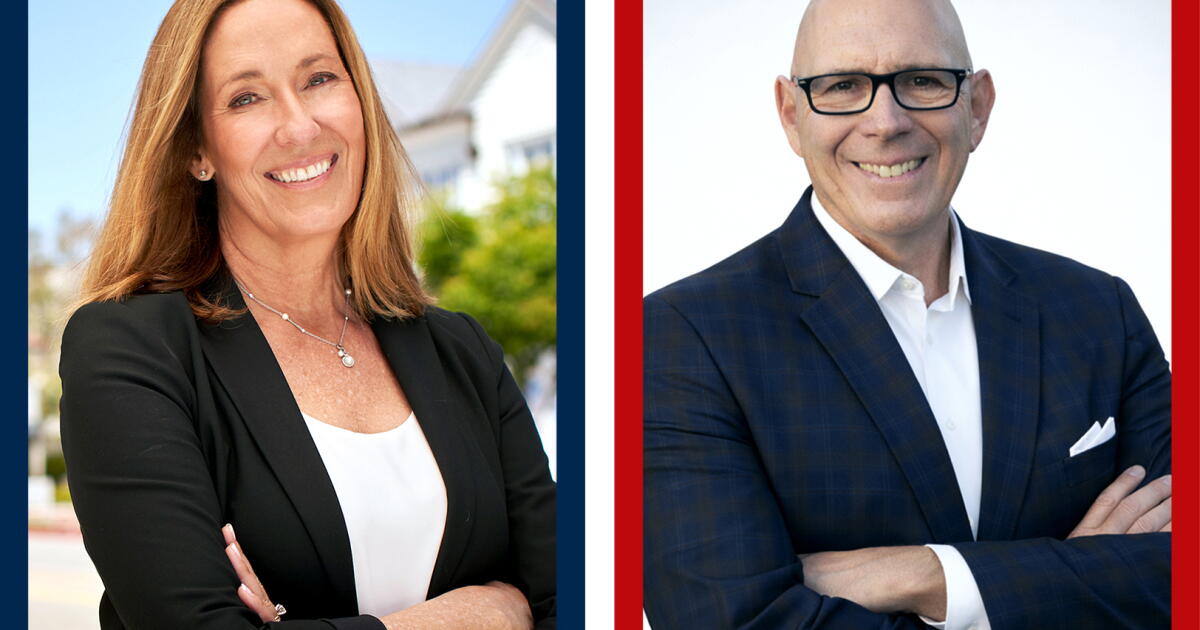
The amendment aims to clarify campaign finance rules for candidates running for a seat on the board of education, which overseas LAUSD and its approximately 350,000 students.
Repetitive language in the Los Angeles City Charter would be deleted and would make clear the same campaign finance rules apply to both mayoral candidates and board of education candidates, except in certain instances, the measure says.
Among those requirements are rules governing campaign contribution limits, filing deadlines, public disclosures and fundraising windows.
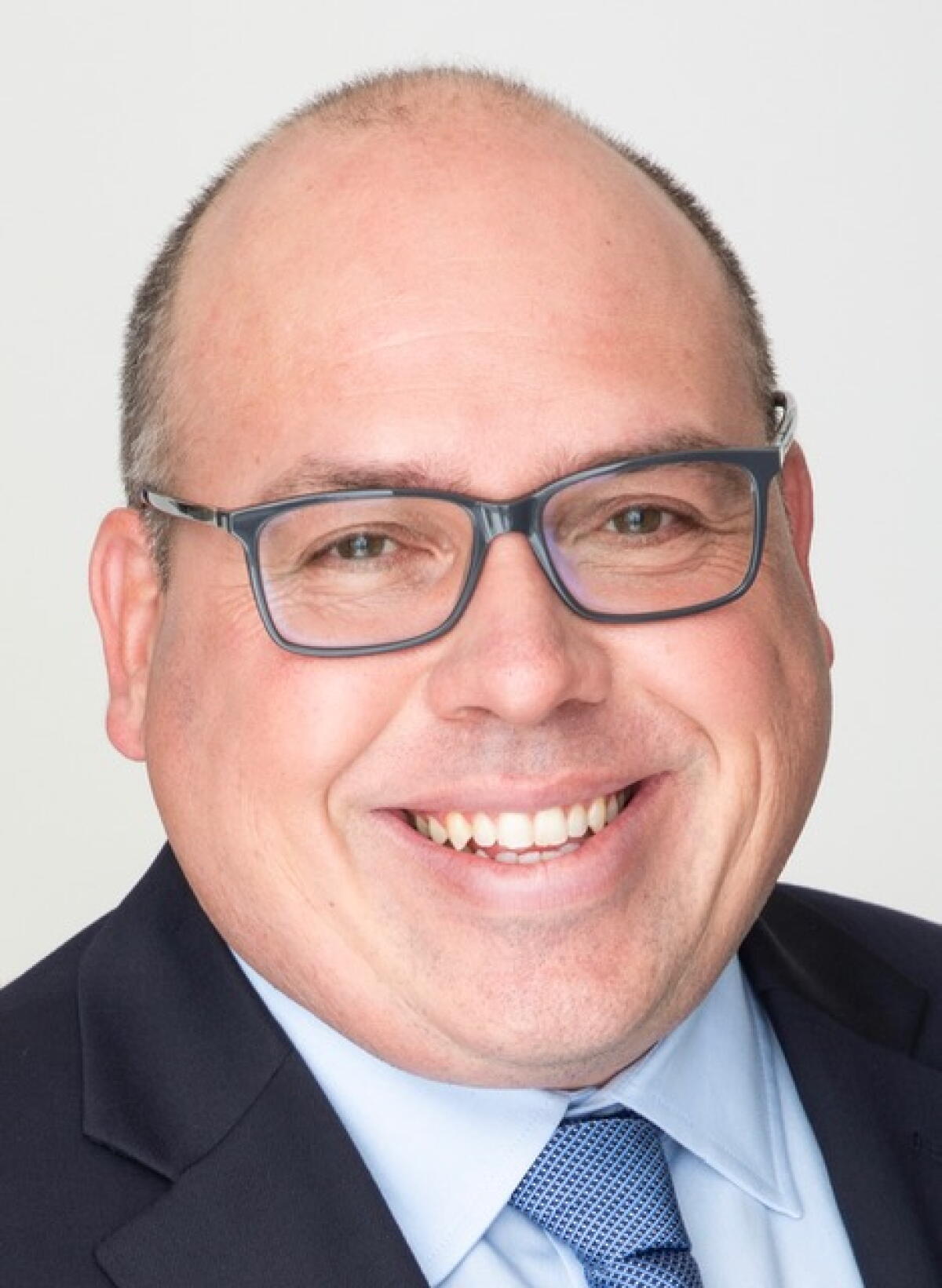
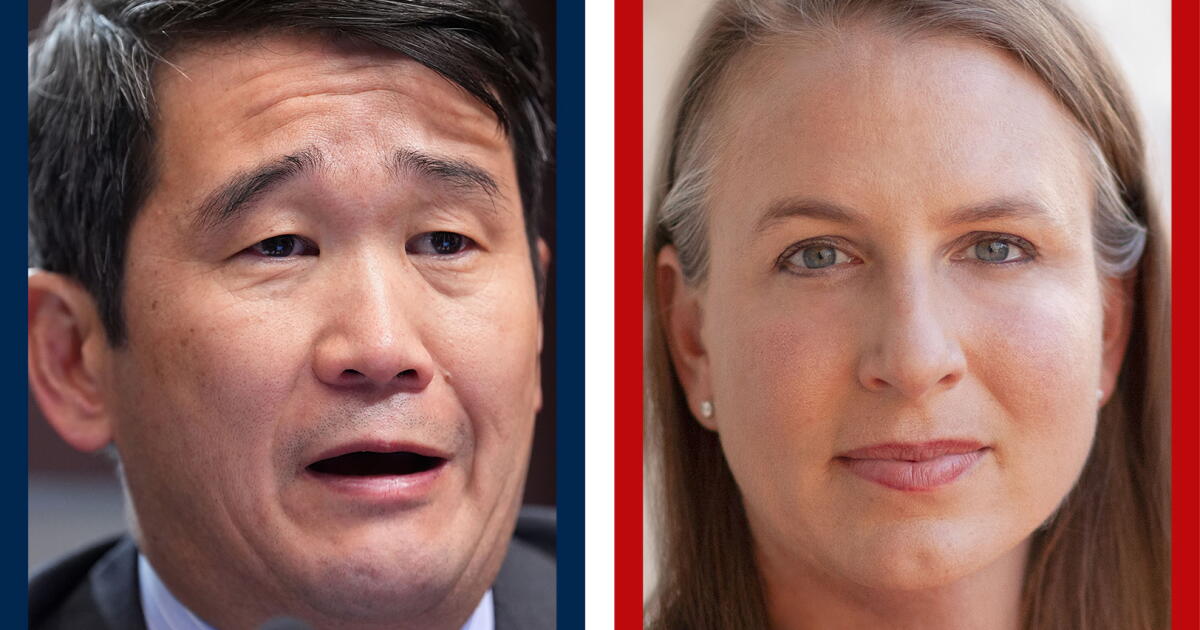
Justin Allen Clayton, L.A. County deputy public defender
Bar rating: Qualified
Clayton is a Los Angeles native who attended public schools, earned a bachelor’s degree in criminology and passed the bar in 2012. He joined the public defender’s office two years later and since 2023 has served as deputy in charge of the Inglewood branch.
Clayton describes himself as a “working supervisor” who conducts arraignments and represents clients at preliminary and other hearings. He has completed dozens of trials, including three with life sentences, according to his website.
The position involves overseeing and training attorneys, as well as law clerks and summer interns, on misdemeanor and felony case preparation and trial strategy.
Clayton said a priority is improving court efficiency through pretrial preparation and “firm but fair enforcement of deadlines.”
Time as a candidate, he said, has shown him the importance of effective communication within the court system in bridging language and cultural differences. He called that a guiding principle, particularly for clients who lack counsel.
“Sometimes, one additional question, or one additional statement, can make all the difference in resolving an issue,” he said.
Clayton said running a public defender branch office, which brings him in contact with judges, sheriffs, court clerks, interpreters and others, combined with 14 years as a trial attorney, gives him a “comprehensive understanding” of the courtroom.
“That combination of courtroom experience, leadership and daily interaction with the many people who make our justice system work has uniquely prepared me to serve as a Superior Court judge,” he said.
Anna Slotky Reitano, L.A. County deputy county counsel
Bar rating: Qualified
Reitano spent the early part of her career in criminal defense, contract law and other sectors. In 2014, she joined the L.A. County public defender’s office. A decade there included three years in juvenile court, where she primarily handled felony cases, and five years at the San Fernando Courthouse, where she represented indigent clients facing felony charges.
Reitano focused on mental health diversion and treatment, aiming to support rehabilitation when possible. Having a brother with schizophrenia and witnessing how families navigate the legal system when dealing with mental illness has informed her approach.
“This has given me a deeper understanding of both the challenges individuals and families face and the ways in which the system can fall short in addressing those needs,” she said.
This is not her first bid for office. She lost a campaign for a judgeship in 2022 and two years later assumed her position in the county counsel’s justice and safety division, where she supervises litigation and advises county departments.
Reitano, a former child actor, volunteers with local schools and, according to her website, mentors “future lawyers” through moot court competitions.
Campaigning, Reitano said, has shown her that constituents, no matter how different, uniformly want “a judge who is experienced, prepared, fair and willing to listen.”
“My experience across criminal, juvenile, civil, administrative and government law has uniquely prepared me to serve wherever the court needs me,” she said.
The state Legislature was tasked with developing a better recall system after Gov. Gavin Newsom faced a gubernatorial challenge in 2021, costing state and local governments more than $200 million.
Newsom defeated the recall attempt after nearly 62% voted to keep him in office. Had he been ousted, conservative talk radio host Larry Elder was the leading candidate to replace him with less than 49% of the vote.
Former state Sen. Josh Newman, who was recalled in 2018 and later reelected to office, co-authored the measure that made it to the ballot. He believes that the elimination of a second simultaneous vote for a replacement removes “the political incentive for gamesmanship around recalls.”
“My solution is really simple: It’s to eliminate that second question and maintain the recall as a valid, powerful tool of accountability,” he said.
It’s not uncommon for someone to get appointed to fill an official’s term if they leave office before their time is up. Newman said that slotting the lieutenant governor into the role of governor in the event of a recall would follow a precedent.
The lieutenant governor currently serves as acting governor when the governor leaves the state.
The measure is backed by four of the five supervisors. During the February meeting, Horvath, who authored the initial motion, said that binding arbitration would promote transparency and push the sides to reach a deal. She said that 21 California jurisdictions, including Sacramento and San Francisco counties, have implemented binding arbitration.
Supervisor Hilda Solis called this “another tool in the toolbox.”
A battery of labor unions representing county workers are on board, including the International Assn. of Firefighters Local 1014, the Assn. for Los Angeles Deputy Sheriffs and the Los Angeles County Lifeguard Assn.
Dave Gillotte, president of IAFF Local 1014, which represents more than 3,000 L.A. County Fire Department employees, said contract negotiations with the county generally are intense and lengthy. He said the goal is never having to resort to binding arbitration, but that if required, this would allow a “neutral third party” to make the final decision.
“Binding arbitration really brings about leverage to move both parties to work hard to get a contract done, where we don’t have that now,” Gillotte told the Times.
Sign up for the L.A. Times California Politics newsletter
Deeply reported insights into legislation, politics and policy from Sacramento, Washington and beyond. In your inbox twice per week.
By continuing, you agree to our Terms of Service, which include arbitration and a class action waiver. You agree that we and our third-party vendors may collect and use your information, including through cookies, pixels and similar technologies, for the purposes set forth in our Privacy Policy such as personalizing your experience and ads.
Democratic State Assemblymember Jacqui Irwin is facing off against Republican candidate and nonprofit leader Samuel Gallucci in the race for California’s 26th Congressional District.
They are seeking to claim the open seat created by the retirement of Rep. Julia Brownley, who has represented the region for the last 12 years. The district stretches from the the Pacific Ocean through the foothills of the Santa Monica mountains, encompassing most of Ventura County and the L.A. County communities of Calabasas and Agoura Hills. It includes the communities of Oxnard, Thousand Oaks, Simi Valley, Ventura and Camarillo as well as wide swaths of vineyards and agricultural land.
As with most Californians, the rising cost of living and especially the price of housing are major concerns for constituents. Many communities sit at the wildland-urban interface, making wildfire prevention and response another essential issue. The district is home to a significant immigrant community in agricultural areas such as Oxnard and Camarillo, which have been the site of Immigration and Customs Enforcement raids and protests.
Steven Veres, 46, is vying to maintain his seat on the Los Angeles Community College District Board of Trustees.
(Courtesy of Steven Veres)
Name: Steven F. Veres
Age: 50
Website: www.steveveres.com
Occupation that appears on the ballot: Los Angeles Community College District, member of the board of trustees
Experience: Veres cited his role as trustee and previous work as a teacher as key experience for another four-year term. Veres also has worked as a state politics adviser, including for Sen. María Elena Durazo. As trustee, he said his work has included strengthening job training programs, improving graduation rates and addressing basic student needs.
“Successful colleges depend on students, faculty, and staff having a meaningful voice in decisions” while the board should “listen, set clear priorities, protect public resources, and give our colleges the support necessary to help students succeed,” he said.
District challenges: The district’s greatest challenge is helping students finish their education, given how many are forced to juggle school with “jobs, housing costs, food insecurity, transportation, and family responsibilities … We need to remove those barriers while making the academic experience easier to navigate,” he said.
Priorities: “First, make college truly affordable. Tuition is only part of the cost. Housing, food, transportation, textbooks and childcare can determine whether a student stays enrolled.
“Second, improve completion and transfer rates. Students deserve clear academic pathways, accessible counseling and course schedules that allow them to earn a degree, certificate or transfer without unnecessary delays. Third, connect education to careers. I want to dramatically expand paid internships, apprenticeships and partnerships with employers and organized labor.
“These priorities reinforce each other: Students are more likely to finish when college is affordable, the path to completion is clear, and they can see the economic value of their education.”
Budget: “Our first responsibility is to use taxpayer dollars efficiently while protecting instruction and student services,” he said. In addition, Veres said that because state funding is based on enrollment, boosting it can be a path to financial stability, along with eliminating unnecessary, duplicative spending across the nine colleges and investing in energy efficiency to cut costs.
“Fiscal responsibility is not simply cutting spending,” he said. “It means directing limited resources toward what produces the greatest value for students and taxpayers.”
Student success: Veres would address barriers to student success and enrollment by pushing to make the application process easier and providing more flexible class schedules — including more evening, weekend, online and hybrid options — for working adults, parents and others. “Our job should not end when a student enrolls. It ends when that student reaches their educational goal,” he said.
Robert Payne is running for Los Angeles Community College Board of Trustees Seat 2.
Occupation that appears on the ballot: researcher/writer/environmentalist
Experience: Payne said he has taught at L.A. Mission College. His education at L.A. Valley College and Cal State Northridge helped prepare him for a career as a writer. He said he has worked on movie crews and ran an import business, among other jobs. Growing up in Pacoima helped him understand the needs of immigrants and “those of diverse backgrounds with limited resources.”
“I went through the [community college] system,” he said. “I know the difficulties. All my ideas come from my direct experience.”
District challenges: Payne cited low enrollment growth as the main challenge. Students also need to see a quicker return on their investment. “Life costs money,” he said. “If students could see immediate advantages to college, the colleges would attract more enrollments.”
He reflected on his own experience when discussing the importance of a quick payback. “I graduated from Cal State Northridge. Nothing I learned at L.A. Valley or Cal State paid off immediately,” he said. “I worked as a janitor, security guard, construction site cleaner. I lucked into a union tech job and I earned my way through graduate school. Years later, the master’s degree finally helped me get work as a ‘professor.’ ”
Priorities: Payne wants to make community colleges “cheaper, faster, better” in part by offering students more training for specific jobs and less expensive online textbooks. He also would support ending student debt.
Budget: He does not support cutting “student opportunities” and said if “the colleges can demonstrate success for the students, enrollment will justify the expense of maintaining the expense of the faculty, the staff, the facilities.”
Student success: Payne wants college to do more to offer “immediate perceived value,” including teaching résumé building, interview skills and how to apply to jobs. He said hiring adjuncts with industry experience could enhance student success.
Kristina Irwin is running for Los Angeles Community College Board of Trustees Seat 6.
Occupation that appears on the ballot: parent/business owner.
Experience: As a former community college student, Irwin has firsthand knowledge of the L.A. community college student experience.
She serves on the general advisory board at Santa Monica College and said she also served on the board of trustees at her children’s school, Palisades Charter High School, during the Palisades fire. She said she holds a Public Engagement & Civic Leadership Certificate from the Davenport Institute at Pepperdine School of Public Policy.
District challenges: Irwin said the main challenge is preparing young people to advance in college when their earlier schooling failed to give them the tools to succeed.
Priorities: Irwin wants to establish “preentry” programs in every local high school that would prepare students for community college and do more to give educators the resources they need to craft classes that “fit the needs and life limitations of the students.”
Budget: Irwin said alternative streams could be identified to fund “classroom student resources.” She said that as “responsible stewards” of district resources, trustee actions “are often under scrutiny either formally or informally.”
Student success: Irwin wants to address barriers to student success and enrollment by doing more to demonstrate how a community college education can give them the tools necessary to succeed in their chosen career.
Name: Roy Payan
Payan told the Times he suspended his campaign.
Adriana Cabrera is running for Los Angeles Community College Board of Trustees Seat 2.
Experience: Cabrera said she attended community college and went on to earn bachelor’s degrees in Chicana/o studies and political science and a master’s in education from Cal State Northridge. She said she also served as president of the Central Alameda Neighborhood Council and co-founded Empowering Youth in South Central, a “grassroots collective of students and educators” that “has supported thousands of first-generation students with college, career, financial-aid, and leadership support.”
“I am not coming into this role to learn higher education after I am elected,” she said. “I have studied it, worked in it, navigated it as a student, built programs within it, worked inside public institutions, and organized communities around it.”
District challenges: Cabrera said student services are too difficult to navigate, too many students struggle to afford basic needs such as housing, and clearer pathways are needed to economic mobility, She said budget decisions also can feel “disconnected” from the staff and students those decisions effect.
Priorities: “My first priority is invest in students first,” she said. Cabrera would do that by making student services easier to navigate and strengthening financial aid and other support, including for food, housing, child care and mental health.
Secondly, Cabrera wants to better connect education to economic mobility through good paying jobs. Lastly, Cabrera would give students, faculty, staff, labor organizations and community members “a meaningful voice before major budget priorities are finalized.”
Budget: Cabrera would review the district’s spending “to make sure existing dollars are being used efficiently” and “identify responsible ways to generate additional revenue without shifting costs onto students.” For instance, renting out underutilized facilities.
Student success: Cabrera would take steps to ensure student services are more readily available and the public has better visibility and say in trustee decisions. “The overall standard I would bring to the board is simple,” she said. “Can students enter LACCD, understand their options, find the support they need, complete their goal, and leave with more opportunity than when they arrived?”
Last year, Kim was one of the sponsors of the Community Investment and Prosperity Act, a proposed law that later was encompassed in another piece of legislation that expanded banks’ ability to invest in communities in a way that promotes economic development and the public good. The law allows national and state member banks to invest up to 20% of their capital and surplus in affordable housing, small business lending and community revitalization.
“Families across California have felt the effects of rising costs for years. From delivering meaningful tax relief to supporting commonsense housing and energy reforms, I remain committed to fighting for opportunity and economic security that put Californians first,” Kim said in a press release issued by Americans for Prosperity in May.
Calvert sees affordability as the biggest challenge facing families and blames Sacramento for the rising costs and “driving businesses out of the state.” He points to his vote in support of the One Big Beautiful Bill Act, which maintained many of the tax cuts in the Tax Cuts and Jobs Act of 2017 and raised the State And Local Tax (SALT) deduction cap.
“My priority is fighting to lower everyday costs, help families keep more of what they earn and supporting policies that fuel economic growth, which in turn provides higher wages and more opportunities for California families and workers,” he said.
The largest chunk of this money — $7.2 billion — would be doled out as loans to builders who agree to rent some of the homes to low-income families; in Los Angeles County, a family of four earning about $133,000 a year qualifies as low-income.
Researchers recently found that the construction of nearly 40,000 low-income homes was in limbo because of a lack of funding.
The second-largest portion of these funds — $1.25 billion — would be set aside for housing for veterans, in the form of homeownership loans. Voters last approved this type of statewide bond for veteran home loans in 2018.
According to the Legislative Analyst’s Office, the remaining dollars would be spread across several other initiatives and could subsidize up to 40,000 rental apartments, 2,500 homes for farmworkers and 1,200 beds for university students:
$1.1 billion to help low- and middle-income families buy homes through direct loans and funds to nonprofits
$500 million for infrastructure related to new housing, such as road and water repairs
$450 million in loans or grants to build or upkeep affordable housing for farmworkers
$350 million to build affordable housing for students, split evenly among the University of California and California State University
$200 million available for tribal members to use to build or repair housing
$200 million available to city and county governments and other entities hoping to pilot programs to build low-cost housing
Arguably the biggest change is to Area Planning Commissions, a group of seven volunteer-led boards that hear cases from homeowners, developers and businesses and make rulings on liquor licenses, hillside developments and more.
The amendment would consolidate those seven commissions into a single unified Neighborhood Appeals Commission.
The goal is efficiency. State laws passed in recent years have changed the appeals process, leading to lower caseloads for the seven boards. It’s also a financial drain on the city to train and take on so many volunteer commissioners while also paying overtime for staffers to host evening meetings for seven bodies — think audio-visual specialists, tech support, etc.
Under the amendment, the total number of commissioners would shrink from 35 to as few as seven, and the staff required to host meetings also would shrink significantly.
A unified board would eliminate the risk of commissions issuing different rulings. Picture a developer trying to build a hillside home; a commission that’s wary of such projects could reject it, while another commission that leans more pro-housing could approve it. Having a single board means that all appeals and applications would be governed by the same logic.
Pave the way for super-skyscrapers
Could an L.A. skyscraper rise higher than those in New York City or Chicago? Could downtown L.A. claim not just the tallest building west of the Mississippi River but also in the entire country?
If so, it would start here.
This amendment allows the City Council to change the existing floor area ratio (FAR) restrictions, which cap the height of certain buildings. FAR ratios vary by neighborhood and height districts, but the highest ratio is currently 13x, meaning a building’s total square footage never can be more than 13 times the size of the parcel of land that it sits on. For reference, L.A.’s tallest building, the Wilshire Grand Center, has a ratio of roughly 10.5, depending on how you calculate the square footage and acreage.
These limits were set in the 1950s, when L.A.’s population was roughly half of what it is now. This amendment would give City Council the flexibility to set higher limits to add density in order to adapt to a growing population.
Individual projects still would require zoning reviews, so no need to worry about skyscrapers coming to Silver Lake.
Set deadlines
You just opened a taco shop and you want to serve margaritas. The City Council said it’s fine, but you’re waiting to hear back from the City Planning Commission. They’re taking too long, and your patrons are drinking water while you wait for a liquor license.
Under current rules, decisions from either the City Council or Planning Department can get kicked back and forth indefinitely. This amendment sets deadlines for both sides to speed up rulings: Planning boards have 30 days to concur or dissent with City Council decisions, and City Council gets 21 days to hold a final vote on Planning decisions — or else the Planning decision becomes final.
Ensure passed amendments actually pass
Here’s how it would work. Say there’s an amendment to the city’s General Plan, which guides land use decisions, or a tweak to one of the neighborhood community plans that oversee development in areas like Hollywood or Boyle Heights. The mayor has signed off on it. The City Planning Commission approves too. But the City Council just hasn’t quite gotten to it yet.
Under current rules, if the City Council doesn’t vote on an amendment within 75 days of the mayor and Planning Commission approvals, it’s automatically denied. This amendment reverses that; if the City Council doesn’t get to an amendment within 75 days, it’s automatically approved.
McKinney has been endorsed by Hochman, the union that represents rank-and-file L.A. police officers and City Councilmembers Traci Park, John Lee, Tim McOsker and Monica Rodriguez. While McKinney has raised half a million dollars, independent expenditures have spent more than $3 million to support the veteran prosecutor.
More than $2 million of those funds have come from a political action committee run by Airbnb. The rental giant was sued by Feldstein Soto for price gouging after the destructive Palisades fire, but McKinney has dismissed criticism that he’s receiving massive financial support from a corporation that if elected, he’d be involved in litigation against.
“Airbnb is going to benefit from a safer L.A., because it’s going to boost tourism to the extent that they have properties and interests here,” he told The Times in May. “When they look at the current city attorney and they look at Marissa Roy, maybe they decided this guy is going to do a better job.”
Roy has the support of the L.A. County Democratic Party, the Democratic Socialists of America’s Los Angeles chapter, California Atty. Gen. Rob Bonta, U.S. Sen. Bernie Sanders (I-Vt.), City Councilmembers Ysabel Jurado and Eunisses Hernandez, L.A. City Controller Kenneth Mejia, L.A. County Supervisors Hilda Solis and Lindsay Horvath, the city attorneys of San Francisco and San Diego, the L.A. County Federation of Labor and a host of other labor unions and Democratic groups.
Mayor Karen Bass endorsed Feldstein Soto in the primary. She has yet to weigh in on the runoff.
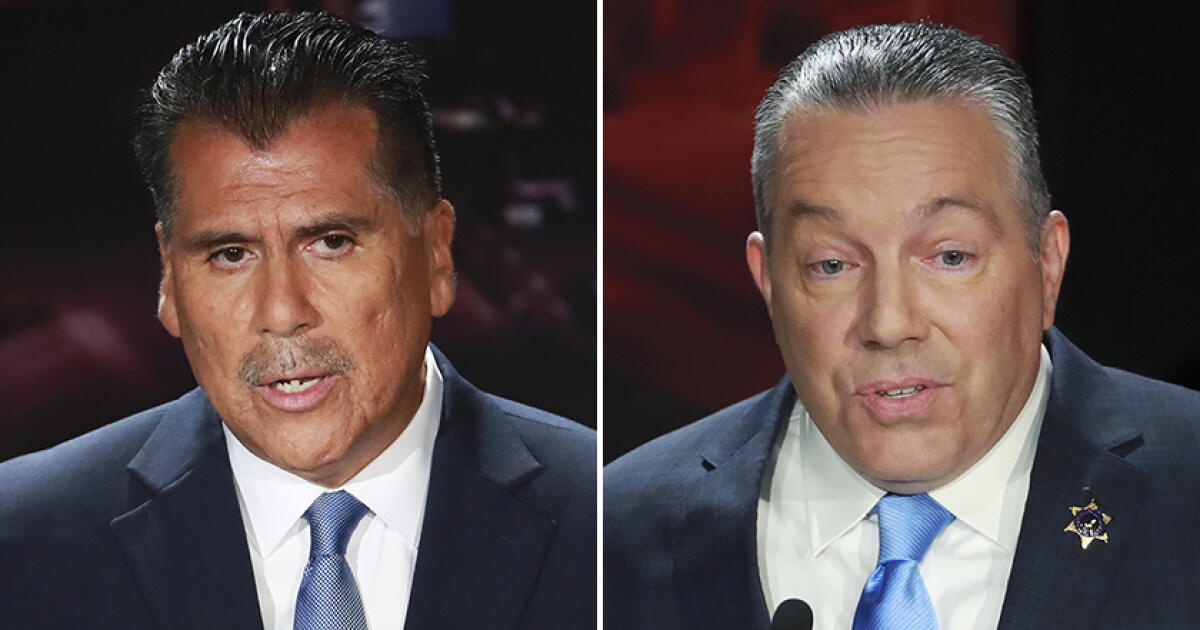
Former Long Beach Police chief Robert Luna came out of retirement to run for sheriff in 2022, promising to turn around a department that had veered off course.
As someone who didn’t have the wide name recognition or countywide political experience of some of his challengers, Luna’s second-place finish to Villanueva in the primary was far from guaranteed, but he ultimately cleared the rest of the field by a wide margin.
Fast-forward four years to June, and Luna received 44.2% of the vote in this primary — less than six points short of winning the race outright — versus Villanueva’s 21.7%. And Luna’s been a more effective fundraiser, bringing in $366,000 since Jan. 1, more than three times the nearly $109,000 Villanueva had raised by June 30, according to their most recent campaign filings. Luna had $352,000 in the war chest as of June 30, and Villanueva had about $56,000.
But Villanueva has wide name recognition in L.A. County. And he pulled off a historic political upset of his own in 2018 when he beat Sheriff Jim McDonnell, who is now the Los Angeles police chief. It was the first time an incumbent L.A. County sheriff lost a reelection campaign in more than a century. It was also the first time in 100 years that a Democrat had been elected to the nonpartisan sheriff’s job.
After running on a progressive platform and pitching himself as a criminal justice reformer, Villanueva tacked hard to the right. Within two years he was a favorite of conservative media, including Fox News, where he appeared repeatedly to vilify “woke” culture and criticize Democrats. He ultimately switched his party registration to Republican in a move that solidified a new base of law-and-order supporters while alienating many who supported him in 2018.
Villanueva’s tenure was marked by controversy and scandal. He launched, then walked back a criminal leak investigation of a Los Angeles Times reporter and was ordered to testify after sheriff’s deputies took and shared pictures at the site of Kobe Bryant’s helicopter crash. Villanueva defied subpoenas over so-called deputy gangs.
Now, Luna is the one defending his record as sheriff over the last four years. He’s presided over declines in homicides and violent crime and established a period of relative calm after the stormy Villanueva years. But Luna’s department has come under scrutiny in the wake of a July 2025 incident in which a grenade exploded accidentally in a department parking lot, killing three deputies. The state has fined the department more than $350,000 after identifying a series of safety violations leading up to the blast.
And the Civilian Oversight Commission filed suit against the department in June for declining to provide certain records related to three cases of use of force the commission issued subpoenas for in February 2025. Luna has said the county’s attorneys maintain that the unredacted records can’t be released until it completes a “meet and confer” process with the Sheriff’s Department union, a claim that watchdogs have disputed.
Min said Trump’s attacks on voting by mail and his attempts to get the U.S. Postal Service to refuse to deliver mail-in ballots, combined with his attempts in 2020 to overturn the election, “should worry every American who cares about our country, our Constitution, and the values of our nation.”
In 2024, Min authored a bill which passed that prohibits local governments from forcing voters to present identification before they cast a ballot at a polling place.
“I will continue to do all I can to stand up against these anti-democratic and un-American attacks on the sanctity of our elections,” Min said.
Le Roux told The Times she supports the Safeguard American Voter Eligibility or SAVE America Act, which would require voters to provide documents proving their citizenship at the time of registration and a photo ID at the time they vote.
In California, people are required to provide a driver’s license number or a portion of their social security number when they register to vote.
“Millions of ballots are mailed out in California with very few safeguards and at significant cost, leading to weeks of uncertainty as the rest of the country laughs and mocks us for our incompetence,” she said.
Le Roux also supports Proposition 39, which will appear on the November ballot in California, and would require voters to show government issued identification at the polls. Voters who submit mail-in ballots would need to provide the last four digits of a government ID to vote.
Proponents of the measure say Los Angeles is falling short in providing basic services, including street and sidewalk maintenance, upkeep of streetlights and trees and other services administered by the Department of Public Works.
The measure is intended to streamline public works decision-making to improve city services and add new sources of revenue by leveraging existing resources such as underutilized city land.
Measure LA’s perhaps most controversial element is the proposal to increase the power of the director of public works while reducing the sway of the Board of Public Works or potentially eliminating it.
The director would be able to manage public works projects, including construction, buying or leasing property, exercising eminent domain with City Council approval, granting street permits, regulating parking and recommending budgets for the department.
An opponent of the measure, Rodriguez said the Board of Public Works was established to provide independent review of city contracting, with commissioners’ decisions made in public meetings.
“Removing this important check and balance would reduce public scrutiny and weaken accountability over billions of taxpayer dollars for public projects,” Rodriguez said in her ballot argument against the measure.
Commissioners are appointed by the mayor. They work full-time on the board for five-year terms administering the Public Works Department while assisted by several bureau heads and the director of public works.
Proponents of the measure say the current system of overseeing public works is ineffective because responsibility is spread among multiple officials, commissions, agencies and bureaus.
“Angelenos see the results in crumbling streets, buckled sidewalks and streetlights that stay dark,” proponents said in their ballot argument.
Another key element of the measure is establishing a two-year budget cycle for the city, which currently adopts its budget annually. Under Measure LA, the mayor would be required to submit a proposed two-year budget to the City Council by April 1. A two-year budget would enhance planning for infrastructure improvements under another new requirement that the city adopt a Capital Infrastructure Plan.
Most major U.S. cities rely on multiyear capital improvement plans to schedule spending on roads, bridges, parks and buildings.
A long-term infrastructure plan administered with two-year budgeting “sets clear priorities, identifies the projects that need to get done, and plans how to fund them over time,” proponents said.
Currently, the charter prohibits the city from mortgaging city-owned property and prevents it from operating purely commercial or industrial businesses. The measure would remove these restrictions to raise new revenue.
Easing restrictions on operating a business also would allow the city to use its intellectual property to sell merchandise with city logos, as is done in other cities including New York, Yaroslavsky said.
Ugarte, who once collected signatures for Measure ULA, also known as the “mansion tax,” says it’s not working as intended and is keeping developers away from the city. The measure levies a tax on property sales above $5.3 million and funnels the money to affordable housing programs and homeless prevention.
“If developers are running away from the city of L.A., we gotta know why. We gotta go back to the drawing board. We gotta accept when we make mistakes, including myself,” Ugarte said.
He supports amending the measure to exempt affordable housing developers. He also wants to raise the threshold for properties subject to the tax to $10 million, to account for the increasing costs of construction.
Ugarte supports State Bill 79, a law mandating that cities increase housing density around public transportation hubs. But more transportation, Ugarte said, needs to come before more housing.
Making L.A. more transit-friendly will lower costs for housing, insurance and parking, Ugarte said, giving residents relief from the city’s high cost of living.
Mazariegos said homeless prevention starts with enforcing a “huge list” of the city’s tenant rights laws, including rent control and prohibitions against landlords harassing tenants.
Building affordable housing, along with enforcing those laws, will keep more people housed, he said.
Mazariegos wants to use public land to build social housing, which is publicly subsidized housing separate from the rental market.
He also would push to extend the travel industry’s upcoming $30 minimum wage to all workers and to tie the minimum wage to the consumer price index.
“A combination of those things will reduce and stop the bleeding of folks going into the street, going homeless, and will start giving us a chance as a city to work our way out of this crisis,” Mazariegos said.
More state money to pay for arts teachers will reach local schools if legislation signed Sunday by Gov. Gavin Newsom works out as intended, but the new law will not resolve a lawsuit accusing the Los Angeles school district of misspending as much as $77 million in its share of the funding.
The aim of Assembly Bill 2440 is to encourage more school systems to use arts funding made available through Proposition 28, which voters passed in November 2022.
“The clear message we heard was that many school districts have been struggling to navigate legal ambiguity regarding compliance with Proposition 28,” said bill author Al Muratsuchi (D-Rolling Hills Estates) in a recent statement to The Times. He said his goal was to provide “statewide guidance” so that all or most school systems could use the money without concern over violations of spending rules that could result in financial penalties.
Proposition 28 sets aside an amount equal to 1% of the state’s base education funding — close to $1 billion per year — to increase arts education. This extra funding is drawn down from the state’s general fund — so it adds to the total allotted for education.
The initial funding, nearly a billion dollars statewide, went out for the 2023-24 school year and has continued annually. But millions of dollars have not yet been spent, according to early reviews of the data.
Some local officials said they were holding back over concerns that they would inadvertently violate the rules for spending the money — and would then have to pay it back, creating significant financial risk.
This bill had backing from arts organizations, education and school district officials and the California Teachers Assn. No opposition was recorded in the legislative record; nor were there any opposing votes as the bill worked its way through the legislative process.
But then Austin Beutner — the author of Proposition 28 — learned of the measure and stepped forward with concerns. He contendedthe bill would make using the arts money easier, but in wrong ways. He said the bill would undermine the guarantee that new arts funding would reach every school. Also it would in effect eliminate the provision that campuses serving low-income communities receive higher levels of new funding. Moreover — and of key importance — the legislation would allow districts to use the new arts money to replace existing arts funding, leaving students no better off than before, he said.
Beutner had structured Proposition 28 precisely to prevent this supplanting of funds. Districts not willing to provide the required increased instruction at every school would, by design, lose access to the new arts money.
Beutner began to rally opposition, including United Teachers Los Angeles, L.A. mayoral candidate Nithya Raman and San Diego school board President Richard Barrera, who is running for state superintendent of public instruction — and who has the endorsement of the California Teachers Assn.
Beutner also announced his attention to file litigation against the bill.
Muratsuchi said he had no intent to undermine the goals of Proposition 28 — and a compromise soon emerged.
The final version — which has Beutner’s approval — clarifies that small schools or small school districts can pool their money to share an arts teacher, provided that every school gets the additional arts instruction. The bill also gives some legal protection for school districts against financial penalties if their arts funding decreases as a result of factors beyond their control, such as the expiration of a grant.
An LAUSD lawsuit continues
Beutner alleges that L.A. Unified has intentionally misused the new arts money.
Beutner pursued passage of Proposition 28 after serving as superintendent of L.A. Unified. His stint ended in mid-2021 with the expiration of a three-year contract.
“LAUSD has done exactly what the law prohibits,” Beutner alleged in an ongoing lawsuit filed in February 2025. “It has eliminated existing funding sources for existing art teachers, and replaced those funds with Proposition 28 funds, thereby violating the requirement that the funds supplement rather than supplant existing sources.”
The lawsuit lists 37 elementary schools with the same or reduced money for arts instruction from 2022-23 to 2023-24 — when the new funding first arrived — and alleges that most L.A. Unified schools faced a similar funding situation.
Before the lawsuit, but in response to growing criticism, L.A. Unified officials quietly added $30 million to the elementary school arts budget for the 2024-25 school year amid ongoing accusations from Beutner, union leaders and parents.
The district has defended its actions.
“We continue to follow implementation guidance as provided by the state of California to ensure that we are fully complying with the requirements of Prop. 28,” the district said in a statement at the time of the lawsuit, a contention that it has made repeatedly.
Good morning, and welcome to L.A. on the Record — our City Hall newsletter. It’s David Zahniser and Noah Goldberg, giving you the latest on city and county government.
It’s one of the most exacting tasks to face a left-leaning candidate running for office in L.A.: filling out the Democratic Socialists of America’s questionnaire.
During the candidate endorsement process, the DSA’s L.A. chapter issues a lengthy form that ends with a spate of yes or no questions, mainly around hot-button topics: Do you support Medicare for All? Do you favor the policies of the Green New Deal? Would you put a halt to police exchange programs with Israel?
When filling out the form, mayoral candidate Nithya Raman voiced support for all three. But unlike some DSA-endorsed candidates, the council member declined to give a yes or no answer on an assortment of other topics, opting for longer explanations.
You’re reading the L.A. on the Record newsletter
Sign up to make sense of the often unexplained world of L.A. politics.
By continuing, you agree to our Terms of Service, which include arbitration and a class action waiver. You agree that we and our third-party vendors may collect and use your information, including through cookies, pixels and similar technologies, for the purposes set forth in our Privacy Policy such as personalizing your experience and ads.
Raman, a DSA member, declined to check either box when asked if she would work as mayor to repeal a law prohibiting homeless encampments near schools. She did the same on whether to divert funds from law enforcement into other public services.
She also declined to say yes or no on removing police from K-12 schools, and on banning the use of facial recognition and other surveillance technologies.
The answers offer the latest sign that Raman has been proceeding with caution on some of the DSA’s litmus test issues. Raman, who tweeted “defund the police” six years ago, said in February that the ranks of the Los Angeles Police Department should not get any smaller.
Appearing Wednesday in Pico-Union, she said she was proud to have the DSA as part of her coalition but also described herself as politically independent.
“I’ve made sure that the decisions that I’m making, the votes that I’m taking, are ones that are based on an understanding of how these policies are actually going to improve the lives of Angelenos,” said Raman, who received the DSA endorsement earlier this month.
Mayor Karen Bass, Raman’s opponent, did not seek the endorsement, saying she was not aligned with some of the group’s positions.
Raman’s questionnaire stands in contrast with those of some of her DSA colleagues.
HugoSoto-Martínez answered nearly every yes-no question posed by the DSA during his first run for City Council in 2022. Ysabel Jurado did the same during her successful council campaign two years later.
So what were Raman’s longer answers? On homeless encampments, she wrote that she has repeatedly voted against increasing the number of locations where tents are prohibited — and doesn’t want to saddle homeless people with criminal records that could stifle their ability to find permanent housing.
Regarding cuts to the LAPD, Raman said she would expand the city’s network of unarmed crisis response teams, ensuring that “trained professionals” — not police officers — respond to mental health and substance use calls.
On campus police, Raman said schools “should never default to armed officers for discipline or student well being.” And on facial recognition software, Raman said she would prohibit surveillance technologies that lack “clear evidence of need and completely enforceable safeguards for civil rights and privacy.”
“I will also require real oversight and consent before the city deploys any of it,” she wrote.
Raman even declined to say yes or no when asked if she wants noncitizens to vote in local elections. But she explained in writing that she voted earlier this year to put a proposal from Soto-Martínez on the ballot that would give the council the ability to enact noncitizen voting for city and school board elections.
Raman and Bass weighed in recently on the deal struck by California Atty. Gen. Rob Bonta and Paramount Skydance Chief Executive David Ellison on the studio’s merger with Warner Bros. Discovery.
Both mayoral candidates said Paramount should be held accountable for the promises contained in the settlement, which requires the company to distribute 30 films per year in theaters for the first two years after the merger, then 32 films per year for the next three years.
Of the two, Raman sounded more dismayed by the deal.
“There was a better outcome than this,” Raman told reporters at a recent news conference. “But this is the outcome that we have, and now it’s incumbent upon us to fight for the best results for workers here.”
For much of this year, Bass and Raman voiced concern that the merger would trigger mass layoffs within the film and television industries. But last month, Bass began calling for the two parties to engage with each other in good faith, saying too many productions had come to a standstill, putting people out of work.
“The prolonged uncertainty around this decision has already led to job losses and left workers wondering what it would mean for their futures,” Bass said in a statement this week.
The settlement alleviated the anxiety felt by some at City Hall that Paramount might follow through on its threat to leave California.
Bass’ stance aligned her more with IATSE, the International Alliance of Theatrical Stage Employees, whose leaders voiced their own concerns about uncertainty while appearing with the mayor at City Hall last month.
Raman was more in sync with Writers Guild of America West, which denounced Bass for pressing Bonta to seek a resolution, saying “industry workers deserve a mayor who believes in upholding the law.”
Bass’ campaign is supported by IATSE Local 33 and the California IATSE Council, which said earlier this year that the mayor has “done more to bring our jobs back to Los Angeles than anyone in city government.”
On Thursday, the Writers Guild endorsed Raman, saying she is a “true pro-labor candidate who walks the walk.”
State of play
— POLLING PRESSURE: A new poll put Raman decisively in the lead in the mayor’s race, showing her with a double-digit advantage over Bass. The findings will ramp up the pressure on Bass and her allies to go sharply negative against Raman while courting the huge number of voters who say they are still undecided.
— MAKING THEIR CASE: Bass and Raman sat down with The Times for two separate, wide-ranging interviews, discussing issues like homelessness, the Palisades fire and the biggest mistakes they’ve made in office.
— PEOPLE MOVER POSTPONED: The opening date of the People Mover train being built at Los Angeles International Airport has been delayed yet again, with contractors now aiming for early January. The 2.25-mile automated train, which has been over budget for years, was originally supposed to open three years ago.
— EXECUTIVE ORDER: Bass ordered a review of the LAPD’s dealings with mentally ill people this week, saying the training that police officers are receiving is “woefully inadequate.” The mayor said she was particularly troubled by a July 29 incident in which police fatally shot a man who approached them with an aluminum bat.
— HURDLES TO HOUSING: Why has housing production been lagging in L.A.? Real estate developers pointed to a list of reasons, including high interest rates, pandemic-era policies like rent freezes and Measure ULA, the voter-approved tax on high-end property sales.
— TRUMP REBUFFED: An appeals court blocked the Trump administration from stopping the Los Angeles Homeless Services Authority from applying for millions of dollars in federal funding. The agency had applied on behalf of homeless service organizations from across the county.
QUICK HITS
Where is Inside Safe? The mayor’s signature program to address homelessness went to the area around 11th and Irolo streets, a location represented by Councilmember Heather Hutt.
On the docket next week: Bass and Raman are slated to appear Tuesday at the Skirball Cultural Center for the 2026 Jewish Los Angeles Mayoral Forum. The event is hosted by the Jewish Federation Los Angeles, the Skirball Cultural Center, ADL Los Angeles and other groups.
Stay in touch
That’s it for this week! Send your questions, comments and gossip to LAontheRecord@latimes.com. Did a friend forward you this email? Sign up here to get it in your inbox every Saturday morning.
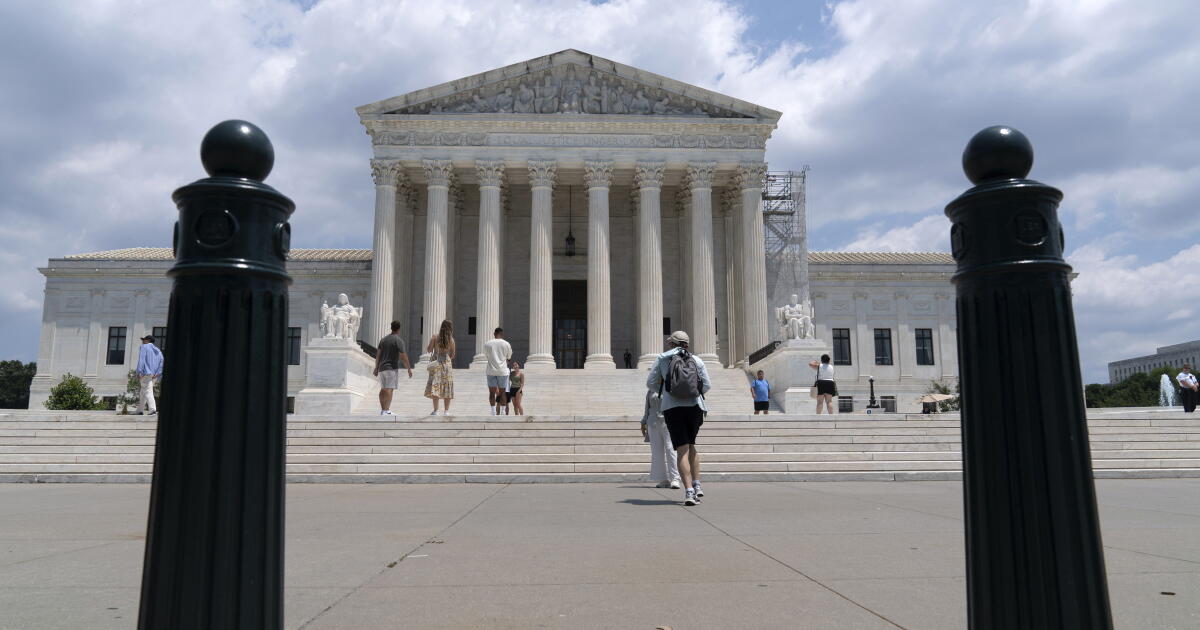
WASHINGTON — For the third time this month, the Supreme Court has rejected Missouri’s bid for one more Republican-leaning congressional district.
With no dissents, the justices upheld a state court order requiring the use of a 2022 election map, which favors Republicans in six of the eight districts.
“At this late date, ordering reversion to the 2025 map in the midst of an ongoing election would usher in electoral chaos,” the justices wrote.
The GOP, with the backing of conservative federal judges, wanted to use a new 2025 election map that redrew the district in Kansas City that had elected a Black Democrat.
That would have given Republicans a 7-1 advantage, but the Supreme Court stood in the way.
“As a matter of state law, the 2022 map — not the 2025 map — must be used in the 2026 congressional election,” the justices said in an unsigned opinion. “This Court has repeatedly cautioned that lower federal courts should not ‘alter the election rules of a state on the eve of an election.”
Each side in this messy dispute accused the other of seeking to change the voting districts on the eve of the election.
On Tuesday, the opponents of the newly drawn GOP-friendly map appealed to the Supreme Court for the third time. They said it is too late to switch the districts because ballots had gone out based on the existing map.
They said the Republicans “demand a new map after votes have already been cast. Ballots using the 2022 map have been printed and mailed, and absentee voting, both by mail and in-person, began today.”
But the state’s Republican attorneys said the primary elections took place under the new 2025 map, and that argues for keeping those districts in place for the general election in November.
Last September, the Missouri General Assembly, following President Trump’s lead, voted to redraw its eight congressional districts. In recent years, the state had sent six Republicans and two Democrats to Congress.
The Legislature’s goal was to flip one more seat in favor of Republicans. The new map would do that by breaking up the Kansas City district that had elected Rep. Emanuel Cleaver, a Black Democrat, with a new district that favored a Republican.
But a group called People Not Politicians and its executive director, Richard von Glahn, gathered more than 300,000 signatures for a referendum to challenge the new law before it took effect.
After waiting nine months to respond, Missouri Secretary of State Denny Hoskins, a Republican, denied the referendum in early August on the same day the primary elections got underway.
Von Glahn and his group of voters sued and won a unanimous decision from the Missouri Supreme Court on Sept. 3. Its judges said the state Constitution authorizes such a referendum and a new election map cannot take effect until the voters have spoken.
Hoskins filed an emergency appeal at the Supreme Court and cited the “chaotic fallout” from the state court “irresponsible decision.”
Justice Brett M. Kavanaugh, who oversees appeals from the 8th Circuit Court based in St. Louis, denied the appeal without comment on Sept. 8.
But shortly after his decision was issued, U.S. District Judge Stephen R. Clark, a Trump appointee, issued a temporary restraining order that prohibited the state from using the any voting map other than the new one.
People not Politicians appealed that decision to the Supreme Court.
On Sept. 10, Kavanaugh and the full court granted the appeal and blocked the judge’s order from taking effect.
The justices did not explain their reasoning, but the meaning of the order was clear. The state Supreme Court ruling meant the new map could not be used for this year’s election.
But that did not stop the 8th Circuit Court from ruling the state must use the new map.
Siding with several Republican candidates, a 2-1 majority said the use of 2022 map was unconstitutional because the primary elections were held under the new map. Its decision ordered the elections to be held using the new map.
This was a surprising ruling, since the Supreme Court’s order on Sept. 10 barred judges in Missouri from intervening further in the dispute over the voting maps.
But after a third trip to the court, the justices said the state must use the 2022 map.
LAS VEGAS — Susan Gonzalez plans to pay off her credit card now that she no longer needs to pay taxes on the dollar bills that she stashes away at the end of long shifts pouring beers and mixing cocktails in a smoky sports bar.
Thanks to President Trump, “there’s more money in our pockets,” the registered Republican said. The Iran war might have spiked gas prices, but Gonzalez is still confident that the U.S. economy is getting stronger.
The Jackpot Bar & Grill, located about 4 miles from the Las Vegas Strip, is in the heart of Nevada’s 3rd Congressional District, where Democratic Rep. Susie Lee is trying to fend off a challenge from Republican candidate Marty O’Donnell. The state has the highest concentration of tipped workers in the country because its economy is driven by the hospitality and tourism industries, making Trump’s “no tax on tips” policy a critical part of his party’s midterm pitch here.
The question for Nevada voters is whether they’re seeing more benefit from lower taxes or more pain from the country’s economic troubles, such as energy costs and declining tourism.
Lee’s district is a top target for the Republican Party in its fight to maintain control of the House. With a mix of working-class and high-income neighborhoods, it’s the most competitive of Nevada’s four congressional seats. In 2024, both Lee and Trump won the district.
Lee has held the seat since 2019, campaigning as a moderate and highlighting her bipartisan record. O’Donnell, a composer known for his work on the “Halo” video game series, became his party’s nominee this year with help from Trump and a $3 million personal loan.
The race has caught the attention of Trump-aligned super PACs. Safety and Affordability, an offshoot of MAGA Inc., committed this month to spending almost $3.2 million on advertising to help O’Donnell, according to the ad-tracking firm AdImpact. The total effectively matches the $3.1 million O’Donnell’s campaign has already spent on advertising reservations through November.
The heavy commitment puts pro-O’Donnell forces ahead by more than $1 million in the ad spending race in the district, where Lee’s campaign has spent $2.9 million and the Democratic House leadership super PAC House Majority Fund has put in $2.3 million.
Nevada is the birthplace of ‘no tax on tips’
Trump first announced his policy proposal at a June 2024 campaign event in Nevada, and he has repeatedly said that he was inspired by a Las Vegas server who suggested the idea.
“So we’re eating, and this beautiful young lady walks over, and I said, ‘How are you doing, everything good?’” Trump said in August. “‘Sir, they’re taxing me to death.’ I said, ‘Really? What are they taxing?’ ‘They’re taxing my tips. Sir, they should have no tax on tips.’”
The proposal was included in a sweeping package of tax breaks, social-services cuts and immigration enforcement that Trump signed into law last year.
O’Donnell has centered his attack against Lee for her vote against that bill.
“When she had an opportunity to vote for things that would actually help the people of the district, she said no,” O’Donnell told The Associated Press.
Lee attributed her vote to what she says were harmful and unpopular policies in the package. She also noted that the “no tax on tips” part of the legislation expires at the end of 2028.
“More importantly, they came at the cost of cutting Medicaid and SNAP and healthcare,” Lee told the AP at a recent canvassing launch in Las Vegas.
She and other Nevada Democrats support a separate proposal that would make permanent “no tax on tips” while also fixing what they say are issues with the current policy.
Slump in tourism lessens ‘no tax on tips’ impact
Lee said the tax cut isn’t helping because tourism is falling off.
“When people are feeling the pinch at home all across this country, the first thing they cut is their trip to Vegas,” Lee said.
Nevada’s tourism fell 7.5% from 2024 to 2025, according to Las Vegas Convention and Visitors Authority CEO and President Steve Hill. Las Vegas hosted the Super Bowl and the second annual Formula 1 Grand Prix in 2024.
At a recent economic forum, Hill said high rollers are continuing to visit the city but lower-income visitors are not. The number of international visitors has also dropped significantly, especially Canadians who watched Trump feud with their country over trade and other issues.
O’Donnell said Las Vegas tourism is on the “comeback.” He said Trump’s tariffs served as a necessary way to negotiate with countries “that have been absolutely ripping us off.”
The composer blames the high cost of living on Democrats. He recently told a crowd at the Republican midterm convention in Dallas that one good job used to be enough to raise a family, buy a house and “live a comfortable, fulfilling life while getting ahead.”
“Somewhere along the way, that deal got broken,” he said. “Now many need two incomes just to tread water, and we’re still digging our way out of Biden’s inflation crisis.”
Nevada’s powerful labor unions are backing Lee
While O’Donnell has help from Republicans’ national war chest, Lee has the support of the political powerhouse that is the Culinary Workers Union, representing 60,000 hospitality workers in Nevada.
Secretary-Treasurer Ted Pappageorge said the current “no tax on tips” policy brings some relief but is “deeply flawed.” A married couple filing jointly can deduct only up to $25,000 of their tipped income, Pappageorge said. The policy also does not apply to automatic gratuities that are charged to large parties, he said. Lee and other Nevada Democrats want to fix that, he said.
“There’s a history of our Democrats here fighting for fair taxation,” Pappageorge said.
On a recent weekend in Lee’s district about 50 days before the election, members from the Culinary Union, the American Federation of Labor and the Congress of Industrial Organizations knocked on voters’ doors, hoping to sway those still undecided.
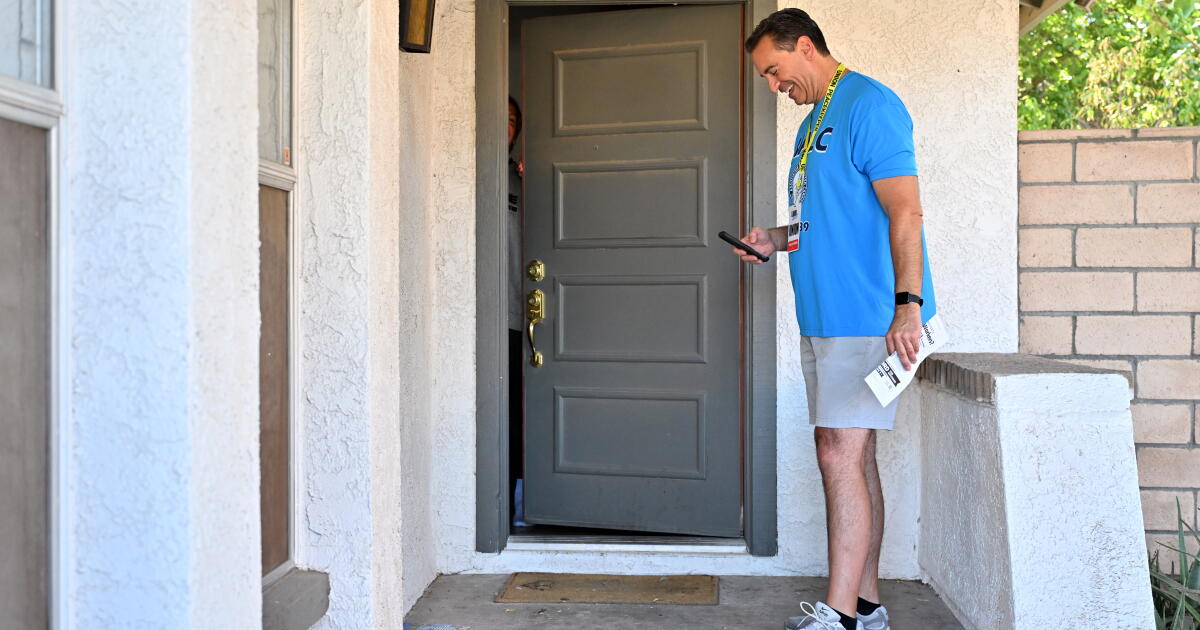
Paul Peterman, president of the local chapter of the National Association of Letter Carriers, wearing a blue union T-shirt, a lanyard and shorts, walked to union households, carrying flyers supporting Lee and other Democrats. He asked a resident who he planned to vote for. “All Republican,” said the man, hidden behind his screen door. Peterman asked if he could leave a non-Republican flyer, and the man said, “No.”
“Sorry to bother you,” Peterman said as the door closed.
At the next door, the voter identified as an independent but said he’d vote for Lee. A voter at another house said who he plans to vote for was private. Nobody answered at the next few doors.
Peterman has been canvassing these neighborhoods for years, describing it as important union work.
“It sends a message that we’re all united, and you also need every hand on deck, too, to be successful in what you want to achieve,” Peterman said.
WASHINGTON — As President Trump tells supporters to vote in November as if he were on the ballot, California Republicans in tight congressional races are sending a different message to voters.
The four California Republicans running in the state’s most competitive U.S. House races, plus a fifth opposing a fellow Republican in a close contest, are appearing to keep some distance from Trump as they campaign ahead of the Nov. 3 election.
They all skipped the president’s midterm convention in Dallas this month. Two candidates in tough races removed references to Trump on their campaign websites. And most are favoring a heavy focus on local and state issues in their campaigns — a contrast to Trump’s approach, driven home in Dallas, of casting the election as a loyalty exercise.
President Trump watches as balloons fall at the Republican convention.
(Alex Brandon / Associated Press)
“You’ve got to do me the biggest favor you’ve ever done me. You’ve got to do this for me: You have to pretend I am on the ticket,” Trump told a crowd at the GOP midterm convention. “Pretend I am on the ticket because this is going to turn out to be one of the most important elections.”
The dynamic within the GOP reflects several competing factors: the need to attract new voters in districts made more purple by California’s redistricting, the hope that Trump can rally the base while candidates focus on swing voters, and the fear among Republicans that the president’s flagging approval ratings could cost them crucial seats in the midterms.
“There is a bit of jujitsu to it,” said Rob Stutzman, a longtime California Republican consultant. “These candidates are hoping that Trump motivates these voters to vote … [while they] focus on gaining votes, particularly from independents who don’t like the president right now.”
The state’s redistricting under Proposition 50, which redrew the congressional map to be more favorable to Democrats, also handed Republican candidates the necessity of persuading more unaffiliated voters and moderate Democrats — likely a major factor in their stances toward the White House, said Pete Peterson, dean of the Pepperdine University School of Public Policy.
“To the degree that Republican candidates are distancing themselves, they’re understanding that they’re actually appealing to newer electorates,” Peterson said. “[The districts] have been made more moderate, more purple, and candidates may be responding accordingly as a way of trying to attract those voters.”
Facing headwinds
The party in power typically faces an uphill battle in midterm elections, and vulnerable candidates often distance themselves from the sitting president. As Republicans fight to keep control of the House and Senate in November, however, they are dealing with particularly serious challenges stemming from Trump’s low favorability rating and public frustration with the economy, the war in Iran and the escalating trade war with Canada.
Trump largely has dismissed concerns about the economy and the war, even as polling shows both are weighing heavily on voters. He also has exacerbated challenges for his party amid the growing public backlash to data centers and artificial intelligence, doubling down on his support for AI advancement in recent days even as GOP candidates in tight races look to respond to constituents’ concerns.
He also drew criticism from some within his party after promising to give a $5,000 payment to every adult citizen if Republicans win the House and Senate in November, a legally murky idea.
Still, Trump has urged Republican lawmakers in tough reelection campaigns to run on his record and earlier this month vowed to spend the last month before the election stumping for candidates in 35 battleground races, including in Alaska and Texas. He has not yet mentioned plans for California.
“All you have to do is talk about it, and you’re going to win and you’re going to win big,” Trump said of his record.
Candidates nationwide seem unconvinced. A Washington Post analysis found that Republican politicians have stopped mentioning Trump on social media, doing so about half as often as they did in January. Many in competitive races skipped his convention, and in recent weeks some have broken with him on data centers and the payout pitch.
In California, the headwinds for the GOP were captured in a survey released last week: A greater share of independents said they would vote for the Democratic candidate over the Republican in their House districts, the Public Policy Institute of California found, and a majority of likely voters polled Sept. 4-10 said they would choose the Democratic candidate if the election were held now.
Robert Rivera, left, of San José and Corky Galey of Modesto listen to gubernatorial candidate Steve Hilton during a town hall in Modesto on Aug. 26.
(Sara Nevis/For The Times)
Last week, Republican gubernatorial candidate Steve Hilton’s campaign blasted a fundraising text to voters that began: “We get it. Maybe you don’t like Trump. Maybe you can’t stand MAGA.”
Democrats have seized on the dynamic.
“California Republicans know their loyalty to a toxic MAGA brand is a losing strategy,” said Anna Elsasser, spokesperson for the Democratic Congressional Campaign Committee. “Unlucky for them, no desperate rebrand can save them from their clear record of broken promises — from raising costs, to ripping away health care, to supporting another forever war everyone hates.”
Leaning on the local
Rep. Young Kim (R-Anaheim Hills) stripped her campaign website of the “America first” branding and references to Trump that defined it before the primary.
(Bill Clark / CQ Roll Call via Associated Press)
In Orange County, Rep. Young Kim — in a close contest with fellow Republican Ken Calvert — has stripped her campaign website of the “America first” branding and references to Trump that defined it before the primary. And in Northern California, Rep. James Gallagher has scrubbed Trump’s endorsement from his campaign website, which months ago prominently featured his close ties to the president.
Other candidates in tight races — Rep. David Valadao, running for reelection in the Central Valley; Kevin Lincoln, challenging Democratic Rep. Adam Gray; and Jim Desmond, running to fill the seat of retiring Republican Rep. Darrell Issa — have leaned on campaign optics centered around their regions rather than on sharply partisan politics.
None of the three attended Trump’s convention. Valadao rarely mentions Trump on social media and is the last House Republican still running who voted for Trump’s second impeachment. Desmond does not mention his support from Trump on his endorsements web page; Lincoln does.
Rep. Kevin Kiley, who left the Republican Party this year after his district was redrawn and after he clashed with Trump over tariffs, also is making an appeal to middle-of-the-road voters, promoting legislation around AI safeguards while taking aim at Sacramento policies. Kiley still caucuses with congressional Republicans but says he won’t if reelected.
Representatives for Gallagher, Lincoln, Desmond and Valadao did not respond to requests for comment.
Chris Pack, a spokesperson for Kim, said she was “proud of her work with President Trump to deliver results for Southern California.” But he framed her race as a choice between Kim and her opponent, saying the campaign’s messaging is focused on Calvert’s record. Pack didn’t answer a question about the removal of Trump’s name from Kim’s website.
Moves like Kim’s and Gallagher’s are angled at conveying to moderate voters that “they’re not going to be beholden to the party line, they’re simply going to run on common sense,” and may give centrist Democratic voters “permission” to consider the candidates, said one GOP operative who works in the state, granted anonymity in order to speak candidly.
In competitive districts like the ones California Republicans are trying to hold on to, Trump’s ask for voters to pretend he’s on the ballot is “probably not as helpful,” the operative said.
Instead, strategists see the local focus as the most effective strategy for California Republicans, along with a focus on statewide issues that allow them to counter policies of Gov. Gavin Newsom that they perceive as unpopular with voters.
“California Republicans know what’s best for their districts,” the operative said. “They all have their own independent records and are pretty well-known by their communities.”
Republicans are making the case that California’s long-term affordability issues, which far predate the current national economic landscape, have been exacerbated and mishandled by Democrats. The party also is leaning on an argument that Democrats are overly focused on Trump and have few substantive policy solutions.
Texas attendees hold up flags and cowboys hats at the Republican convention.
(Smiley N. Pool / Dallas Morning News via Getty Images)
Mike Madrid, a veteran California Republican political consultant, argued that a last-minute rebrand is unlikely to stick for candidates whose party has built a political identity around loyalty to the president and his policies. He said Republicans’ retreat is a sign of how Trump’s popularity is dwindling.
“I wouldn’t call that subtle in politics,” he said. “When you’re distancing yourself from the president of your own party, a man that everybody’s been championing as a political and cultural hero in those parts, I don’t think that’s subtle at all.”
When asked to make his case to midterm voters in an interview last week, Vice President JD Vance argued that Americans should give his party more time to deliver.
“Give us another chance,” Vance said on the All-In Podcast. “Give us another couple of years to continue to work on the amazing things that we have been doing for the past two years.”
The advertising blitzkrieg of L.A.’s mayoral campaign is here.
Mayor Karen Bass and her opponent, City Councilmember Nithya Raman, dropped new campaign commercials over the last week, buying time on television, streaming channels and other platforms. Supporters of both candidates released ads as well.
The two candidates relied heavily on free media for most of the summer, putting videos on Instagram and inviting the news media to cover their appearances.
The dam effectively burst on Monday, with Raman touting her new Hollywood-themed ad “For Your Consideration,” timed to coincide with the Emmy Awards.
You’re reading the L.A. on the Record newsletter
Sign up to make sense of the often unexplained world of L.A. politics.
By continuing, you agree to our Terms of Service, which include arbitration and a class action waiver. You agree that we and our third-party vendors may collect and use your information, including through cookies, pixels and similar technologies, for the purposes set forth in our Privacy Policy such as personalizing your experience and ads.
The 30-second spot starts with Raman stepping out on the town, then shifts to some standard L.A. imagery: freeways, palm trees, Echo Park Lake and, of course, the Hollywood sign.
“L.A. shows the world what it means to be a star,” declares the ad’s narrator, actor and screenwriter Bob Odenkirk. “And every Angeleno deserves the chance to reach for their own.”
After Raman has stopped off at a taco stand and hugged a dog, Odenkirk delivers the ad’s final message: “Change. Affordability. An L.A. that loves you back.”
That ad ran on television a few times before being cycled onto social media, per the Raman campaign.
Three days later, Bass went up with a 30-second spot — on digital platforms for now — centered on President Trump’s immigration raids.
The ad offers footage from the day in July 2025 when Bass confronted federal immigration agents in MacArthur Park. The video features images of gun-toting federal agents in military uniforms and Bass hopping out of a car in an aquamarine pant suit to face them.
“When someone comes after your family, you don’t hesitate,” Bass says. “You stand up. You fight.”
One of Bass’ most formidable allies — the Los Angeles Police Protective League — went hard negative with its first ad of the runoff campaign, offering the message that Raman “Doesn’t Get It.”
The commercial, released Friday, follows a young girl as she walks past a homeless encampment, juxtaposed against video of Raman talking about her opposition to a law that prohibits encampments near schools.
“I don’t think a kid’s gonna be safer because a tent is 500 feet away from a school,” Raman said in the clip, which was taken from a 2024 candidate forum in Sherman Oaks.
The backpack-wearing child speaks to the camera and says: “Walking to school shouldn’t be scary.”
“I’m just a kid,” she says. “But even I know I’d be safer if this was 500 feet away.”
The police union says the ad will start running on television this weekend and already is on social media platforms.
Meanwhile, Raman’s backers have an assortment of attack ads running on Facebook and Instagram.
Streets For All, a group that wants to expand the city’s bus and bike lane network, pulled video footage from a different Sherman Oaks candidate forum — this one featuring Bass and Raman last month.
At that event, Bass told the audience that Raman is unresponsive to her constituents, forcing many in Sherman Oaks to contact the mayor’s office directly.
“Many of you have my cellphone, you have called me,” Bass says in the ad. “You called on me specifically for help.”
Streets For All contends those remarks show that Bass gives wealthy homeowners her number while “regular Angelenos get ignored.”
“L.A. deserves a mayor who doesn’t just listen to the rich and powerful,” the ad says.
By Friday, Streets For All had nearly two dozen different video spots opposing Bass over such issues as homelessness, transparency and the Palisades fire, according to Ethics Commission filings.
The biggest backer of the group’s political action committee is hedge fund manager Aaron Sosnick. Of the $1.2 million that the group plans to spend in the mayor’s race, Sosnick has provided $1 million, said Michael Schneider, who heads the group.
Schneider said the committee also has financial support from retired real estate developer Yuval Bar-Zemer — known for his work in the Arts District — and Todd Wexman, chief principal of 4SITE Real Estate, a real estate development company.
Raman pollster says she’s in the lead
The Raman campaign shared the results of a new internal poll that showed their candidate with a five-point lead over Bass.
Of the 600 likely voters who were surveyed, 44% supported Raman and 39% backed Bass, with 17% undecided, according to a memo provided to the campaign and viewed by The Times. The survey, conducted by Hart Research Associates in early September, had a margin of error of 4 percentage points.
“In the initial trial heat for Los Angeles mayor, Councilmember Nithya Raman is in the rare position for a challenger of already LEADING the incumbent,” the polling firm wrote.
Another poll, commissioned by an independent expenditure group supporting Raman, portrayed the race as a statistical tie, at least initially. Estamos con Nithya for Mayor of LA 2026, sponsored by the Western States Regional Council of Carpenters, said its poll showed Bass with 38% and Raman at 37%.
However, when voters received more information on the candidates, Raman took a 7-percentage-point lead, with 41% supporting her and 34% supporting Bass, according to a memo prepared by the group’s pollster.
The margin of error was 3.7 percentage points.
The Bass campaign declined to share its internal polling when contacted by The Times.
However, Neighborhoods for a Better L.A., an independent expenditure group supporting the mayor, said a survey it commissioned in early August showed the mayor with an edge over Raman of 41% to 35%, with 24% of the electorate undecided.
That poll, conducted by Tulchin Research, surveyed 1,200 likely Los Angeles voters and has a 2.8-percentage-point margin of error, the group said.
The poll also found that when given “balanced biographies” about both candidates, Bass’ support grew to 45% while Raman went down to 33%.
“Communications focused on Raman’s record can both reduce her support and consolidate voters behind Bass,” the pollsters wrote.
Giving back El Grito cash
Los Angeles City Councilmember Imelda Padilla locked down sponsorships for the city’s celebration of El Grito, which marks Mexico’s independence.
Tuesday’s event, which featured an evening of musical performances, was sponsored by an assortment of city contractors and government agencies, including waste hauler Athens Services and the Department of Water and Power.
Still, Padilla decided she didn’t want to partner with one particular business, announcing at the last minute that organizers no longer would accept a $5,000 sponsorship from Home Depot.
On the day of the celebration, Padilla issued an apology on Instagram, saying she had heard from community members upset over the event’s affiliation with Home Depot, whose parking lots have been the site of many federal immigration raids.
“We have rescinded their partnership for this event,” Padilla said in her post. “The spirit of El Grito is rooted in celebrating our Latino heritage and creating a space where our families feel welcomed, safe, and celebrated.”
In an email, a Home Depot spokesperson said the company is not involved in immigration enforcement activities and doesn’t coordinate with Immigration and Customs Enforcement or U.S. Border Patrol. The company also doesn’t receive advance warning about enforcement actions, the representative said.
“We cannot legally interfere with federal enforcement agencies, including preventing them from coming into our stores and parking lots,” Home Depot spokesperson Evelyn Fornes said.
State of play
— COZY WITH CARUSO: Billionaire developer Rick Caruso, who was defeated by Bass in 2022, appeared alongside the mayor at a groundbreaking for the Palisades Recreation Center. Caruso praised her for her work on the project but stopped short of endorsing, saying he intends to meet with Raman in the coming weeks.
— LIFE AFTER PRATT: The voters who picked reality TV personality Spencer Pratt in the June 2 primary election are now up for grabs. But will they stay home instead of picking a mayoral candidate?
— BASS BAILS: The mayor skipped a congressional hearing on waste and fraud in homeless spending this week, calling the session politically motivated. Rep. Tim Burchett, the Republican who chaired the subcommittee meeting, accused her of dodging accountability.
— FINDING FRAUD: Federal authorities arrested three people who were working in Los Angeles-area homeless nonprofits this week, accusing one of them of misappropriating more than $7.5 million in taxpayer funds. Scott Turner, secretary of the Department of Housing and Urban Development, said the Los Angeles Homeless Services Authority, which provided the funding, had allowed fraud to “run rampant.”
— WE’RE IN THE MONEY: The 2028 Summer Olympic Games in Los Angeles will generate up to $40.6 billion in increased economic output and add as many as 224,000 jobs, according to an upbeat economic forecast released this week. Another, more tempered estimate put the increase at $20.5 billion to $25.4 billion.
— SEETHING OVER SKID ROW: Some activists want dogs taken away from homeless residents living in Skid Row, saying those animals are living in an unsafe environment. A Bass aide responded by cautioning that it is “neither humane nor legal to remove animals from their human companions without appropriate cause.”
QUICK HITS
Where is Inside Safe? The mayor’s signature program to combat homelessness went to Avalon Boulevard and 64th Street in South L.A., an area represented by Councilmember Curren Price.
On the docket next week: The council’s Public Works Committee meets Tuesday to discuss ways of cleaning, safeguarding or demolishing nuisance properties.
Stay in touch
That’s it for this week! Send your questions, comments and gossip to LAontheRecord@latimes.com. Did a friend forward you this email? Sign up here to get it in your inbox every Saturday morning.
WASHINGTON — The unprecedented spate of mid-decade redistricting for the U.S. House has changed the congressional districts for one-tenth of Americans and significantly altered the makeup of at least one-fifth of districts, according to a new study.
A report by Protect Democracy found that 34.8 million people — about one in 10 Americans — now live in a different district than they did during the 2024 election cycle. And about one-fifth of all Americans now live in a district where more than a quarter of voters are new to the district compared with the last election cycle.
The findings display the stark overhaul that partisan redistricting fights kicked off by President Trump last year have caused for Americans across the country. The new congressional maps are increasingly drawn in ways that favor partisan politics over factors like geography and shared communities. That raises concerns among scholars about how the country’s hyperpolarized politics are affecting American democracy.
“If this trend continues, it really brings into question whether or not elected officials are really representing their constituents anymore, or if the voters are being randomly picked by mapmakers to squeeze out partisan advantage,” said Ben Raderstorf, a policy advocate at Protect Democracy and one of the paper’s co-authors.
The bare-knuckled partisan redistricting battle for the House began when Trump urged the Republican-controlled legislature in Texas, the second most populous state, to redraw its congressional map to help the party. The highly unusual plan prompted an immediate response from California, the most populous state, which held a successful referendum to tilt its map toward Democrats.
Other states followed, and Republicans are positioned to potentially gain nine seats because of redistricting.
The Protect Democracy report warns that such partisan tactics reduce faith in American elections generally and insulate incumbent lawmakers from public opinion. That can make political organizing more difficult, the report cautioned, potentially worsening the country’s already highly polarized politics. Both parties may also enter a “doom loop” where they embrace more aggressive and frequent redistricting efforts to avoid ceding any ground to their rivals.
In some states such as Missouri, the mid-decade redistricting has created confusion for voters about which district they live in and which candidates will appear on their November ballot. After conflicting lower court rulings, the U.S. Supreme Court last week blocked new Missouri districts backed by Trump that had been used in the primary, leaving the state to revert to its previous districts for the general election.
The report concludes with a call for new electoral structures the authors believe would eliminate the potential downsides of partisan redistricting, like proportional representation or a formal truce between the parties to implement nonpartisan districting plans.
Nine states already use nonpartisan commissions to draw congressional district lines but those provisions have limits. California, for instance, suspended its nonpartisan maps with a referendum last year in response to Texas’ redistricting measures.
Such remedies would face long odds in Congress and statehouses, but scholars believe there are few other avenues to turn down the temperature in the partisan redistricting fights.
“This is only going to get worse until somebody stops it,” Raderstorf said. “The logic of gerrymandering points inevitably towards maximalist partisan advantage on both sides. There is no off-ramp other than reform. It is the only way to break the cycle.”
DELANO, Calif. — The rows of candies and nuts at the Guadalajara Meat Market — tamarindo con chile, seasoned pistachios, spicy paletas — sat mostly untouched as customers filtered through this carniceria in the late afternoon heat.
“You see a lot of people consuming the minimum, what they need to get by through the week,” said owner Carina Murillo, 31, as she checked out customers on a recent weekday. “Instead of buying six items, they’re buying three items.”
While customers bypass extras, like the snacks at the front counter, Murillo’s costs have gone up. Imported goods from Mexico and Canada have become more difficult to source and sometimes carry tariffs, she said. Transportation fees have risen as diesel prices respond to the war in Iran. The market’s insurance costs have risen by about a third. All of it has forced Murillo to increase prices.
“You see a lot of people consuming the minimum,” says Carina Murillo, owner of Guadalajara Meat Market. “Instead of buying six items, they’re buying three items.”
As the area struggles, Murillo, a college graduate who years ago felt motivated enough to door-knock for political causes, is among those who have become disillusioned. Those in Washington, she said, don’t understand the lives of the working people who keep the country running.
There have been “years where I feel completely overpowered to the point where I’m not motivated to take part,” said Murillo, who didn’t vote in 2024 but plans to do so in November. “That’s what happens when you feel discouraged or like nothing’s going to change.”
The economic strife plaguing Americans is clear in this rural, majority-Latino Central Valley congressional district, home to the state’smost competitive House race, the closely watched contest between Republican Rep. David Valadao and Democrat Randy Villegas.
Democrats hope the national economic angst will translate into big turnout in the midterm elections, but some in this region worry that years of financial struggle may depress voters’ desire to participate rather than motivate them.
Rep. David Valadao (R-Hanford) presides over a congressional hearing in March. The Republican is in a race against Democrat Randy Villegas that is considered a toss-up.
(Allison Robbert / Associated Press)
And Republicans, who rely on their party turnout beating that of Democrats in rural areas, also face the risk that frustration with the current political climate could dampen enthusiasm.
“Before they can think about Valadao, before Trump or Gavin Newsom or who’s going to run, families are concerned with the immediate: paying the rent, having the food on the table,” said Eliseo Gamiño, who heads the Central Valley Leadership Round Table, a coalition of Latino community leaders and elected officials. “You can’t be thinking about voting when your kids are hungry.”
Few voters who spoke to The Times in this swing district were decided on which party to support in November — or whether to vote at all. Such undecided voters will likely decide the election outcome, and persuading them is the key challenge for both parties as November nears.
Alexa Lopez sweeps up at closing time on a slower than usual Friday that saw one dress sold at Christina’s Fashion in Delano.
In a district that is the third-youngest in population in the country, the simmering uncertainty among Gen Z and millennial voters in particular could affect turnout or results.
Thirty-one percent of its voting-age population is 29 or younger, according to the Tufts University research center CIRCLE, which tracks youth civic engagement, making it among the top swath of House races in which young people could swing the outcome.
California’s swingiest district
The 22nd District, carved from the state’s agricultural epicenter, is one of fewer than two dozen toss-up races nationwide that will likely determine which party controls the U.S. House in the second half of President Trump’s current term. It is also among several high-stakes races nationwide that will test progressive candidates.
Valadao’s seat has long been considered a vulnerable one; Democrats added about 100,000 Fresno residents to the district under Proposition 50’s new map in a bid to help their chances. The boundaries include swaths of Kern, Kings and Tulare counties, along with a very small piece of Madera County.
“It’s going to be crucial in an area that is more purple, more bipartisan, where it’s very clear it can go either way … that these candidates make an effort to get those voters on their team,” said Brittany Martinez, a California-based Republican strategist.
Valadao, 49, who comes from a dairy farming family, is well known in the district and has repeatedly secured victory in close races, retaking the seat in 2020 after losing it in 2018’s blue wave. He saw a close race in 2022, then won by nearly seven percentage points in 2024, outperforming Trump.
His biggest vulnerability this time around may be his vote for the One Big Beautiful Bill Act, which included steep cuts to Medicaid. Local hospitals are bracing for funding cuts, though a carve-out may keep many valley residents from losing coverage. The district has the highest proportion of Medi-Cal recipients of any in the state, with 67% of residents enrolled as of 2025, according to the California Health Care Foundation.
Valadao spent part of the August recess touring the Central Valley for private meetings with local entities including a hospital, a housing program, a sawmill and a school district, and held a telephone town hall last week. Democrats have criticized him for not holding face-to-face voter events, including public town halls.
Democratic candidate Randy Villegas chats with residents during an August town hall in Hanford.
Villegas, 31, a professor and school board member who was endorsed by Sen. Bernie Sanders (I-Vt.) and is aligned with the Working Families Party, bested a Democrat backed by the party’s House campaign arm to win the nomination.
Villegas has banked on a more public-facing approach to win over swing voters — recently handing out popsicles from a pushcart he wheeled around a Labor Day event in Bakersfield, for instance — a strategy his campaign calls “going everywhere.” Republicans have criticized his record as too far left for the moderate district.
Both candidates have attempted to lean away from partisan narratives. Valadao rarely mentions Trump on social media and did not attend the president’s Republican convention in Dallas last week; Villegas has worked to frame the progressive issues he champions as an effort to help Central Valley voters rather than an ideology.
Trump carried the district as drawn now by less than 2 percentage points in 2024. Since then, residents say they have felt squeezed by housing, gas and grocery prices. The war in Iranhas pinched Central Valley farmers — already struggling withwater supply and other issues — by driving up fertilizer prices.
Ailyn Flores, center, picks up balloons for a party at Big Delano Discount store.
Tyler Stidham, 28, and her husband recently moved back to Lemoore from San José with their 1-year-old in order to live with family because they could no longer afford their own place.
“Rent got too high and having a family is expensive,” she said as the couple waited for their order from a food truck at the Hanford farmers market on a recent Thursday evening. They have cut out family trips and started meal-planning and budgeting to save money.
Stidham said she is planning to vote and hoping government leaders can make life more affordable. Her husband recalled a favorable impression of Valadao after once meeting him. Stidham isn’t sure who she’ll be casting her vote for.
“I haven’t done my research [yet],” she said.
Young voters said they felt frustrated waiting for a better economy that has yet to materialize.
“I feel like the government is playing in our face. I feel like everything is a show,” said Emma Woodward, 23, of Hanford.
The Sierra movie theater has closed down in Delano, Calif.
(Gary Kazanjian / For The Times)
A store manager at a coffee chain, Woodward bought a house last year to avoid throwing money at increasingly high rent payments, but it has been “hard to survive.” She got a roommate to help with costs, but the two of them sometimes find themselves using food drives for groceries. She has cut out “fun spending,” including concerts and travel.
Woodward said she wanted to vote in order to send the message to Congress that the economy needs improvement. She, too, wanted to research the candidates further; she leaned toward Villegas but was not yet convinced.
‘Whatever happens happens’
Valadao and Villegas must also battle to reach apathetic voters — those who may sit the election out or who are fed up with both parties. In one indication of voter fatigue, local organizers have found it a challenge to register new voters this year.
Dresses on display at Christina’s Fashion store after closing time on a quiet Friday night in Delano, Calif.
People who are unregistered often express mistrust in the government and the feeling that “nothing’s going to change,” said Biviana Camacho, 23, civic engagement program manager for Loud for Tomorrow, a youth organizing group based in Delano that runs voter registration events.
“A lot of folks have been in survival mode for such a long time,” she added, as the group worked on planning a fall event series on a recent afternoon. Their goal: 20 to 25 new registrations per event.
The group’s head of membership, Rosanai Paniagua, 28, agreed. “Here, there’s not a lot of hope because people haven’t seen what good policy could do for them,” she said. “A lot of apathy, for sure, because change hasn’t really happened here.”
Marco Estrada, 20, taking a break outside the Main Street barbershop where he works in Delano, said he wasn’t sure he could imagine anything Congress could do for him. He’s never voted and doesn’t plan to in November. His two co-workers said the same.
“Whatever happens happens,” Estrada said.
Valeria Valdez, a College of the Sequoias freshman, said she was planning to vote in her first election and said the government should help lower gas prices. The 18-year-old wasn’t sure, though, whether she would make a decision in the House race.
“It feels pretty far away from me, to be honest,” she said. “I just want to do what I can for our community and not focus on how corrupt the government is.”
That sentiment is part of what Villegas is aiming to target as he meets voters.
“It’s easy to feel cynical and apathetic in a moment where so many things seem stacked against us,” Villegas said in an interview. “But I tell people that … their vote and their voices do matter, otherwise we wouldn’t have billionaires and corporations spending millions of dollars trying to influence these election outcomes.”
A spokesperson for Valadao did not respond to a request for comment. Valadao said on a Washington Sun podcast in January that he “absolutely” worries about Republican voter enthusiasm, but noted it was a problem on both sides of the aisle. Earlier this month, he conveyed confidence about his race.
“I’ve won in these types of races. I can win again,” he told the Associated Press. “I think we should be fine.”
Inside Murillo’s market, business picked up as 5 o’clock neared. Murillo rang up tortillas, cuts of meat, and three-liter Mexican soda bottles. She advised a customer about treating a bug bite, helped a man wire money and cajoled a city worker about getting a sidewalk repair.
Congress should “definitely” be helping communities like hers, she said. She plans to research her voting options so she can participate in November. But trusting political candidates, she mused, can feel like a risk for voters.
“Whether they execute what they promise or not,” she said, “that’s shown with time.”