dismiss

Feds move to dismiss case over 20,000 California ballots after Supreme Court denied appeal

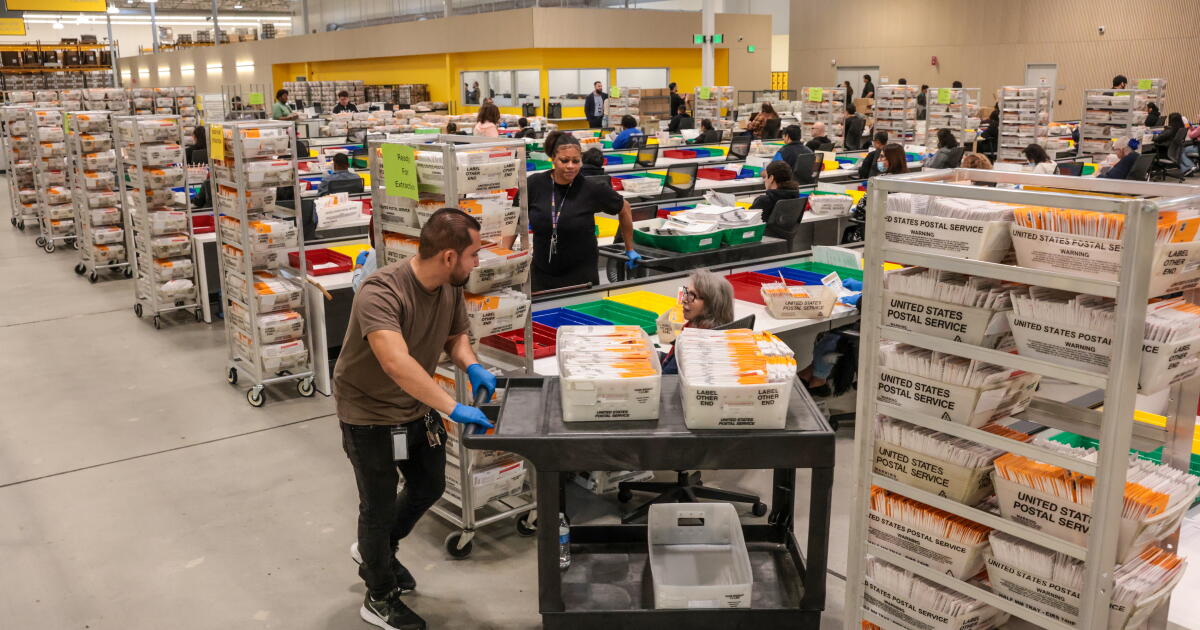
The U.S. Justice Department moved Friday to voluntarily dismiss its lawsuit challenging the counting of 20,000 ballots in California, arguing the relief it sought is now impossible given Tuesday’s midterm election has concluded.

The Justice Department had sought a court order requiring state and Los Angeles County election officials to set aside the ballots, which it alleged could be from noncitizen voters. U.S. District Judge David O. Carter and a three-judge panel of the U.S. 9th Circuit Court of Appeals had both rejected that request, and the U.S. Supreme Court denied a Trump administration appeal to those lower court rulings — with no noted dissents.

Carter had ruled that the government’s request was probably unconstitutional, given the Constitution gives states and Congress power over elections, not the executive, and probably ran afoul of federal law barring sweeping vetting of voter rolls in the immediate run-up to an election.

However, he had set a schedule moving forward for additional fact-finding in the case — including by appointing a special master to dig into the data the federal government was relying on to assert the 20,000 voters were potentially noncitizens.

In a filing before Carter on Friday, Assistant U.S. Atty. Julie Hamill in Los Angeles wrote that that court process was no longer necessary, as it would not provide the relief that the federal government was seeking by filing its lawsuit.

“In light of the Supreme Court’s denial, the United States is evaluating how to best ensure that American votes are protected, including by preventing vote dilution by noncitizens. In addition, by the time of this Court’s hearing on Nov. 13 in this matter, California will have already commingled the challenged ballots with lawful ones,” Hamill wrote. “There is then no way to get the challenged ballots segregated. As a result, the relief the United States sought and needed is no longer available — rendering voluntary dismissal necessary.”

Hamill wrote that the Trump administration had sought to “protect American voters and to prevent the irreparable harm of state and local election officials including illegally cast votes in the final vote tabulation,” but had “exhausted its appeals to obtain timely relief” by going to — and being denied by — the Supreme Court.

First Assistant U.S. Atty. Bill Essayli’s office in Los Angeles — where Hamill works — referred questions about the filing to the Justice Department.

Kiersten Pels, a Justice Department spokesperson, said the litigation at issue was “moot” but that the Trump administration “is not backing down” in its targeting of alleged noncitizen voters, including in a separate case in which it is still demanding that California “conduct proper list maintenance, including removing noncitizens from the state’s voter rolls — which will be crucial to ensure fair elections in the future.”

Secretary of State Shirley Weber, a defendant in the case, did not immediately respond to a request for comment Friday.

L.A. County Registrar-Recorder/County Clerk Dean Logan, another defendant, said he was “pleased that the administration has accepted the clarity of the court findings” against it and ended its lawsuit.

“At each stage of this election, and in response to the Department of Justice, we have been clear that state and federal law sets well-defined standards for verifying and challenging voter eligibility,” Logan said. “Our commitment and focus remain on the fair, secure, accurate, and legal processes we are engaged in to complete and certify the election.”

California Atty. Gen Rob Bonta, in a statement, said that after losing in every court it tried, including the Supreme Court, “the Trump Administration has given up its latest unlawful effort to interfere with California’s elections and disenfranchise eligible voters.”

Bonta added: “Rest assured: California has and always will defend your fundamental right to vote.”

Tricia Webber, president of the California Assn. of Clerks and Election Officials, said state election officials “are very pleased” with the voluntary dismissal of the case — which she said “affirms that our elections are administered with the utmost integrity and care.”

“At the same time, we are under no illusions. We recognize that this issue is unlikely to go away permanently, and we remain fully prepared to continue defending California’s election administration against future challenges,” she said. “We will always stand ready to protect every eligible voter’s right to participate in a fair and secure election process.”

The administration’s filing — three days after President Trump’s party took a drubbing in the midterms — marks a sudden and unremarkable conclusion to an unprecedented court battle in the days leading up to the election, when the federal government sought permission from the courts to force state and local elections officials to set aside votes during an ongoing election.

Carter had rejected the administration’s request for immediate intervention in a blistering Oct. 28 ruling, calling its allegations about the ineligible voters “not credible” and warning that the proposed action could disenfranchise eligible voters and sow chaos in the ongoing midterm election.

“This request violates longstanding constitutional principles mandating that states have control over their elections,” Carter wrote. “If [the Trump administration’s] last-minute request for relief were granted, either party could create chaos for their own political purposes to disrupt the election process.”

While Justice Department officials characterized the relief it had requested from the court as “targeted and modest,” Carter had reached a sharply different conclusion — writing that the administration’s demands would “wreak havoc” on an ongoing election and “create a chilling effect on election workers and voters alike, and discount the votes of United States citizens.”

The reliability of the government’s list became a central issue in the litigation. Logan’s office said its review of about 200 flagged voters found that a substantial portion appeared to have been born in the United States, a finding Homeland Security officials disputed.

Election officials elsewhere in California also reported problems with the lists, including names of people who did not appear to live in their counties or to be registered voters. Justice Department officials sent letters to election officials across the state, demanding that they sequester flagged ballots and warning of potential criminal penalties if they failed to comply.

The three-judge 9th Circuit panel that heard the federal government’s appeal to Carter’s ruling — composed of two appointees of President Trump and one of President Biden — came to some of the same conclusions Carter did in a 2-1 ruling. One of the Trump appointees dissented, writing that he would have ruled for the administration.

Carter ordered an expedited hearing on the state’s and county’s motions to dismiss the case and the government’s motion for a preliminary injunction. He ordered all parties by Nov. 6 to submit witness lists, including experts, regarding the reliability of the list of voters and the methodology behind it. He ordered both sides to appear at the Nov. 13 hearing, with submitted witnesses prepared to take the stand.

Ending the litigation now will forestall that process to detail the origins of the administration’s list — which is still being used by federal prosecutors in California to target individual voters for criminal prosecution.

Source link

Buss family asks judge to dismiss Jeanie Buss’ Lakers sale petition

Lawyers for Janie and Joey Buss, two of the co-trustees of the Buss Family Trust that owns part of the Lakers, filed a response to Jeanie Buss’ petition Friday with intention to move forward with the proposed sale of the family’s remaining shares of the team.

While Jeanie is trying to block her five siblings from selling the team, the new response filed in L.A. Superior Court states that Janie and Joey, the two other co-trustees of the family trust, were authorized and required to implement the vote after a majority of the living siblings opted to terminate the trust in August. The vote of five siblings to sell the shares triggered the termination clause in the trust, and the filing argues that the trust doesn’t grant trustees discretion to disregard a valid vote to terminate.

The filing, which follows formal opposition filed on behalf of five Buss siblings last week that defended their right to vote to sell the team, asks the court to dismiss Jeanie’s petition or deny it in its entirety.

Jeanie argued that her siblings could not terminate the family trust and sell the remaining 17.82% of the team without her approval, citing a 2017 court order that instructed trustees to “take reasonably available steps” to support Jeanie’s annual election as Lakers controlling governor. The court order, obtained after Jeanie’s older brothers Jimmy and Johnny Buss tried to oust her from the organization, installed Janie and Joey as co-trustees.

But the court order did not prohibit a sale or termination of the trust, lawyers for Janie and Joey argue. While the order named “voting the trust’s shares” as a reasonable action, it did not require the trust to hold a 15% stake in the team to reach the NBA’s eligibility threshold for minority owners to serve on the league’s board of governors, the filing states.

Jeanie was selected by her father Jerry Buss to serve as the team’s controlling governor after his death in 2013.

Since the family patriarch bought the team, the Forum and the Kings for $67.5 million in 1979, the Lakers have become one of the most valuable brands in sports. Mark Walter, who purchased controlling ownership from the Buss siblings in 2025, sold his shares to venture capitalist Joshua Kushner and former Disney chief executive Bob Iger 14 months later at a record $12.5 billion valuation.

Using a tag-along provision secured during the sale to Walter, the five Buss siblings hope to maximize value for all six beneficiaries, including Jeanie, the new filing reports. Selling the 17.82% stake in the team would be worth about $2.2 billion.

A hearing is scheduled for Dec. 8. The Lakers open the regular season on Oct. 21 against the Golden State Warriors at Crypto.com Arena. Jeanie was seen at the Lakers’ home preseason opener on Oct. 8, sitting courtside on the baseline.

Source link

Sudan cannot afford to dismiss a chance for dialogue | Opinions

More than three years into the war between the Sudanese Armed Forces (SAF) and the Rapid Support Forces (RSF), Sudan is desperately in need of a political settlement. The fighting has caused immense suffering, and a military solution alone cannot rebuild the state or reunify its fractured society. Under such circumstances, any effort aimed at encouraging Sudanese-Sudanese dialogue deserves serious consideration rather than outright rejection.

In August, a self-appointed committee of 19 Sudanese public figures, chaired by Ahfad University President Qasim Badri, launched an initiative to prepare the ground for national dialogue inside Sudan. Its members had earlier met SAF chief General Abdel Fattah al-Burhan and called for legal restrictions on opposition politicians to be lifted. The authorities subsequently issued a decree to drop certain politically motivated charges against Sudanese abroad returning for dialogue and grant participants temporary legal protections. These are limited but important confidence-building measures.

The initiative has nevertheless faced strong opposition. The civilian coalition Sumoud, led by former Prime Minister Abdalla Hamdok, and Ta’sis, an alliance that includes the RSF, have opposed the proposed internal dialogue. They question its independence and warn that holding talks in army-controlled areas could legitimise al-Burhan’s authority and entrench the country’s divisions. These concerns are legitimate and deserve serious attention. But the committee says it is not seeking to negotiate Sudan’s future or determine the agenda of a national dialogue. Its role is to help create the conditions for Sudanese political actors to engage one another directly. The question is whether it can fulfil that role without allowing one side of the conflict to dominate the process. Dismissing the initiative before it has had an opportunity to demonstrate its value would be premature.

The country’s political actors and civil society organisations remain deeply divided, previous mediation efforts have faltered, and the war continues to make comprehensive political engagement increasingly difficult. The committee’s initiative is an attempt to break the deadlock. Efforts to prepare for political dialogue should not be postponed until the fighting stops. Securing a ceasefire and ensuring humanitarian access are urgent priorities, but preparations for political dialogue can proceed alongside efforts to achieve them.

The committee’s members were not elected, and they do not represent every political constituency. Yet the committee’s legitimacy cannot be judged solely by how it was created. It must also be judged by whether it can help bring a broader range of political actors into a national dialogue.

Good intentions alone cannot resolve concerns about credibility. Political dialogue can succeed only if participants believe the process is fair and independent. The legitimacy required to facilitate a political opening is not necessarily the same as that required to negotiate a national settlement. But even a preparatory initiative must earn the trust of those it seeks to bring together.

The committee’s meeting with al-Burhan was a practical necessity. As army chief and head of the Sovereignty Council, he was in a position to respond to the committee’s demands for legal protections. Engaging with al-Burhan does not in itself amount to an endorsement of his authority. But if the initiative becomes too closely associated with the army, other political actors may view it as an extension of al-Burhan’s political agenda rather than an independent facilitator. The committee must therefore demonstrate that its engagement extends beyond the military authorities and that it is prepared to work with political forces that oppose them.

The initiative was launched in Khartoum, which is under army control. This raises a genuine concern about whether a process beginning in territory controlled by one side of the war can attract the confidence of political forces across the country. A national dialogue cannot be confined to one geographical or political constituency. Entire regions have experienced different realities of war, governance, displacement and insecurity. The committee must find ways to reach those living outside army-controlled areas, including Sudanese displaced by the fighting, and ensure they can participate freely and without intimidation.

Sumoud and Ta’sis’s decision to reject the initiative does not automatically invalidate the process. Their concerns deserve consideration, but outright rejection at this early stage risks closing off an opportunity for political engagement. At the same time, their absence matters. Sudan’s crisis is too deep and complex to be addressed by any single political current. The committee cannot expect every stakeholder to endorse its initiative immediately, but it must create conditions that persuade reluctant actors to participate. If it fails to do so, the initiative itself will have failed.

The African Union Commission and the Arab League have also welcomed the initiative, providing an important measure of regional support. Their endorsement lends weight to the effort to revive Sudanese-led political dialogue, although external backing cannot substitute for the confidence of Sudan’s own political forces.

The committee’s initiative should therefore be judged without excessive optimism or automatic suspicion. The legal measures announced following its engagement with al-Burhan are an encouraging first step, but the real test lies ahead. Does it help remove legal and political obstacles facing opposition actors in practice, not just on paper? Can it win the confidence of those who have rejected it? Can it ensure that Sudanese across the country’s political and geographical divides have an opportunity to participate freely?

What is clear, however, is that Sudan’s crisis will ultimately require Sudanese actors with profoundly different visions of the country’s future to sit together and engage one another politically. No committee can do that on their behalf. No external actor can do it for them. At best, a preparatory initiative can help create the conditions under which such engagement becomes possible. The concerns raised by its critics should not be dismissed, but neither should they be grounds for rejecting the initiative before it has had an opportunity to address them. Those who have rejected it should remain open to reconsidering their position if the committee demonstrates that it can build an independent and inclusive process. If it succeeds, it will have rendered an important national service.

The views expressed in this article are the author’s own and do not necessarily reflect Al Jazeera’s editorial stance.

Source link