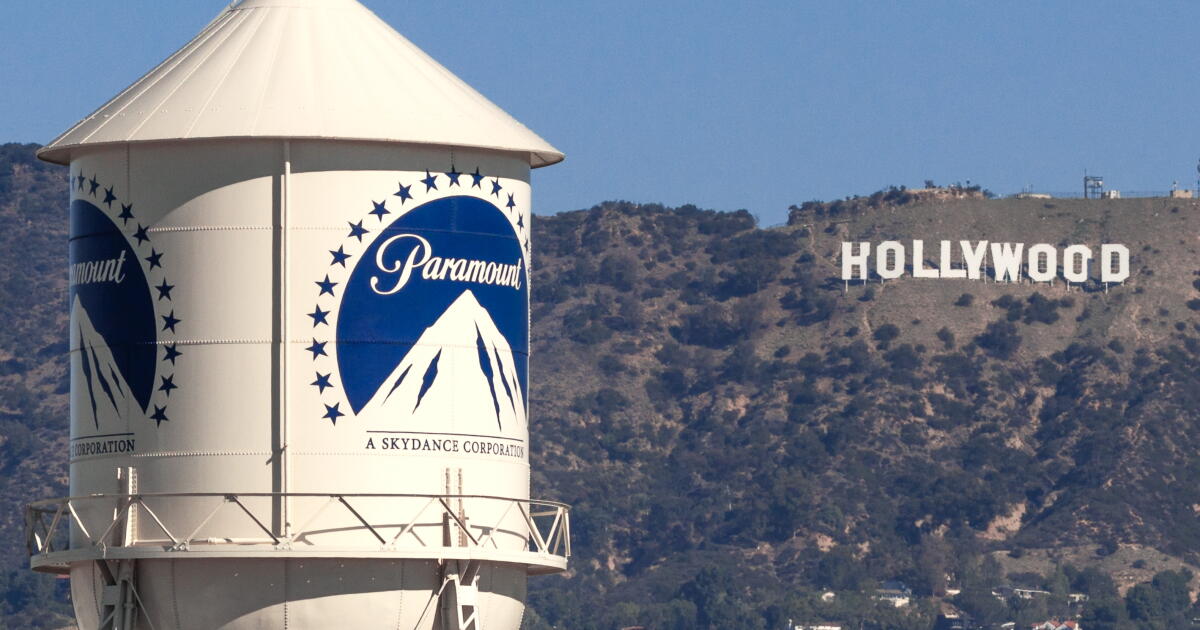
Warner Bros. Discovery’s impending sale has rattled Hollywood — and the company’s balance sheet as the auction’s high costs increasingly come into focus.
The New York-based media company released its first-quarter earnings Wednesday, which included a $2.9 billion loss. That amount includes $1.3 billion in restructuring expenses, including updated valuations for Warner’s declining linear cable television networks.
Contributing to the net loss was the $2.8 billion termination fee paid to Netflix in late February when the streaming giant bowed out of the bidding for Warner. The auction winner, Paramount Skydance, covered the payment to Netflix but Warner still must carry the obligation on its balance sheet in case the Paramount takeover falls apart. Should that happen, Warner would have to reimburse Paramount.
Warner also spent another $100 million to run the auction and prepare for the upcoming transaction, according to its regulatory filing.
“As we prepare for our next chapter, our focus remains on executing our key strategic priorities: scaling HBO Max globally, returning our Studios to industry leadership, and optimizing our Global Linear Networks,” Warner Bros. Discovery leaders said Wednesday in a letter to shareholders.
Warner generated $8.9 billion in revenue, a 3% decline from the same quarter one year ago, excluding the effect of foreign exchange rate fluctuations.
Its streaming services, including HBO Max, notched milestones in the quarter and 9% revenue growth to $2.9 billion. The company launched HBO Max in Germany, Italy, Britain and Ireland during the quarter.
Advertising revenue for streaming was up 20% compared to the first quarter of 2025.
The streaming unit posted a 17% increase to $438 million in adjusted earnings before interest, taxes, depreciation and amortization (EBITDA).
Warner’s studios, primarily its TV business, had a strong quarter.
Studios revenue rose 31% to $3.1 billion, compared to the prior year quarter.
Television revenue soared 58% (excluding exchange rate fluctuations) due to increased program licensing fees to support the launch of HBO Max in international markets. Those launches also propelled the movie studio, which saw revenue increase 21%.
Video games revenue declined 30% because of lower library revenues.
Adjusted EBITDA for the studios grew $516 million (158%) to $775 million compared to the prior year quarter.
The company’s vast linear television networks saw revenue fall 9% to $4.4 billion compared to the prior year period.
TV distribution revenue tumbled 8% largely due to a 10% decrease in domestic linear pay TV subscribers.
The company also felt the loss of its NBA contract for its TNT channel, which NBC picked up. Advertising revenue fell 12%. “The absence of the NBA negatively impacted the year-over-year growth rate,” Warner said.
As the costs of the merger with Paramount come into clearer focus, the opposition has grown louder.
More than 4,000 artists and entertainment industry workers, including Bryan Cranston, Noah Wyle, Kristen Stewart and Jane Fonda, have signed an open letter warning about the dangers of the merger with Paramount. “This transaction would further consolidate an already concentrated media landscape, reducing competition at a moment when our industries — and the audiences we serve — can least afford it,” according to the letter.
“The result will be fewer opportunities for creators, fewer jobs across the production ecosystem, higher costs, and less choice for audiences in the United States and around the world.”
Adjusted EBITDA for the television networks fell 10% to $1.6 billion, compared to the prior year quarter.
Warner ended the quarter with $3.3 billion in cash on hand and $33.4 billion of gross debt.
It was my first time hiking through Tilden Regional Park, a 2,079-acre wooded hilly expanse near Berkeley, and I was looking for one very specific thing: a small red, white and blue rounded triangular trail marker with a tiny map of the United States.
I’d already struck out twice, parking at the wrong trailheads, and I was really hoping the third time would be the charm. I trudged up the Upper Big Springs Trail, a wide dirt path lined with fragrant eucalyptus, pine trees and California bay laurels and, peeking out of the invasive grasses, California poppies and orange bush monkey flower.
I crested a hill after about two-thirds of a mile, and there I saw a sign, both literal and metaphorical, on a small brown post letting me know I was exactly where I needed to be. I was officially hiking along the American Discovery Trail, a contiguous 6,800-mile coast-to-coast nonmotorized route of multiuse trails that runs from Point Reyes National Seashore in Marin County to Cape Henlopen State Park in Delaware.
The American Discovery Trail sign in Tilden Regional Park near Berkeley.
(Jaclyn Cosgrove / Los Angeles Times)
“The ADT is all about connections — people to people, community to community, urban areas to wilderness,” according to a website outlining its history. “… The ADT connects five National Scenic, 12 National Historic, and 34 National Recreational Trails; passes through urban centers like Cincinnati and San Francisco; leads to 14 National Parks and 16 National Forests” and visits thousands of historic, cultural and natural sites.
I’m excited to share not only about the joy that can be found along this route, but also how you can join a relay in July across America along the trail. I certainly plan to!
You are reading The Wild newsletter
Sign up to get expert tips on the best of Southern California’s beaches, trails, parks, deserts, forests and mountains in your inbox every Thursday
By continuing, you agree to our Terms of Service, which include arbitration and a class action waiver. You agree that we and our third-party vendors may collect and use your information, including through cookies, pixels and similar technologies, for the purposes set forth in our Privacy Policy such as personalizing your experience and ads.
I’d never heard of the American Discovery Trail until last week when I attended the California Trails & Greenways conference in San Ramon. There, I met with American Discovery Trail co-founder John Fazel and John Mercurio, the trail’s California coordinator, to learn more.
The idea to create a coast-to-coast trail was born out of a 1980-81 hike across America called “HikaNation,” where several members of the American Hiking Society trekked more than 4,000 miles across the country. That adventure inspired Backpacker magazine and the American Hiking Society in 1989 to start developing the American Discovery Trail.
A view of the San Francisco Bay from the Seaview Trail in Tilden Regional Park near Berkeley. The route is a part of the American Discovery Trail.
Then, in 1991, the American Hiking Society hired a national coordinator to work with volunteer state coordinators to develop the route, and in 1996, trail advocates formed the American Discovery Trail Society to ensure their dreams became a reality.
“It’s an opportunity to get to know America up close and personal and not as a flyover,” said Fazel, who grew up in Iowa.
The San Pablo Reservior as seen from Tilden Regional Park near Berkeley.
(Jaclyn Cosgrove / Los Angeles Times)
Most people don’t complete the trail in one trip, Fazel said, as it takes months to finish and requires participants to leave the East Coast around February to ensure that enough snow has melted by the time they reach the mountains in Colorado and California.
Although the trail has existed for several years, Fazel and Mercurio admit that they don’t know exactly how much of the route is a recreational trail, sidewalk or roadway. That’s in part because it’s a technically complicated task to complete, especially for a mostly volunteer group. But it’s also because the route is ever-evolving (which is actually exciting).
“Since we got involved, small towns, counties, even states are funding millions of dollars to build trails in their area, and when they see a national trail goes across the country, they want to connect to it, and when they do, where it is on back roads, we can move it off,” Fazel said. “And it happens.”
A labyrinth in Tilden Regional Park along the American Discovery Trail.
(Jaclyn Cosgrove / Los Angeles Times )
In California, the only place hikers are on pavement for a significant amount of time is from the Antioch Bridge north to Sacramento as they travel through the Sacramento-San Joaquin Delta, Fazel said.
Mercurio said he is working with local officials to try to move the trail from this narrow roadway onto an old railroad track that’s owned by the state.
“It’s been sitting there vacant for many, many years,” Mercurio said. “Now, they should know that there’s this national trail, this coast-to-coast trail, [that] is interested in utilizing that to provide a safe way for us to make our way across the delta.”
Unlike the Pacific Crest Trail, Appalachian Trail and other multistate routes, the American Discovery Trail is not federally designated under existing law.
The National Park Service studied the American Discovery Trail in the mid-’90s and acknowledged that the American Discovery Trail doesn’t fit neatly into any of the existing categories outlined in the National Trails System Act, Mercurio said. The agency mapped out three options for Congress to consider, including creating a new category for discovery trails, he said.
A lush tree canopy along the Seaview Trail, part of the American Discovery Trail, in Tilden Regional Park.
(Jaclyn Cosgrove / Los Angeles Times)
Trail advocates have been pushing Congress for more than 25 years to create such a category. They came close in 2021 when U.S. Rep. Mark DeSaulnier (D-Concord) introduced such legislation that garnered 63 co-sponsors.
“We had people on the House resources committee who were far right and killed it,” Fazel said, adding the trail has otherwise garnered bipartisan support for decades in states it passes through.
There was a mix of suspicion and concern that the recognition of the trail would lead to eminent domain and requests for federal money, neither of which the trail’s organizers want, Fazel and Mercurio said.
“The thing is, we don’t build any trail at all,” Mercurio said. “All we do is route onto stuff that’s already there, and our presence influences local jurisdictions to create trail that would be good for our route. But they’re in this anti-federal feeling, so they just knee-jerk don’t want to support it.”
The Golden Gate Bridge as seen from Tilden Regional Park.
(Jaclyn Cosgrove / Los Angeles Times)
The duo remains optimistic that their trail will get national recognition. In the interim, they’ve got other big plans.
On July 1, as long as everything goes according to plan, the American Discovery Trail Society will launch its “America 250 Relay,” aiming to cross the Golden Gate Bridge by July 4 and ending in Delaware at the Atlantic Ocean on Thanksgiving Day.
Anyone can join to traverse the trail in a people- or horse-powered way. Participants will carry a copy of the Declaration of Independence in a celebration of America and the outdoors. (I’ve already texted two best friends to entice them to do part of the relay with me!)
A flax-leaved blue pimpernel in Tilden Regional Park.
(Jaclyn Cosgrove / Los Angeles Times)
In a time of rising authoritarianismacross the globe, it’s important we seek both joy and connection, focusing less on what we’re fed by algorithms and more on our shared humanity. I know that sounds fairly Pollyanna, but especially as a transgender American who constantly worries about whether I can safely visit my family in the Midwest, where lawmakers are seemingly seeking to outlaw my existence, I do actually mean it.
As I neared the end of the trail, a golden Labrador retriever greeted me, and after lots of head scratches, I met the dog’s owner. He and I started chatting, and soon realized that, although we belonged to different generations, we had both grown up as farm kids.
He started to tell me the story of when his dad ran himself over with a tractor.
“My dad ran himself over with a tractor too!” I said. “Did your dad start the tractor from the ground even though he’d told you a million times as a kid not to?”
“No, but he did try to get off and get back on a moving tractor,” he said, which my new friend’s father had repeatedly told him not to do.
I didn’t expect to discuss tractors and hay bales with a stranger in the East Bay, but I found that these experiences are a part of what the American Discovery Trail provides.
3 things to do
A human and canine guest travel along a previous CicLAvia event route.
(CicLAvia Los Angeles)
1. Wander the car-free streets of West L.A. CicLAvia, an L.A. nonprofit, will host a free three-mile, car-free open streets event from 9 a.m. to 4 p.m. Sunday through West L.A. The event marks the 65th open streets event the organization has held around L.A., but it’s the first time that one has been held in West L.A. The route includes portions of Santa Monica and Westwood boulevards. Attendees are invited to traverse the route in any people-powered device, although there are certain restrictions on e-bikes. Learn more at ciclavia.org.
2. Prop up the pollinators in Castaic TreePeople will host Pollinator Palooza from 9 a.m. to 1:30 p.m. Saturday at Castaic Lake. Volunteers will plant milkweed and restore habitat. The event will also feature plant giveaways, an environmental resource fair and a pollinator-themed fashion show. Learn more at treepeople.org.
3. Orient yourself in Irvine Save Orange Hills and Naturalist For You will host a hike, yoga and meditation event from 8 to 10 a.m. Sunday at Irvine Regional Park. After a short warm-up hike, guests will take part in an all-levels yoga session. Tickets are $17.85, but no one will be turned away due to lack of funds. Register at eventbrite.com.
The must-read
San Joaquin River Parkway, currently operated by the San Joaquin River Conservancy, would join various properties into an 874-acre state park, expanding recreation opportunities and greater access along the river. The park would complement nearby Millerton Lake State Recreation Area.
(California State Parks)
California could soon see the development of three new state parks in the Central Valley. State officials announced the proposed parks on Wednesday, which are Feather River Park in Yuba County, San Joaquin River Parkway near Fresno and Dust Bowl Camp in Bakersfield, Times staff writer Hayley Smith wrote. State officials also aim to expand three existing parks in Mendocino County, Nevada County and San Mateo County. “California’s state parks are nothing short of iconic — with locations like Big Sur, Southern California beaches, and the world’s tallest trees — but our state has even more to offer,” said Wade Crowfoot, California’s natural resources secretary.
Happy adventuring,
P.S.
Hikers and trail builders have until April 30 to complete the California Trails Survey, which state officials will use to help shape how nonmotorized recreational trails are developed in the state — and how officials use millions from Prop 4, often called the “climate bond” because its money is supposed to be spent to combat climate change. The survey includes two portions, one for trail users and another for trail builders and advocates. If you fit both categories, you are invited to complete both portions. Early data, released at a trails conference I attended last week, suggested that white hikers were overrepresented in the results, so please spread the word, especially to BIPOC hiking organizations in your area!
For more insider tips on Southern California’s beaches, trails and parks, check out past editions of The Wild. And to view this newsletter in your browser, click here.
The Philippines has raised alarm after discovering cyanide on Chinese vessels operating near a disputed atoll in the South China Sea, intensifying tensions in an already volatile region.
Officials say laboratory tests confirmed the presence of the toxic substance in materials seized during naval operations at Second Thomas Shoal, known in the Philippines as Ayungin Shoal.
The area is a longstanding flashpoint between Philippines and China, with both sides asserting competing claims.
Why the Allegation Matters
Philippine authorities are framing the discovery as more than an environmental violation. According to security officials, the use of cyanide could damage marine ecosystems, kill fish stocks, and weaken the reef structure beneath a grounded Philippine naval vessel stationed at the shoal.
That ship plays a critical role in maintaining Manila’s territorial claim, meaning any environmental damage could also have strategic consequences.
Officials have gone as far as calling it an act of sabotage.
Rising Tensions at Sea
The accusation comes against a backdrop of repeated confrontations in the area. Manila has previously accused Beijing of interfering with resupply missions to its troops stationed on the grounded vessel, including a violent 2024 incident that injured a Filipino sailor.
China has consistently denied such allegations, instead accusing the Philippines of encroaching on its territory.
Despite recent diplomatic talks aimed at reducing friction, incidents at sea continue to test fragile understandings between the two sides.
The Bigger Dispute
The South China Sea remains one of the world’s most contested regions. China claims nearly the entire waterway, overlapping with claims from several Southeast Asian nations.
A 2016 international tribunal ruling rejected Beijing’s sweeping claims under international law, but China does not recognize the decision.
With more than $3 trillion in global trade passing through these waters each year, even localized tensions carry global significance.
Implications: Environment Meets Geopolitics
This incident adds a new dimension to the dispute by linking environmental harm with strategic rivalry.
If proven, the use of cyanide could:
Escalate diplomatic tensions between Manila and Beijing
Draw wider international attention to environmental practices in contested waters
Further complicate already fragile cooperation efforts in the region
It also underscores how control over maritime territory is not just about military presence, but also about sustaining the ecosystems that support it.
Analysis: A Dangerous New Phase
The allegation signals a shift in how disputes in the South China Sea are unfolding. Beyond naval standoffs and legal arguments, there is now a growing risk of indirect tactics that target resources and infrastructure.
Whether intentional or not, the incident deepens mistrust and makes de-escalation more difficult.
The cyanide discovery is more than an environmental concern. It is a geopolitical flashpoint that could further inflame one of the world’s most sensitive maritime disputes.
As tensions persist, even seemingly small incidents have the potential to ripple far beyond the waters where they occur.
Coronation Street’s Megan Walsh will finally be exposed in upcoming scenes on the ITV soap, leaving Eva Price and her entire family shaken when they discover what she has been doing
Eva Price will make a shock discovery about her stepson on Coronation Street
Coronation Street‘s Megan Walsh will finally be exposed in upcoming scenes on the ITV soap. The teacher, played by Beth Nixon, has been carrying out an illicit affair with her student Will Driscoll as part of a controversial storyline on the ITV soap.
Will arrived with his family last October to move into the Rovers Return, and it was quickly established that Megan was his athletics coach but there was a lot more to it than just that. Megan eventually moved to Weatherfield, got a job at the local secondary school and has even started up a relationship with Daniel Osbourne (Rob Mallard) as a cover-up.
Megan’s flatmate Leanne also looks set to weigh in on the harrowing situation, as her own stespon Sam Blakeman (Jude Riordan) has worked out what his going on between Will and Megan, and has received multiple threats from the villainous teacher. After the bombshell scenes, this will also leave Daniel wondering where he stands as he potentially comes to realise that his entire relationship was a lie.
Just weeks ago, Corrie aired a flashforward episode that revealed that Megan is one of five potential murder victims, along with fellow villains Jodie Ramsey, Carl Webster, Maggie Driscoll, and Theo Silverton. So will this all lead to the ultimate downfall for Megan or will the teacher actually face prison time for her crimes?
Coronation Street boss Kate Brookes recently explained that she the story was a “very important” one to tell. She said: “It’s a very important story to tell and we want to be as truthful as possible. As part of that story Sam will end up getting embroiled in it all.
“Sam is semi-related to the pub family and he potentially gets wind that something’s amiss. We will see the lengths that Megan will go to manipulate Sam into keeping quiet. It’ll be massively detrimental to Sam’s wellbeing.”
Meanwhile, for actress Beth Nixon, Coronation Street marks her television debut but she had actually auditioned for other parts on the soap before landing the role of Megan. Speaking to York College, Beth shared that the casting team had seen Beth in several shows at her drama school: the Arden School of Theatre in Manchester, so she was “kind of on their radar.”
Revealing her past audition history, Beth explained: “But I’d auditioned for Corrie twice before – as a baddie both times of course – including for the role of Lauren.” Actress Cait Fitton ended up being cast as Lauren, making her debut in 2022, and has remained on the show since.
Beth added: “Then, earlier this year, my agent sent me a casting brief and explained it was for a paedophile, which is a bit crazy to play because they’re obviously not a redeemable character, so they can push it pretty far.” After sending a self-tape Beth attended a chemistry test with other actors who were being considered to play Will. She then performed a scene on the set at The Bistro – and it turned out the bosses were rather impressed with her.
Beth – who was working as a skin clinic manager before joining Corrie – said: “I was at work when my agent called me. I was upstairs as my colleague watched the desk and, when he told me I’d got it, everybody in the clinic could hear me screaming my head off and then I cried, because it’s been four years since I graduated and this is my first TV role.
“It’s been a hard time and I was really close to quitting, having a normal job and pursuing a different career, so this just came at exactly the right time and when I needed it.”