Flash floods and extreme mudslides have turned Chile’s eastern Santiago district of Las Condes into a ‘disaster zone’, with over 1,000 residents evacuated from their homes.
PHILADELPHIA — Safety Kam Curl did not see it happen initially because he was on the Rams sideline teasing the Philadelphia Eagles about what he thought was his team’s certain victory.
Punter and holder Ethan Evans had a close-up view of the first part, but could not stop the second.
Quarterback Matthew Stafford, an 18th-year pro, said he had never witnessed a game-ending play like it.
Those were just a few of the memories from Rams players when asked about last season’s game against the Philadelphia Eagles at Lincoln Financial Field.
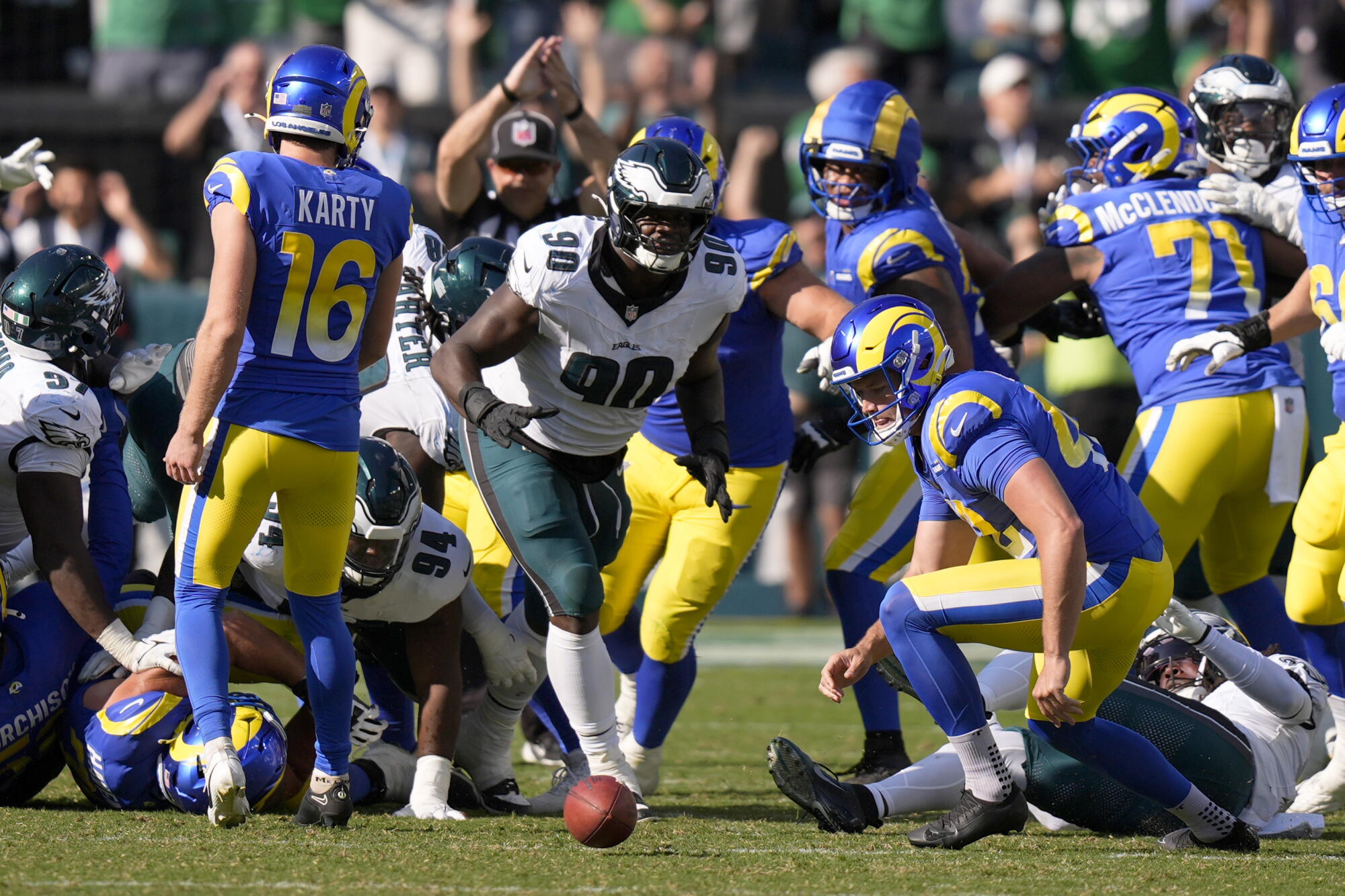
Minutes after the Eagles blocked a late field-goal attempt, the Rams lined up for another one on the final play. Jordan Davis of the Eagles leaped and blocked the kick, scooped the ball and returned it 61 yards for a touchdown that sent the Rams to a 33-26 defeat.
“All I heard was ‘boom, boom,’” Curl said of the kick and subsequent block, “and then I looked and it was all bad from there.”
Philadelphia Eagles defensive tackle Jordan Davis prepares to pick up a loose ball after blocked field-goal attempt against the Rams on Sept. 21, 2025.
And they arrive with several special teams units that remain a concern for a star-studded team that opened the season as the overwhelming favorite to win Super Bowl LXI at SoFi Stadium.
Not that the Rams have looked the part.
They lost their opener against the San Francisco 49ers in Australia, rebounded with a victory over the New York Giants, and last Sunday blew a 16-0 halftime lead in a 30-26 loss to the Denver Broncos in Denver.
Now they play an Eagles team coming off a 27-7 defeat by the Chicago Bears.
Late last season, coach Sean McVay fired special teams coordinator Chase Blackburn, and Ben Kotwica served as interim coordinator for the final two games. During the offseason, McVay hired Bubba Ventrone, who had coordinated special teams for the Indianapolis Colts and Cleveland Browns.
They also signed veteran long-snapper Joe Cardona and linebacker Grant Stuard, a special teams veteran.
The Rams’ field-goal unit is seemingly in a better place than it was last season.
Kicker Harrison Mevis replaced Joshua Karty several games after the debacle against the Eagles. He made 18 of 19 field-goal attempts in nine regular-season games and the playoffs, and has made four of five attempts this season, including two against the Broncos.
The Rams have improved in “that particular phase,” McVay said, “but you have to do it again” against a formidable Eagles field-goal block unit.
“That certainly is not anything we’re taking for granted,” McVay said.
On the same day the Rams lost to the Eagles last season, Ventrone was coaching for the Browns, who blocked a field-goal attempt by the Green Bay Packers with less than 30 seconds left, and then won the game with a field goal.
“It comes down to execution and playing with good fundamentals in those areas,” Ventrone said. “If we can do that, then we’ll be in a better spot.”
While the field-goal unit has mostly thrived, Evans has struggled with consistency, specifically directional placement of his kicks. On Friday, the Rams waived punt returner Xavier Smith, who fumbled in last season’s NFC championship game and made several decision-making errors against the Broncos. Alex Bachman will return punts against the Eagles, McVay said.
The kickoff coverage unit gave up a long return against the 49ers but appears to have improved.
The Rams will need solid performances from the offense, defense and special teams if they hope to defeat the Eagles for only the second time in eight games under McVay.
The Rams would be going for the second consecutive victory over the Eagles had they not blown a 19-point third-quarter lead and had two kicks blocked last season.
The Rams trailed 27-26 when they lined up for a 44-yard attempt with three seconds left.
“You knew it was going to be the last play no matter what,” Rams defensive coordinator Chris Shula said. “You weren’t going to [overtime]. I think I put my headset down.
“You put everything away and you’re like, ‘All right, here we go. This kick is going to decide my mood for this next week.’”
Evans recalled that after Davis blocked Karty’s kick, the ball went over Evans’ head. He attempted to dive on the ball, but he was hit in the back.
“By the time I got up and looked,” Evans said, “[Davis] was already in the end zone.”
The Rams aim to avoid a repeat.
Curl said the formula for success was simple. And it applied for offense, defense and special teams.
THE UK Government has issued a new travel warning to Brits heading to Thailand following mass flooding.
According to the Foreign Office, severe floods believed to be the worst in Bangkok in over a decade are impacting parts of Thailand caused by heavy rainfall.
Floods in Thailand are causing flights to Bangkok to be delayed or cancelledCredit: Reuters
Impacted destinations include Bangkok, Nonthaburi, Pathum Thani and Samut Prakan.
On the FCDO website it states: “All 50 districts of Bangkok have been declared disaster-affected areas. Travel disruption, including road closures and flooding of low-lying areas, is possible.
Sign up for the Travel newsletter
Thank you!
“The Thai government has declared special public holidays on 28 and 29 September in Bangkok, Nonthaburi, Pathum Thani and Samut Prakan.
“Many government offices and services may be closed or operating with reduced capacity.
Bangkok has officially been declared a disaster zone after relentless rains triggered widespread flooding in the Thai capital. Up to 300 millimetres of rain fell in some areas overwhelming the city’s canals and drainage system.
Nonstop rain since Thursday has submerged Thai capital’s roads and canals, sending water into many homes and stores.
Published On 26 Sep 202626 Sep 2026
Bangkok authorities have declared a disaster zone across all 50 districts of Thailand’s capital after three consecutive days of rainfall caused heavy flooding.
The disaster designation, which gives local organisations authority to take action, came on Saturday after Governor Chadchart Sittipunt said almost 300mm (11.8 inches) of rain had fallen since Thursday afternoon.
Recommended Stories
list of 4 itemsend of list
The nonstop rain inundated roads and canals with water, sending water into many homes and stores alongside them, according to reports. Photos and videos showed major roads submerged and cars abandoned after drivers were unable to move through the rising water.
Chadchart said the east of the city was most impacted and warned that more rain was forecast again on Saturday. He added that flooding should recede once the rain subsides, as city officials work to drain floodwaters as quickly as possible.
“The rain keeps falling and we are doing our best. We are trying to pump the water out, but the water in canals are full,” he said on social media. “The risk areas are those who live near canals. Every canal is now filled.”
Later on Saturday, the government said the flooding situation had “stabilised” but added it would still take two or three days for the water to drain, as long as the rain held off. “If more rainwater doesn’t fall in the area, it will be solved,” he said.
People walk past abandoned vehicles on a flooded Phetchaburi Road in Bangkok on September 26, 2026 [Lillian Suwanrumpha/AFP]
Chadchart also advised residents to move their cars to higher ground, as Bangkok’s public transport authority offered free access to MRT train “park and ride” carparks to store their vehicles until October 2.
Reporting from a flooded street in Bangkok, Al Jazeera’s Tony Cheng said the Thai capital is no stranger to heavy rain during the monsoon season, but the continuous rainfall had locals worried.
“What usually happens is we get heavy downpours for a couple of hours, then you’ll see the street often flooded but it would flow away into the drains quickly, and it would only happen in isolated areas too,” he said.
“What’s happening here is … happening all across the city. This is not a flash flood; this is persistent heavy rain since Thursday evening, and it shows no sign of letting up.”
Somkid Pheuk-ngam, 67, a vendor who lives near a canal just north of central Bangkok, said she had to close her shop for two days.
“The water keeps coming in. It’s hard to go out now. It’s at my waist level,” she told the AFP news agency. “I cannot go anywhere,” she said, adding that this was “worse than the 2011 flood.”
Widespread flooding across Thailand in 2011 killed more than 500 people and damaged millions of homes.
The Department of Disaster Prevention and Mitigation has warned of low pressure across eastern, northeastern and central Thailand until Sunday, saying there was a risk of flash floods, forest runoff, mudslides and river overflow.
Be careful what you wish for when you’re wishing for a new offensive coordinator.
Chargers fans were so over Greg Roman. Anything would be better than his run-heavy scheme stunting quarterback Justin Herbert’s anticipated ascension. Anyone would be preferable to the man holding the reins while the Chargers scored just three points in last season’s wild-card loss to the New England Patriots, after which Roman was fired.
Somehow, after just two games, the Chargers’ offense under McDaniel has Bolts fans wishing anyone else was running the show. Roman included.
Because Roman wouldn’t have overcomplicated a third-and-inches play-call. He wouldn’t have had the 6-foot-6, 240-pound Herbert line up in shotgun and call for motion.
Share via
The Chargers lost to the Las Vegas Raiders 26-14 on Sunday, and the schedule doesn’t get any easier for them moving forward.
And the subsequent snap wouldn’t have hit receiver Tre’ Harris before it got to Herbert. And instead of losing five yards and having Herbert, in a rare show of emotion, slapping the turf in frustration, the Chargers probably would have gotten a fresh set of downs.
So far, McDaniel’s brief Chargers’ tenure hasn’t just been a disappointment. It has, through two games, been a disaster. Because the Chargers really needed these first two wins against opponents who both won only three games last season.
Instead, the Chargers’ offense looked as disjointed and discombobulated in Sunday’s 26-14 loss to the Las Vegas Raiders as it did the previous week in their 26-14 loss to the Arizona Cardinals.
It was an unwanted second helping of “humble pie,” as McDaniel described the Chargers’ Week 1 defeat. And it was nasty.
Now the Chargers’ schedule is about to come at them fast, with their next games against the Buffalo Bills, the Super Bowl champion Seattle Seahawks, Denver Broncos, Kansas City Chiefs and then the Rams, the preseason Super Bowl favorites.
After consecutive 11-win seasons under Jim Harbaugh — who’d never lost to the Raiders and never previously lost two consecutive games to start a season — the Chargers might blink and find themselves 0-7.
What’s worse than frustratingly quick postseason exits? Not making the playoffs at all.
And the Chargers are going to need to engineer a quick turnaround if they’re going to be among the 15% of teams that start a season 0-2 and still reach postseason play.
Chargers offensive coordinator Mike McDaniel walks on the sideline before a preseason game against the San Francisco 49ers at SoFi Stadium on Aug. 20.
(Robert Gauthier / Los Angeles Times)
To do that, they’ll need to score more points. They’ll need to stop shooting themselves in the proverbial feet and take some better shots downfield. Stop dropping the ball — figuratively, literally. They fumbled six times Sunday!
And stop thinking so much. Sundays are for reacting, and any amount of thinking is overthinking.
Maybe it’s personnel? The fact that, outside of Ladd McConkey, the Chargers are short on receivers who can reliably create separation.
Maybe it’s just a matter of time that the Chargers don’t have much of, cramming to learn McDaniel’s methods, to dial in the timing and coordination.
Or maybe, for McDaniel, it’s as simple as simplifying what he’s trying to do with this Chargers offense.
When he was hired in January, the prevailing thought was that the cerebral partnership between McDaniel and Herbert would prove a perfect match.
Even though McDaniel was dismissed after the Dolphins missed the playoffs two consecutive seasons, the coach — who’d developed a reputation as a talented offensive mind under Kyle Shanahan with the San Francisco 49ers — was a hot commodity on the coaching market.
McDaniel reportedly drew interest from the Baltimore Ravens, Cleveland Browns, Tampa Bay Buccaneers, Bills and Raiders. But he opted to come to L.A. to work with Herbert as the All-Pro QB’s fifth offensive coordinator in seven seasons (following three offensive coordinators in his four years at Oregon).
Starting over again, in these two games with McDaniel, Herbert has thrown for a modest 401 yards, just two touchdowns and three interceptions — though one of them bounced off David Njoku’s hands Sunday.
Chargers quarterback Justin Herbert watches a pass attempt fall incomplete after he is hit by Raiders defensive end Malcolm Koonce during the fourth quarter Sunday.
(Allen J. Schaben / Los Angeles Times)
There have also been protection problems, fumbles, a missed field goal, and lots of penalties — including four on star left tackle Joe Alt, who was called for a hold that resulted in a safety on an anything-that-can-go-wrong-will-go-wrong Sunday.
“I’m not looking in any one direction,” Harbaugh said Sunday. “I’m looking at it all.”
On TV, Herbert appeared to be looking off into space on the sideline as McDaniel sat chattering beside him, the game mercifully winding down.
Asked what McDaniel’s message was to the offense, Herbert said: “I haven’t been able to speak with him after.”
There’s a lot to talk about, but be careful what you ask.
Embattled German Chancellor Friedrich Merz has vowed to stay on despite exit polls in two local elections suggesting damaging defeats for his centre-right Christian Democratic Union (CDU) party.
In the north-eastern state of Mecklenburg-Vorpommern, the party was projected to only just scrape into parliament, while the far-right AfD was on track to win the most votes. Merz called the result “a disaster” for his party.
In Berlin, the ruling CDU was also expected to be beaten by Die Linke (The Left).
Merz is under mounting pressure, with poor approval ratings and rumours he could even be replaced mid-term in a so-called chancellor swap.
Echoing comments he made after that defeat, Merz told reporters at the party’s Berlin headquarters on Sunday that he would forge ahead with his coalition government’s plans to push through a package of economic, tax and welfare reforms.
“The reforms have to come,” he insisted. “I am taking on this responsibility, because I want to move our country forward”.
“What needs to be done now requires backbone, steadfastness and patience,” Merz said. “I will demonstrate this as CDU party chairman and, above all, as chancellor of our country.”
“I would even go so far as to say that these reforms are the antidote to the authoritarian poison that, with the fascination of authoritarianism, is penetrating ever deeper into our society,” Merz added.
One person has been confirmed dead and more than 30 remain missing after the MV Matui ferry sank off the coast of Vanuatu, according to a statement from the office of Prime Minister Jotham Napat. The incident occurred on Sunday, with dozens of crew and passengers on board, the statement said.
Search and rescue operations are ongoing in Vanuatu, a Pacific Island nation located approximately 1,750 km (1,090 miles) east of Australia. The Prime Minister’s office stated on Facebook that 15 individuals have been accounted for alive. The ferry sank in adverse weather conditions on Friday between the islands of Ambae and Santo, according to New Zealand public broadcaster RNZ. The search has shifted from open waters to the south-east coast, where currents may have carried survivors, RNZ reported.
Investigation into causes
The statement from the Prime Minister’s office indicated that strong winds and marine warnings may not have been heeded, and that potential negligence, including overloading of the vessel, is being investigated. Authorities have announced that a formal investigation will be conducted to determine the causes of the incident.
“To the survivors, we pray for your strength and recovery. To the families of those missing and those we have lost, please know that the nation stands with you in this time of grief,” the statement from the Prime Minister’s office said.
Rescue operations and official response
Matai Seremaiah, a representative of the Luganville area in Vanuatu’s Parliament, stated that rescue efforts began after a crew member of the MV Matui swam ashore and raised the alarm. “He alerted us that the ship has capsized, we went out for the search,” Seremaiah said in remarks broadcast by RNZ.
The Vanuatu police, the Vanuatu Maritime Safety Authority, and the ferry’s operator, Tui Shipping Agency, have not yet responded to requests for comment. The search and rescue operation continues as authorities work to locate the missing passengers and crew.
WASHINGTON — A federal judge has ruled that a plan by the Trump administration to slash staffing at the federal agency tasked with responding to disasters by 50% was unlawful.
The opinion issued late Friday marked a victory for labor groups who had sued the agency. The labor organizations had argued that plans by the Department of Homeland Security, which was then led by Secretary Kristi Noem, violated congressional protections that were designed to safeguard the independence of the Federal Emergency Management Agency.
The issue of the FEMA staffing was part of a much larger lawsuit filed by the American Federation of Government Employees and other labor groups, contesting efforts by the Trump administration to slash the federal workforce.
U.S. District Judge Susan Illston wrote in her opinion that top Homeland Security officials late last year directed FEMA’s leadership to submit a staffing plan that included a 50% staffing cut even though the agency’s own supervisors objected.
“Frankly, the FEMA staffing plan number appears as if pulled from thin air,” wrote Illston.
FEMA responded in a statement late Saturday saying that while it does not comment on personnel matters and ongoing litigation, “DHS and FEMA are ready for the 2026 hurricane season.”
“We’re ensuring workforce stability and a strong, deployable force for upcoming national events and potential disasters; making the agency leaner, faster and laser-focused on supporting state, local, tribal and territorial partners before, during and after disasters,” the statement said. “FEMA continues to maintain a roster of experienced leadership and support staff across headquarters and regional offices.”
The Department of Homeland Security did not immediately respond to requests for comment.
In the opinion, Illston wrote that it was clear that the government violated rules established after 2005’s Hurricane Katrina that put decisions on staffing levels squarely in the hands of FEMA, not the Department of Homeland Security, and that prevented Homeland Security from “substantially” reducing the “functions” of FEMA.
Illston didn’t order a specific remedy to carry out her opinion but directed the two sides to meet and decide on a course of relief.
Although FEMA has experienced terminations, the 50% staffing cuts ultimately were not carried out. In recent months, after top leadership changes at FEMA and the Department of Homeland Security, the agency has rehired some staffers who were let go.
FEMA was one of the agencies targeted for staff reductions in the federal government as part of a broad Trump administration plan to reduce the size of government. The embattled agency has been buffeted by mass staff departures, disruptions of grant programs and delays of disaster aid.
In May, a Trump-appointed FEMA Review Council submitted a final report recommending sweeping changes to how the agency supports states, tribes and territories in disaster.
The final version backed away from the recommendation to cut the FEMA workforce by 50%, which was included in a December 2025 draft reviewed by the Associated Press.
The council instead recommended the agency conduct a “strategic review” to determine “appropriate staffing levels.”
In an August report, the Government Accountability Office said it found that the departures of thousands of staff in 2025 resulted in a “loss of institutional knowledge and experienced personnel” and “exacerbated longstanding workforce challenges.”
More than 4,300 employees, or about 17% of FEMA’s workforce, separated from the agency in the 2025 budget year, with over 1,500 through voluntary reductions. The agency also made about 2,900 new hires.
The GAO recently recommended to Congress that it “consider requiring” FEMA to base “significant workforce decisions” on a more strategic planning process.
Without it, the GAO found, “FEMA cannot be assured that the agency is positioned to effectively meet its mission needs.”