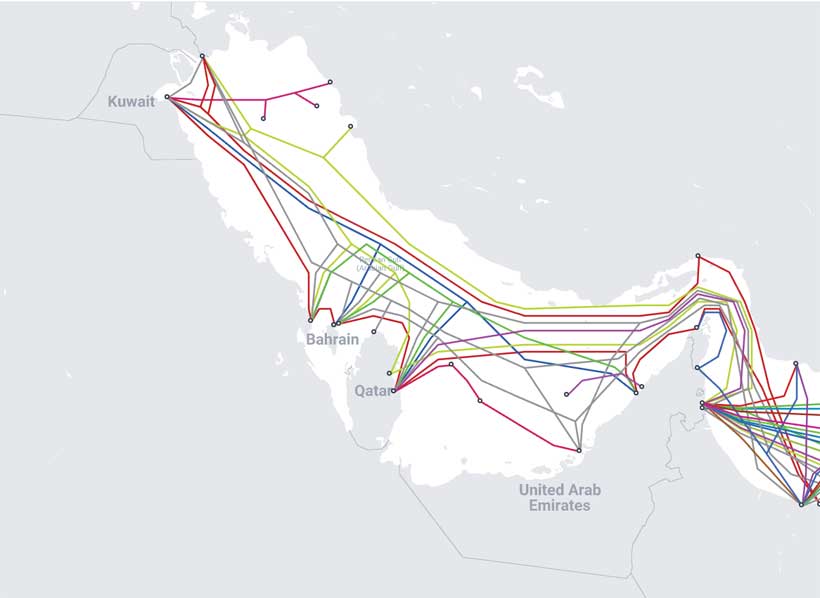
Why Subsea Cables in Hormuz Are at Risk in the Iran War
Iran has raised concerns about the vulnerability of submarine cables in the Strait of Hormuz, which are crucial for the region’s digital economy. This narrow waterway, known for its importance in global oil shipments, also supports several fibre-optic cables connecting countries from India and Southeast Asia to Europe via the Gulf states and Egypt.
Submarine cables are essential for transmitting data and power, carrying about 99% of the world’s internet traffic. They play a significant role in telecommunications, cloud services, and online communication. Damage to these cables can lead to internet slowdowns, outages, disrupted e-commerce, and delayed financial transactions, causing economic consequences, according to analyst Masha Kotkin.
Gulf countries, especially the UAE and Saudi Arabia, have invested billions into artificial intelligence and digital infrastructure to reduce dependence on oil, with their national AI companies relying heavily on undersea cables for data transfer. Key submarine cables in the Strait of Hormuz include the Asia-Africa-Europe 1 (AAE-1), the FALCON network, and the Gulf Bridge International Cable System, with additional infrastructures being built.
Despite the growth in submarine cable length, faults have remained stable at around 150–200 incidents yearly, largely due to human activities like fishing and anchor dragging, with state-sponsored sabotage being a potential risk. Other threats include undersea currents, earthquakes, and typhoons. To mitigate these risks, the industry has measures such as burying cables and selecting safer routes.
The ongoing Iran war has caused significant disruption to energy supply and regional infrastructure, though subsea cables have not yet suffered damage. However, military operations increase the risk of unintentional damage from ships inadvertently impacting cables. Historical incidents, like one in 2024, highlight these risks.
Repairing damaged cables in conflict areas presents challenges, including obtaining permits and addressing the dangers of remaining fighting or mines. Once conflicts end, another challenge lies in re-evaluating the sea floor to ensure the cables’ safety.
If subsea cables are damaged, there are alternatives like land-based links, but experts warn that satellite systems cannot replace them due to limited capacity and higher costs. Low-Earth-orbit networks like Starlink are not a scalable solution for millions of users at present.
with information from Reuters