Why two blue states voted differently on taxing the rich
These are happy days for California’s super wealthy. (Unless you’re Jensen Huang.)
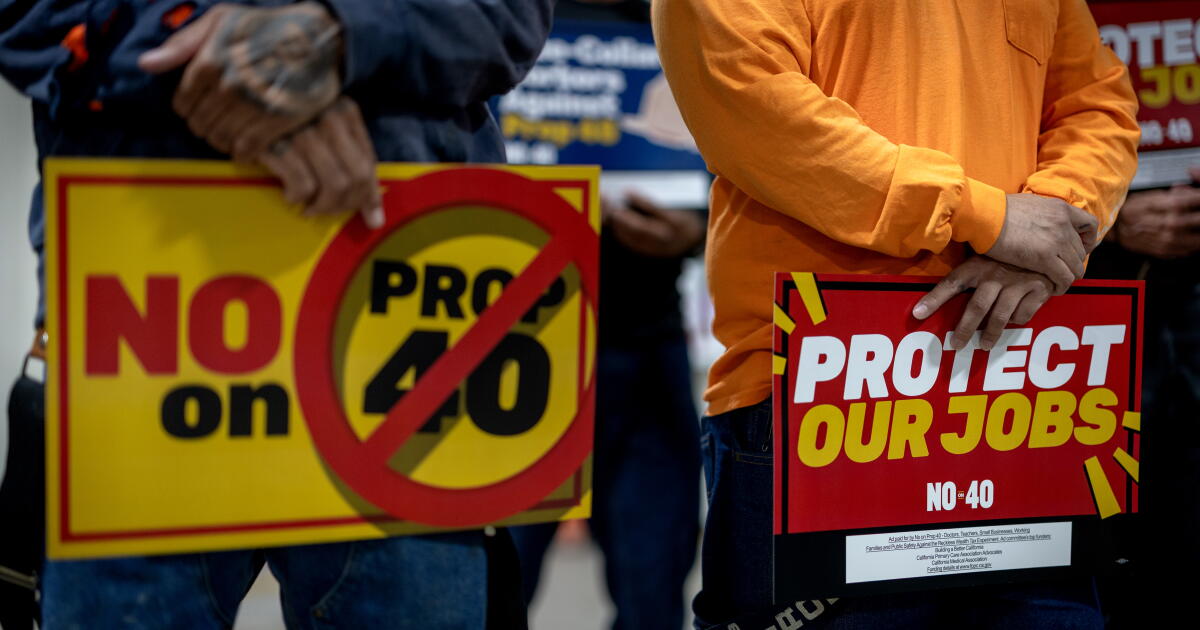
After a phenomenally expensive campaign — financed by some of the self-same members of that upper strata — voters rejected a ballot measure that would have slapped a one-time, 5% tax on billionaires’ assets.
The measure, a first of its kind, was sold as a way to offset federal cuts to healthcare imposed by the heedless Trump administration. The outcome wasn’t especially close: Proposition 40 lost 53% to 47%.
On the very same day, hundreds of miles up the coast, voters in Washington state were asked whether they wished to roll back a new law imposing a 9.9% tax on incomes over $1 million a year.
Washington is a place with no corporate or personal income tax and opponents suggested the “millionaire tax” was a first step — a slippery slope, the proverbial camel poking its snout under the tent — toward a broader tax that would ultimately hit middle- and lower-income residents as well.
Despite that, voters upheld the tax; the result was even more decisive than in California. Washingtonians opposed repeal, 58% to 42%.
The two almost-neighbors, California and Washington state, are deep-blue bulwarks with celebrated tech industries, nagging affordability issues and many of the same animosities and resentments toward a swelling population of filthy-rich tech bros and the rarefied ranks of the 1%. (Like California, Washington has seen the exodus of several of its uber-rich executives, including Amazon founder Jeff Bezos and former Starbucks Chief Executive Howard Schultz.)
“The economy has been helped in many ways in Seattle and surrounding areas by these big companies, but there’s also a real rejection of the ethos that goes with it,” said Mark Stephan, who teaches political science at Washington State University Vancouver. “We don’t want to live in a society up here in the Northwest where things are so out of whack between those who have more and those who have less.”
How, then, to explain the disparate election results?
The establishment strikes back
Perhaps the most significant difference is the opposition that lined up against Proposition 40.
Yes, billionaires spent nearly $400 million to throttle the measure. But money isn’t everything. Witness Texas, where California expat Elon Musk burned through $224 million — like one of his exploding rockets! — only to see the Lone Star state turn blue from the Panhandle to the Rio Grande.
More vital to tanking the wealth tax was the opposition of prominent Democrats — Gov. Gavin Newsom, heir apparent Xavier Becerra, progressive stalwart Katie Porter, to name a few — and the resistance from influential left-leaning organizations such as Planned Parenthood and several of California’s powerful labor unions.
They offered “what I like to call the permission slip” to vote no, said Brandon Castillo, a veteran Sacramento strategist who watched the Proposition 40 campaign from the sidelines. Opponents “had enough groups to either confuse or give that permission slip to those sort of moderate voters, Democrats and decline to state, that are critical to get a ballot measure to pass.”
In Washington state, by contrast, Democratic Gov. Bob Ferguson supported the millionaire tax, which was less ambitious in scope and more straightforward in design — a levy on annual income vs. cumulative wealth — than California’s measure. The tax was also supported by the state’s major labor unions, which helped out-raise the opposition, led by a Seattle-area hedge fund millionaire.
Seeing is believing
Proponents of the tax also benefited from a court decision that allowed a statement on the ballot negatively describing the effect repeal would have on the state’s perennially strained budget. The language, drafted by the state’s Democratic-led attorney general’s office, warned of cuts to education and healthcare in particular.
That was crucial, said Kara Krnacik a Seattle pollster whose surveys found that voters were significantly more likely to support the tax when presented with that warning. “I think that’s what pushed people over the edge,” Krnacik said.
Todd Donovan, a political science professor at Western Washington University in Bellingham, agreed.
“You could see the clear stakes if you voted against it,” Donovan said. “It wasn’t just like a hypothetical…. It was like, these programs are going to go away.”
The vote against repeal isn’t the final word.
The tax, which aims to bring in more than $3 billion a year starting in 2029, seems destined to wind up before the state’s Supreme Court before a single cent can be collected. “Our fight … is far from over,” Brian Heywood, the millionaire hedge fund manager who was the tax’s most prominent opponent, said in a postelection statement.
In California, the verdict on taxing the state’s well-to-do was more mixed.
While rejecting Proposition 40, voters overwhelmingly approved a measure to make permanent a state income tax on high earners — the top 2% — that had been set to expire in 2030. (There was no richly funded opposition.)
Voters also narrowly passed a ballot initiative banning new taxes on an array of personal assets, such as business interests and financial investments, which opponents of Proposition 40 qualified as a poison pill to nullify the result had voters approved the measure.
Despite that, proponents of a wealth tax say they may try again with another ballot initiative in 2028.
Death and skirmishing over taxes: Two of life’s inevitabilities.
What else you should be reading
Get smart:Trump’s troubles at home deepen Asian fears of a pivot toward China
The deep dive: The L.A. mayor’s race is over. Now the scramble is on for elected L.A. County executive
The L.A. Times Special: Newsom, Hegseth, Becerra — who’s in the hottest water? Our columnists discuss
Until next time,
mzb
—
Was this newsletter forwarded to you? Sign up here to get it in your inbox.