different people

The creatives behind ‘Oh, Mary!’ address the hype prior to L.A. run

There are many metrics by which to measure the success of “Oh, Mary!,” the Tony Award-winning play that has taken the stage by storm. And here’s a new one: Effusive hype and high ticket demand has resulted in Center Theatre Group booking the show for its 2028 60th anniversary season even before its national touring production hits the Ahmanson Theatre on Nov. 10.

As evidenced by Tuesday’s announcement, the current tour, starring drag queen Alaska Thunderf— is set to arrive in L.A. next week with sky-high expectations. Ironically, director Sam Pinkleton originally resisted the idea of a tour, feeling the show might lose some of its charm on the road.

“I was convinced it was a bad idea,” Pinkleton said with a laugh during a recent interview. “But when we went to Broadway, I also thought that was a terrible idea, and I was absolutely wrong.” The director was originally concerned the scrappy little show with a cast of five wouldn’t play as well in larger houses. “But seeing how well it works on Broadway, I think it’s actually better than in the small room. It’s not a play I would call subtle; it really fills a room. So that gave me a lot of confidence about a national tour.”

Written by and originally starring Cole Escola, “Oh, Mary!” is a revisionist take on former First Lady Mary Todd Lincoln’s life in the days leading to Abraham Lincoln’s assassination. Historical accuracy be damned, the show presents Mary as a wannabe star repressed by her closeted husband. Premiering off-Broadway in February 2024 and set to run six weeks, the show was given multiple extensions before transferring to Broadway, where it won Tony Awards for Escola’s performance and Pinkleton’s directing. Escola was also a finalist for the Pulitzer Prize in drama that same year.

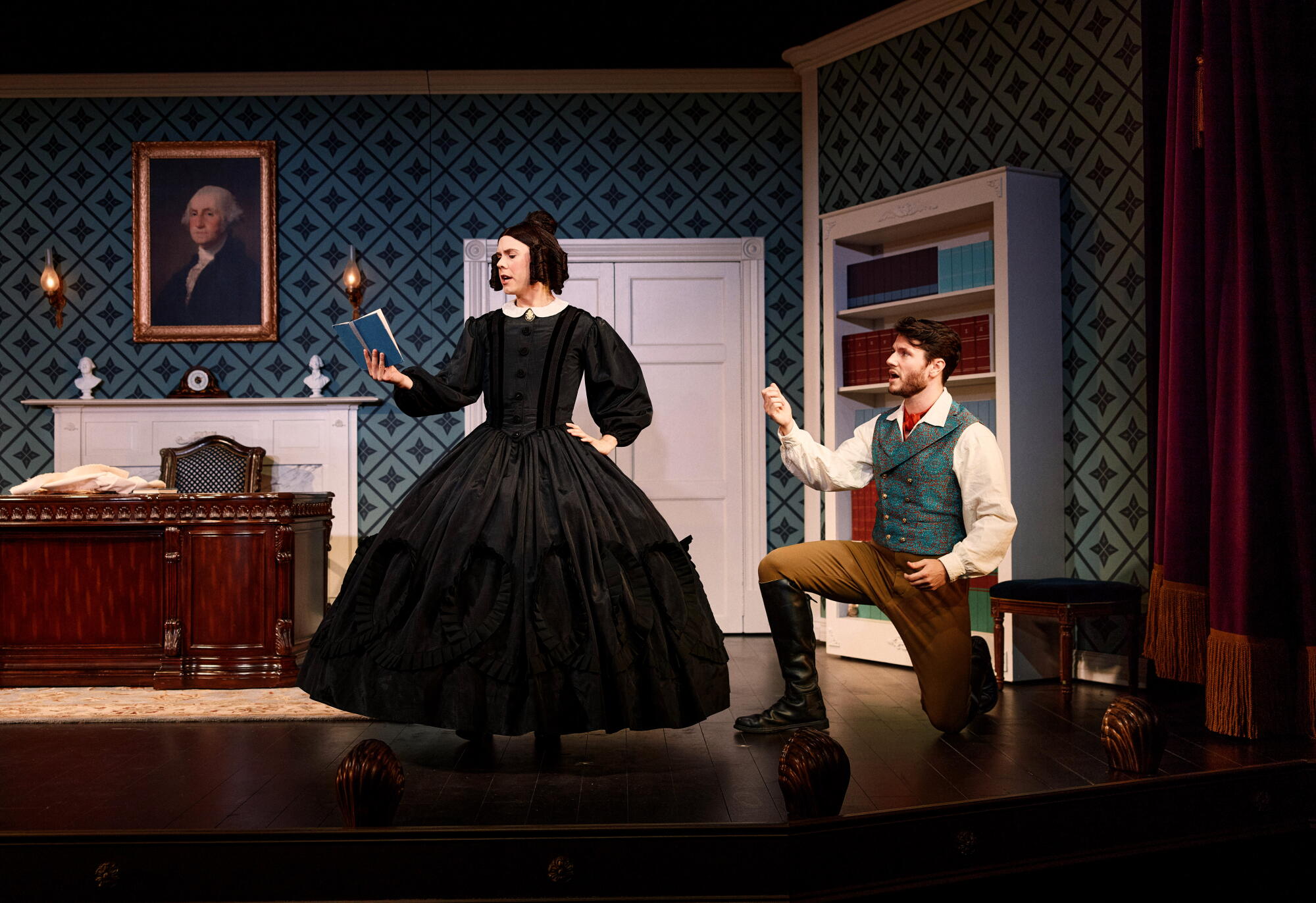
Cole Escola and James Scully in "Oh, Mary!" on Broadway.

Cole Escola and James Scully in “Oh, Mary!” on Broadway. Many actors have since taken on the role of Mary Todd Lincoln.

(Emilio Madrid)

But “Oh, Mary!” has achieved much more than gold statues and box office receipts — it’s a genuine pop-culture phenomenon, a familiar meme and a show beloved by seemingly all demographics.

“I think a turning point was early in the run when Steven Spielberg, Tony Kushner and Sally Field all came together,” Pinkleton said. “We were all like, ‘What is happening?’”

Other notable audience members, including Madonna and Michelle Obama, followed, while actors such as Maya Rudolph, Bowen Yang and Tituss Burgess signed up to don Mary’s ringlet wig as the Broadway run stretched on. “It’s wild to think that tonight, you can see it in three different places,” says Pinkleton, referring to the productions in New York, London and the national tour.

If the tour’s leading lady is feeling any pressure, she’s not showing it. Alaska admits that even she was skeptical of the show’s advance hype. “I kept hearing, ‘Oh, you have to see this play, this play is so good,’” she recalled during a Zoom interview from the show’s San Francisco stop. “And I thought, ‘How good can a play be? What is everyone talking about?’”

But the moment she saw it, she understood. “I was immediately enamored, I was hooked.”

An actor in a dressing room.

“Oh, Mary!” star Alaska says the show feels written for her, even thought she knows it’s not.

(Gabriela Hasbun / For The Times)

When it came time to cast the tour, Pinkleton immediately thought of Alaska, known to most audiences as the winner of the second season of “RuPaul’s Drag Race All Stars.” Pinkleton had worked with her before, most notably in the 2021 production of the Go-Go’s musical “Head Over Heels” at the Pasadena Playhouse. “I knew for a fact that Alaska could do this in her sleep,” he said. “As the kids say, I have receipts. She’s the real thing and she was made for this.”

Following an early Zoom work session, Alaska was on board. “I feel like it was written for me, but I know it wasn’t,” she said. “And that’s a testament to Cole writing something very true and anchored in real emotion. I think anyone who has ever felt underestimated or misunderstood or overlooked can really identify with this role.”

In many ways, the joy of playing Mary is that different actors bring different aspects and personality nuances to the role. “It’s a big, juicy part that works in the hands of radically different people,” Pinkleton said.

Asked what she feels she brings to the role, Alaska said she didn’t go in thinking about how to make it her own. “I really just approached it truthfully,” she said, noting that while the show is a comedy, the circumstances Mary finds herself in are genuinely tragic, and she wanted to be true to that. “This isn’t jokey to me — it’s really serious, intense and high-stakes. I wanted to do it like an Ibsen play or Shakespeare.”

The show doesn’t play like a tragedy, however. It’s a roller coaster ride from the start, and Pinkleton said he always wants the audience to have a great time.

An actor puts on makeup backsstage.

“Oh, Mary!” star Alaska puts on makeup backstage at the Curran Theatre during the San Francisco stop of the show’s national tour.

(Gabriela Hasbun / For The Times)

“I know there’s a lot of amazing theater being made about various traumas, but I can only control my corner of things and I just feel that most of us have had a bad day in one way or another,” he said. “And it would be awesome if our time at the theater was joyous. And I take that really, really seriously.”

Both director and star are well aware of the expectations that come with a show so beloved and discussed. “I try not to think about it,” said Alaska. “I just trust in the show being so beautifully constructed and it truly has something for everyone, whoever you are.”

For his part, Pinkleton said with a laugh, “There’s definitely some element for me of, ‘Like, it’s just a play, calm down.’” But part of maintaining its heart and charm is remembering that at its core, “it’s kind of a small operation.”

“It was made with a really hands-on approach by a very small group of people who cared a lot and that spirit has remained even as we’ve scaled it up,” Pinkleton said. It hasn’t been easy work; Pinkleton credits several people for their contributions, particularly the tour’s associate director Sunny Min-Sook Hitt, who occupied the same role during the original production. “It’s taken a lot of worthwhile work to keep it what it is. There’s just not a world where ‘Oh, Mary!’ can turn into ‘Jersey Boys,’” Pinkleton said. The national tour is already selling out houses across the country and receiving a rapturous response. “Every night has a different energy and the audience is definitely a part of the show,” Alaska said. “In San Diego, we were in a 3,000-person theater, we’ve never played one that size. It felt like the stadium version of ‘Oh, Mary!’”

Pinkleton said he makes “a lot of big, gay shows” and people have asked him how he thinks “Oh, Mary!” will play in smaller cities. “Honestly, I was a weird, loud, gay kid in Richmond, Virginia, and I’m excited to bring it to places that might not get this kind of thing,” he noted. And sometimes silly comedies can be the most meaningful, particularly to marginalized communities. “It’s meaningful that there will be some people for whom ‘Oh, Mary!’ is also a kind of a life raft.”

‘Oh, Mary!’

Where: Ahmanson Theatre, 135 N. Grand Ave., Los Angeles

When: Nov. 10 to Dec. 6. Check website for days and times.

Tickets: Start at $59.80

Contact: (213) 628-2772 or CenterTheatreGroup.org

Running time: 80 minutes, no intermission
Source link

‘The Diplomat’ creator on Kate Wyler’s bold choice in Season 4

In case it wasn’t already clear: Debora Cahn, the creator of “The Diplomat,” likes to leave viewers in suspense.

The Netflix political thriller has followed Kate Wyler (Keri Russell), the highly competent, intensely impulsive, deeply flawed and incredibly relatable career diplomat, as she’s cleaned up backroom deals, navigated volatile international crises and unstable government leadership — all while managing a topsy-turvy marriage tangled up in it. And the stakes escalate with each season’s finale, forcing Kate to test her limits. But the fourth season has brought her breaking point.

Alarmed by the questionable decision-making by President Grace Penn (Allison Janney) — as the bullying tactics used against the U.K. to ensure their cooperation against Russia become untenable — Kate resigns in unplanned, but grand fashion at the G7 summit in front of world leaders. She’s eventually joined by other members of Penn’s administration: chief of staff Billie Appiah (Nana Mensah), Secretary of State Miguel Ganon (Miguel Sandoval) and, most notably, her husband, Vice President Hal Wyler (Rufus Sewell).

“We like a good cliffhanger,” Cahn says during a recent video call.

Cahn’s thought about how “The Diplomat” will ultimately conclude. But like the show’s savvy titular character, she perfectly executes the art of the charming evasion when pressed for answers — namely, how close are we to getting there?

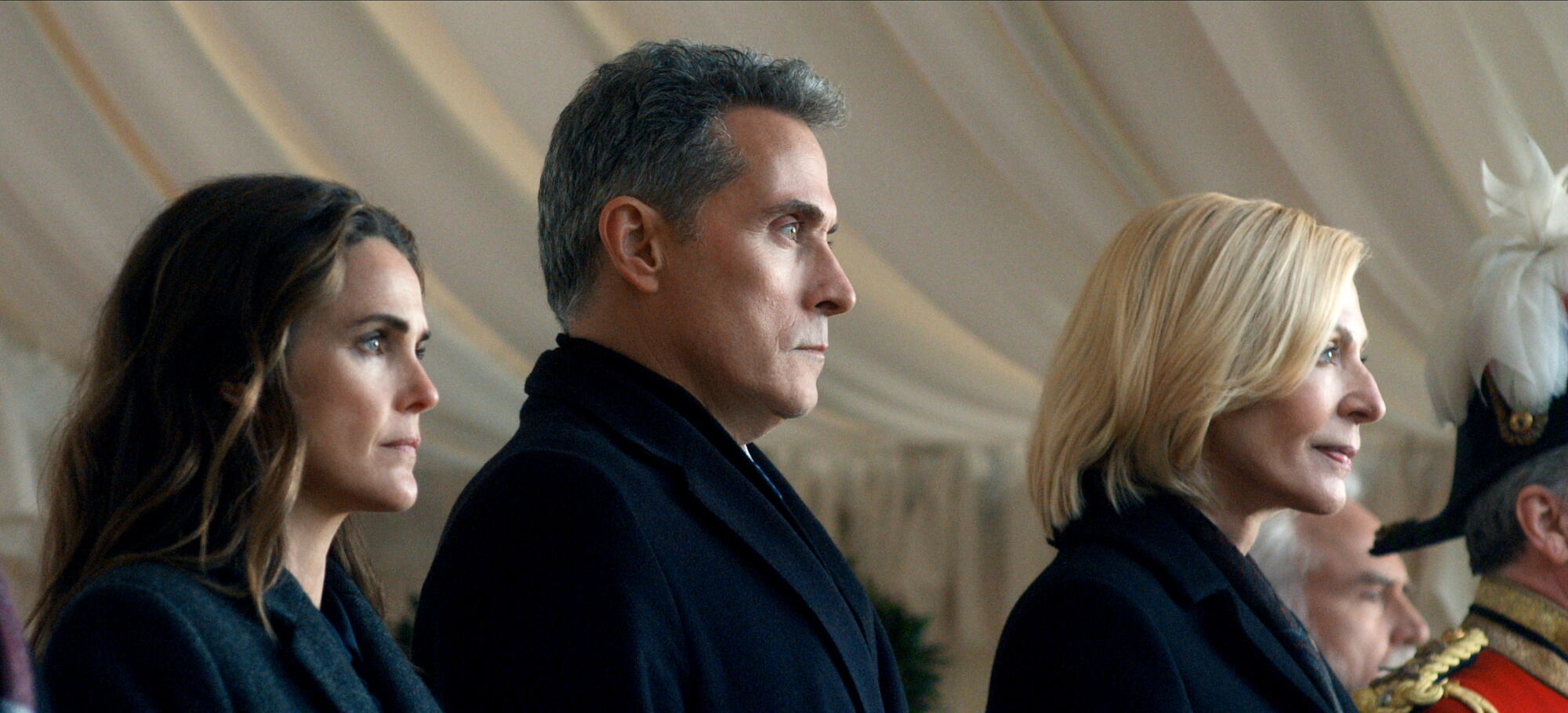
The side profiles of a brunette woman, a man and a blond woman, standing beside each other under a white tent.

Keri Russell as Kate Wyler, left, Rufus Sewell as Hal Wyler, Allison Janney as Grace Penn in Season 4 of “The Diplomat.”

(Netflix)

“I don’t know — maybe it just did,” she teases. Cahn then turns more serious: “I’ve always had an idea of what the end is. As with everything on the show, I’m always delighted to have that idea blown out of the water by a better idea, but so far it hasn’t happened.”

Cahn began her television writing career on Aaron Sorkin’s acclaimed political drama, “The West Wing,” spanning seasons 4 through 7. After working on shows such as “Grey’s Anatomy,” “Vinyl” and “Homeland,” she took the helm as creator and showrunner for the first time with “The Diplomat.” And writing a political drama today meant grappling with a creative responsibility she hadn’t faced before.

“I didn’t have to figure out what ‘The West Wing’s’ political position was going to be or what ‘The West Wing’ thought about the world,” she says. “I want to make a show that is compelling for a lot of different people. And there are certain things that are happening in the world that, as much as I try or would like to be even-handed, … [are] really difficult to ignore when you’re living at a time when you feel like democracy is crumbling.”

On a recent afternoon from her home in New York, Cahn spoke more about the new season of “The Diplomat.” These are edited excerpts from the conversation, which includes spoilers.

A woman and a man sit in the backseat of a car, each staring out their respective window

The marriage between Kate (Keri Russell) and Hal (Rufus Sewell) is tangled with their work.

(Netflix)

So much of the show, but particularly this season, is about lines that are drawn and the crossing of them. How did you and the writers decide what would be the line for Kate?

It took months and months and months to decide because we wanted to treat the question as realistically as possible. A lot of good people don’t quit. And so, why? What’s the reasoning? The whole season is examining that question for Kate and, in a way, for all of them. I didn’t want to be like, “Well, she doesn’t like the president, so she walked on out.”

What did you want out of that final moment of the season?

The moment when she stands up, she has come to a clarifying realization that her line has just been crossed. It happens in that room. And we argued about that a lot. We ended up feeling really strongly that it be what was happening right there. That this was a question she had wrestled with, but when you see that you are off the cliff, it will become clear what you have to do. So for her, Grace’s speech was that moment. She then walks out of the room and thinks: “What the mother f— did I just do? I’ve just ended my career. Have I ended my husband’s career?” That’s how she feels until she hears the door open and sees Billie walk out, and both of them go through a similar moment when they hear the door open, and Ganon walks out; then obviously the last one [is Hal] that really nobody was expecting. But for Kate, there is a big difference between having realized that you can’t go forward because your own line has been crossed, to realizing that you have started a movement, and that there is a contagion in that action.

How much did the real world, particularly international relations, inform or shape the season?

I don’t ever like to do a ripped-from-the-headlines show, particularly because we write it and then a year or two passes before it gets on air. But it did feel like, at a time when this administration was coming back into power again, and their first move was to fire people and really obliterate the institution that we were writing about, it didn’t seem like a story that we could walk around and ignore.

A man in a tuxedo and a woman in a shimmering white gown sit beside each other while applauding

Bradley Whitford as Todd Penn and Allison Janney as Grace Penn in Season 4 of “The Diplomat.”

(Nick Wall/Netflix)

We haven’t had a woman president. We know the sexism around this topic: Women are too weak, women can’t make tough decisions. What was the lay of the conversation in the writers’ room about who Grace Penn would be as president?

The situation that we wanted to sustain throughout the season was she’s not doing these things because she got shot, her stomach hurts and she’s mad. She’s doing things because she became president, and she thinks this is how the country needs to be run. Is there an overcompensation around her making sure that people don’t think that she’s too weak and afraid to be a foreign policy hawk? I think in plenty of circumstances, women in positions like that are more likely to take a strong decisive military action because there is this looming concern of, “Well is she tough enough? Is she gonna try and have everybody hold hands and make up?” There is an instinct to make sure that people realize that that isn’t your plan. Every one of the decisions that she made, we made sure that there was a smart, strategic, security mandated argument for doing what she was doing.

What Grace says at the top of that summit regarding the U.K. and Russia, if you didn’t know what was going on behind the scenes, it would seem reasonable and strategic.

I’m happy to hear you say that because that was very deliberate. We went round and round with different versions of what she said in that speech because some people would listen to it and say, “Oh, my God, she can’t say that. It’s just overwhelmingly reprehensible.” Then we would show our Washington people, and they were like, “It’s not so bad.” Democrats who were like, “This isn’t crazy. This is kind of middle of the road these days.” We realized that we couldn’t have her saying things that have become accepted in Washington because the public would view it as monstrous, and we didn’t want to be portraying a villain.

Is that the most difficult thing for you as the showrunner of a political show today — a president as a villain?

It’s trickier than I hoped it would be. I’m not really interested in the presidency as much as I’m interested in the thousands of people who interact with the president and perhaps don’t, as individuals, wield as much power in their hands as that office holder does. But real power, particularly in numbers, can make things happen or stop really disastrous things from happening. Whether or not we think that there’s a villain in the White House, what does everybody else do to try to manage it?

A bald man sits in front of a desk with U.K. flags positioned on either side of him

Rory Kinnear, who plays Prime Minister Nicol Trowbridge, sings opera in a scene where his character is having a hallucination.

(Clifton Prescod / Netflix)

There’s a surreal interlude with Prime Minister Nicol Trowbridge (Rory Kinnear) and his hallucinations — he’s singing opera, at one point. How did you arrive at that turn for him?

I would be lying if I didn’t say one of the big reasons I wanted to do that was because I found out Rory Kinnear sings opera. When we knew we were going to have this situation where he was going to through something even more stressful than everything that he’s been through up until now, it felt like it would be really great to see what’s going on in there [his mind]. I called him up and I said, “I’d like to have you singing ‘Pagliacci’ — is that OK?” And he was like, “Well, let’s start warming up now.”

For a brief moment, with Grace shot, Hal is acting president. I’m curious how you arrived at the length of time he’d fill in for Grace. It’s a few hours. And it reveals so much.

There’s a gravitational pull that we’ve been resisting ever since we made the president a big role, and then placed one of our leads in the role of vice president. There’s this pull toward the White House. But I’ve never wanted to be like, “Oh, well, then Hal’s president. Then, Hal dies, and Kate’s president! Everybody gets a chance.” Once he was VP, it started to seem equally absurd to not have a taste of that because it is, in fact, the reality in that job.

Making Hal a president for a long period of time wasn’t all that interesting to me, but I did want a little bit of a window into it. We think we really know what Hal Wyler is going to do in that role — and by we, I mean Kate, really —and it just isn’t true at all. It also turns out she really had no idea who he was as a vice president, and he’s a much different person than she thought. She thought he was going to continue to be a bull in a china shop, big swings and big ideas and asking for forgiveness, not permission. That’s not who he’s been in that job.

A group of people line up on a stage

Billie (Nana Mensah), left, Kate (Russell), Hal (Sewell), Grace (Janney), Fitzwilliam (Neil Pearson) and Todd (Whitford) in “The Diplomat.”

(Nick Wall/Netflix)

Both couples faced questions like: Who is this person I married or how am I responding to who they are at this moment? What were you interested in exploring in both these dynamics?

The conversation that we were just having is in a way relevant for all four of them. Not only is Hal different than Kate thought he would be, Hal’s different than Hal thought he would be. I haven’t run a show before. This is this is my first time in that position, and I am absolutely different than I thought I would be. I was 100% sure I knew exactly how I would handle things, and it didn’t happen. That’s an idea that we wanted to keep alive for Hal and definitely for Grace. You can prepare for it all you want and still not know.

You can’t help but feel for Todd as he tries to figure out Grace. But then he nearly dismantles NATO and you’re like, Todd!

Todd goes through two phases. He has this terrible feeling of helplessness that is eventually supplanted by this terrible feeling of power that he’s unable to manage. In a lot of ways, the Todd story is the most realistic one we’re telling because a lot of people who’ve never done this before are making the most consequential decisions, literally in the world. And Todd’s not a dumb guy, and I don’t think the people that we’re watching do this are dumb people, but, boy, are they in over their head really fast.

I want to talk about Grace and Todd and the use of “babe.” There’s something so intriguing to me about what they’ve done with that pet name across the season.

You’re thinking about all my favorite things. I don’t know what to say other than I’m glad it’s reading. You take a term of affection, and, at a certain point, it just becomes a name. The affection that it carries with it is just a horrible memory of a moment that is clearly gone.

Source link