dhs shutdown

Some wait times at airport bottlenecks are easing with TSA paychecks promised

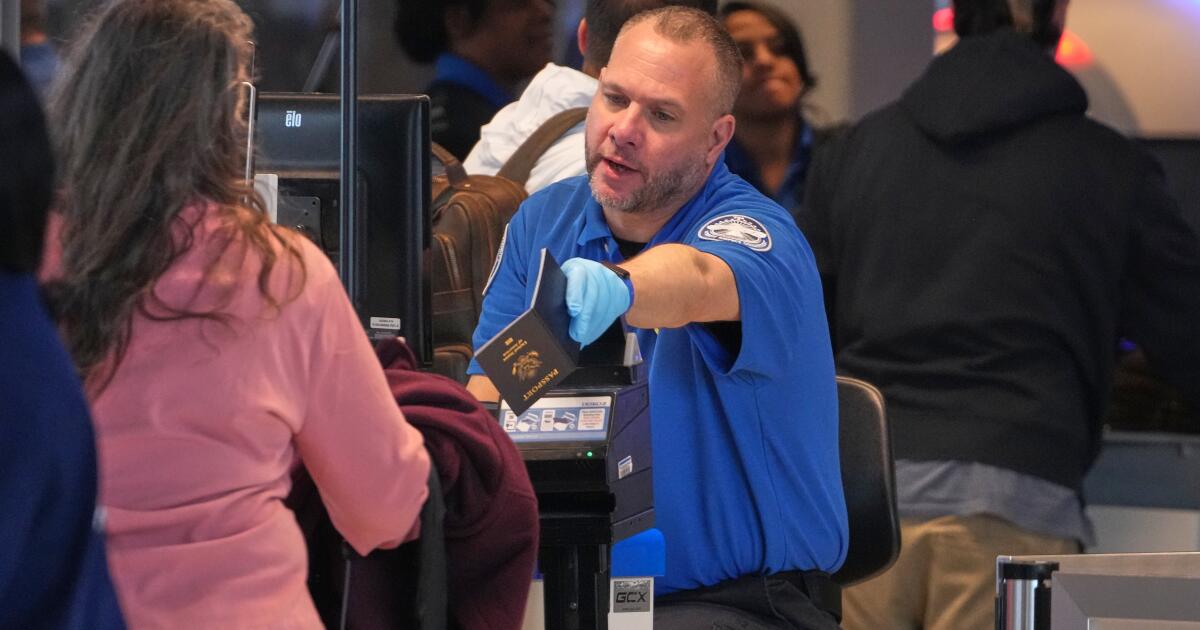
After weeks of chaos in U.S. airports, the Transportation Safety Administration said the first paychecks in weeks are being sent as early as Monday to its workers, giving the beleaguered aviation system a boost of optimism.

Wait times at some TSA security bottlenecks, such as the airport checkpoints in Atlanta and Houston, improved significantly Monday morning.

But how long it will take for long security lines to consistently return to normal — and how long federal immigration officers will stay in airports — remains unknown as the busy spring break travel season continues.

The DHS shutdown has resulted in not only travel delays but also warnings of airport closures as TSA workers missing paychecks stopped going to work. Those workers were just recovering financially since last fall’s extended government shutdown.

Wait times still pushed beyond two hours at New York’s LaGuardia Airport Monday morning. Baltimore-Washington International Airport had minimal wait-times Monday morning, but continued to advise travelers to arrive three hours before their scheduled departure.

President Trump on Friday ordered the Department of Homeland Security to pay TSA officers immediately to ease the lines plaguing airports. The move came after Trump rejected bipartisan congressional efforts to fund the TSA while negotiations continue with Democrats, who have refused to approve more funding without restraints on Trump’s immigration enforcement and mass deportation operations.

Democrats are demanding better identification for the officers, judicial warrants in some cases and for agents to refrain from conducting raids around schools, churches or other sensitive places. Republicans and the White House have been willing to negotiate on some points, but the sides have yet to reach a final agreement.

On Monday, there were few signs of progress on Capitol Hill, where the Senate held a short session without considering the House bill and resumed its two-week break. GOP Sen. John Hoeven of North Dakota said afterward that Senate Republicans are talking with Democrats and also the House as they try to find a way to funding DHS.

TSA employees had gone without pay since DHS funding lapsed in February. The department’s shutdown reached 44 days on Sunday, eclipsing the record 43-day shutdown last fall that affected all of the federal government.

The DHS shutdown has resulted in not only travel delays but also warnings of airport closures as TSA workers missing paychecks stopped going to work. Those workers had already endured the nation’s longest government shutdown last fall. Multiple airports experienced greater than 40% callout rates, and nearly 500 of the agency’s nearly 50,000 transportation security officers quit during the shutdown.

Trump deployed Immigration and Customs Enforcement agents to some airports a week ago to help with security as TSA callouts rose nationwide. How long they stay, White House border czar Tom Homan said, depends on how quickly TSA employees return to work. A TSA statement said the agency “has immediately begun the process of paying its workforce,” with paychecks arriving “as early as Monday.”

The overall absentee rate among TSA officers scheduled to work dipped slightly on Sunday, according to DHS. The highest were concentrated at major airports that have seen consistently elevated absences lately.

Those included BWI, both of Houston’s main airports; Louis Armstrong International Airport in New Orleans; Atlanta’s Hartsfield-Jackson International Airport; and John F. Kennedy International Airport in New York.

Funk and Seewer write for the Associated Press. AP reporters Rio Yamat in Las Vegas and Mary Clare Jalonick in Washington contributed to this report.
Source link

Lawmakers vent frustration over Homeland Security shutdown as lines grow at nation’s airports

Republican and Democratic senators vented their frustrations with the lack of progress in funding the Department of Homeland Security, which is resulting in more Americans enduring long lines at airports around the country. It’s a problem that is expected to intensify as the impasse enters its fourth week.

Democrats stressed they were willing to fund some of Homeland Security, but not Immigration and Customs Enforcement as well as Customs and Border Protection, without changes in their operations. Republicans made clear that some of the Democratic demands were a non-starter. The result was that each party blocked the other’s proposal for temporarily resolving the standoff during an hours-long debate Wednesday on the Senate floor.

The stark divide over a shutdown that began on Feb. 14 was acknowledged by members on both sides of the political aisle.

“We are in a negotiation. However, we are not close,” Sen. Brian Schatz (D-Hawaii) said at one point. “You may think this is some issue that we think we’re going to turn to our political advantage, but I promise you, when we saw Renee Good and Alex Pretti killed, this became an issue that was beyond politics.”

“And there are a lot of us who are not going to provide resources to this agency that is acting in such a ways that makes citizens of the United States so unsafe.”

Some Republicans were just as adamant that they oppose some of the changes Democrats are seeking to make.

“Let me be clear, we are going to do nothing — nothing — that kneecaps ICE’s ability to enforce our immigration laws,” said Sen. Eric Schmitt (R-Mo.).

Following the longest federal shutdown in the country’s history last year, Congress completed work on 11 of this year’s 12 appropriations bills. Only the bill for Homeland Security remains outstanding.

Democrats are seeking several changes at the department that include prohibiting ICE enforcement operations at sensitive locations like schools and churches, allowing independent investigations into alleged wrongdoing, requiring warrants to be signed by judges before federal agents can forcibly enter private homes or other nonpublic spaces without consent, and requiring agents to wear identification and remove their masks.

A push for more talks

Senate Majority Leader John Thune (R-S.D.) said his side has made repeated overtures to Democrats on a funding bill. He said the last offer on Homeland Security funding came from the White House nearly two weeks ago and there has been no response from the Democrats.

“Usually, around here, in order to get a deal, there has to be a negotiation where the two sides sit down together,” Thune said. “And my understanding is that has been completely rebuffed by the senator from Washington.”

The senator Thune was referring to, Sen. Patty Murray, the lead Democrat on the Senate Appropriations Committee, said she’s continued to talk with Republican colleagues, but those aren’t “real negotiations.” The White House needs to be at the table for that to occur. She said she needed assurance that Stephen Miller, the influential White House deputy chief of staff, would not upend any agreements that senators reach.

“I am willing to talk to people, but I’m not willing to sit in a room, have coffee, give away a few things and have Stephen Miller override whatever we all agree to,” Murray said. “ … We need to know the White House is serious.”

Homeland Security has been central to President Trump’s sweeping changes in immigration enforcement. Under Trump, the number of people ICE arrests and detains each month has climbed dramatically. The tactics that ICE has employed have generated alarm among Democrats, and some Republicans have also called for a more “strategic” approach.

During bipartisan negotiations earlier this year, appropriators agreed to a Homeland Security funding bill that did include more resources for de-escalation training and $20 million to outfit immigration enforcement agents with body-worn cameras. But that deal unraveled after the Pretti shooting in Minneapolis.

“My side was not going to stand down and say, ‘oh well, nothing happened,’” Murray said.

For the second time in two weeks, Murray offered a proposal to fund all of Homeland Security except for ICE and Customs and Border Protection, but Republicans objected.

Similarly, Sen. Katie Britt (R-Ala.) offered a proposal to fund all of Homeland Security for two weeks so that federal workers could get paid and government operations could continue while the two sides negotiate their differences on immigration enforcement. This time, Democrats objected.

The result was the standoff continues, but lawmakers were at least talking to each other, perhaps one small sign of progress.

Shutdown strains air travel

The large majority of the more than 260,000 employees at Homeland Security continue to work but are going unpaid. It’s the second time in recent months they’ve had to work without pay after last fall’s record, 43-day shutdown. The most visible sign of the shutdown has been a shortage of Transportation Security Administration screeners at airports.

Houston’s secondary airport weathered the worst problems, with lines consistently lasting over three hours for much of Sunday and Monday. Passengers also had to wait more than an hour to get through security at several other airports, including in New Orleans and Atlanta.

Homeland Security in a social media post Wednesday blamed Democrats for a shutdown that “has led to HOURS long security lines at airports across the country, leading Americans to miss their spring break flights.”

Trade groups are also worried about the economic impact of the travel delays. The U.S. Chamber of Commerce called on Congress to quickly approve a funding bill and end the department’s shutdown.

“Blocking operational funding and paychecks for those who help us travel safely is wrong and strains the air travel system,” said Neil Bradley, the business group’s executive vice president and chief policy officer.

Freking writes for the Associated Press.

Source link